Chapter 13
Payout Policy
Instructor’s Resources
Overview
Chapter 13 concentrates on the payout decision from the viewpoint of both the firm and the investors. The types of payout
policies, forms of dividends, and their possible effects on the value of the firm are included in this chapter. The arguments for
the relevancy and irrelevancy of dividends are presented. The legal, contractual, and internal constraints affecting dividend
policy are discussed. An introduction to dividend reinvestment plans is included. The chapter notes that dividend cash
outflows reduce corporate assets while enhancing personal wealth, and therefore have implications for both the student’s
professional life and personal life.
Answers to Review Questions
1.The two primary ways in which a firm can distribute cash to shareholders is through a dividend payment and share
3.Dividends are divided by earnings in computation of the dividend payout ratio. Because dividends are more stable than
4.All holders of a firm’s stock in the firm’s stock ledger on the date of record, which is set by the directors, will receive a
declared dividend. These stockholders are referred to as holders of record. Due to the time needed to make bookkeeping
5.The Jobs and Growth Tax Reconciliation Act of 2003 substantially reduced the marginal tax rate on dividends received by
6.Dividend reinvestment plans enable stockholders to use dividends to acquire full or fractional shares at little or no
transaction cost. These plans can be handled in either of two ways. In one approach, a third-party trustee is paid a fee to
© 2015 Pearson Education, Inc.
2 Gitman/Zutter Principles of Managerial Finance, Brief, Seventh Edition
7.The residual theory of dividends suggests that a firm’s dividend payment should be the amount left over (the residual) after
8.The dividend irrelevance theory proposed by Miller and Modigliani (M & M) states that in a perfect world the value of a
firm is not affected by dividends but is determined solely by the earnings power and risk of the company’s assets. The
proportion of retained earnings used for dividends versus reinvestment also has no impact on value. M & M argues that
Conversely, Gordon and Lintner’s dividend relevance theory states that there is a direct relationship between a firm’s dividend
9.a. Legal constraints prohibit the corporation from paying out cash dividends that are considered part of a firm’s “legal
capital,” measured either by the par value of common stock or the par value plus paid-in capital in excess of par.
10. With a constant-payout-ratio dividend policy, a firm pays out a certain percentage of earnings each period. A regular
While the constant-payout-ratio policy results in dividend variability and owner uncertainty, the regular dividend policy and
11. A stock dividend is a dividend paid in the form of stock made to existing owners. Although stock dividends are more
The stockholder’s assumption that he or she will break even in five years with a 20% stock dividend is incorrect. A stock
12. A stock split is a method of increasing the number of shares belonging to each shareholder. A stock split reduces the par
© 2015 Pearson Education, Inc.
Chapter 3: Financial Statements and Ratio Analysis 3
are made when the firm believes its stock price is too (low) high to be actively traded. A stock dividend works the same
Suggested Answer to Focus on Ethics Box: Are Buybacks Really
a Bargain?
Do you agree that corporate managers would manipulate their stock’s value prior to a buyback, or do you believe that
corporations are more likely to initiate a buyback to enhance shareholder value?
Student answers will vary based on their views and experiences and their faith, or lack thereof, in corporate management. As the
vignette points out, the study that shows increased earnings after buybacks can be interpreted in more than one way. One thing
Answers to Warm-Up Exercises
E13-1. Relevant dividend dates
Answer: The firm will need $260,000 of cash to pay the dividend. Because a weekend intervenes, the stock will begin
selling exdividend on Friday, April 28, which is four days before the date of record.
E13-2. Residual theory of dividend payout
E13-3. Legal constraints on dividend payout
Answer: If legal capital is defined solely as the par value of common stock, Ashkenazi will be able to pay out paid-in capital
in excess of par plus all retained earnings.
E13-4. Constant dividend payout ratio
Answer: The first step in analyzing the Kopi scenario is to determine the historical payout ratio.
Year EPS Dividend/Share Dividend Payout Ratio
© 2015 Pearson Education, Inc.
4 Gitman/Zutter Principles of Managerial Finance, Brief, Seventh Edition
2012 $1.75 $0.95 54.29%
2013 1.95 1.20 61.54
2014 2.05 1.25 60.98
2015 2.25 1.30 57.78
Discussion: Kopi Companies’ historical dividend payout ratio has been fairly consistent and near the 60% constant
E13-5. Stock dividend
Answer: After the 10% stock dividend, Hilo’s stockholder’s equity account is as follows:
Solutions to Problems
P13-1. Dividend payment procedures
LG 1; Basic
a. Debit Credit
Retained earnings (Dr.) $330,000
Dividends payable (Cr.) $330,000
P13-2. Personal finance: Dividend payment
LG 1; Intermediate
a. Friday, May 7
b. Monday, May 10
P13-3. Residual dividend policy
LG 2; Intermediate
© 2015 Pearson Education, Inc.
Chapter 3: Financial Statements and Ratio Analysis 5
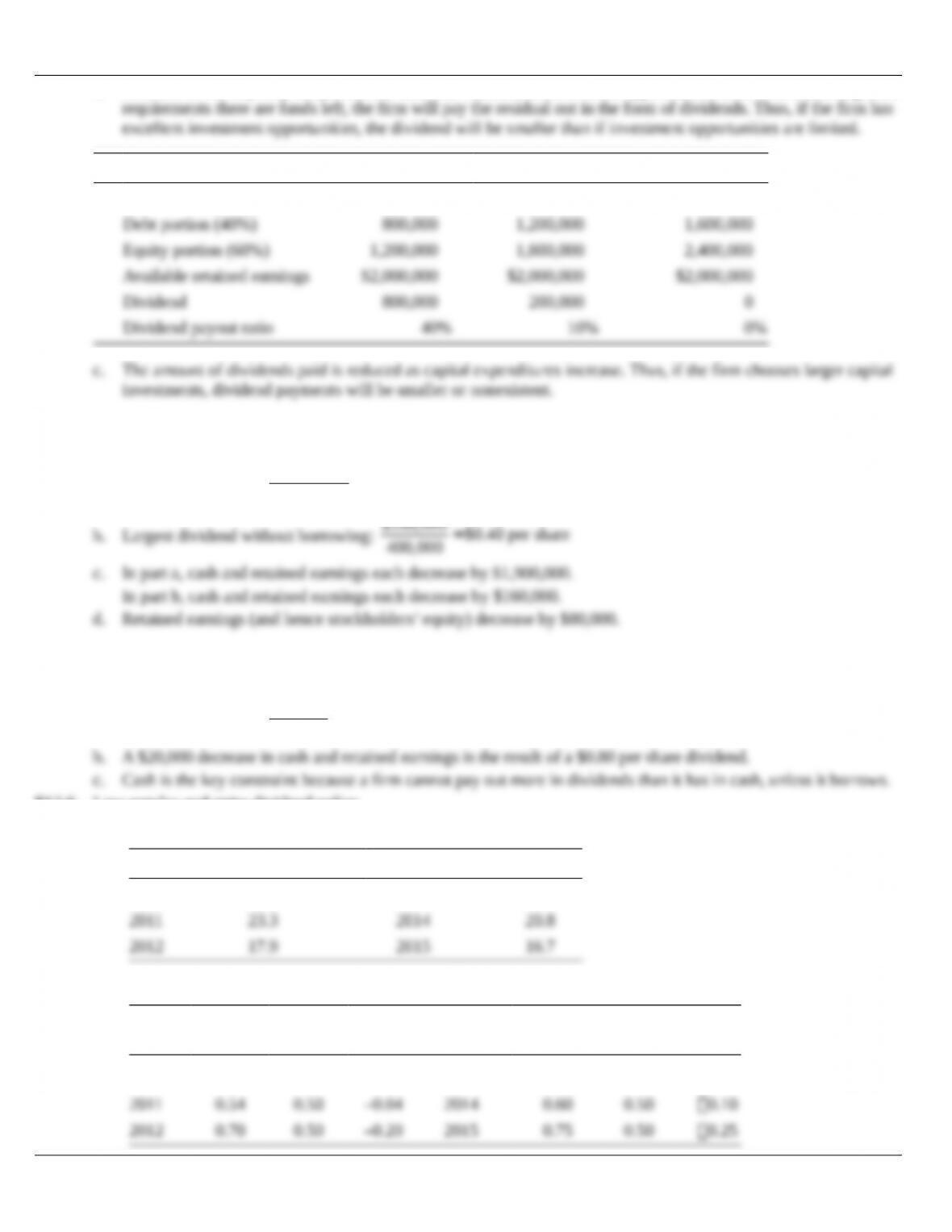
a. Residual dividend policy means that the firm will consider its investment opportunities first. If after meeting these
b. Proposed
Capital budget $2,000,000 $3,000,000 $4,000,000
P13-4. Dividend constraints
LG 3; Intermediate
a. Maximum dividend:
$1,900,000 $4.75 per share
400,000 =
$160,000 $0.40 per share
P13-5. Dividend constraints
LG 3; Intermediate
a. Maximum dividend:
$40,000 $1.60 per share
25,000 =
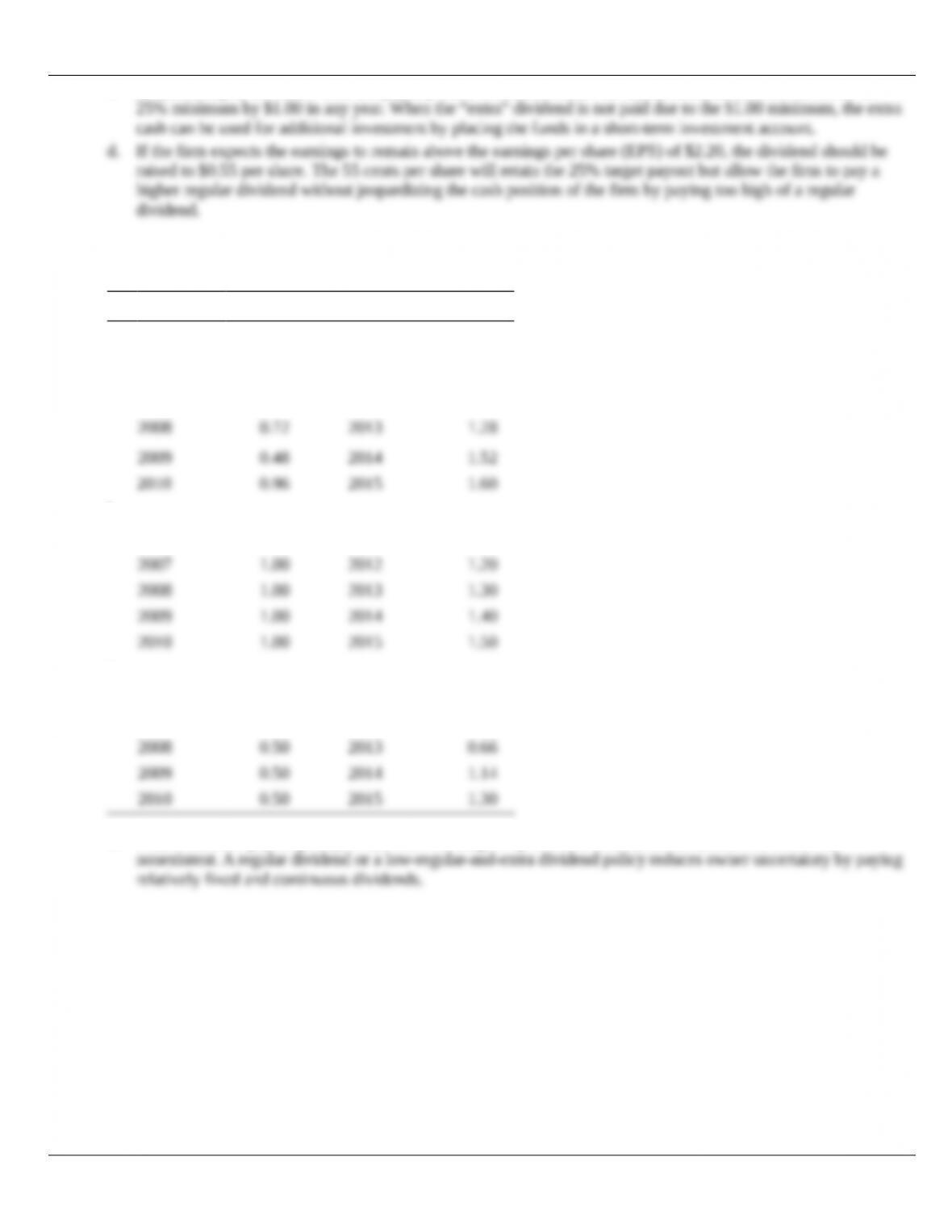
P13-6. Low-regular-and-extra dividend policy
LG 4; Intermediate
a. Year Payout % Year Payout %
2010 25.4 2013 22.7
b.
Year
25%
Payout
Actual
Payout $ Diff. Year
25%
Payout
Actual
Payout $ Diff.
2010 $0.49 0.50 0.01 2013 0.55 0.50 0.05
© 2015 Pearson Education, Inc.
6 Gitman/Zutter Principles of Managerial Finance, Brief, Seventh Edition
c. In this example, the firm would not pay any extra dividend because the actual dividend did not fall below the
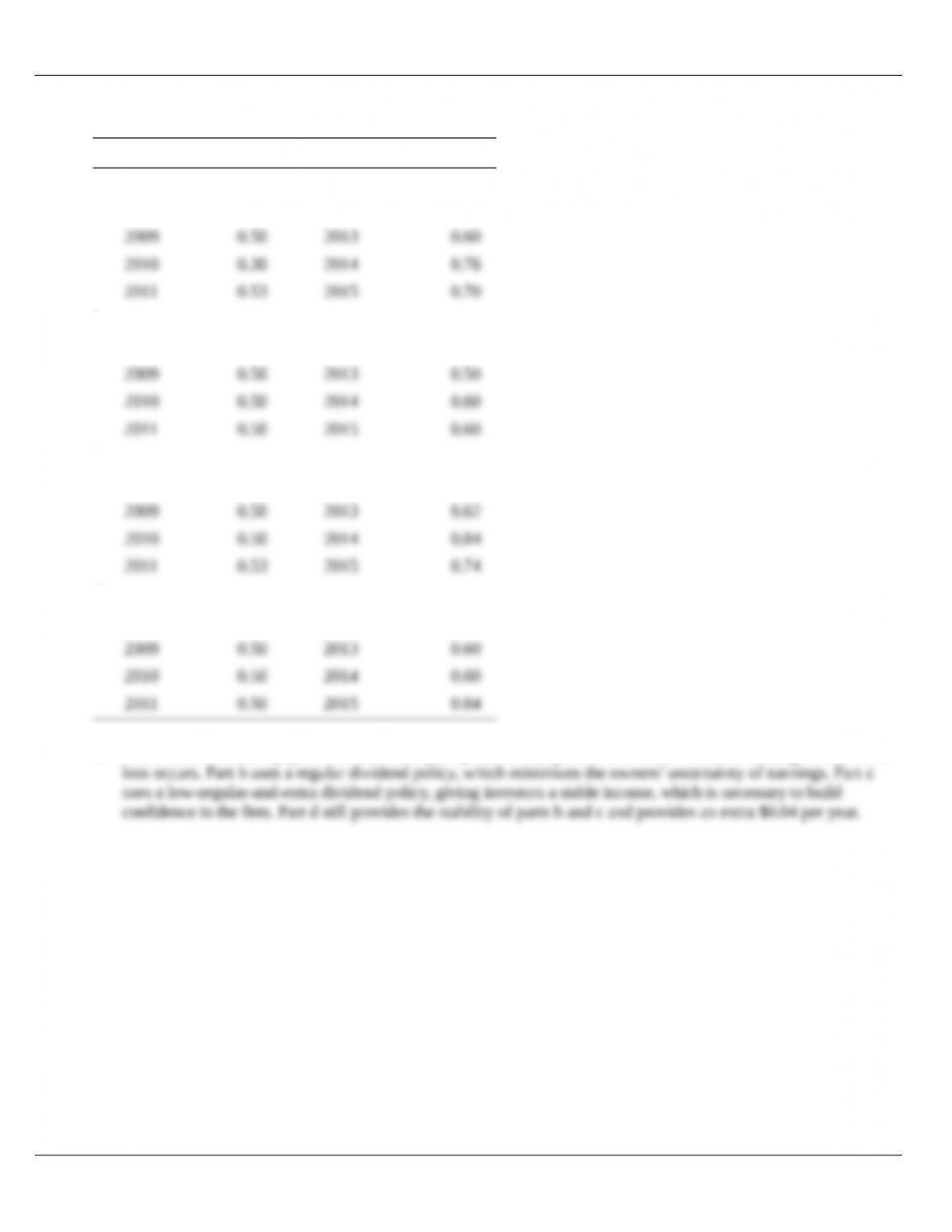
P13-7. Alternative dividend policies
LG 4; Intermediate
Year Dividend Year Dividend
a.
2006 $0.10 2011 $1.28
2007 0.00 2012 1.12
b.
2006 $1.00 2011 $1.10
c.
2006 $0.50 2011 $0.66
2007 0.50 2012 0.50
d. With a constant-payout policy, if the firm’s earnings drop or a loss occurs, the dividends will be low or
© 2015 Pearson Education, Inc.
Chapter 3: Financial Statements and Ratio Analysis 7
P13-8. Alternative dividend policies
LG 4; Challenge
Year Dividend Year Dividend
a.
2008 $0.22 2012 $0.00
b.
2008 $0.50 2012 $0.50
c.
2008 $0.50 2012 $0.50
d.
2008 $0.50 2012 $0.50
e. Part a uses a constant-payout-ratio dividend policy, which will yield low or no dividends if earnings decline or a
© 2015 Pearson Education, Inc.