
Chapter 11
Capital Budgeting Cash Flows and Risk Refinements
Instructor’s Resources
Overview
This chapter expands upon the capital budgeting techniques presented in the previous chapter (Chapter 10). Shareholder
wealth maximization relies upon selection of projects that have positive net present values. The most important and difficult
aspect of the capital budgeting process is developing good estimates of the relevant cash flows. Chapter 11 focuses on the
basics of determining relevant after-tax cash flows of a project, from the initial cash outlay to the annual cash stream of costs
and benefits and terminal cash flow. It also describes the special concerns facing capital budgeting for the multinational
company. The text highlights how capital budgeting will be a critical aspect of the professional life and personal life of
students upon graduation. This chapter expands capital budgeting to consider risk with such methods as scenario analysis and
simulation. Capital budgeting techniques used to evaluate international projects, as well as the special risks multinational
companies face, are also presented. In addition, two basic risk-adjustment techniques are examined: certainty equivalents and
risk-adjusted discount rates. The chapter presents students with several examples of the application of risk-based refinements
when capital budgeting in their professional and personal life.
Answers to Review Questions
1. Capital budgeting projects should be evaluated using incremental after-tax cash flows because after-tax cash flows are
available to the firm. When evaluating a project, concern is placed only on added cash flows expected to result from its
2. The three components of cash flow for any project are (1) initial investment, (2) operating cash flows, and (3) terminal
3. Sunk costs are costs that have already been incurred, and thus the money has already been spent. Opportunity costs are
4. To minimize long-term currency risk, companies can finance a foreign investment in local capital markets so that the
project’s revenues and costs are in the local currency rather than dollars. Techniques such as currency futures, forwards,
© 2015 Pearson Education, Inc.

2 Gitman/Zutter Principles of Managerial Finance, Brief, Seventh Edition
5. a. The cost of the new asset is the purchase price. (Outflow)
b. Installation costs are any added costs necessary to get an asset into operation. (Outflow)
6. The book value of an asset is its strict accounting value.
Book value installed cost of asset – accumulated depreciation
Gains and losses in the sale of an asset may have tax consequences, and hence these are key forms of taxable income.
More specifically, taxable income may arise from (1) capital gain: portion of sale price above initial purchase price, taxed
7. The asset may be sold (1) for more than its book value, (2) for the amount of its book value, or
8. The depreciable value of an asset is the installed cost of a new asset and is based on the depreciable cost of the new
project, including installation cost.
9. Depreciation is used to decrease the firm’s total tax liability and then is added back to net profits after taxes to determine
10. To calculate incremental operating cash inflow for both the existing situation and the proposed project, the depreciation
11.The terminal cash flow is the cash flow resulting from termination and liquidation of a project at the end of its economic
life. The form of calculating terminal cash flows is shown below:
Terminal Cash Flow Calculation:
After-tax
proceeds from
sale of new asset
–
After-tax
proceeds from
sale of old asset
Change in
net working
capital
=
Terminal
cash
flow
Extended Presentation:
© 2015 Pearson Education, Inc.
Chapter 3: Financial Statements and Ratio Analysis 3
12. There is usually a significant degree of uncertainty associated with capital budgeting projects. There is the usual business
risk along with the fact that future cash flows are an estimate and do not represent exact values. The uncertainly of each
13. Risk, in terms of cash inflows from a project, is the variability of expected cash flows, hence the expected returns of the
14. a. Scenario analysis uses a number of possible inputs (cash inflows) to assess their impact on
b. Simulation is a statistically based approach using random numbers to simulate various cash flows associated with
15. Answers will vary for question because values are algorithmically generated in MyFinanceLab.
16. Risk-adjusted discount rates (RADRs) reflect the return that must be earned on a given project in order to adequately
compensate the firm’s owners. The relationship between RADRs and the capital asset pricing model (CAPM) is a purely
17. A firm whose stock is actively traded in security markets generally does not increase in value through diversification.
Investors themselves can more efficiently diversify their portfolio by holding a variety of stocks. Because a firm is not
18. RADRs are most often used in practice for two reasons: (1) financial decision makers prefer using rate of return-based
19. A comparison of NPVs of unequal-lived mutually exclusive projects is inappropriate because it may lead to an incorrect
20. Real options are opportunities embedded in real assets that are part of the capital budgeting process. Managers have the
Abandonment—the option to abandon or terminate a project prior to the end of its planned life.
© 2015 Pearson Education, Inc.
4 Gitman/Zutter Principles of Managerial Finance, Brief, Seventh Edition
21. Strategic NPV incorporates the value of the real options associated with the project whereas traditional NPV includes
NPVstrategic NPVtraditional Value of real options
22. Capital rationing is a situation where a firm has only a limited amount of funds available for capital investments. In most
cases, implementation of the acceptable projects would require more capital than is available. Capital rationing is common
23. The IRR approach and the NPV approach to capital rationing both involve ranking projects on the basis of IRRs. Using
the IRR approach, a cut-off rate and a budget constraint are imposed. The NPV first ranks projects by IRR and then takes
24. Answers will vary for question because values are algorithmically generated in MyFinanceLab.
Suggested Answer to Focus on Ethics Box:
A Question of Accuracy
What would your options be when faced with the demands of an assertive chief executive officer (CEO) who expects
you to “make it work”? Brainstorm several options.
There is a chance that you may be working for an “assertive CEO” at some point in your career. This may be by choice or by
If the answer is that you should break the law or do something unethical, you may have three viable options other than doing
something that you should not do. One option is to seek the guidance of your “mentor” if you have one in the company. He or
However, do not immediately assume that “do whatever it takes” or “make it work” automatically includes anything unethical
or illegal. The CEO may just be stating that more resources or effort need to be put into solving the problem.
Answers to Warm-Up Exercises
E11-1. Classification of project costs and cash flows
Answer: $3.5 billion already spent—sunk cost (irrelevant)
© 2015 Pearson Education, Inc.

Chapter 3: Financial Statements and Ratio Analysis 5
E11-2. Finding the initial investment
Answer: $20,000 Purchase price of new machinery
E11-3. Book value and recaptured depreciation
E11-4. Sensitivity analysis
Answer: Using the 12% cost of capital to discount all of the cash flows for each scenario to yield the following NPVs,
E11-5. Risk-adjusted discount rates
Answer: Project Sourdough RADR 7.0%
N 7, I 7%, PMT $5,500
Project Greek Salad RADR 8.0%
N 7, I 8%, PMT $4,000
Yeastime should select Project Sourdough.
E11-6. ANPV
Answer: You may use a financial calculator to determine the IRR of each project. Choose the project with the higher IRR.
Project M
Step 1: Find the NPV of the project
NPVM Key strokes
Step 2: Find the ANPV
Project N
Step 1: Find the NPV of the project
© 2015 Pearson Education, Inc.

6 Gitman/Zutter Principles of Managerial Finance, Brief, Seventh Edition
NPVM Key strokes
Solve for NPV $13,235.82
Step 2: Find the ANPV
Based on ANPV, you should advise Outcast, Inc., to choose Project M.
Solutions to Problems
Note: The MACRS depreciation percentages used in the following problems appear in Chapter 4, Table 4.2. The percentages
are rounded to the nearest integer for ease in calculation.
For simplification, five-year-lived projects with five years of cash inflows are typically used throughout this chapter. Projects
with usable lives equal to the number of years of cash inflows are also included in the end-of-chapter problems. It is important
to recall from Chapter 4 that under the Tax Reform Act of 1986, MACRS depreciation results in n 1 years of depreciation
for an n-year class asset. This means that in actual practice projects will typically have at least one year of cash flow beyond
their recovery period.
P11-1. Relevant cash flow and timeline depiction
LG 1, 2; Intermediate
as an annuity.
c.
© 2015 Pearson Education, Inc.
Chapter 3: Financial Statements and Ratio Analysis 7
This is a nonconventional cash flow pattern, which has several cash flow series of equal size, which is referred to as an
embedded annuity.
P11-2. Expansion versus replacement cash flows
LG 3; Intermediate
a.
Year Relevant Cash
Flows
Initial investment ($28,000)
b. An expansion project is simply a replacement decision in which all cash flows from the old asset are zero.
P11-3. Sunk costs and opportunity costs
LG 2; Basic
c.
P11-4. Sunk costs and opportunity costs
LG 2; Intermediate
b. Opportunity cost—The development of the computer programs can be done without additional expenditures on
d. Sunk cost—The money for the storage facility has already been spent, and no matter what decision the company
© 2015 Pearson Education, Inc.
8 Gitman/Zutter Principles of Managerial Finance, Brief, Seventh Edition
P11-5. Personal finance: Sunk and opportunity cash flows
LG 2; Intermediate
a. The sunk costs or cash outlays are expenditures that have been made in the past and have no effect on the cash
b. Sunk costs (cash flows):
Opportunity costs (cash flows):
P11-6. Book value
LG 3; Basic
Asset
Installed
Cost
Accumulated
Depreciation
Book
Value
A $ 950,000 $ 674,500 $275,500
P11-7 Change in net working capital calculation
LG 3; Basic
a.
Current Assets Current Liabilities
Cash $15,0
00
Accounts payable $90,00
0
Net working capital current assets current liabilities
c. Yes, in computing the terminal cash flow, the net working capital increase should be reversed.
© 2015 Pearson Education, Inc.
Chapter 3: Financial Statements and Ratio Analysis 9
P11-8. Calculating initial investment
LG 3, 4; Intermediate
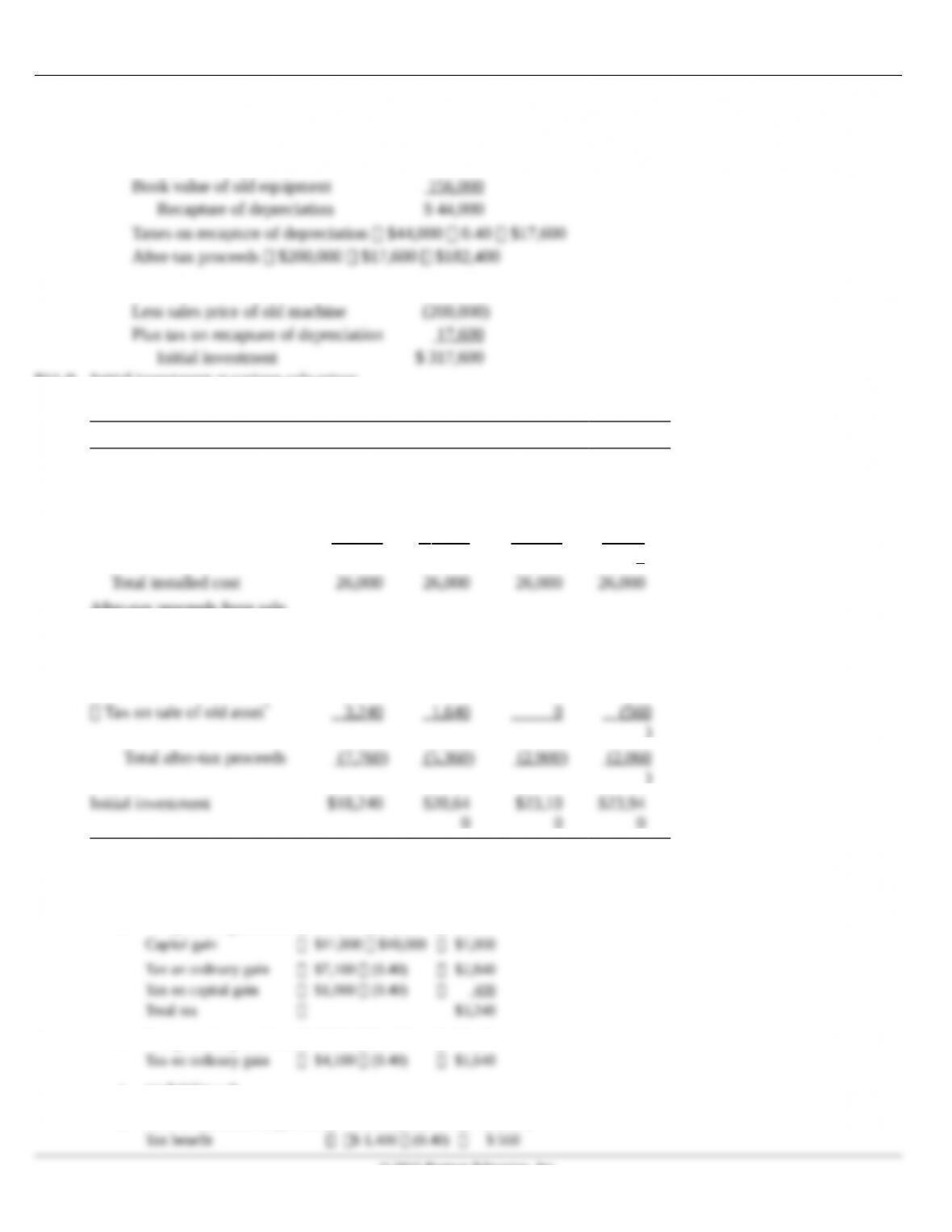
a. Book value $325,000 (1 0.20 – 0.32) $325,000 0.48 $156,000
b. Sales price of old equipment $200,000
c. Cost of new machine $ 500,000
P11-9. Initial investment at various sale prices
LG 3, 4; Intermediate
(a) (b) (c) (d)
Installed cost of new asset:
Cost of new asset $24,000 $24,00
0
$24,00
0
$24,00
0
Installation cost 2,000 2,000 2,000 2,00
0
After-tax proceeds from sale
of old asset
Proceeds from sale
of old asset (11,000) (7,000) (2,900) (1,500)
)
)
0
0
0
Book value of existing machine $10,000 [1 (0.20 0.32 0.19)] $2,900
*Tax Calculations:
a. Recaptured depreciation $10,000 $2,900 $7,100
b. Recaptured depreciation $7,000 $2,900 $4,100
c. tax liability = 0
d. Loss on sale of existing asset $1,500 $2,900 ($1,400)
© 2015 Pearson Education, Inc.

10 Gitman/Zutter Principles of Managerial Finance, Brief, Seventh Edition
© 2015 Pearson Education, Inc.