P10-24. All techniques—decision among mutually exclusive investments
LG 2, 3, 4, 5, 6; Challenge
Project
A B C
Cash inflows (years 15) $20,00
0
$ 31,500 $ 32,500
a. Payback*3 years 3.2 years 3.4 years
b. NPV* $10,34
5
$ 10,793 $ 4,310
c. IRR*19.86% 17.33% 14.59%
*Supporting calculations follow.
a. Payback Period: Project A: $60,000 $20,000 3 years
Project B: $100,000 $31,500 3.2 years
Project C: $110,000 $32,500 3.4 years
b. NPV
Project A
Project B
Project C
c. IRR
Project A
Project B
Project C
© 2015 Pearson Education, Inc.
2 Gitman/Zutter Principles of Managerial Finance, Brief, Seventh Edition
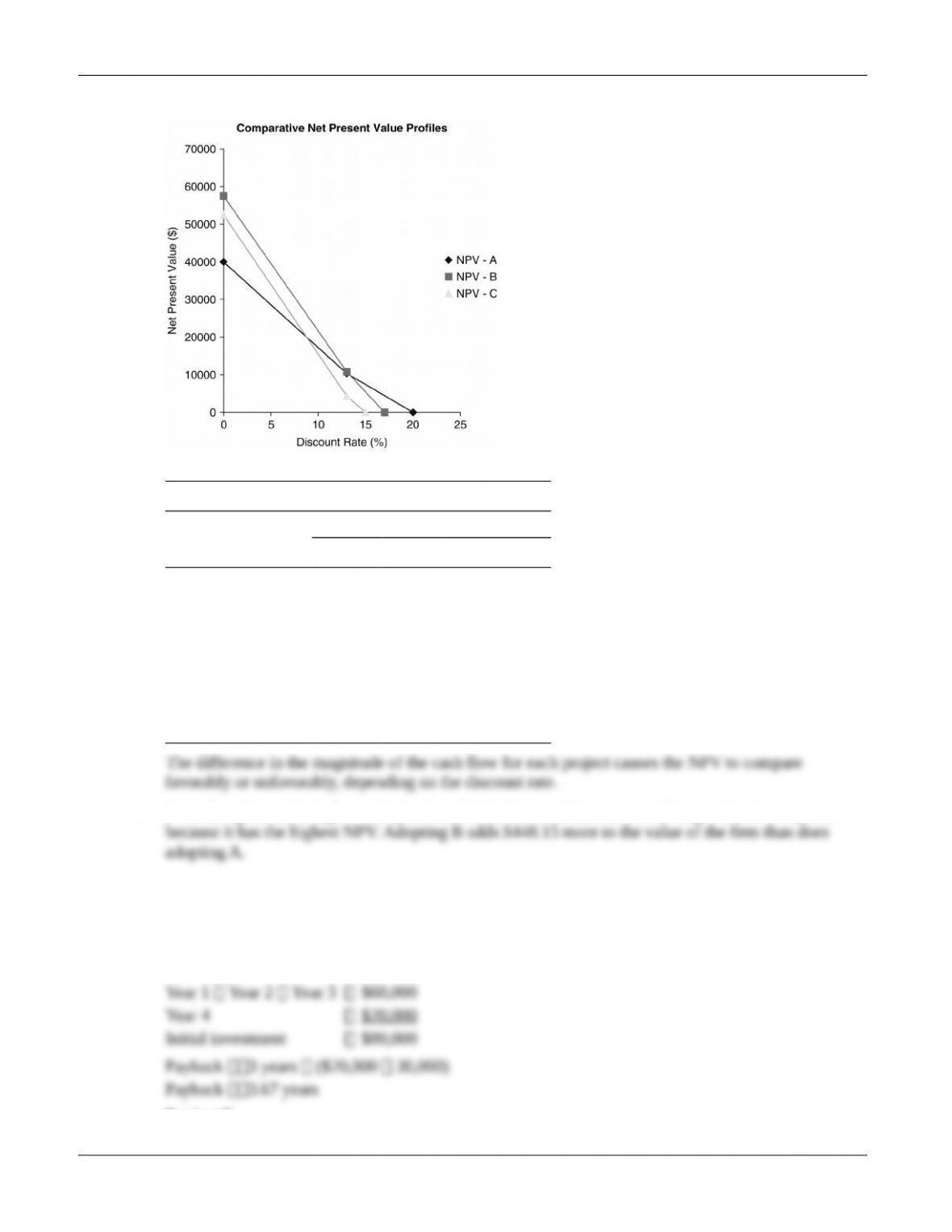
d.
Data for NPV Profiles
NPV
Discount Rate A B C
0% $40,00
0
$57,500 $52,500
13% $10,34
5
10,793 4,310
15% 7,043 5,593 0
17% 3,987 0 —
20% 0 — —
e. Even though A ranks higher in Payback and IRR, financial theorists would argue that B is superior
P10-25. All techniques with NPV profile—mutually exclusive projects
LG 2, 3, 4, 5, 6; Challenge
a. Project A
Payback period
Project B
Payback period
© 2015 Pearson Education, Inc.
Chapter 10: Capital Budgeting Techniques 3
$50,000 $15,000 3.33 years
b. Project A
CF0 $80,000; CF1 $15,000; CF2 $20,000; CF3 $25,000; CF4 $30,000;
Project B
CF0 $50,000; CF1 $15,000; F1 5
c. Project A
CF0 $80,000; CF1 $15,000; CF2 $20,000; CF3 $25,000; CF4 $30,000;
Project B
CF0 $50,000; CF1 $15,000; F1 5
Solve for IRRB 15.24%
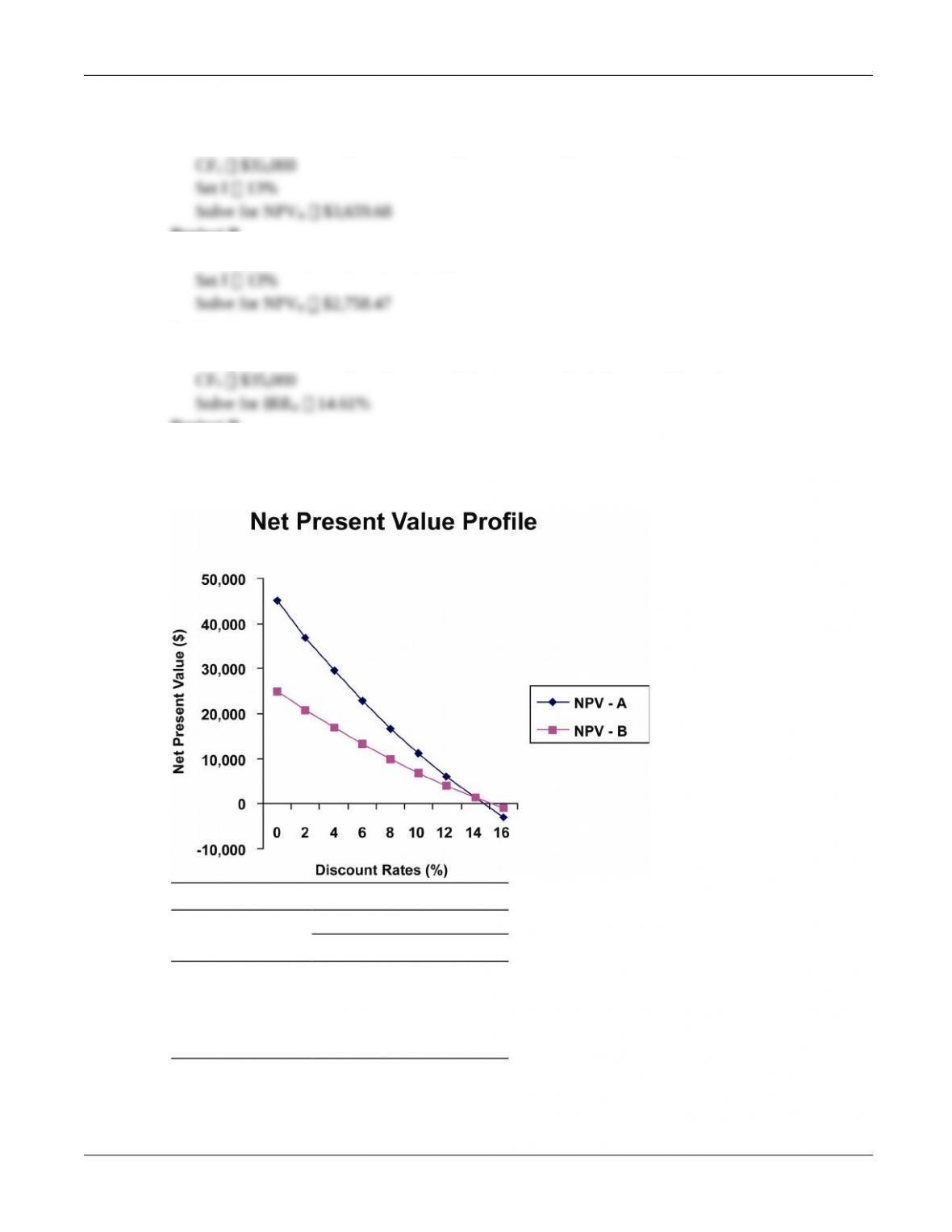
d.
Data for NPV Profiles
NPV
Discount Rate A B
0% $45,000 $25,000
13% $3,655 2,755
14.6% 0 —
15.2% — 0
Intersection—approximately 14%
If cost of capital is above 14%, conflicting rankings occur.
The calculator solution is 13.87%.
© 2015 Pearson Education, Inc.
4 Gitman/Zutter Principles of Managerial Finance, Brief, Seventh Edition
e. Both projects are acceptable. Both have similar payback periods, positive NPVs, and equivalent IRRs
that are greater than the cost of capital. Although Project B has a slightly higher IRR, the rates are
very close. Because Project A has a higher NPV, accept Project A.
P10-26. Integrative—Multiple IRRs
LG 6; Basic
a. First the project does not have an initial cash outflow. It has an inflow, so the payback is immediate.
b. CF0 $200,000, CF1 920,000, CF2 $1,582,000, CF3 $1,205,200, CF4 $343,200
Set I 0%; Solve for NPV $0.00
c. There are multiple IRRs because there are several discount rates at which the NPV is zero.
d. It would be difficult to use the IRR approach to answer this question because it is not clear which IRR
e. It is best simply to use NPV in a case where there are multiple IRRs due to the changing signs of the
cash flows.
P10-27. Integrative—Conflicting Rankings
LG 3, 4, 5; Intermediate
a. Plant Expansion
CF0 $3,500,000, CF1 1,500,000, CF2 $2,000,000, CF3 $2,500,000, CF4 $2,750,000
© 2015 Pearson Education, Inc.
Chapter 10: Capital Budgeting Techniques 5
b.
Rank
Project NPV IRR PI
Plant Expansion 1 2 2
Product Introduction 2 1 1
c. The NPV is higher for the plant expansion, but both the IRR and the PI are higher for the product
d. Because the NPV of the plant expansion project is higher, the firm’s shareholders would be better off if
the firm pursued that project, even though it has a lower rate of return.
P10-28. Ethics problem
LG 1, 6; Intermediate
YEAR LED PROJECT SOLAR PROJECT
0 –$4,200,000 –$500,000
1 700,000 60,000
2 700,000 60,000
3 700,000 60,000
4 700,000 60,000
a. LED project
SOLAR project
b. Combined project
NPVCOMBINED = NPVLED + NPVSOLAR
= $287,473.37 + ($131,325.97)
= $156,147.40
© 2015 Pearson Education, Inc.
6 Gitman/Zutter Principles of Managerial Finance, Brief, Seventh Edition
c. If Diane agrees to combine the two projects into a single proposal, the company would not be maximizing
Case
Case studies are available on www.myfinancelab.com.
Making Norwich Tool’s Lathe Investment Decision
The student is faced with a typical capital budgeting situation in Chapter 10’s case. Norwich Tool must select one
of two lathes that have different initial investments and cash inflow patterns. After calculating both unsophisticated
and sophisticated capital budgeting techniques, the student must reevaluate the decision by taking into account the
higher risk of one lathe.
a. Payback period
Lathe B:
b. 1. NPV
Year
Discount
Rate
Lathe A
Cash Flow PV
Lathe B
Cash Flow PV
0 13% −
$660,000
$58,132.88 $360,000 $43,483.24
1 128,000 $88,000
2. IRR
Lathe A
1 2 3 4 5
$128,000 $182,000 $166,000 $168,000 $450,000
$0 $660,000
(1 IRR) (1 IRR) (1 IRR) (1 IRR) (1 IRR)
= + + + + –
+ + + + +
IRR 15.95%
Lathe B
1 2 3 4 5
$88,000 $120,000 $96,000 $86,000 $207,000
$0 $360,000
(1 IRR) (1 IRR) (1 IRR) (1 IRR) (1 IRR)
= + + + + –
+ + + + +
IRR 17.34%
© 2015 Pearson Education, Inc.
Chapter 10: Capital Budgeting Techniques 7
Under the NPV rule both lathes are acceptable because the NPVs for A and B are greater than zero. Lathe
c. Summary
Lathe A Lathe B
Payback period 4.04 years 3.65 years
NPV $58,133 $43,483
IRR 15.95%
Both projects have positive NPVs and IRRs above the firm’s cost of capital. Lathe A, however, exceeds the
If the firm has unlimited funds, it should choose all projects with positive NPVs in order to maximize
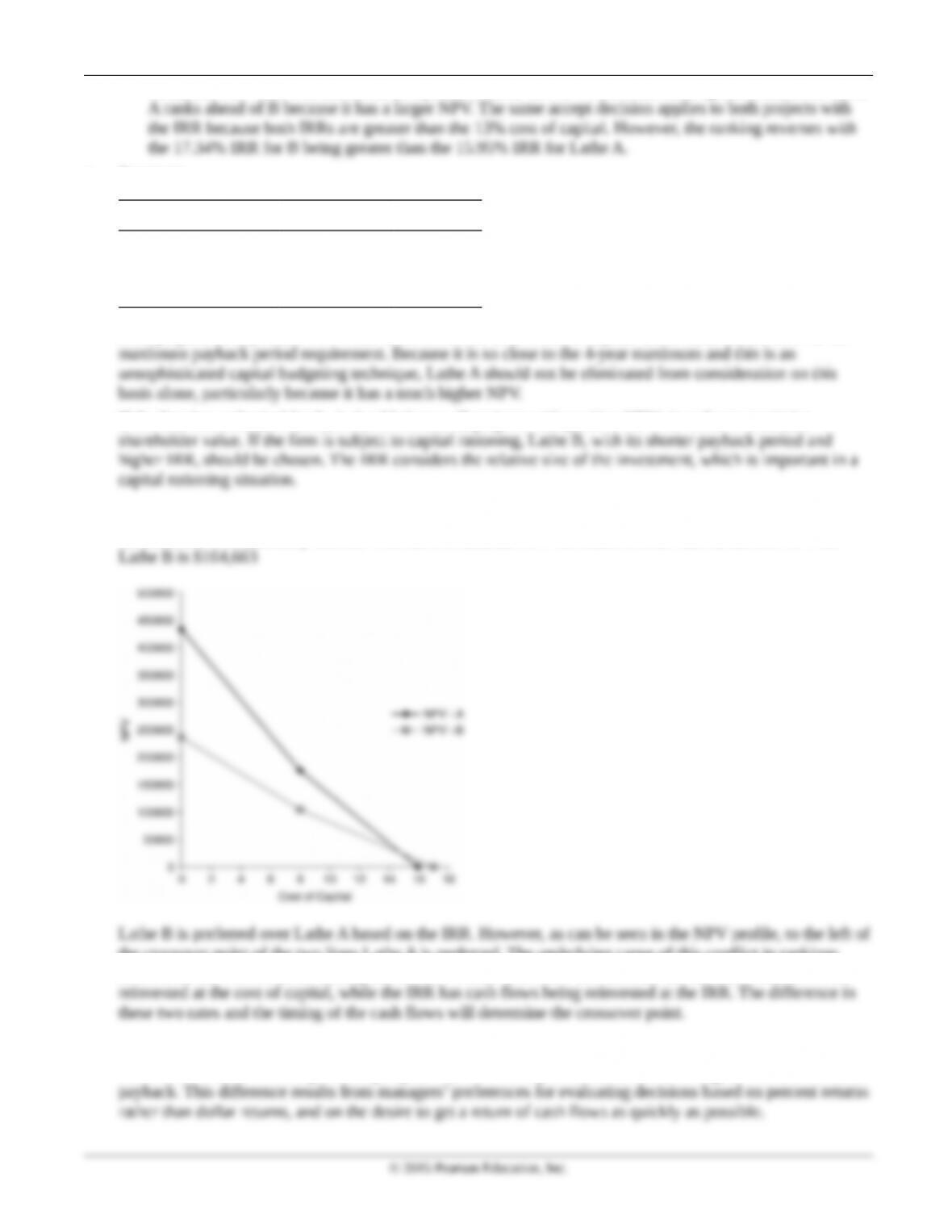
d. To create an NPV profile it is best to have at least three NPV data points. To create the third point an 8%
discount rate was arbitrarily chosen. With the 8% rate, the NPV for Lathe A is $176,078, and the NPV for
the crossover point of the two lines Lathe A is preferred. The underlying cause of this conflict in rankings
arises from the reinvestment assumption of NPV versus IRR. NPV assumes the intermediate cash flows are
e. On a theoretical basis Lathe A should be preferred because of its higher NPV and thus its known impact on
shareholder wealth. From a practical perspective, Lathe B may be selected due to its higher IRR and its faster

project, where the NPVs should both be greater than 0. The crucial part of this step is the estimate of the discount
rate used to calculate the NPVs. Each group must defend their chosen rate of discount. The final calculation is the
IRR for each project.
Given the calculations regarding the payback period, NPV, and IRR of each project, the groups are asked to choose
the more desirable project. This choosing process should be detailed, giving the reader a sense of the reasons for
choosing between the projects. A summary of each method and a defense for the interpretation of these results should be
included in each group’s write-up. Giving groups an example of a variety of potential projects will help students
© 2015 Pearson Education, Inc.