
Part 5
Long-Term Investment Decisions
Chapters in This Part
Chapter 10 Capital Budgeting Techniques
Chapter 11 Capital Budgeting Cash Flows and Risk Renements
Chapter 10
Capital Budgeting Techniques
Instructor’s Resources
Overview
This chapter is the first of three that deal with long-term investment decisions. This chapter covers capital budgeting
techniques, Chapter 11 deals with the basic principles of determining relevant cash flows, and Chapter 12 considers risk and
refinements in capital budgeting. Both the sophisticated [net present value (NPV) and the internal rate of return (IRR)] and
unsophisticated (average rate of return and payback period) capital budgeting techniques are presented here. Discussion
centers on the calculation and evaluation of the NPV and IRR in investment decisions, with and without a capital rationing
constraint. Several illustrations exist explaining why capital budgeting techniques will be useful to students in their
professional and personal lives.
Answers to Review Questions
1.Once the relevant cash flows have been developed, they must be analyzed to determine whether the projects are acceptable
2.The payback period is the exact time it takes to recover a firm’s initial investment in a project. In case of a mixed stream,
3.The weaknesses of using the payback period are (1) no explicit consideration of shareholders’ wealth, (2) failure to take
fully into account the time value of money, and (3) failure to consider returns beyond the payback period and hence overall
© 2015 Pearson Education, Inc.
2 Gitman/Zutter Principles of Managerial Finance, Brief, Seventh Edition
4.NPV computes the present value of all relevant cash flows associated with a project. For conventional cash flow, NPV
NPV present value of cash inflows initial investment
6.NPV, PI, and EVA are all based on the same underlying idea, that investments should earn a rate of return high enough to
meet investors’ expectations. The PI differs from NPV in that it is expressed as a rate of return. That is, it measures the
8.The IRR on an investment is the discount rate that would cause the investment to have a NPV of zero. It is found by solving
Chapter 3: Financial Statements and Ratio Analysis 3
Suggested Answer to Focus on Ethics Box: Nonfinancial Considerations for
Project Selection
What are the potential risks to a company of unethical behaviors by employees? What are potential risks to the public
and to stakeholders?
The consequences to the company may include prosecution, fines, and other penalties for the improper conduct of its
employees. Legal sanctions bring unwanted publicity that can result in loss of business or damage to the company’s good
certainly lead to termination of employment, not to mention damage to the employee’s personal reputation.
Employees’ unethical behavior could cost the company customers, suppliers, and sources of capital. Consequences for the
Answers to Warm-Up Exercises
E10-1. Payback period
Answer: The payback period for Project Hydrogen is 4.29 years. The payback period for Project Helium is 5.75 years. Both
E10-2. NPV
Answer:
Year Cash Inflow Present Value
1 $400,000 $ 377,358.49
E10-3: NPV comparison of two projects
Answer:
Project Kelvin
Present value of expenses –$45,000
Project Thompson
© 2015 Pearson Education, Inc.
4 Gitman/Zutter Principles of Managerial Finance, Brief, Seventh Edition
Present value of expenses $275,000
Present value of cash inflows 277,373 (PMT $60,000, N 6, I 8, Solve for PV)
E10-4: IRR
Answer: You may use a financial calculator to determine the IRR of each project. Choose the project with the higher IRR.
Project T-Shirt
Project Board Shorts
Based on IRR analysis, Billabong Tech should choose project T–Shirt.
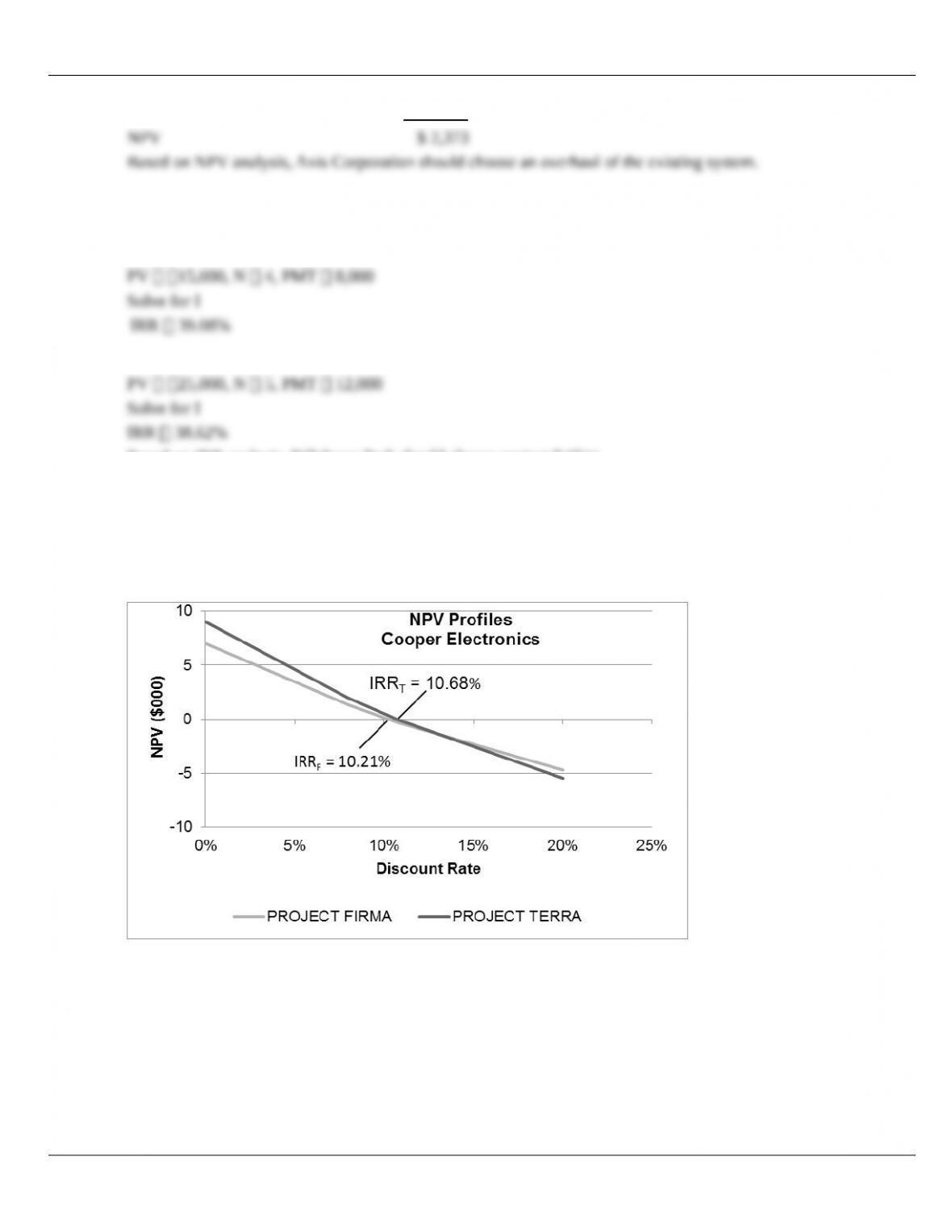
E10-5: NPV
Answer:
Note: The IRR for Project Terra is 10.68% while that of Project Firma is 10.21%. Furthermore, when the discount
rate is zero, the sum of Project Terra’s cash flows exceed that of Project Firma. Hence, at any discount rate that
produces a positive NPV, Project Terra provides the higher net present value.
© 2015 Pearson Education, Inc.

Chapter 3: Financial Statements and Ratio Analysis 5
Solutions to Problems
Note to instructor: In most problems involving the IRR calculation, a financial calculator has been used. Answers to
NPV–based questions in the first 10 problems provide detailed analysis of the present value of individual cash flows.
Thereafter, financial calculator worksheet keystrokes are provided. Most students will probably employ calculator
functionality to facilitate their problem solution in this chapter and throughout the course.
P10-1. Payback period
LG 2; Basic
P10-2. Payback comparisons
LG 2; Intermediate
a. Machine 1: $14,000 $3,000 4 years, 8 months
P10-3. Choosing between two projects with acceptable payback periods
LG 2; Intermediate
a.
Project A Project B
Year
Cash
Inflows
Investment
Balance Year
Cash
Inflows
Investment
Balance
0$100,000 0 $100,000
1 $10,000 90,000 1 40,000 60,000
2 20,000 70,000 2 30,000 30,000
3 30,000 40,000 3 20,000 10,000
4 40,000 0 4 10,000 0
5 20,000 5 20,000
Both Project A and Project B have payback periods of exactly 4 years.
© 2015 Pearson Education, Inc.
6 Gitman/Zutter Principles of Managerial Finance, Brief, Seventh Edition
P10-4. Personal finance: Long-term investment decisions, payback period
LG 4
a. and b.
Project A Project B
Year
Annual
Cash Flow
Cumulative
Cash Flow
Annual
Cash Flow
Cumulative
Cash Flow
0 $(9,000) $(9,000) $(9,000) $(9,000)
1 2,200 (6,800) 1,500 (7,500)
c. The payback method would select Project A because its payback of 3.9 years is lower than Project B’s payback of
4.25 years.
d. One weakness of the payback method is that it disregards expected future cash flows as in the case of Project B.
P10-5. NPV
LG 3; Basic
NPV PVn Initial investment
a. N 15, I 9%, PMT $150,000
b. N 15, I 9%, PMT $320,000
c. N 15, I 9%, PMT $365,000
P10-6. NPV for varying cost of capital
LG 3; Basic
a. 10%
© 2015 Pearson Education, Inc.
Chapter 3: Financial Statements and Ratio Analysis 7
b. 12%
N 8, I 12%, PMT $5,000
c. 14%
N 8, I 14%, PMT $5,000
P10-7. NPV—independent projects
LG 3; Intermediate
Project A
N 10, I 14%, PMT $4,000
Reject
Project B—PV of Cash Inflows
Accept
Project C—PV of Cash Inflows
Reject
Project D
© 2015 Pearson Education, Inc.
8 Gitman/Zutter Principles of Managerial Finance, Brief, Seventh Edition
NPV $1,066,939 $950,000
NPV $116,938.70
Accept
Project E—PV of Cash Inflows
Accept
P10-8. NPV
LG 3; Challenge
b. N 5, I 9%, PV $1,500,000
c. Present valueAnnuity Due PVordinary annuity (1 discount rate)
d. No, the cash flows from the project will not influence the decision on how to fund the project. The investment
and financing decisions are separate.
© 2015 Pearson Education, Inc.