
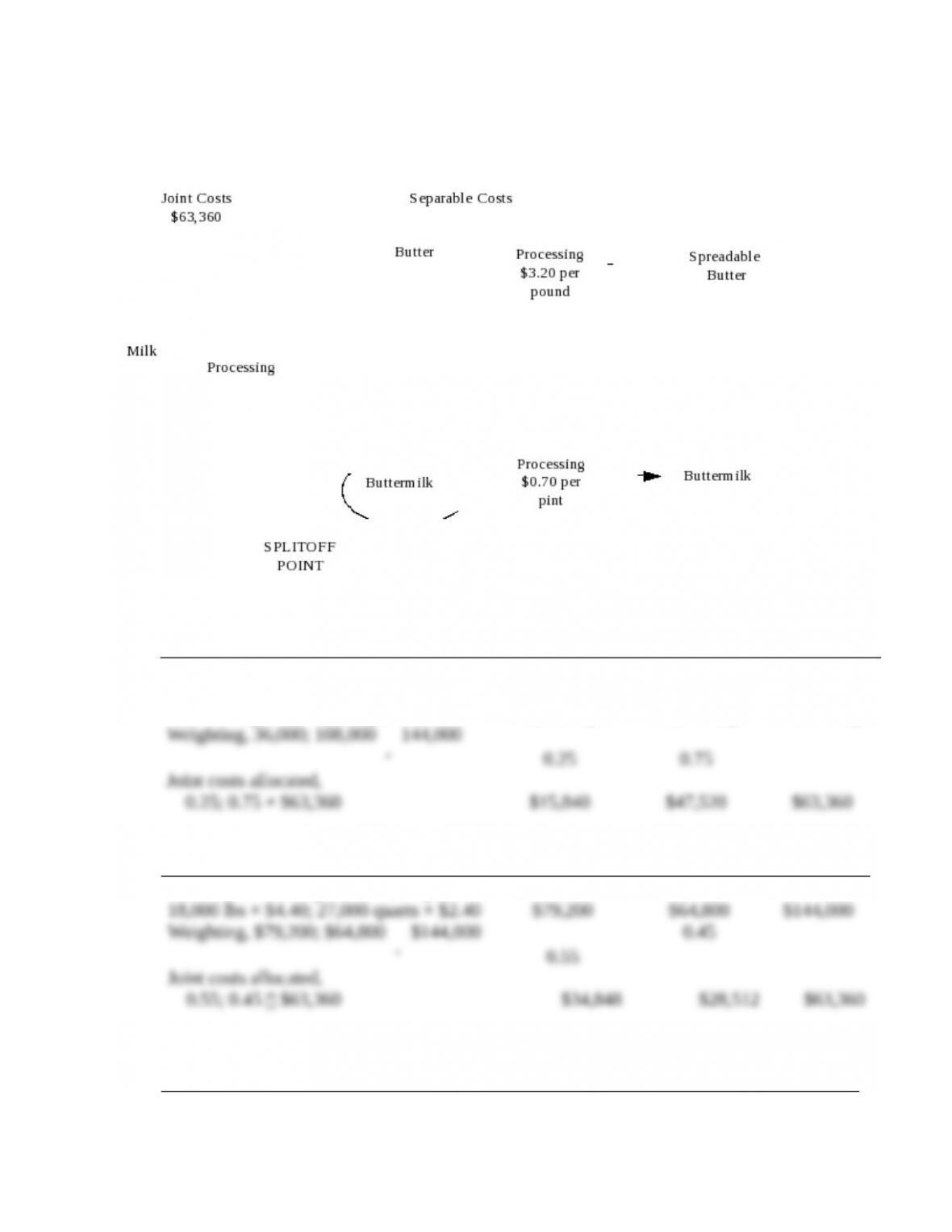
Weighting, $108,000; $64,800
$172,800
0.625
0.375
Joint costs allocated,
0.625; 0.375 $63,360
$39,600
$23,760
$63,360
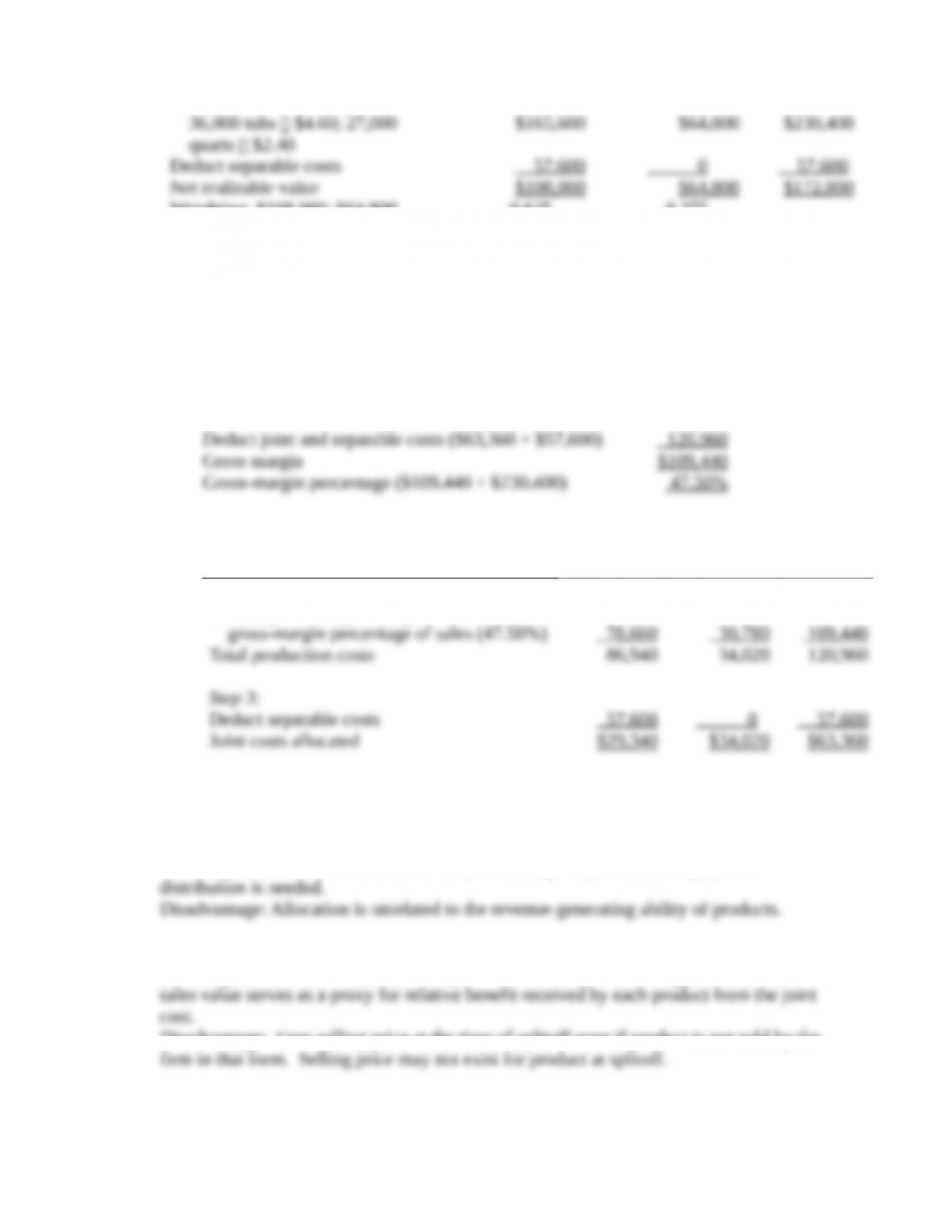
d. Constant gross-margin percentage NRV method:
Step 1:
Final sales value of total production (see 1c.) $230,400
Deduct joint and separable costs ($63,360 + $57,600) 120,960
Gross margin $109,440
Gross-margin percentage ($109,440 ÷ $230,400) 47.50%
Step 2:
Butter
Buttermilk
Total
Final sales value of total production
$165,600
$64,800
$230,400
Deduct gross margin, using overall
gross-margin percentage of sales (47.50%)
78,660
30,780
109,440
Total production costs
86,940
34,020
120,960
Step 3:
Deduct separable costs
57,600
0
57,600
Joint costs allocated
$29,340
$34,020
$63,360
2. Advantages and disadvantages:
– Physical-Measure
Advantage: Low information needs. Only knowledge of joint cost and physical
distribution is needed.
Disadvantage: Allocation is unrelated to the revenue-generating ability of products.
– Sales Value at Splitoff
Advantage: Considers market value of products as basis for allocating joint cost. Relative
sales value serves as a proxy for relative benefit received by each product from the joint
cost.
Disadvantage: Uses selling price at the time of splitoff even if product is not sold by the
firm in that form. Selling price may not exist for product at splitoff.
– Net Realizable Value
Advantages: Allocates joint costs using ultimate net value of each product; applicable
when the option to process further exists
Disadvantages: High information needs; Makes assumptions about expected outcomes of
future processing decisions
Weighting, $375,000; $562,500
$937,500
0.40
0.60
Joint costs allocated, 0.40; 0.60 × $600,000
$240,000
$360,000
$600,000
Floor Mats
Car Mats
Rubber
Shreds
Total
Revenues, 25,000 × $12;
85,000 × $6
$300,000
$510,000
$30,100d
$840,100
Cost of goods sold:
Joint costs allocated, 0.40;
0.60 × $600,000
$240,000
$360,000
$600,000
Less: Ending inventory
( 48,000)e
( 33,600)f
( 81,600)
Cost of goods sold
$192,000
$326,400
$518,400
Gross margin
$108,000
$183,600
$30,100
$321,700
d 43,000 lbs × $0.70 per lb. = $30,100
e 6,250 × $240,000/31,250 = $48,000
f 8,750 × $360,000/93,750 = $33,600
3. The production method of accounting for the byproduct is only appropriate if The Mat
Place is positive they can sell the byproduct at the expected selling price. Moreover, The
Mat Place should view the byproduct’s contribution to the firm as material enough to find
it worthwhile to record and track any inventory that may arise. The sales method is
appropriate if either the disposition of the byproduct is unsure or the selling price is
unknown, or if the amounts involved are so negligible as to make it economically infeasible
for The Mat Place to keep track of byproduct inventories.
16-34 (15 min.) Byproduct-costing journal entries (continuation of 16–33).
The Mat Place’s accountant needs to record the information about the joint and byproducts in the
general journal, but is not sure what the entries should be. The company has hired you as a
consultant to help its accountant.
Required:
1. Show journal entries at the time of production and at the time of sale assuming the Mat Place
accounts for the byproduct using the production method.
2. Show journal entries at the time of production and at the time of sale assuming the Mat Place
accounts for the byproduct using the sales method.