Chapter 1 Introduction to Managerial Accounting
Chapter 1
Introduction to Managerial Accounting
Quick Check
Answers:
Chapter 1 Introduction to Managerial Accounting
(5 min.) S1-6
a. The Institute of Management Accountants says that more accountants work in organizations rather than at
CPA firms.
(10 min.) S1-7
Each of the four ethical standards contributes to maintaining the IMA’s (and society’s) expectation that management
accountants will uphold the highest standards of ethical behavior.
COMPETENCE: Without the necessary competence, management accountants will be unable to perform their
responsibilities. Even if they do recognize an ethical dilemma, they could lack the competence required to determine all
the alternative courses of action and the implications of each alternative.
(5 min.) S1-8
a. Providing earnings information to your brother before it is publicly announced violates the confidentiality
standard.
Chapter 1 Introduction to Managerial Accounting
Exercises (Group A)
(10 min.) E1-12A
a. Managerial accounting systems report on various segments or business units of the company.
b. When managers evaluate the company’s performance compared to the plan, they are performing the
(10 min.) E1-13A
1. Financial accounting information
3. Both
5. Financial accounting information
7. Both
9. Financial accounting information
11. Financial accounting information
13. Financial accounting information
(10 min.) E1-14A
2. competence
4. credibility
6. integrity
8. competence
10. credibility
12. confidentiality
Managerial Accounting 4e Solutions Manual
(10 min.) E1-15A
Req. 1
Total costs of adopting lean production model:
Employee training…………..…………………..……………………..
$26,000
Streamline plant’s production process……………………….
68,000
Supplier identification………………………….………….…………
7,500
Total costs…………………………….…………………………………..
$101,500
Req. 2
Benefits of adopting lean production:
Savings in warehouse expenses……………………………..
$67,000
Lower spoilage costs……..…….…………..………….…………….
38,200
Total benefits…………..………………….…………………………
$105,200
Req. 3
Expected total benefits…………………….…………………….
$105,200
Expected total costs…………………..…….…………………….
(101,500)
Excess of benefits over costs…………………………..………….
$ 3,700
The company should adopt the lean production model because the expected benefits exceed the costs.
(10 min.) E1-16A
a. Social
b. Environmental
c. Economic
d. Social
e. Social
f. Environmental
g. Environmental
h. Social
i. Social
j. Economic
k. Environmental
l. Social
m. Environmental
Chapter 1 Introduction to Managerial Accounting
Exercises (Group B)
(5 min.) E1-17B
a. U.S. companies must follow GAAP or IFRS in their financial accounting systems.
(5-10 min.) E1–18B
1. Both
3. Financial accounting information
5. Financial accounting information
7. Financial accounting information
9. Financial accounting information
11. Both
13. Financial accounting information
(10 min.) E1-19B
2. competence
4. competence
6. credibility
8. competence
10. confidentiality
12. confidentiality
Managerial Accounting 4e Solutions Manual
(10 min.) E1-20B
Req. 1
Total costs of adopting lean production model:
Employee training………………………………………………………
$45,100
Streamline plant’s production process……………………….
35,000
Supplier identification………………………….…………………….
7,750
Total costs……….………………………………………………………..
$87,850
Savings in warehouse expenses……………………………..
$87,000
Lower spoilage costs………………………..………………….…....
35,200
Total benefits…………..………………….…………………………
$122,200
Req. 3
Expected total benefits…………………….……………………..
$122,200
Expected total costs……………………………………………….
(87,850)
Excess of benefits over costs………………..……………………
$ 34,350
The company should adopt the lean production model because the expected benefits are greater than the costs.
(10 min.) E1-21B
a. Environmental
b. Social
c. Environmental
d. Environmental
e. Economic
f. Social
g. Environmental
h. Environmental
i. Social
j. Environmental
k. Economic
l. Environmental
m. Environmental
Chapter 1 Introduction to Managerial Accounting
Problems (Group A)
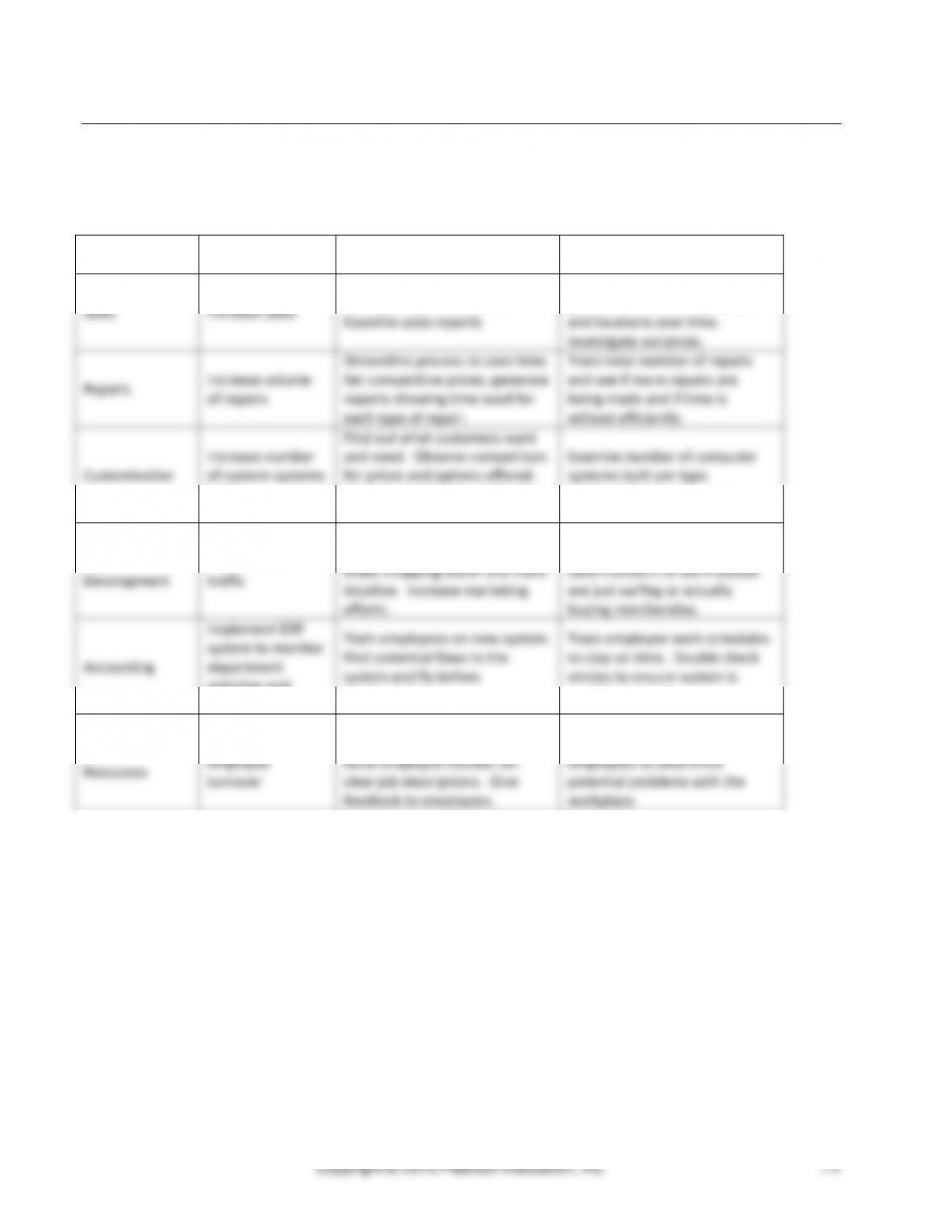
(45-60 min.) P1-22A
Req. 1
Planning
Directing
Controlling
Sales
Increase Sales
Setting competitive prices
Examine sales reports
Monitor sales numbers and
prices from different products
and locations over time.
Investigate variances.
Repairs
Increase volume
of repairs
Streamline process to save time.
Set competitive prices; generate
reports showing time used for
each type of repair.
Track total number of repairs
and see if more repairs are
being made and if time is
utilized efficiently.
Customization
Increase number
of custom systems
built
Find out what customers want
and need. Observe competitors
for prices and options offered.
Improve employee certification
and offer higher-quality parts.
Examine number of computer
systems built per type
(multimedia, gaming, etc.).
Web
Development
Increase web
traffic
Improve design of web site.
Offer more products online.
Make shopping easier and more
intuitive. Increase marketing
efforts.
Monitor web traffic by having an
online counting device. Look at
sales numbers to see if people
are just surfing or actually
buying merchandise.
Accounting
Implement ERP
system to monitor
department
activities and
record finances
Train employees on new system.
Find potential flaws in the
system and fix before
implementation.
Track employee work schedules
to stay on time. Double check
entries to ensure system is
working properly.
Human
Resources
Decrease
employee
turnover
Hire employees that are “a good
fit” for the company.
Raise employee morale; set
clear job descriptions. Give
feedback to employees.
Monitor both involuntary and
voluntary turnover. Interview
employees to determine
potential problems with the
workplace.
Managerial Accounting 4e Solutions Manual
(continued) P1-22A
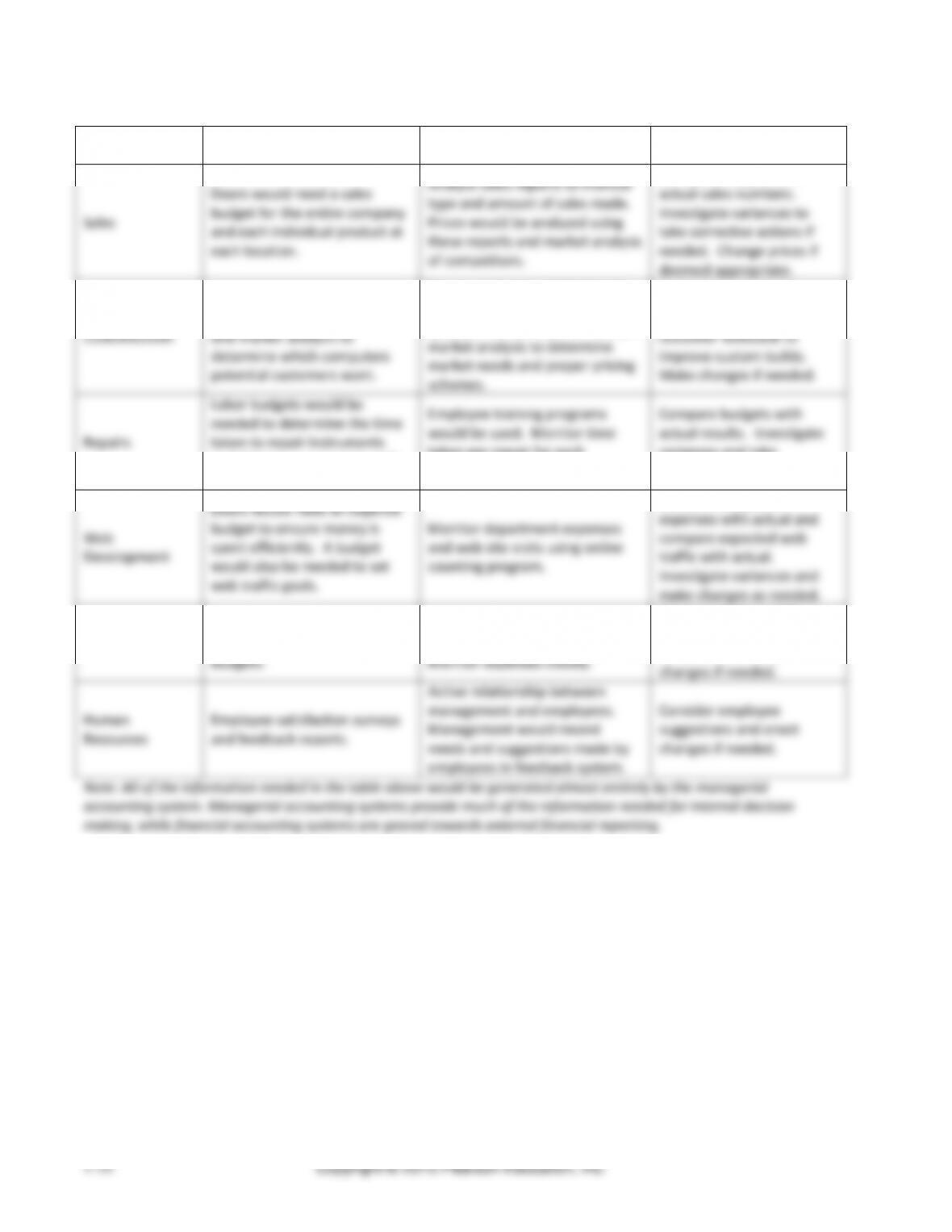
Req. 2
Planning
Directing
Controlling
Sales
Doors would need a sales
budget for the entire company
and each individual product at
each location.
Analyze sales reports to monitor
type and amount of sales made.
Prices would be analyzed using
these reports and market analysis
of competitors.
Compare budgets with
actual sales numbers.
Investigate variances to
take corrective actions if
needed. Change prices if
deemed appropriate.
Customization
Budgets for types of computers
offered, time needed per job,
and market analysis to
determine which computers
potential customers want.
Ensure customer satisfaction by
hiring qualified staff. Research
quality of available parts. Analyze
market analysis to determine
market needs and proper pricing
schemes.
Compare budgets with
actual results. Use
customer feedback to
improve custom builds.
Make changes if needed.
Repairs
Labor budgets would be
needed to determine the time
taken to repair instruments
and if hiring more repair staff
would be feasible.
Employee training programs
would be used. Monitor time
taken per repair for each
member of repair staff.
Compare budgets with
actual results. Investigate
variances and take
corrective action if needed.
Web
Development
Doors would need an expense
budget to ensure money is
spent efficiently. A budget
would also be needed to set
web traffic goals.
Monitor department expenses
and web site visits using online
counting program.
Compare budgeted
expenses with actual and
compare expected web
traffic with actual.
Investigate variances and
make changes as needed.
Accounting
Doors would need time
budgets as well as expense
budgets.
Train employees on new system
to keep within time budget.
Monitor expenses closely.
Compare budget with
actual numbers. Investigate
variances and make
changes if needed.
Human
Resources
Employee satisfaction surveys
and feedback reports.
Active relationship between
management and employees.
Management would record
needs and suggestions made by
employees in feedback system.
Consider employee
suggestions and enact
changes if needed.
Note: All of the information needed in the table above would be generated almost entirely by the managerial
accounting system. Managerial accounting systems provide much of the information needed for internal decision
making, while financial accounting systems are geared towards external financial reporting.
Chapter 1 Introduction to Managerial Accounting
(15-20 min.) P1-23A
a. If advertising is postponed, there is no transaction to record. This strategy is beyond the responsibility of the
controller, so it does not violate IMA standards.
b. The value of each individual sales return may not be material. However, even if each is small on an individual
Chapter 1 Introduction to Managerial Accounting
(10-15 min.) P1–25A
Costs:
Financial assistance to dealers………………………..
$ 740,000
Computer hardware upgrade………………………….
145,000
Software and consulting fees………………………..
215,000
Total costs…………………………………………………………
$1,100,000
Value of benefits (lower labor costs)………….………..
$1,430,000
Total costs………………………….………………………….…
(1,100,000)
Excess of benefits over costs……………………………
$ 330,000
Because the benefits exceed the costs, a cost-benefit analysis suggests that the company should proceed with the
Internet-based ordering system.
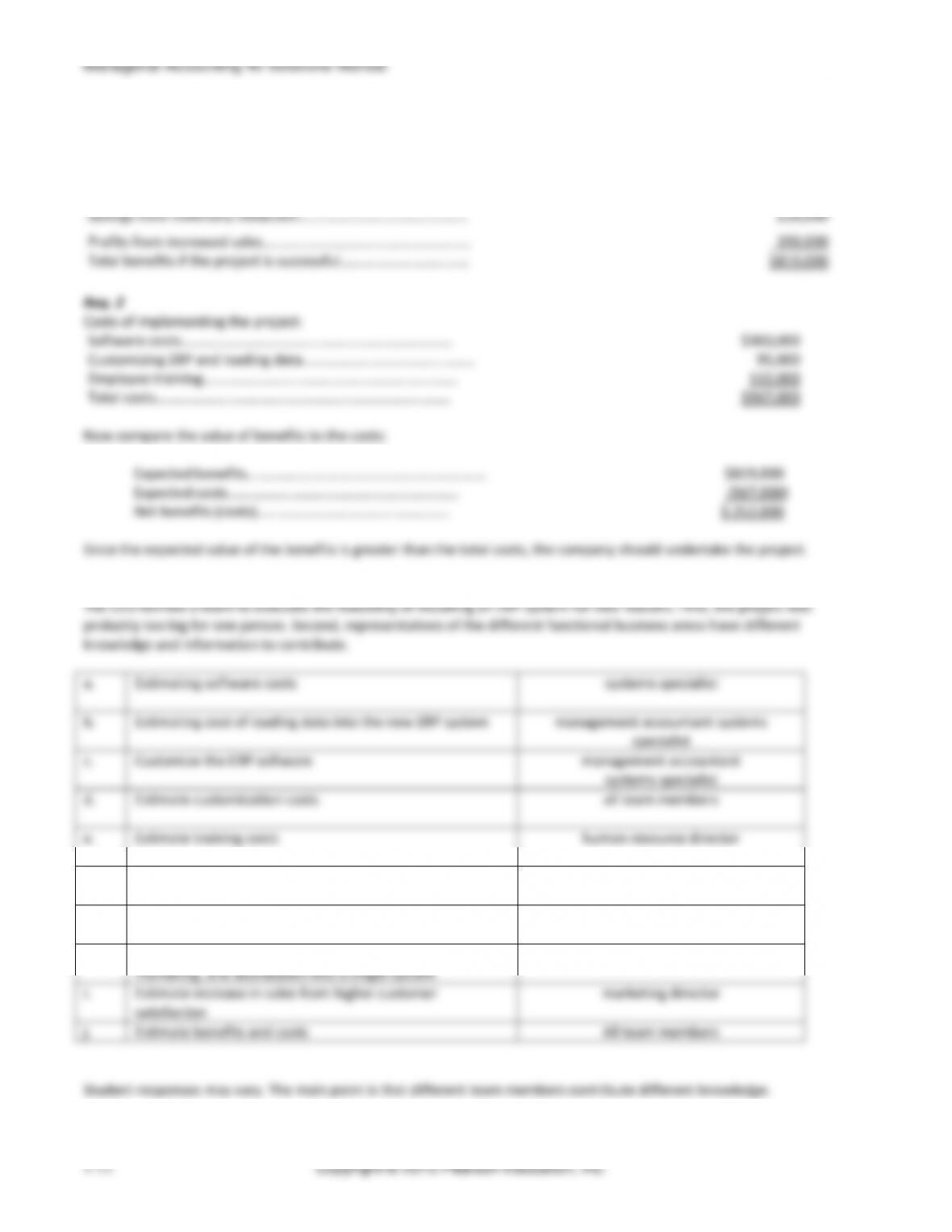
(20-25 min.) P1-26A
Req. 1
The expected value of the benefits is the labor cost savings of $928,000. This is a downward revision from what was
originally estimated in P1-25A.
Expected value of benefits……….………………………
Total costs (from P1–25A)……………………………….
Net cost………………….….…………………………………