(continued) P 9-82B
Req. 5
Leverage
ratio
Total assets ($7,265,000)
Total stockholders’ equity ($2,633,000)
=
2.76
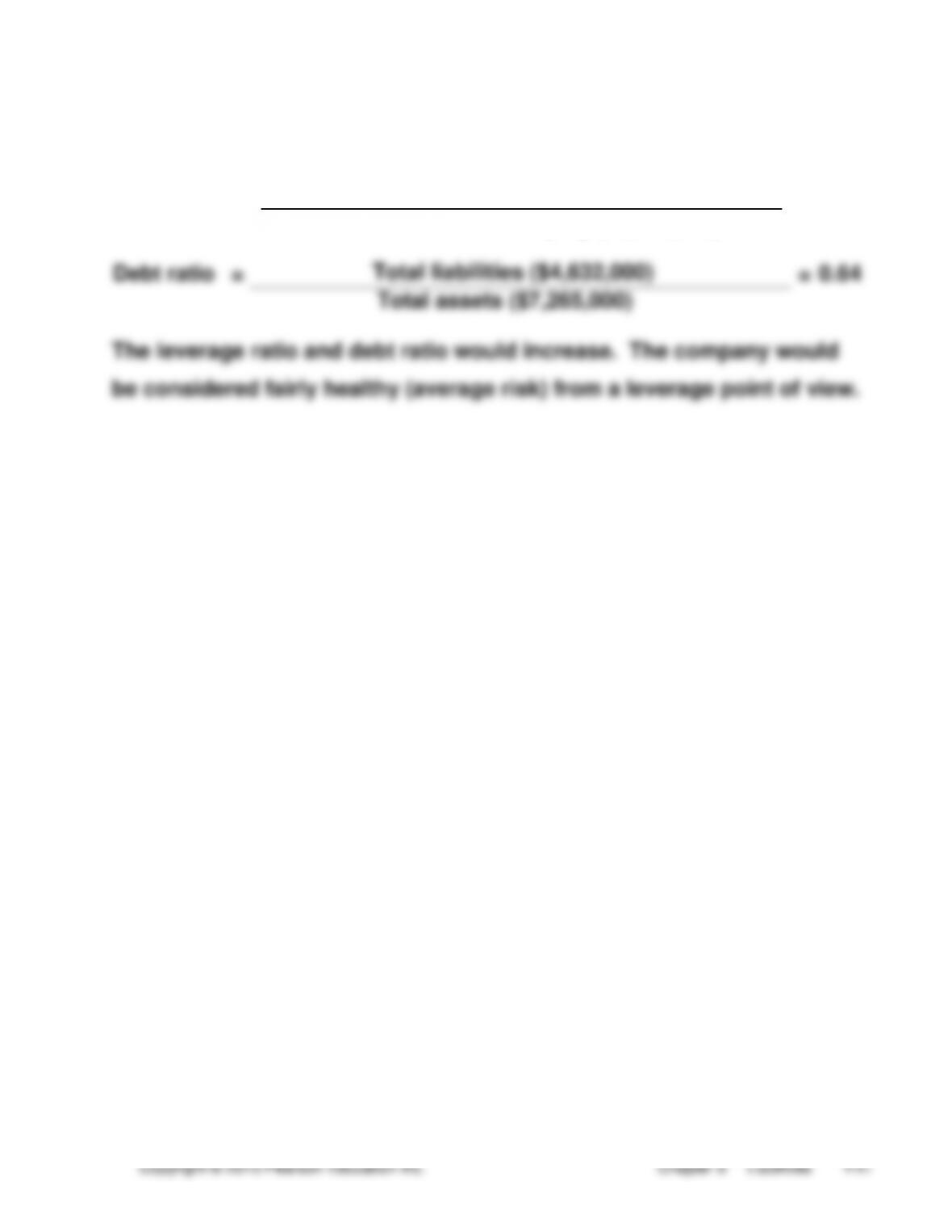
Debt ratio
=
Total liabilities ($4,632,000)
=
0.64
Total assets ($7,265,000)
The leverage ratio and debt ratio would increase. The company would
be considered fairly healthy (average risk) from a leverage point of view.
Challenge Exercises and Problem
(10-15 min.) E 9-83
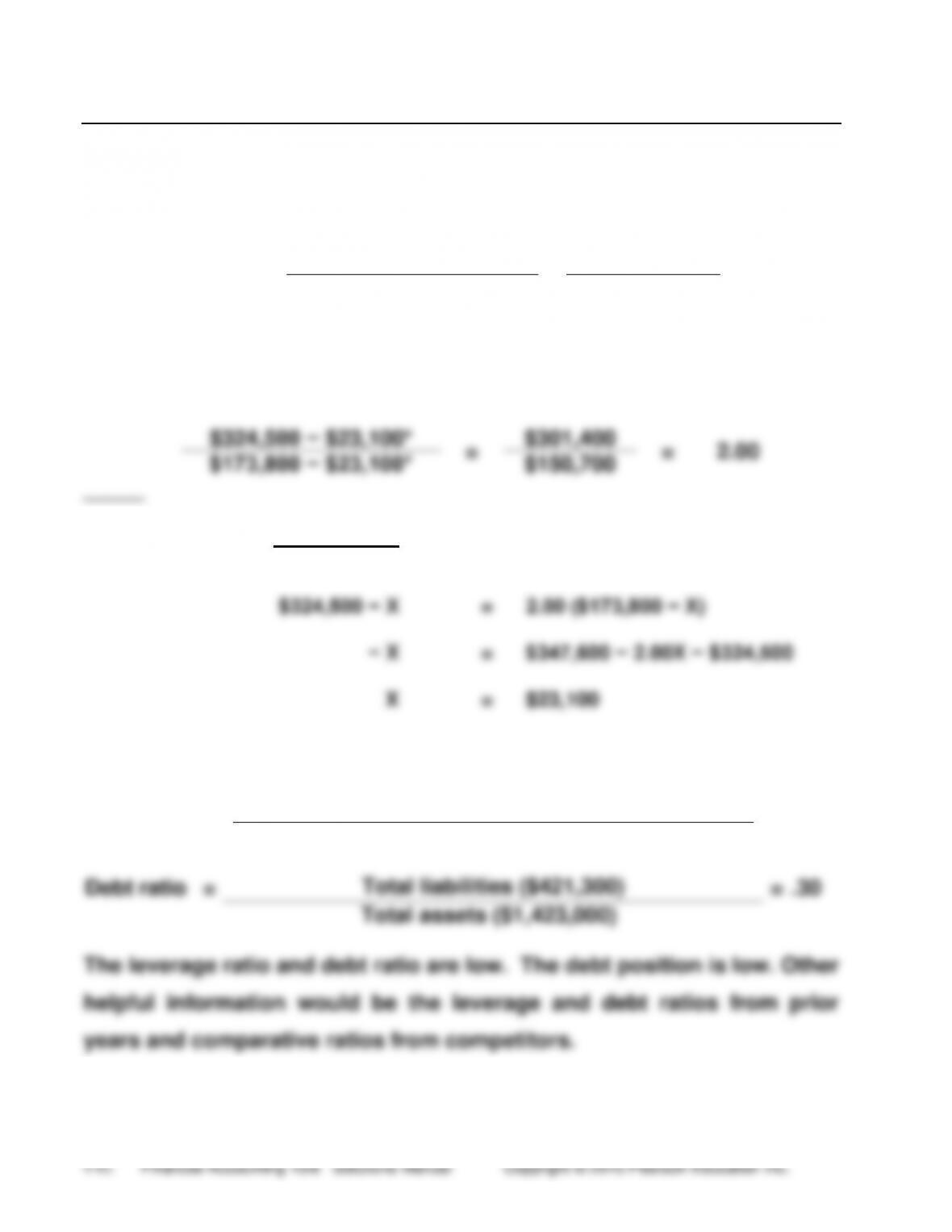
Current ratio
=
Total current assets
=
$324,500 – X
=
2.00
Total current liabilities
$173,800 – X
Let X = amount of current liabilities to pay in order to achieve a current
ratio of 2.00. Murphee Marketing Services should pay off $23,100* of
current liabilities. Then the current ratio will be:
=
=
2.00
(20-30 min.) P 9-84
Req. 1
a. Current ratio
2014
2013
Current
ratio
Current assets
$21,579
= 1.17
$17,551
1.28
Current liabilities
$18,508
$13,721
2014
2013
Debt
ratio
Total
liabilities
$72,921 – $31,317
=.571
$48,671 – $25,346
=.479
Total
assets
$72,921
$48,671
Req. 2
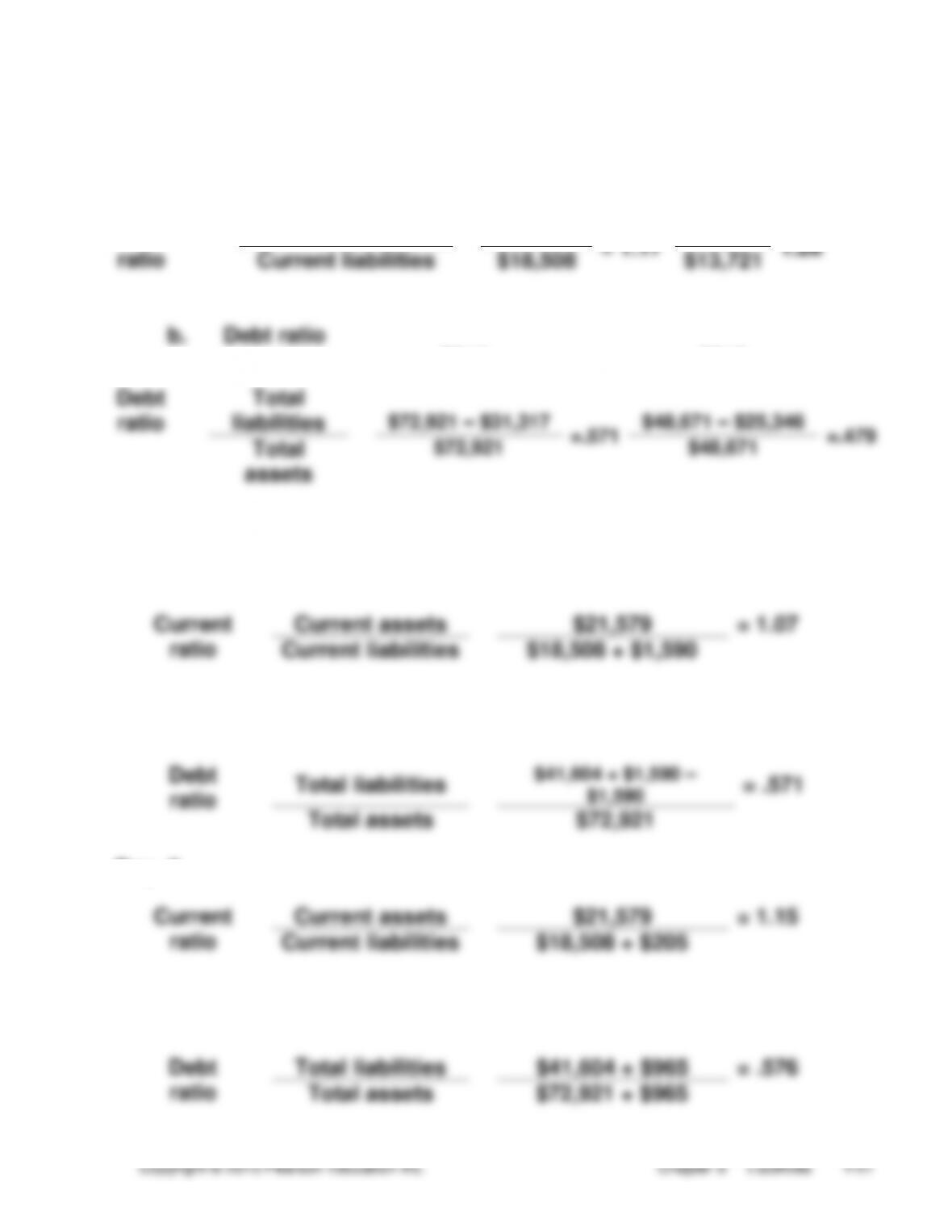
a. Current ratio
Current
ratio
Current assets
$21,579
= 1.07
Current liabilities
$18,508 + $1,590
b. Debt ratio
Current assets
$21,579
= 1.15
Decision Cases
(15-20 min.) Decision Case 1
Req. 1
As
Reported
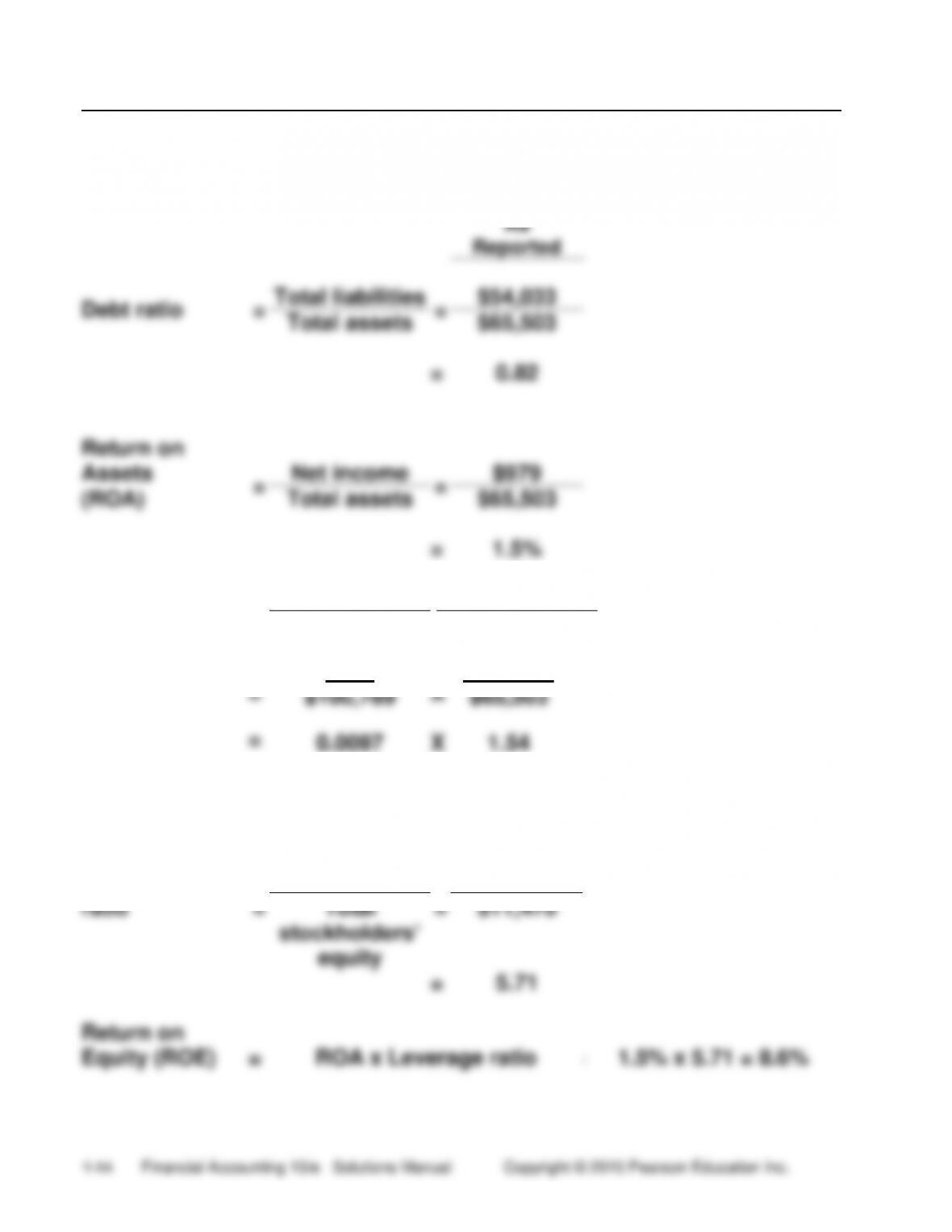
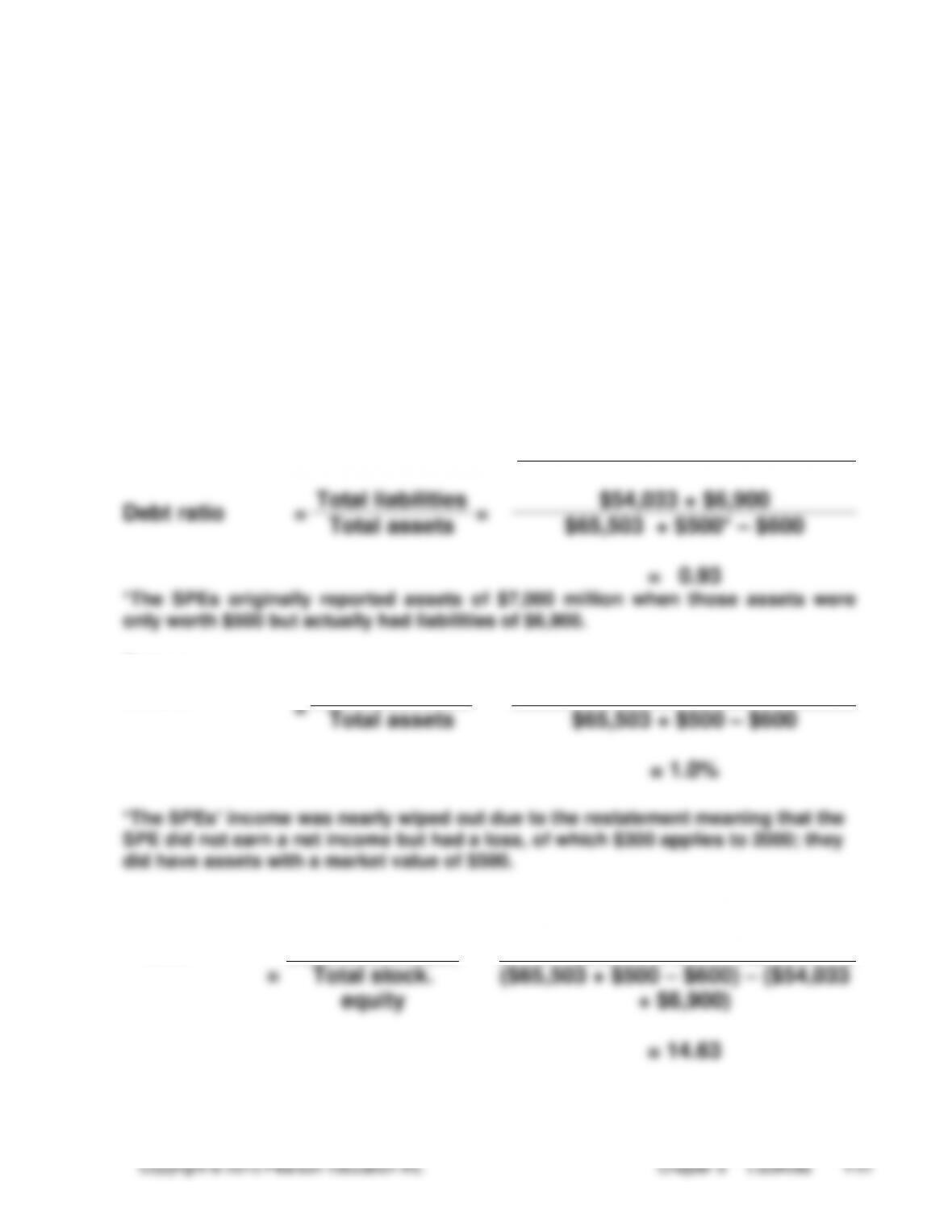
Debt ratio
=
Total liabilities
=
$54,033
Total assets
$65,503
=
0.82
Return on
Assets
=
Net income
=
$979
(ROA)
Total assets
$65,503
=
1.5%
Req.2
=
=
=
=
Net income
Revenue
$979
$100,789
0.0097
1.5%
X
X
X
Revenue
Total assets
$100,789
$65,503
1.54
Leverage
=
Total assets
=
$65,503
ratio
Total
stockholders’
$11,470
equity
=
5.71
Return on
Equity (ROE)
=
=
(continued) Decision Case 1
The ROE is greater than the ROA because the leverage ratio is
extremely high which magnifies the ROA. The debt ratio is also
extremely high and indicates that 82% of the assets were financed
with debt. The high leverage ratio and debt ratio should have made
investors question the soundness of Enron.
Req. 3
After Including the
Special-Purpose Entities
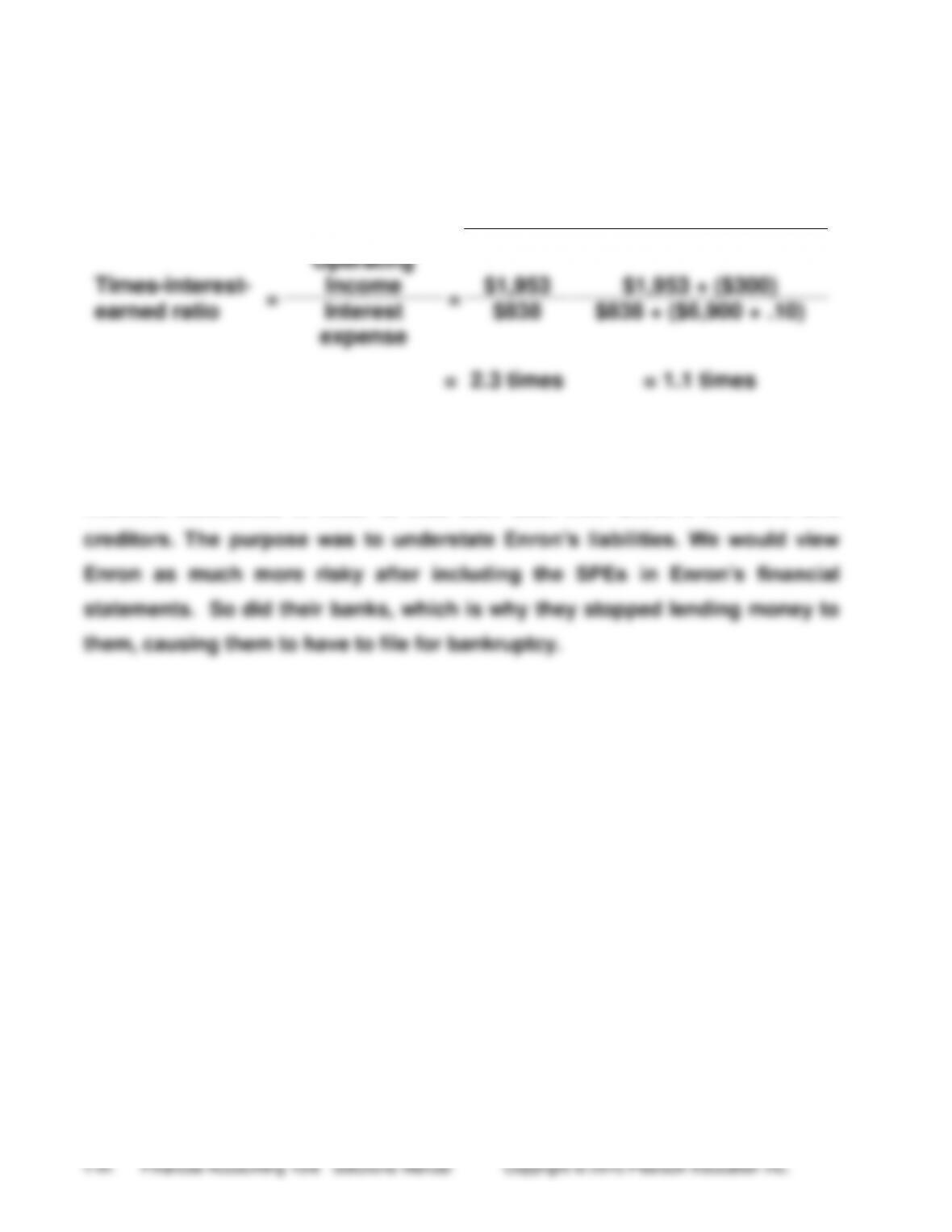
Debt ratio
=
Total liabilities
=
$54,033 + $6,900
Total assets
$65,503 + $500* – $600
= 0.93
*The SPEs originally reported assets of $7,000 million when those assets were
only worth $500 but actually had liabilities of $6,900.
Return on
assets
=
Net income
$979 – $300*
Total assets
$65,503 + $500 – $600
= 1.0%
*The SPEs’ income was nearly wiped out due to the restatement meaning that the
SPE did not earn a net income but had a loss, of which $300 applies to 2000; they
did have assets with a market value of $500.
LLeverage
L ratio
=
Total assets
$65,503 + $500 – $600
Total stock.
equity
($65,503 + $500 – $600) – ($54,033
+ $6,900)
= 14.63
(continued) Decision Case 1
As
After Including the
Reported
Special-Purpose Entities
Operating
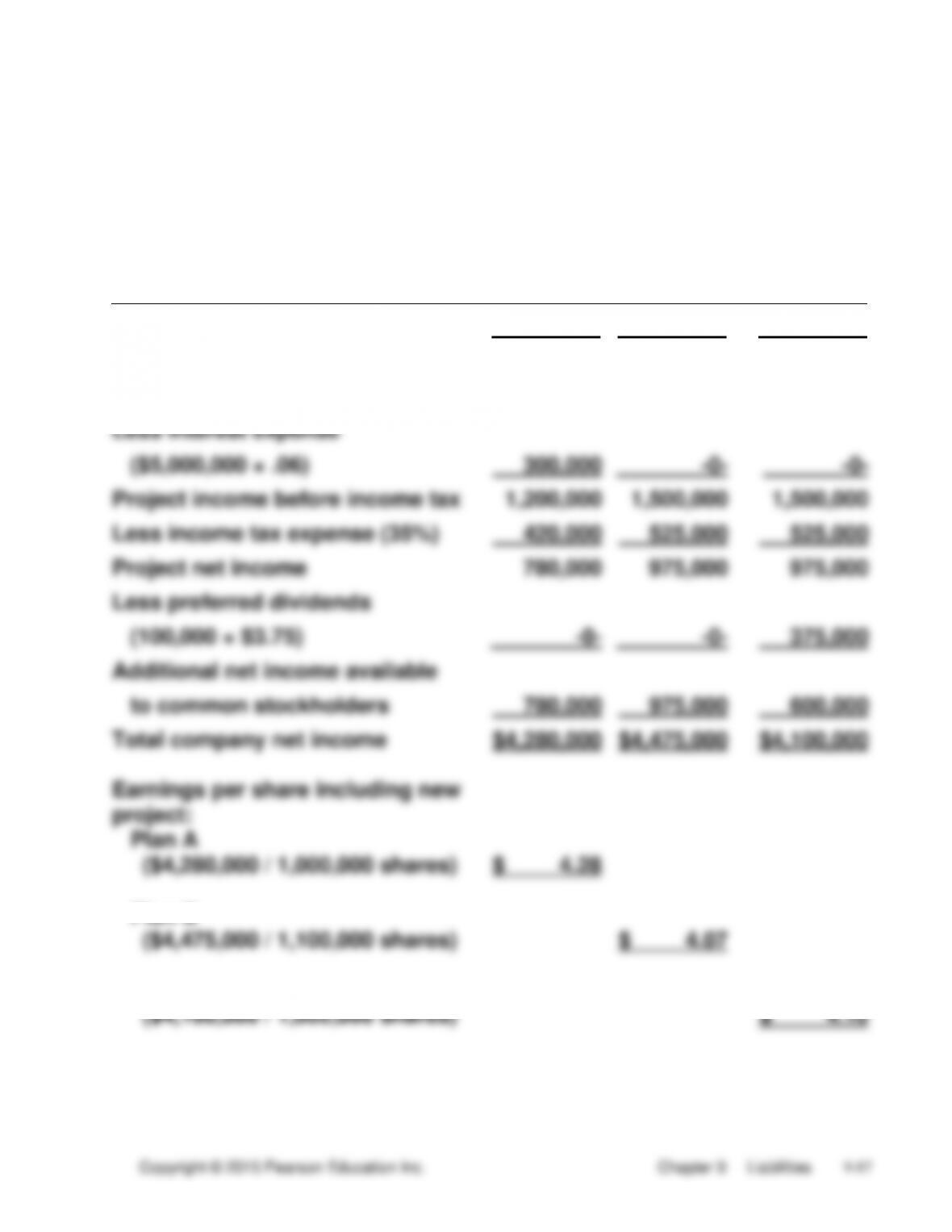
Times-interest-
=
Income
=
$1,953
$1,953 + ($300)
earned ratio
Interest
$838
$838 + ($6,900 × .10)
expense
=
2.3 times
= 1.1 times
Req. 4
It appears that Enron excluded the special-purpose-entities (SPEs) from its
financial statements in order to hide their debt from Enron’s investors and
(30-40 min.) Decision Case 2
Req. 1 (Analysis of financing plans)
PLAN A
PLAN B
PLAN C
BORROW
AT 6%
ISSUE
COMMON
STOCK
ISSUE $3.75
NONVOTING
PREFERRED
STOCK
Net income before expansion
$3,500,000
$3,500,000
$3,500,000
Project income before interest
and income tax
$1,500,000
$1,500,000
$1,500,000
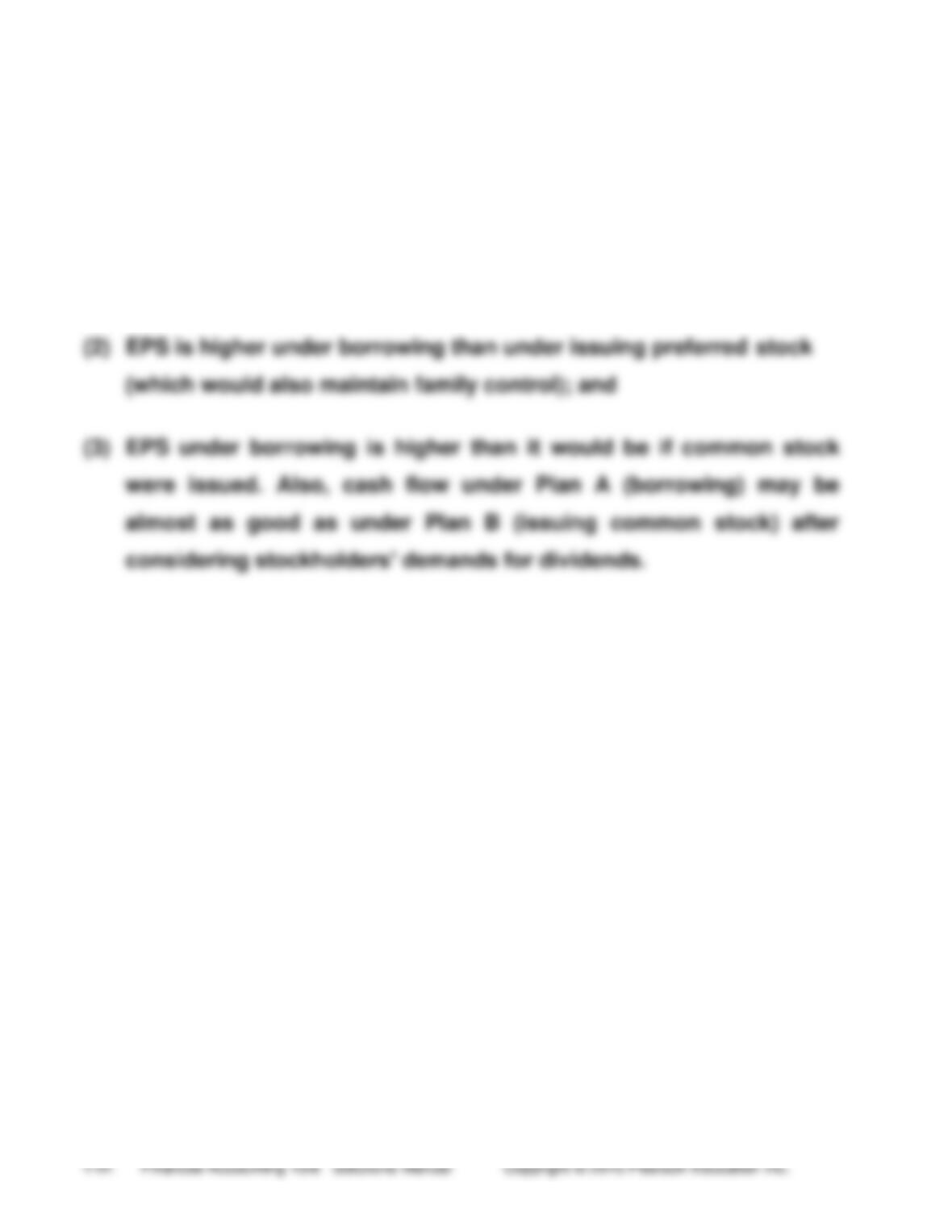
Less interest expense
($5,000,000 × .06)
300,000
-0-
-0-
Project income before income tax
1,200,000
1,500,000
1,500,000
Less income tax expense (35%)
420,000
525,000
525,000
Project net income
780,000
975,000
975,000
Less preferred dividends
(100,000 × $3.75)
-0-
-0-
375,000
Additional net income available
to common stockholders
780,000
975,000
600,000
Total company net income
$4,280,000
$4,475,000
$4,100,000
Earnings per share including new
project:
Plan A
($4,280,000 / 1,000,000 shares)
$ 4.28
Plan B
($4,475,000 / 1,100,000 shares)
$ 4.07
Plan C
($4,100,000 / 1,000,000 shares)
$ 4.10
(continued) Decision Case 2
Req. 2 (Recommendation)
The best choice appears to be Plan A — borrowing at 6% — because:
(1) Borrowing allows the family to maintain control of the
business;
Ethical Issue 1
Req. 1
Req. 2 and 3
The potential parties and economic consequences of the decision not to
disclose contingent liabilities are:
1. The bank and its shareholders: With misleading information, they
might extend additional funds to the borrower assuming a better ability
to pay back the funds than actually exists. A contingent liability creates
(continued) Ethical Issue 1
Req. 3 Legal and ethical consequences
Banks have legal requirements in loan agreements that require debtors
FASB and IASB about a new standard for reporting contingencies. It is
likely that, in the future, more losses resulting from lawsuits and other
contingencies are likely to be disclosed in the body and the footnotes of
financial statements.
Ethical Issue 2
1. The ethical issue is whether to structure this lease to avoid its having
4 years, it will be only 66 2/3 percent of the economic life of the asset (6
years). Thus, the lease will fail all of the mechanical tests for the lease
2. The stakeholders are Gocker, the lessee; Morgan, the lessor; and
Last National Bank, Gocker’s present creditor. The potential
consequences to the stakeholders are:
a. economic: If the lease is structured as a capital lease, Gocker
(continued) Ethical Issue 2
b. legal: If we assume that GAAP substitutes for legal requirements, if
3. Student responses will vary on this question. Some will say that, if
the rules allow it, then why not engineer the transaction in such as way
as to benefit Gocker by keeping the asset, and the lease obligation, off
the books. After all, this is perfectly legal, and perfectly in accordance