
(continued) Decision Case 1
Req. 1
*Cost of goods sold:
Units
Cost
La Petite (FIFO):
10,000
×
$4
=
$ 40,000
5,000
×
5
=
25,000
7,000
×
6
=
42,000
3,000
×
7
=
21,000
25,000
$128,000
Burgers (LIFO):
10,000
×
$7
=
$ 70,000
7,000
×
6
=
42,000
5,000
×
5
=
25,000
3,000
×
4
=
12,000
25,000
$149,000
(continued) Decision Case 1
Req. 2
INVESTMENT NEWSLETTER
TO: Our Clients
FROM: Student Name
RE: Selecting the stock of La Petite France Bakery or Burgers
Ahoy! as a long-term investment
In picking a stock we suggest you consider the following factors:
La Petite France and Burgers Ahoy! are basically identical companies.
The two companies started operations at the same time and engaged in
essentially the same transactions. Their main difference lies in the
accounting methods that they use.
1. La Petite France’s income statement reports a net income of $95,400
compared to $72,600 for Burgers Ahoy!. On the surface La Petite
2. Burgers Ahoy! reports a lower net income than La Petite France, but
(continued) Decision Case 1
importantly, LIFO and DDB result in the lowest amount of income tax
and thereby save money that Burgers can invest in new projects.
(20-30 min.) Decision Case 2
1. A dishonest manager might debit the cost of an expense to a plant
2. A dishonest manager might debit an expense account for the cost of a
3. We support the recording and reporting of intangible assets at cost,
less accumulated amortization, in accordance with GAAP because the
business paid a price for intangibles like any other asset. The
argument for recording intangibles at $1 or $0 is consistent with the
Ethical Issue
Req. 1
The ethical issue in this case is “What is the proper amount of the
purchase price to allocate to the land and the proper amount to allocate to
value of your assets. This could lead to criminal charges or further
criminal behavior.
Req. 4
United Jersey Bank should change the allocation of their purchase price to
60% building and 40% land. In the long run, for fair and equitable treatment
Focus on Financials: Amazon.com, Inc.
(30-40 min.)
Req. 1
Property and Equipment includes land and buildings, furniture and
Req. 2
Note 1 states that the depreciation method used for the financial
statements is the straight-line method. Note 1 does not state the method
Req. 3
Millions
Depreciation (and amortization) expense
$ 1,700
Accumulated depreciation and amortization
$ 2,522
(continued) Amazon.com
amortization amounts for all years the company has used its property
and equipment.
Req. 4
During 2012, Amazon.com, Inc. paid $3,785 million to purchase fixed
assets, including internal-use software and website development. These
Req. 5
Amazon.com, Inc. reports goodwill of $2,552 million on its 2012 balance
sheet, and acquired intangible assets, included within “Other Assets” on
Focus on Analysis: YUM! Brands, Inc.
(20-30 min.)
Req. 1
YUM! Brands, Inc. paid $1,099 million for capital expenditures during
fiscal 2012. This information is found in the investing activities section
of the cash flows statement.
Req. 2
Req. 3
Depreciation and amortization are calculated using the straight-line
Req. 4
(continued) YUM! Brands, Inc.
Req. 5
YUM! Brands records goodwill when if acquires a restaurant or another
business. Goodwill comes from each of the six divisions of the
Req. 6
2012
2011
Net income
$1,597
$1,319
÷ Average total assets
÷
($9,011 + $8,834) / 2
÷
($8,834 + $8,316) / 2
= Return on assets
=
17.90%
=
= 15.38%
Financial Accounting 10/e Solutions Manual Copyright © 2015 Pearson Education Inc.
82
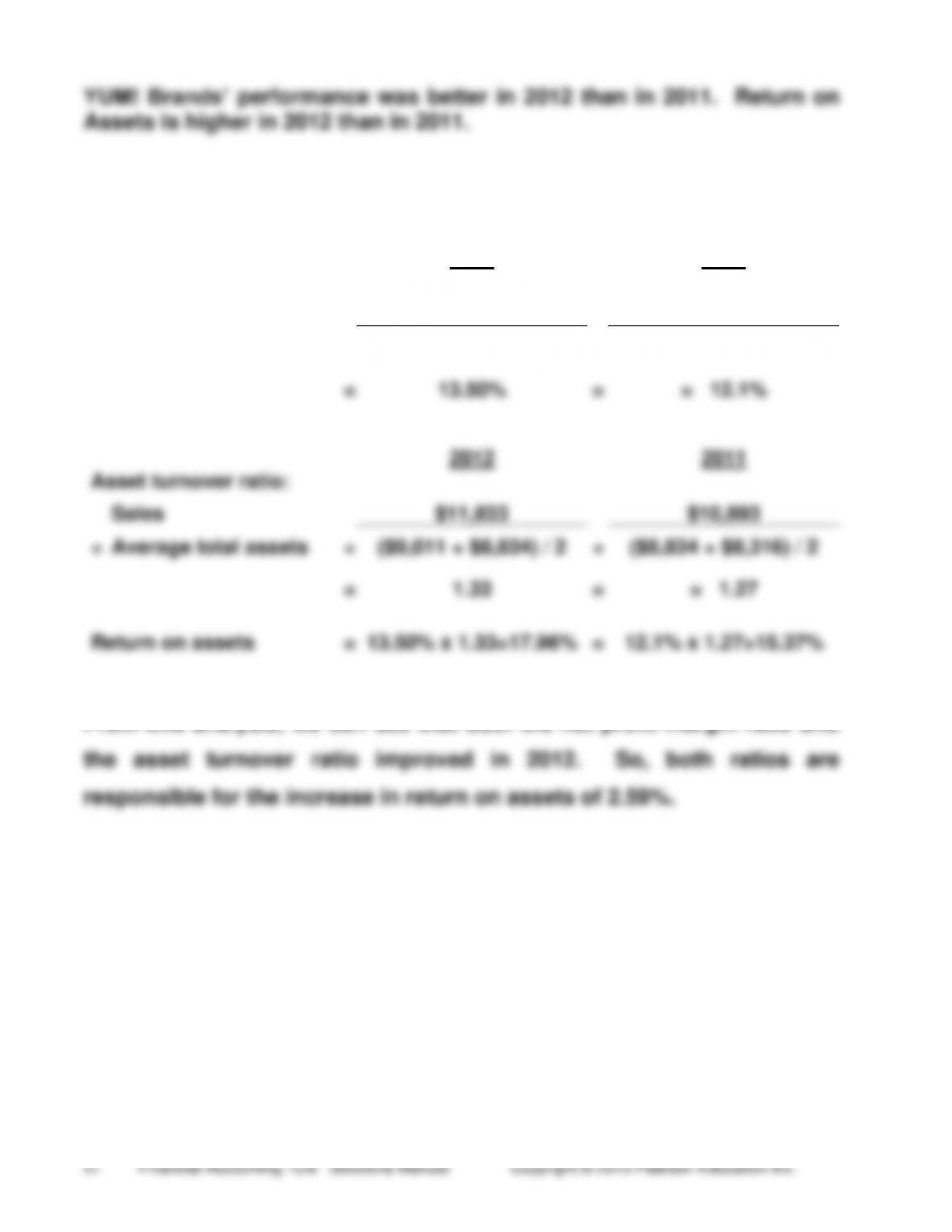
YUM! Brands’ performance was better in 2012 than in 2011. Return on
Assets is higher in 2012 than in 2011.
The Dupont formula:
Net profit margin ratio:
2012
2011
Net income
$1,597
$1,319
÷ Sales
÷
$11,833
÷
$10,893
=
13.50%
=
= 12.1%
Asset turnover ratio:
2012
2011
Sales
$11,833
$10,893
÷ Average total assets
÷
($9,011 + $8,834) / 2
÷
($8,834 + $8,316) / 2
=
1.33
=
= 1.27
Return on assets
=
13.50% x 1.33=17.96%
=
12.1% x 1.27=15.37%
From this analysis, we can see that both the net profit margin ratio and

Group Projects