(20-30 min) P 6-75
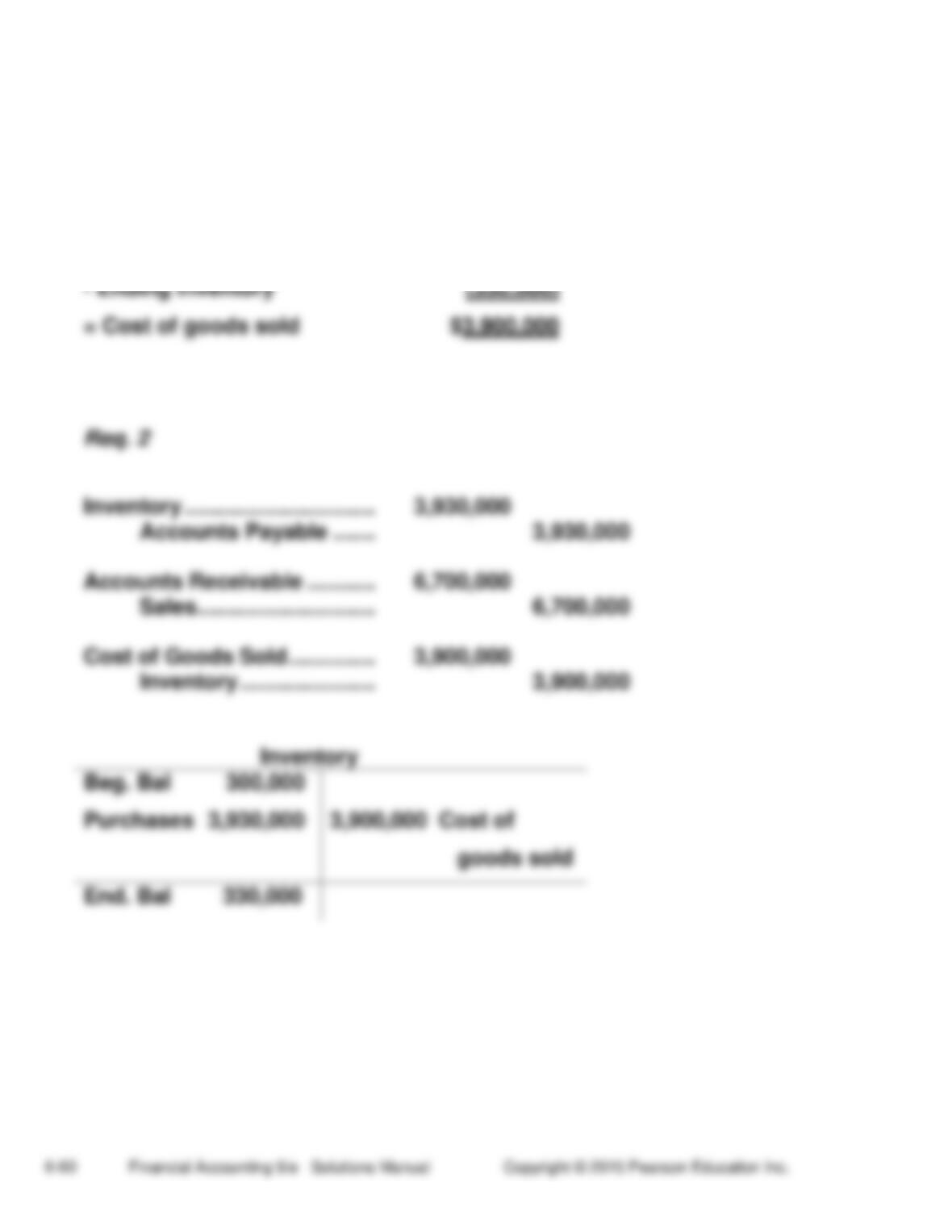
Req. 1
Beginning inventory $ 300,000
+ Purchases ? $3,930,000
(continued) P 6-75
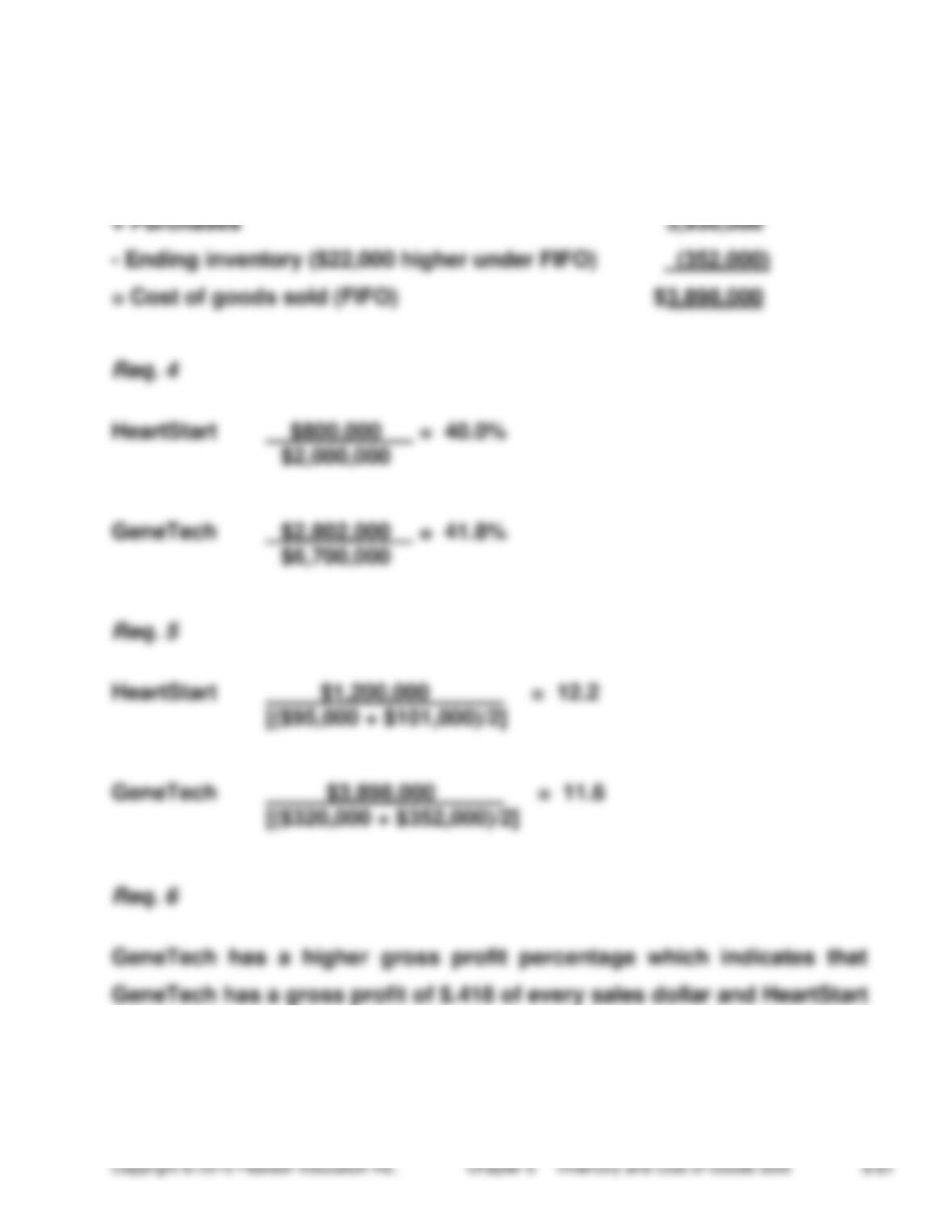
Req. 3
Beginning inventory ($20,000 higher under FIFO) $ 320,000
has a gross profit of $.40 of every sales dollar. GeneTech has a lower
inventory turnover than HeartStart, although both appear strong.
Decision Cases
(50-60 min.) Decision Case 1
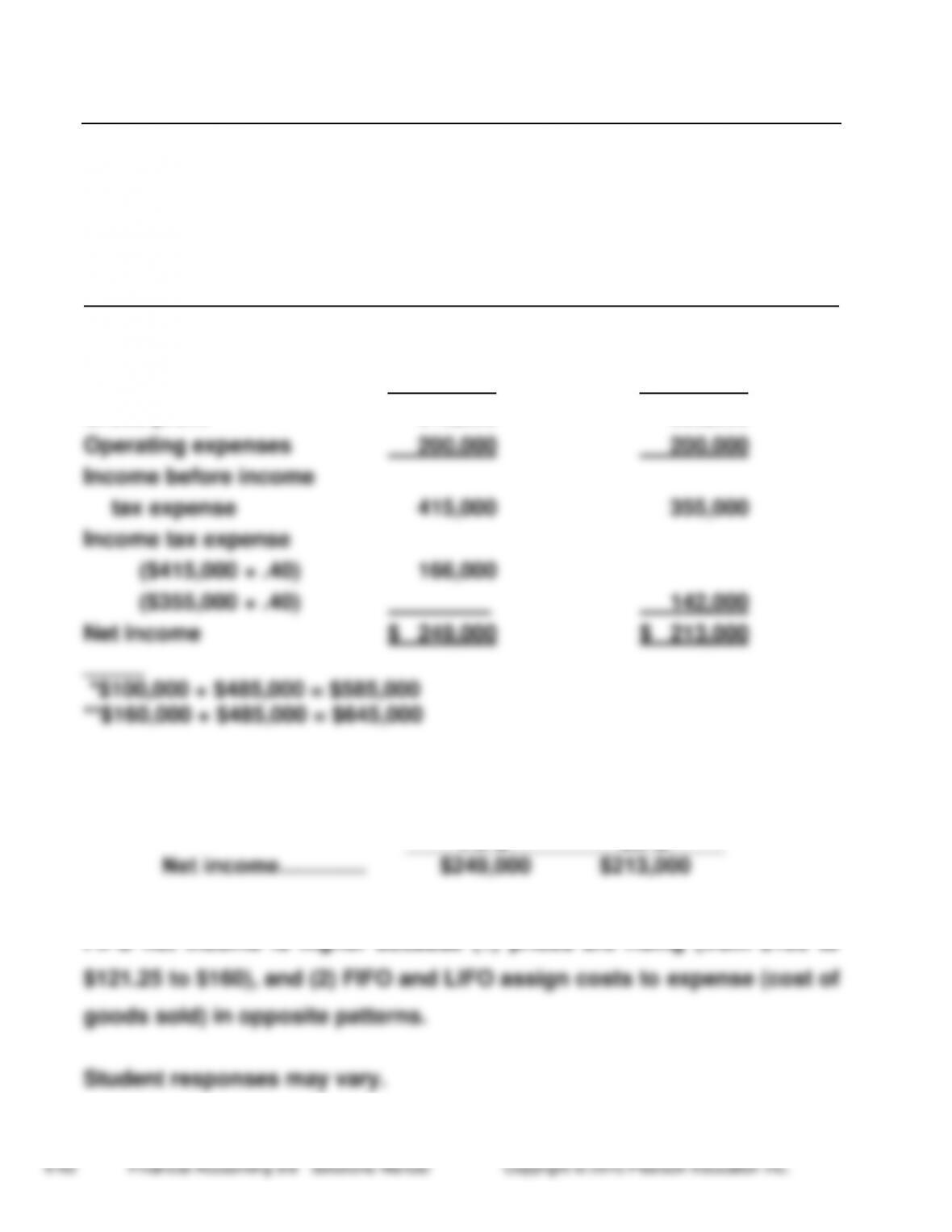
Req 1
Duracraft Corporation
Income Statement
FIFO
LIFO
Sales revenue
$1,200,000
$1,200,000
Cost of goods sold:
585,000*
645,000**
Gross profit
615,000
555,000
Operating expenses
200,000
200,000
Income before income
tax expense
415,000
355,000
Income tax expense
($415,000 × .40)
166,000
($355,000 × .40)
142,000
Net income
$ 249,000
$ 213,000
_____
*$100,000 + $485,000 = $585,000
**$160,000 + $485,000 = $645,000
Req. 2
FIFO
LIFO
Net income…………
$249,000
$213,000
FIFO net income is higher because (1) prices are rising (from $100 to
(15-25 min.) Decision Case 2
Req. 1
This question provides a rich setting for a class discussion. There’s no
single correct answer to this question. Some students may favor Company
B because it reports higher net income than Company A. B may be
Req. 2
Yes, the authors would prefer managers to be faithful in representing the
disclosures for inventory — for all the reasons accountants are transparent
Ethical Issue
Req. 1
Changing accounting methods year after year hurts a company’s
Req. 2
The consistency principle is violated.
Req. 3
Creditors and outside investors could be harmed by accounting
changes year after year. It becomes difficult to tell which changes in the
Focus on Financials: Amazon.com, Inc.
(30 min.)
Req. 1
Millions
December 31,
December 31,
2012
2011
Inventory (from the balance sheet)
$6,031
$4,992
In addition to these inventories that Amazon.com, Inc. owns,
Amazon.com, Inc. handles a significant amount of sellers’ inventory on
consignment. Note 1 of the Consolidated Financial Statements
Req. 2
Note 1 of the Consolidated Financial Statements (Description of
(continued) Focus on Financials: Amazon.com, Inc.
Req. 3
Millions
Rearranging,
Beginning Inventory
Cost of sales
(2012 income statement)
$45,971
+
Purchases
+
Ending inventory
(at Dec. 31, 2012)
6,031
=
Cost of goods available
=
Cost of goods available
52,002
−
Ending Inventory
−
Beginning inventory
(at Dec. 31, 2011)
(4,992)
=
Cost of sales
=
Purchases
$47,010
Req. 4
The gross profit percentage decreased slightly during 2012:
2012
2011
Net product sales
$51,733
100.0%
$42,000
100.0%
Cost of sales
45,971
88.9%
37,288
88.8%
Gross profit
$ 5,762
11.1%
$ 4,712
11.2%
(continued) Focus on Financials: Amazon.com, Inc.
Req. 5
Amazon.com, Inc.’s rate of inventory turnover for 2012 is 8.34 times.
Cost of sales
=
$45,971
=
8.34
times
Average inventory
($4,992 +
$6,031) / 2
2011 Inventory turnover is 9.1 times.
Cost of sales
=
$37,288
=
9.10
times
Average inventory
($4,992 +
$3,202) / 2
Req. 6
Answers to this question will vary, depending on when the exercise is
Focus on Analysis: YUM! Brands, Inc.
(30-40 min.)
Req. 1
a.
Inventory on hand at fiscal 2012 year end, $313 million.
b.
Cost of sales, $3,874 million.
Millions
c.
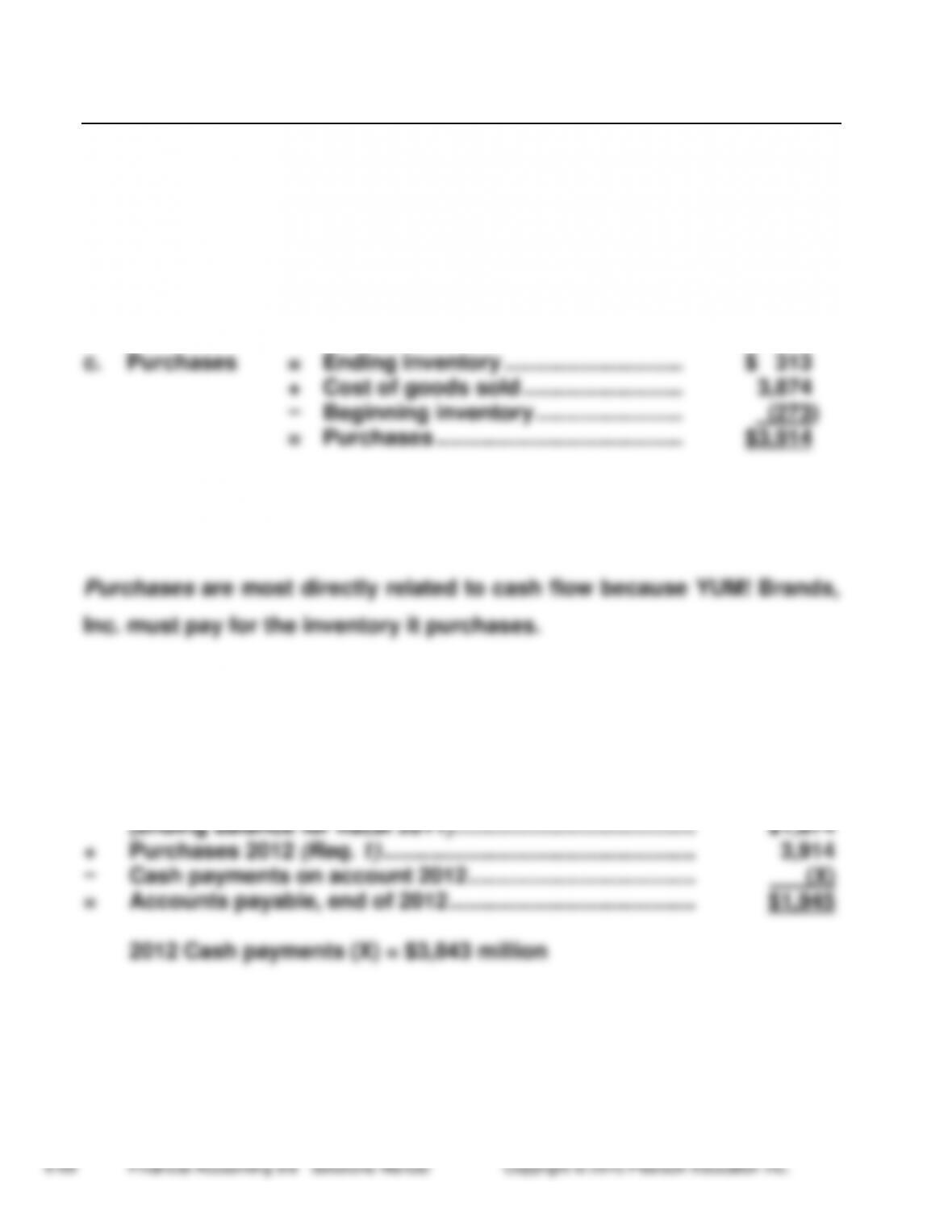
Purchases
=
Ending inventory ………………………..
$ 313
+
Cost of goods sold ……………………..
3,874
−
Beginning inventory ……………………
(273)
=
Purchases ………………………………….
$3,914
Req. 2
Req. 3
Millions
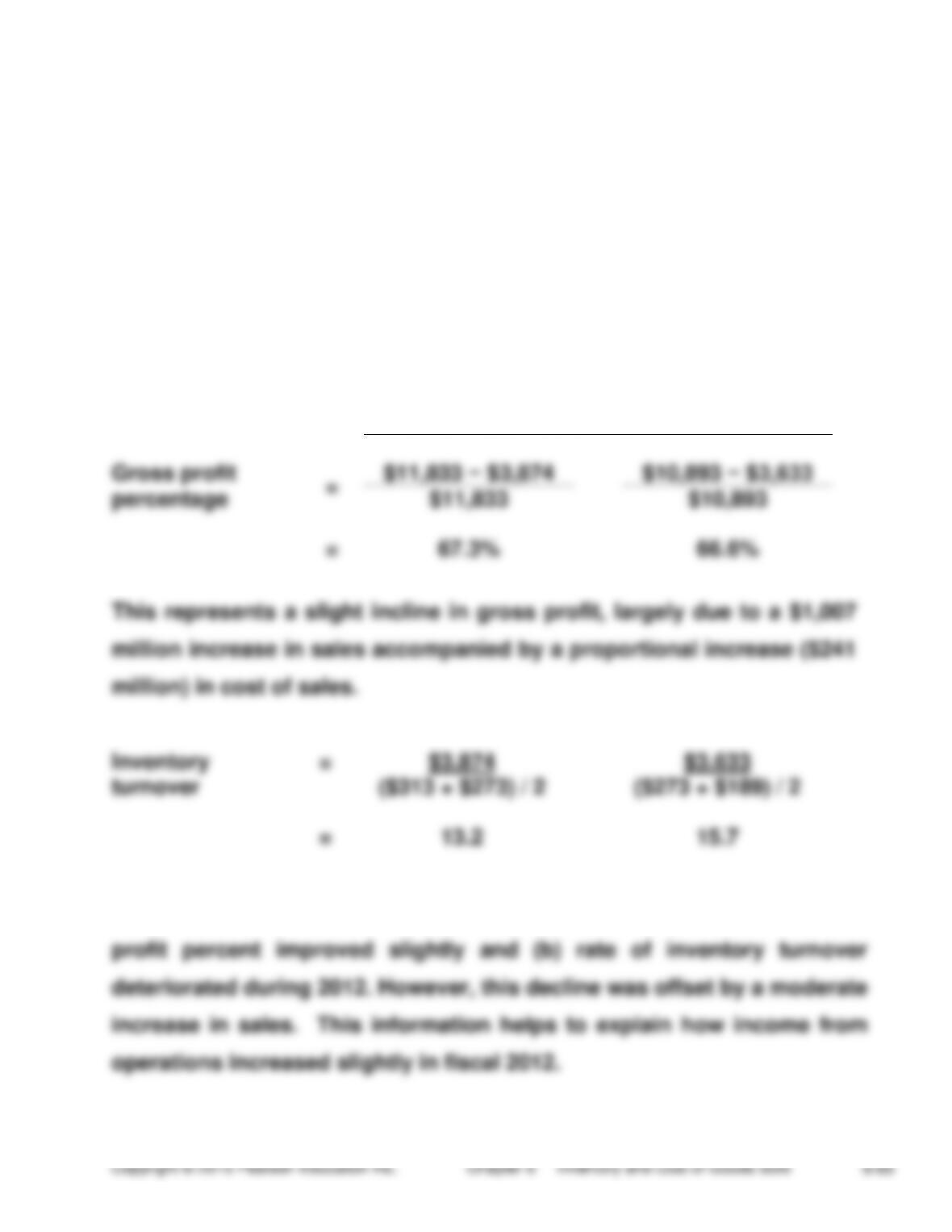
Accounts payable, beginning of 2012
(ending balance for fiscal 2011) …………………………………
$1,874
+
Purchases 2012 (Req. 1) ……………………………………………
3,914
−
Cash payments on account 2012 ……………………………….
(X)
=
Accounts payable, end of 2012 ………………………………….
$1,945
2012 Cash payments (X) = $3,843 million
(continued) Focus on Analysis: YUM! Brands, Inc.
Req. 4
Note 2 of the Consolidated Financial Statements (Summary of
Significant Accounting Policies), under Inventories, states: “We value or
inventories at the lower of cost…or market”. The company uses the
First-in, First-out (FIFO) method.
Req. 5
(Dollars in millions)
2012
2011
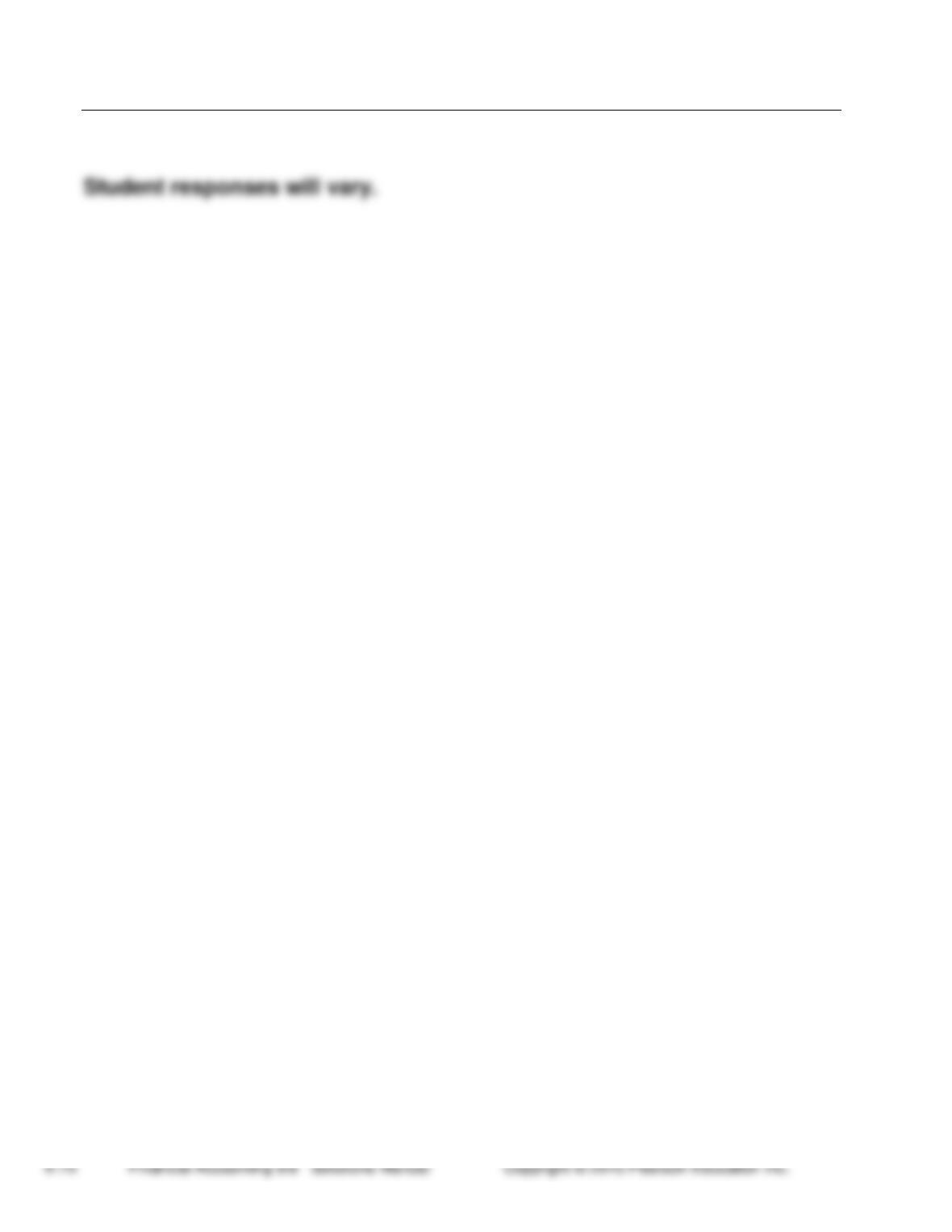
Gross profit
=
$11,833 − $3,874
$10,893 − $3,633
percentage
$11,833
$10,893
=
67.3%
66.6%
Inventory
turnover
=
$3,874
($313 + $273) / 2
$3,633
($273 + $189) / 2
=
13.2
15.7
Inventory turnover declined slightly. Overall, YUM! Brands’ (a) gross
Group Project
Chapter 6 Appendix
Appendix Short Exercises
(10-15 min.) S6A-1
(Journal entries)
General Journal
1.
Purchases
1,190
Accounts Payable
1,190
Purchased inventory on account.
2.
Accounts Receivable
2,900
Sales Revenue
2,900
Sold inventory on account.
3.
End-of–period entries to update inventory
and record Cost of Goods sold:
a.
Cost of Goods Sold
580
Inventory (beginning balance)
580
Transfer beginning inventory to COGS.
b.
Inventory (ending balance)
650
Cost of Goods Sold
650
Set up ending inventory based on physical
count.
c.
Cost of Goods Sold
1,190
Purchases
1,190
Transfer purchases to COGS.
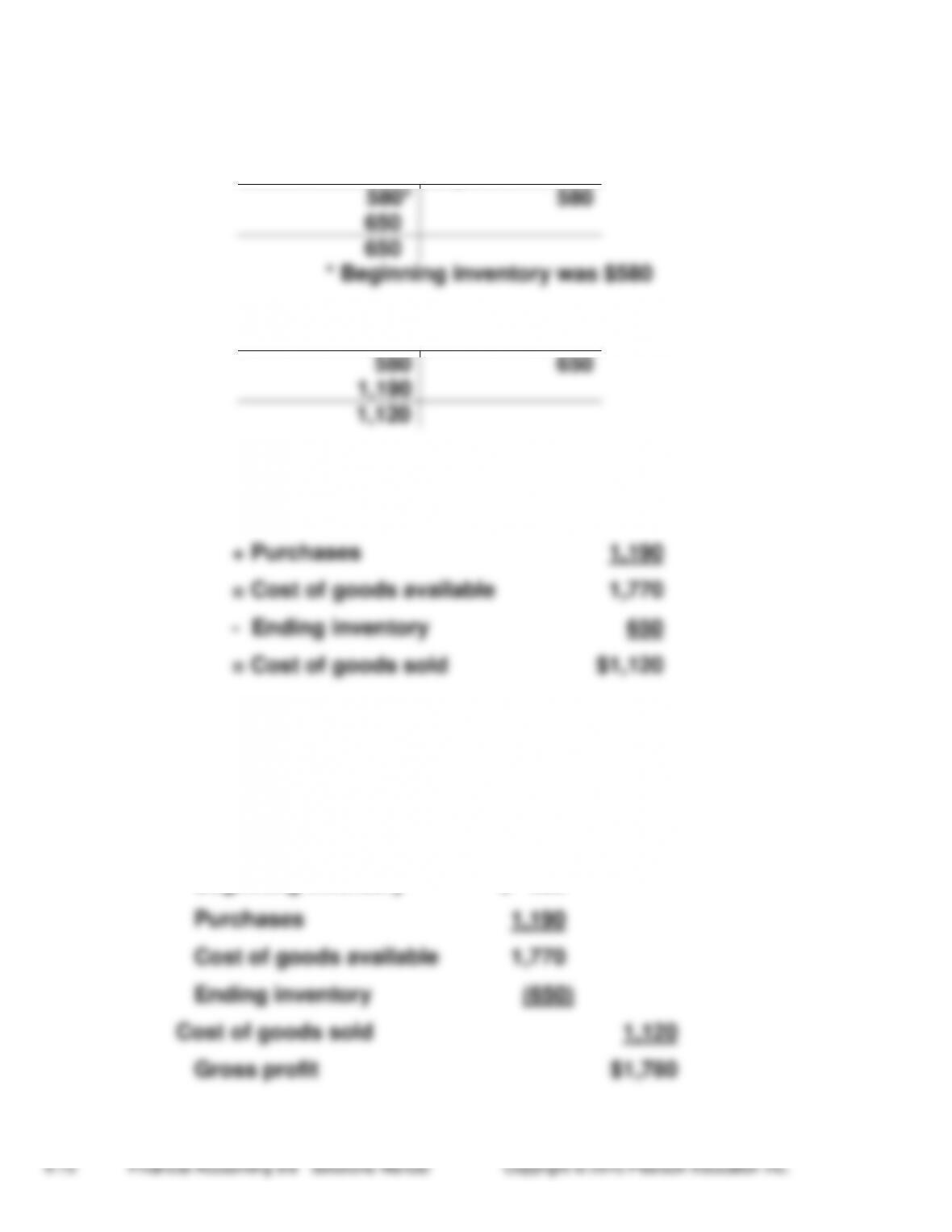
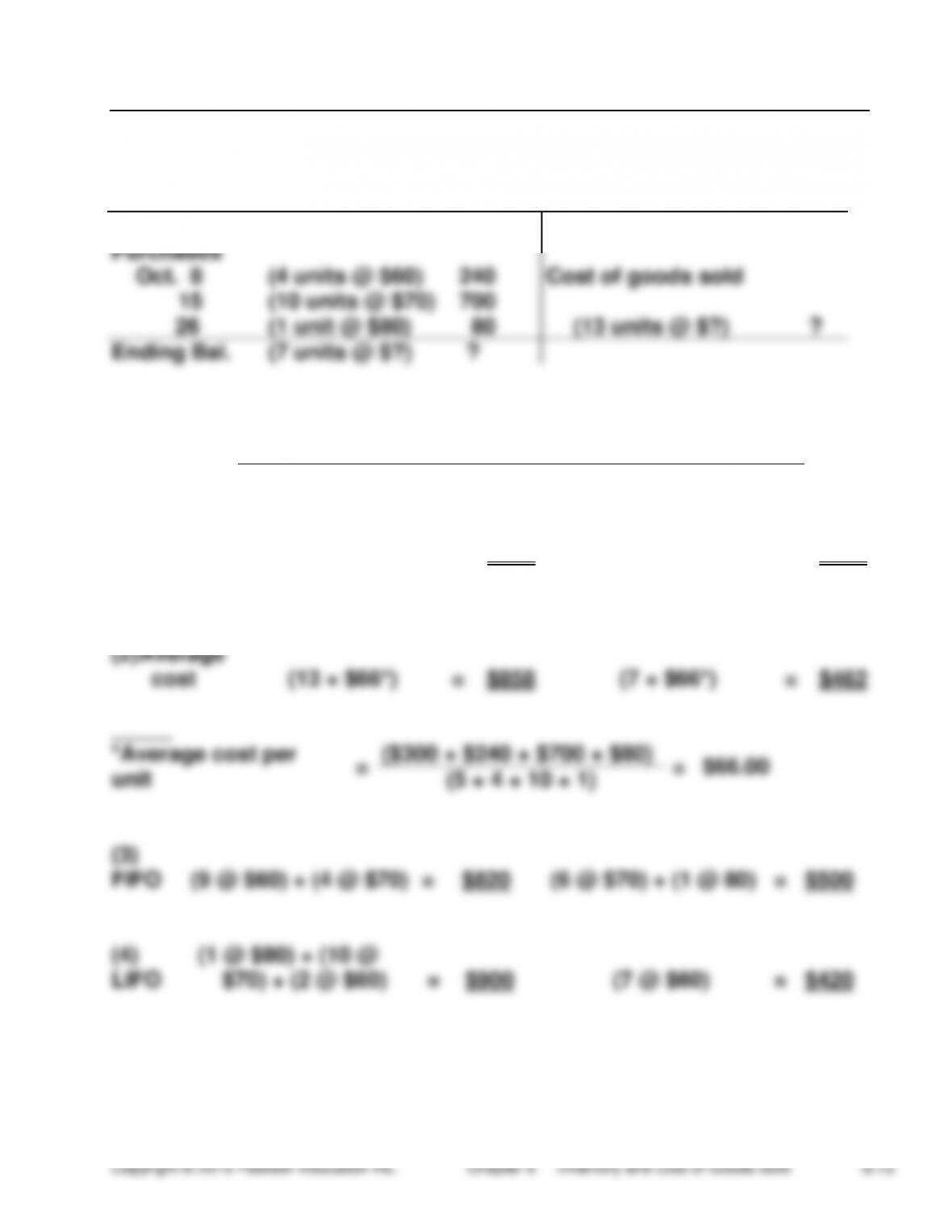
(10-15 min.) S6A-2
Req. 1 Posting general journal entries
Inventory
580*
580
650
650
* Beginning inventory was $580
Cost of Goods Sold
580
650
1,190
1,120
Req. 2
Cost-of-Goods-Sold Model
Beginning inventory
$ 580
+ Purchases
1,190
= Cost of goods available
1,770
– Ending inventory
650
= Cost of goods sold
$1,120
Req. 3
Flexon Technologies
Income Statement (Partial)
Sales revenue
$2,900
Cost of goods sold:
Beginning inventory
$ 580
Purchases
1,190
Cost of goods available
1,770
Ending inventory
(650)
Cost of goods sold
1,120
Gross profit
$1,780
Appendix Exercises
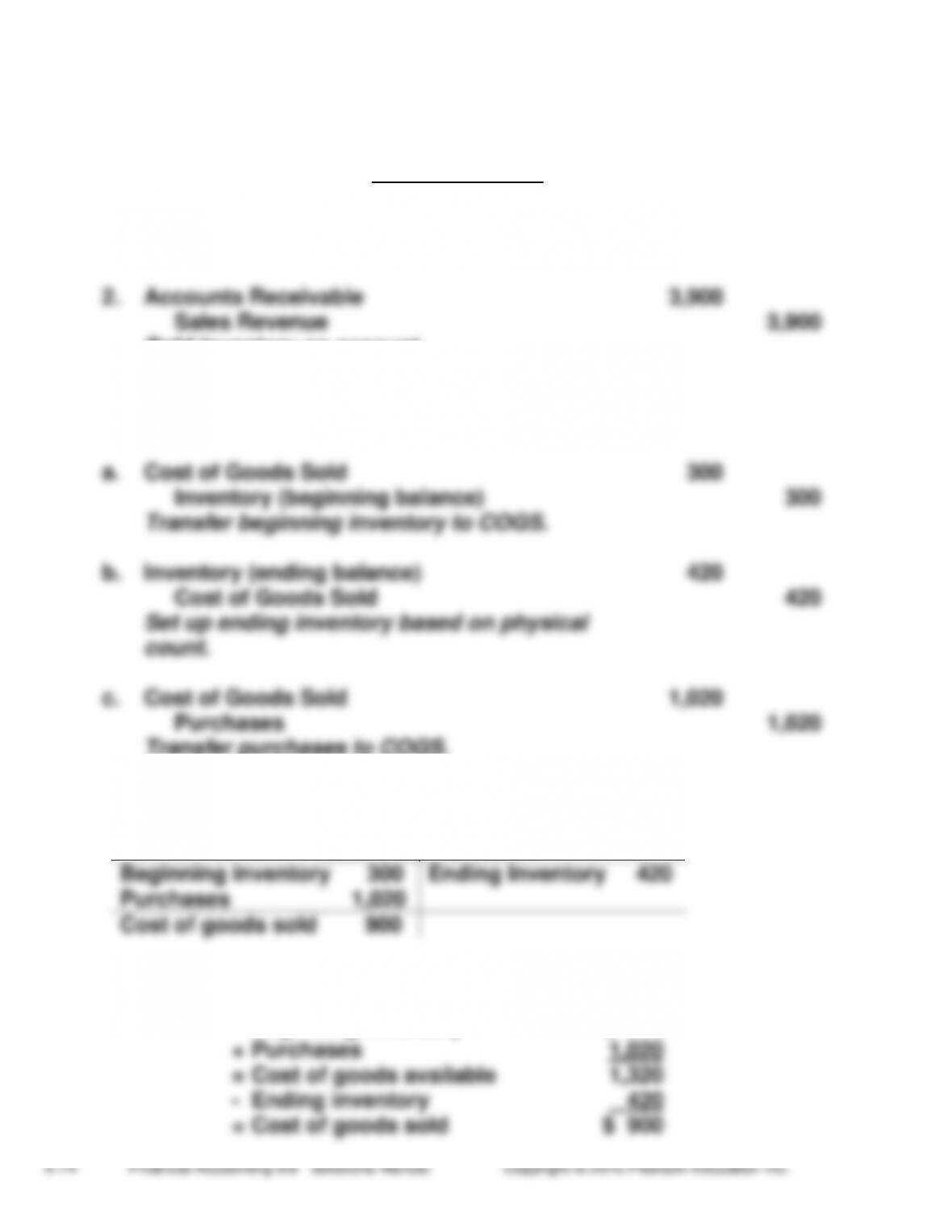
(10-15 min.) E6A-3A
Inventory
Begin. Bal.
(5 units @ $60) 300
Purchases
Oct. 8
(4 units @ $60) 240
Cost of goods sold
15
(10 units @ $70) 700
26
(1 unit @ $80) 80
(13 units @ $?)
?
Ending Bal.
(7 units @ $?) ?
Cost of
Goods Sold
Ending Inventory
(1) Specific
unit
cost
(6 @ $60) + (6 @
$70) + (1 @ $80)
=
$860
(3 @ $60) + (4 @
$70)
=
$460
(2) Average
cost
(13 × $66*)
=
$858
(7 × $66*)
=
$462
($300 + $240 + $700 + $80)
(3)
(4)
(1 @ $80) + (10 @
(10-15 min.) E6A-4A
Reqs. 1, 2, & 3 (Journal entries)
General Journal
1.
Purchases
1,020
Accounts Payable
1,020
Purchased inventory on account.
2.
Accounts Receivable
3,900
Sales Revenue
3,900
Sold inventory on account.
3.
End-of–period entries to update inventory
and record Cost of Goods Sold:
a.
Cost of Goods Sold
300
Inventory (beginning balance)
300
Transfer beginning inventory to COGS.
b.
Inventory (ending balance)
420
Cost of Goods Sold
420
Set up ending inventory based on physical
count.
c.
Cost of Goods Sold
1,020
Purchases
1,020
Transfer purchases to COGS.
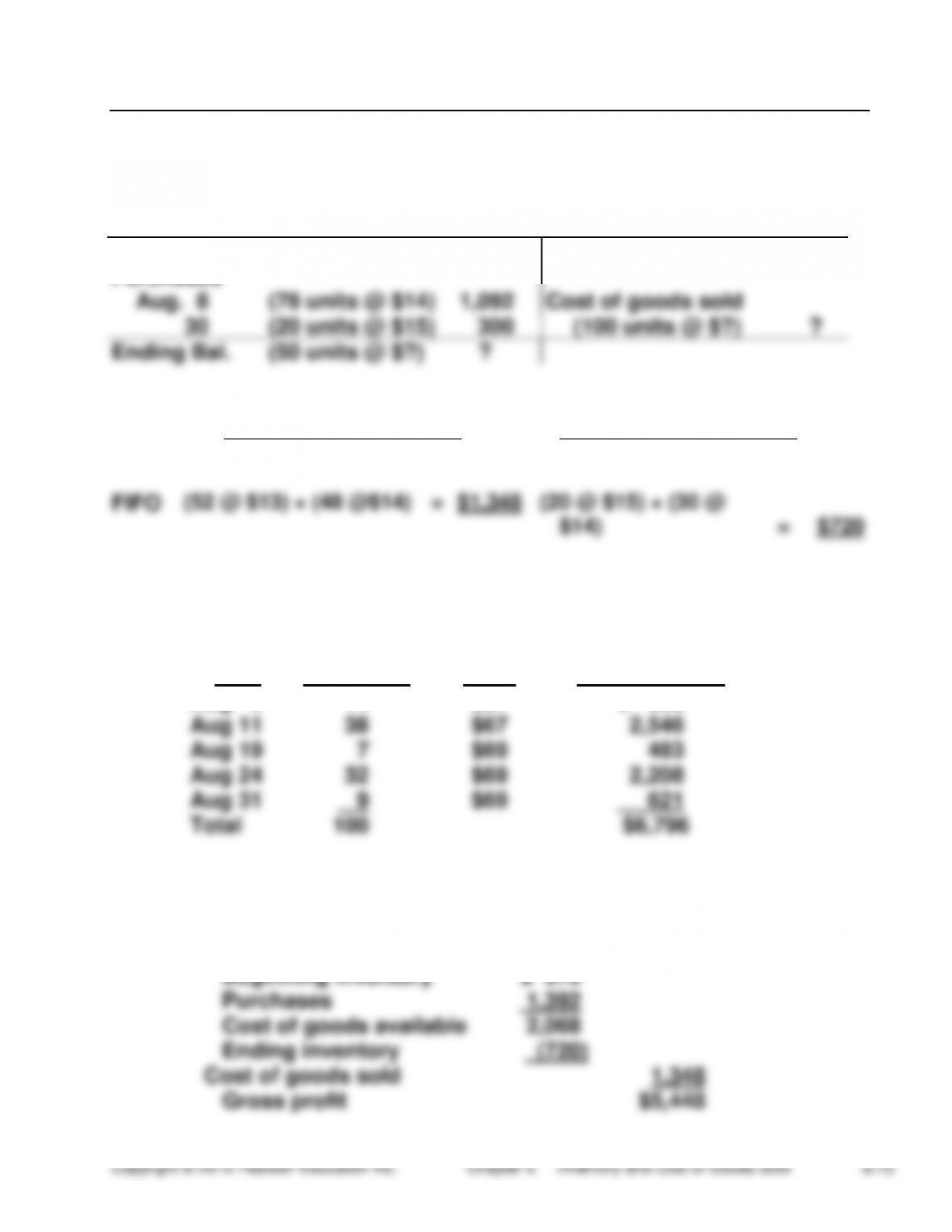
Posting general journal entries
Cost of Goods Sold
Beginning inventory 300
Ending Inventory 420
Purchases 1,020
Cost of goods sold 900
Req. 4 Cost-of-Goods-Sold Model
Beginning inventory
$ 300
+ Purchases
1,020
= Cost of goods available
1,320
– Ending inventory
420
= Cost of goods sold
$ 900
Appendix Problems
(20-25 min.) P6A-5A
Req. 1
Inventory
Begin. Bal.
(52 units @ $13) 676
Purchases
Aug. 8
(78 units @ $14) 1,092
Cost of goods sold
30
(20 units @ $15) 300
(100 units @ $?)
?
Ending Bal.
(50 units @ $?) ?
Cost of Goods Sold
Ending Inventory
FIFO
(52 @ $13) + (48 @$14)
=
$1,348
(20 @ $15) + (30 @
$14)
=
$720
Req. 2
Date
Units Sold
Selling
Price
Total Revenue
Aug 3
14
$67
$ 938
Aug 11
38
$67
2,546
Aug 19
7
$69
483
Aug 24
32
$69
2,208
Aug 31
9
$69
621
Total
100
$6,796
Waverly Outlet
Income Statement (Partial)
Sales revenue
$6,796
Cost of goods sold:
Beginning inventory
$ 676
Purchases
1,392
Cost of goods available
2,068
Ending inventory
(720)
Cost of goods sold
1,348
Gross profit
$5,448
(20-30 min.) P6A–6A
Req. 1 (Journal entries)
General Journal
(thousands)
1.
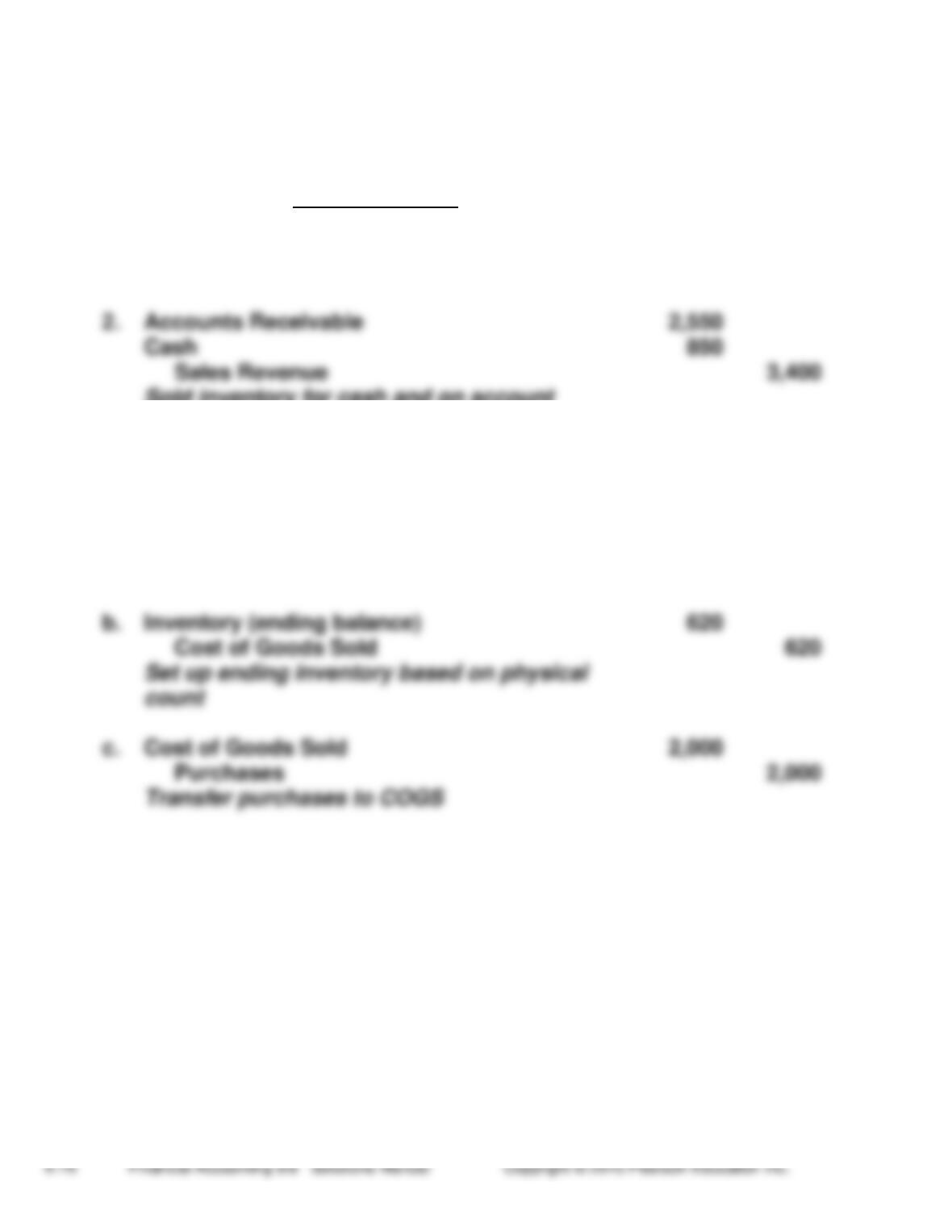
Purchases
2,000
Accounts Payable
2,000
Purchased inventory on account
2.
Accounts Receivable
2,550
Cash
850
Sales Revenue
3,400
Sold inventory for cash and on account
3.
End-of–period entries to update inventory
and record Cost of Goods Sold:
a.
Cost of Goods Sold
490
Inventory (beginning balance)
490
Transfer beginning inventory to COGS
b.
Inventory (ending balance)
620
Cost of Goods Sold
620
Set up ending inventory based on physical
count
c.
Cost of Goods Sold
2,000
Purchases
2,000
Transfer purchases to COGS
(continued) P6A-6A
Req. 2
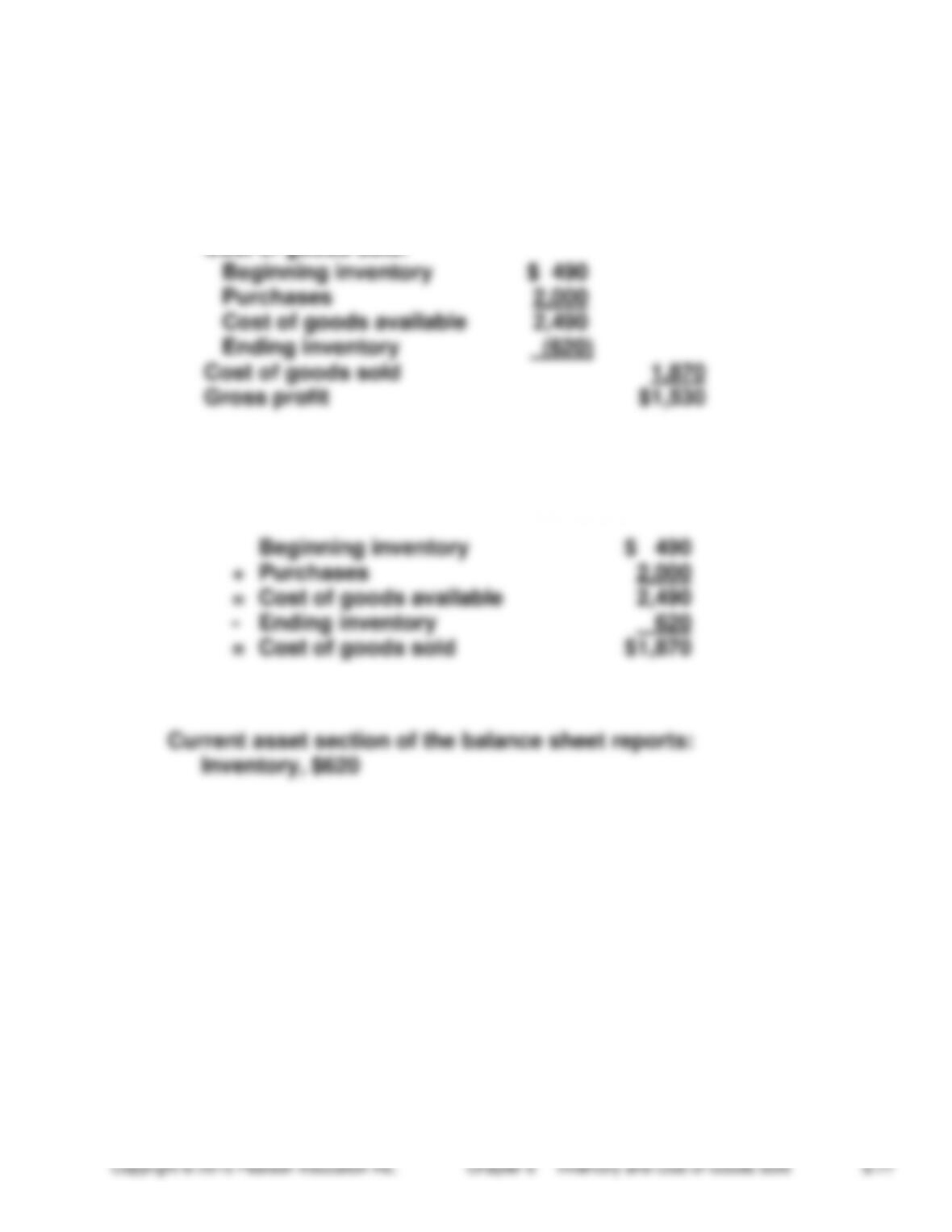
Total Desserts, Inc.
Income Statement (Partial)
Sales revenue
$3,400
Cost of goods sold:
Beginning inventory
$ 490
Purchases
2,000
Cost of goods available
2,490
Ending inventory
(620)
Cost of goods sold
1,870
Gross profit
$1,530
Cost-of-Goods-Sold Model
Beginning inventory
$ 490
+ Purchases
2,000
= Cost of goods available
2,490
– Ending inventory
620
= Cost of goods sold
$1,870