(20-25 min.) P 6-61A
Req. 1
Cost of sales, budgeted ($721,000 × 1.05) ………….
$ 757,050
+ Ending inventory, budgeted ……………………………..
86,000
= Cost of goods available ……………………………………
843,050
− Beginning inventory ………………………………………..
(64,000)
= Purchases, budgeted ……………………………………….
$ 779,050
Req. 2
Shorty’s Convenience Stores
Budgeted Income Statement
Year Ended December 31, 2014
Sales ($986,000 × 1.05) ……………………………………….
$1,035,300
Cost of sales ($721,000 × 1.05) …………………………...
757,050
Gross profit ……………………………………………………….
278,250
Operating expenses ($109,000 − $8,750) ……………..
100,250
Net income ………………………………………………………..
$ 178,000
(15-20 min.) P 6-62A
Req. 1 (corrected income statements)
Downton Home Store
Income Statement (adapted; amounts in millions)
Years Ended December 31, 2014, 2013, and 2012
2014
2013
2012
Net sales revenue …………………….
$47
$44
$41
Cost of goods sold:
Beginning inventory …………….
$13
$14
$ 8
Net purchases ……………………..
31
29
27
Cost of goods available ……….
44
43
35
Ending inventory …………………
(11)
(13)
(14)
Cost of goods sold ………………
33
30
21
Gross profit ……………………………..
14
14
20
Operating expenses ………………….
8
8
8
Net income ………………………………
$ 6
$ 6
$12
(continued) P 6-62A
Req. 2
Req. 3
Inc.
(20-30 min.) P 6-63B
Req. 1
Inventory ………………………………………………….
8,008,000
Accounts Payable …………………………………
8,008,000
Accounts Payable ……………………………………..
7,860,000
Cash ……………………………………………………
7,860,000
Cash …………………………………………………………
5,400,000
Accounts Receivable …………………………………
10,282,500
Sales Revenue ……………………………………..
15,682,500
Cost of Goods Sold (153,000 × $58.62*) ………
8,968,860*
Inventory ……………………………………………..
8,968,860
Operating Expenses ………………………………….
4,500,000
Cash ($4,500,000 × 0.50) ……………………….
2,250,000
Accrued Liabilities ($4,500,000 × 0.50) ……
2,250,000
Income Tax Expense …………………………………
774,774
Income Tax Payable (see Req. 3) …………..
774,774
_____
*($1,196,000 + $8,008,000) ÷ (23,000 + 28,000 + 48,000 + 58,000) = $58.62
(continued) P 6-63B
Req. 2
Inventory
Beg. bal.
1,196,000
Purchases
8,008,000
COGS
8,968,860
End. bal.
235,140
Req. 3
Super Buy Store in San Diego
Income Statement
Year Ended June 30, 2014
Sales revenue ……………………………………….
$15,682,500
Cost of goods sold ……………………………….
8,968,860
Gross profit ………………………………………….
6,713,640
Operating expenses ………………………………
4,500,000
Income before tax …………………………………
2,213,640
Income tax expense (35%) …………………….
774,774
Net income …………………………………………..
$ 1,438,866
Inc.
(20-30 min.) P 6-64B
Req. 1
The store uses FIFO.
This is apparent from the flow of costs out of inventory. For example, the
Req. 2
Cost of goods sold:
15
×
$36
=
$ 540
27
×
36
=
972
6
×
38
=
228
29
×
38
=
1,102
$2,842
Sales [(42 units × $68) + (35 x $70)]…………………………….
$5,306
Cost of goods sold ……………………………………………………
(2,842)
Gross profit ………………………………………………………………
$2,464
Req. 3
Cost of January 31 inventory (47 x $38) + (25 × $40) =
$ 2,786
(20-30 min.) P 6-65B
Req. 1
Inventory
Beg. bal.
(75 units @ $16) 1,200
Purchases:
Mar. 3
(95 units @ $18) 1,710
17
(165 units @ $20) 3,300
Cost of goods sold
23
(36 units @ $21) 756
(318 units @ $?)
?
End. bal.
(53 units @ $?) ?
Cost of Goods Sold
Ending Inventory
Average cost
318 × $18.78* = $5,972
53 × $18.78* = $995
Inc.
(continued) P 6-65B
Req. 2
LIFO results in the highest cost of goods sold because (a) the
company’s prices are rising and (b) LIFO assigns the cost of the latest
Req. 3
Army-Navy Surplus
Income Statement
Month Ended March 31, 2014
Sales revenue (318 × $47) ………………………………
$14,946
Cost of goods sold ………………………………………..
5,972
Gross profit ………………………………………………….
8,974
Operating expenses ………………………………………
2,755
Income before income taxes ………………………….
6,219
Income tax expense (30%) ……………………………..
1,866
Net income ……………………………………………………
$ 4,353
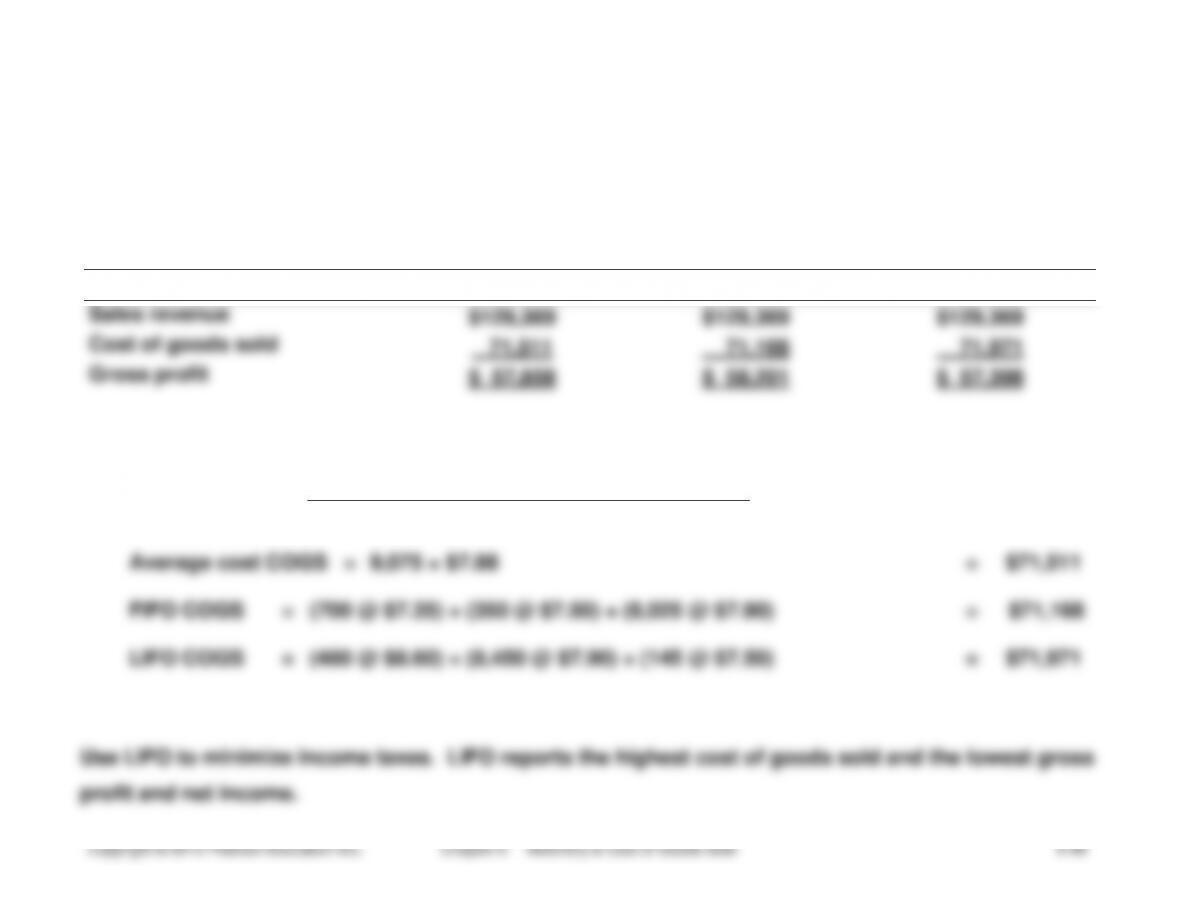
(30-40 min.) P 6-66B
Req. 1 (partial income statements)
Parker Aviation
Income Statement
Year Ended October 31, 2014
AVERAGE
FIFO
LIFO
Sales revenue
$129,369
$129,369
$129,369
Cost of goods sold
71,511
71,168
71,971
Gross profit
$ 57,858
$ 58,201
$ 57,398
Computations of cost of goods sold:
Average cost
=
($5,145 + $2,625 + $66,755 + $4,128)
=
$7.88
per case
(700 + 350 + 8,450 + 480)
Average cost COGS = 9,075 × $7.88
=
$71,511
FIFO COGS
=
(700 @ $7.35) + (350 @ $7.50) + (8,025 @ $7.90)
=
$71,168
LIFO COGS
=
(480 @ $8.60) + (8,450 @ $7.90) + (145 @ $7.50)
=
$71,971
Req. 2
(15-20 min.) P 6-67B
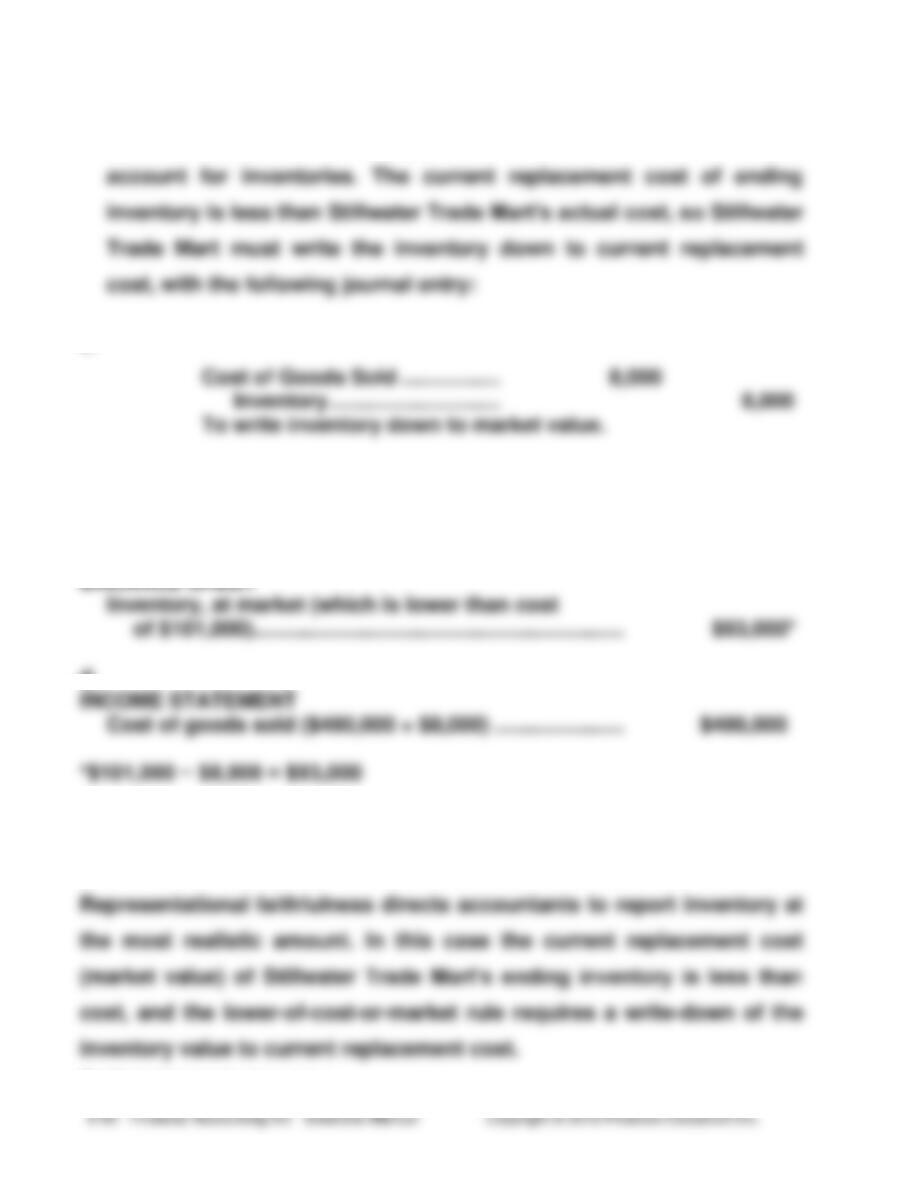
a. Stillwater Trade Mart should apply the lower-of-cost-or-market rule to
b.
Cost of Goods Sold ……………..
8,000
Inventory ………………………..
8,000
To write inventory down to market value.
Stillwater Trade Mart should report the following in its financial
statements:
c.
BALANCE SHEET
Inventory, at market (which is lower than cost
of $101,000) ………………………………………………………
$93,000*
d.
INCOME STATEMENT
Cost of goods sold ($490,000 + $8,000) ………………….
$498,000
*$101,000 − $8,000 = $93,000
e. Relevance and representational faithfulness are the reasons to
account for inventory at the lower of cost or market value.
Student responses may vary.
(20-30 min.) P 6-68B
Req. 1
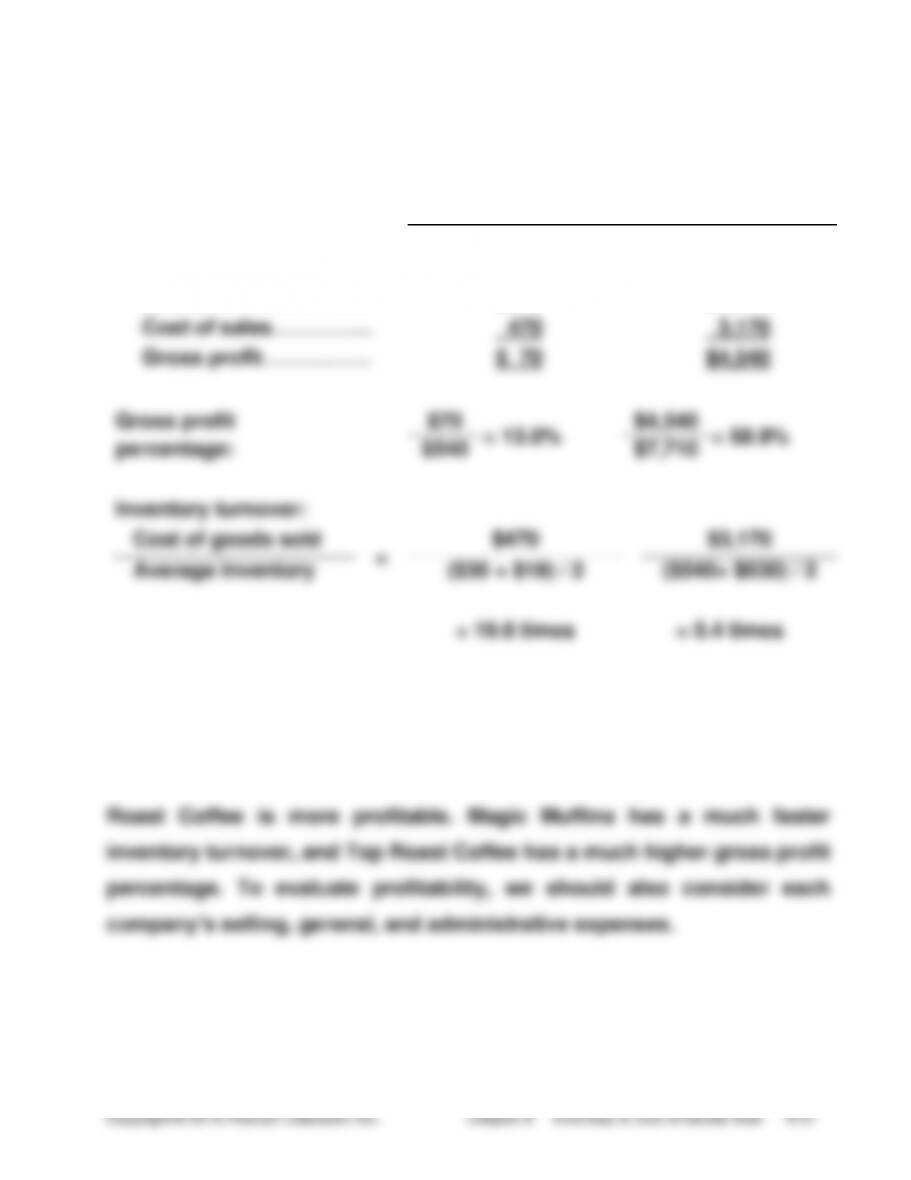
Magic Muffins, Inc.
Top Roast Coffee
Corp.
Millions
Millions
Gross profit percentage:
Sales…………………….
$540
$7,710
Cost of sales……………
470
3,170
Gross profit…………….
$ 70
$4,540
Gross profit
$70
= 13.0%
$4,540
= 58.9%
percentage:
$540
$7,710
Inventory turnover:
Cost of goods sold
=
$470
$3,170
Average inventory
($30 + $18) / 2
($540+ $630) / 2
= 19.6 times
= 5.4 times
Req. 2
From these statistics, it’s hard to tell whether Magic Muffins or Top
(25-30 min.) P 6-69B
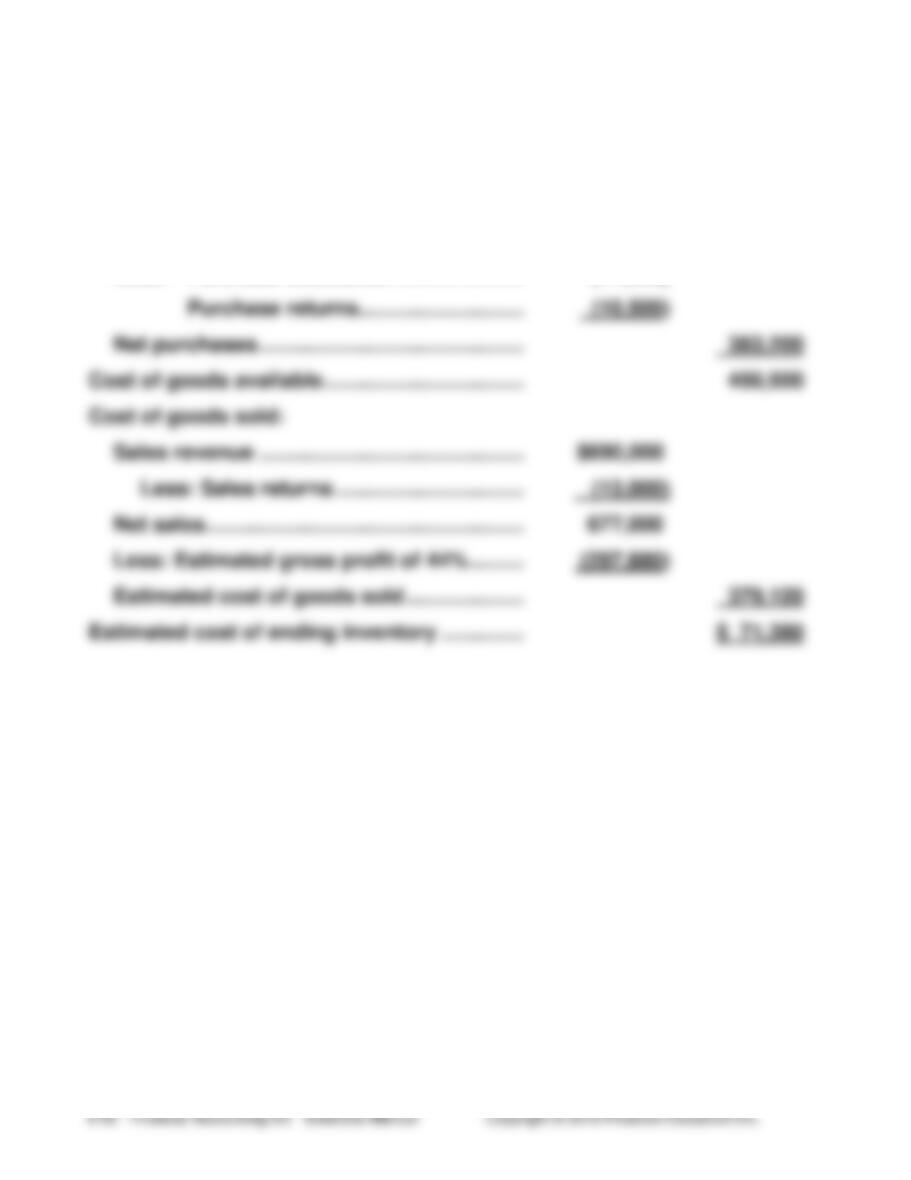
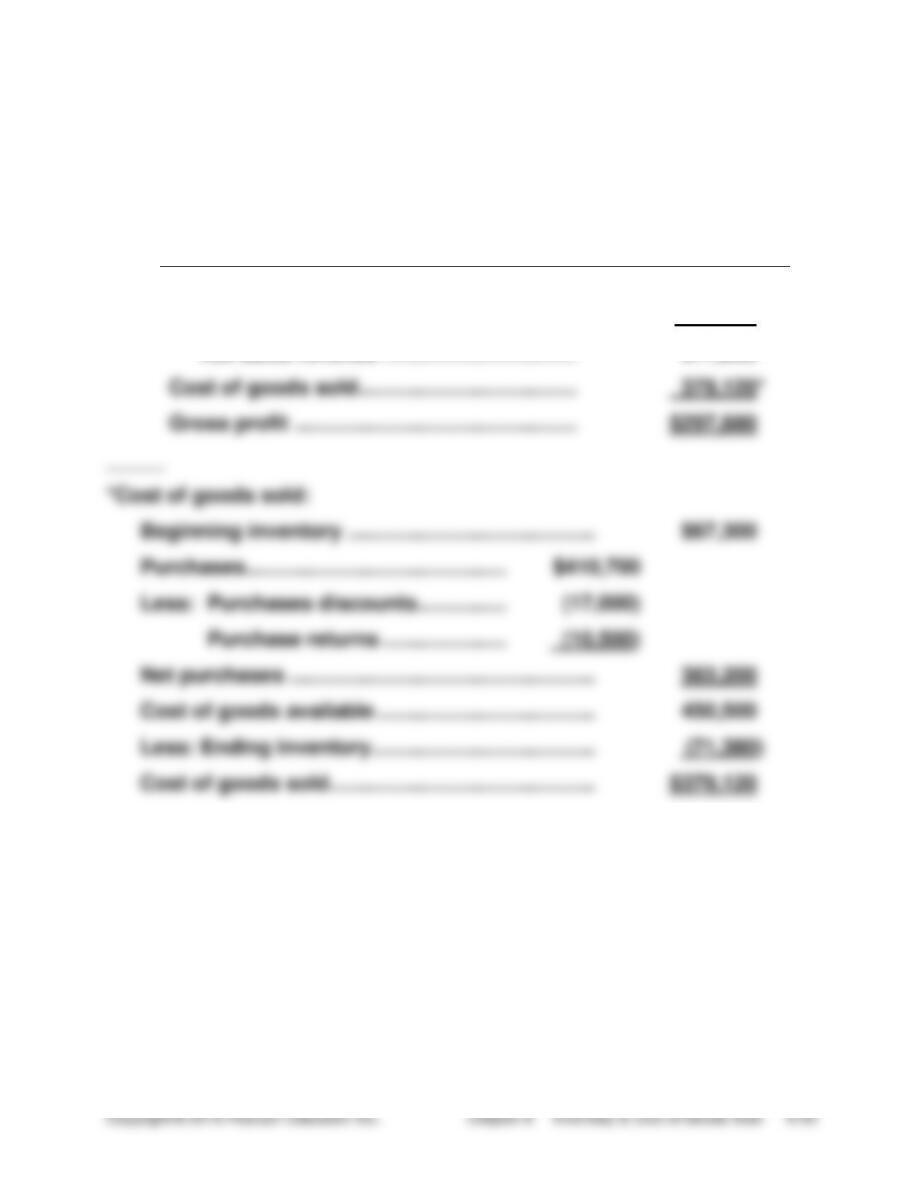
Req. 1 (estimate of ending inventory by the gross profit method)
Beginning inventory …………………………………
$ 67,300
Purchases ……………………………………………….
$410,700
Less: Purchase discounts …………………..
(17,000)
Purchase returns ……………………….
(10,500)
Net purchases ………………………………………
383,200
Cost of goods available …………………………….
450,500
Cost of goods sold:
Sales revenue ………………………………………
$690,000
Less: Sales returns …………………………..
(13,000)
Net sales ………………………………………………
677,000
Less: Estimated gross profit of 44% ………
(297,880)
Estimated cost of goods sold ………………..
379,120
Estimated cost of ending inventory …………..
$ 71,380
(continued) P 6-69B
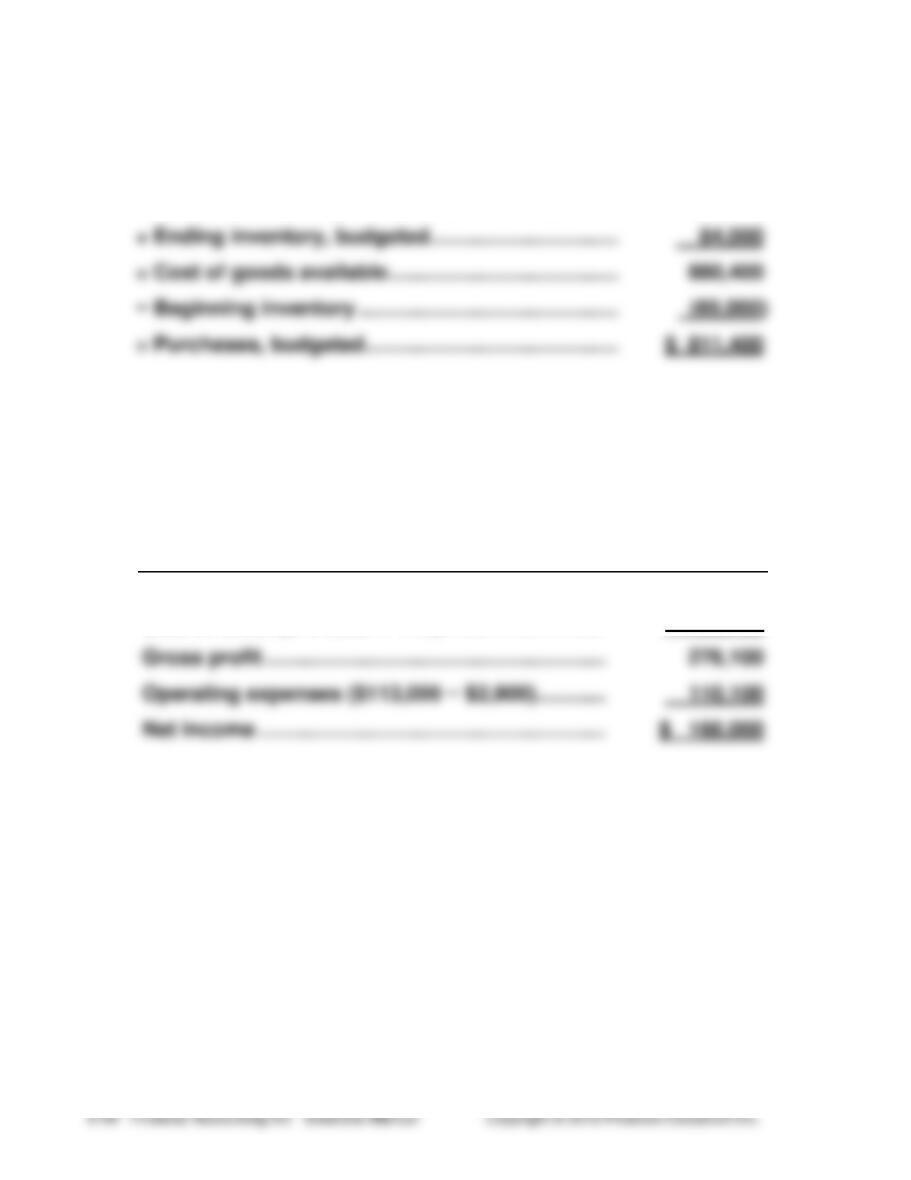
Req. 2 (income statement through gross profit)
Sternberg Company
Income Statement (partial)
Two Week Period ending March 15 (date of the fire)
Sales revenue …………………………..………….
$690,000
Less: Sales returns ………………………….
(13,000)
Net sales revenue …………………………...
677,000
Cost of goods sold ……………………………….
379,120*
Gross profit …………………………………………
$297,880
_____
*Cost of goods sold:
Beginning inventory …………………………..……….
$67,300
Purchases ……………………………………..
$410,700
Less: Purchases discounts ……………
(17,000)
Purchase returns …………………
(10,500)
Net purchases …………………………………………….
383,200
Cost of goods available ……………………………….
450,500
Less: Ending inventory …………………………..……
(71,380)
Cost of goods sold ………………………………………
$379,120
(20-25 min.) P 6-70B
Req. 1
Cost of sales, budgeted ($724,000 × 1.10) ……….
$ 796,400
+ Ending inventory, budgeted …………………………..
84,000
= Cost of goods available …………………………………
880,400
− Beginning inventory ……………………………………..
(69,000)
= Purchases, budgeted …………………………………….
$ 811,400
Req. 2
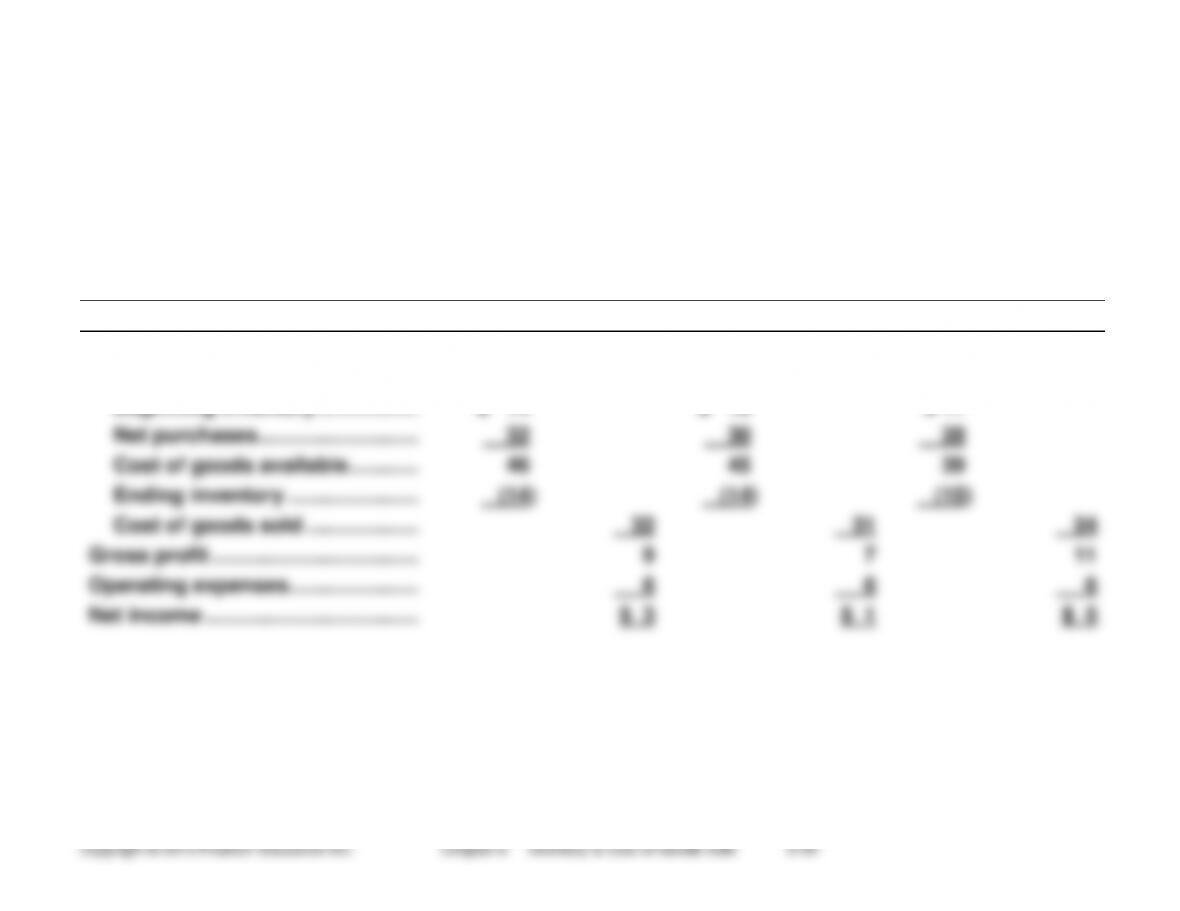
Chuck’s Convenience Stores
Budgeted Income Statement
Year Ended December 31, 2014
Sales ($975,000 × 1.10) ………………………………….
$1,072,500
Cost of sales ($724,000 × 1.10) ………………………
796,400
Gross profit ………………………………………………….
276,100
Operating expenses ($113,000 − $2,900)…………
110,100
Net income …………………………………………………..
$ 166,000
(15-20 min.) P 6-71B
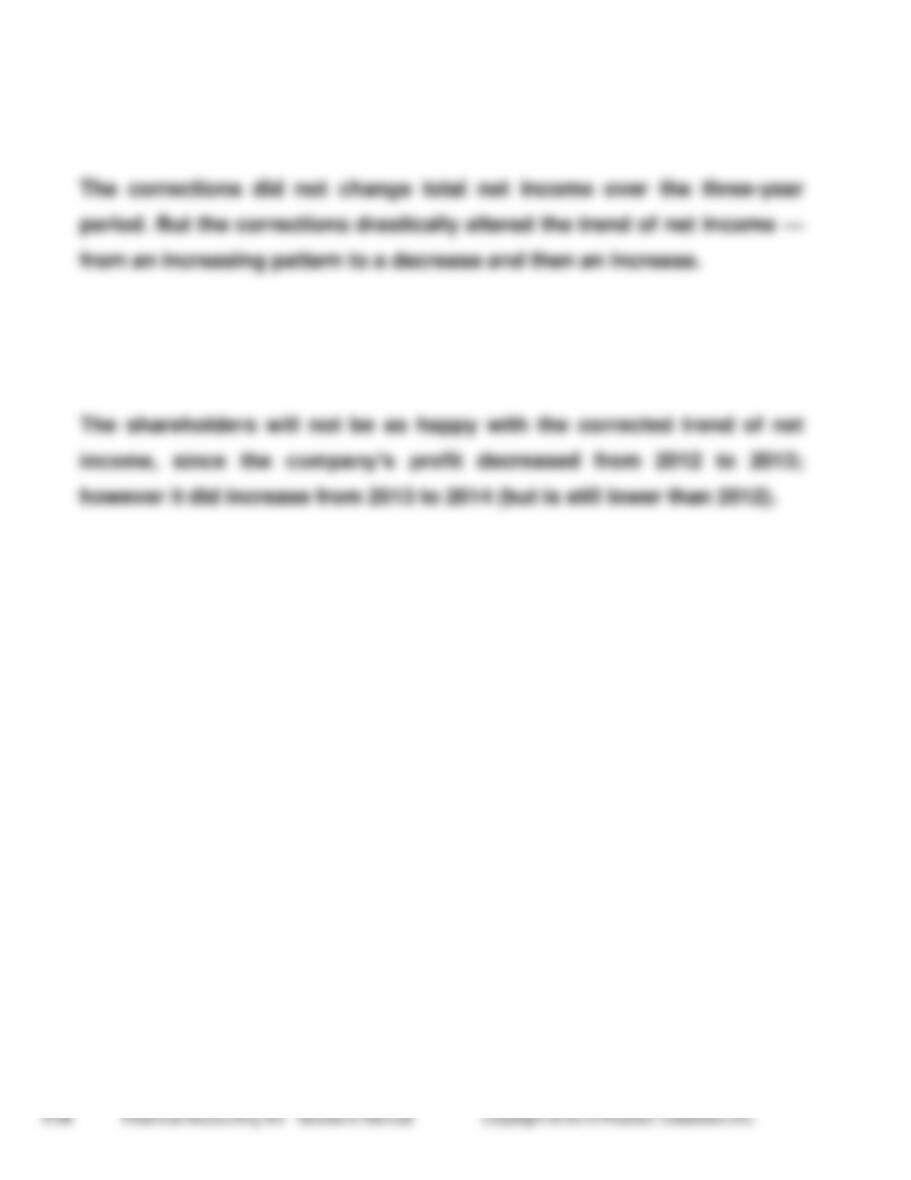
Req. 1 (corrected income statements)
Durango Furniture
Income Statement (adapted; amounts in millions)
Years Ended December 31, 2014, 2013, and 2012
2014
2013
2012
Net sales revenue …………………….
$41
$38
$35
Cost of goods sold:
Beginning inventory ……………..
$ 14
$ 15
$ 11
Net purchases ………………………
32
30
28
Cost of goods available…………
46
45
39
Ending inventory ………………….
(14)
(14)
(15)
Cost of goods sold ……………….
32
31
24
Gross profit ……………………………..
9
7
11
Operating expenses ………………….
6
6
6
Net income ………………………………
$ 3
$ 1
$ 5
(continued) P 6-71B
Req. 2
Req. 3
Challenge Exercises and Problem
(5–10 min.) E 6-72
a. Buy inventory late in the year.
b. Company is using LIFO.
(20-30 min.) E 6-73
Req. 1
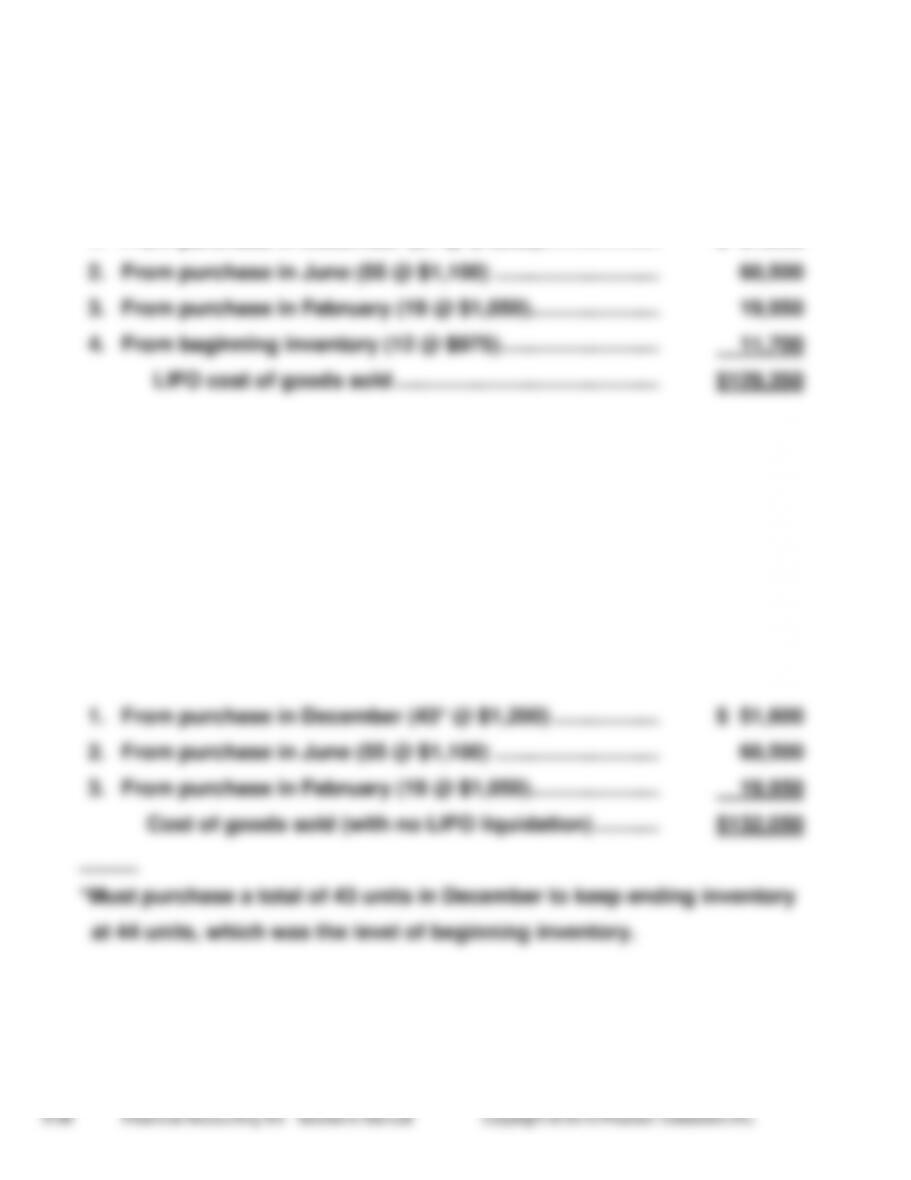
LIFO cost of goods sold =
1.
From purchase in December (31 @ $1,200) ………………..
$ 37,200
2.
From purchase in June (55 @ $1,100) ……………………….
60,500
3.
From purchase in February (19 @ $1,050) ………………….
19,950
4.
From beginning inventory (12 @ $975) ………………………
11,700
LIFO cost of goods sold …………………………..………….
$129,350
Req. 2
Cost of goods sold with the additional year-end purchase
(this would have avoided a LIFO liquidation—that is,
kept year-end inventory at the same level it was at the
beginning of the year)
1.
From purchase in December (43* @ $1,200) ………………
$ 51,600
2.
From purchase in June (55 @ $1,100) ……………………….
60,500
3.
From purchase in February (19 @ $1,050) ………………….
19,950
Cost of goods sold (with no LIFO liquidation) ………..
$132,050
_____
*Must purchase a total of 43 units in December to keep ending inventory
at 44 units, which was the level of beginning inventory.
(20-30 min.) E 6-74
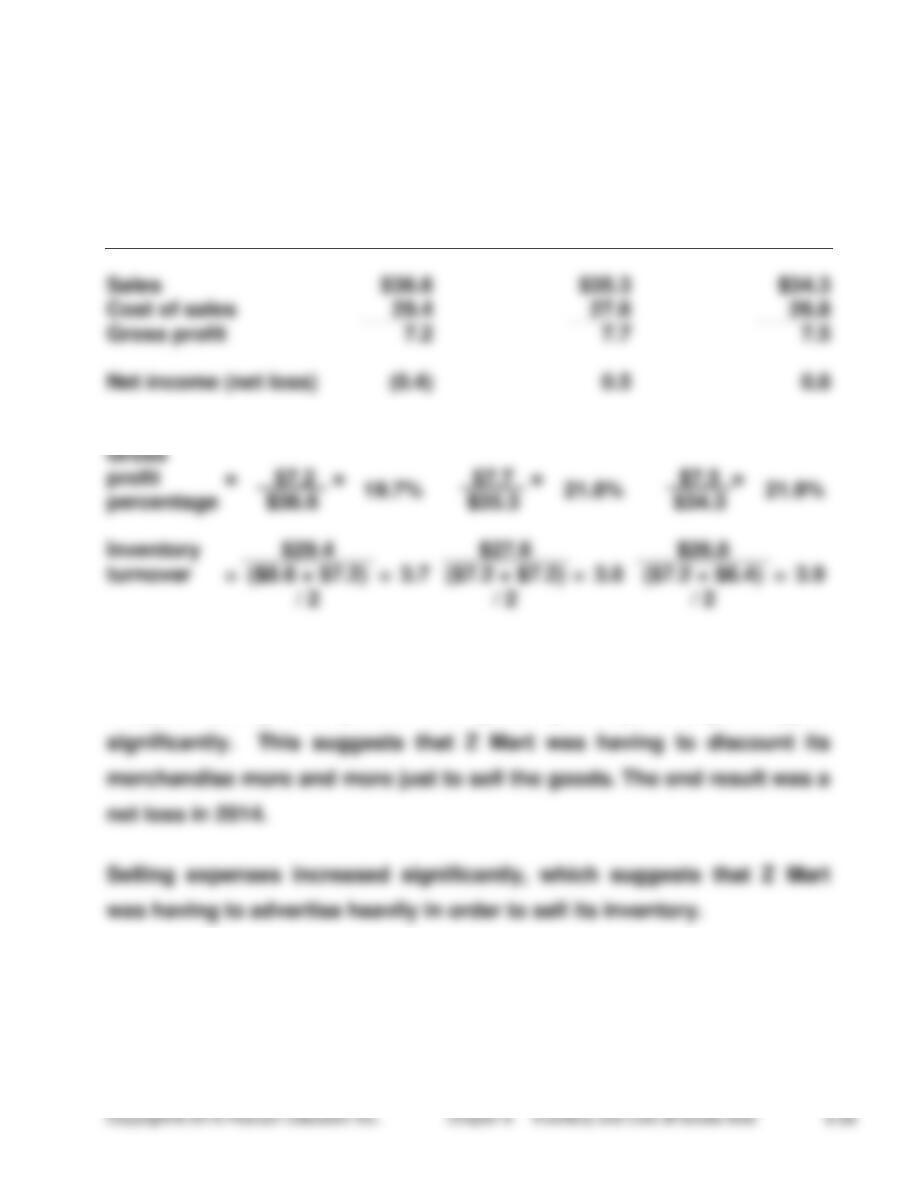
Sales increased, the gross profit increased then dropped, and net
income slid into a net loss, as shown here:
Dollars in millions
2014
2013
2012
Sales
$36.6
$35.3
$34.3
Cost of sales
29.4
27.6
26.8
Gross profit
7.2
7.7
7.5
Net income (net loss)
(0.4)
0.5
0.8
Gross
profit
=
$7.2 =
19.7%
$7.7 =
21.8%
$7.5 =
21.9%
percentage
$36.6
$35.3
$34.3
Inventory
=
$29.4
=
3.7
$27.6
=
3.8
$26.8
=
3.9
turnover
($8.6 + $7.2)
/ 2
($7.2 + $7.2)
/ 2
($7.2 + $6.4)
/ 2
Both the gross profit percentage and the rate of inventory turnover
dropped during this period. The gross profit percentage dropped