(continued) P 13-51A
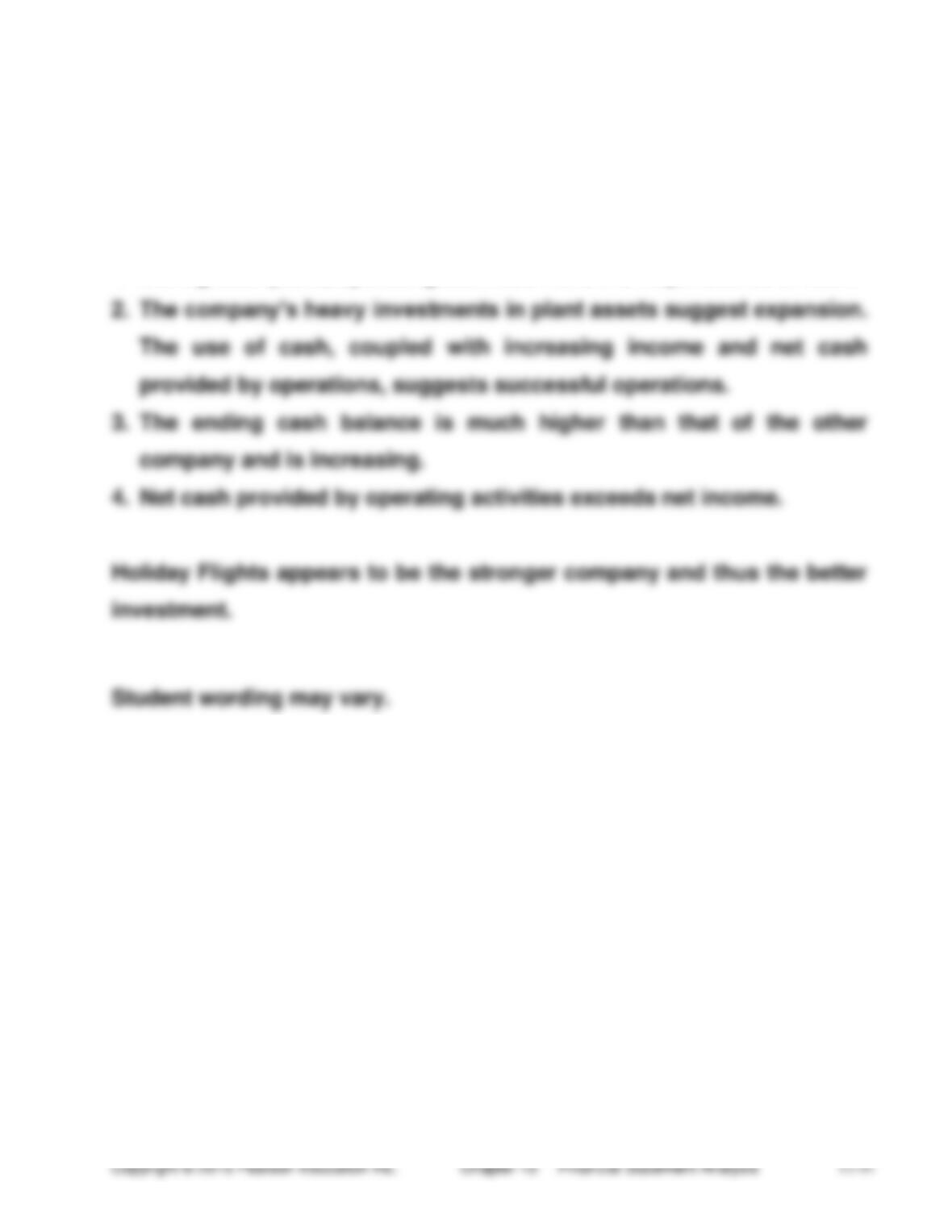
Holiday Flights’ statement of cash flows reveals the following strengths
(no significant weaknesses):
1. During both years, operating activities were the major source of cash.
(30-40 min.) P 13-52A
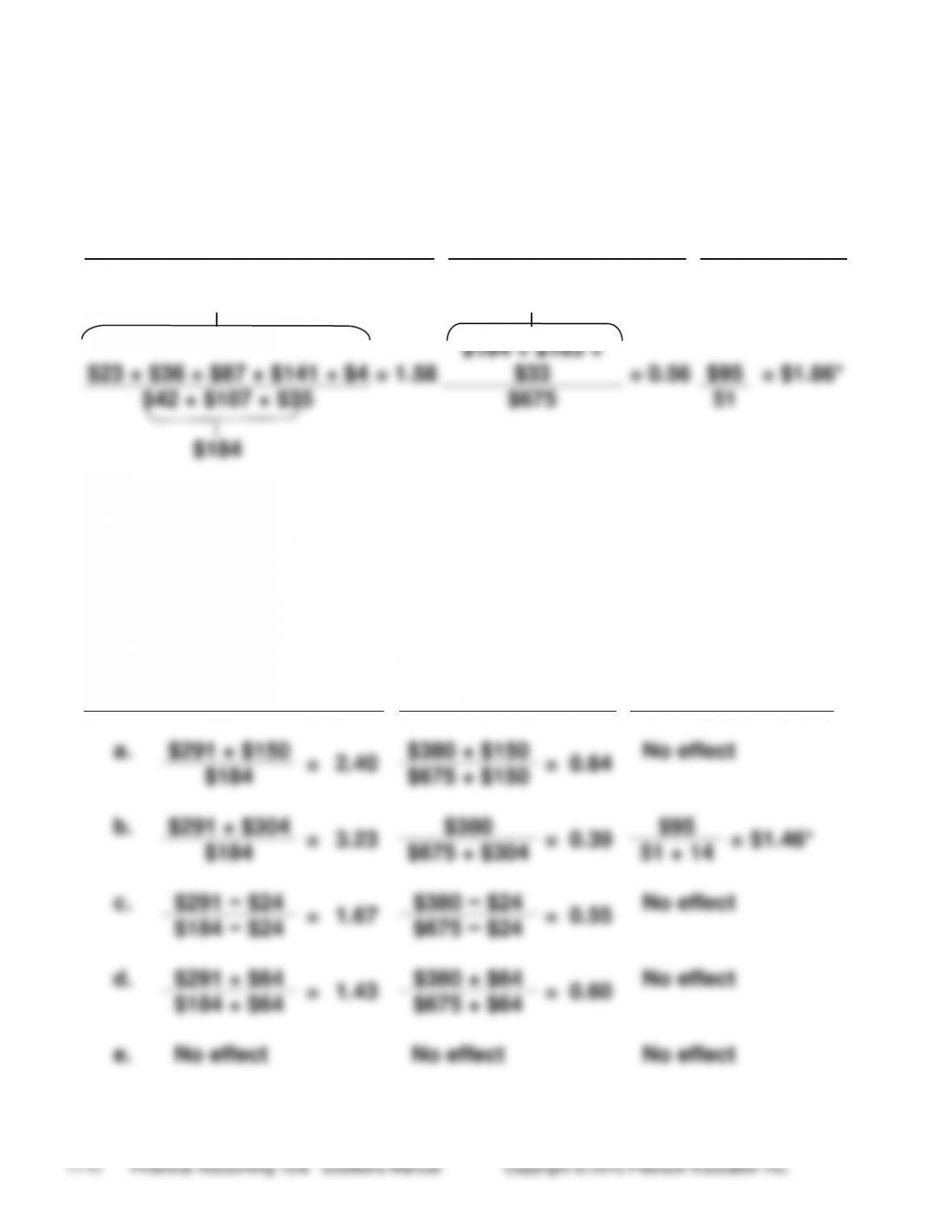
Req. 1 (ratios before the transactions)
(Dollar Amounts and Stock Quantities in Thousands)
Current Ratio
Debt Ratio
Earnings per
share
$291
$380
$23 + $36 + $87 + $141 + $4
= 1.58
$184 + $163 +
$33
= 0.56
$95
= $1.86*
$42 + $107 + $35
$675
51
$184
____
*Not in thousands.
Req. 2 (ratios after the transactions)
(Dollar Amounts and Stock Quantities in Thousands)
Trans-
action
Current Ratio
Debt Ratio
Earnings per Share
a.
$291 + $150
=
2.40
$380 + $150
=
0.64
No effect
$184
$675 + $150
b.
$291 + $304
=
3.23
$380
=
0.39
$95
=
$1.46*
$184
$675 + $304
51 + 14
c.
$291 − $24
=
1.67
$380 − $24
=
0.55
No effect
$184 − $24
$675 − $24
d.
$291 + $64
=
1.43
$380 + $64
=
0.60
No effect
$184 + $64
$675 + $64
e.
No effect
No effect
No effect
_____
*Not in thousands.
(40-50 min.) P 13-53A
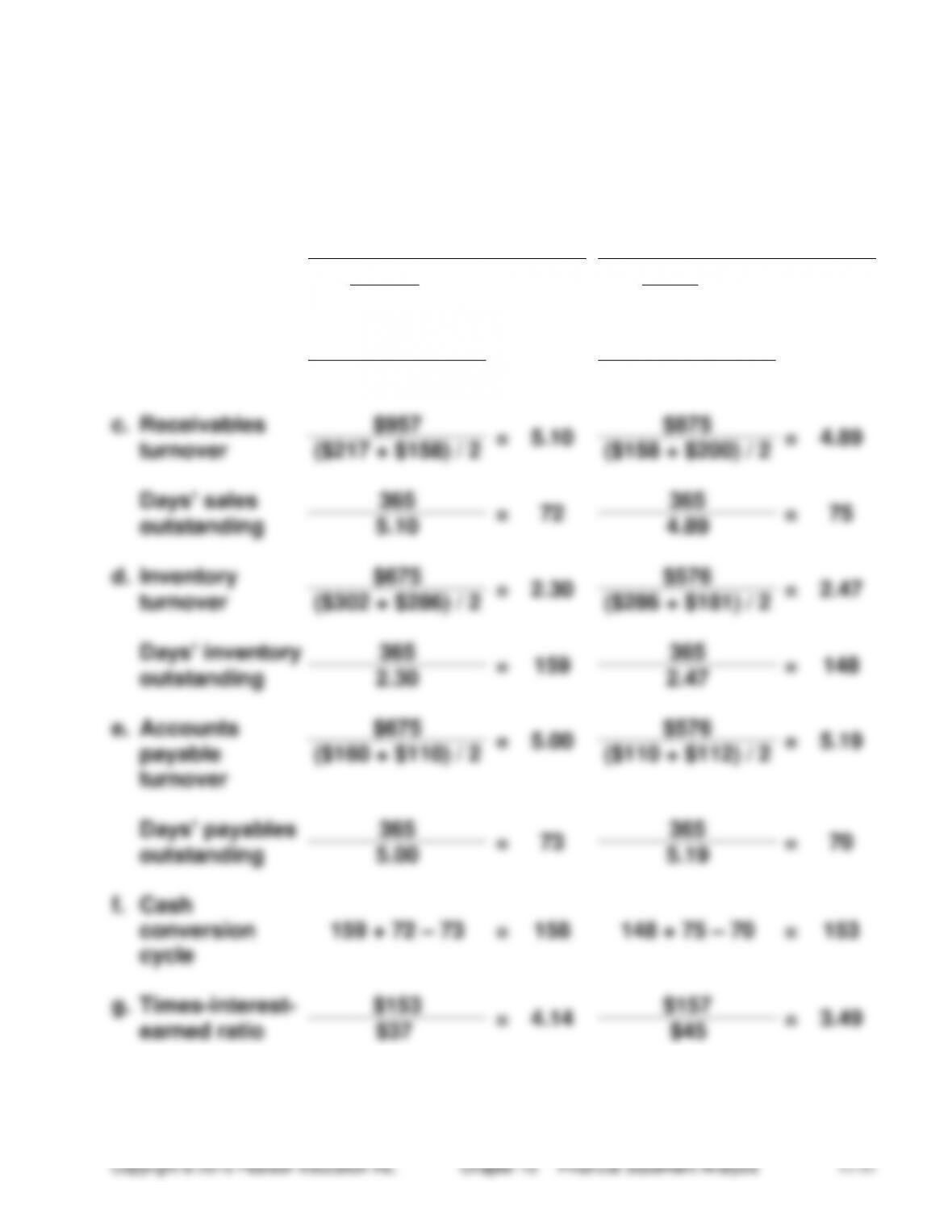
Req. 1
(Dollar Amounts and Stock Quantities in Thousands)
2014
2013
a.
Current ratio
$568
=
1.93
$522
=
1.75
$295
$298
b.
Quick (acid-
$45 + $217
=
0.89
$49 + $158
=
0.69
test) ratio
$295
$298
c.
Receivables
$957
=
5.10
$875
=
4.89
turnover
($217 + $158) / 2
($158 + $200) / 2
Days’ sales
365
=
72
365
=
75
outstanding
5.10
4.89
d.
Inventory
$675
=
2.30
$576
=
2.47
turnover
($302 + $286) / 2
($286 + $181) / 2
Days’ inventory
365
=
159
365
=
148
outstanding
2.30
2.47
e.
Accounts
$675
=
5.00
$576
=
5.19
payable
($160 + $110) / 2
($110 + $112) / 2
turnover
Days’ payables
365
=
73
365
=
70
outstanding
5.00
5.19
f.
Cash
conversion
cycle
159 + 72 – 73
=
158
148 + 75 – 70
=
153
g.
Times-interest-
$153
=
4.14
$157
=
3.49
earned ratio
$37
$45
(continued) P13-53A
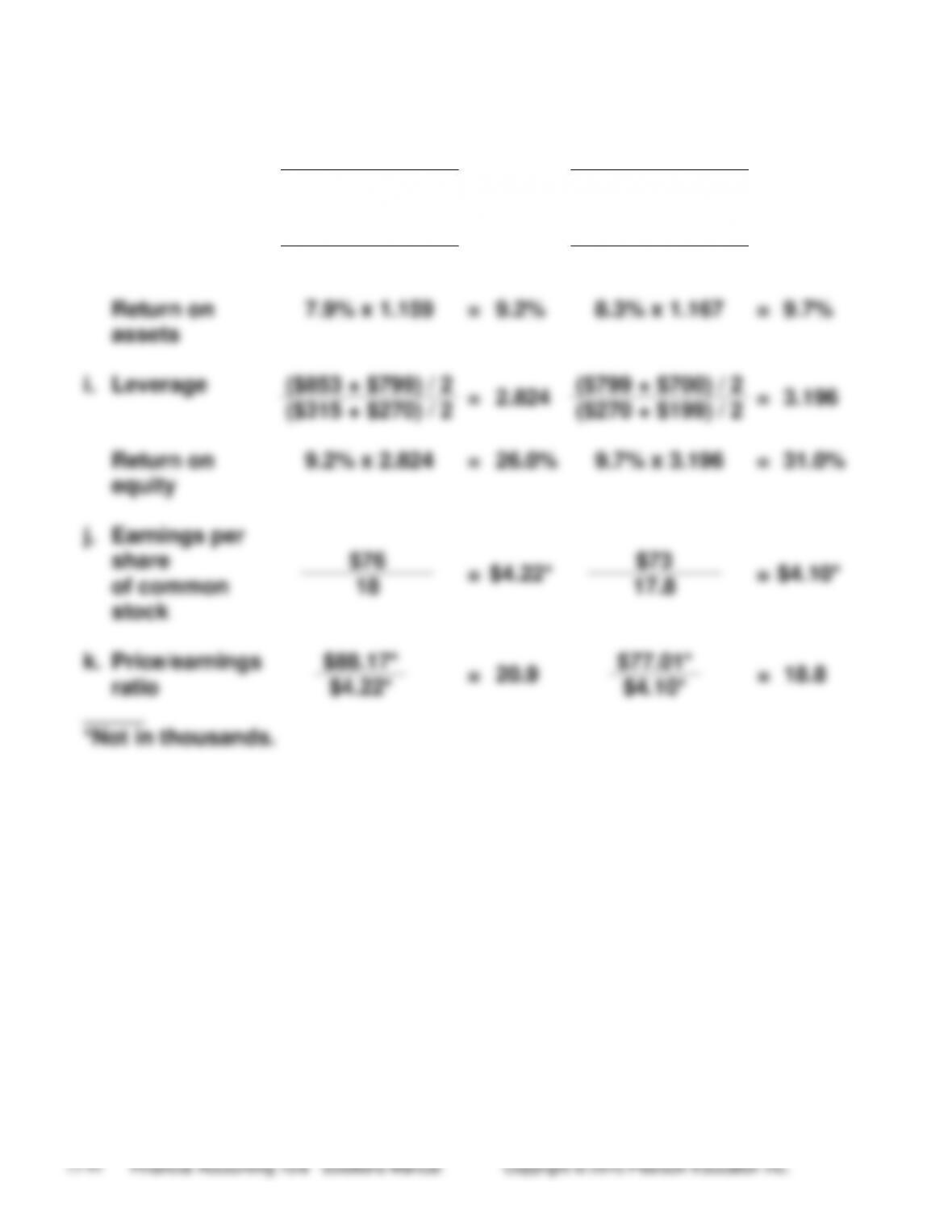
h.
Return on
$76
=
0.079
$73
=
0.083
sales
$957
$875
Asset
$957
=
1.159
$875
=
1.167
turnover
($853 + $799) / 2
($799 + $700) / 2
Return on
7.9% x 1.159
=
9.2%
8.3% x 1.167
=
9.7%
assets
i.
Leverage
($853 + $799) / 2
=
2.824
($799 + $700) / 2
=
3.196
($315 + $270) / 2
($270 + $199) / 2
Return on
9.2% x 2.824
=
26.0%
9.7% x 3.196
=
31.0%
equity
j.
Earnings per
share
$76
=
$4.22*
$73
=
$4.10*
of common
stock
18
17.8
k.
Price/earnings
$88.17*
=
20.9
$77.01*
=
18.8
ratio
$4.22*
$4.10*
_____
*Not in thousands.
(continued) P 13-53A
Req. 2
Decisions:
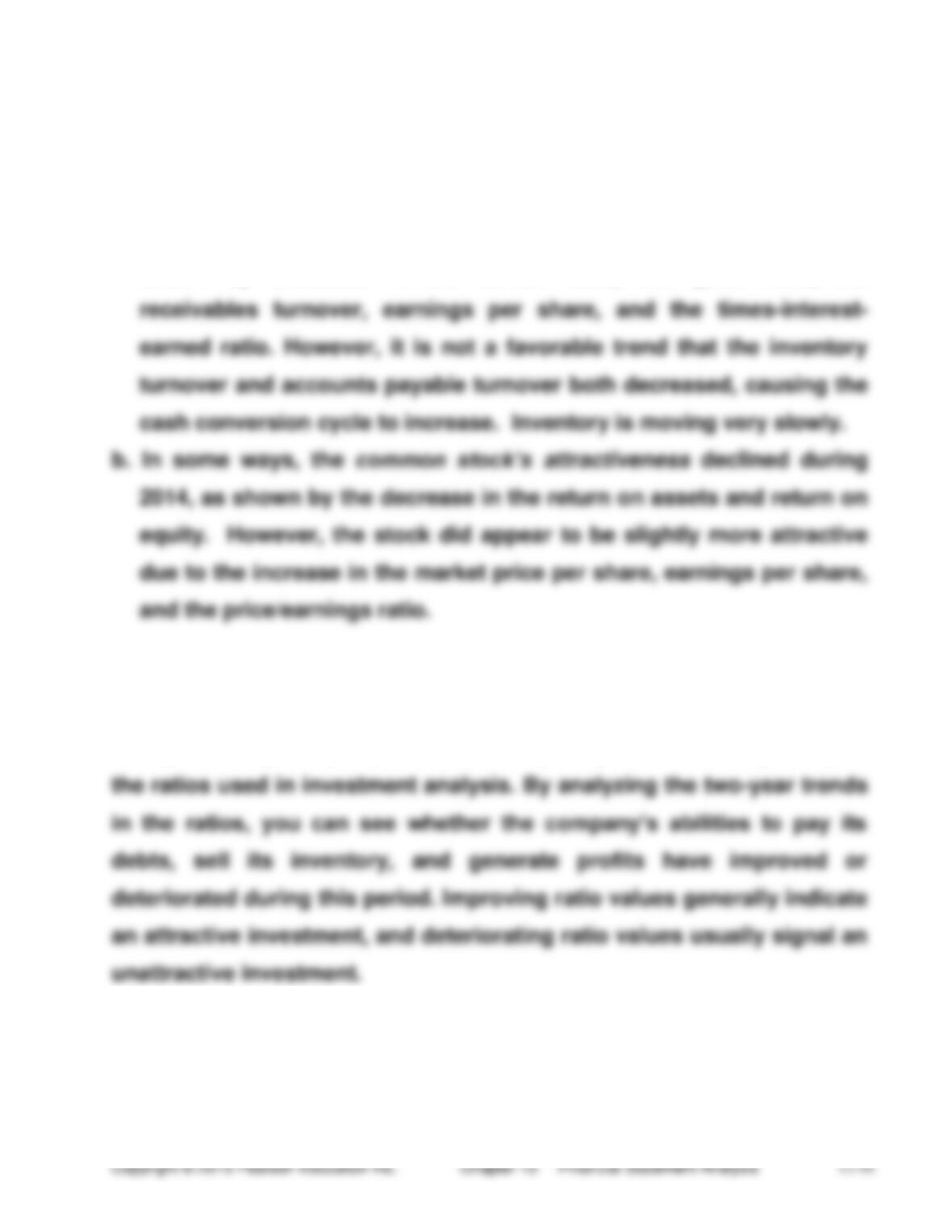
a. The company’s financial position improved slightly during 2014 as
shown by increases in the current ratio, the quick ratio, the
Req. 3
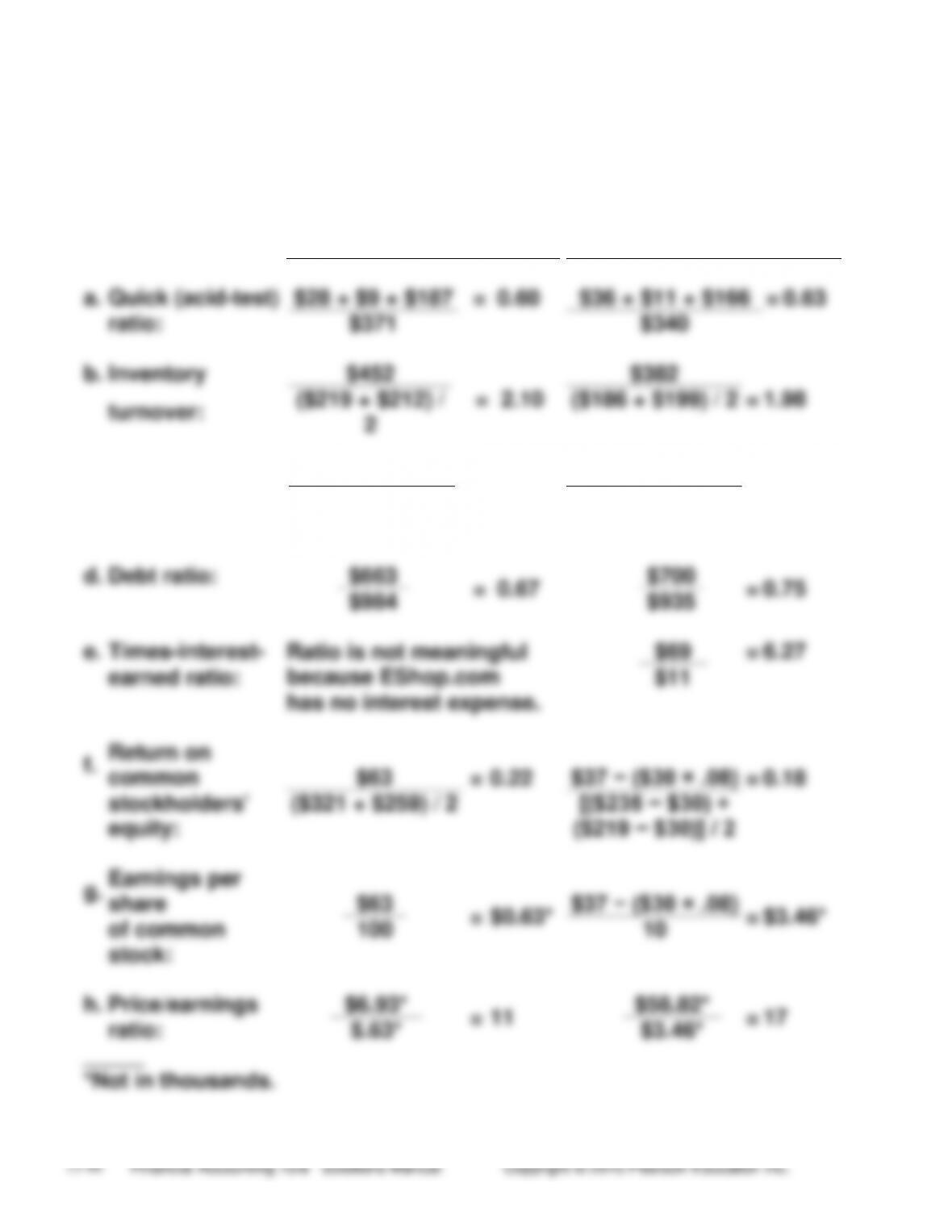
This problem gives you practice in computing and evaluating many of
(45-60 min.) P 13–54A
Req. 1
(Dollar Amounts and Stock Quantities in Thousands)
EShop.com
TopSales Stores
a.
Quick (acid-test)
$28 + $9 + $187
=
0.60
$36 + $11 + $166
=
0.63
ratio:
$371
$340
b.
Inventory
$452
=
2.10
$382
=
1.98
turnover:
($219 + $212) /
2
($186 + $199) / 2
c.
Days’ sales in
($187 + $143) / 2
=
101
($166 + $194) / 2
=
127
average
$598 / 365
$518 / 365
receivables:
d.
Debt ratio:
$663
=
0.67
$700
=
0.75
$984
$935
e.
Times-interest-
Ratio is not meaningful
because EShop.com
$69
=
6.27
earned ratio:
$11
has no interest expense.
f.
Return on
common
$63
=
0.22
$37 − ($30 × .08)
=
0.18
stockholders’
($321 + $259) / 2
[($235 − $30) +
equity:
($219 − $30)] / 2
g.
Earnings per
share
$63
=
$0.63*
$37 − ($30 × .08)
=
$3.46*
of common
stock:
100
10
h.
Price/earnings
$6.93*
=
11
$58.82*
=
17
ratio:
$.63*
$3.46*
(continued) P 13-54A
Decision:
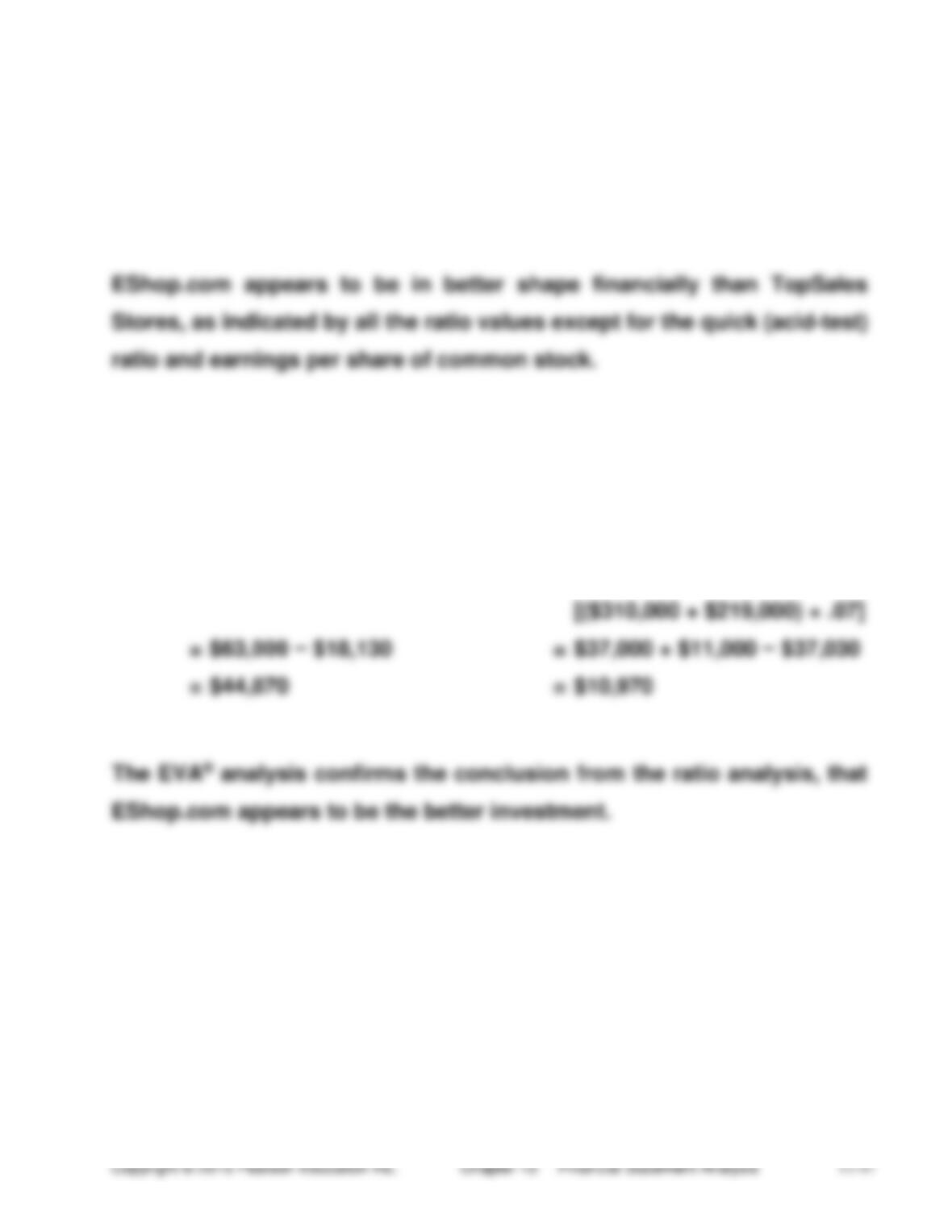
EShop.com’s common stock seems to fit the investment strategy better.
Its price/earnings ratio is lower than that of TopSales Stores, and
Req. 2
EShop.com
TopSales Stores
EVA®
$63,000 − [($0 + $259,000) × .07]
$37,000 + $11,000 −
[($310,000 + $219,000) × .07]
=
$63,000 − $18,130
=
$37,000 + $11,000 − $37,030
=
$44,870
=
$10,970
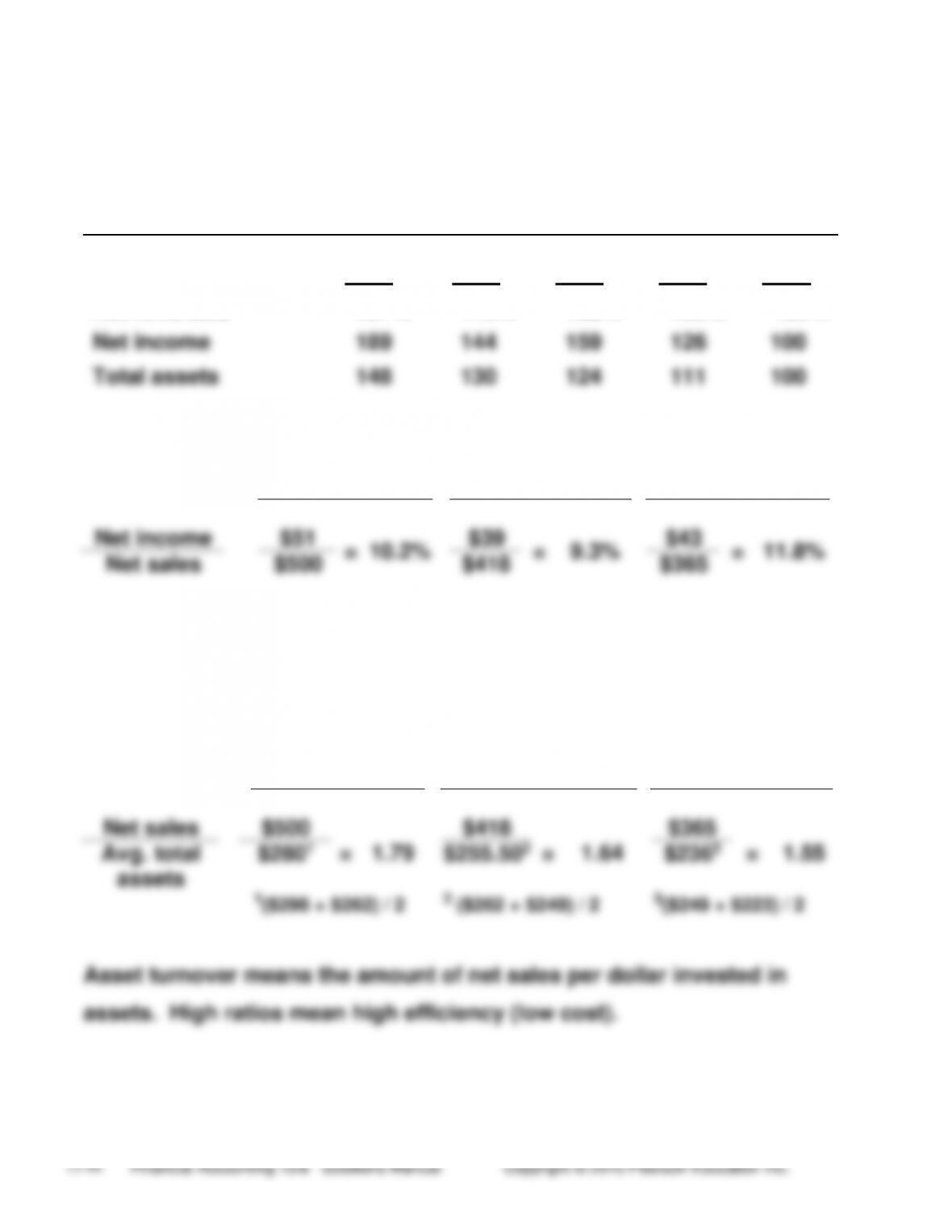
The EVA® analysis confirms the conclusion from the ratio analysis, that
EShop.com appears to be the better investment.
(20-30 min.) P 13-55B
Req. 1 Trend percentages
Lloyd Shipping, Inc.
Trend Percentages
2014
2013
2012
2011
2010
Net revenues
167%
140%
122%
103%
100%
Net income
189
144
159
126
100
Total assets
148
130
124
111
100
Req. 2 Return on net sales (Dollar amounts in thousands)
2014
2013
2012
Net income
$51
=
10.2%
$39
=
9.3%
$43
=
11.8%
Net sales
$500
$418
$365
Return on sales measures the amount of net income for each dollar of
net sales.
Req. 3 Asset turnover (Dollar amounts in thousands)
2014
2013
2012
Net sales
$500
=
1.79
$418
=
1.64
$365
=
1.55
Avg. total
assets
$2801
$255.502
$2363
1($298 + $262) / 2
2 ($262 + $249) / 2
3($249 + $223) / 2
Asset turnover means the amount of net sales per dollar invested in
assets. High ratios mean high efficiency (low cost).
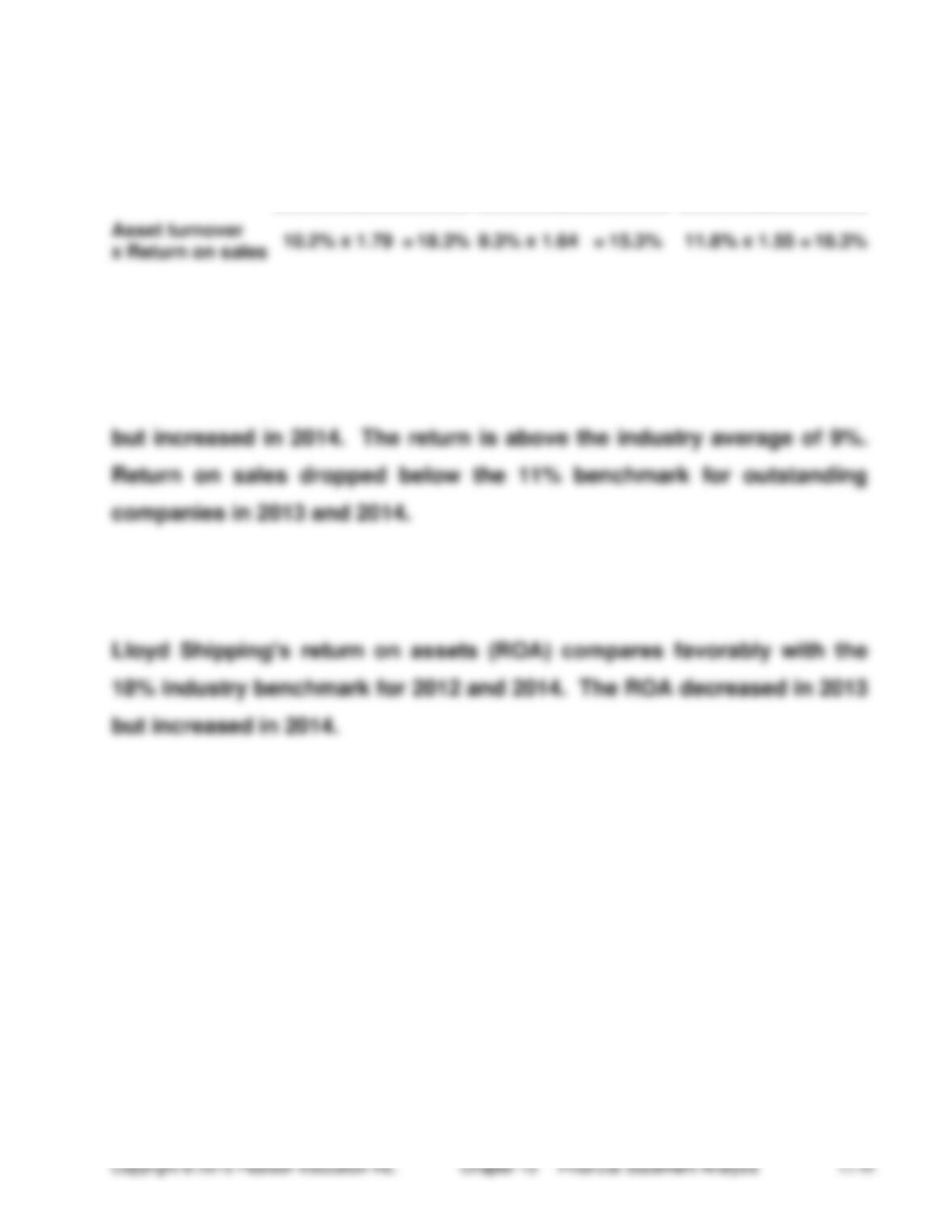
(continued) P 13-55B
Req. 4 Return on assets (Dollar amounts in thousands)
2014
2013
2012
Asset turnover
x Return on sales
10.2% x 1.79
=
18.3%
9.3% x 1.64
=
15.3%
11.8% x 1.55
=
18.3%
Req. 5
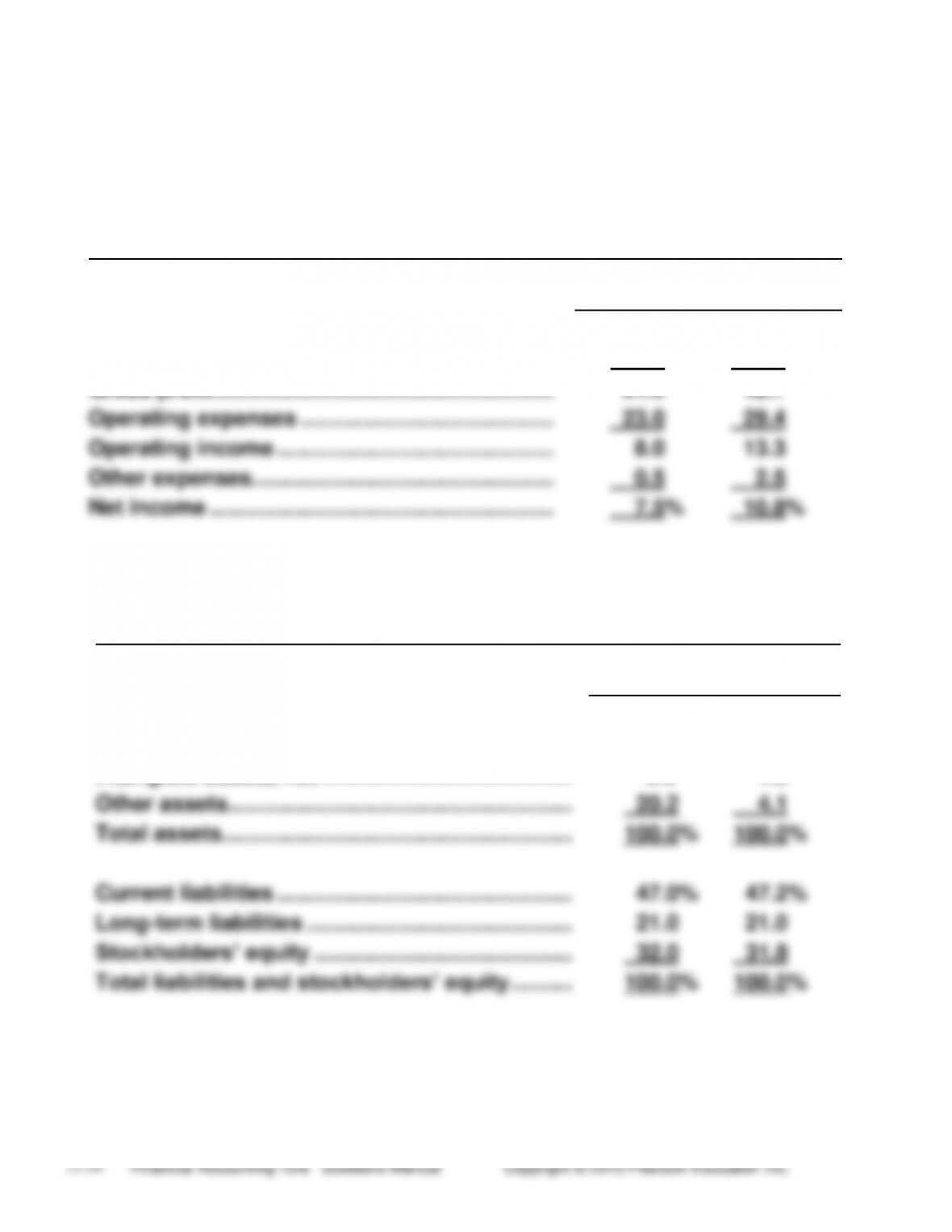
Lloyd Shipping’s rate of return on net sales declined from 2012 to 2013,
Req. 6
(20-30 min.) P 13-56B
Req. 1
Sharp Products, Inc.
Common-Size Income Statement Compared
to Industry Average
Year Ended December 31, 2014
Sharp
Products
INDUSTRY
AVERAGE
Net sales ……………………………………………………
100.0%
100.0%
Cost of goods sold …………………………………….
69.0
57.3
Gross profit ……………………………………………….
31.0
42.7
Operating expenses …………………………………..
23.0
29.4
Operating income ………………………………………
8.0
13.3
Other expenses ………………………………………….
0.5
2.5
Net income ………………………………………………..
7.5%
10.8%
Sharp Products, Inc.
Common-Size Balance Sheet Compared to Industry Average
December 31, 2014
Sharp
Products
INDUSTRY
AVERAGE
Current assets …………………………………………….
59.0%
72.1%
Fixed assets, net …………………………………………
17.8
19.0
Intangible assets, net …………………………………..
3.0
4.8
Other assets ………………………………………………..
20.2
4.1
Total assets …………………………………………………
100.0%
100.0%
Current liabilities …………………………………………
47.0%
47.2%
Long-term liabilities …………………………………….
21.0
21.0
Stockholders’ equity ……………………………………
32.0
31.8
Total liabilities and stockholders’ equity ……….
100.0%
100.0%
(continued) P 13-56B
Req. 2
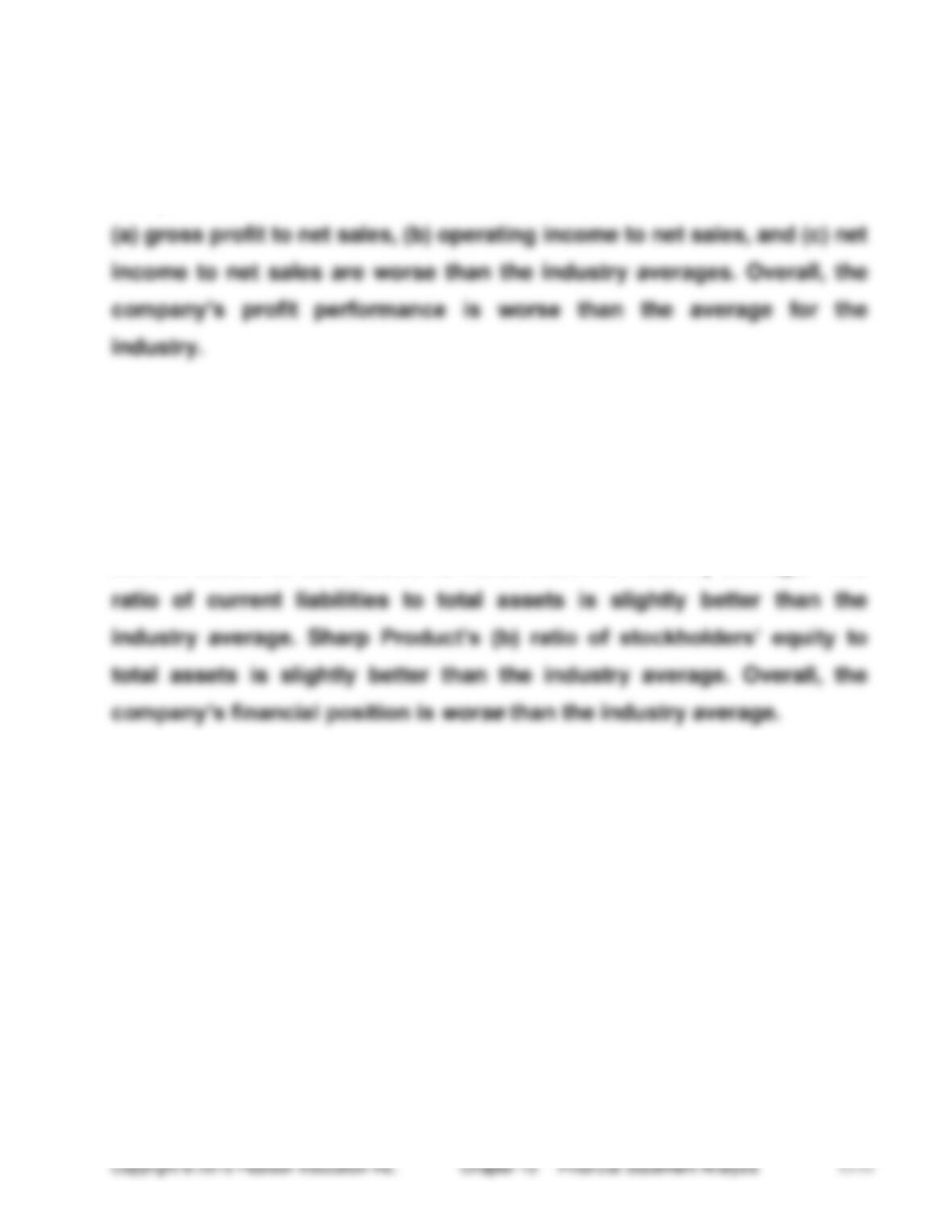
Sharp Product’s common-size income statement shows that its ratios of
Req. 3
Sharp Product’s common-size balance sheet shows that its (a) ratio of
current assets to total assets is worse than the industry average. The
(20-30 min.) P 13-57B
High Flight Airlines’s statement of cash flows reveals few strengths. The
company’s weaknesses include:
1. Net income and cash provided by operations are down significantly.
There was a net loss in 2015.
(continued) P 13-57B
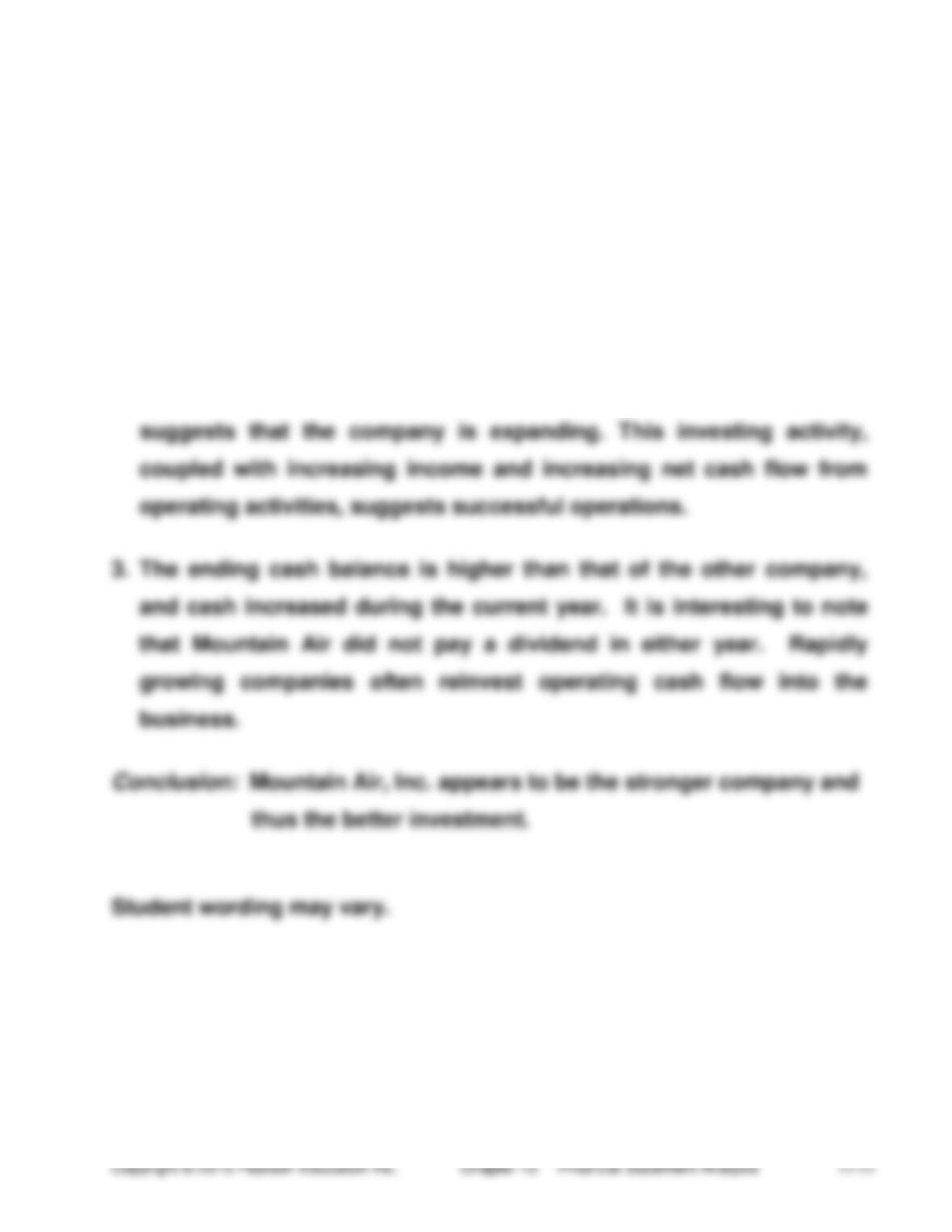
Mountain Air, Inc’s statement of cash flows reveals the following
strengths (no significant weaknesses):
1. During both years, operating activities generated the bulk of the
company’s cash. Furthermore, the trend of net income is up, a
favorable sign.
2. The company’s heavy investments in property, plant, and equipment
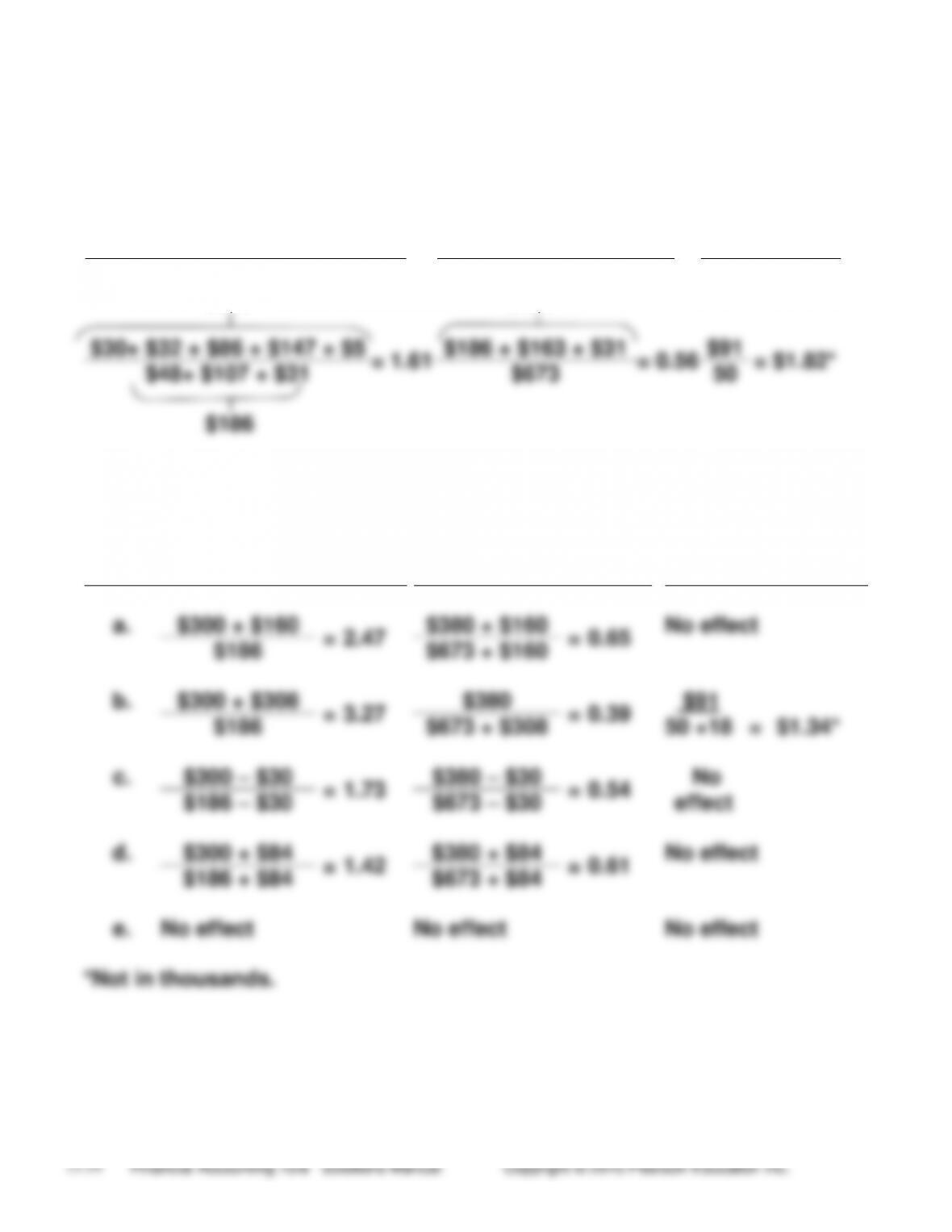
(30-40 min.) P 13-58B
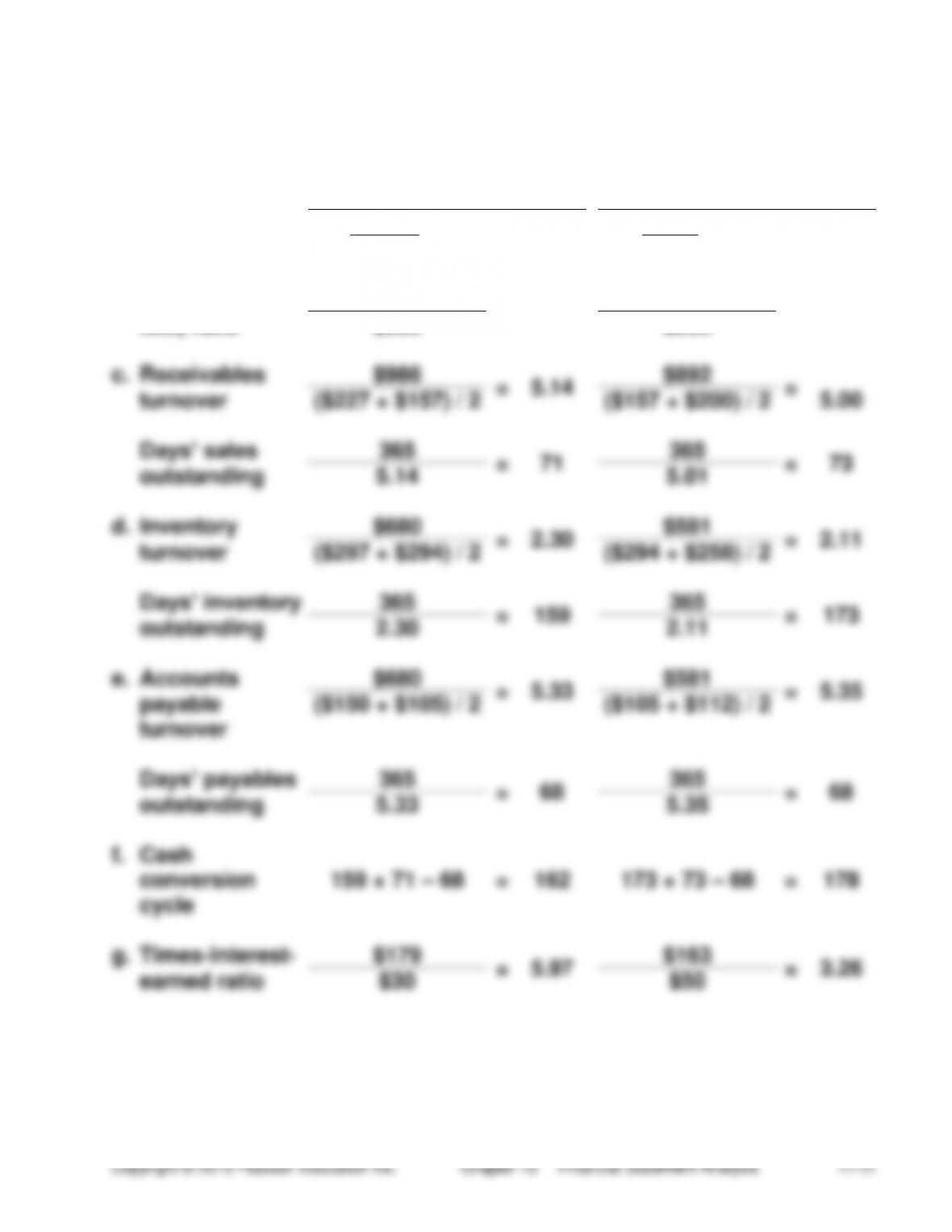
Req. 1 (ratios before the transactions)
(Dollar Amounts and Stock Quantities in Thousands)
Current Ratio
Debt Ratio
Earnings per
share
$300
$380
$30+ $32 + $86 + $147 + $5
= 1.61
$186 + $163 + $31
= 0.56
$91
= $1.82*
$48+ $107 + $31
$673
50
$186
Req. 2 (ratios after the transactions)
(Dollar Amounts and Stock Quantities in Thousands)
Trans-
action
Current Ratio
Debt Ratio
Earnings per share
a.
$300 + $160
=
2.47
$380 + $160
=
0.65
No effect
$186
$673 + $160
b.
$300 + $308
=
3.27
$380
=
0.39
$91
$186
$673 + $308
50 +18
=
$1.34*
c.
$300 – $30
=
1.73
$380 – $30
=
0.54
No
$186 – $30
$673 – $30
effect
d.
$300 + $84
=
1.42
$380 + $84
=
0.61
No effect
$186 + $84
$673 + $84
e.
No effect
No effect
No effect
(40-50 min.) P 13-59B
Req. 1 (Dollar amounts and stock quantities in thousands)
2014
2013
a.
Current ratio
$563
=
1.98
$562
=
1.92
$285
$292
b.
Quick (acid-
$32 + $227
=
0.91
$82 + $157
=
.82
test) ratio
$285
$292
c.
Receivables
$986
=
5.14
$892
=
5.00
turnover
($227 + $157) / 2
($157 + $200) / 2
Days’ sales
365
=
71
365
=
73
outstanding
5.14
5.01
d.
Inventory
$680
=
2.30
$581
=
2.11
turnover
($297 + $294) / 2
($294 + $258) / 2
Days’ inventory
365
=
159
365
=
173
outstanding
2.30
2.11
e.
Accounts
$680
=
5.33
$581
=
5.35
payable
($150 + $105) / 2
($105 + $112) / 2
turnover
Days’ payables
365
=
68
365
=
68
outstanding
5.33
5.35
f.
Cash
conversion
159 + 71 – 68
=
162
173 + 73 – 68
=
178
cycle
g.
Times-interest-
$179
=
5.97
$163
=
3.26
earned ratio
$30
$50
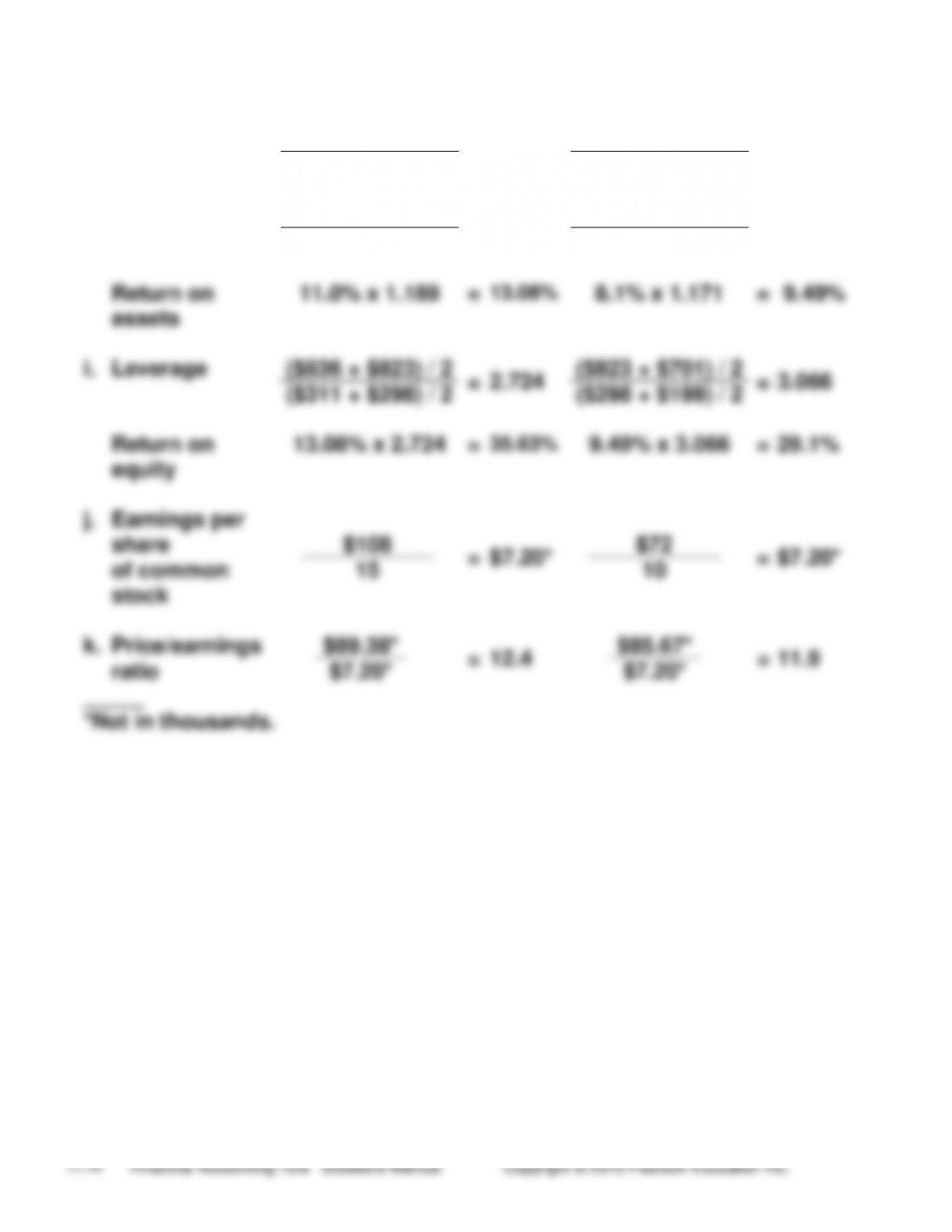
(continued) P13-59B
h.
Return on
$108
=
0.110
$72
=
0.081
sales
$986
$892
Asset
$986
=
1.189
$892
=
1.171
turnover
($836 + $823) / 2
($823 + $701) / 2
Return on
11.0% x 1.189
=
13.08%
8.1% x 1.171
=
9.49%
assets
i.
Leverage
($836 + $823) / 2
=
2.724
($823 + $701) / 2
=
3.066
($311 + $298) / 2
($298 + $199) / 2
Return on
13.08% x 2.724
=
35.63%
9.49% x 3.066
=
29.1%
equity
j.
Earnings per
share
$108
=
$7.20*
$72
=
$7.20*
of common
stock
15
10
k.
Price/earnings
$89.38*
=
12.4
$85.67*
=
11.9
ratio
$7.20*
$7.20*
_____
*Not in thousands.
(continued) P 13-59B
Req. 2
Decisions:
a. The company’s financial position improved during 2014 as shown by
increases in the current ratio, the quick ratio, the receivables
Req. 3
This problem gives you practice in computing and evaluating several of
the ratios used in investment analysis. By analyzing the two-year trends
(45-60 min.) P 13-60B
Req. 1
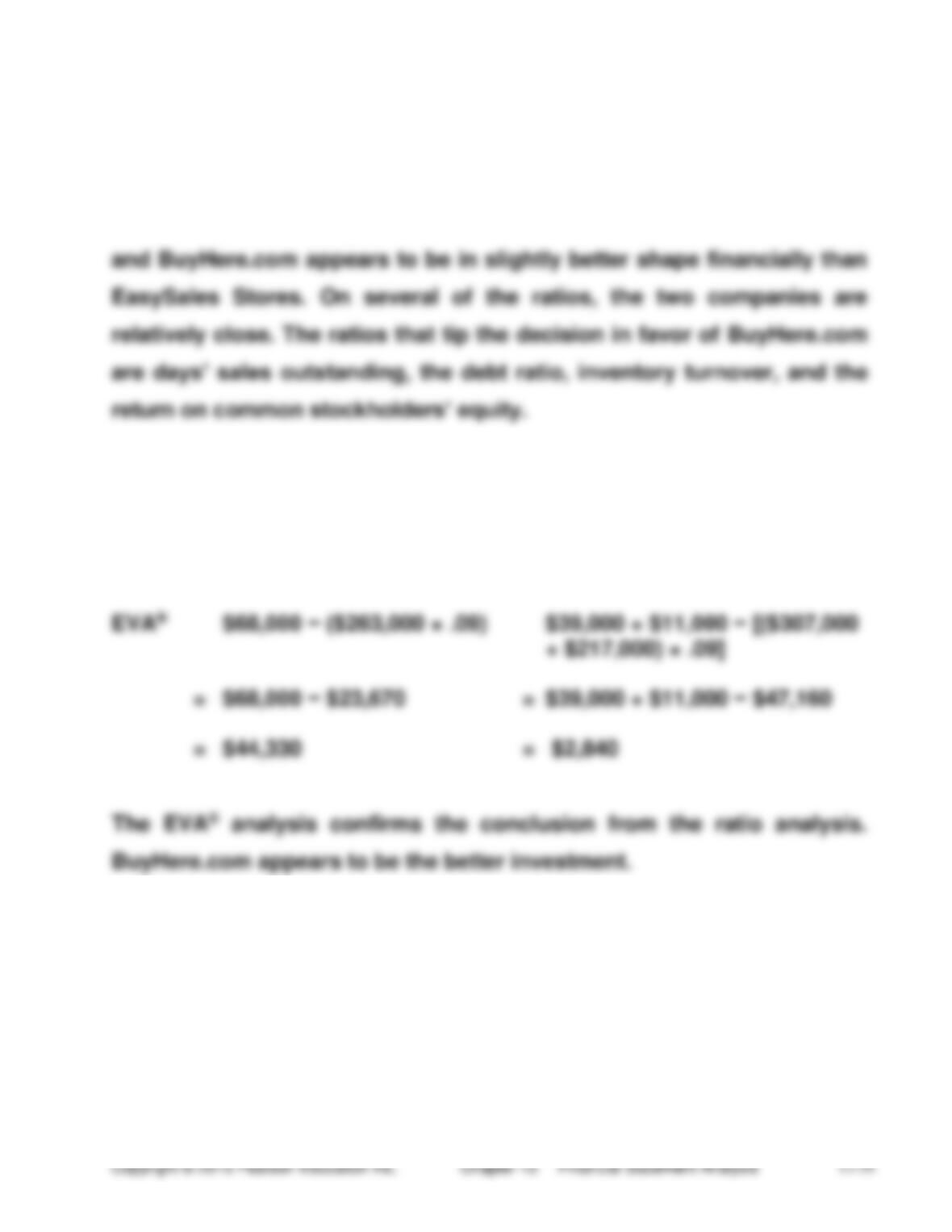
(Dollar Amounts and Stock Quantities in Thousands)
BuyHere.com
EasySales Stores
a.
Quick (acid-test)
$31 + $7 + $182
=
0.60
$36 + $11 + $165
=
0.64
ratio:
$368
$332
b.
Inventory
$455
=
2.21
$382
=
2.00
turnover:
($208 + $204) / 2
($184 + $198) / 2
c.
Days’ sales
($182 + $144) / 2
=
99
($165 + $192) / 2
=
125
outstanding:
$601 / 365
$523 / 365
d.
Debt ratio:
$665
=
0.68
$710
=
0.77
$984
$927
e.
Times-interest-
Ratio is not meaningful
$76
=
6.91
earned ratio:
because BuyHere has
$11
no interest expense.
f.
Return on
common
$68
=
0.23
$39 − ($20 × .06)
=
0.19
stockholders’
equity:
($319 + $263) / 2
[($217 − $20) +
($217 − $20)] / 2
g.
Earnings per
share
$68
=
$0.45*
$39 − ($20 × .06)
=
$3.78*
of common
stock:
150
10
h.
Price/earnings
$4.95*
=
10.9
$64.26*
=
17
ratio:
$.45*
$3.78*
*Not in thousands.
(continued) P 13-60B
Decision:
The common stock of BuyHere.com seems to fit the investment strategy
better. Its price/earnings ratio is lower than that of EasySales Stores,
Req. 2
BuyHere.com
EasySales Stores
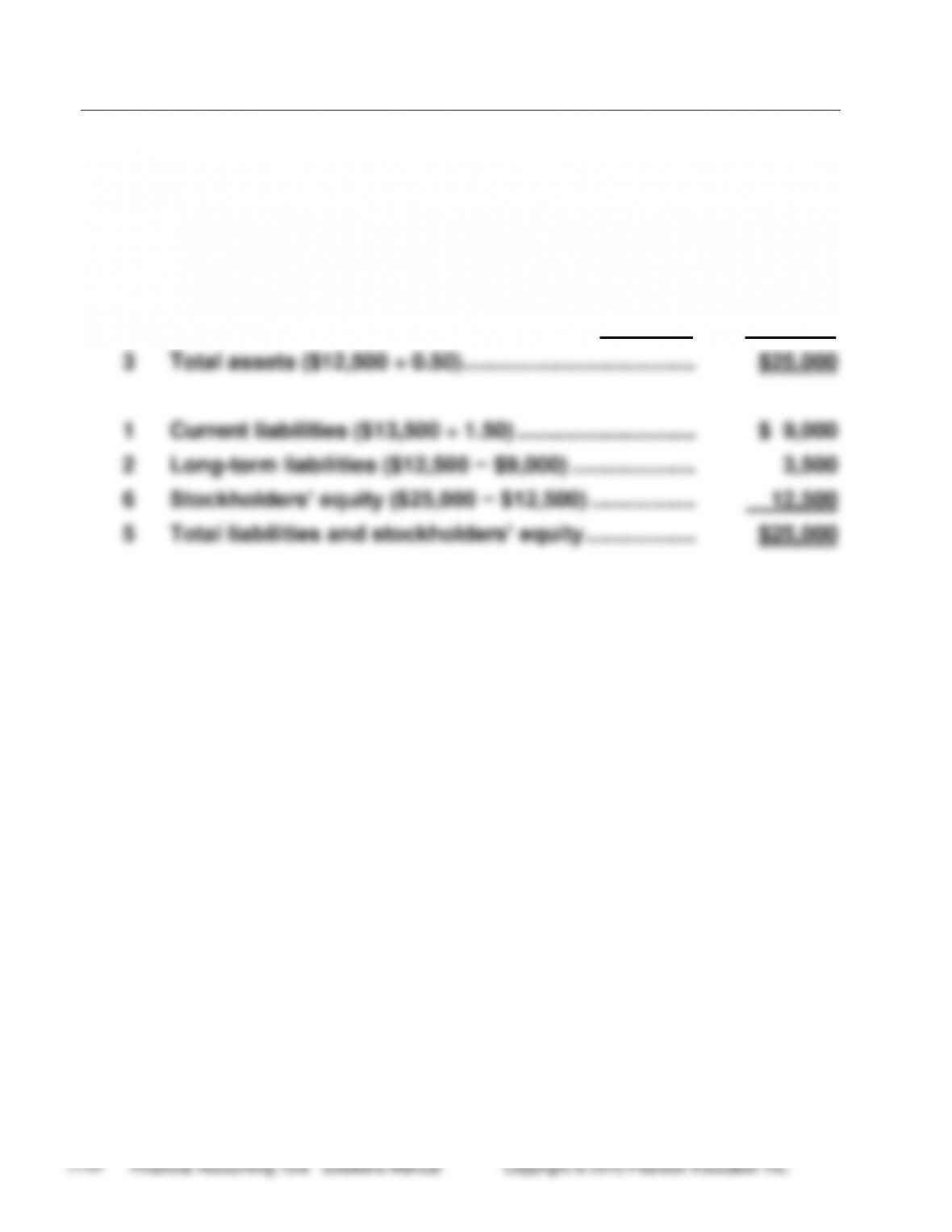
EVA®
$68,000 − ($263,000 × .09)
$39,000 + $11,000 − [($307,000
+ $217,000) × .09]
=
$68,000 − $23,670
=
$39,000 + $11,000 − $47,160
=
$44,330
=
$2,840
The EVA® analysis confirms the conclusion from the ratio analysis.
BuyHere.com appears to be the better investment.
Challenge Exercises and Problem
(20-30 min.) E 13-61
ORDER OF
COMPUTATION
Millions
Given
Current assets ……………………………………………………
$13,500
4
Property, plant, and equipment …………….
$13,100
Given
Less Accumulated depreciation ……………
(1,600)
11,500
3
Total assets ($12,500 ÷ 0.50) ………………………………..
$25,000
1
Current liabilities ($13,500 ÷ 1.50) ………………………..
$ 9,000
2
Long-term liabilities ($12,500 − $9,000) ………………..
3,500
6
Stockholders’ equity ($25,000 − $12,500) ……………..
12,500
5
Total liabilities and stockholders’ equity ………………
$25,000