(continued) Decision Case 1
Req. 4
Plan 1 appears to fit the plans of Smith and Jones better than Plan 2
because:
• Their primary goal is to raise as much capital as possible without
giving up control of the business. Under Plan 2, the outside
(15-20 min.) Decision Case 2
Req. 1
The stock dividend does not affect your proportionate ownership in the
company because all the stockholders receive 10% new shares. All
stockholders are in the same relative position after the dividends as they
were before.
Req. 2
Req. 3
You incur no loss in value because the market value of your investment
Req. 4
If the company continues paying the $0.715 cash dividend per share,
after issuing the 10% stock dividend, total cash dividends will increase.
(Your annual dividends will rise to $7,865 [11,000 shares × $0.715].) The
increase in dividends might attract new investors, who view the
Ethical Issue 1
Req. 1
The ethical issue is, “What is the correct amount at which to record and
disclose the value of the franchise on Campbell’s balance sheet?”
Req. 2 and Req.3
The stakeholders in the transaction include Campbell, the potential
Analysis of the decision to overvalue the franchise:
(a) Economic: Campbell is better off temporarily, unless potential
buyers sue him for damages, in which case he could be worse off.
(b) Legal: If potential buyers are damaged by Campbell’s actions, they
might sue him for recovery of those damages. In this situation, the
(continued) Ethical Issue 1
payments are lower than they should be. This could expose Campbell to
future investigations from the IRS.
(c) Ethical: This type of scheme is harmful to everyone involved. It is
Req. 4
The franchise should be valued at its true value, which is $50,000.
Ethical Issue 2
Req. 1
The ethical issue is whether the company acted properly in purchasing
their shares on the open market based on inside information known only
to them.
Req. 2 and Req. 3
Stakeholders include the company, its officers and directors, the
shareholders from whom the stock was purchased, and the general
public.
(a) Economic analysis: The company, and likely its officers and
directors, benefitted temporarily at the other shareholders’ expense.
(b) Legal analysis: If St. Genevieve is a public company, their actions
are illegal. The Securities Exchange Act of 1934 prohibits insider
(continued) Ethical Issue 2
prison. In addition, actions such as these have been the basis for
numerous civil stockholder lawsuits, to recover monetary damages
suffered because of the actions of the company.
Focus on Financials: Amazon.com, Inc.
(20-30 min.)
Req. 1
Amazon.com, Inc. has two classes of stock authorized at December 31,
2012:
Req. 2
Purchase of treasury stock during 2012 $960 million
Req. 3
The company earned and reported net loss of $39 million. It appears
first in the Consolidated Statements of Operations. It also appears as a
(continued) Amazon.com, Inc.
Req. 4
Amazon.com
Wal-Mart
Net
Profit
$(39)
=
–0.06%
$16,999
=
3.62%
Margin
ratio
$61,093
$469,162
Asset
$61,093
=
$61,093
=
2.11
$469,162
=
2.37
turnover
($32,555+
$25,278)/2
$28,917
(203,105 + 193,406)
/ 2
ROA
-0.06% x 2.11
=
–0.13%
3.62% x 2.37
=
8.58%
Leverage
$28,917
=
$28,917
=
3.63
$198,256
=
2.52
ratio
($8,192 +
$7,757) / 2
$7,975
($81,738 + $75,761)
/ 2
ROE
–0.13% x 3.63
=
–0.47%
8.58% x 2.52
=
21.62%
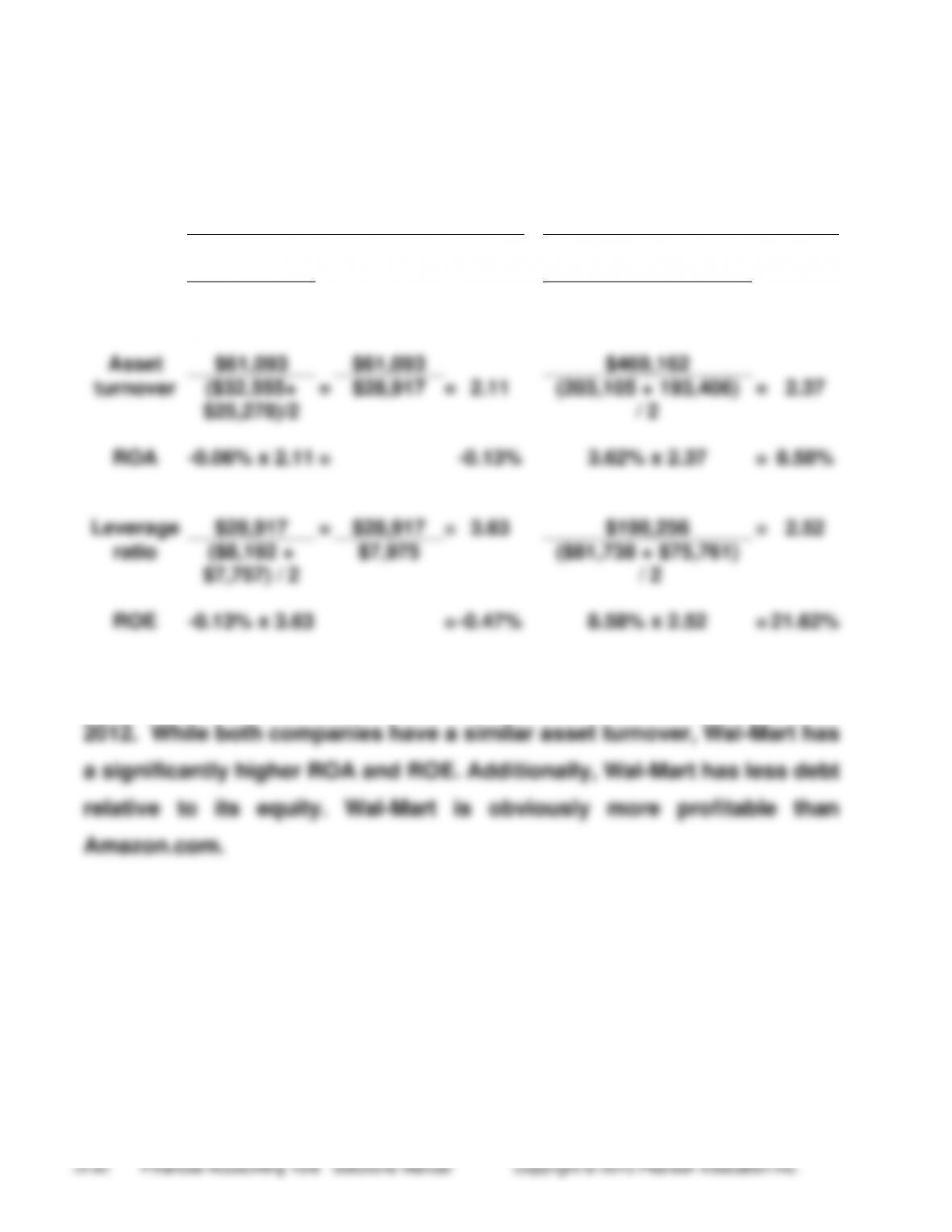
Amazon.com has negative ROA and ROE ratios due to its net loss in
Student answers may vary if another company is chosen for
comparison.
Focus on Analysis: YUM! Brands, Inc.
(20-30 min.)
Req. 1
YUM! Brands, Inc. has 750,000,000 shares of common stock authorized,
451,000,000 shares issued and outstanding.
Req. 2
YUM! Brands, Inc. purchased 15,000,000 shares of treasury stock for
$985,000,000($191,000,000 + $794,000,000). This represents an average
price of $65.67 per share.
The reasons why YUM! Brands purchased treasury might include:
(continued) YUM! Brands
Req. 3
YUM! Brands, Inc. issued 6,000,000 new shares to employees as part of
Req. 4
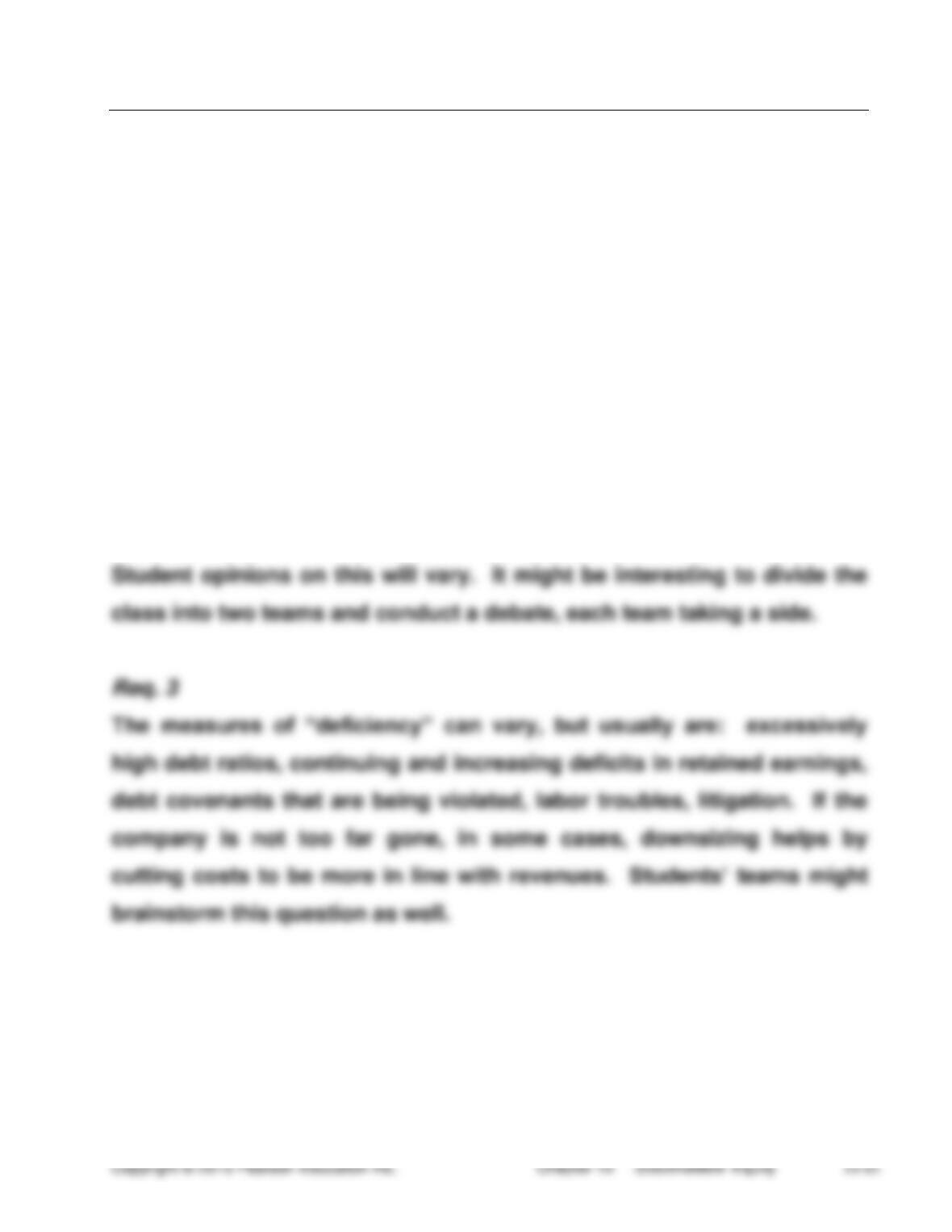
Retained Earnings
2,052 Beg. Balance
Purchase of
Treasury stock 794
1,597* Net Income
Dividends declared 569
2,286 End. Balance
*only controlling interest portion, see the consolidated statements of
shareholders’ equity.
Group Project in Ethics
(1-3 hours, including discussion)
Req. 1
Stakeholders in a corporation vary widely with the nature of the
corporation. In the case of the corporations included in this case (GM,
Chrysler, AIG, Citibank, Bank of America) because of their size and the
scope of their operations, stakeholders include the shareholders,
bondholders, other creditors, employees, suppliers, customers, local,
regional, national and international economies, federal, state and local
governments—just about everyone in the broadest sense of the term.
Req. 2
Req. 4
Student opinions on this will vary.
(continued) Group Project in Ethics
Req. 5
Student opinions on this will vary and should be related to the opinions
they express in requirement 4. This question has economic, political
and social ramifications. Some would say that government taking equity