
Chapter 10
Stockholders’ Equity
Short Exercises
(5–10 min.) S 10-1
Corporation’s advantages:
• Continuous life
• Transferability of ownership
• Limited liability of the stockholders
• Ease of raising capital
Corporation’s disadvantages:
• Double taxation of distributed profits
• Government regulation
• Separation of ownership and management
The authority structure of a corporation begins with shareholders, who
hold ultimate power. Shareholders elect the board of directors who in
turn appoint officers. The board elects a chairperson (CEO), who is
usually the most powerful person in the organization. The board
designates the president (COO) and various vice presidents.
(5-10 min.) S 10-2
1. The common stockholders are the real owners of a corporation.
2. Preferred stockholders have priority over common stockholders in (1)
3. Common stockholders benefit more from a successful corporation
because the preferred stockholders’ dividends are limited to a
specified amount. The common stockholders take more risk so their
potential for gains through an increase in the value of the company’s
(10 min.) S 10-4
Millions
Bragg Legal Services:
Cash …………………………………………………………..
19,831
Common Stock ……………………………………….
31
Additional Paid-in Capital ………………………..
19,800
Daylight Doughnuts:
Cash …………………………………………………………..
365
Common Stock ……………………………………….
365
(10 min.) S 10-5
Case A — Issue stock and buy the assets in separate transactions:
Journal
DATE
ACCOUNT TITLES AND EXPLANATION
DEBIT
CREDIT
Cash ………………………………………………..
756,000
Common Stock (17,000 × $25) ………
425,000
Paid-in Capital in Excess of Par —
Common ……………………………………..
331,000
Issued stock.
Building …………………………………………..
548,000
Equipment ……………………………………….
208,000
Cash …………………………………………..
756,000
Purchased plant assets.
Building …………………………………………..
548,000
Equipment ……………………………………….
208,000
Common Stock (17,000 × $25) ………
425,000
Paid-in Capital in Excess of Par —
Common ……………………………………..
331,000
Issued stock to acquire building and equipment.
The balances in all accounts are the same.
(5-10 min.) S 10-6
Thousands
Stockholders’ equity:
Common stock, $.01 par, 900 thousand shares
issued and outstanding …………………………………….
$ 9
Paid-in capital in excess of par ……………………………..
207
Retained earnings ………………………………………………..
643
Other stockholders’ equity ……………………………………
(27)
Total stockholders’ equity …………………………………….
$832
(10 min.) S 10-7
Amounts In Thousands
a.
Total revenues …………………………………………………………
$1,450
Total expenses ………………………………………………………..
836
Net income ………………………………………………………………
$ 614
b.
Accounts payable …………………………………………………….
$ 460
Other current liabilities …………………………………………….
2,562
Long-term debt ………………………………………………………..
23
Total liabilities …………………………………………………………
$3,045
c.
Total liabilities (from Req. b) …………………………………….
$3,045
Total stockholders’ equity (from S 10-6) ……………………
832
Total assets …………………………………………………………….
$3,877
d.
Net profit
margin ratio
=
Net income
Total revenues
$614
$1,450
=
.423
(continued) S 10-7
e.
Asset
turnover
Total revenues
Total assets
$1,450
$3,877
=
.37
f.
Leverage
ratio
Total assets
Total stockholders’ equity
$3,877
$832
=
4.66
g.
Return on
equity
Net income
Total stockholders’ equity
$614
$832
=
.74
(5 min.) S 10-8
Journal
DATE
ACCOUNT TITLES AND EXPLANATION
DEBIT
CREDIT
Millions
Treasury Stock……………………………………
34
Cash ……………………………………………..
34
Cash …………………………………………………
15
Treasury Stock ………………………………
6
Paid-in Capital from Treasury Stock
Transactions ……………………………..
9
(15-20 min.) S 10-9
Req. 1
MEMORANDUM
TO: Lucinda Lowery Exports, Inc., Board of Directors
FROM: Student Name
RE: How the purchase of treasury stock will make it more difficult
for outsiders to take over the company
Purchasing treasury stock decreases the amount of stock outstanding. If
Lucinda Lowery Exports holds a sufficient quantity of company stock in
the treasury, outsiders, such as the Alberton investor group, may not be
Req. 2
Sales of treasury stock at prices above the purchase price increase
company assets because of the greater amount of assets coming in
from the sale than went out to buy the stock. Treasury stock
(10 min.) S 10-10
Journal
DATE
ACCOUNT TITLES AND EXPLANATION
DEBIT
CREDIT
2014
Dec.
15
Retained Earnings
($200,000 × .06) + (36,000 × $.14) …………
17,040
Dividends Payable ………………………..
17,040
Declared a cash dividend.
2015
Jan.
4
Dividends Payable ……………………………..
17,040
Cash …………………………………………….
17,040
Paid the cash dividend.
1. $137,750 (95,000 shares × $1.45 per share)
2. Preferred: $137,750
(5-10 min.) S 10-12
Req. 1
Journal
DATE
ACCOUNT TITLES AND EXPLANATION
DEBIT
CREDIT
May
11
Retained Earnings (34,000 × .08 × $20) ………..
54,400
Common Stock (34,000 × .08 × $3) …………..
8,160
Paid-in Capital in Excess of Par-Common …
46,240
Req. 2
No effect on total assets.
No effect on total liabilities.
No effect on total stockholders’ equity.
(10 min.) S 10-13
Total stockholders’ equity …………………………..………………
$4,907,000
Less: Preferred stock ………………………………………………
(480,000)
Preferred dividends in arrears
(40,000 × .01 × $12 x 3) ………………………………..
(14,400)
Common equity ………………………………………………………….
$4,412,600
Number of common shares outstanding
(67,000 − 1,200) ………………………………………………
÷ 65,800
Book value per share of common stock ……………………….
$ 67.06
(5-10 min.) S 10-14
(a)
Rate of return on
total assets (ROA)
=
Net profit margin ratio x Asset turnover
(b)
Rate of return on
common
=
ROA x Leverage ratio
stockholders’
equity (ROE)
Req. 1
The components of ROA are net profit margin ratio and asset turnover.
Net profit margin ratio [(net income minus preferred dividends)/net sales]
Req. 2
The leverage ratio (average total assets/average common stockholders’
(10-15 min.) S 10-15
Req. 1
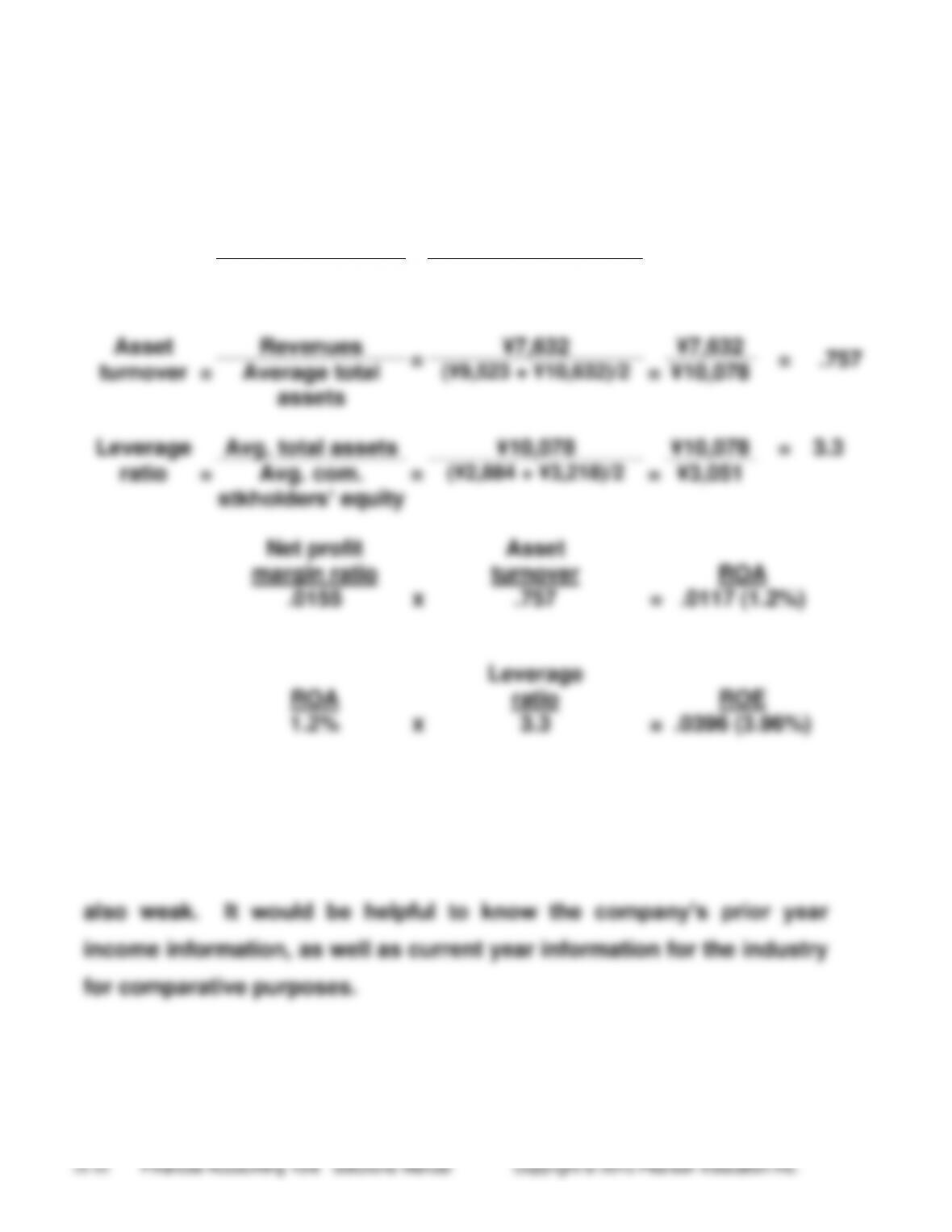
Net
profit
=
Net income
=
¥118
=
.0155
margin
Revenues
¥7,632
ratio
Asset
Revenues
=
¥7,632
¥7,632
=
.757
turnover
=
Average total
(¥9,523 + ¥10,632)/2
=
¥10,078
assets
Leverage
Avg. total assets
=
¥10,078
¥10,078
=
3.3
ratio
=
Avg. com.
stkholders’ equity
(¥2,884 + ¥3,218)/2
=
¥3,051
Net profit
Asset
margin ratio
turnover
ROA
.0155
x
.757
=
.0117 (1.2%)
Leverage
ROA
ratio
ROE
1.2%
x
3.3
=
.0396 (3.96%)
Req. 2
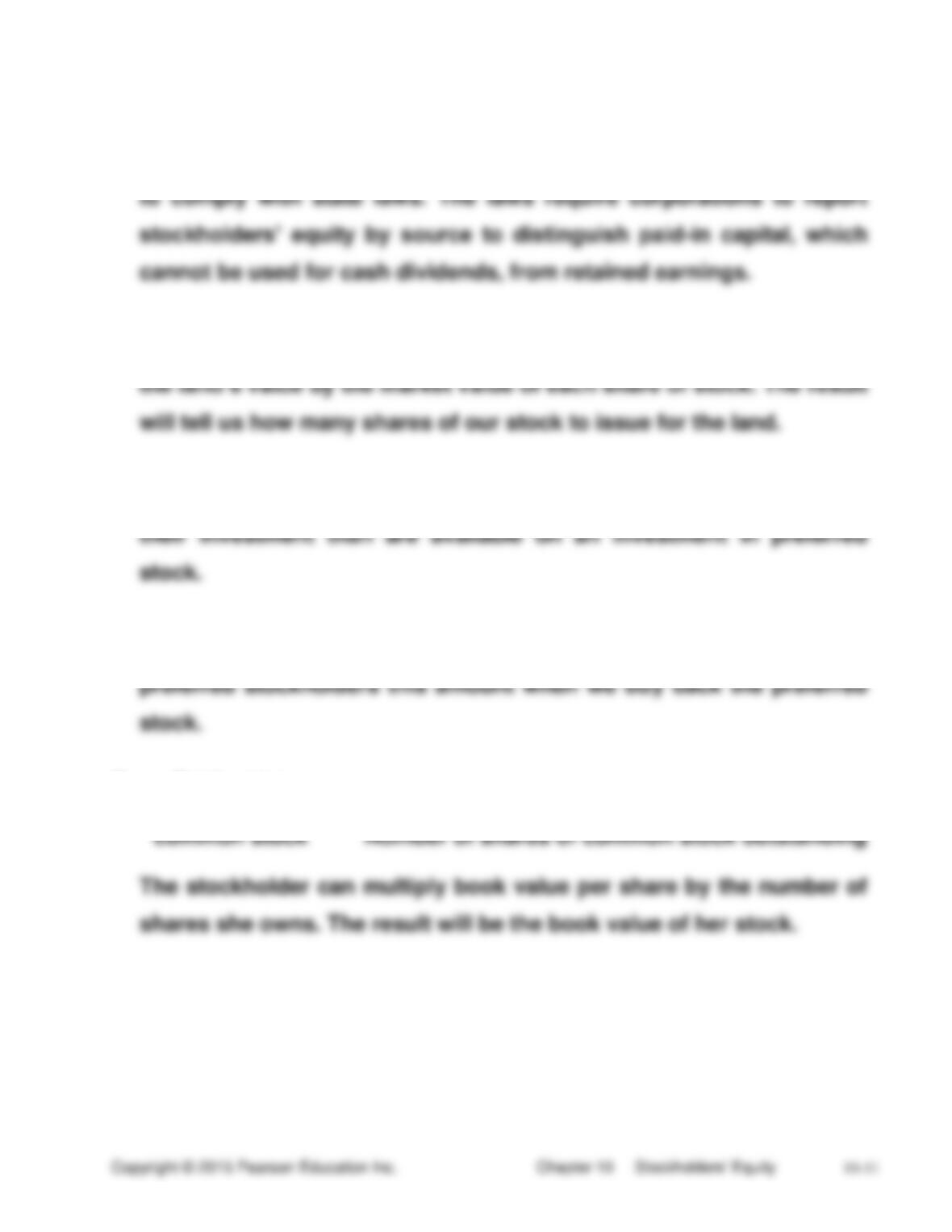
The company’s rate of return on total assets for 2014 is weak. The
company’s rate of return on common stockholders’ equity for 2014 is
(20-30 min.) S 10-16
1. Corporations report common stock and retained earnings separately
2. We should first determine the market value of the land. Then divide
3. Investors buy common stock in the hope of earning higher returns on
4. The redemption value of our preferred stock requires us to pay the
5.
Book value
per share of
=
Total stockholders’ equity − Preferred equity
common stock
Number of shares of common stock outstanding
(5-10 min.) S 10-17
Billions
Cash flows from financing activities:
Paid off long-term notes payable ……………………………….
$(3.1)
Issued common stock ……………………………………………….
2.4
Purchased treasury stock ………………………………………….
(3.9)
Paid cash dividends ………………………………………………….
(0.7)
Net cash used by financing activities……………………………..
$(5.3)
(10 min.) S 10-18
Req. 1
$1,510,000 ($320,000 + $1,190,000)
Req. 2
The stock dividend:
Req. 3
Req. 4
$76,000
Req. 5
Exercises
(10-15 min.) E 10-19A
Req. 1
Journal
DATE
ACCOUNT TITLES AND EXPLANATION
DEBIT
CREDIT
Apr.
23
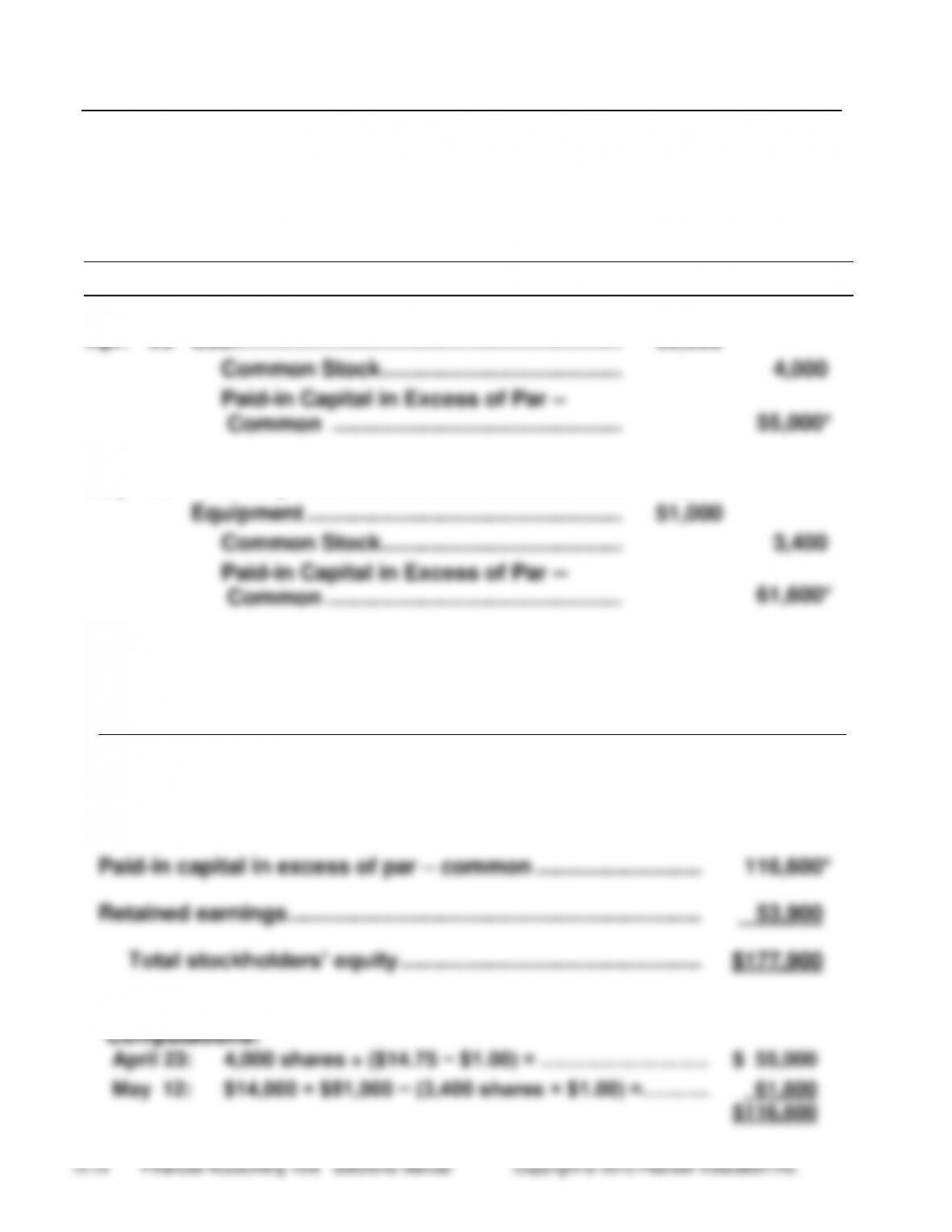
Cash …………………………………………………….
59,000
Common Stock …………………………………
4,000
Paid-in Capital in Excess of Par –
Common ………………………………………..
55,000*
May
12
Inventory ………………………………………………
14,000
Equipment ……………………………………………
51,000
Common Stock …………………………………
3,400
Paid-in Capital in Excess of Par —
Common …………………………………………
61,600*
Req. 2
Stockholders’ Equity
Common stock, $1.00 par, 18,000 shares authorized,
7,400 shares issued and outstanding ………………………..
$ 7,400
Paid-in capital in excess of par – common ………………………
116,600*
Retained earnings ………………………………………………………….
53,900
Total stockholders’ equity ………………………………………….
$177,900
_____
*Computations:
April 23: 4,000 shares × ($14.75 − $1.00) = …………………….
$ 55,000
May 12: $14,000 + $51,000 − (3,400 shares × $1.00) =……….
61,600
$116,600
(10 min.) E 10-20A
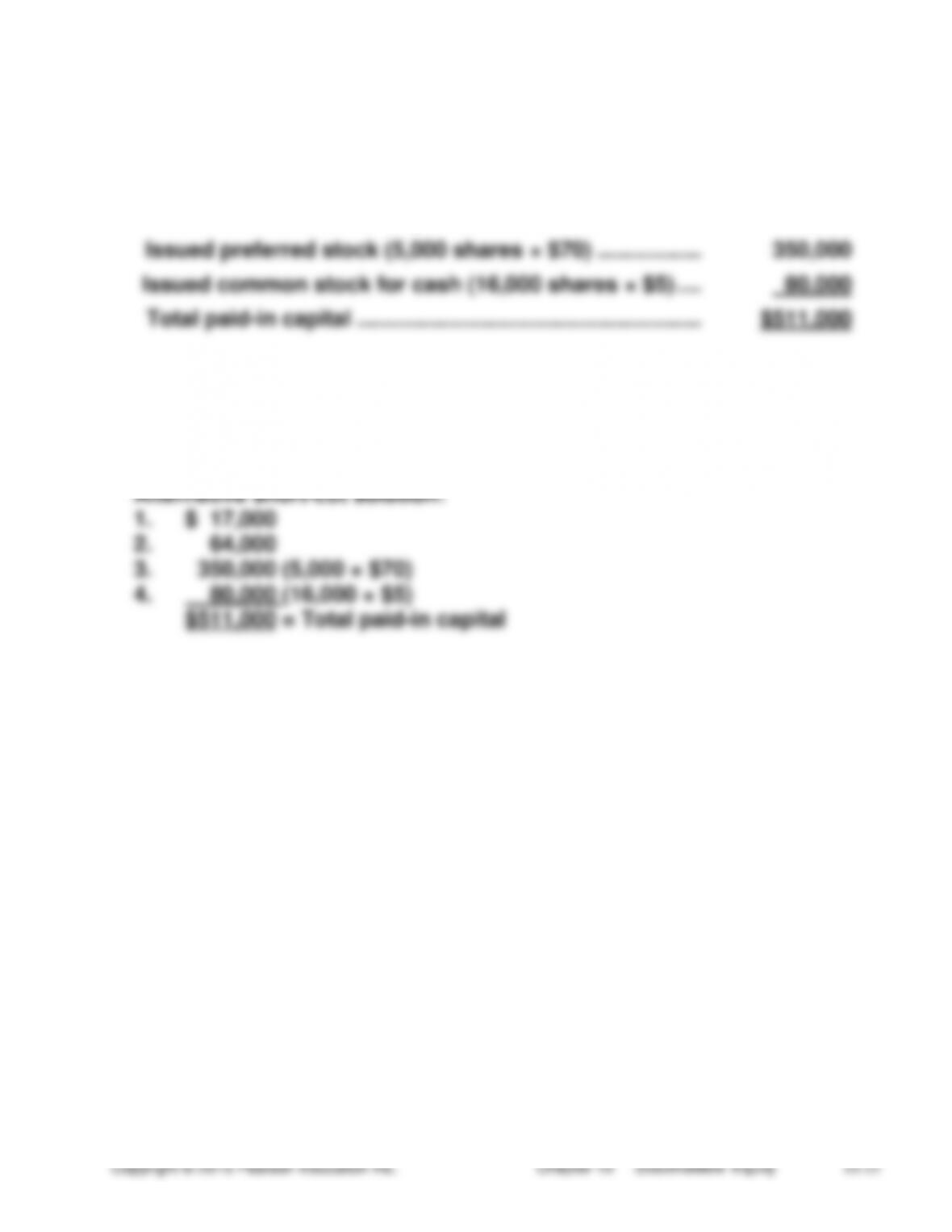
Paid-in capital consists of:
Issued common stock for legal services …………………..
$ 17,000
Issued common stock for patent ……………………………..
64,000
Issued preferred stock (5,000 shares × $70) ……………..
Issued common stock for cash (16,000 shares × $5) ….
350,000
80,000
Total paid-in capital ………………………………………………..
$511,000
Unused data:
Net income
Dividends declared
Alternative short-cut solution:
1.
$ 17,000
2.
64,000
3.
350,000 (5,000 × $70)
4.
80,000 (16,000 × $5)
$511,000 = Total paid-in capital
(10-15 min.) E 10-21A
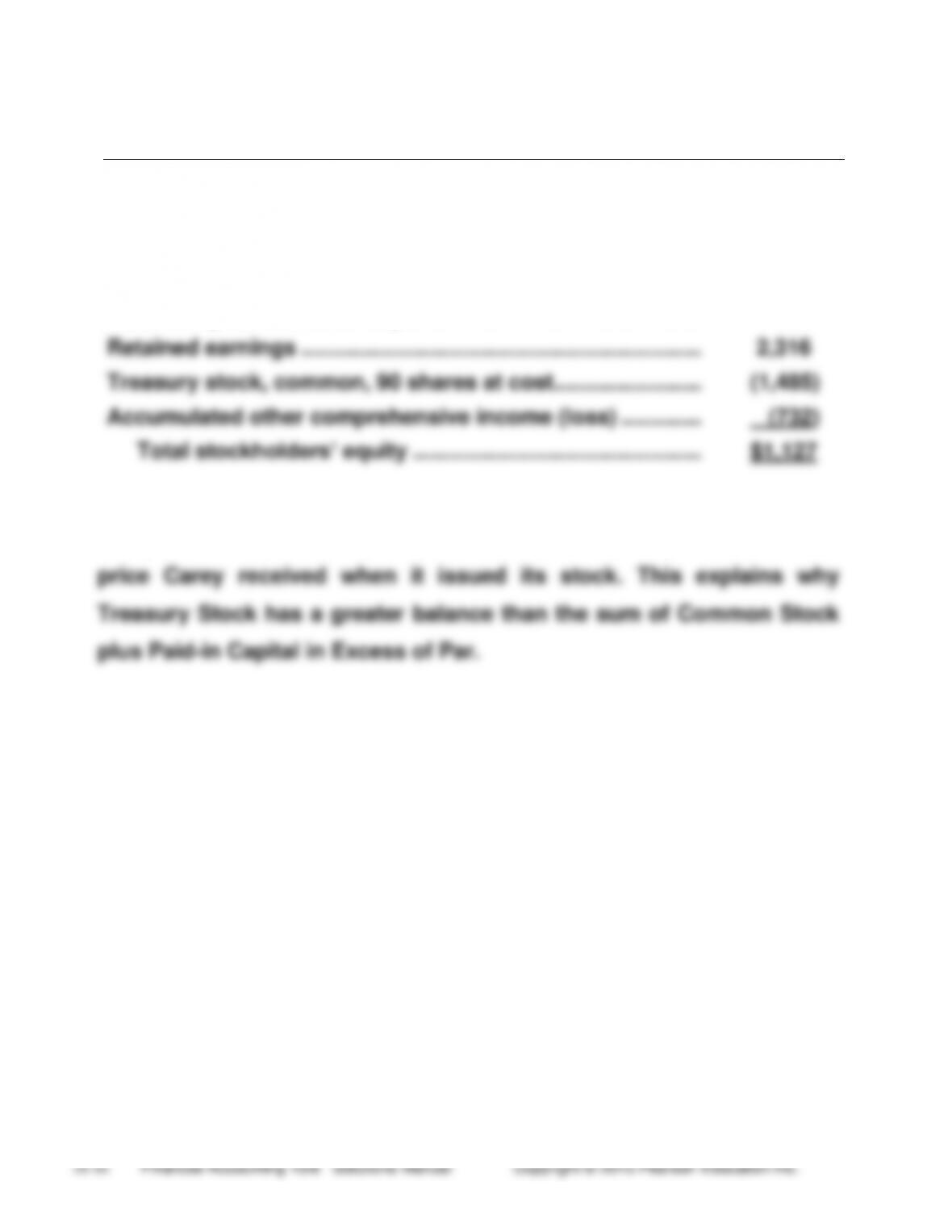
Stockholders’ Equity (Thousands)
Common stock, $0.25 par, 900 shares
authorized, 500 shares issued and 410 shares
outstanding ……………………………………………………………..
$ 125
Paid-in capital in excess of par ……………………………………..
903
Retained earnings ………………………………………………………..
2,316
Treasury stock, common, 90 shares at cost ……………………
(1,485)
Accumulated other comprehensive income (loss) ………….
(732)
Total stockholders’ equity ………………………………………..
$1,127
Carey Software paid a higher price to acquire treasury stock than the
(10 min.) E 10-22A
Req. 1
Journal
DATE
ACCOUNT TITLES AND EXPLANATION
DEBIT
CREDIT
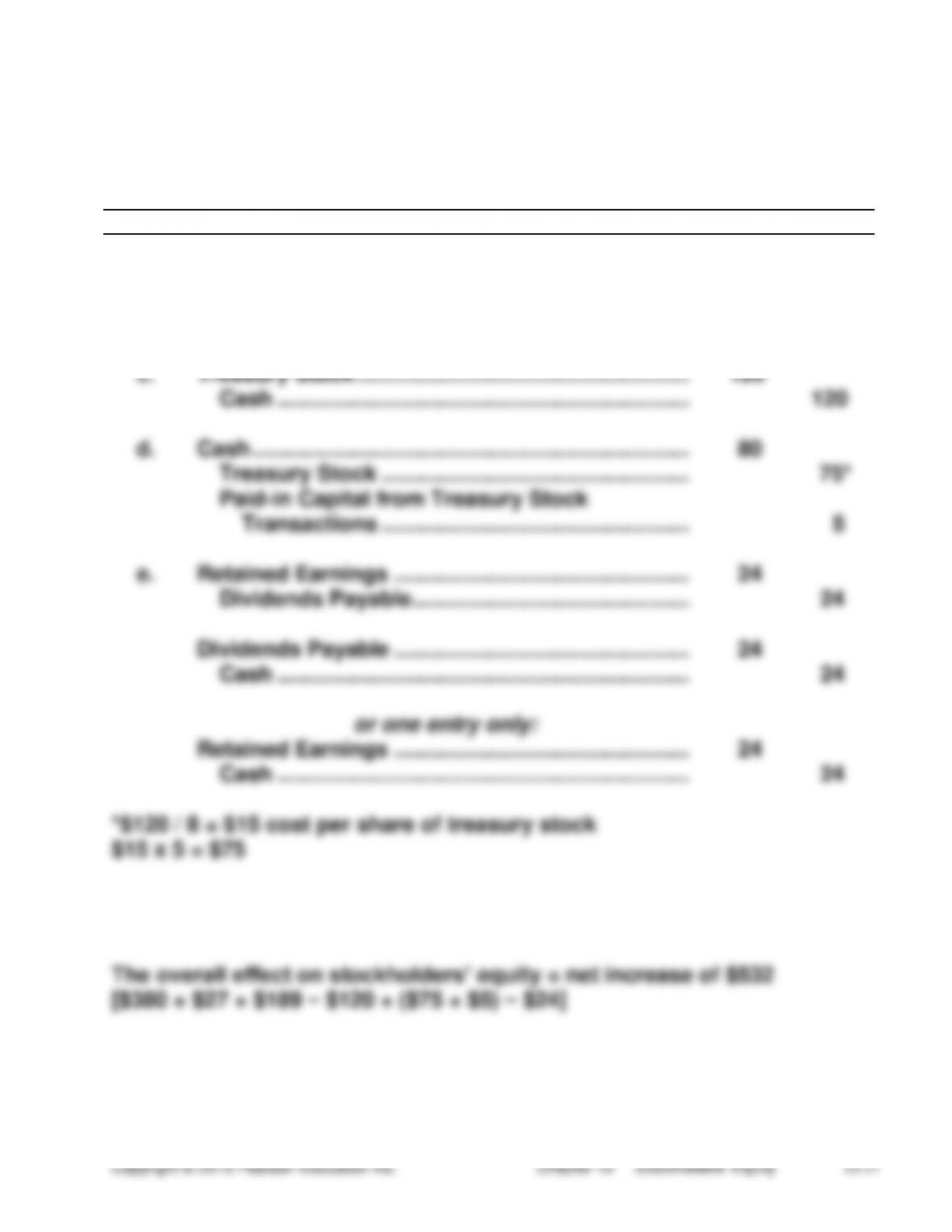
Millions
b.
Cash (18 million × $12.00) ………………………………
216
Common Stock (18 million × $1.50) ……………..
27
Paid-in Capital in Excess of Par Value ………….
189
c.
Treasury Stock ………………………………………………
120
Cash …………………………..……………………………..
120
d.
Cash ……………………………………………………….…….
80
Treasury Stock …………………………..………………
75*
Paid-in Capital from Treasury Stock
Transactions …………………………………………..
5
e.
Retained Earnings …………………………………………
24
Dividends Payable ………………………………………
24
Dividends Payable …………………………………………
24
Cash …………………………..……………………………..
24
or one entry only:
Retained Earnings …………………………………………
24
Cash …………………………..……………………………..
24
Req. 2
(10 min.) E 10-23A
Millions
Stockholders’ Equity:
Common stock, $1.50 par value,
2,418 million shares issued ($3,600 + $27) ……………….
$ 3,627
Paid-in capital in excess of par value ($7,200 + $189) ……
7,389
Paid-in capital from treasury stock transactions ………….
5
Retained earnings ($1,490 + $380 − $24) ………………………
1,846
Treasury stock, at cost ($85 + $120 − $75) ……………………
(130)
Total stockholders’ equity …………………………..………….
$12,737
(20-30 min.) E 10-24A
Req. 1
Possible causes for preferred stock decrease:
• Conversion of preferred stock into common stock
Req. 2
Possible causes for common stock increase:
Req. 3
(Millions
of shares
of stock)
Dec. 31, 2015
Common shares issued ………………………………………….
500
Less: Treasury stock, number of shares ………………….
(23)
Common shares outstanding ………………………………….
477
(continued) E 10-24A
Req. 4
Retained Earnings (Millions)
Dec. 31, 2014
Bal.
5,086
Dividends
251
Net income
1,350
Dec. 31, 2015
Bal.
6,185
Req. 5 (All amounts in millions)
December 31,
Purchases
2015
2014
During 2015
Cost of treasury stock ………………………..
$307
−
$121
=
$ 186
Treasury stock, number of shares ………
23
−
8
=
÷ 15
Average price per share paid for
treasury stock purchased during 2015 ………
$12.40