Chapter 23
Risk Management in Financial
Institutions
Managing Credit Risk
Screening and Monitoring
Long-Term Customer Relationships
Loan Commitments
Collateral
Compensating Balances
Credit Rationing
Managing Interest-Rate Risk
Income Gap Analysis
Duration Gap Analysis
Example of a Nonbanking Financial Institution
Some Problems with Income Gap and Duration Gap Analyses
The Practicing Manager: Strategies for Managing Interest-Rate Risk
◼ Overview and Teaching Tips
Risk management has become a major concern for managers of financial institutions in recent years. This
chapter provides an introduction to this subject which is useful for business students who will not take jobs
in the financial institutions industry, and it also provides a solid grounding for students who will go on to
pursue more advanced courses in risk management in financial institutions.
The section on managing credit risk is an excellent application of the basic concepts of adverse selection
and moral hazard to explain managerial practices in the financial institutions industry.
The section on managing interest rate risk introduces students to how interest-rate risk is measured and
then uses a Practicing Manager application to outline strategies for how to manage interest-rate risk. If
duration GAP analysis is covered, then it is necessary that the Practicing Manager application in Chapter 3
on duration be covered earlier in the course.
This chapter is really one big application of concepts introduced earlier in the course. Not only does it help
solidify students’ understanding of these concepts, but it also shows how these concepts are useful for
solving managerial problems that business students are likely to encounter in the real world.

Chapter 23: Risk Management in Financial Institutions 135
◼ Answers to End-of-Chapter Questions
1. Yes. By warning borrowers that they will not be able to get future loans if they engage in risky
2. Secured loans are an important method of lending for financial institutions because if the borrower
3. Uncertain. In some cases, raising rates may generate more income and thus increase profits. However,
4. To reduce adverse selection, a banker needs to screen out bad credit risks by learning as much as
5. Compensating balances can act as collateral. They also help establish long-term customer relationships,
which make it easier for the bank to collect information about prospective borrowers, thus reducing the
6. False. Although diversification is a desirable strategy for a bank, it may still make sense for a bank to
◼ Quantitative Problems
1. A bank issues a $100,000 variable-rate, 30-year mortgage with a nominal annual rate of 4.5%. If the
required rate drops to 4.0% after the first six months, what is the impact on the interest income for the
first 12 months?
Solution: At 4.5%, the required payment is calculated as:
First, calculate the interest for the first six months:
PMT = 506.685, N = 354, I = 4.5/12, FV = 0
136 Mishkin/Eakins • Financial Markets and Institutions, Eighth Edition
Copyright © 2015 Pearson Education, Inc.
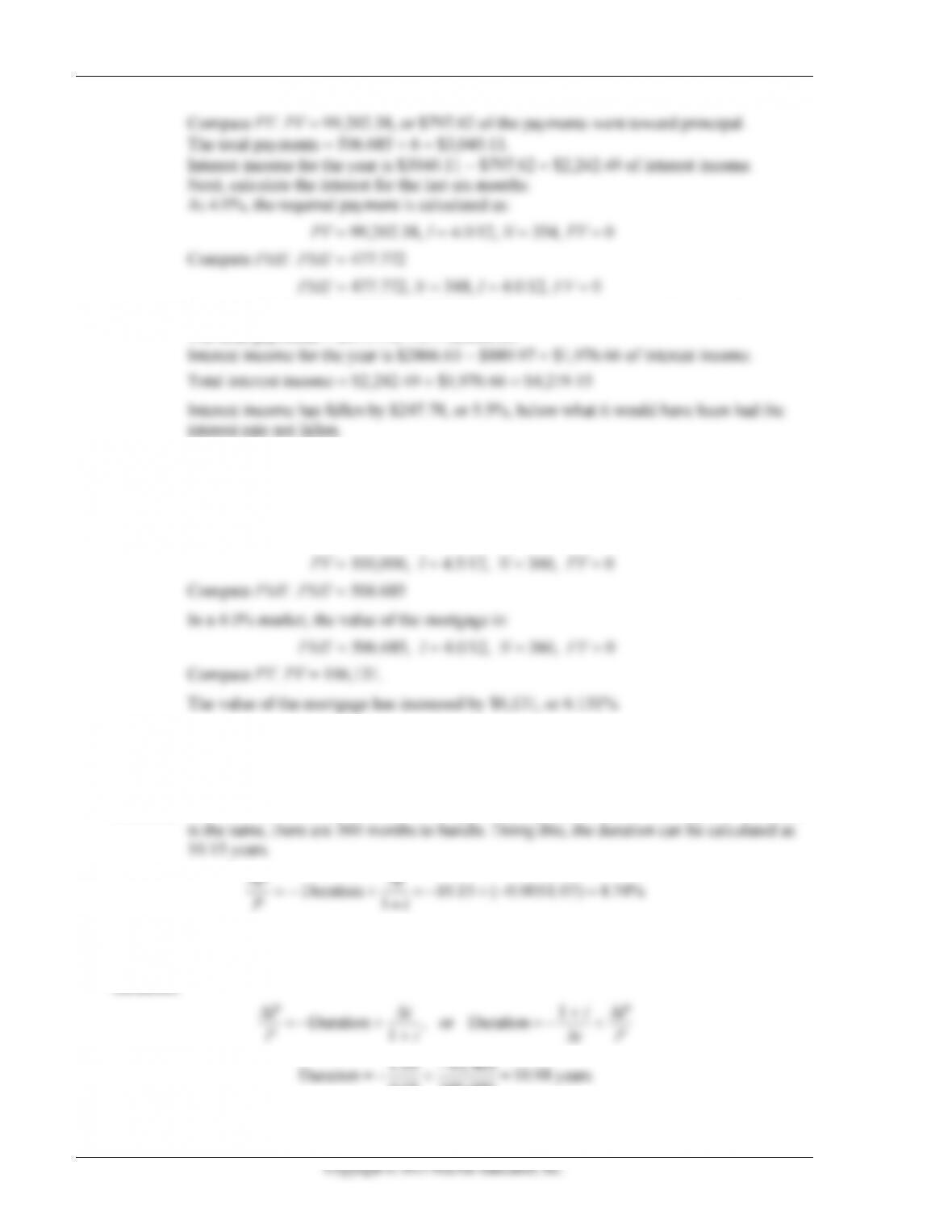
Compute PV. PV = 99,202.38, or $797.62 of the payments went toward principal.
The total payments = 506.685 6 = $3,040.11.
Interest income for the year is $3040.11 − $797.62 = $2,242.49 of interest income.
Next, calculate the interest for the last six months:
At 4.0%, the required payment is calculated as:
PV = 99,202.38, I = 4.0/12, N = 354, FV = 0
Compute PMT. PMT = 477.772
PMT = 477.772, N = 348, I = 4.0/12, FV = 0
Compute PV. PV = 98,312.41, or $889.97 of the payments went toward principal.
The total payments = $477.772 6 = $2,866.63.
2. A bank issues a $100,000 fixed-rate, 30-year mortgage with a nominal annual rate of 4.5%. If the
required rate drops to 4.0% immediately after the mortgage is issued, what is the impact on the value
of the mortgage?
Solution: At 4.5%, the required payment is calculated as:
3. Calculate the duration of a $100,000 fixed-rate, 30-year mortgage with a nominal annual rate of 7.0%.
What is the expected percentage change in value if the required rate drops to 6.5% immediately after
the mortgage is issued?
Solution: The duration calculation should be completed using a spreadsheet. Although the technique
1
Pi
+
4. The value of a $100,000 fixed-rate, 30-year mortgage falls to $89,537 when interest rates move from
5% to 6%. What is the approximate duration of the mortgage?
Solution:
1
Duration , or Duration
1
P i i P
P i i P
+
= − = −
+
1.05 10,463
Duration 10.98 years
0.01 100,000
−
= − =
Chapter 23: Risk Management in Financial Institutions 137
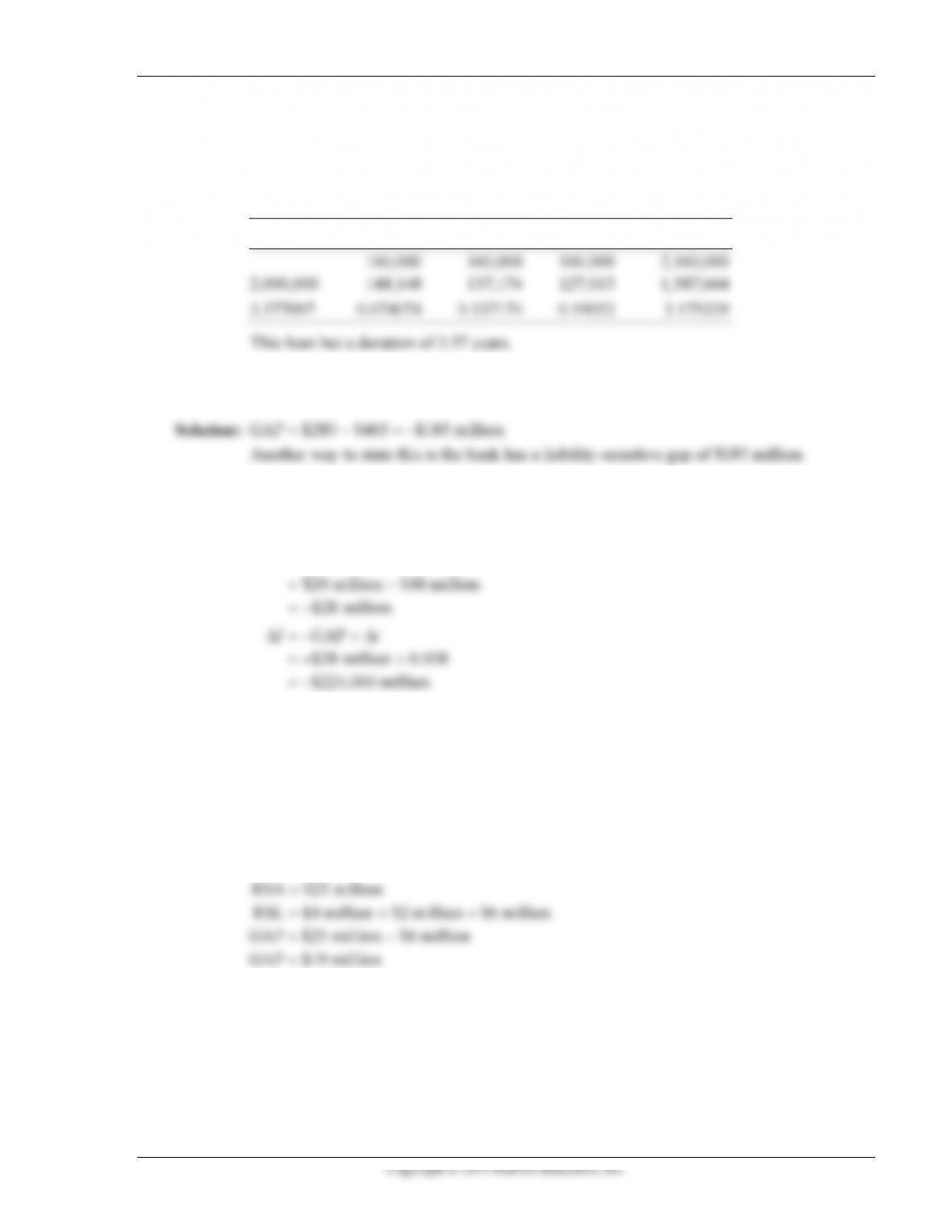
5. Calculate the duration of a commercial loan. The face value of the loan is $2,000,000. It requires simple
interest yearly, with an APR of 8%. The loan is due in four years. The current market rate for such
loans is 8%.
Solution: The annual interest is 0.08 $2,000,000 = $160,000
0
1
2
3
4
160,000
160,000
160,000
2,160,000
2,000,000
148,148
137,174
127,013
1,587,664
3.577097
0.074074
0.137174
0.19052
3.175329
This loan has a duration of 3.57 years.
6. A bank’s balance sheet contains interest-sensitive assets of $280 million and interest-sensitive
liabilities of $465 million. Calculate the income gap.
7. Calculate the income gap for a financial institution with rate-sensitive assets of $20 million and rate-
sensitive liabilities of $48 million. If interest rates rise from 4% to 4.8%, what is the expected change
in income?
Solution: GAP = RSA − RSL
8. Calculate the income gap given the following items:
• $8 million in reserves
• $25 million in variable-rate mortgages
• $4 million in checkable deposits
• $2 million in savings deposits
• $6 million of 2-year CD’s
Solution: GAP = RSA − RSL



140 Mishkin/Eakins • Financial Markets and Institutions, Eighth Edition
Solution:
15. The following financial statement is for the current year:
Second National Bank
Assets
Duration
Liabilities
Duration
Reserves
5,000,000
0.00
Checkable Deposits
15,000,000
2.00
Securities
Money Market
Deposits
5,000,000
0.10
1 Year
5,000,000
0.40
Savings Accounts
15,000,000
1.00
1 to 2 Years
5,000,000
1.60
CDs
2 years
10,000,000
7.00
Variables-rate
10,000,000
0.50
Residential Mortgages
1 Year
15,000,000
0.20
Variables-rate
10,000,000
0.50
1 to 2 Years
5,000,000
1.20
Fixed-rate
10,000,000
6.00
2 years
5,000,000
2.70
Commercial Loans
Interbank Loans
5,000,000
0.00
1 Year
15,000,000
0.70
Borrowings
1 to 2 Years
10,000,000
1.40
1 Year
10,000,000
0.30
2 years
25,000,000
4.00
1 to 2 Years
5,000,000
1.30
Buildings, etc.
5,000,000
0.00
2 years
5,000,000
3.10
Bank Capital
5,000,000
Total
$100,000,000
Total
$100,000,000
Calculate the duration gap for the bank.
Solution:
gap 2.695 (95/100 1.03) 1.7165
al
A