Chapter 18
Financial Regulation
Asymmetric Information and Financial Regulation
Government Safety Net
Global Box: The Spread of Government Deposit Insurance Throughout the World: Is This a
Good Thing?
Restrictions on Asset Holdings
Capital Requirements
Prompt Corrective Action
Financial Supervision: Chartering and Examination
Global Box: Where is the Basel Accord Heading After the Global Financial Crisis?
Assessment of Risk Management
Disclosure Requirements
Consumer Protection
Mini-Case Box: Mark-to-Market Accounting and the Global Financial Crisis
Restrictions on Competition
Macroprudential Versus Microprudential Supervision
Mini-Case Box: The Global Financial Crisis and Consumer Protection Regulation
Summary
E-Finance Box: Electronic Banking: New Challenges for Bank Regulation
Global Box: International Financial Regulation
The 1980s Savings and Loan and Banking Crisis
Federal Deposit Insurance Corporation Improvement Act of 1991
Banking Crises Throughout the World in Recent Years
“Déjà Vu All Over Again”
The Dodd-Frank Wall Street Reform and Consumer Protection Act of 2010
Dodd-Frank
Too-Big-to-Fail and Future Regulation
What Can Be Done About the Too-Big-to-Fail Problem?
Other Issues for Future Regulation
◼ Overview and Teaching Tips
This chapter stresses an analytic way of thinking by conducting an analysis using the adverse selection
and moral hazard concepts to show why our regulatory system takes the form it does and how it led to a
Chapter 18: Financial Regulation 107
banking crisis. The discussion in this chapter on the savings and loan and banking crisis of the 1980s is
very brief because it happened a long time ago. However, discussion of this episode is still relevant today
because many of the same forces that caused the banking and S&L crisis in the 1980s caused the recent
financial crisis as well as the bailout of Fannie Mae and Freddie Mac. Chapter 26, which can be found on
the companion web site describes this episode in more detail and also has a detailed discussion of the
principal-agent problem and how it explains the political economy of the banking crisis. I believe this
material is worth teaching even though it is past history because discussion of this material is highly
stimulating to students and helps them understand how our political system affects our economic system.
Like all of us, students enjoy reading about scandals, which is why the Charles Keating story in that web
chapter makes the principal-agent problem come alive.
The chapter ends with a discussion of the Dodd-Frank bill and then the too-big-to–fail problem and future
regulation. Instead of lecturing on this issue, I have the students themselves speculate on whether the
Dodd-Frank bill solves the too-big-to-fail problem and whether it will prevent a crisis like the recent
global financial crisis from ever happening again. This gets them to apply the concepts in this chapter and
makes for a very spirited discussion.
Note that Chapter 7 does not need to be covered in order to teach this chapter. However, if Chapter 7 is
covered in class, Chapter 18 is a nice application of the analysis in that chapter. Indeed, the instructor
might want to stress in class the counterparts in private financial markets to the methods bank regulators
use to cope with adverse selection and moral hazard.
◼ Answers to End-of-Chapter Questions
2. There would be adverse selection because people who might want to burn their property for some
3. Chartering banks is the bank regulation that helps reduce the adverse selection problem because
4. Regulations that restrict banks from holding risky assets directly decrease the moral hazard of risk
taking by the bank. Requirements that force banks to have a large amount of capital also decrease the
5. The benefits of a too-big-to-fail policy are that it makes bank panics less likely. The costs are that
6. Because off-balance-sheet activities do not appear on bank balance sheets, they cannot be dealt
with by simple bank capital requirements, which are based on bank assets, such as a leverage ratio.
108 Mishkin/Eakins • Financial Markets and Institutions, Eighth Edition
Copyright © 2015 Pearson Education, Inc.
requirement that banks set aside additional bank capital for different kinds of off-balance-sheet
activities.
Chapter 18: Financial Regulation 111
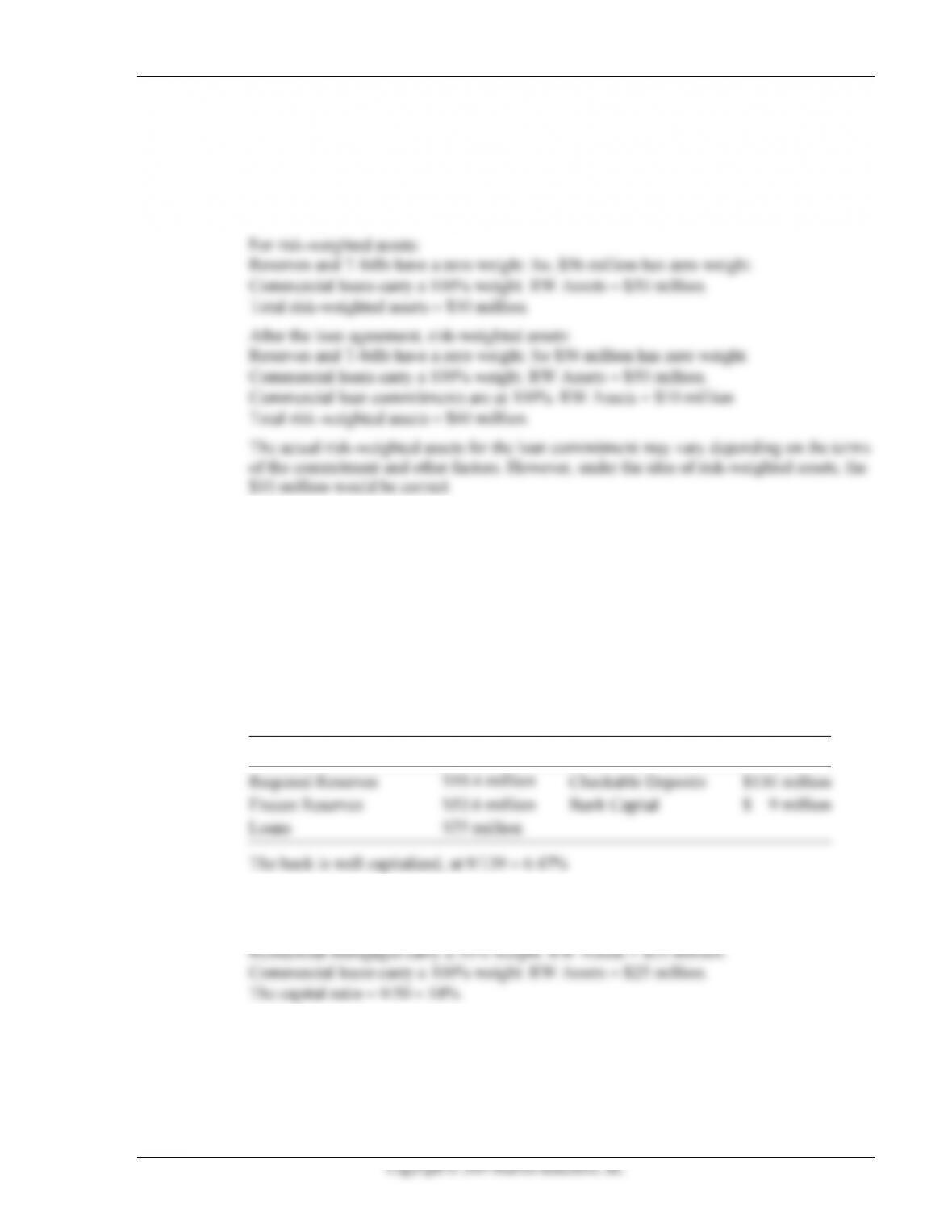
The bank commits to a loan agreement for $10 million to a commercial customer. Calculate the bank’s
capital ratio before and after the agreement. Calculate the bank’s risk-weighted assets before and after
the agreement.
Solution: Before the agreement, the capital ratio = 6/106 = 5.66%. Since the loan agreement has no
accounting transaction, the capital ratio is the same after.
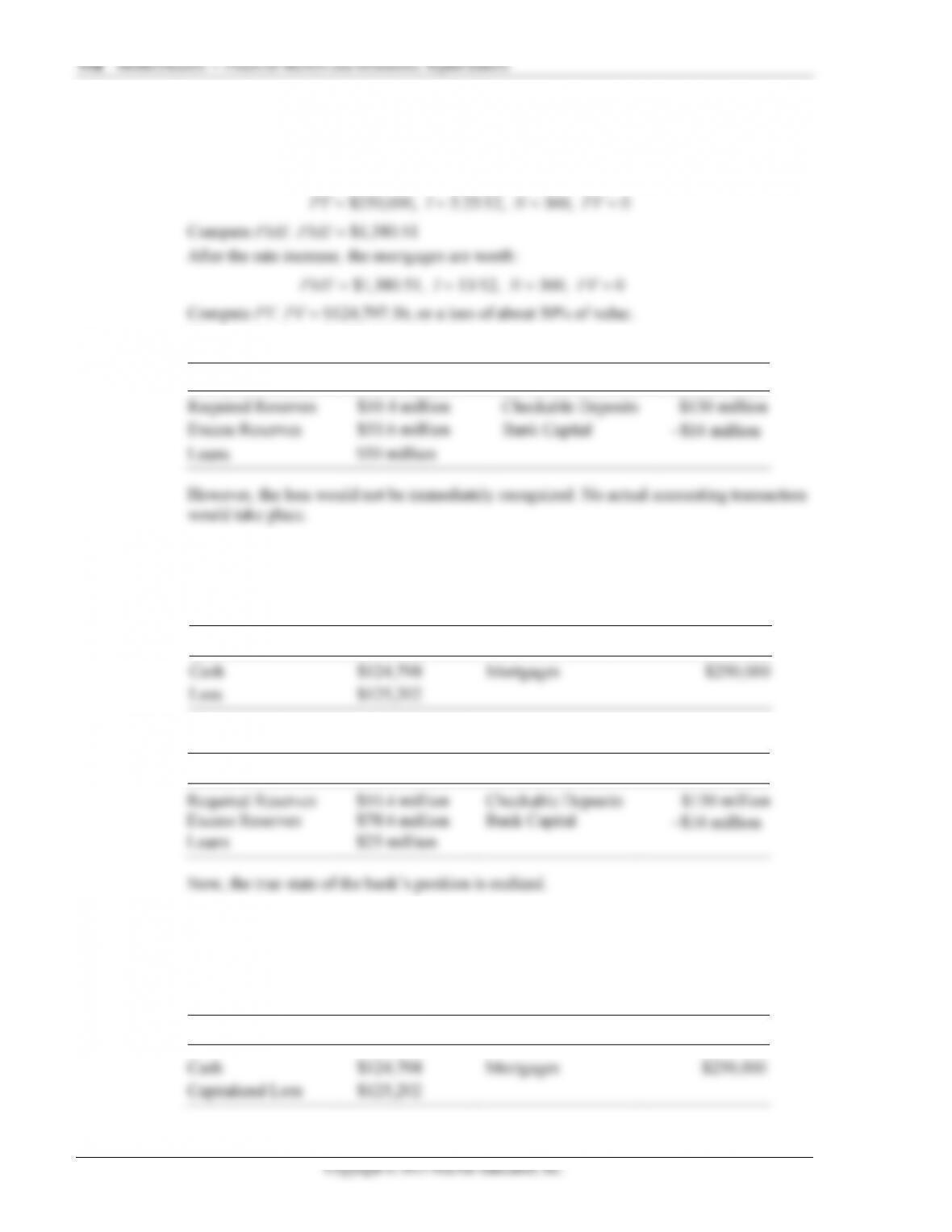
4. Oldhat Financial started its first day of operations with $9 million in capital. $130 million in
checkable deposits are received. The bank issues a $25 million commercial loan and another
$50 million in mortgages, with the following terms:
• mortgages: 200 standard 30-year, fixed-rate with a nominal annual rate of 5.25% each
for $250,000
• commercial loan: 3-year loan, simple interest paid monthly at 0.75%/month
If required reserves are 8%, what does the bank balance sheet look like? Ignore any loan loss
reserves. How well capitalized is the bank?
Solution:
Assets
Liabilities
Required Reserves
$10.4 million
Checkable Deposits
$130 million
Excess Reserves
$53.6 million
Bank Capital
$ 9 million
Loans
$75 million
The bank is well capitalized, at 9/139 = 6.47%
5. Calculate the risk-weighted assets and risk–weighted capital ratio of Oldhat’s first day.
Solution: Reserves have a zero weight. So, $64 million has zero weight.
Chapter 18: Financial Regulation 113
Then, each year for the next 30 years, the loss would be written off:
Debit
Credit
Loss (Expense)
$4,173.40
Capitalized Loss
$4,173.40
After the fact, the actual balance sheet is now:
Assets
Liabilities
Required Reserves
$10.4 million
Checkable Deposits
$130 million
Excess Reserves
$78.6 million
Bank Capital
$ 9 million
Capitalized Loss
$25 million
Loans
$25 million
The bank is again well capitalized, at 9/139 = 6.47%
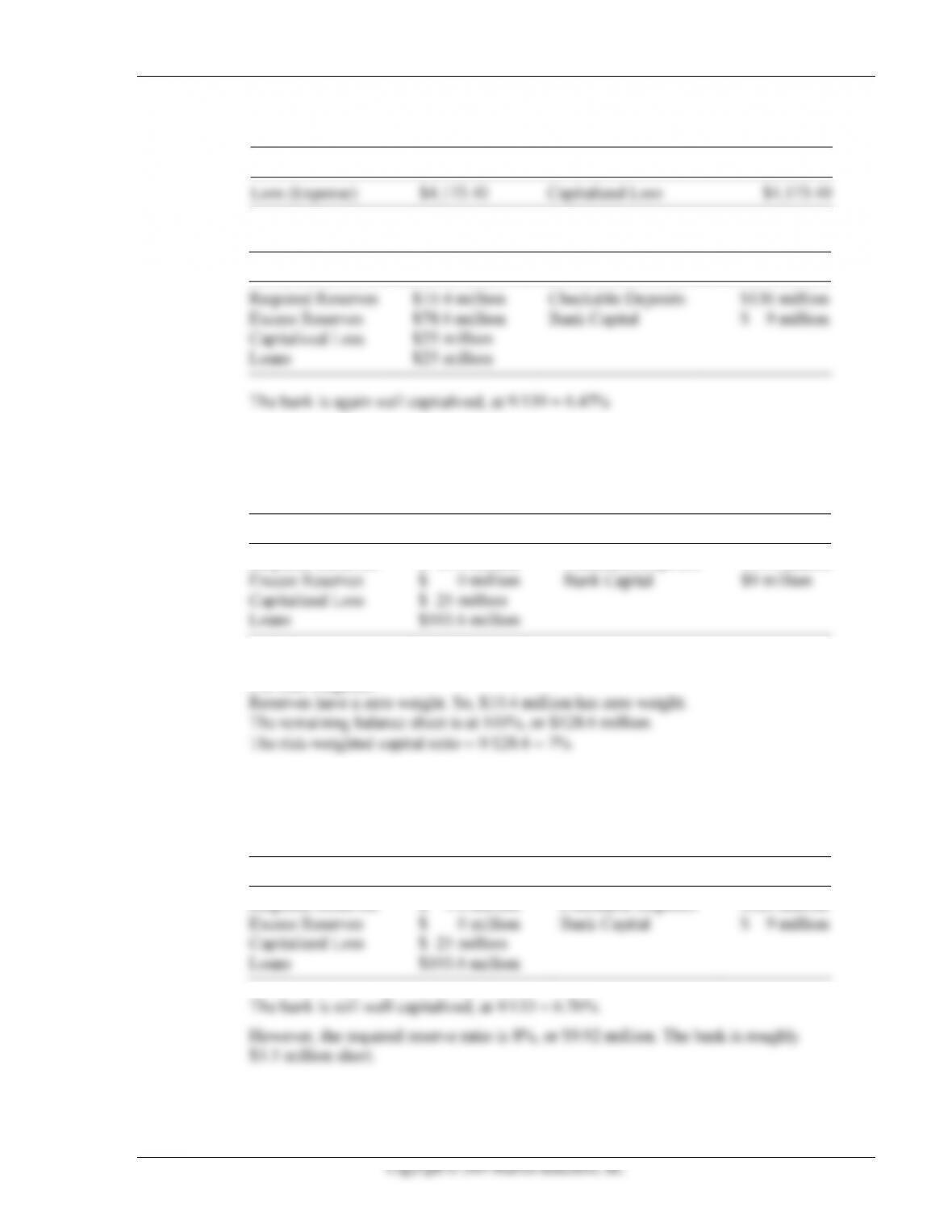
9. Oldhat decides to invest the $78.6 million in excess reserves in commercial loans. What will be the
impact on its capital ratio? Its risk-weighted capital ratio?
Solution: With the commercial loan, the balance sheet is now:
Assets
Liabilities
Required Reserves
$ 10.4 million
Checkable Deposits
$130 million
Excess Reserves
$ 0 million
Bank Capital
$9 million
Capitalized Loss
$ 25 million
Loans
$103.6 million
The bank is still well capitalized, at 9/139 = 6.47%.
For risk-weighted:
10. The bad news about the mortgages is featured in the local newspaper, causing a minor bank run.
$6 million is deposits are withdrawn. Examine the bank’s condition.
Solution: The balance sheet is now:
Assets
Liabilities
Required Reserves
$ 4.4 million
Checkable Deposits
$124 million
Excess Reserves
$ 0 million
Bank Capital
$ 9 million
Capitalized Loss
$ 25 million
Loans
$103.6 million
The bank is still well capitalized, at 9/133 = 6.76%.
However, the required reserve ratio is 8%, or $9.92 million. The bank is roughly
$5.5 million short.