Chapter 16
The International Financial System
Intervention in the Foreign Exchange Market
Foreign Exchange Intervention and the Money Supply
Inside the Fed Box: A Day at the Federal Reserve Bank of New York’s
Foreign Exchange Desk
Unsterilized Intervention
Sterilized Intervention
Balance of Payments
Global Box: Why the Large U.S. Current Account Deficit Worries Economists
Exchange Rate Regimes in the International Financial System
Fixed Exchange Rate Regimes
How a Fixed Exchange Rate Regime Works
The Policy Trilemma
Monetary Unions
Global Box: Will the Euro Survive?
Currency Boards and Dollarization
Global Box: Argentina’s Currency Board
Speculative Attacks
Managed Float
Global Box: Dollarization
Case: The Foreign Exchange Crisis of September 1992
The Practicing Manager: Profiting from a Foreign Exchange Crisis
Case: How Did China Accumulate Over $3Trillion of International Reserves?
Capital Controls
Controls on Capital Outflows
Controls on Capital Inflows
The Role of the IMF
Should the IMF Be an International Lender of Last Resort?
How Should the IMF Operate?
Chapter 16: The International Financial System 93
◼ Overview and Teaching Tips
Chapter 16 shows why international financial transactions have important implications for the conduct of
monetary policy. The beginning of the chapter explains how foreign exchange market intervention affects
both the exchange rate, a country’s international reserves, and the money supply. It then discusses the
balance of payments, but this sometimes dry topic can be spiced up for students by a discussion of the
material in the box on why large current account deficits worry economists.
The chapter then goes on to discuss how fixed exchange rate systems work. Three applications in this
section make the material come alive for students. The first examines the September 1992 foreign
exchange crisis, while the second discusses how China has accumulated over
$3 trillion of international reserves, a subject of great interest to students. These applications capture the
imagination of students because huge profits were made during the 1992 foreign exchange crisis, and they
are curious about how a poor country like China became one of the world’s largest holders of international
reserves and U.S. Treasury securities.. These applications also give students further practice with the
model of the foreign exchange market developed in Chapter 15.
◼ Answers to End-of-Chapter Questions
1. The purchase of dollars involves a sale of foreign assets which means that international reserves fall.
2. The purchase of dollars involves a sale of foreign assets, which means that international reserves fall
and the monetary base decreases. The resulting fall in the money supply causes interest rates to rise
3. a. A receipt in the capital account;
b. a payment in the current account;
4. Because other countries often intervene in the foreign exchange market when the United States has a
5. The increase in British productivity would create a tendency for the pound to appreciate relative to
the dollar. The higher value of the pound would now cause Americans to exchange dollars for gold,
94 Mishkin/Eakins • Financial Markets and Institutions, Eighth Edition
Copyright © 2015 Pearson Education, Inc.
rate back down to its par level because it would cause the price level to rise, which would lead to a
depreciation of the pound.
6. Two euros per dollar.
7. The situation would be as depicted in Figure 2, Panel (b). The central bank would need to sell domestic
currency and buy foreign assets, thus increasing its international reserves and the monetary base.
8. A large balance-of-payments surplus may require a country to finance the surplus by selling its currency
9. True, because when the exchange rate is falling, the central bank must buy its currency, which lowers
its holdings of international reserves and its monetary base. Similarly, when the exchange rate is
10. Countries may implement a contractionary monetary policy when they decide to intervene in the
11. False. As seen in the chapter, a reserve currency country, such as the United States, can have its
12. When other countries buy U.S. dollars to keep their exchange rates from changing vis-à-vis the dollar
13. False. Inflation occurred when the world was under the gold standard before World War I. The gold
14. There are no direct effects on the money supply because there is no central bank intervention in a pure
flexible exchange rate regime; therefore, changes in international reserves that affect the monetary
15. Uncertain. Although after 1973, countries no longer must intervene in the foreign exchange market to
keep their currencies at a par level and so could pursue more independent monetary policy, they have
Chapter 16: The International Financial System 95
Copyright © 2015 Pearson Education, Inc.
exchange market. Thus they continue to have substantial fluctuations in international reserves, which
affect their money supply.
16. Although capital outflows can harm a country when they lead to a devaluation of the domestic
currency, controls in capital outflows are generally not thought to be a good idea. They are seldom
17. By keeping out capital inflows, there may be less speculative capital to flow out during a crisis and a
lower likelihood that capital inflows will fuel a lending boom and excessive risk-taking on the part of
18. Engaging in a lender-of-last resort operation is likely to weaken the credibility of the central bank and
lead to inflation and an even larger depreciation of the domestic currency. Because debt is short-term
19. Some critics think not. They believe that IMF lending which was used to bail out foreign lenders makes
financial crises more likely. These lenders then expect to be bailed out and thus provided funds that were
20. The international lender of last resort needs to make it clear that it will extend liquidity only to
◼ Quantitative Problems
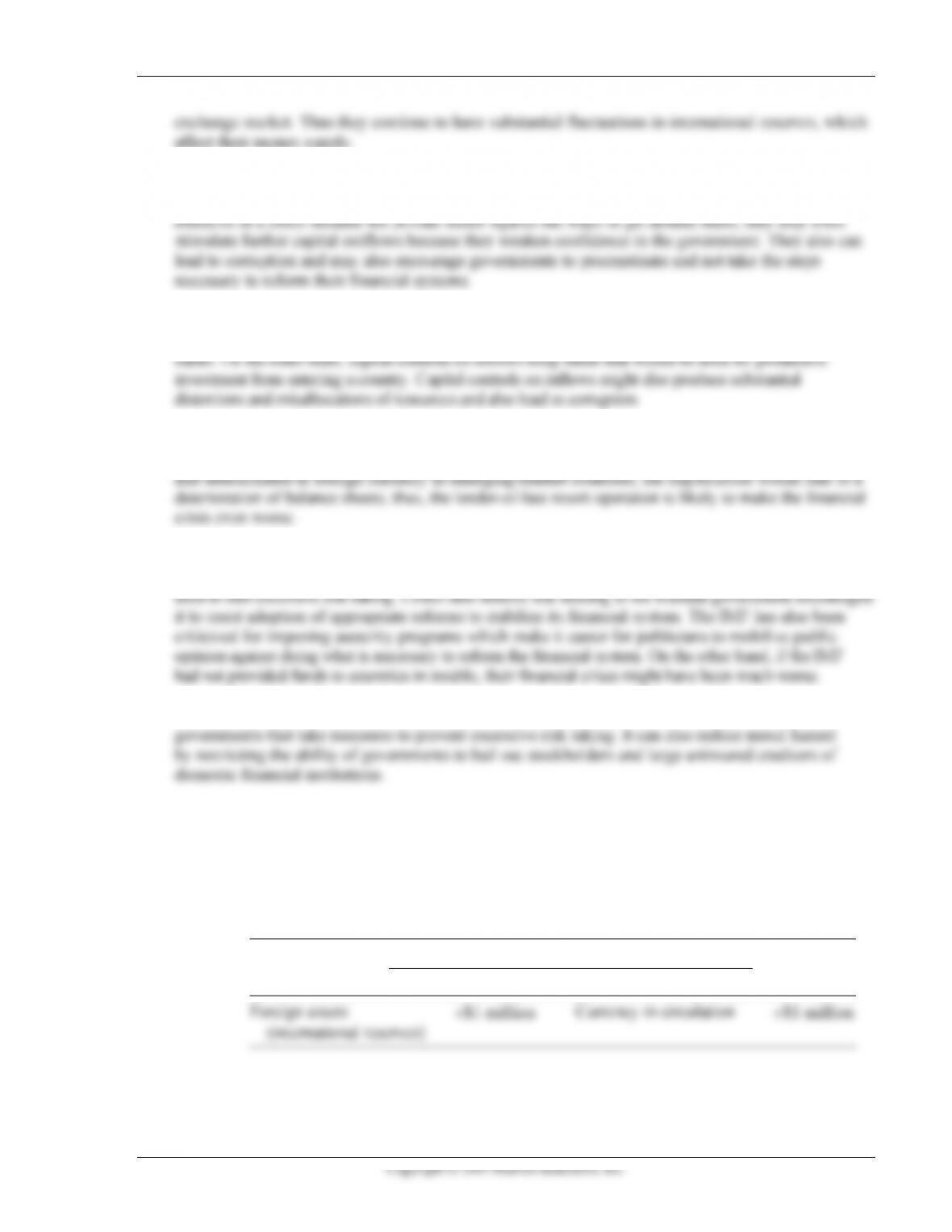
1. The Federal Reserve purchases $1,000,000 of foreign assets for $1,000,000. Show the effect of this
open market operation using T-accounts.
Solution:
Federal Reserve System
Assets
Liabilities
Foreign assets
+$1 million
Currency in circulation
+$1 million
(international reserves)