
Chapter 11
The Money Markets
The Money Markets Defined
Why Do We Need the Money Markets?
Money Market Cost Advantages
The Purpose of the Money Markets
Who Participates in the Money Markets?
U.S. Treasury Department
Federal Reserve System
Commercial Banks
Businesses
Investment and Securities Firms
Individuals
Money Market Instruments
Treasury Bills
Case: Discounting the Price of Treasury Securities to Pay the Interest
Mini Case Box: Treasury Bill Auctions Go Haywire
Federal Funds
Repurchase Agreements
Negotiable Certificates of Deposit
Commercial Paper
Banker’s Acceptances
Eurodollars
Global Box: Ironic Birth of the Eurodollar Market
Comparing Money Market Securities
Interest Rates
Liquidity
How Money Market Securities are Valued
58 Mishkin/Eakins • Financial Markets and Institutions, Eighth Edition
◼ Overview and Teaching Tips
This chapter explores the institutional features of the money markets. The money market is the market for
debt securities issued with the original maturities of less than one year and a high degree of liquidity. They
are usually sold in large denominations and have low default risk. The chapter shows why money markets
are needed and their purpose to the government, firms, financial institutions, and individuals. The money
market is an interim investment that provides a higher return than holding cash or money in the bank but
less than what is usually expected from long-term investments.
There are several players in the money market which include the U.S. Treasury Department, the Federal
Reserve, commercial banks, businesses, investment firms, and individuals. All participants work on both
sides of the market except for the U.S. Treasury Department, which is always a demander and never a
supplier of the money market. The participants use a variety of money market instruments to diversify
their needs. This section shows that most of these securities are short term and low risk. Point out to
students the international aspect of the use of Eurodollars so they get a broader view of securities around
the world. The securities also have several characteristics that are similar and different. Discuss with the
students the characteristics of interest rates, maturity, and liquidity.
The final section deals with how money market securities are valued.
◼ Answers to End-of-Chapter Questions
1. The money markets can be characterized as having securities that trade in one year or less, are of
large denomination, and are very liquid.
3. Banks have higher costs than the money market owing to the need to maintain reserve requirements.
4. Term securities have a specific maturity date. Demand securities can be redeemed at any time. A six-
month certificate of deposit is a term security. A checking account is a demand security.
5. Following the Great Depression, regulators were primarily concerned with stopping banks from failing.
6. The U.S. government sells large numbers of securities in the money markets to support government
7. Businesses both invest and borrow in the money markets. They borrow to meet short-term cash flow
8. Merrill Lynch initially felt that it could better service it’s regular customers by making it easier to buy
Chapter 11: The Money Markets 61
Copyright © 2015 Pearson Education, Inc.
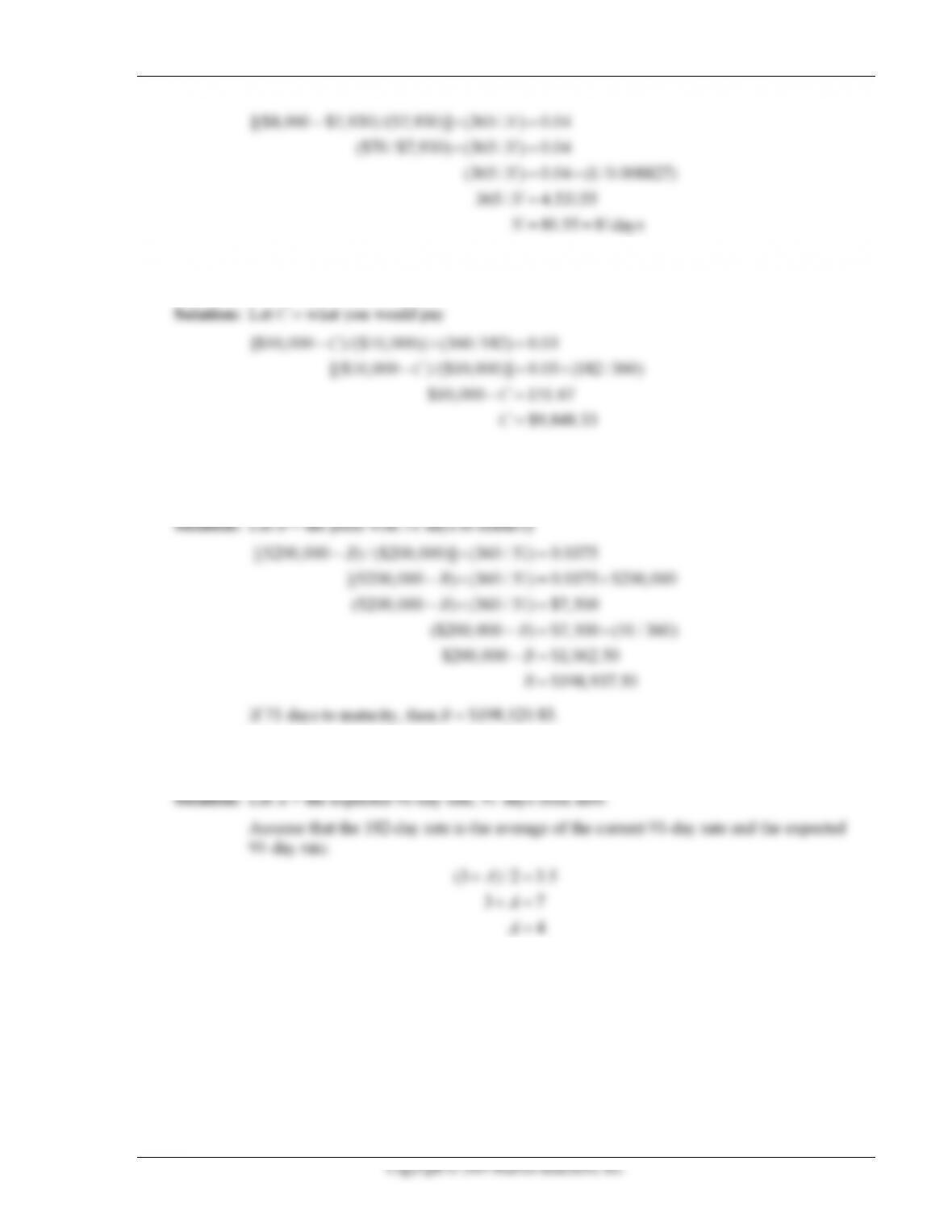
[($8,000 $7,930) /($7,930)] (365 / ) 0.04
($70 / $7,930) (365 / ) 0.04
(365 / ) 0.04 (1/ 0.008827)
365 / 4.53155
80.55 81days
N
N
N
N
N
− =
=
=
=
==
8. How much would you pay for a Treasury bill that matures in one year and pays $10,000 if you
require a 3% discount rate?
$10,000 151.67
$9,848.33
C
C
−=
=
9. The annualized discount rate on a particular money market instrument is 3.75%. The face value is
$200,000 and it matures in 51 days. What is its price? What would be the price if it had 71 days to
maturity?
10. The annualized yield is 3% for 91-day commercial paper and 3.5% for 182-day commercial paper.
What is the expected 91-day commercial paper rate 91 days from now?
4
A
=