3M – “3M employees continuously challenge the upper limits of product
reliability and capability through process and product innovation and the
application of proven quality principles. Underlying this effort is a strong
corporate commitment to the Six Sigma strategy for achieving breakthrough
9-52 (60-90 min.)
This problem provides a comprehensive review of many of the techniques and
terms that were introduced in previous chapters. It might be used as a final examination.
You may wish to skip part (7).
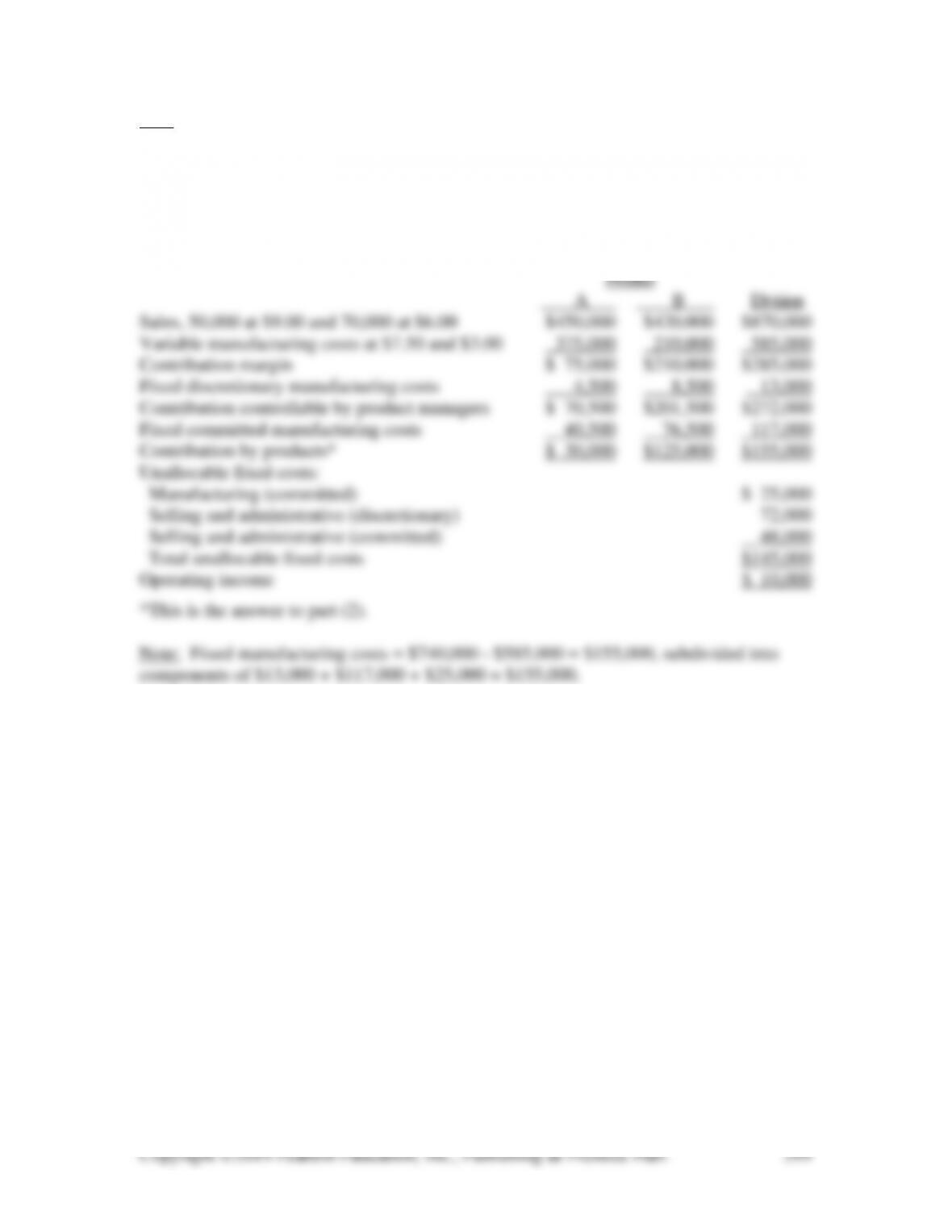
Some answers are based on the following detailed master budget:
Copyright ©2014 Pearson Education, Inc., Publishing as Prentice Hall.
400
Answers to requirements:
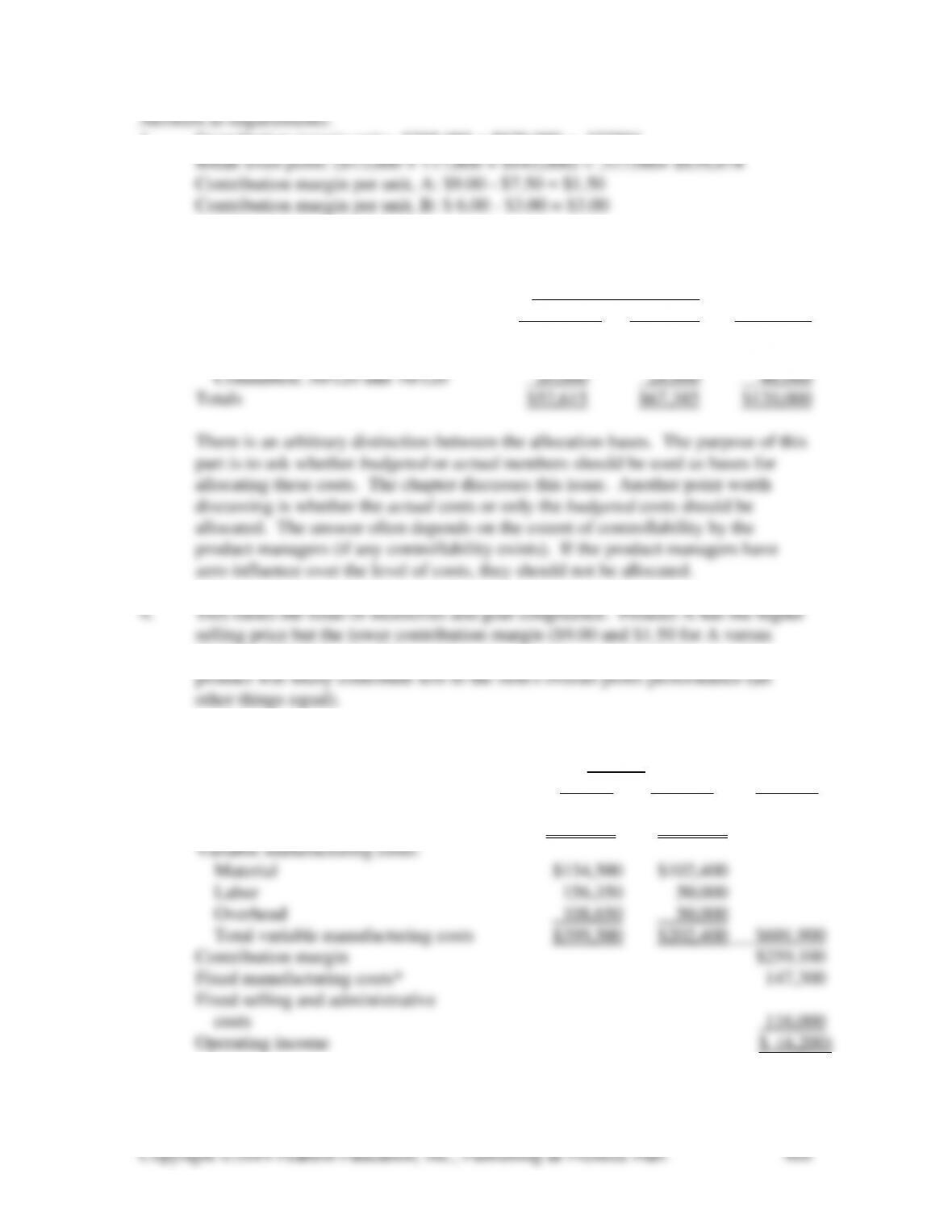
1. Contribution margin ratio: $285,000 ÷ $870,000 = .327586
2. See the footnote to the Master Budget above.
3. Product
__ A B Total
Selling and administrative expenses:
Discretionary, 53/117 and 64/117 $32,615 $39,385 $ 72,000
$6.00 and $3.00 for B). The resulting incentives to push the higher-priced
5. Actual results were:
Product
__A _ B Total
Sales, 53,000 units at $9.00 and 64,000
units at $6.00 $477,000 $384,000 $861,000
*The $749,200 total manufacturing costs given in the problem minus $601,900 of
variable manufacturing cost, also given, equals $147,300.
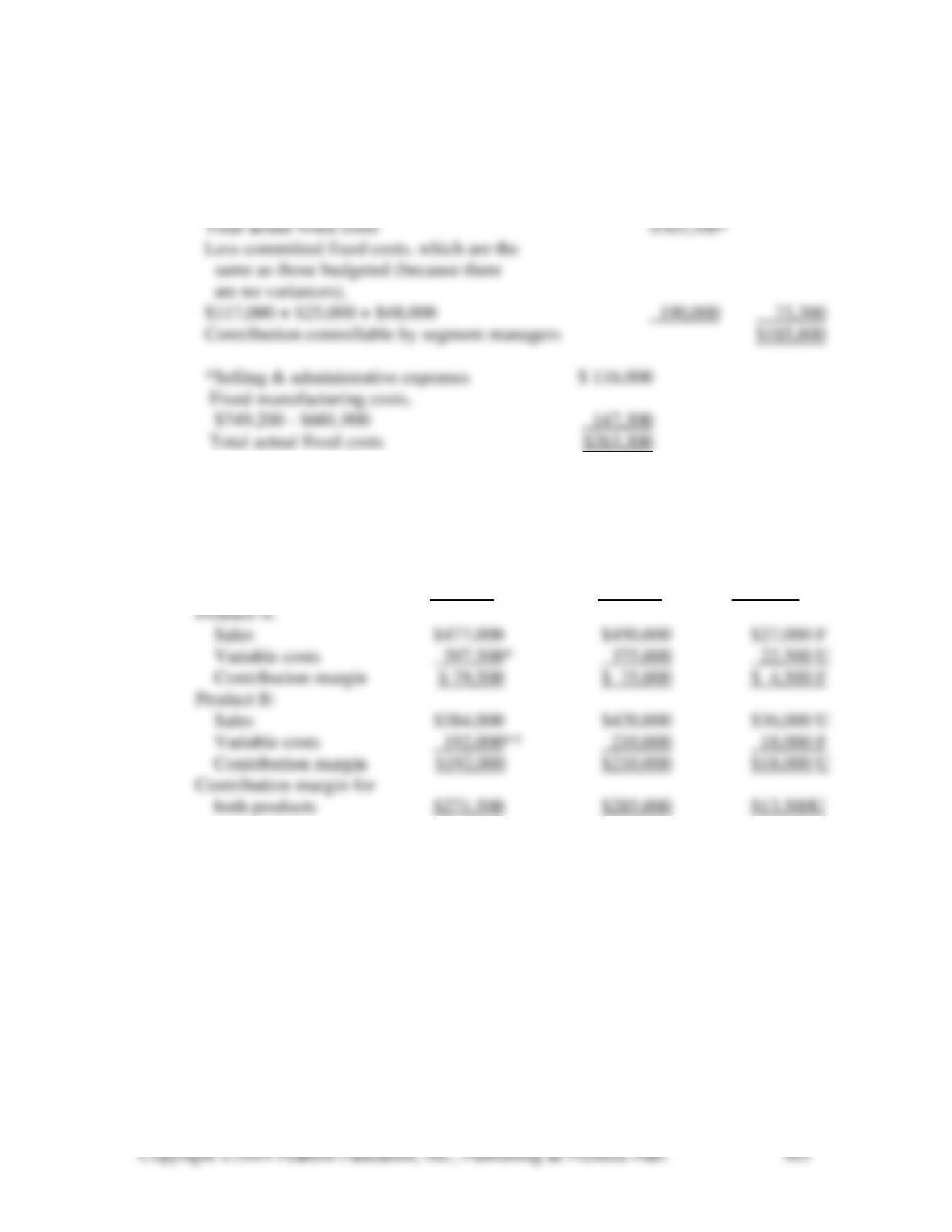
The “controllable contribution” is the actual contribution margin less the fixed
discretionary costs, which would be:
Actual contribution margin $259,100
6. The analysis rests solely on master budgeted sales and costs versus actual sales
and costs at budgeted unit prices:
Actual Sales Budgeted Sales Sales
at Budgeted at Budgeted Activity
Prices Prices Variance
*53,000 units × $7.50
**64,000 units × $3.00
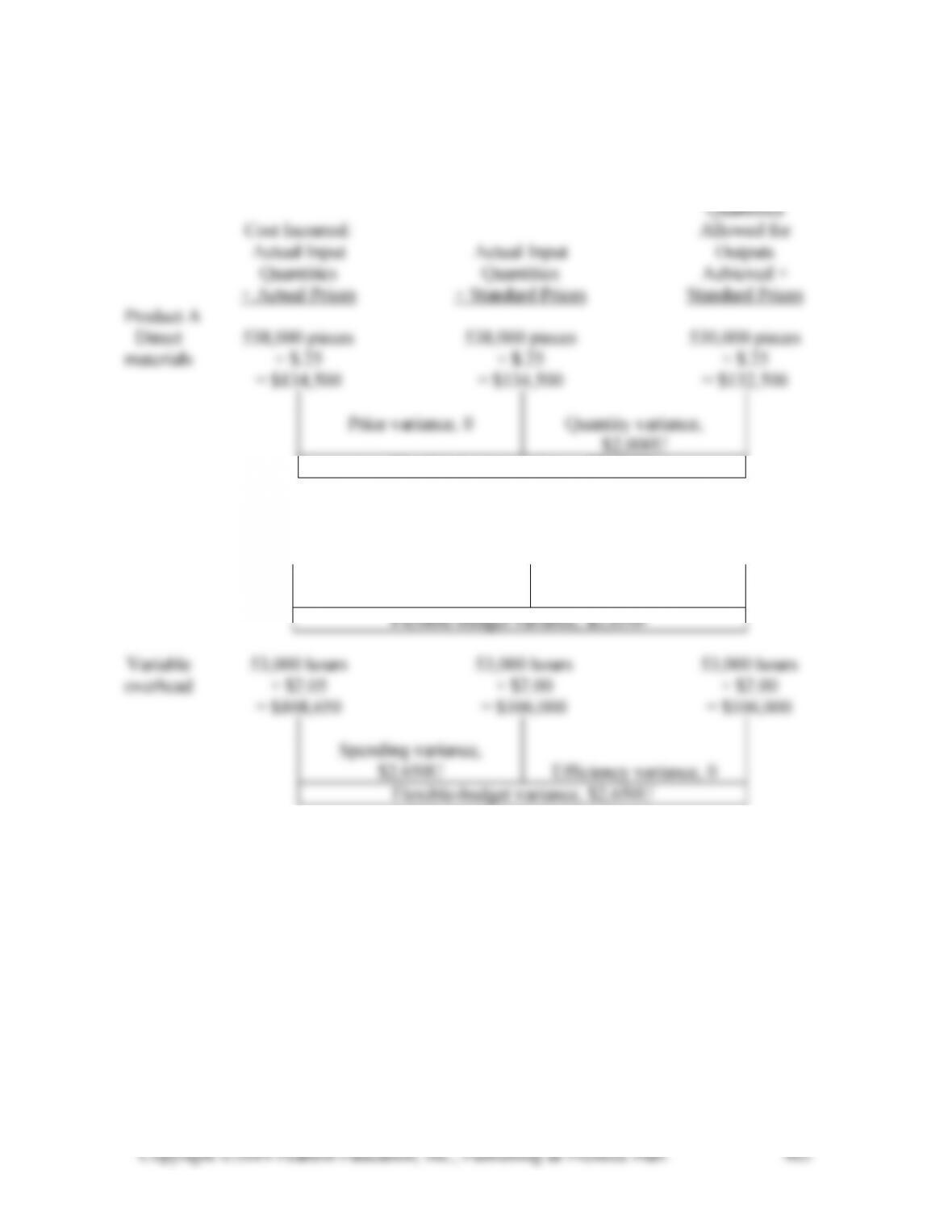
7.
Flexible Budget:
Standard Input
Quantities
Cost Incurred:
Allowed for
Actual Input
Quantities
Actual Input
Quantities
Outputs
Achieved ×
× Actual Prices
× Standard Prices
Standard Prices
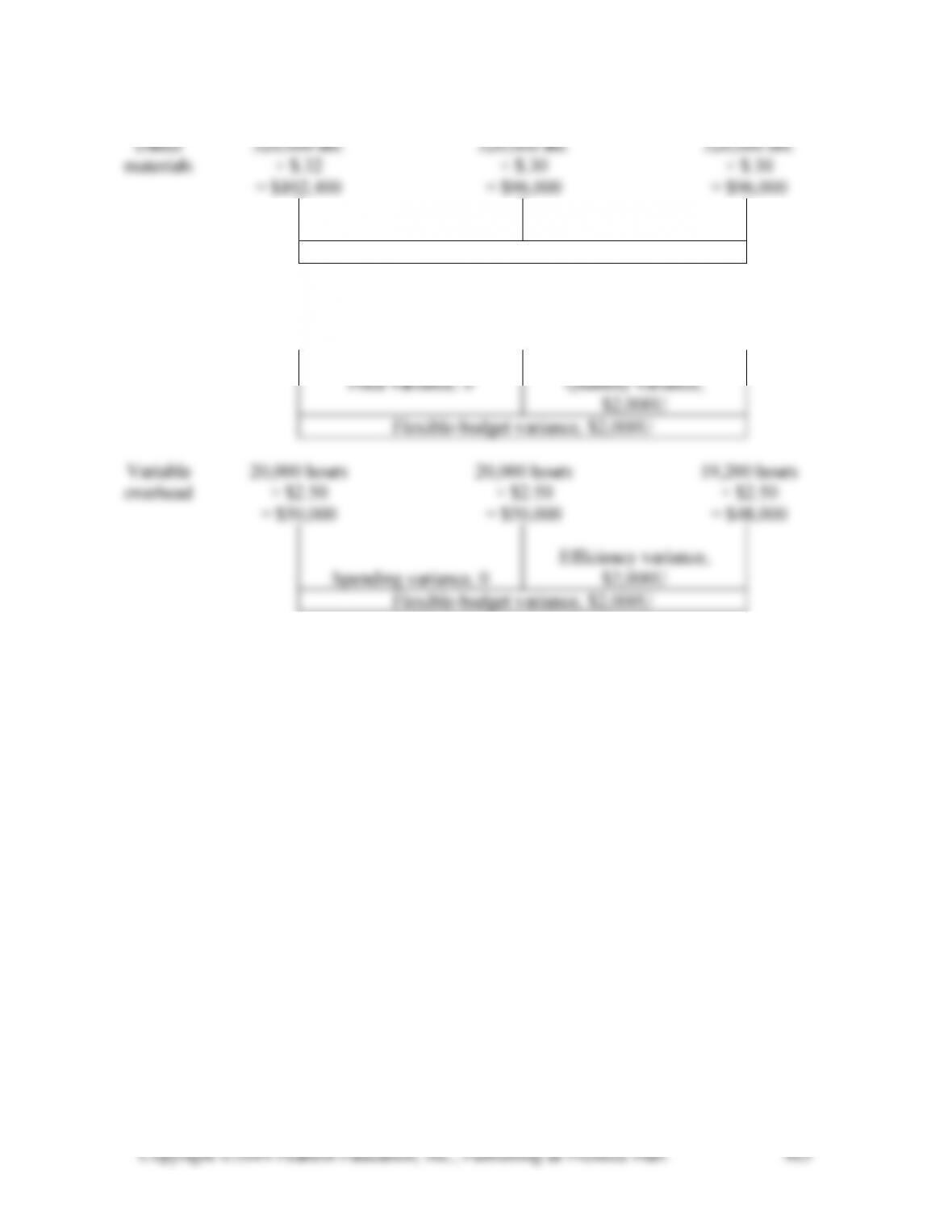
Product A
Direct
538,000 pieces
538,000 pieces
530,000 pieces
materials
× $.25
× $.25
× $.25
= $134,500
= $134,500
= $132,500
Price variance, 0
Quantity variance,
$2,000U
Flexible-budget variance, $2,000U
Labor
53,000 hours
53,000 hours
53,000 hours
× $2.95
× $3.00
× $3.00
= $156,350
= $159,000
= $159,000
Price variance, $2,650F
Quantity variance, 0
Flexible-budget variance, $2,650F
53,000 hours
53,000 hours
53,000 hours
overhead
× $2.05
× $2.00
× $2.00
= $108,650
= $106,000
= $106,000
$2,650U
Efficiency variance, 0
Flexible-budget variance, $2,650U
Product B
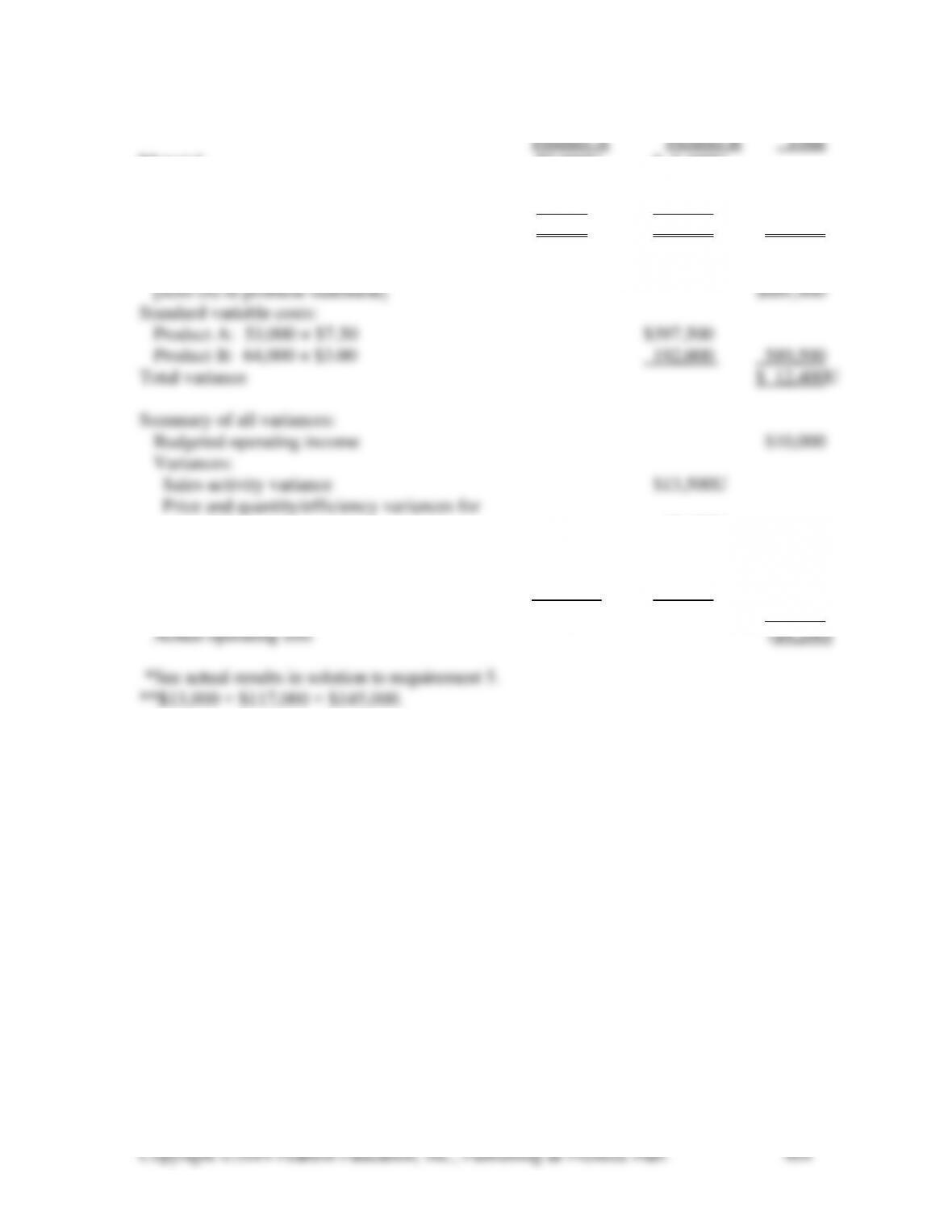
Direct
320,000 lbs.
320,000 lbs.
320,000 lbs.
materials
× $.32
× $.30
× $.30
= $102,400
= $96,000
= $96,000
Price variance, $6,400U
Quantity variance, 0
Flexible-budget variance, $6,400U
Labor
20,000 hours
20,000 hours
19,200 hours
× $2.50
× $2.50
× $2.50
= $50,000
= $50,000
= $48,000
Price variance, 0
Quantity variance,
$2,000U
Flexible-budget variance, $2,000U
20,000 hours
20,000 hours
19,200 hours
overhead
× $2.50
× $2.50
× $2.50
= $50,000
= $50,000
= $48,000
Spending variance, 0
$2,000U
Flexible-budget variance, $2,000U
Check:
Material $2,000U $ 6,400U
Labor 2,650F 2,000U
Variable overhead 2,650U 2,000U
Totals $2,000U $10,400U $12,400U
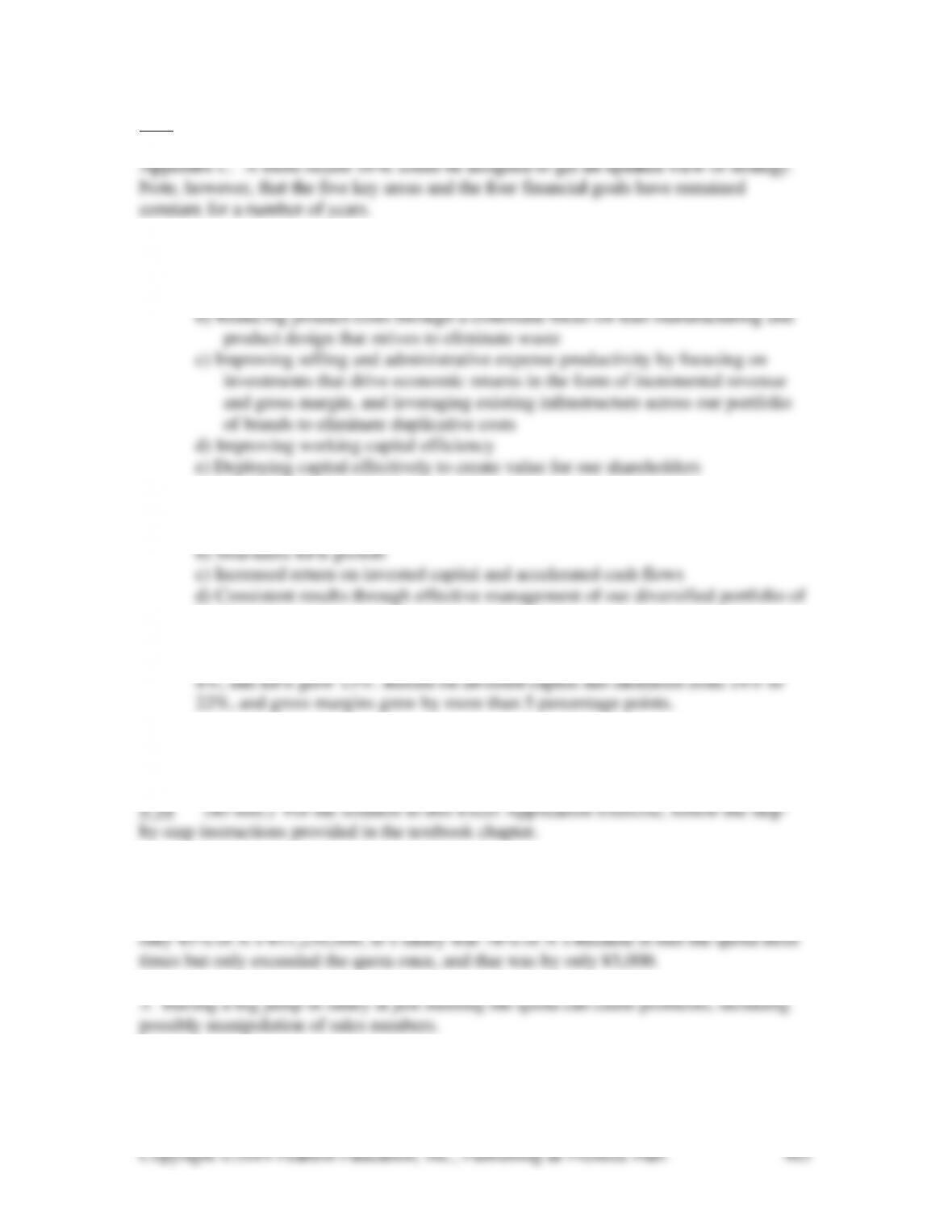
Total actual variable costs
variable costs 12,400U
Budget variance for fixed costs:
Actual* $263,300
Budgeted** 275,000 11,700F
Total variances 14,200U
9-53 (20 – 30 min.)
NOTE TO INSTRUCTOR: This solution is based on the 2012 10-K included in
1. According to the Nike 10-K, the five key areas are:
a) Making the supply chain a competitive advantage, through operational
discipline
2. The four long-term financial goals are:
a) High single digit revenue growth
business
3. Over the past ten years, all of the financial goals have been met. Revenues grew
4. Students might suggest a variety of non-financial goals from the customer
perspective, business process perspective, or innovation and learning perspective.
1. Salesclerk A’s average salary of ¥129,185.7 is greater than B’s ¥101,062.5.
2. Just meeting the quota has a big payoff. Although B’s total sales of ¥4,575,000 were
9-55 (60 min. or more)
The purpose of this exercise is to develop goals and objectives for a familiar
organization. By working in teams, students may see the possibly conflicting objectives
of various stakeholder groups. They will also see how difficult it can be to develop
9-56 (20 – 30 min.) NOTE TO INSTRUCTOR: This solution is based on the web site
1. The factors driving their growth strategy are “strengthening our core business,
renewing our focus on discontinuous innovation, and implementing a $10 billion
productivity program,” all discussed in more detail in the letter to shareholders.
2. P&G lists two major categories under Brands: (1) Beauty and Grooming, and
(2) Household Care. The household care category lists 32 brands (including Mr.
Clean, Bounty, Swiffer, and Febreze products). Bounty and Mr. Clean are well–
established brand names with several specific products under each brand name.