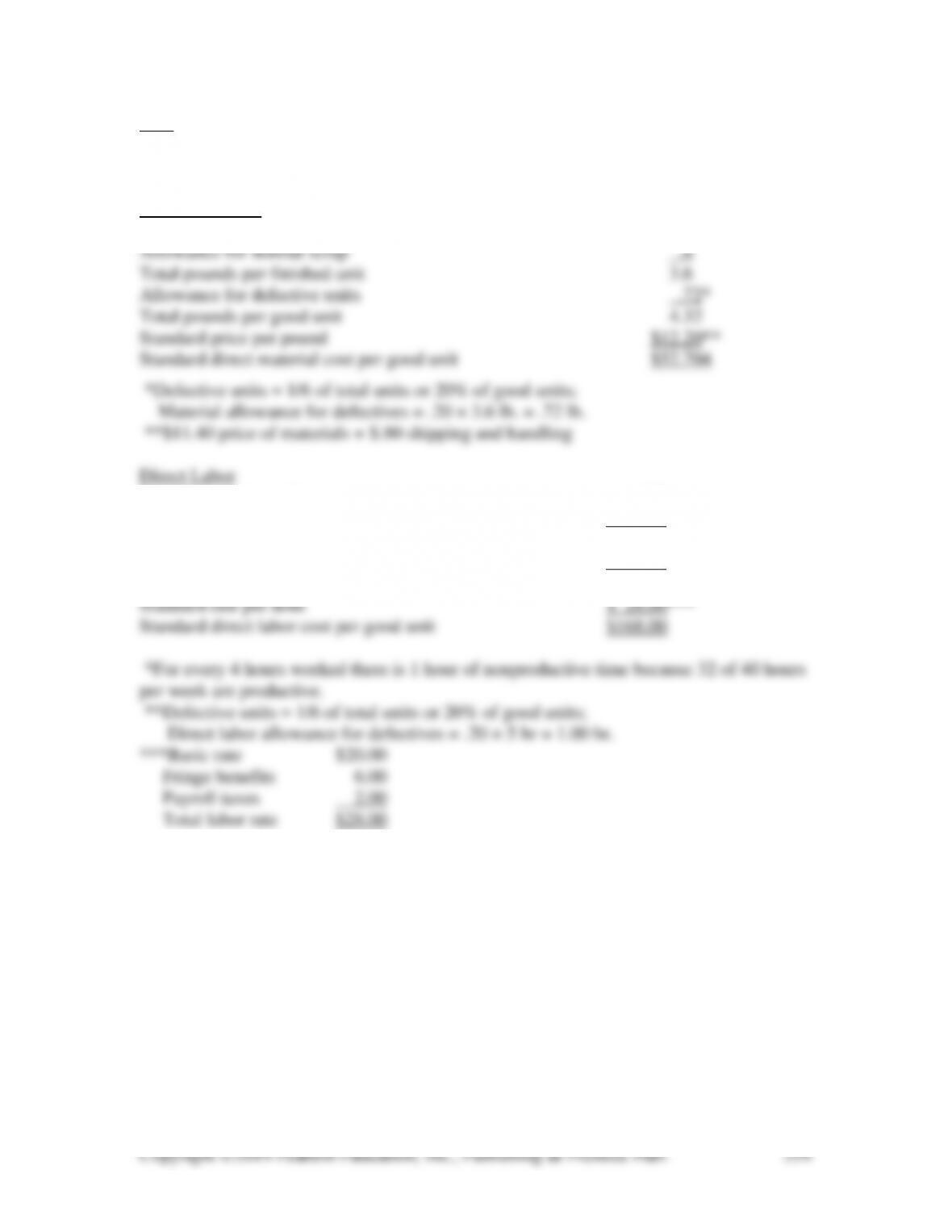
8-49 (25-35 min.) This problem is complicated by the need to include an allowance
for defective units in the standard costs. Note that some accountants object to standards
that “accept defects” by allowing for defects in the standards.
Direct Materials
Pounds in final product 3.2
Hours of actual machining per unit 4.00
Allowance for nonproductive time 1.00*
Total hours per finished unit 5.00
Allowance for defective units 1.00**
Total hours per good unit 6.00
Copyright ©2014 Pearson Education, Inc., Publishing as Prentice Hall.
355
8-50 (50-75 min.)
1. a. Sales-activity variance = Budgeted unit contribution margin × Difference
between the static budget sales in units and the actual sales in units
= $9.20 × (9,000 – 8,000)
= $9,200 unfavorable
This variance is labeled as a sales-activity variance because it quantifies
Budgeted direct labor = $8.00 × 8,000 = $64,000
2.
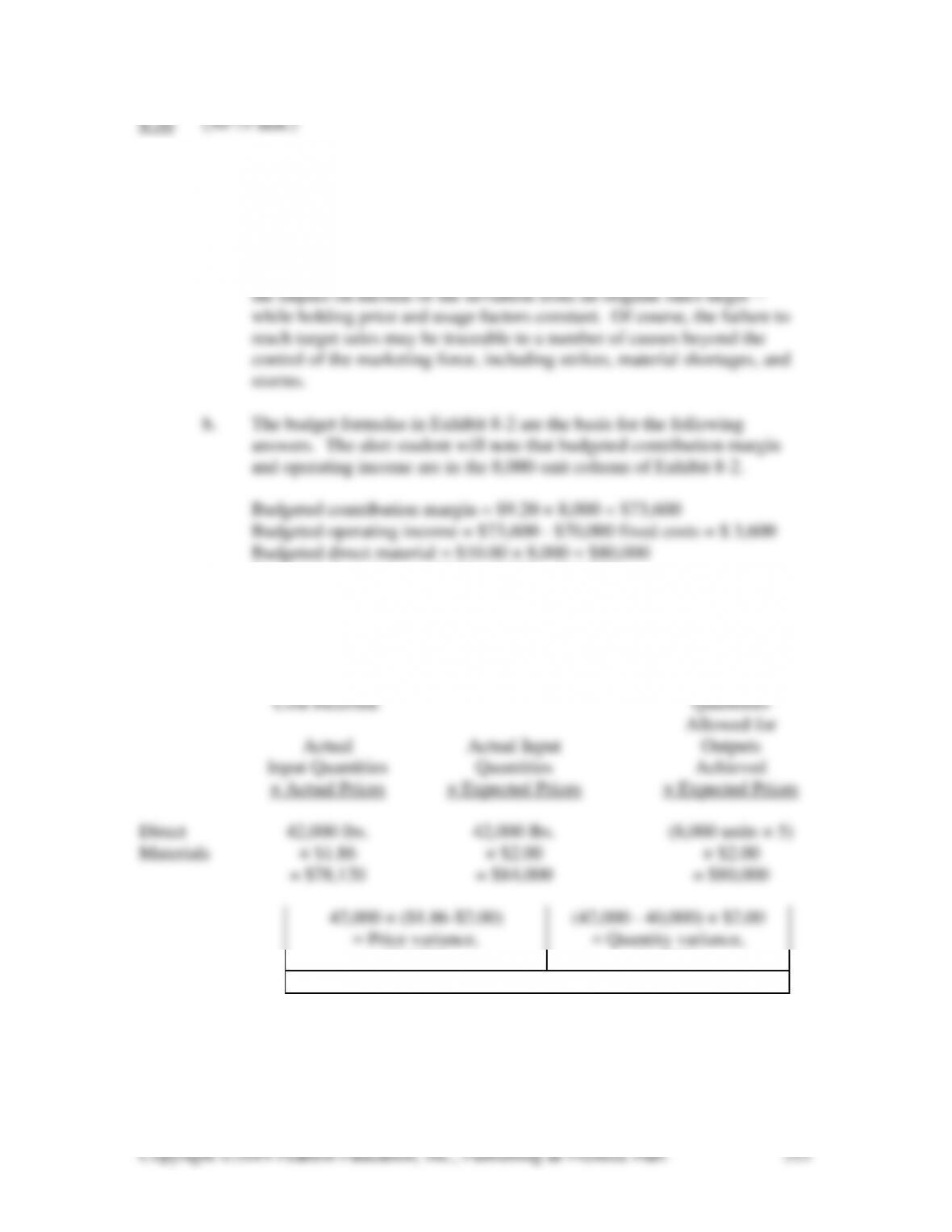
Flexible Budget:
Cost Incurred:
Standard Input
Quantities
Allowed for
Actual
Input Quantities
Actual Input
Quantities
Outputs
Achieved
× Actual Prices
× Expected Prices
× Expected Prices
Direct
42,000 lbs.
42,000 lbs.
(8,000 units × 5)
Materials
× $1.86
× $2.00
× $2.00
= $78,120
= $84,000
= $80,000
42,000 × ($1.86-$2.00)
(42,000 – 40,000) × $2.00
= Price variance,
= Quantity variance,
$5,880F
$4,000U
Flexible-budget variance, $1,880F
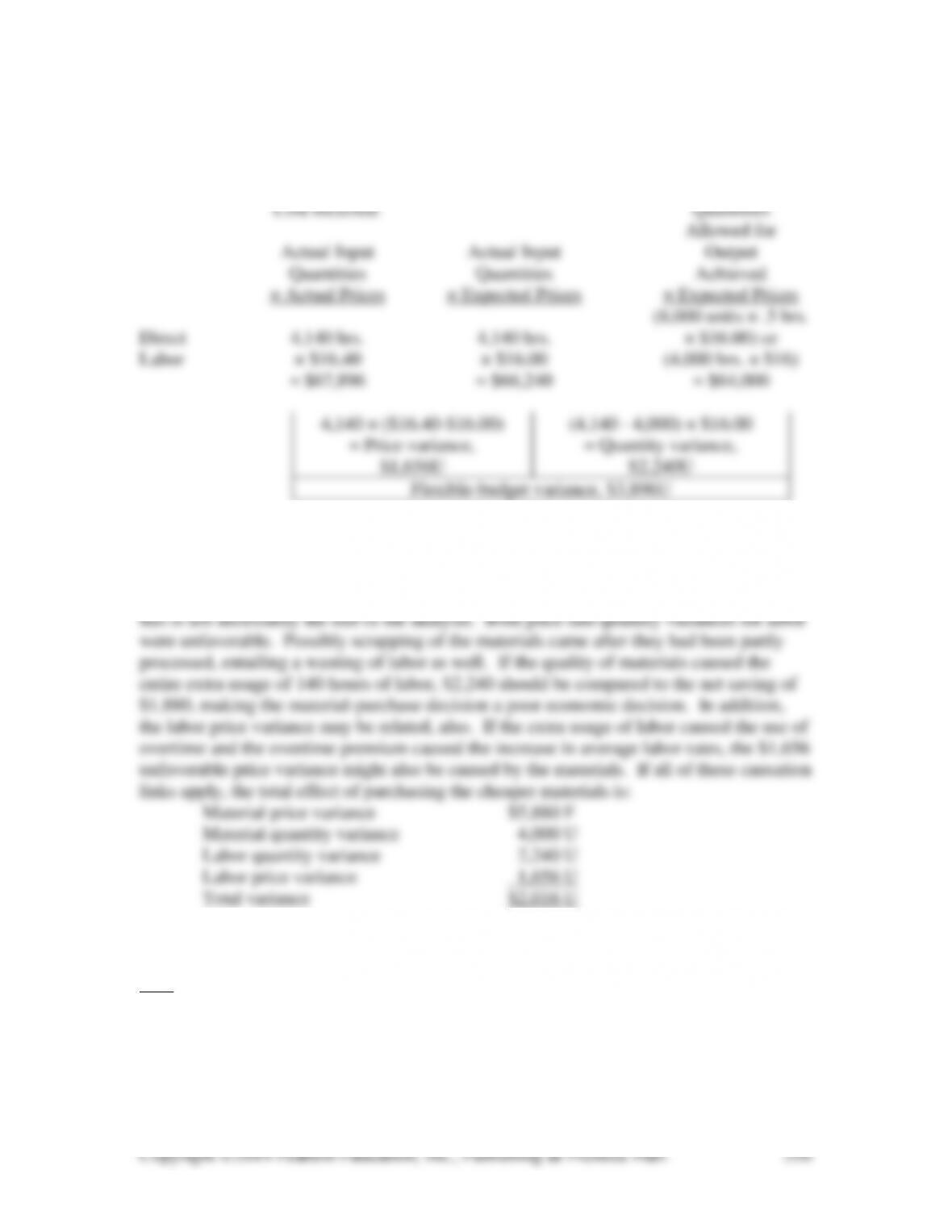
Flexible Budget:
Cost Incurred:
Standard Input
Quantities
Allowed for
Actual Input
Quantities
Actual Input
Quantities
Output
Achieved
× Actual Prices
× Expected Prices
× Expected Prices
(8,000 units × .5 hrs.
Direct
4,140 hrs.
4,140 hrs.
× $16.00) or
Labor
× $16.40
× $16.00
(4,000 hrs. × $16)
= $67,896
= $66,240
= $64,000
4,140 × ($16.40-$16.00)
(4,140 – 4,000) × $16.00
= Price variance,
= Quantity variance,
$1,656U
$2,240U
Flexible-budget variance, $3,896U
3. The purchasing manager for Dominion apparently purchased material for $.14
per pound less than the standard, saving the company $5,880. However, the company
used more of the material, perhaps because poor quality of the materials caused excessive
waste. The cost of the extra material was $4,000, leaving a net saving of $1,880. But
8-51 (30 min.) The solution is given in the textbook after the problem itself.
Copyright ©2014 Pearson Education, Inc., Publishing as Prentice Hall.
357
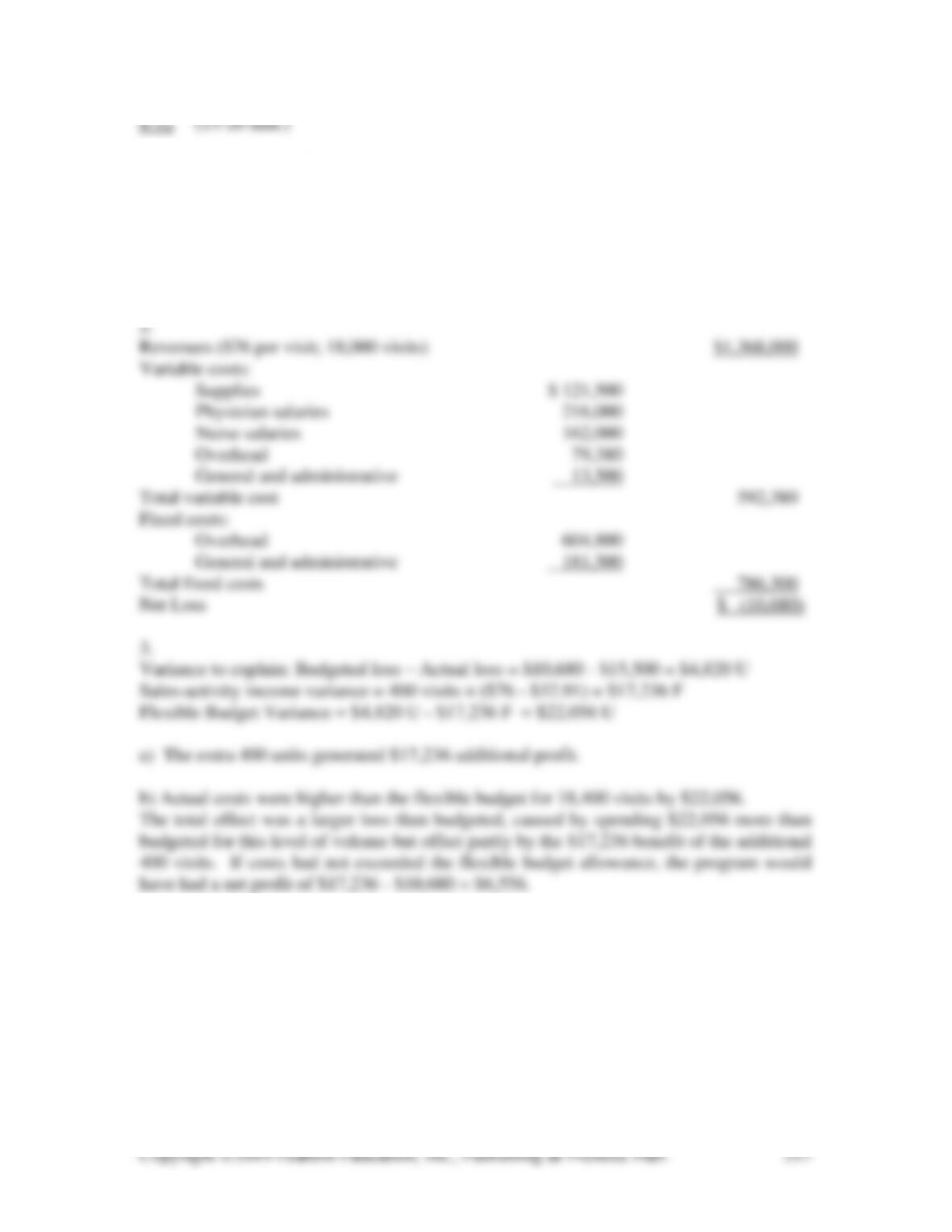
8-52 (15-20 min.)
1. Variable cost per visit, 20X8: $114, 750 + $204,000 + $153,000 + 21% × ($204,000 +
$153,000) + ($194,250 – $181,500) = $559,470.
Therefore, variable cost per visit are $559,470 ÷ 17,000 = $32.91.
Fixed costs are $181,500 + [$676,200 – .20 × (204,000 + $153,000)] = $786,300.
Cost Function: $32.91 per visit variable and $786,300 per year fixed.
8-53 (35-45 min.)
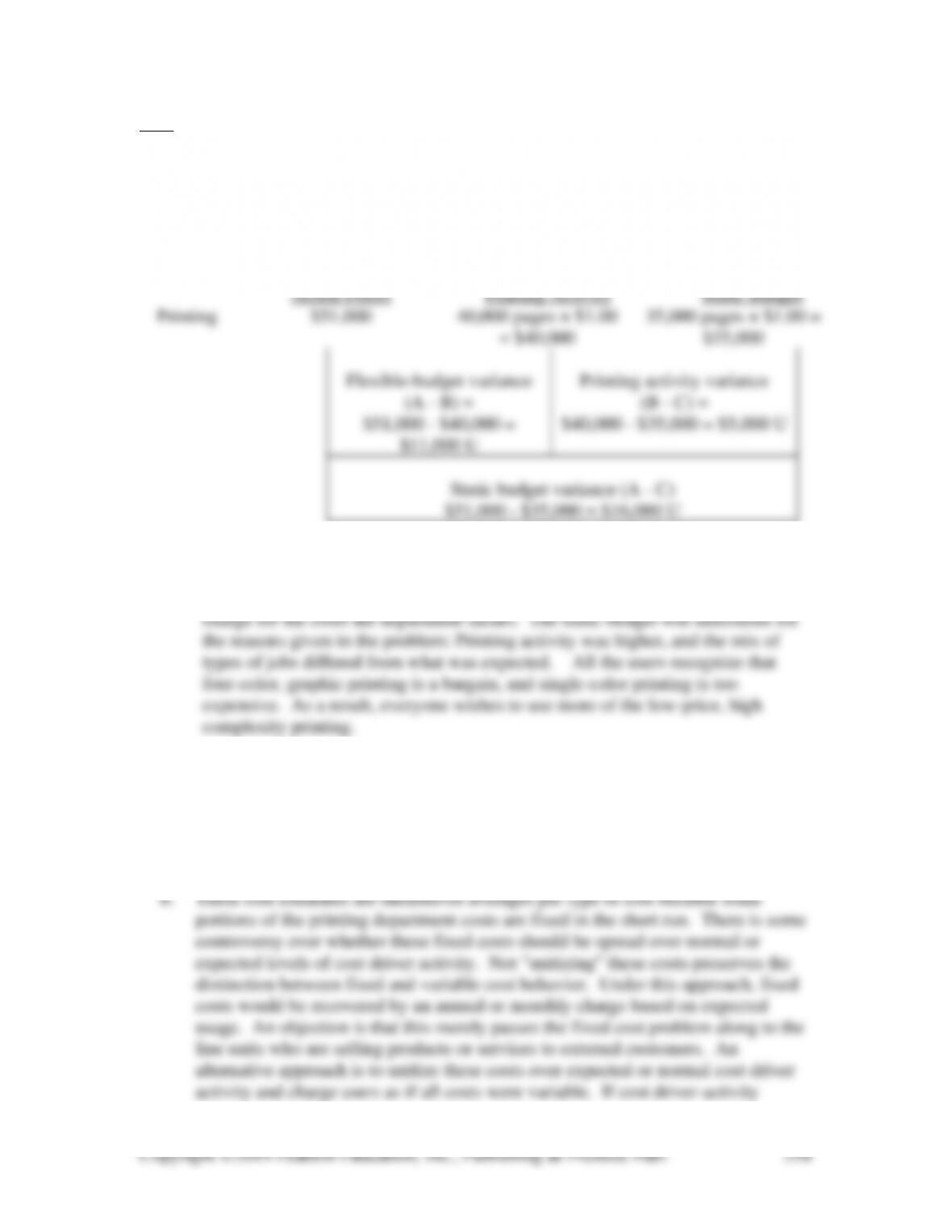
1. Printing department costs for the first month:
A
B
C
Actual Cost Incurred:
Actual Inputs ×
Actual Prices
Flexible Budget for Actual
Printing Activity
Static Budget
Printing
$51,000
40,000 pages × $1.00
= $40,000
35,000 pages × $1.00 =
$35,000
Flexible-budget variance
(A – B) =
$51,000 – $40,000 =
$11,000 U
Printing activity variance
(B – C) =
$40,000 – $35,000 = $5,000 U
Static budget variance (A – C)
$51,000 – $35,000 = $16,000 U
2. Likely explanations are that (1) the $1.00 charge per page is an average printing
cost, but costs per page can differ greatly with relative complexity, (2) the
printing department has not identified the appropriate cost drivers to enable it to
3. a. The ABC analysis is an attempt to measure the costs of printing complexity. If
the analysis is accurate, then four-color printing jobs will cost at least $1.35 per
page ($.35 + $1.00). Simple, black-and-white jobs will cost only $.35 per page.
Since the costs of different types of jobs will vary under this new system, it is
critical that the ABC estimates are accurate.
Copyright ©2014 Pearson Education, Inc., Publishing as Prentice Hall.
359
expectations are accurate, there should not be significant static budget variances.
Large errors in forecasting, however, will lead to large budgeting errors because
total fixed costs charged will not equal total fixed costs incurred.
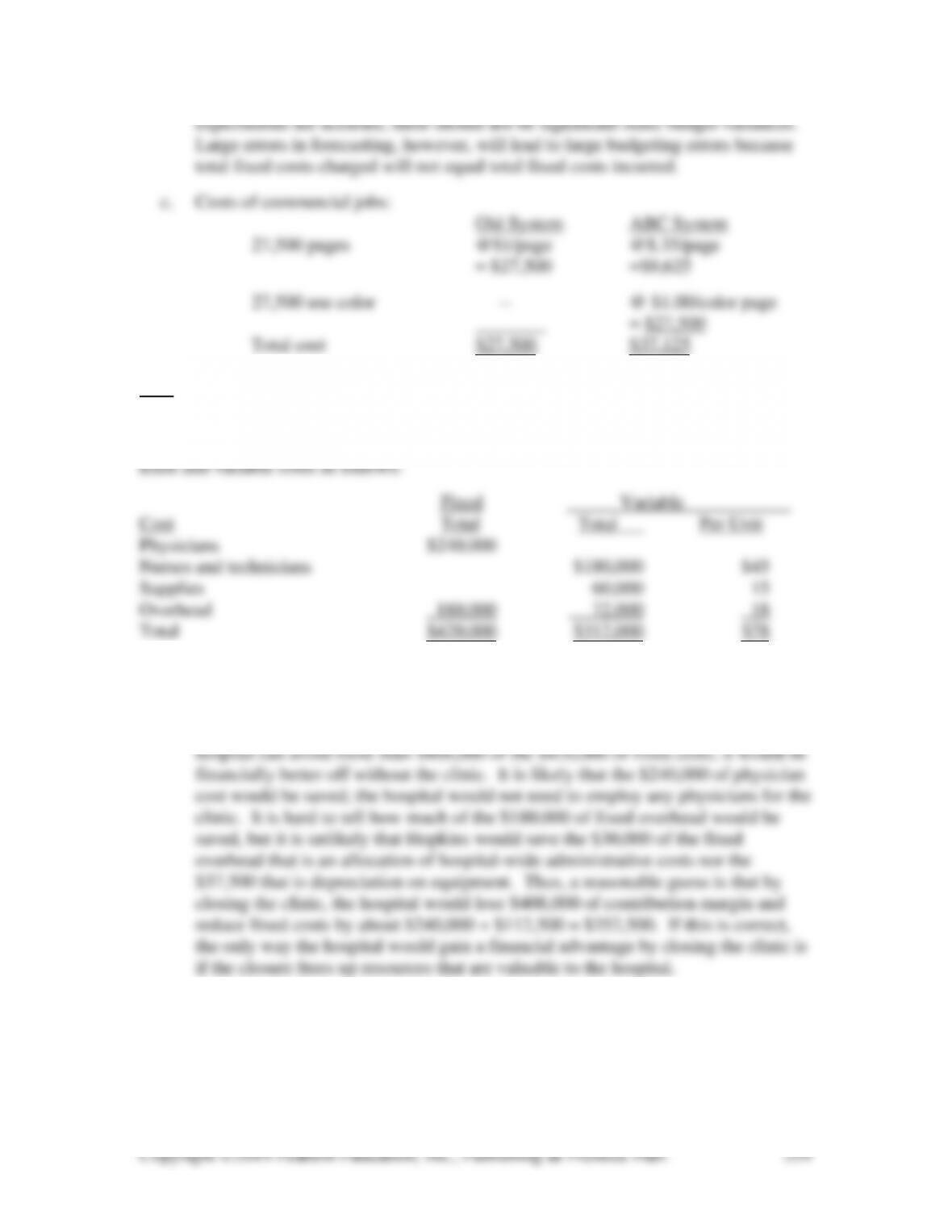
c. Costs of commercial jobs:
Old System ABC System
27,500 pages @$1/page @$.35/page
= $27,500 =$9,625
27,500 use color — @ $1.00/color page
= $27,500
Total cost $27,500 $37,125
8-54 (40-50 min.)
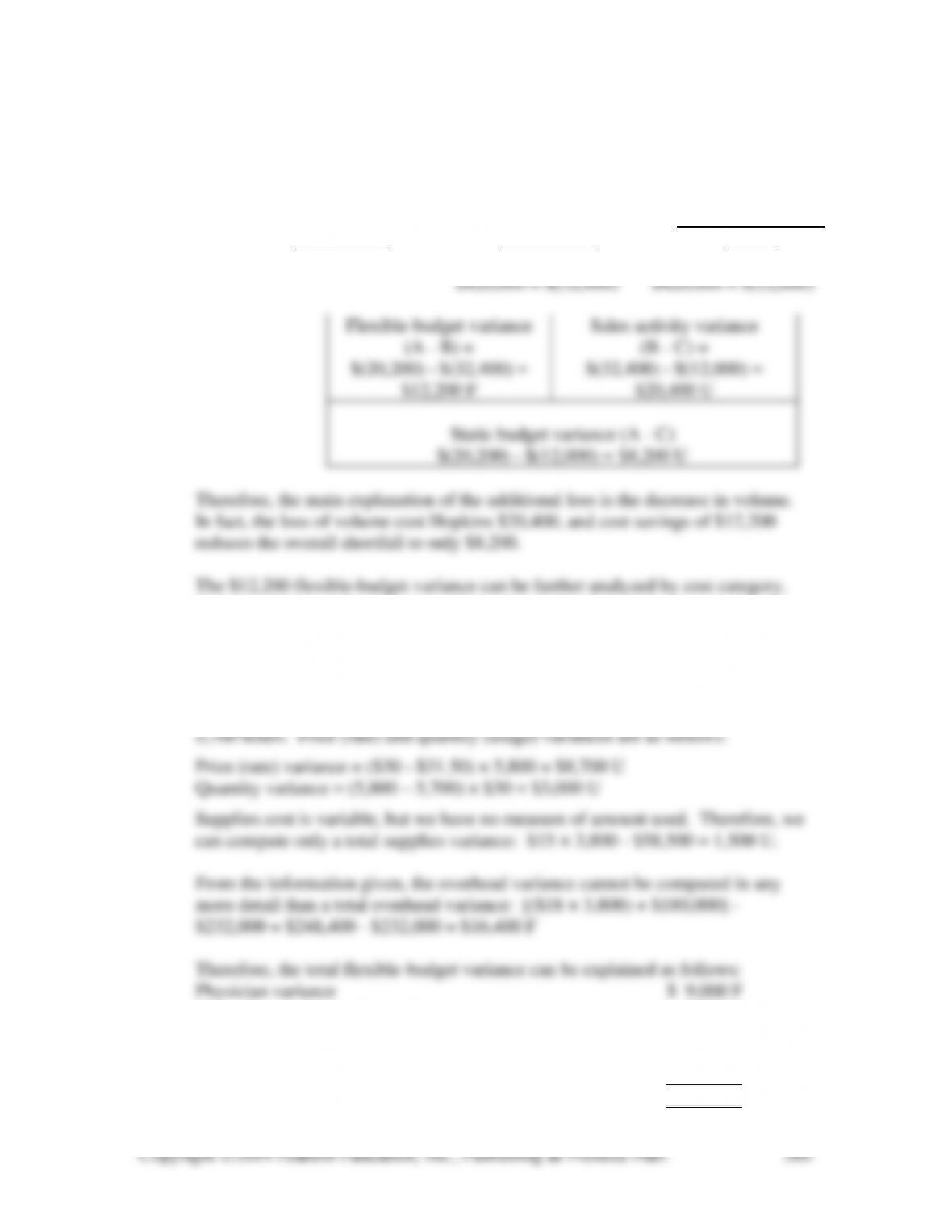
Before proceeding to answer the questions asked, it is helpful to get a good understanding
of the cost behavior. The costs of the outpatient clinic can be broken down into budgeted
1. Whether Hopkins Community Hospital would save money by closing its
outpatient clinic depends on what fixed costs it might avoid if the clinic were
closed. The budgeted contribution margin is $180 – $78 = $102 per patient,
giving a total contribution from 4,000 patients of 4,000 × $102 = $408,000. If the
2. The difference between the static budget loss of $12,000 and the actual loss of
$20,200 can first be divided into a sales-activity variance and a flexible-budget
variance:
A
B
C
Actual
Profit (Loss)
Flexible Budget
Profit (Loss)
Static Budget Profit
(Loss)
$(20,200)
$102 × 3,800 –
$420,000 = $(32,400)
$102 × 4,000 –
$420,000 = $(12,000)
Flexible-budget variance
(A – B) =
$(20,200) – $(32,400) =
$12,200 F
Sales activity variance
(B – C) =
$(32,400) – $(12,000) =
$20,400 U
Static budget variance (A – C)
$(20,200) – $(12,000) = $8,200 U
Therefore, the main explanation of the additional loss is the decrease in volume.
In fact, the loss of volume cost Hopkins $20,400, and cost savings of $12,200
reduces the overall shortfall to only $8,200.
The $12,200 flexible-budget variance can be further analyzed by cost category.
First, consider the physician cost. Since physician costs are fixed, we can only
compute a total physician cost variance: $240,000 – $231,000 = $9,000 F.
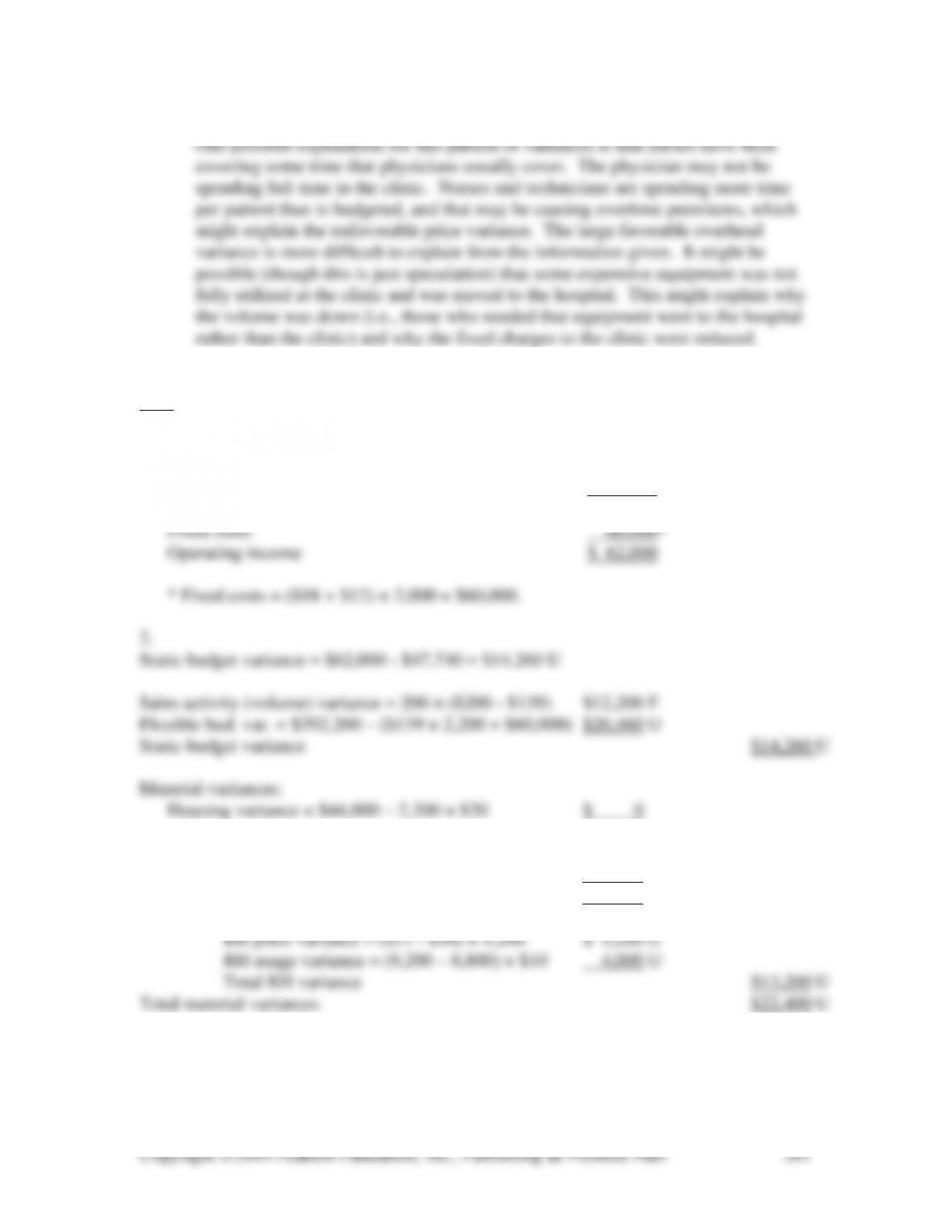
Nurse and technician costs are variable and have a standard rate of $30 per hour
and an actual rate of $182,700 ÷ 5,800 = $31.50. A total of 5,800 hours was used;
standard hours allowed for 3,800 patients is 1.5 hrs./patient × 3,800 patients =
Nurse & technician price variance 8,700 U
Nurse & technician quantity variance 3,000 U
Supplies variance 1,500 U
Overhead variance 16,400 F
Total flexible-budget variance $12,200 F
8-55 (45 – 60 min.)
1.
Revenue (2,000 × $200) $400,000
Variable costs (2,000 × $139) 278,000
Contribution margin (2,000 × $61) $122,000
PCB variances:
PCB price variance = ($16 – $15) × 4,700 $ 4,700 U
PCB usage variance = (4,700 – 4,400) × $15 4,500 U
Total PCB variance = $75,200 – 2,200 × $30 $ 9,200 U
Reading heads variances:
Copyright ©2014 Pearson Education, Inc., Publishing as Prentice Hall.
362
Labor variances:
Assembly variances:
Assembly price variance = ($8 – $8) × 3,900 0
Assembly quantity var. = ($4,400 – 3,900) × $8 $4,000 F
Total assembly variances $4,000 F
PCB variances:
PCB price variance = ($9.90 – $9) × 2,400 $2,160 U
PCB quantity variance = (2,400 – 2,200) × $9 1,800 U
Total PCB variances $3,960 U
Reading heads variances:
RH price variance = ($11 – $10) × 3,500 $3,500 U
From these variances we learn that operations were not very efficient. The extra 200
units of sales increased income before taxes by $12,200, but this was more than offset by
operating inefficiencies that cost Gates $26,460, leaving the company short of budget by
$26,460 – $12,200 = $14,260.
The material variances and the RH and PCB labor variances were all unfavorable and
8-56 (30-40 min.) Monetary amounts in millions of dollars.
The actual results from the Results of Operations summary for 2010 are:
Net sales 19,014
Variable cost (cost of sales) 10,214
Contribution margin 8,800
Net sales 20,862 20,862 20,915
Variable cost (cost of sales) 11,354 11,207 11,235
Contribution margin 9,508 9,655 9,680
Fixed costs 6,693 6,326 6,326
Income (before taxes) 2,815 3,329 3,354
2) Variable costs increased at a higher rate than sales, yielding a $147 U flexible budget
variable cost variance.
3) Spending for fixed costs was $367 more than budgeted, yielding a $367 U fixed
1. The favorable flexible-budget variance for sales is caused by an increase in selling
prices.
3. The flexible-budget variance ($500 F) and the sales-activity variance ($25,000 U)
completely explain the $24,500 U static-budget variance.
8-58 (60 min. or more)
The purpose of this exercise is to understand the difficulty of setting standard
costs for even simple products or services. For many products or services, identifying the
direct material and direct labor inputs may not be hard, but identifying the overhead
8-59 (30-50 min.) NOTE TO INSTRUCTOR: This solution is based on the web site in
1. Hershey’s Web site seems primarily directed to customers. The most prominent
items across the top of the page are products, promotions, ads, recipes, and items
2. The static budget for 2012 income before income taxes, assuming a 4% increase
in net sales and variable costs (but no increase in fixed costs) relative to 2011, is:
2012 Static
3. The flexible budget for a sales increase of 6% and actual results assuming sales
and variable costs increased by 6% and fixed costs increased by 1%:
2012 Flexible 2012 Actual
Budget for a 6% with 1% higher
Sales Increase fixed costs