6-55 (15 min.)
1. Incremental Revenue, $10 × 4,000 $40,000
2. a. The joint costs can increase by any amount, since they are sunk and irrelevant. Western
should always choose to process further.
b. Total Revenue, $160,000 + $120,000 $280,000
6-56 (15-30 min.)
1. Sales: 20,000 × 12 × $19 $4,560,000
Less expenses: Direct materials $ 4.30
2. Sales, 20,000 × 12 × 112% × $16
= 268,800 × $16 $4,300,800
3. Cost to obtain order: $8,160 ÷ 6,800 $1.20
Direct materials 4.30
4. The variable selling expenses only $2.90
6-57 (15-20 min.)
1. The salesman’s analysis is faulty because it includes depreciation on the old equipment,
which is irrelevant. Moreover, both the total and unit costs are based on an annual
2. New Old
Machine Machine
3. Let X = Number of units
6-58 (15 min.)
Management misjudged the life of the old freight cars. This may raise questions about
the accuracy of the estimated useful life of the new freight cars. However, the unexpired costs of
the old freight cars are not relevant to this decision. The conceptual error being made by the
6-59 (15-30 min.)
1. Cost Comparison—Replacement of Equipment
Relevant Items Only
Three Years Together
2. Cost Comparison—Replacement of Equipment
Including Relevant and Irrelevant Items
Three Years Together
Keep Replace Difference
3. Keep Replace
Cash operating costs $11,800 $ 6,200
Depreciation expense 3,800 5,100
6-60 (10 min.)
This problem extends problem 6-A4. It should not be assigned without also assigning
6-A4.
2. The division would show lower income, a loss of $16,000 instead of a gain of $5,000,
3. The answers to the first two parts probably would be unaffected. The point is that
decision models and performance evaluation models may conflict in nonprofit
6-61 (20 min.)
The numbers in this case are a slight modification of those given in an article in the New
York Times, November 21, 1994.
1. On Broadway Off Broadway
Attendance 400 400
2. On Broadway Off Broadway
Attendance 750 375
3. a. $252,000 $60 = 4,200 weekly attendance
4. On Broadway Off Broadway
Attendance 600 400
5. Total profit for a 100-week run:
6. a. $1,295,000 $36,000 = 36weeks
b. $ 440,000 $26,000 = 17 weeks
7. Let X be the length of run in weeks at which on-Broadway profit equals off-Broadway
profit:
8. Mr. Simon’s decision depends on his predictions of attendance on Broadway versus off
Broadway and his attitude toward risk. The on-Broadway production has more risk
because of its bigger up-front investment. If the attendance figures in requirements 4
and 5 are accurate, the off-Broadway alternative is better for any runs less than 85.5
6-62 (20-30 minutes)
1. Assume they outsource:
Costs:
20,000 × $18 = ($360,000)
Cost savings:
6-63 (15-20 min.)
1. The opportunity cost of the land is 10% × $18,000,000 = $1,800,000.
2. Costs saved by closure of tomato farm:
Variable production costs $ 550,000
Shipping costs 200,000
6-64 (10–15 min.)
1. Even if reprocessing creates beans of acceptable quality, Starbucks should sell the beans
as-is because it generates more profit than reprocessing them.
2. Sell as is $4,560
6-65 (30-40 min.)
1. Minnetonka Corporation should make the bindings.
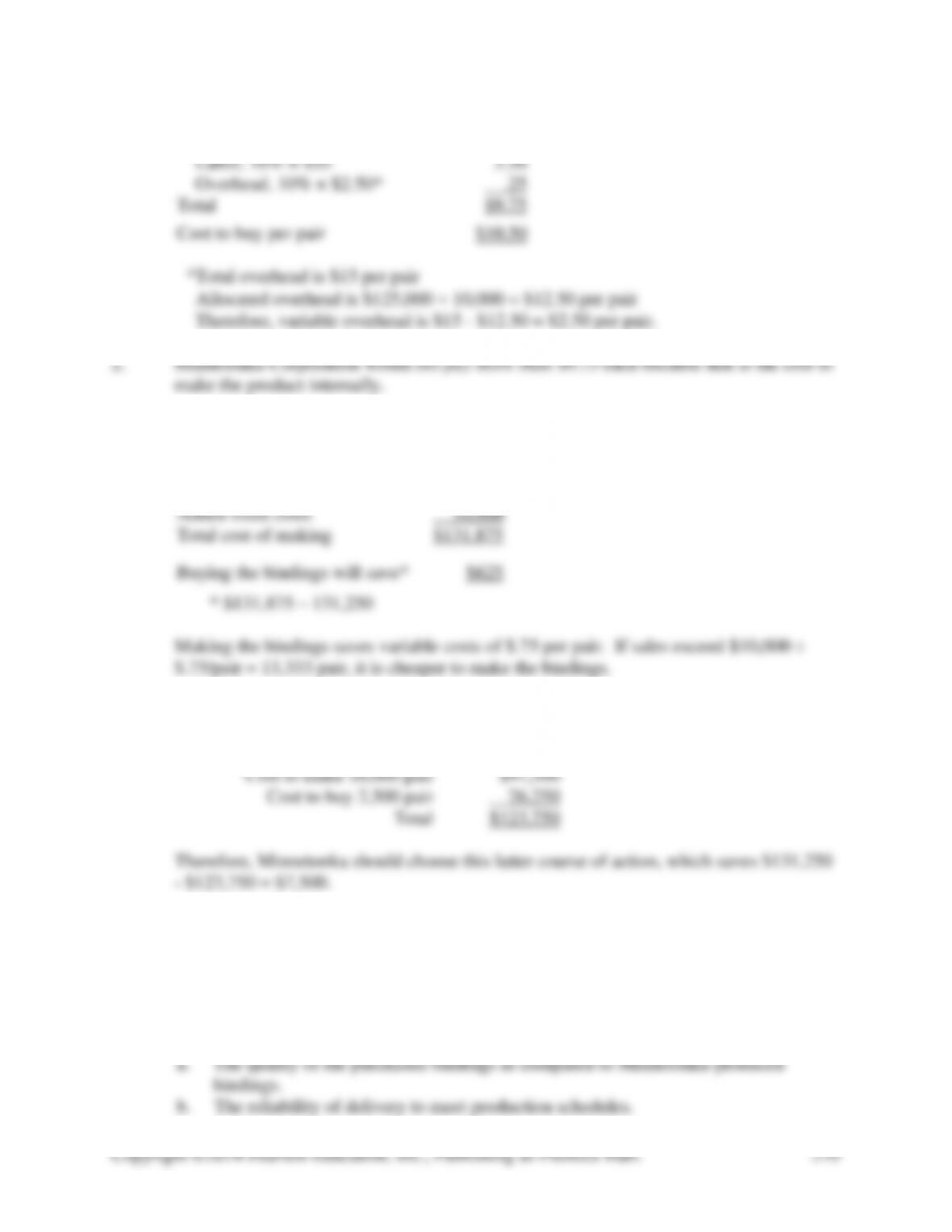
Cost saved by purchasing bindings:
Material, 20% × $30 $6.00
3. At a volume of 12,500 pair, Minnetonka should buy the bindings. The cost of buying
12,500 pair is $131,250. The cost of making 12,500 pair is:
12,500 × $9.75 $121,875
4. Minnetonka Corporation needs 12,500 pair of bindings. The cost to buy 12,500 pair is
$131,250. The cost to make 10,000 and buy 2,500 is:
5. There are many non-quantifiable factors that Minnetonka should consider in addition to
the economic factors calculated above. Among such factors are:

Copyright ©2014 Pearson Education, Inc., Publishing as Prentice Hall.
271
c. The financial stability of the supplier.
d. Development of an alternate source of supply.
e. Alternate uses of binding manufacturing capacity.
f. The long-run character and size of the market.
6-66 (30-45 min.)
1. The $10,000 disposal value of the old equipment is irrelevant because it is the same for
either choice. This solution assumes that the direct department fixed overhead is
avoidable. You may want to explicitly discuss this assumption.
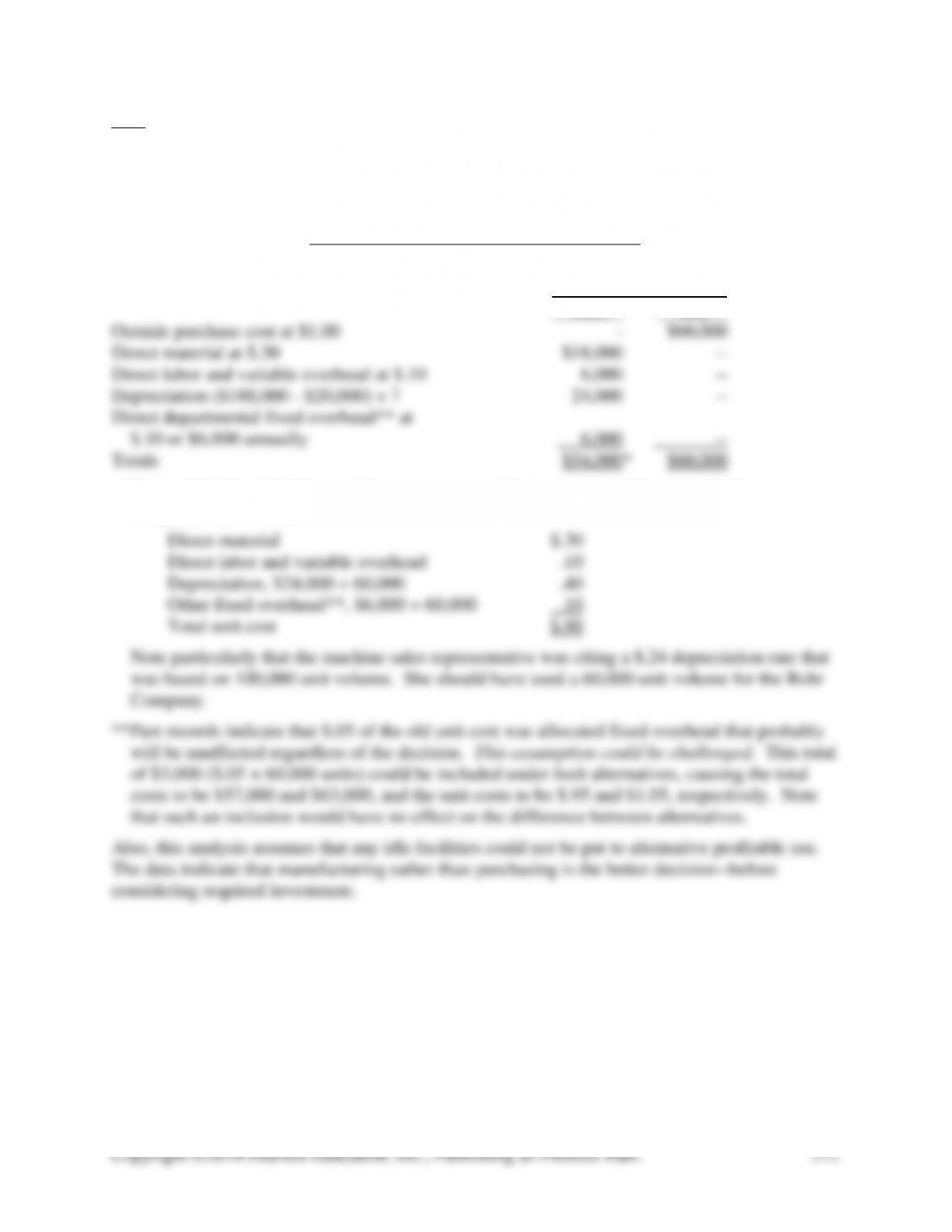
Cost Comparison for Make or Buy Decision
At 60,000 Units
Normal Volume
Make Buy
*On a unit basis, which is very dangerous to use unless proper provision is made for
comparability of volume:
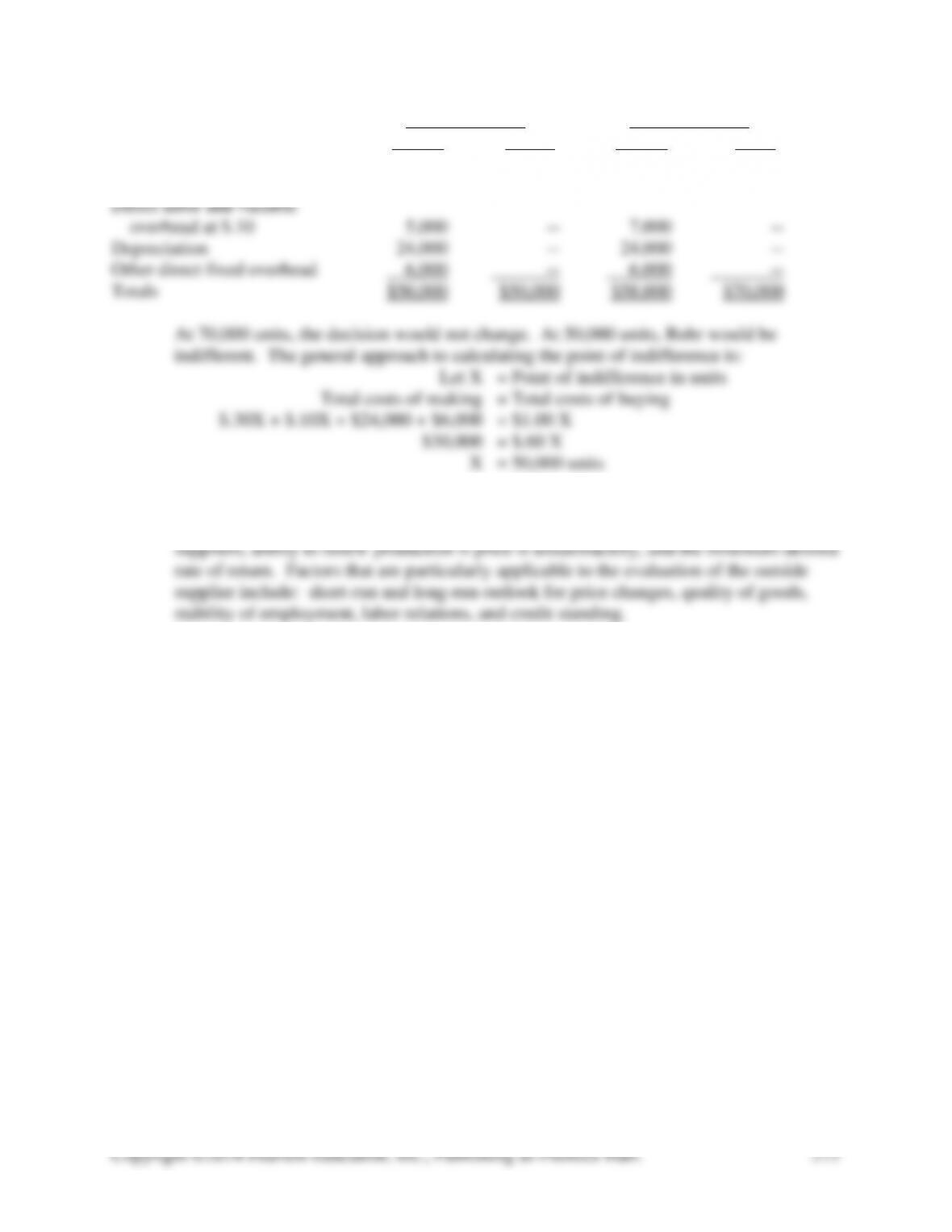
2. At 50,000 Units At 70,000 Units
Make Buy Make Buy
Outside purchase at $1.00 – $50,000 – $70,000
Direct material at $.30 $15,000 — $21,000 —
3. Other factors would include: Dependability of estimates of volume needed, need for
quality control, possible alternative uses of the facilities, relative merits of other outside
6-67 (20 – 30 minutes)
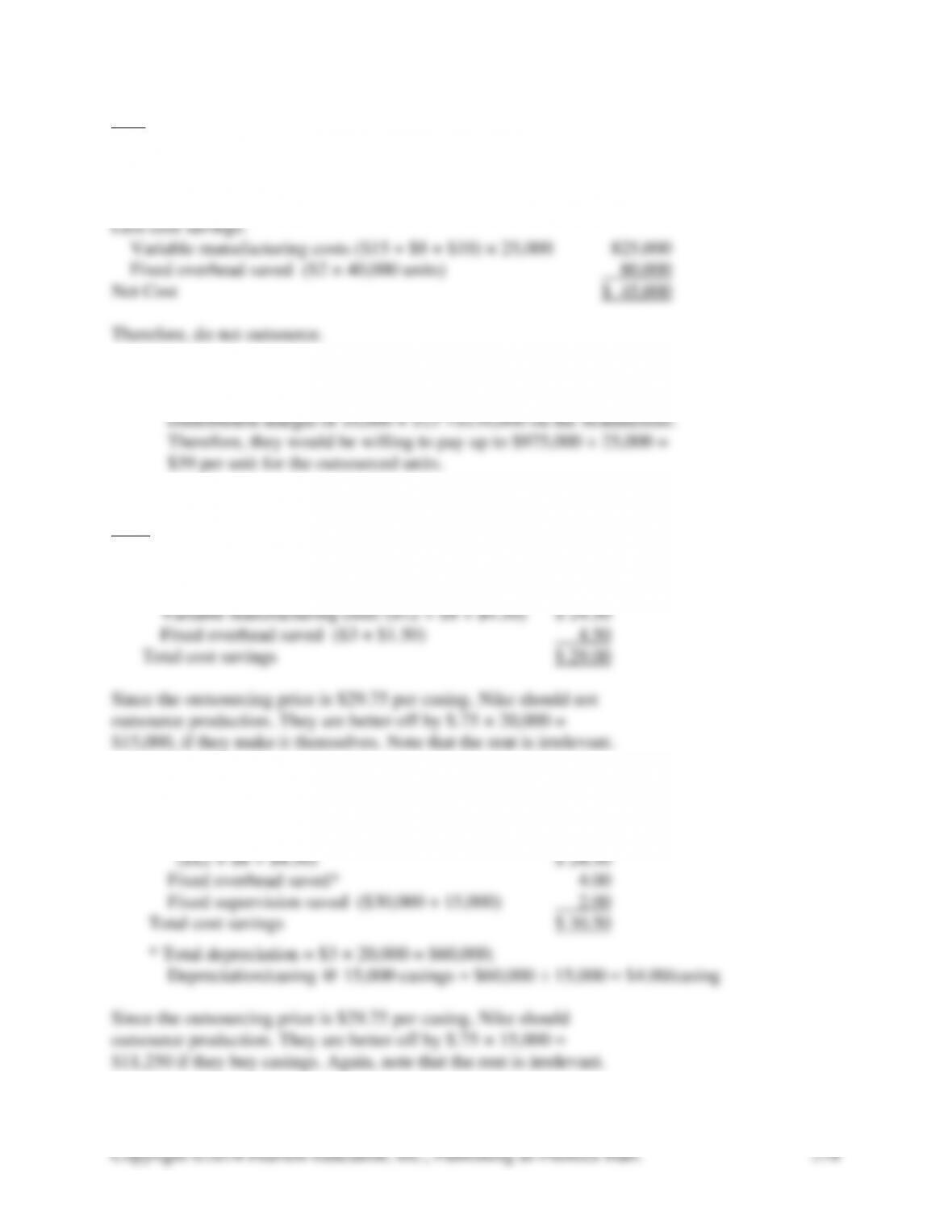
1. Assume they outsource:
Costs: 25,000 × $38 ($950,000)
2. If they outsource and make the Scanmeister, their cost savings are
$825,000 in variable manufacturing cost. Additionally, they earn a
6-68 (30-40 minutes)
1. Assume they outsource:
Cost Savings per casing:
2. Assume they outsource:
Cost Savings per casing:
Variable manufacturing costs
6-69 (25 – 30 min.) For the solution to this Excel Application Exercise, follow the step-by-
2. Only product C should be processed further. Products A and B should be sold at the split-off
point.
6-70 (60 min. or more)
This exercise provides experience searching the literature of a particular subject as well
as developing a better understanding of outsourcing decisions. Students will research the
6-71 (30-45 min.)
changed.
1. Some of the topics are “Our Story,” “Bagged Coffee”, “About the Company”, “Investor
Services”, “Social and Environmental Responsibility”, “Career Opportunities”, “Contact
2. To find out information concerning the financial statements, the place to look would be
in the “Investor Services,” which is under the category “About the Company.” In 2011,
3. To learn more about coffee, you would click on the link “Our Story,” followed by the
additional link “Behind the Bean.” The links that likely would provide information
about coffee differences in general (but not their own specific coffees), based solely on
4. Green Mountain Coffee provides information regarding the environment, environmental
actions the company has taken, the organizations, including those in the coffee
community and those in the local community, that the company supports. Additionally,