
CHAPTER 6
COVERAGE OF LEARNING OBJECTIVES
LEARNING
OBJECTIVE
FUNDA-
MENTAL
ASSIGN-
MENT
MATERIAL
CRITICAL
THINKING
EXERCISES
AND
EXERCISES
PROBLEMS
CASES, EXCEL,
COLLAB. &
INTERNET
EXERCISES
LO1: Use a
differential analysis to
examine income
effects across
alternatives, and show
that an opportunity
cost analysis yields
identical results.
24,27,28,29,
30,31, 42,44
45,46,47,48,
49,50,56,61
LO2: Decide whether
to make or buy
certain parts or
products.
A1,B1
25,32,33,34
62,63
65,66,67,68, 70
LO3: Choose whether
to add or delete a
product line using
relevant information.
B3
36
LO4: Compute the
optimal product mix
when production is
constrained by a
scarce resource.
A2,B2
35
51,53
LO5: Decide whether
a joint product should
be processed beyond
the split-off point.
A3,B4
37,38
54,55
69
LO6: Decide whether
to keep or replace
equipment.
A4,B5
40
57,59
LO7: Identify
irrelevant and
misspecified costs.
26,39,41
52,58,64
71
LO8: Discuss how
performance
measures can affect
decision making.
B6
43
60
CHAPTER 6
Relevant Information and Decision Making With a Focus on Operational Decisions
6-A1 (20 min)
1. The key to this question is what will happen to the fixed overhead costs if production of
the boxes is discontinued. Assume that all $46,800 of fixed costs will continue. Then,
2. Some subjective factors are:
• Might Weyerhaeuser raise prices if Vineyard Fruit closed down its box-making
facility?
3. In this case the fixed costs are relevant. However, it is not the depreciation on the old
equipment that is relevant. It is the cost of the new equipment. Annual cost savings by
boxes.
6-A2 (10 min.)
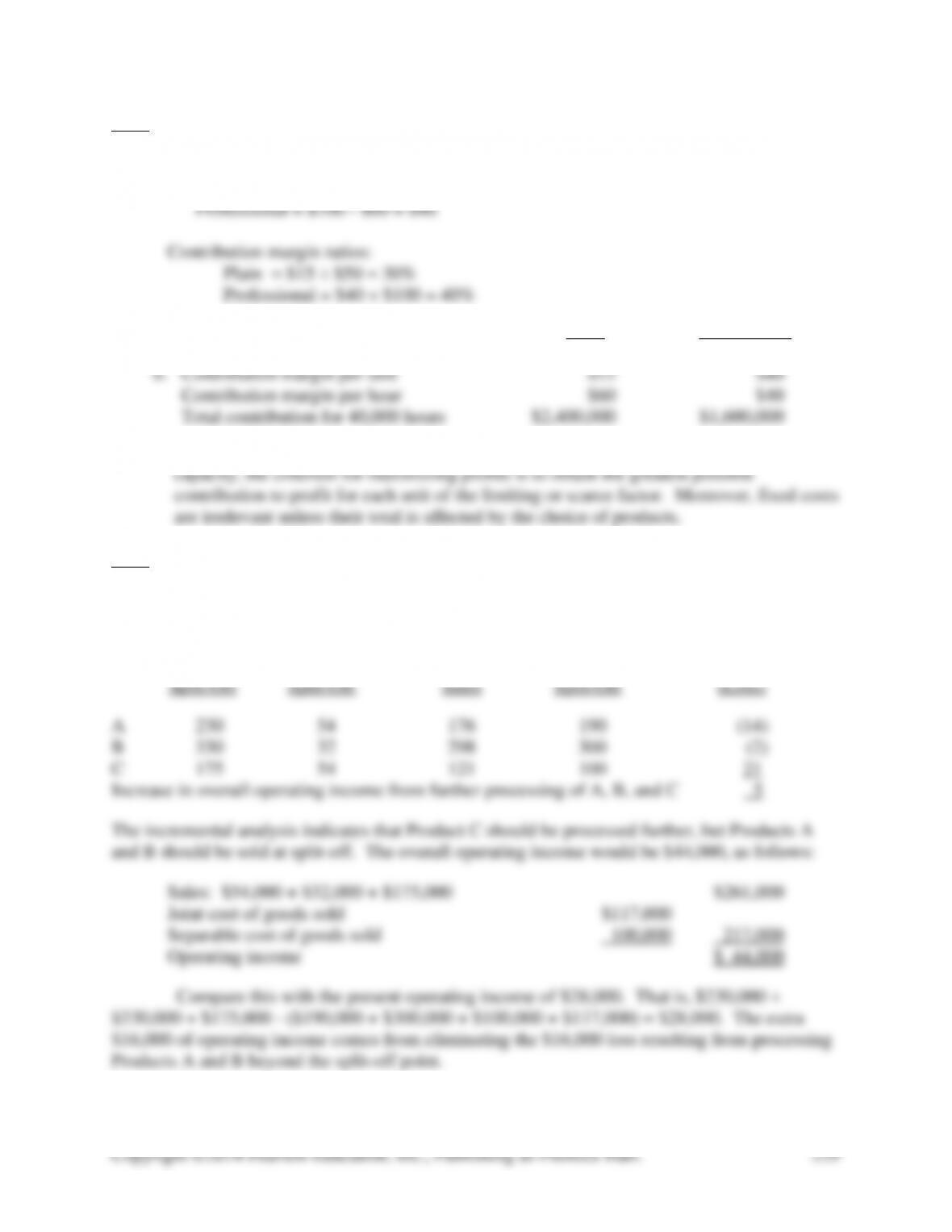
1. Contribution margins:
Plain = $50 – $35 = $15
2. Plain Professional
a. Units per hour 4 1
3. The plain circular saws are the best use of the scarce machine hours. For a given
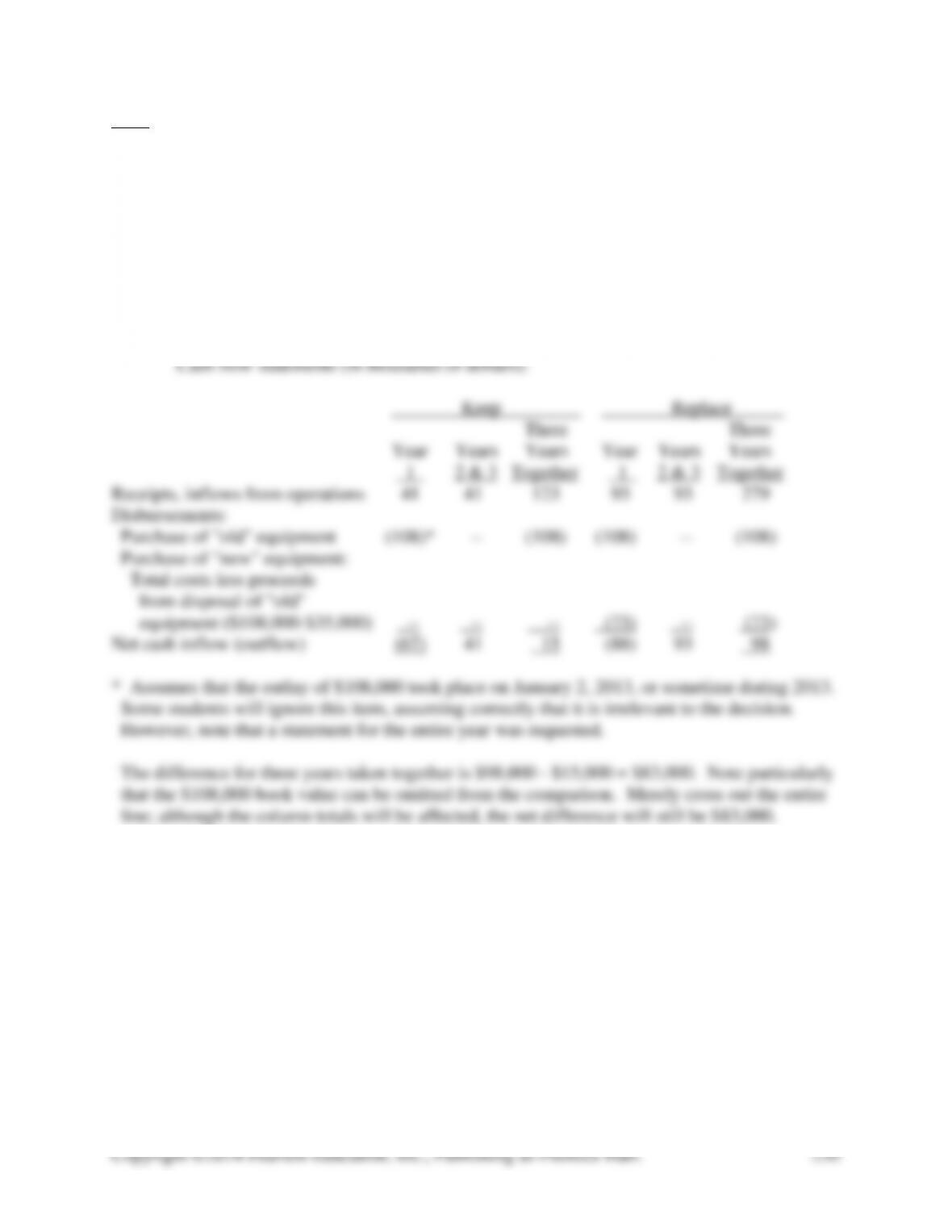
6-A3 (15 min.) Table is in thousands of dollars.
1,2. (a) (b) (a)-(b) (c) (a)-(b)-(c)
Separable
Sales Sales Costs Incremental
Beyond at Incremental Beyond Gain or
6-A4 (30-40 min.)
Problem 6-60 is an extension of this problem. The two problems make a good
combination.
1. Operating inflows for each year, old machine:
$850,000 – ($740,000 + $69,000) $41,000
Operating inflows for each year, new machine:
$850,000 – ($740,000 + $17,000*) $93,000
* $69,000 – $52,000
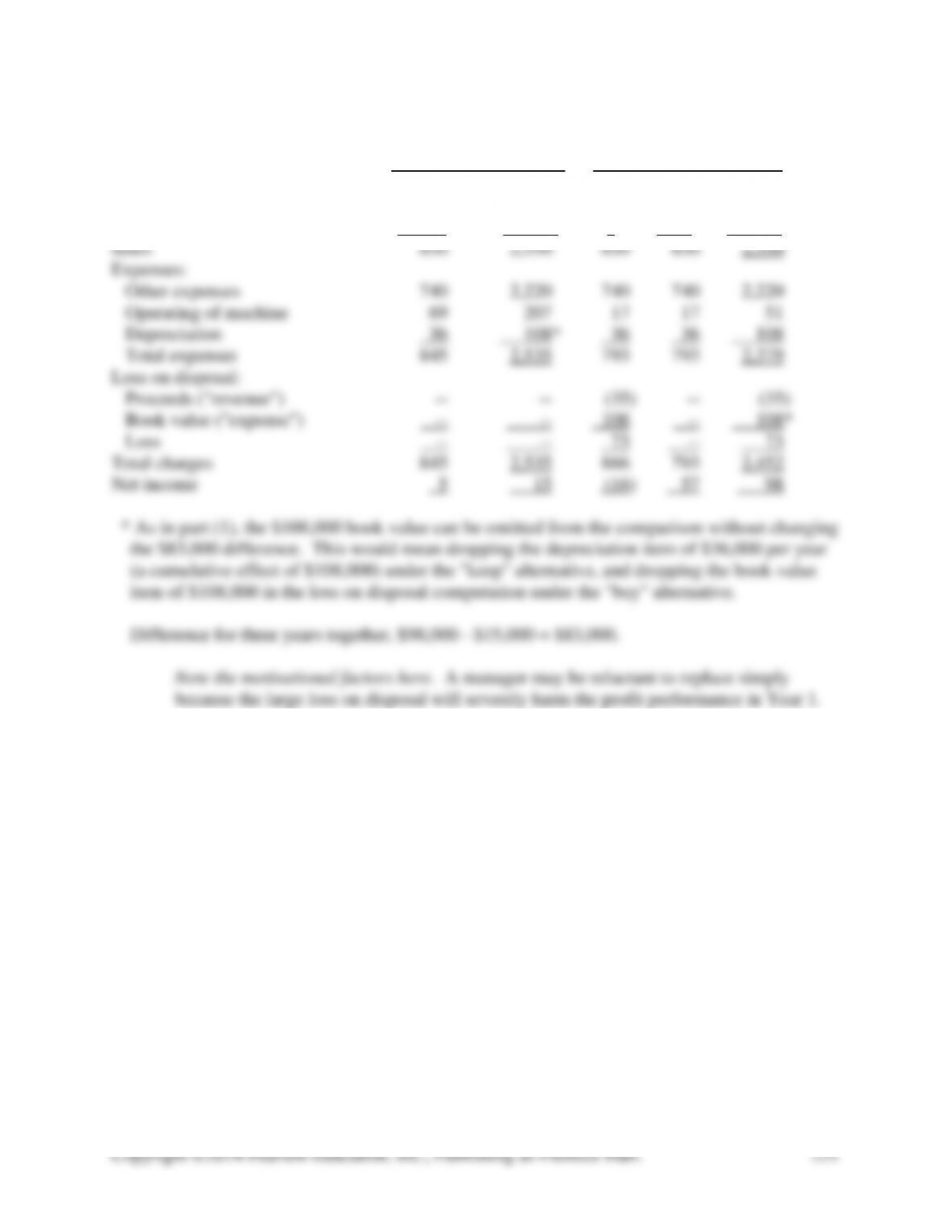
2. Income statements (in thousands of dollars):
Keep Replace
Three Three
Years Years Year Years Years
1, 2 & 3 Together 1 2 & 3 Together
3. The net difference for the three years taken together would be unaffected because the
item is a past cost. You can substitute any number for the original $108,000 figure for
the old equipment without changing this answer.
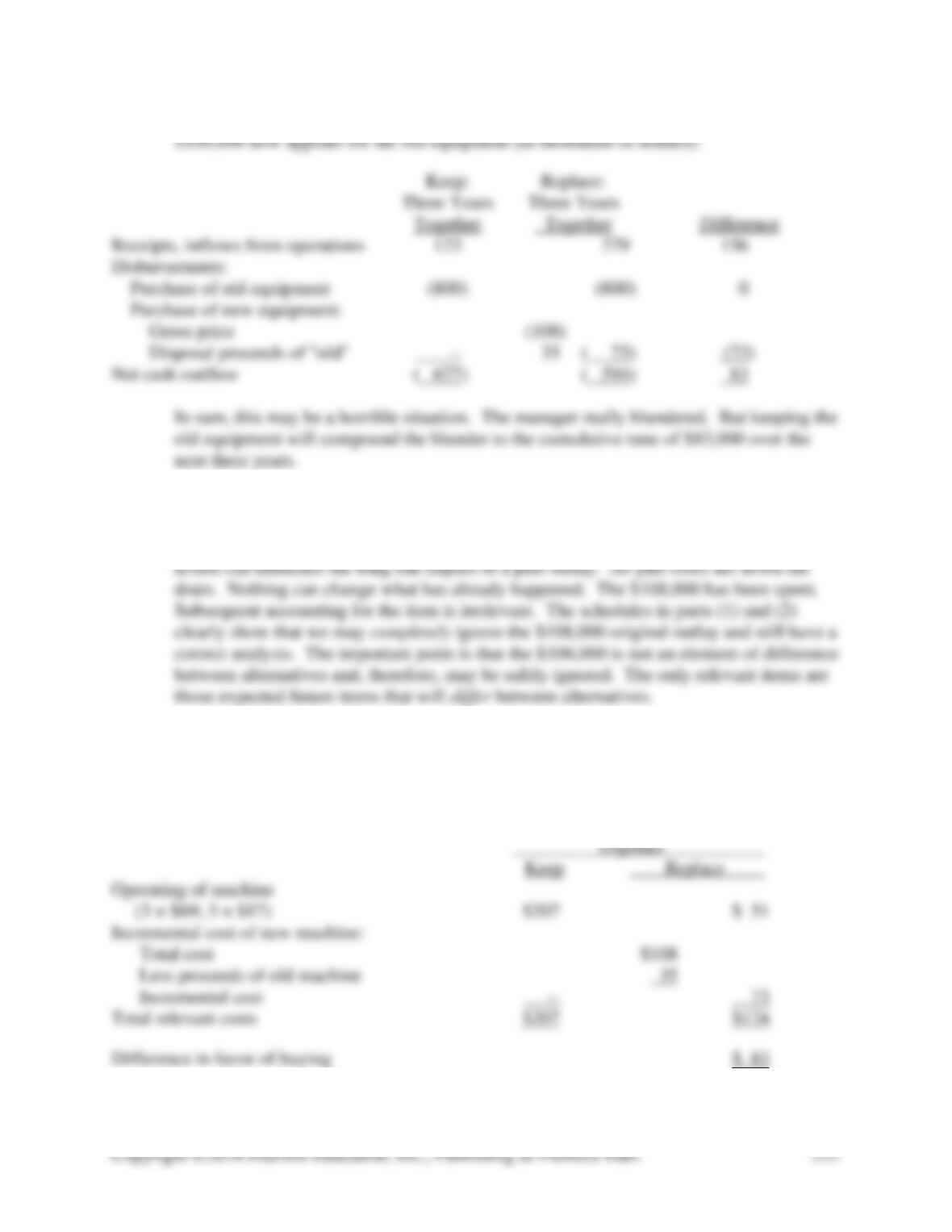
For example, examine how the results would change in part (1) by inserting $800,000 where the
4. Diplomatically, Slater should try to convey the following. All of us tend to indulge in
the erroneous idea that we can soothe the wounded pride of a bad purchase decision by
using the item instead of replacing it. The fallacy is believing that a current or future
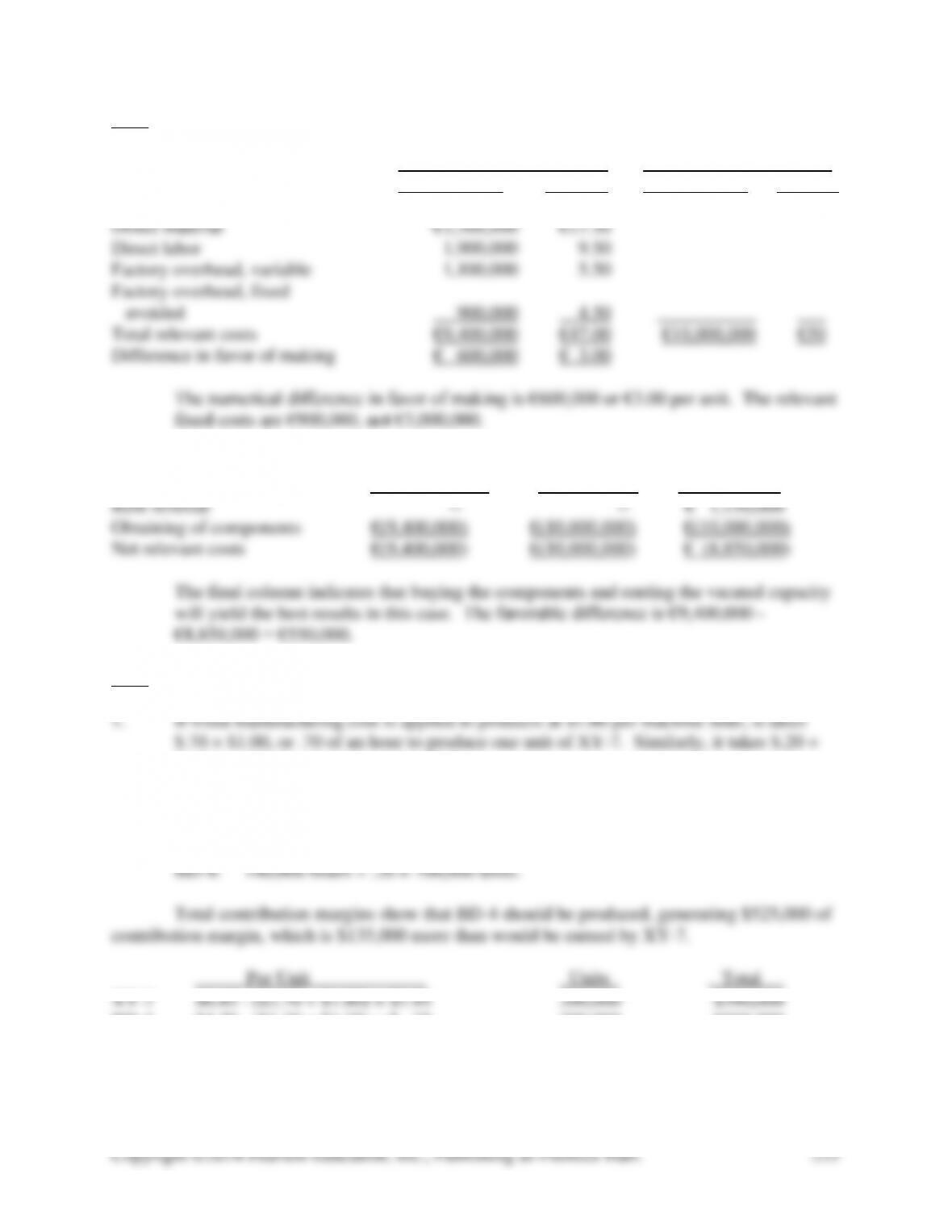
5. The $108,000 purchase of the original equipment, the sales, and the other expenses are
irrelevant because they are common to both alternatives. The relevant items are the
following (in thousands of dollars):
Three Years
6-B1 (15-20 min.)
1. Make Buy
Total Per Unit Total Per Unit
Purchase cost €10,000,000 €50
2. Buy and Leave
Make Capacity Idle Buy and Rent
6-B2 (15 min.)
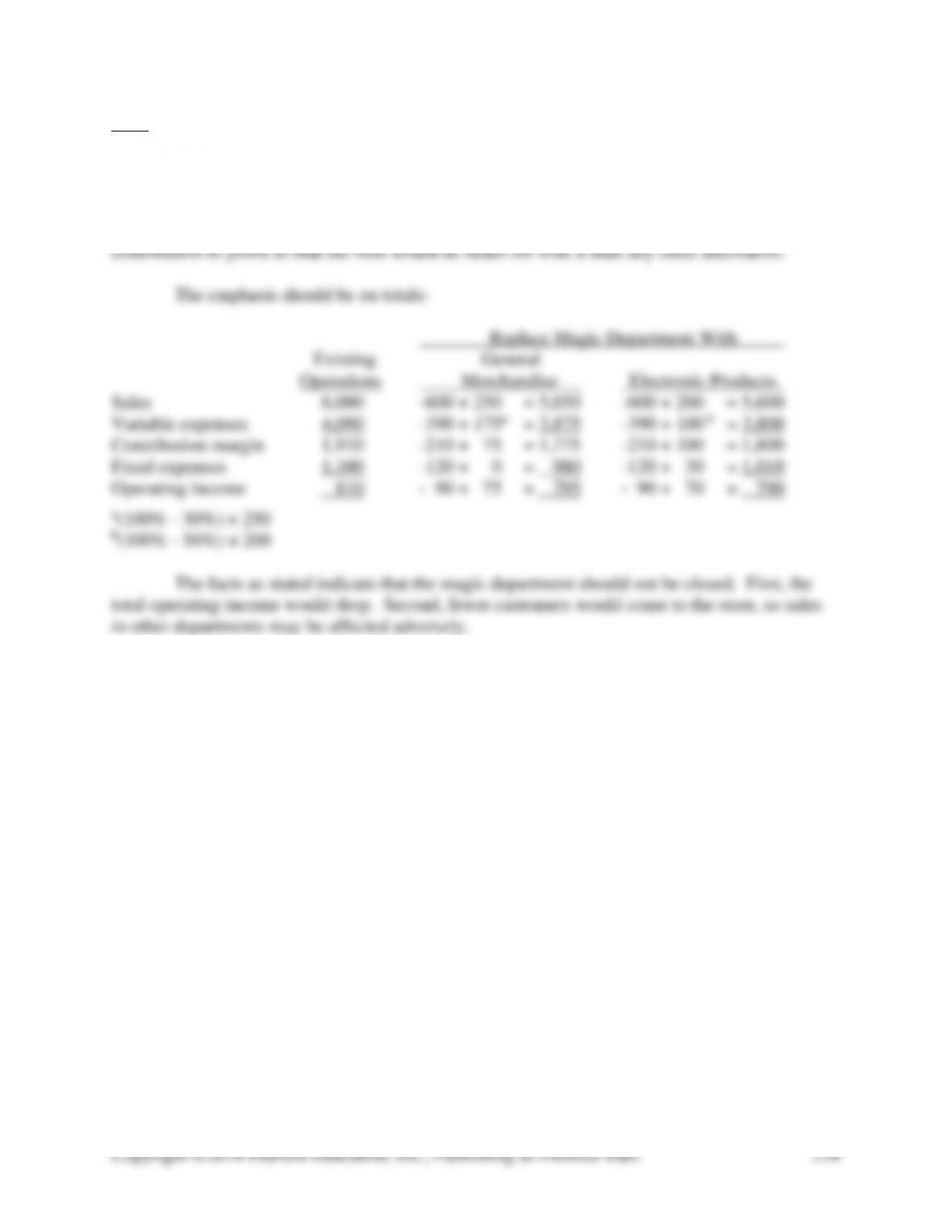
$1.00 or .20 of an hour to produce BD-4.
2. If there are 140,000 hours of capacity:
XY-7: 140,000 hours ÷ .70 = 200,000 units.
BD-4 $4.20 – ($1.70 + $1.75) = $ .75 700,000 $525,000
6-B3 (15-20 min.)
All amounts are in thousands of British pounds.
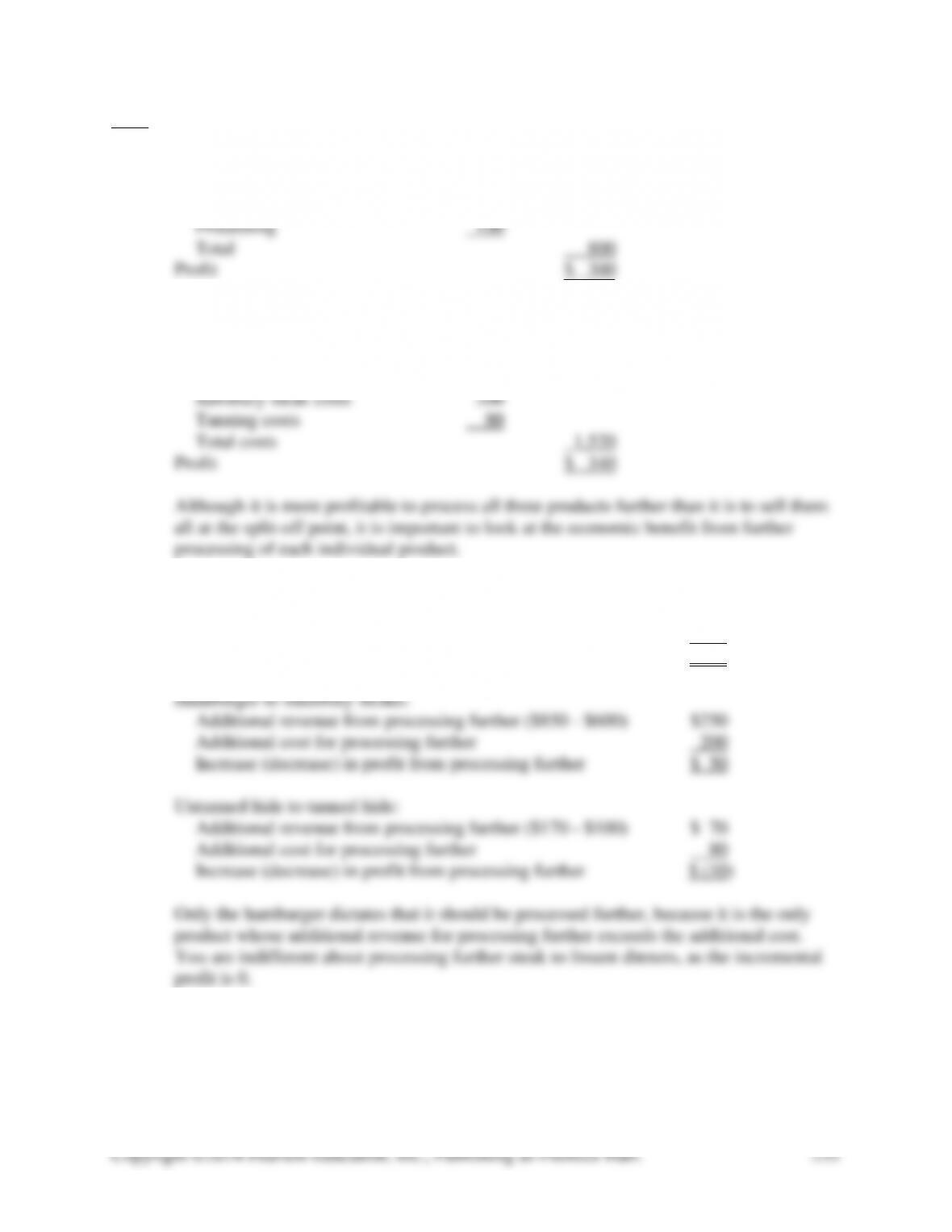
The major lesson is that a product that shows an operating loss based on fully allocated
costs may nevertheless be worth keeping. Why? Because it may produce a sufficiently high
6-B4 (15 min.)
1. Sales ($400 + $600 + $100) $1,100
Costs:
Raw materials $700
2. Sales ($840 + $850 + $170) $1,860
Costs:
Joint costs $800
Frozen dinner costs 440
3. Steaks to frozen dinners:
Additional revenue from processing further ($840 – $400) $440
Additional cost for processing further 440
Increase (decrease) in profit from processing further $ 0
4. The resulting profit would be $350:
Sales ($400 + $850 + $100) $1,350
Costs:
6-B5 (15-20 min.)
1. Three Years Together
Keep Replace Difference
Cash operating costs $51,000 $33,000 $18,000
Old equipment, book value:
2. Three Years Together
Keep Replace Difference
3. Benefits of the replacement alternative* $18,000
Deduct initial net cash outlay required** 11,100
6-B6 (10 min.)
1. The replacement alternative would be chosen because the county would have $6,900
more cash accumulated in three years.
2. The keep alternative would be chosen because the higher overall costs of photocopying
for the first year would be shown for the replacement alternative (under accrual
accounting):
6-2 The $800 represents an opportunity cost. It is the amount forgone by rejecting an
6-3 Accountants do not ordinarily record opportunity costs in accounting records because
6-4 A differential cost is any difference in total cost or revenue between two alternatives. A
6-5 No. Incremental cost has a broader meaning. It is the addition to total costs by the
6-6 The decline in costs would be called differential or incremental savings.
6-7 Not necessarily. Qualitative factors can favor either making or buying. Often factors
6-9 Yes. The costs that make a difference when a product or department is being deleted are
the avoidable costs.
6-11 Joint products are two or more manufactured products that (1) have relatively significant
6-12 The split-off point is where the individual products produced in a joint process become
6-13 Yes. Techniques for assigning joint-product costs to individual products are useful only
for product costing, not for deciding on further processing after the split-off point. The product
6-14 No. Once inventory has been purchased, the price paid is a sunk cost. It is true that
6-15 No. Sunk costs are irrelevant to the replacement decision.
6-16 No. Past costs are not relevant because they cannot be affected by a decision. Although
6-17 Only b and c are relevant.
a. Book value of old equipment is irrelevant to a replacement decision because it does not
6-19 Yes. The statement is correct in terms of total variable costs.
1. Most unit costs are stable only over a certain range of output, and care must be taken to
Two other reasons are mentioned in the text:
2. Unit costs must be reduced to the same base (denominator) before comparing or
combining them.
6-22 An inconsistency between a decision model and a performance evaluation model occurs
when a decision about whether to replace a piece of equipment is based on the cash flow effects
6-23 The wide use of income statements to evaluate performance may overly influence
6-24 Yes, this statement is generally correct. Accountants record transactions. But
6-25 Deciding whether to outsource payroll functions requires estimates of the cost of
designing, maintaining, and using a payroll system internally compared to the cost of a contract
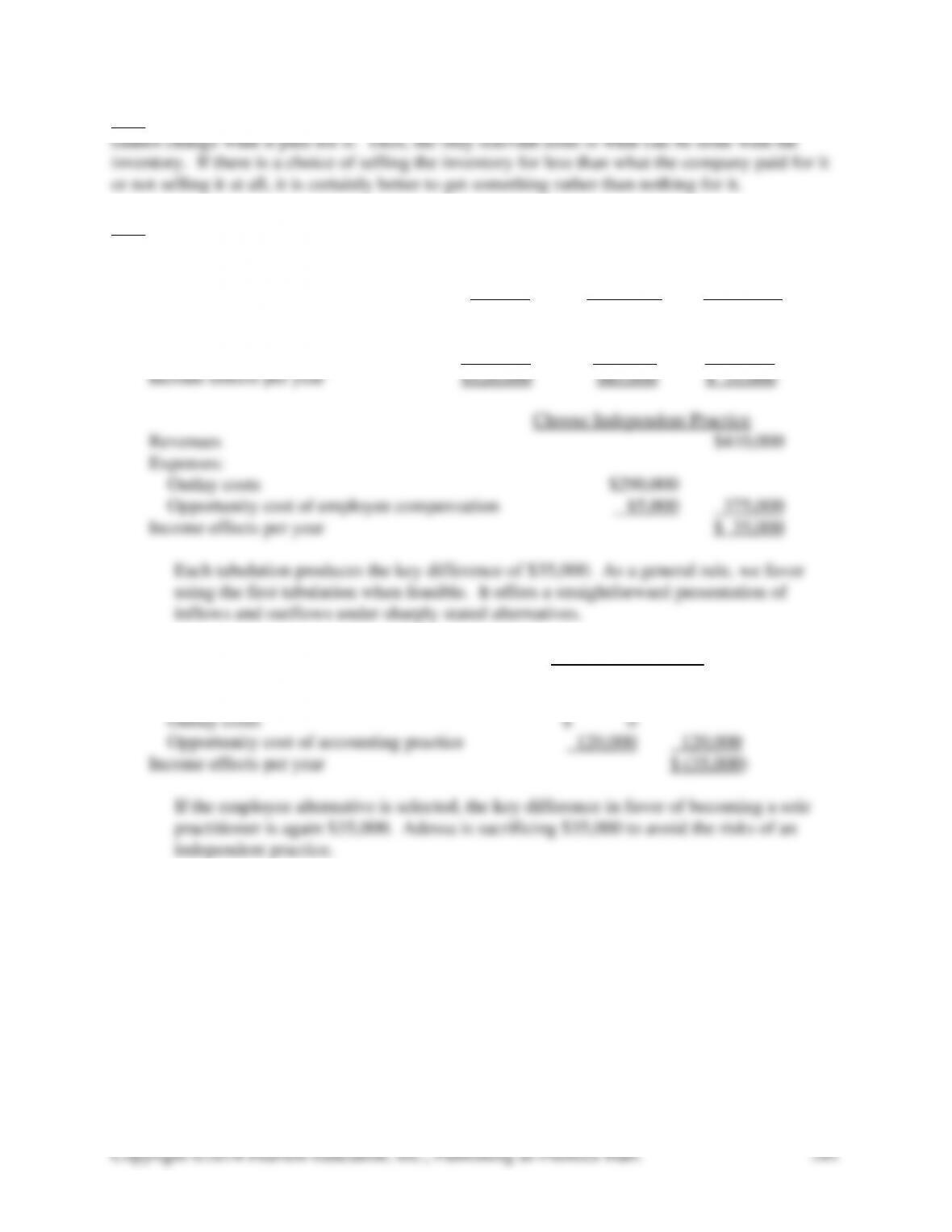
6-26 Whenever total costs are unitized by dividing by total units and the resulting unit costs
are then used to predict new total costs based on a different level of production, errors are being
made if any of the costs are fixed. If the new production level is higher, predicted total costs are
overestimated. If the new production level is lower, predicted total costs are underestimated.
Never unitize fixed costs if the resulting unit cost will be used for planning purposes!
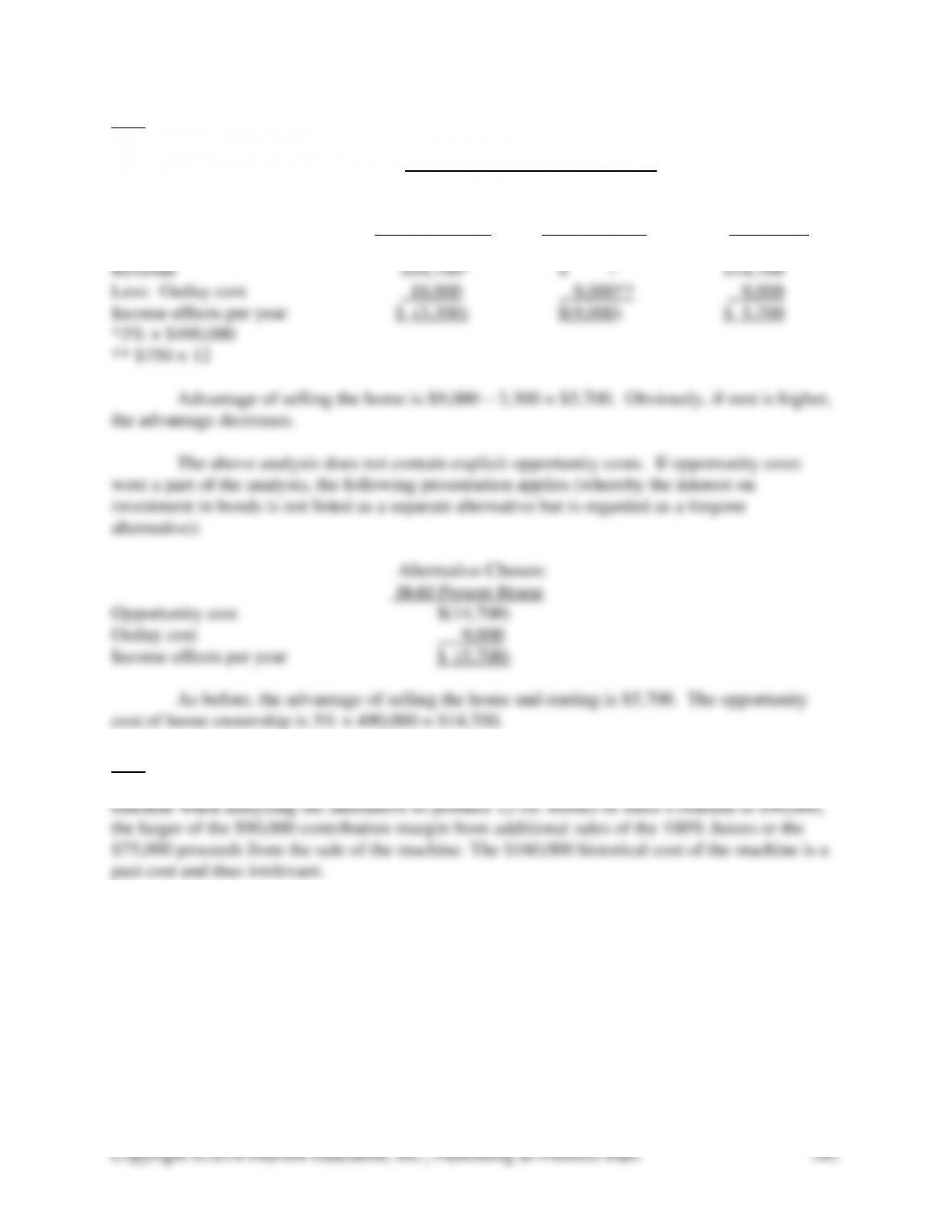
6-27 The amount paid for inventory is a sunk cost. Once a company has the inventory, it
6-28 (10-15 min.)
1. Independent
Practice Employee Difference
Operating revenues $410,000 $85,000 $325,000
Operating expenses 290,000 — 290,000
2. Choice as Employee
Revenue $ 85,000
Expenses:
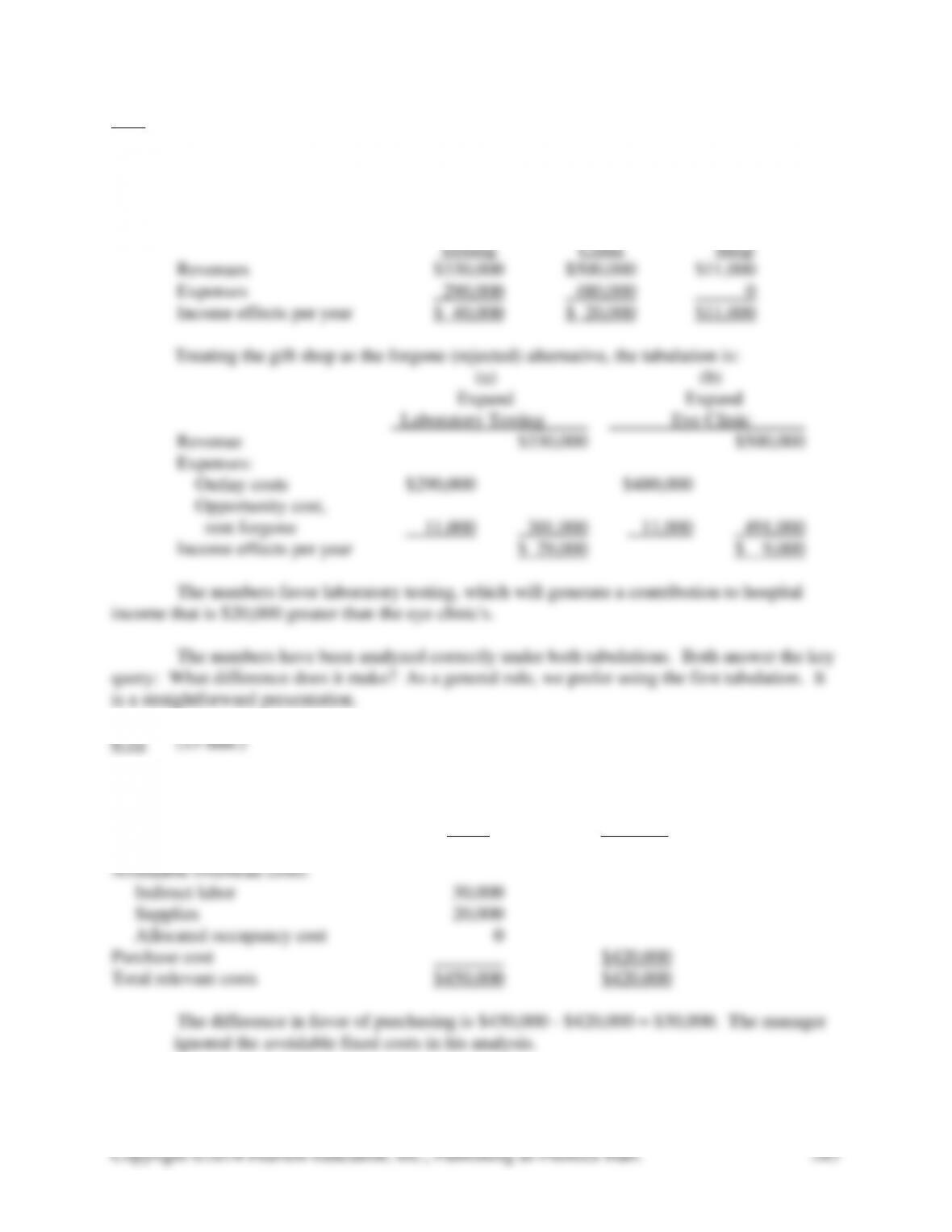
6-29 (10-15 min.)
Alternatives Under Consideration
(1) (2) (1) – (2)
Sell, Rent, and Hold
Invest in Bonds Present Home Difference
6-30 (15-20 min.) Opportunity cost is the maximum available contribution to profit forgone
by using limited resources for a particular purpose. In this case, the opportunity cost of the
6-31 (15-20 min.) The first tabulation is probably easier to understand, but the choice of a
tabulation is a matter of taste:
(a) (b) (c)
Expand Expand Rent to
Laboratory Eye Gift
1. It is easiest to analyze total costs, not unit costs.
Make Purchase
Direct materials $400,000
2. Because the quantitative difference is small, qualitative factors may dominate the
decision. Companies using a just-in-time system need assurance of both quality and
timeliness of supplies of materials, parts, and components. A small, local company may
not be reliable enough for Bose. In essence, Bose may be willing to “invest” $30,000, the
6-33 (20-25 min.)
Nantucket Nectars should make the bottles.
Make Buy
Per Per
6-34 (15-20 min.)
Buy and
Use
Buy and Facilities Buy and
Leave for Rent
6-35 (20 min.)
1. These warehouse stores attempt to maximize profits by cutting prices and increasing
inventory turnover. Since profit is the product of contribution margin and unit sales, it
can be affected by changing either. Total profit can be increased if the added inventory
2. Such a criterion by itself gives no indication what total contribution margin (TCM) can
be expected. Inventory turnover or sales volume must be used also. The total
Copyright ©2014 Pearson Education, Inc., Publishing as Prentice Hall.
246
6-36 (10-15 min.)
1. The key is to focus on lost revenues and avoidable costs:
Revenues, 750 hours
@ CHF10 per hour CHF 7,500
program.
2. Among the qualitative factors to consider are that the after-school care program might
6-37 (10 min.)
Product M should not have been processed further. The only valid approach is to
concentrate on the separable costs and revenues beyond split-off:
Sell at Process
Split-off Further as