5-53 (20 min.)
Basic Marginal Total
Number of flights per month 3,000 120 3,120
Available seats 300,000 12,000 312,000
Seats filled 156,000 2,400 158,400
Whelan, only after the line’s basic schedule has been set.
“Then you go a step farther,” he says, and see if adding more flights will
contribute to profits. Similarly, if he’s thinking of dropping a flight with a
disappointing record, he puts it under the marginal microscope: “If your revenues are
going to be more than your out-of-pocket costs, you should keep the flight on.”
all. A pair of night coach flights on the Houston-San Antonio-El Paso-Phoenix-Los
Angeles leg, added on a marginal basis, have turned out to be so successful that they
are now more than covering fully allocated costs.
Alternative. Whelan uses an alternative cost analysis closely allied with the
marginal concept in drawing up schedules. For instance, on his 11:11 p.m. flight
Copyright ©2014 Pearson Education, Inc., Publishing as Prentice Hall.
215
And there are other absolute-loss flight scheduled solely to bring passengers to a
connecting Continental long-haul flight; even when the loss on the feeder service is
considered a cost on the long-haul service, the line makes a net profit on the trip.
Continental’s data handling system produces weekly reports on each flight, with
revenues measured against both out-of-pocket and fully allocated costs. Whelan uses
these to give each flight a careful analysis at least once a quarter. But those added on
a marginal basis get the fine-tooth-comb treatment monthly.
The business on these flights tends to be useful as a leading indicator, Whelan
finds, since the off-peak traffic is more than normally sensitive to economic trends
and will fall off sooner than that on the popular-hour flights. When he sees the night
coach flights turning in consistently poor showings, it’s a clue to lower his projections
5-54 (15-20 min.)
1. Total variable costs are $.85 + $.65 = $1.50 per boomerang.
Total fixed costs are $109,000 + $23,000 = $132,000
Volume in units 170,000 220,000 260,000
2. Note the significant difference in predictions. For example, the correct analysis
indicates $157,000 operating income at a 170,000 volume level; the incorrect
5-55 (15-20 min.)
1. Compare option a to option b:
Extra revenue from option a: ($32 – $15) × 30 passengers = $510
Extra costs for option a: ($2.20 – $.20) × 65 mi + $400 = $530
2. This depends on the total additional revenues and costs for option b, the best of
the two options:
Revenue: $15 × 30 $450.00
$197. The cost of the tour guide and the cost of moving the car to the main track
5-56 (15-20 min.)
1. Net income will be increased by 300 × (€40 – €25 – €10) = €1,500.
3. €180,000, €70,000, €30,000, €10; i.e., all numbers are irrelevant except €25.
4. Selling price: €180,000 ÷ 2,000 units = €90
Total sales: 2,400 × 2 × €90 = €432,000
5-57 (15-25 min.)
1. Budgeted fixed manufacturing overhead per unit:
$72,000,000 ÷ 9,000,000 = $8
2. Relevant items:
Additional sales $3,450,000
3. Students may raise many points, including:
a. Whether the president is willing to “invest” $740,000 in forgone operating
4. Budgeted fixed manufacturing overhead rate would be $72,000,000 ÷ 4,500,000
= $16. However, the additional operating income in requirement 2 would be
5-58 (20-30 min.) When this problem was used in an exam, it was well done by
students who used contribution margin analysis in total dollars. A number of students
attempted to force a decision by means of analysis of unit costs or by break-even
analysis, failing to consider the effect of sales volume on profits. A number of good
solutions were marred by failure to draw specific conclusions.
However, this is in excess of present capacity.
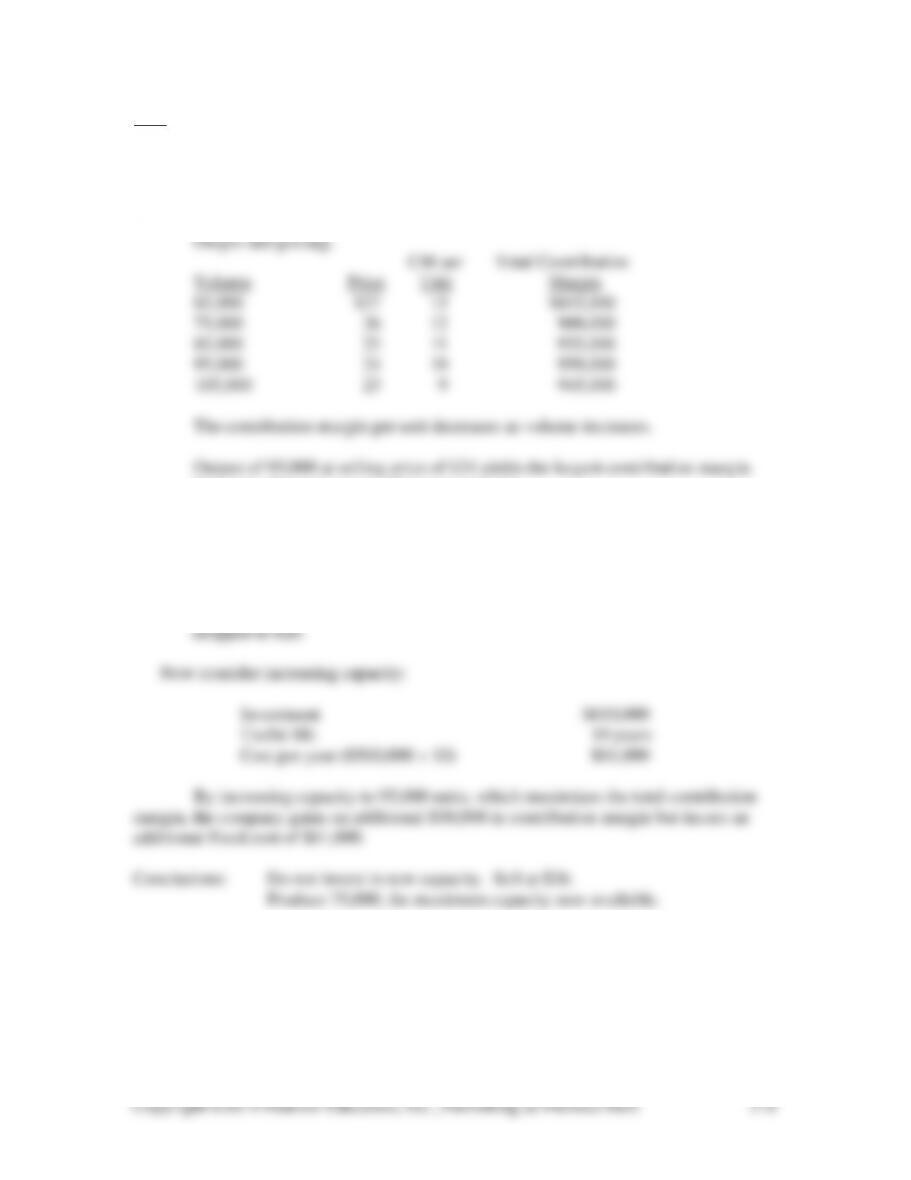
Maximum at present capacity: 75,000 units output at $26
= Contribution margin of $900,000
This is $900,000 – $845,000 = $55,000 more contribution than is generated by
the current price of $27. Even with no capacity expansion, the price should be
5-59 (10-15 min.)
1. Manufacturing cost $27.00
$32.40, assuming that market research is right about the market price of $26.00.
Even with no profit margin, the cost of $27 exceeds the price of $26.
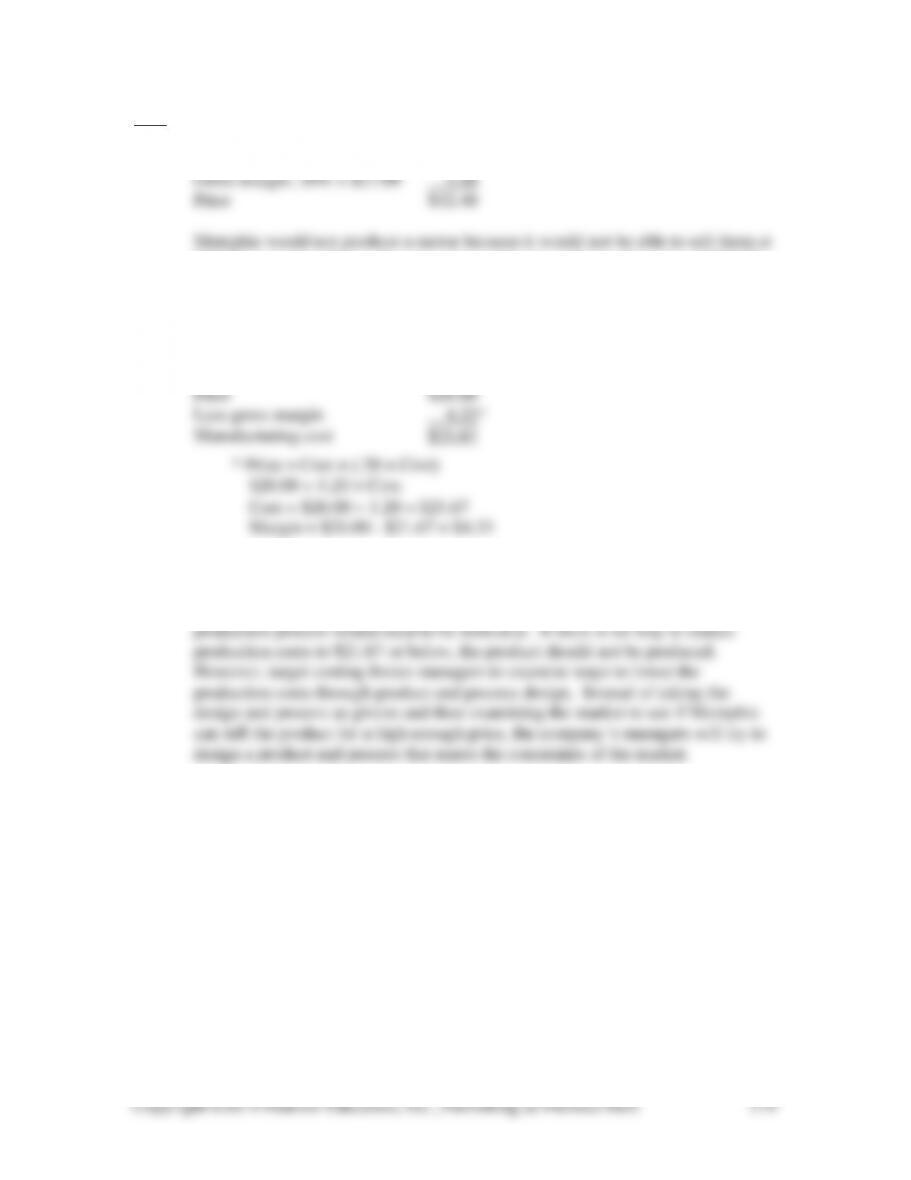
2. Using target costing, Memphis would begin with the market price of $26.00.
From this, managers would compute the largest acceptable manufacturing cost,
$21.67:
3. Memphis managers would have to determine if they could design the garage-
door-opener motor and its production process in a way that manufacturing costs
were below $21.67. Both the design specifications for the motor and the
5-60 (35-45 min.)
Cost per driver
unit
C-200472
C-200473
C-200474
C-200475
Number
of units
Cost
Numbe
r of
units
Cost
Number
of units
Cost
Numbe
r of
units
Cost
Direct material
$1.60/ pound
2,000
$3,200
1,000
$ 1,600
4,000
$ 6,400
800
$1,280
Setup/maintenance
$1,015/ setup
10
10,150
4
4,060
12
12,180
5
5,075
Processing
$370/ mach. hr.
20
7,400
12
4,440
32
11,840
12
4,440
Marketing
$860/order
30
25,800
10
8,600
50
43,000
16
13,760
Customer service
$162/sales call
55
8,910
35
5,670
20
3,240
28
4,536
Total existing cost
$55,460
$24,370
$76,660
$29,091
Total demand in units
2,000
1,400
4,000
600
Existing cost per unit
$ 27.73
$ 17.41
$ 19.17
$ 48.49
Target cost per unit
$23.40*
$ 16.80
$ 21.00
$ 30.00
Required cost
reduction
$ 4.33
$ 0.61
$ 0
$ 18.49
RCR as a percent of
market price
11.1%
2.2%
0%
37.0%
Decision
Redesign product and
process using value
engineering
Release to
production and set
kaizen cost
improvement plan
Release to
production
Abandon subject to
approval
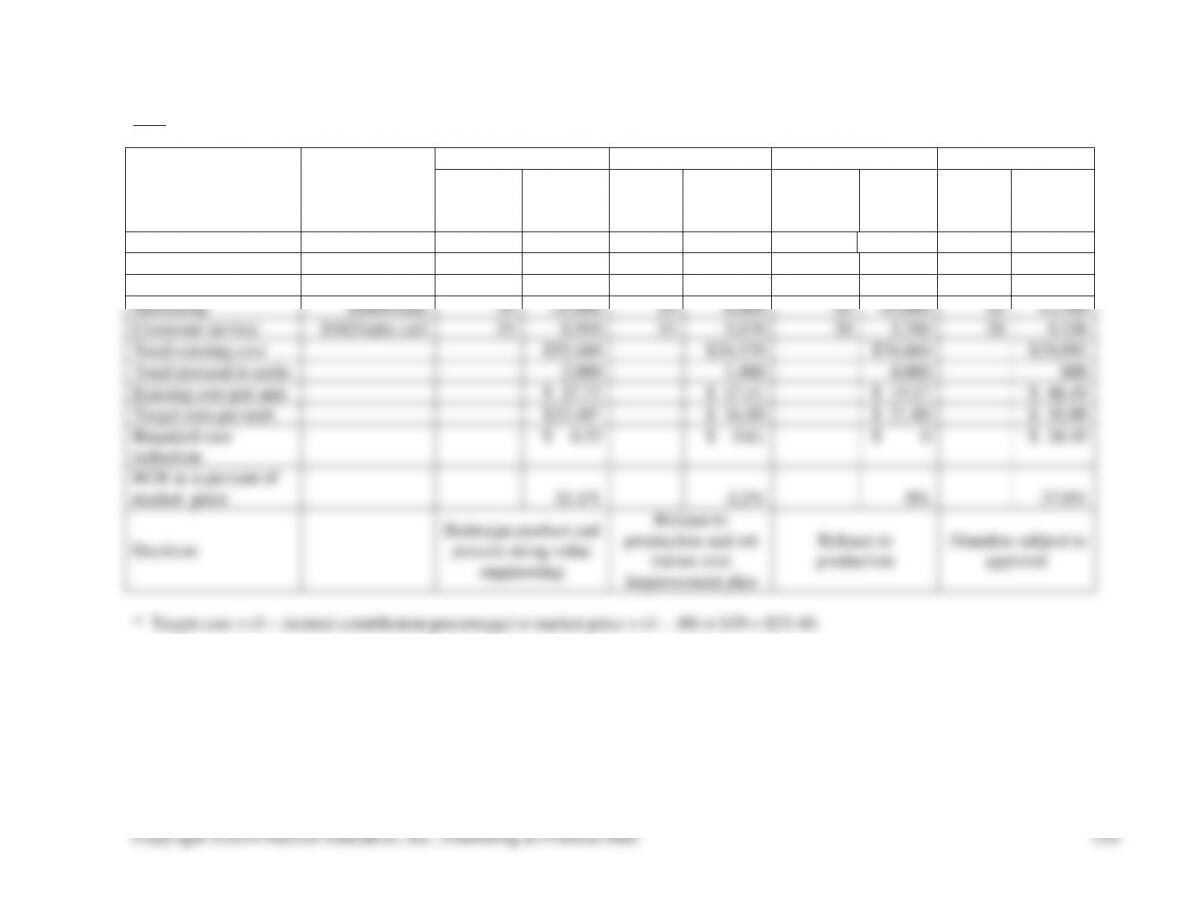
* Target cost = (1 – desired contribution percentage) × market price = (1 – .40) × $39 = $23.40.
5-61 (20 min.)
1. Contribution margin = $795 – ($460 + $40) = $295
Total contribution = $295 × 47,700 mowers = $14,071,500
2. Desired profit = .10 × ($795 × 47,700) = $3,792,150
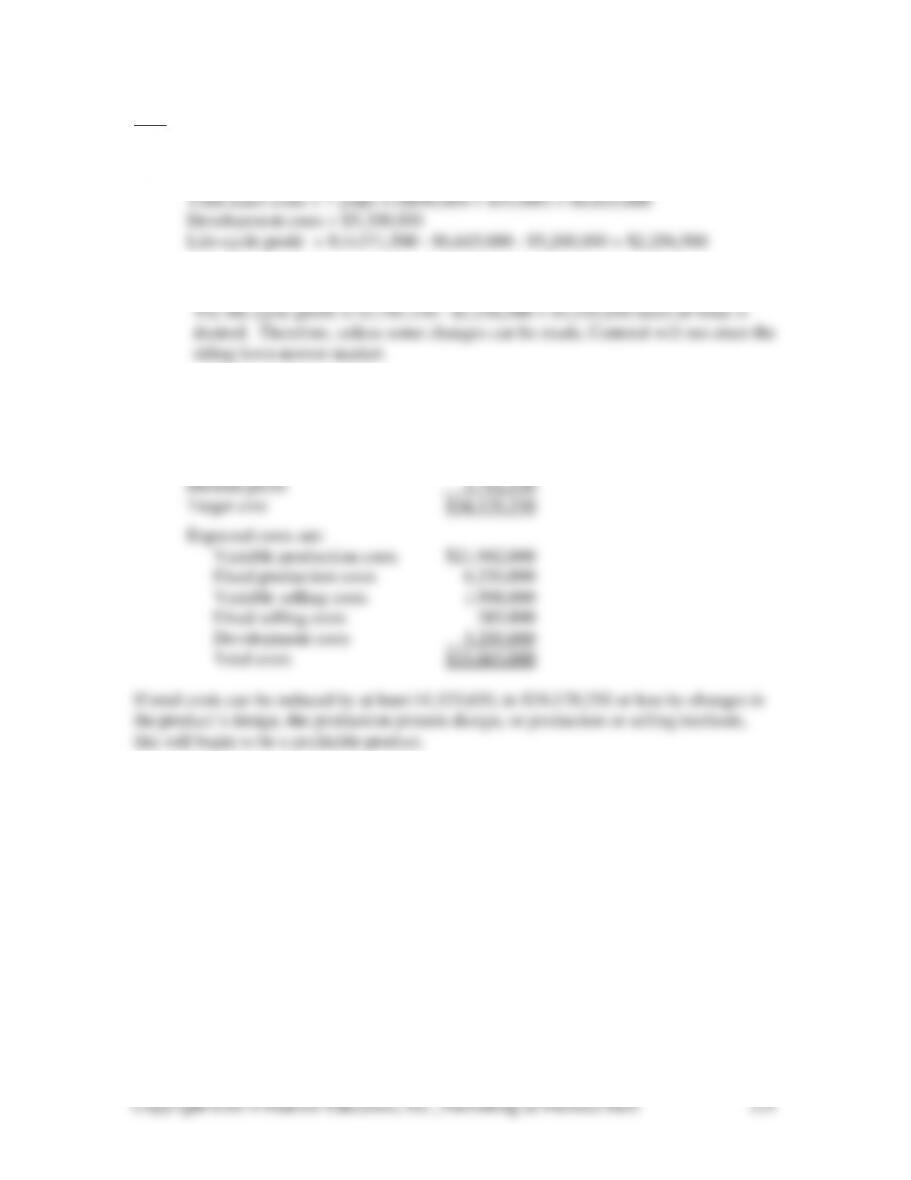
3. A target costing company does not quit when the first cost estimate comes in too
high. Managers establish a target cost and try to adjust design, production and
marketing processes to meet the target cost. In this case, the target cost is:
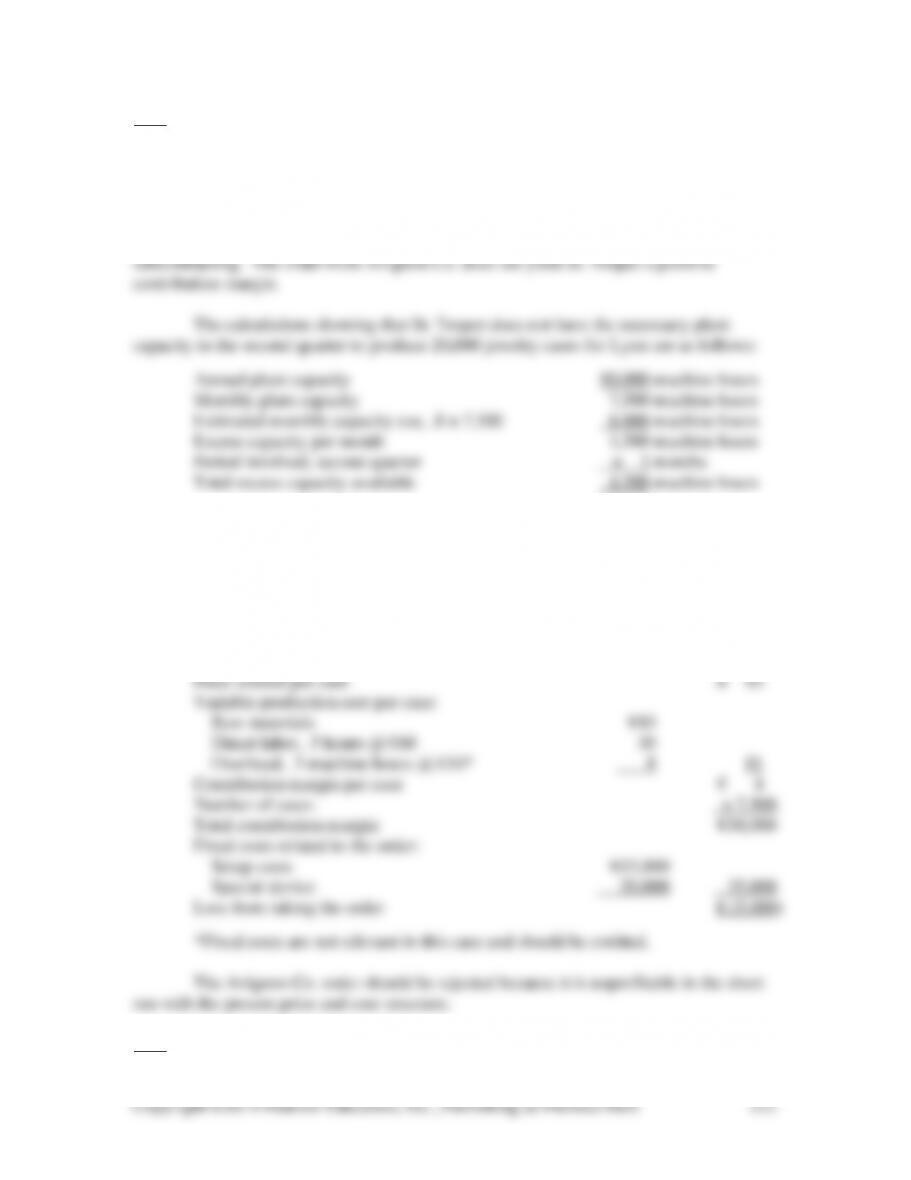
Revenue $37,921,500
5-62 (30 – 40 min.)
Fixed overhead allocation rate per machine hour = €2,160,000 90,000 = €24
Variable overhead allocation rate = €40–€24 = €16 per machine hour
St. Tropez should not accept either order. The company does not have adequate
plant capacity to manufacture the order of 20,000 jewelry cases from Lyon Inc. without
Machine hours required to produce 20,000 jewelry cases
= Number of cases × machine hours per case = 20,000 × .25 = 5,000 hours.
The Lyon Inc. order for 20,000 jewelry cases would require 5,000 machine
hours, but only 4,500 machine hours are available in the second quarter.
Computations related to the order from Avignon Co. are as follows:
5-63 (10 – 15 min.)
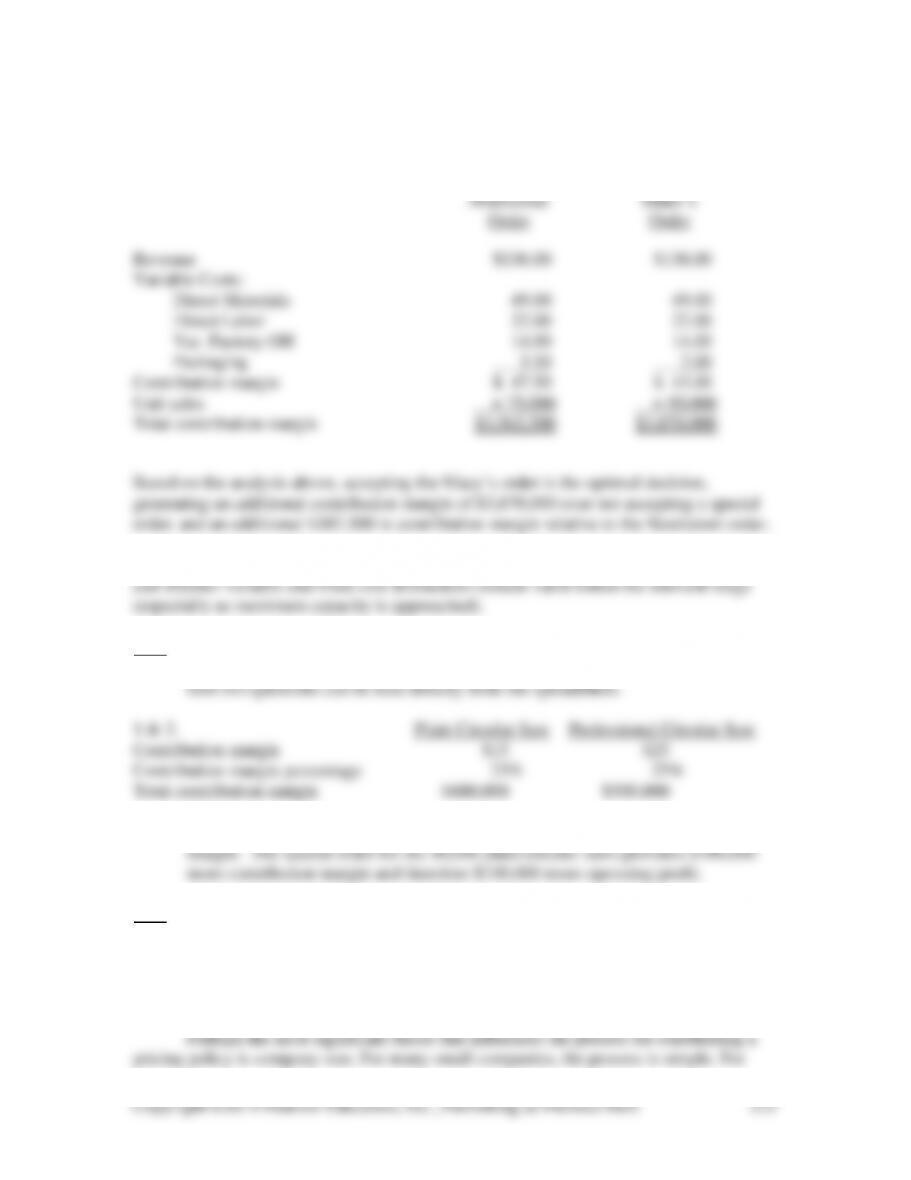
1. Capacity is not sufficient to accept both orders, but there is enough capacity to
accept either the Nordstrom or the Macy’s order. There is excess capacity for 150,000
shoes, but the two orders together would require production of 90,000 + 75,000 =
165,000 shoes.
2. Some considerations would involve cannibalization of existing sales by lower prices,
5-64 (20 – 30 min.) For the solution to this Excel Application Exercise, follow the
step-by-step instructions provided in the textbook chapter. The answers to the
3. The relevant costs are the variable costs, so we can focus on the contribution
5-65 (60 min. or more)
Pricing tends to be more of an “art” than a “science” in small firms. In large firms,
students will find a wide variety of tools and techniques but will most likely get
interesting answers to all the recommended questions.
Copyright ©2014 Pearson Education, Inc., Publishing as Prentice Hall.
224
example, one restaurant establishes prices using a formula of three times the cost of food
used in each menu item. This markup is designed (hoped) to cover all the operating costs
in the restaurant’s value chain beyond food cost (direct material). Other important factors
commonly mentioned include market conditions and the experience level of
management.
Small companies tend not to use target costing. Some form of cost plus pricing is
most often used. When target costing is used and managers are asked to explain the
target-costing process, it is often discovered that only some elements of a fully developed
target costing process are used.
Students may discover that different pricing policies are used for different product
or service families in the same firm. This is particularly true for large companies that
compete in many different markets.
5-66 (50 – 60 min.)
1. In its 2011 Annual Report, the major component of Colgate’s strategy is investing in
innovative new products with growth potential. The company supports this strategy
by focusing on the value chain functions R & D and marketing. The company that
places an emphasis on rapid product development needs relevant information
2. The importance of Colgate’s code of conduct can be measured several ways. Not only
does the company provide a link to the actual code of conduct for public viewing, the
following excerpt from the section “Living our Values” gives a good feel for the code
of conduct priority at Colgate.
Since 1987, our Code of Conduct has served as a guide for our daily
Copyright ©2014 Pearson Education, Inc., Publishing as Prentice Hall.
225
people, including Directors, Officers, and all employees of the Company
and its subsidiaries around the globe. Vendors and Suppliers are also
subject to these requirements as adherence to the Code is a condition for
conducting business with Colgate.
The Code of Conduct is regularly updated and reissued to ensure its
comprehensiveness. On June 7, 2012, Colgate’s Board of Directors
approved certain amendments to the Code of Conduct, including (i)
enhancements to existing provisions regarding conflicts of interest (to
address potential conflicts from internal interactions), protection of
Colgate’s confidential information and use of information technology
resources and (ii) additional provisions regarding data privacy and social
media. The updated Code of Conduct also highlights Colgate’s values
and leading with respect principles.
Yet another excerpt from that section speaks to Colgate’s commitment to ethical
values:
Most importantly, each employee is responsible for demonstrating
integrity and leadership by complying with the provisions of the Code of
Conduct, Global Business Practices Guidelines, Company policies and
all applicable laws. By fully including ethics and integrity in our
ongoing business relationships and decision-making, we demonstrate a
commitment to a culture that promotes the highest ethical standards.
3. As of late 2012, one of the new products is a Hill’s® Prescription Diet® y/d™ cat
4. The company displays its major product groups and major market regions using a
heading page. In late 2012, eight laundry conditioners were listed. The information
5. The company’s financial strategy is to continuously improve gross margin
percentage, reduce overhead (sales, general, and administrative expenses), and

59.1% in 2010 to 57.3% in 2011 (from the comparative consolidated statements of
income). Selling, general, and administrative expenses (a good surrogate for
of $1.734 billion in 2011.
These results are the primary source supporting increased R & D and advertising for