5-37 (20 min.)
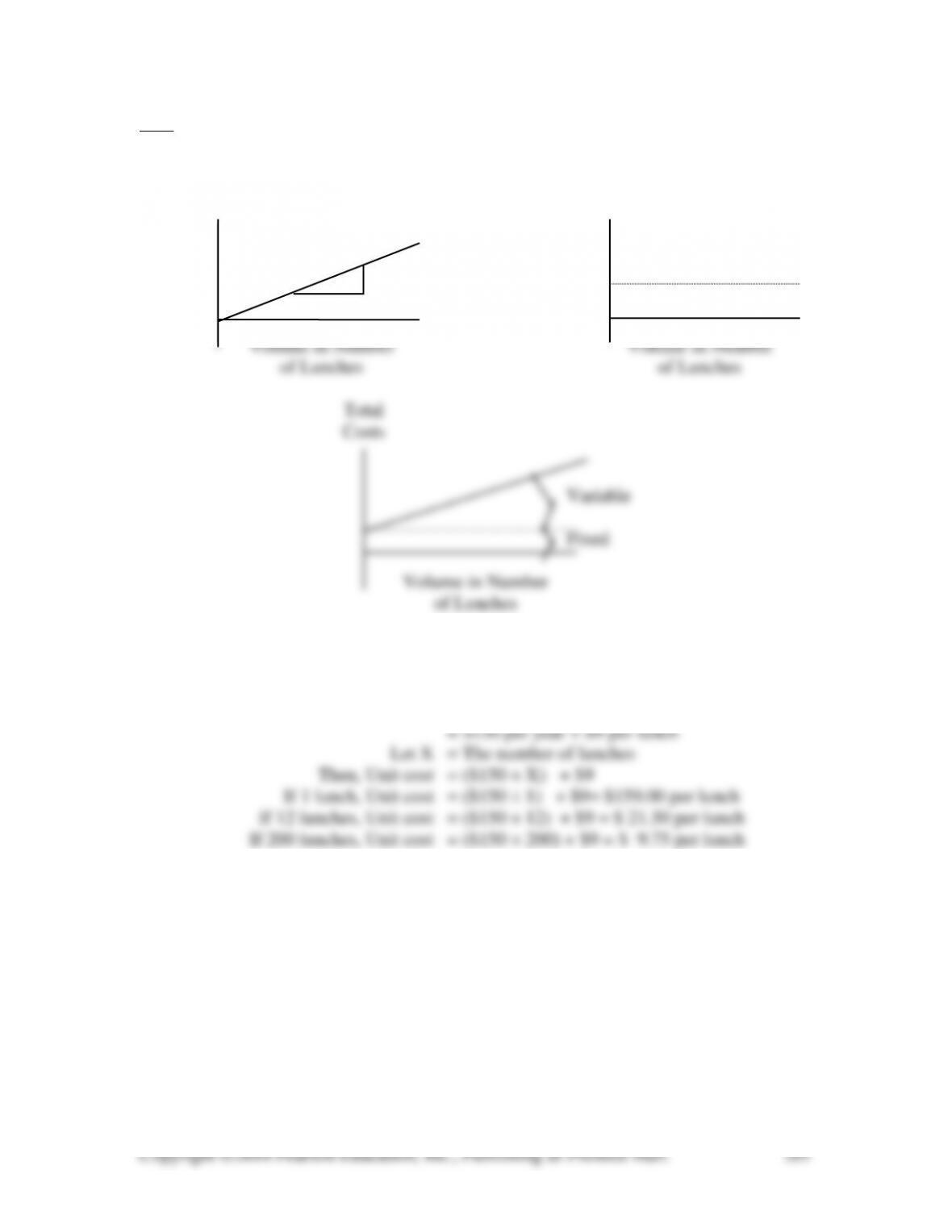
1. Total Total
Variable Fixed Costs
Costs
$9 $150
2. There are correct ways and incorrect ways to analyze the data. A correct way
follows:
Total cost = Total FC + Total VC
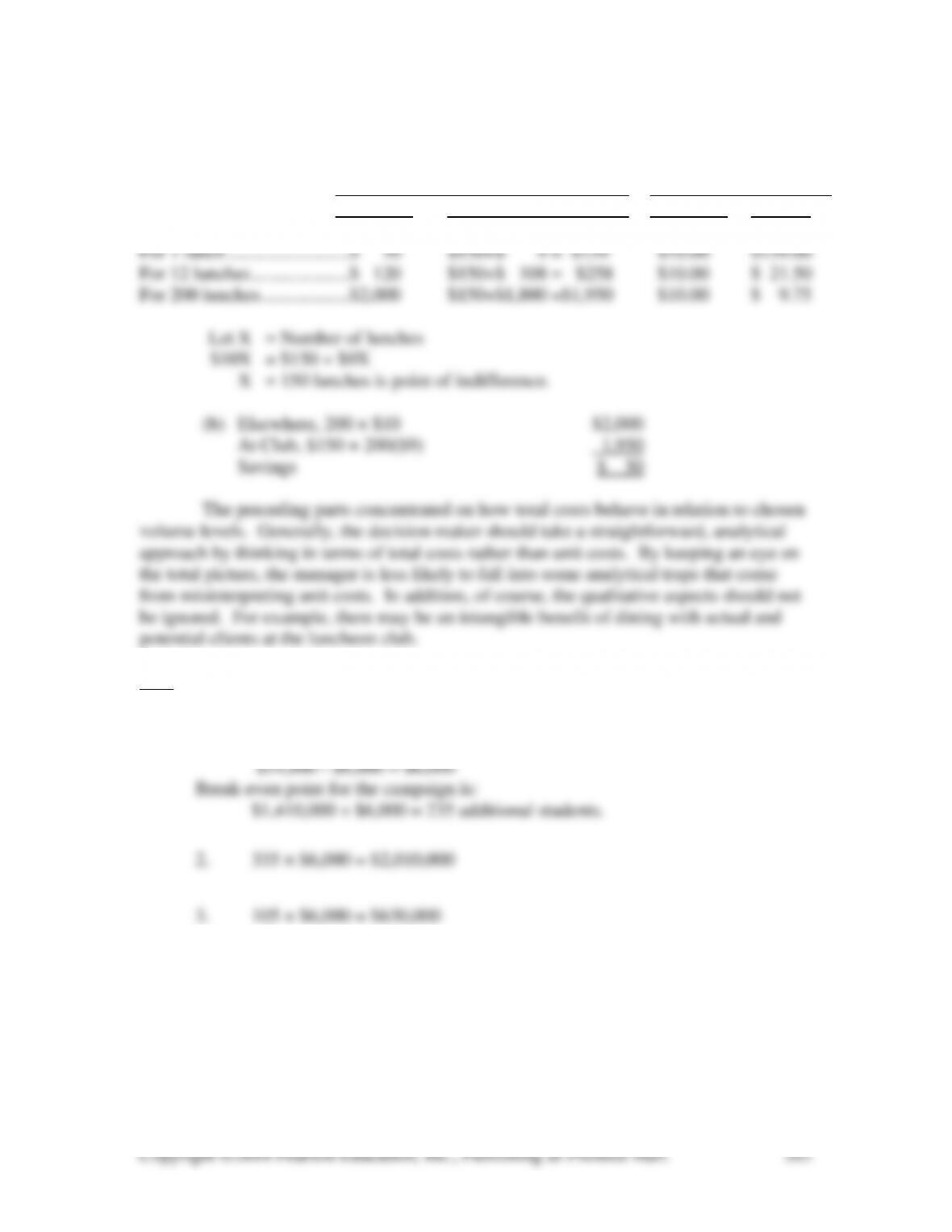
3. (a) The CPA can compare either total annual costs or unit costs. Let X = the
total number of lunches in question.
Total Costs Unit Costs
Elsewhere At Club Elsewhere At Club
In general ……………………….$ 10X $150+$ 9X $10.00 ($150÷X)+$9
5-38 (15 min.)
1. Except for the advertising costs, the fixed costs are irrelevant in this situation.
The contribution margin per student is:
5-39 (10 min.)
Cost per Unit of Product
Variable manufacturing cost $12.00 $12.00 $12.00
Variable selling and admin. cost 7.00 7.00
5-40 (20 min.)
This solution may be obvious to most students. However, the use of this
problem in executive programs and regular classes has shown that some students need
this exercise before they become convinced that the “unitization” of fixed costs can be
misleading. Moreover, in decision-making in general, the use of total rather than unit
Fixed costs 1.00 300,000
Net income ($ .60) ($180,000)
The new business would alter the picture as follows, assuming fixed costs are
“spread” on a 50/50 basis:
Regular Special Total
Copyright ©2014 Pearson Education, Inc., Publishing as Prentice Hall.
204
No matter how the fixed costs are spread, the total fixed costs will be $300,000
and the total net loss will be $210,000. This is true despite the fact that fixed costs per
unit have fallen from $1.00 to $.50. The moral is: beware of unit fixed costs.
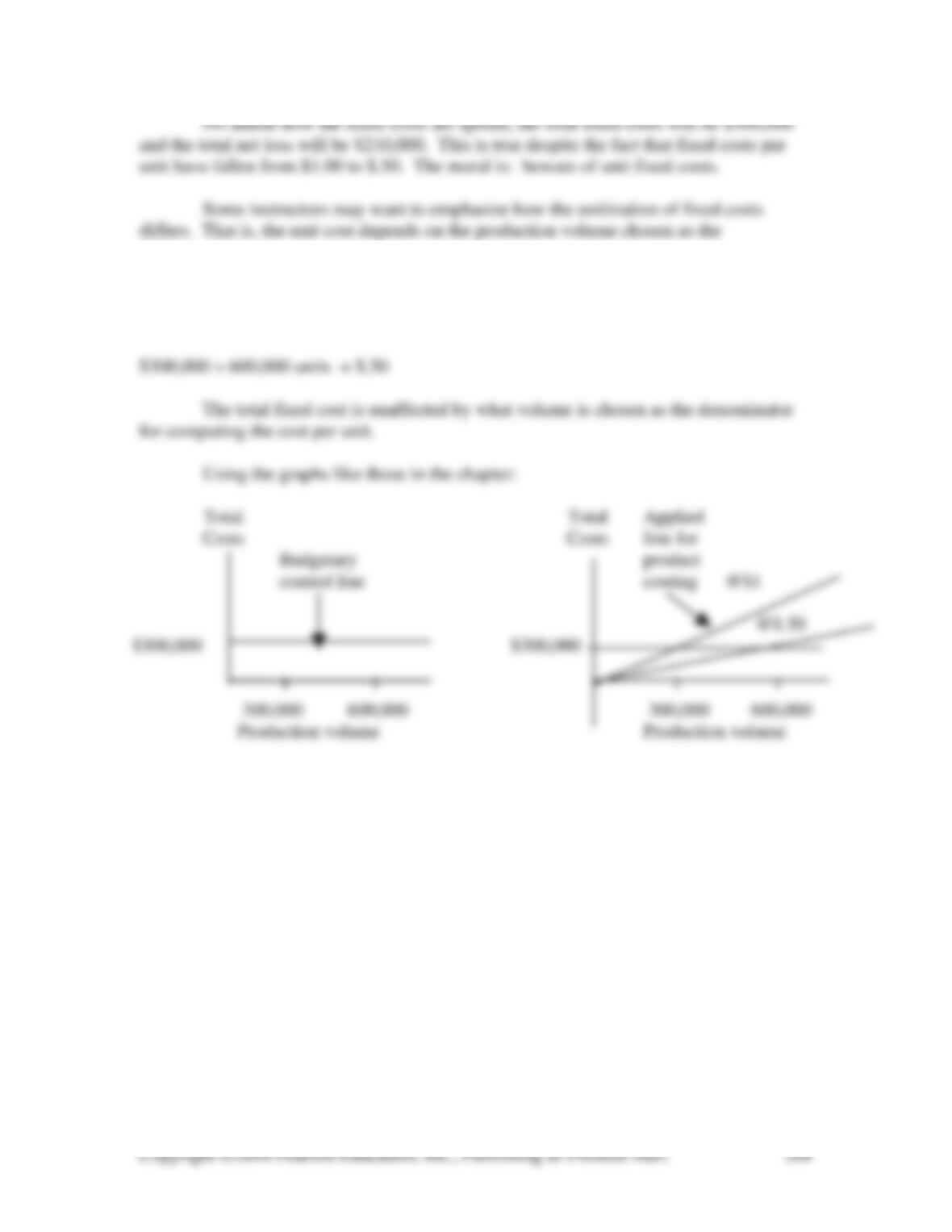
Some instructors may want to emphasize how the unitization of fixed costs
differs. That is, the unit cost depends on the production volume chosen as the
denominator.
Fixed costs per unit = Total fixed costs ÷ Production vol. = $300,000 ÷ 300,000 units = $1
or
5-41 (10-15 min.)
Pricing policies always seem to spark much student interest. This “break-even”
philosophy is similar to the “base or bulk volume” philosophy favored by many
executives. That is, the “normal” pricing applies to the bulk or base of the business, but
5-42 (15 min.)
1. Assuming that total fixed costs are the same at production levels of 6,000 and
10,000 units, the analysis can focus on contribution margins:
2. Subjective factors include image in the marketplace (higher price may give an
5-43 (10 min.)
5-44 (10-15 min.)
1. (150% × $30,000) + ($75 × 2,000 hours) = $45,000 + $150,000 = $195,000
2 & 3.
2. Minimum bid $133,000
5-45 (10 min.)
Unit Target Cost = Target Price – Target Profit
= $75 – .25 × $75
= $56.25
5-46 (15 – 20 min.)
1. Unit Target Cost = Target Price – Target Profit
= $230 – .2 × $230
2. Total Cost Savings = .4 × $5,000,000 – $1,100,000 = $900,000
5-47 (10 min.)
This problem raises issues for which there are no right answers. Determining the
types of product promotion activities that are ethically and legally appropriate is not an
easy question, and the role of price discrimination is especially difficult.
For a company to legally charge different prices to different customers, it usually
Copyright ©2014 Pearson Education, Inc., Publishing as Prentice Hall.
208
students want to focus on, and it may be the one with the most ethical content, but it
should not be the sole issue discussed.
5-48 (25-35 min.) All amounts are in millions of Euros.
1. LAGRANDE CORPORATION
Contribution Income Statement
For 2012
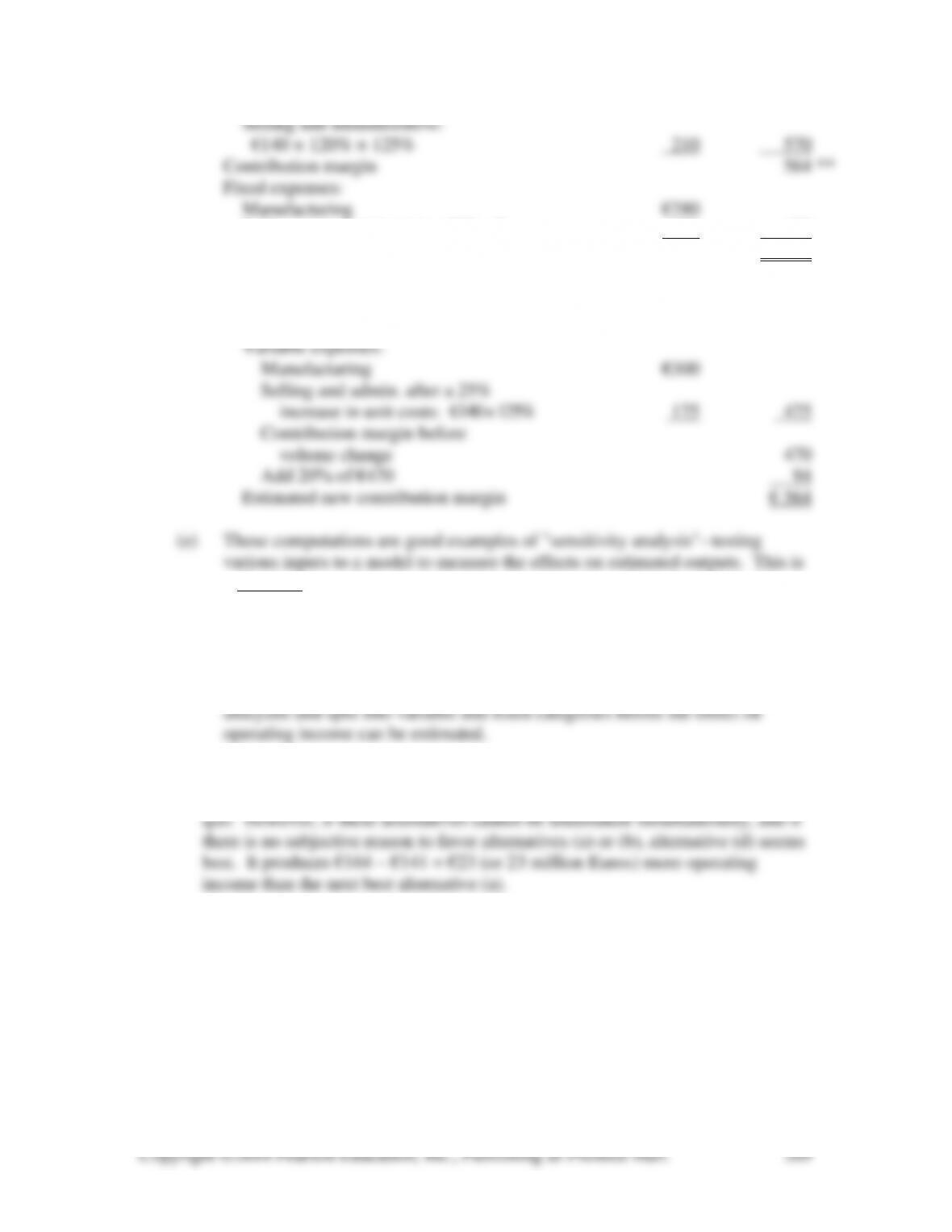
2. (a) Sales: €900 × 90% × 130% €1,053
Variable expenses: €440 × 130% 572
Contribution margin 481 *
Fixed expenses 340
Operating income € 141
(c) Sales €900
Variable expenses:
Manufacturing: €300 × 85% €255
Selling and administrative 140 395
Contribution margin 505
Copyright ©2014 Pearson Education, Inc., Publishing as Prentice Hall.
209
Selling and administrative:
€140 × 120% × 125% 210 570
Contribution margin 564 **
Fixed expenses:
Manufacturing €280
Selling and administrative: €60 × 2 120 400
Operating income € 164
**Alternate computation of contribution margin:
Sales after a 5% increase in prices:
€900 × 105% € 945
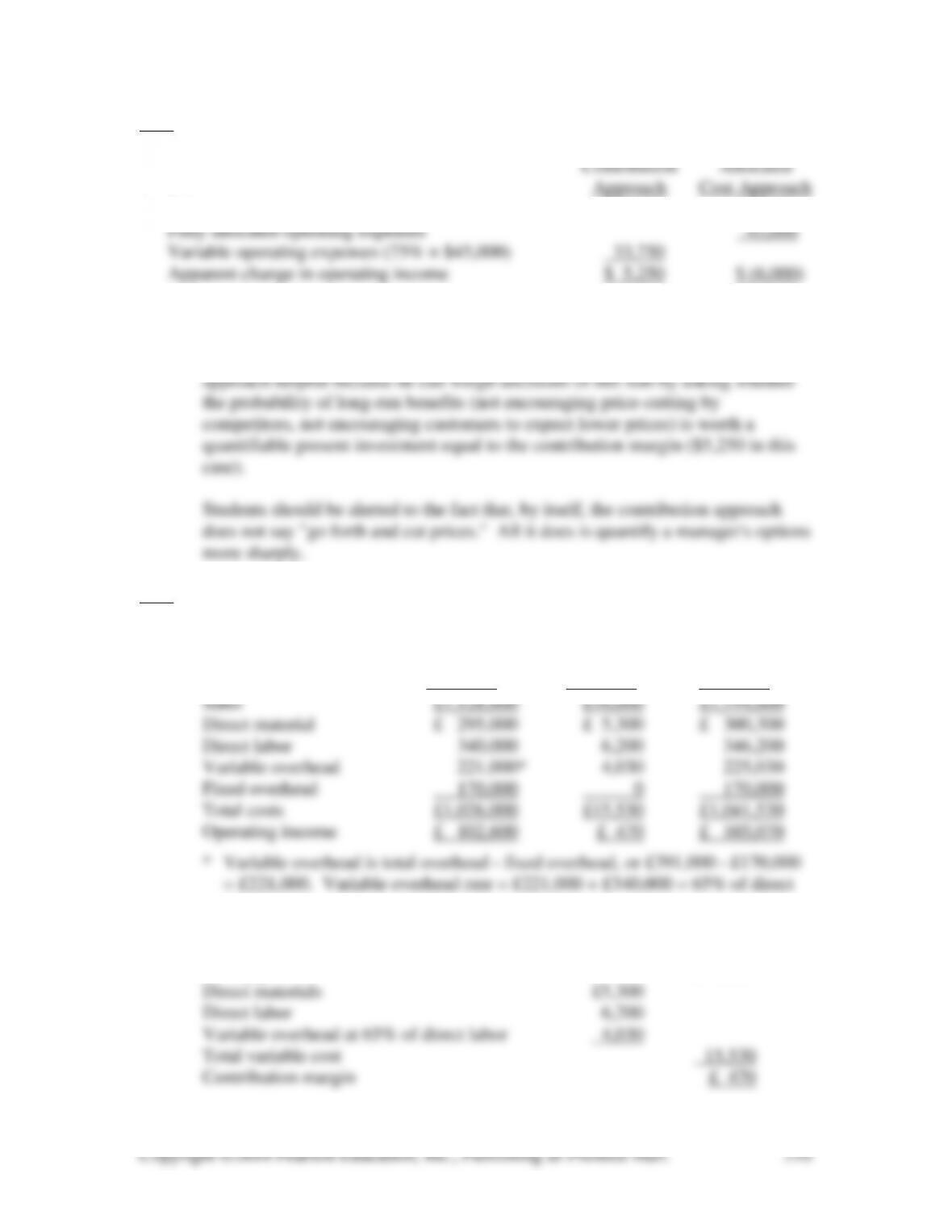
a planning procedure. An important point to make with students is that the
contribution form of income statement is much more appropriate for these
purposes than the absorption form.
The analysis is readily calculated by using data from the contribution income
statement. In contrast, the data in the absorption income statement must be
3. Alternative (c) is clearly undesirable because it produces less operating income
than the status quo. Alternatives (a), (b) or (d) would be better than the status
5-49 (10-15 min.)
Fully
1. Sales $39,000 $39,000
2. A decision not to accept the order means that short-run income would be $5,250
lower. In effect, by turning down the business, Transnational invests $5,250 to
possibly achieve some long-run benefits. Goldmark can find the contribution
5-50 (20-25 min.)
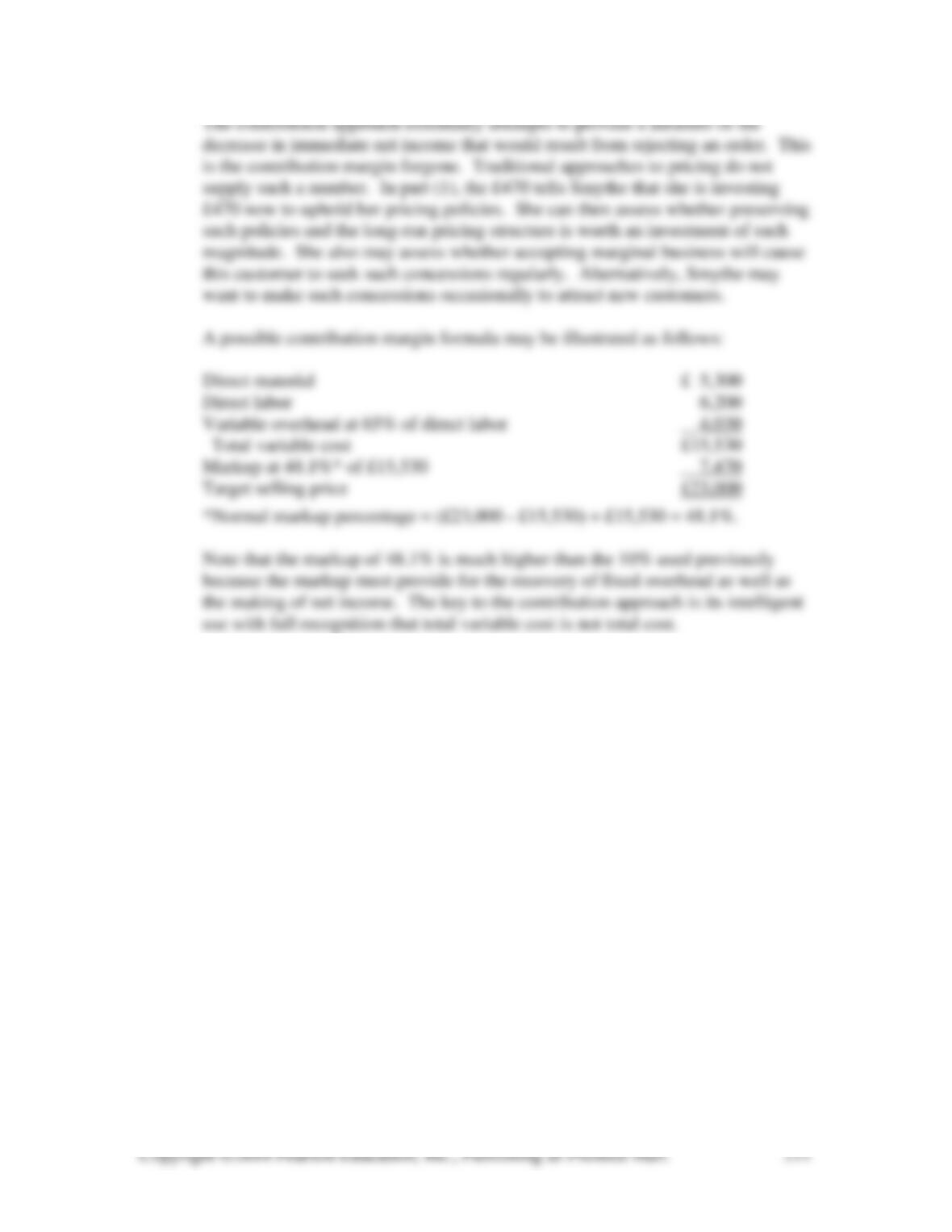
1. Net income would be increased by £470 if the order were taken:
Without Effect of With
the Order the Order the Order
labor.
2. A contribution approach to pricing might appear as follows:
Selling price £16,000
Copyright ©2014 Pearson Education, Inc., Publishing as Prentice Hall.
211
The contribution approach essentially attempts to provide a measure of the
decrease in immediate net income that would result from rejecting an order. This
is the contribution margin forgone. Traditional approaches to pricing do not
supply such a number. In part (1), the £470 tells Smythe that she is investing
£470 now to uphold her pricing policies. She can then assess whether preserving
such policies and the long-run pricing structure is worth an investment of such
magnitude. She also may assess whether accepting marginal business will cause
this customer to seek such concessions regularly. Alternatively, Smythe may
want to make such concessions occasionally to attract new customers.
A possible contribution margin formula may be illustrated as follows:
Direct material £ 5,300
Direct labor 6,200
Variable overhead at 65% of direct labor 4,030
Total variable cost £15,530
Markup at 48.1%* of £15,530 7,470
Target selling price £23,000
*Normal markup percentage = (£23,000 – £15,530) ÷ £15,530 = 48.1%.
Note that the markup of 48.1% is much higher than the 10% used previously
because the markup must provide for the recovery of fixed overhead as well as
the making of net income. The key to the contribution approach is its intelligent
use with full recognition that total variable cost is not total cost.
5-51 (15-20 min.)
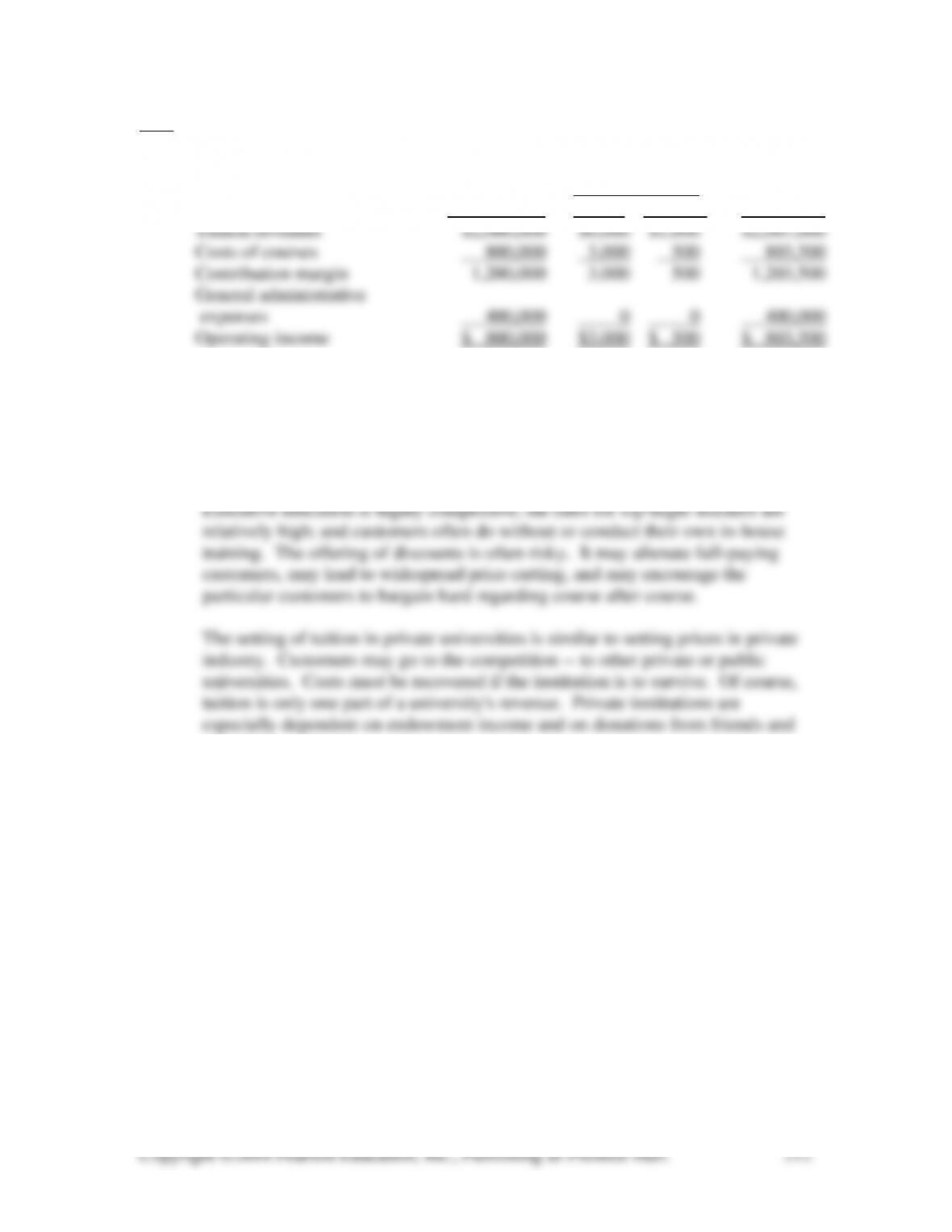
1. Final Course
Year to Enrollment Grand
Date 30 10 More Totals
2. The same general considerations influence pricing decisions in profit-seeking
and nonprofit organizations. The exception is price-setting by many
government-owned entities, which often is heavily affected by legislative bodies.
The familiar three Cs — customers, costs, and competition — do influence price
setting.
alumni.
5-52 (15 min.)
1. Contribution margin from direct sales = $12 – $2 = $10
Contribution margin from sales to distributor = $45 – $2 = $43
3. Total contribution from direct sales = 33 million × ($12.30 – $2) = $339.9 million.
Sales at CM of $43 to get contribution of $339.9 million:
$339,900,000 $43 = 7,904,651 DVDs