
CHAPTER 5
COVERAGE OF LEARNING OBJECTIVES
LEARNING
OBJECTIVE
FUNDA–
MENTAL
ASSIGNMENT
MATERIAL
CRITICAL
THINKING
EXERCISES AND
EXERCISES
PROBLEMS
CASES, EXCEL,
COLLAB. &
INTERNET
EXERCISES
LO1: Discriminate
between relevant and
irrelevant information
for making decisions.
23,30,37,38
49,50,51,54,
57
66
LO2: Apply the decision
process to make
business decisions.
28,29,39
LO3: Construct
absorption and
contribution–margin
income statements and
identify their relevance
for decision making.
A1,B1
24,31,32,33,
34,35
48
LO4: Decide to accept
or reject a special order
using the contribution
margin approach.
A2,B2
36,40
55,56
62, 63,64
LO5: Explain why
pricing decisions depend
on the characteristics of
the market.
A2,B2
25,42
58
LO6: Identify the
factors that influence
pricing decisions in
practice.
26,41
47,52,53
65
LO7: Compute a target
sales price by various
methods, and compare
the advantages and
disadvantages of these
methods.
A3
43,44
LO8: Use target costing
to decide whether to add
a new product.
A4,B3
27,45,46
59,60,61
CHAPTER 5
Relevant Information for Decision Making with a Focus on Pricing Decisions
5-A1 (40-50 min.)
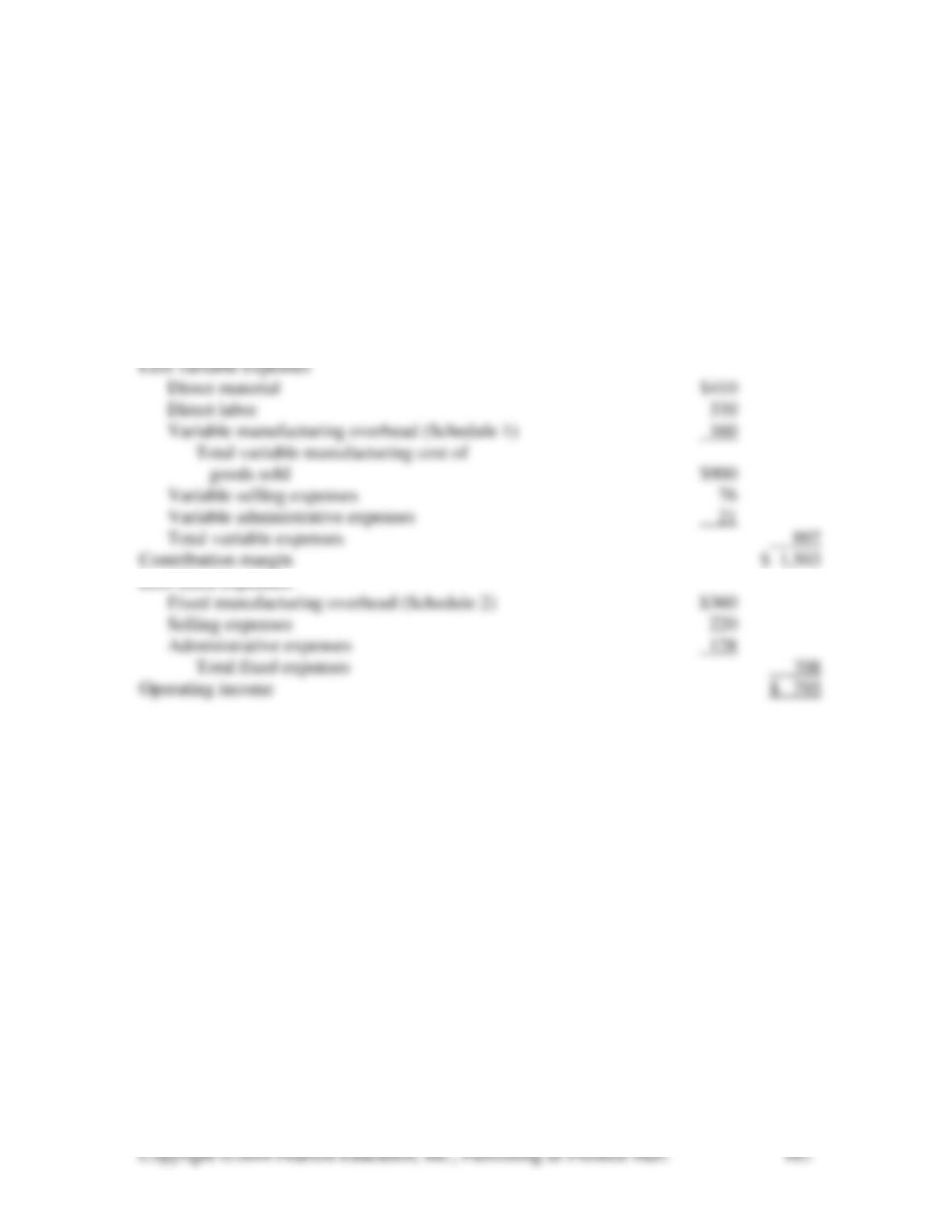
1. LIBERTY COMPANY
Contribution Income Statement
For the Year Ended December 31, 2012
(in thousands of dollars)
Sales $2,500
Less fixed expenses:
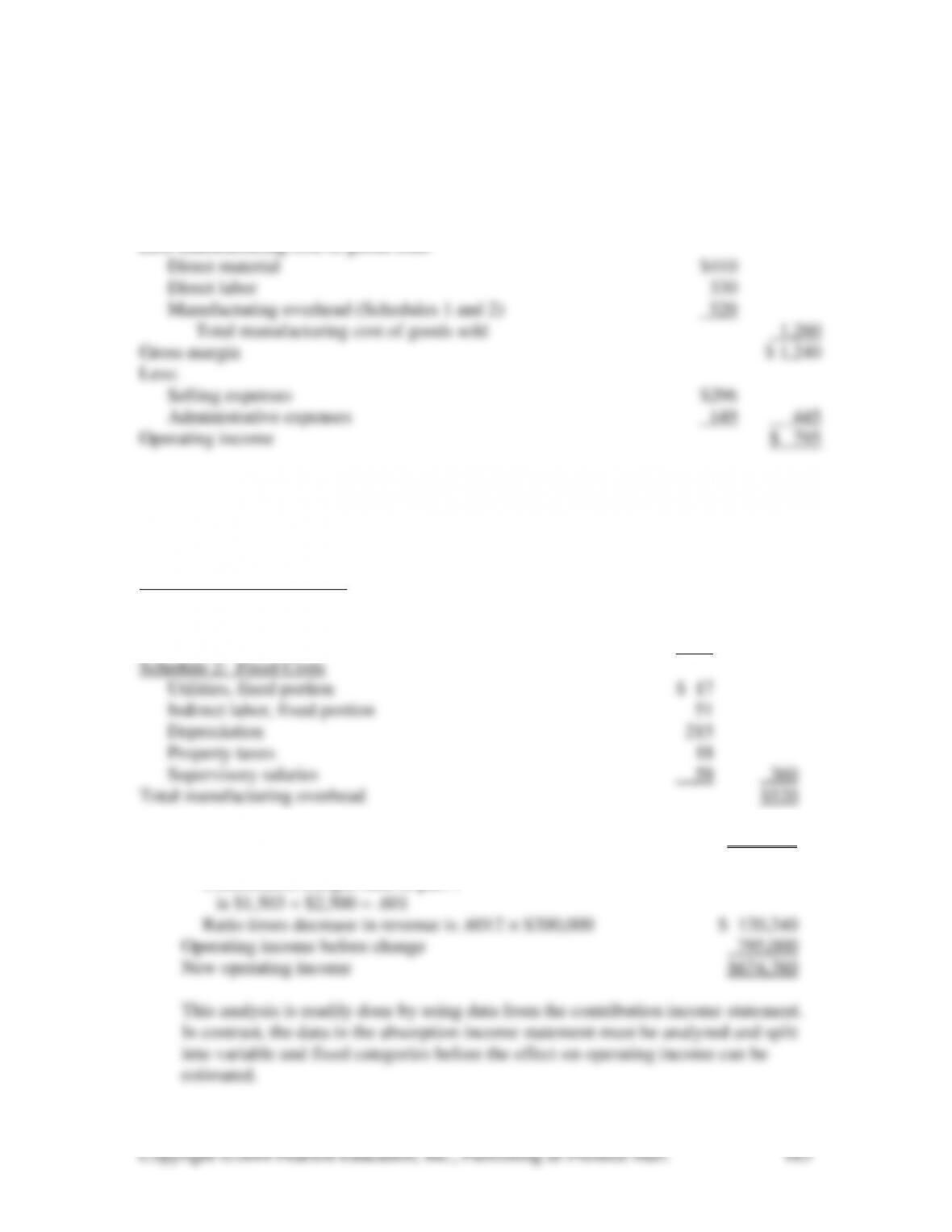
LIBERTY COMPANY
Absorption Income Statement
For the Year Ended December 31, 2012
(in thousands of dollars)
Sales $2,500
Less manufacturing cost of goods sold:
LIBERTY COMPANY
Schedules of Manufacturing Overhead
For the Year Ended December 31, 2012
(in thousands of dollars)
Schedule 1: Variable Costs
Supplies $ 25
Utilities, variable portion 42
Indirect labor, variable portion 93 $160
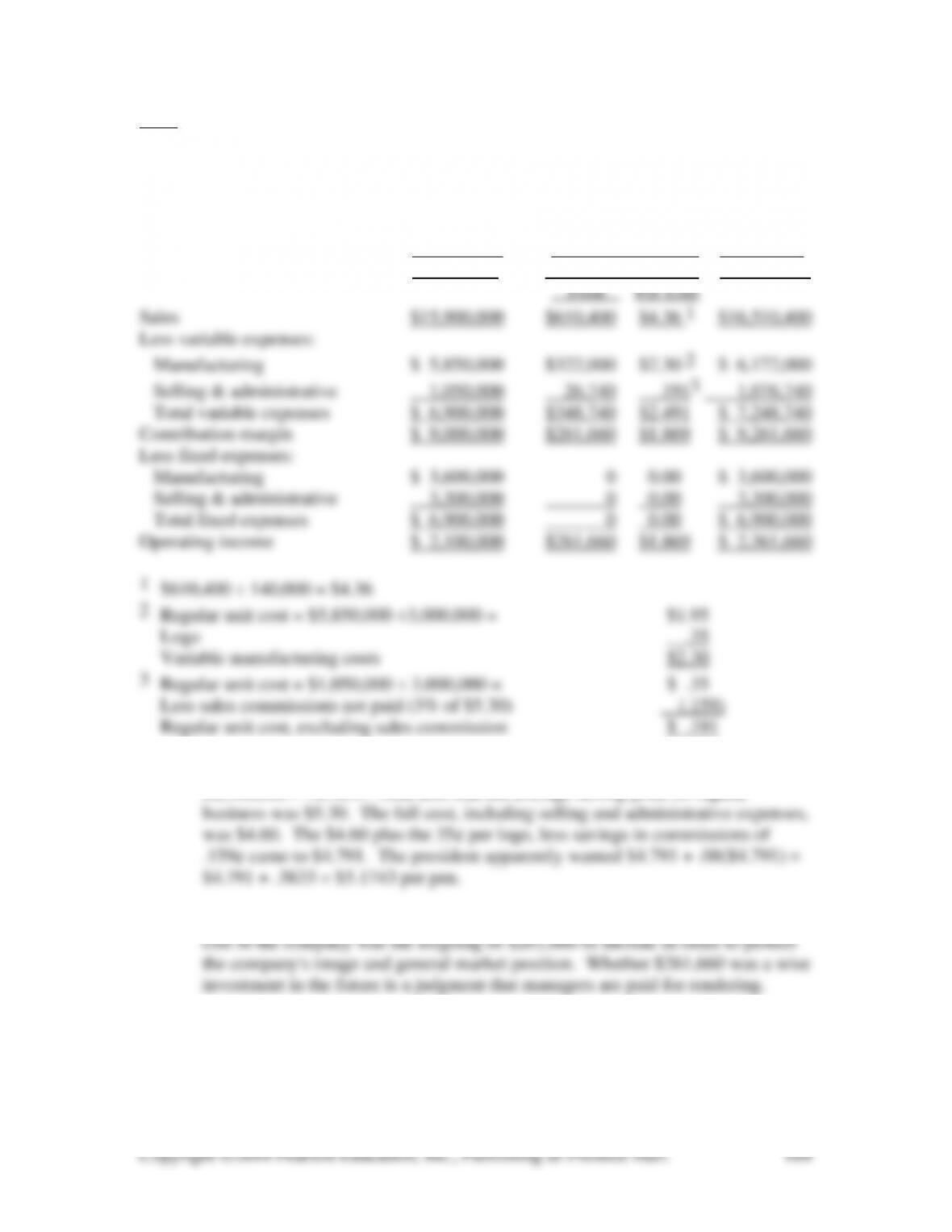
2. Change in revenue $200,000
Change in total contribution margin:
Contribution margin ratio in part 1
5-A2 (25-30 min.)
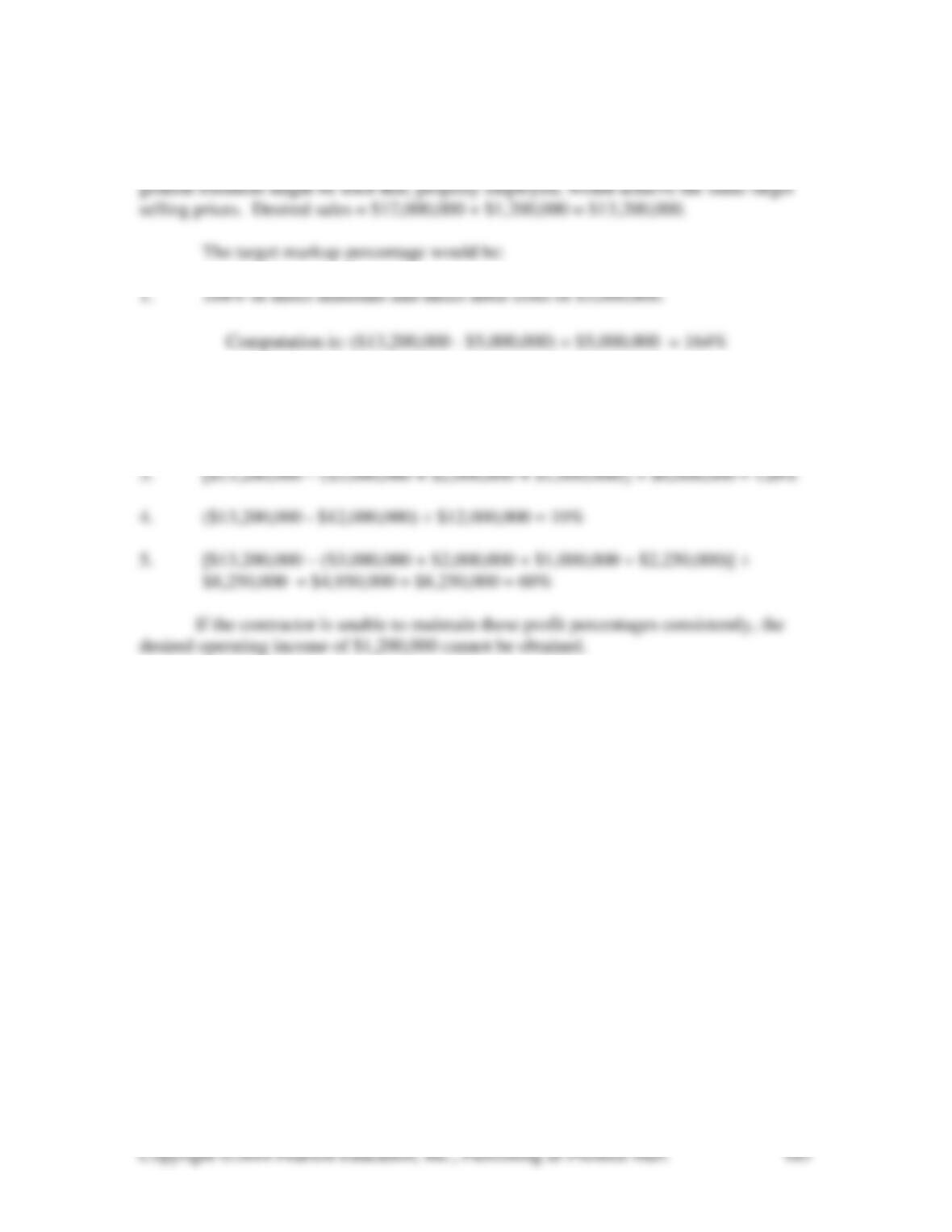
1. A contribution format, which is similar to Exhibit 5-6, clarifies the analysis.
Without With
Special Effect of Special
Order Special Order Order
Units 3,000,000 140,000 3,140,000
2. Operating income from selling 4.67% more units would increase by $261,660 ÷
$2,100,000 = 12.46%. Note also that the average selling price on regular
Most students will probably criticize the president for being too stubborn. The
5-A3 (15-20 min.)
The purpose of this problem is to underscore the idea that any of a number of
2. 76% of the full cost of jobs of $7,500,000.
Computation is: ($13,200,000 – $7,500,000) ÷ $7,500,000 = 76%
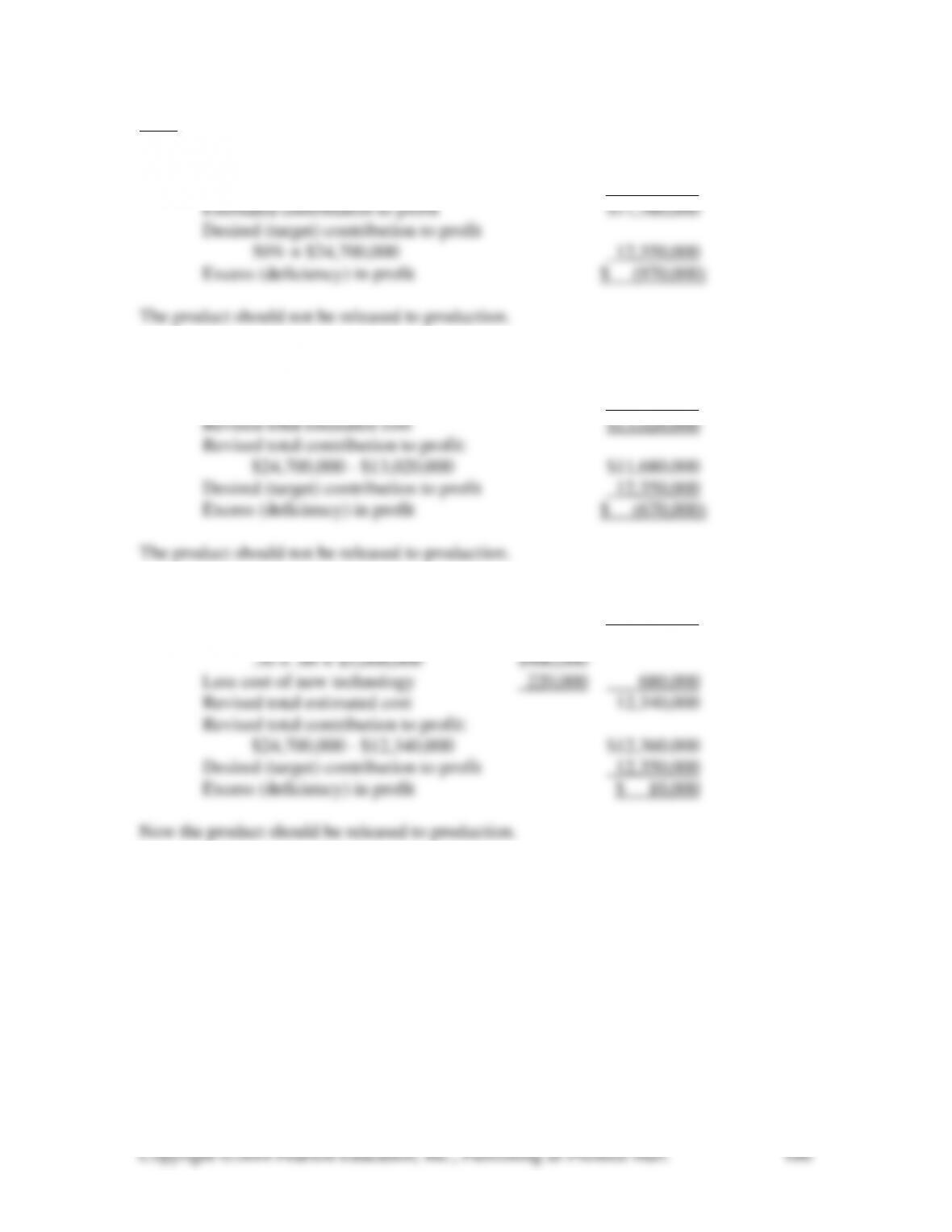
5-A4 (15-20 minutes)
1. Revenue ($380 × 65,000) $24,700,000
Total cost over product life 13,320,000
2. Previous total estimated cost $13,320,000
Cost savings from suppliers
.15 × .40 × $5,000,000 300,000
3. Previous revised total estimated cost from
requirement 2. $13,020,000
Process improvement savings:
5-B1 (40-50 min.)
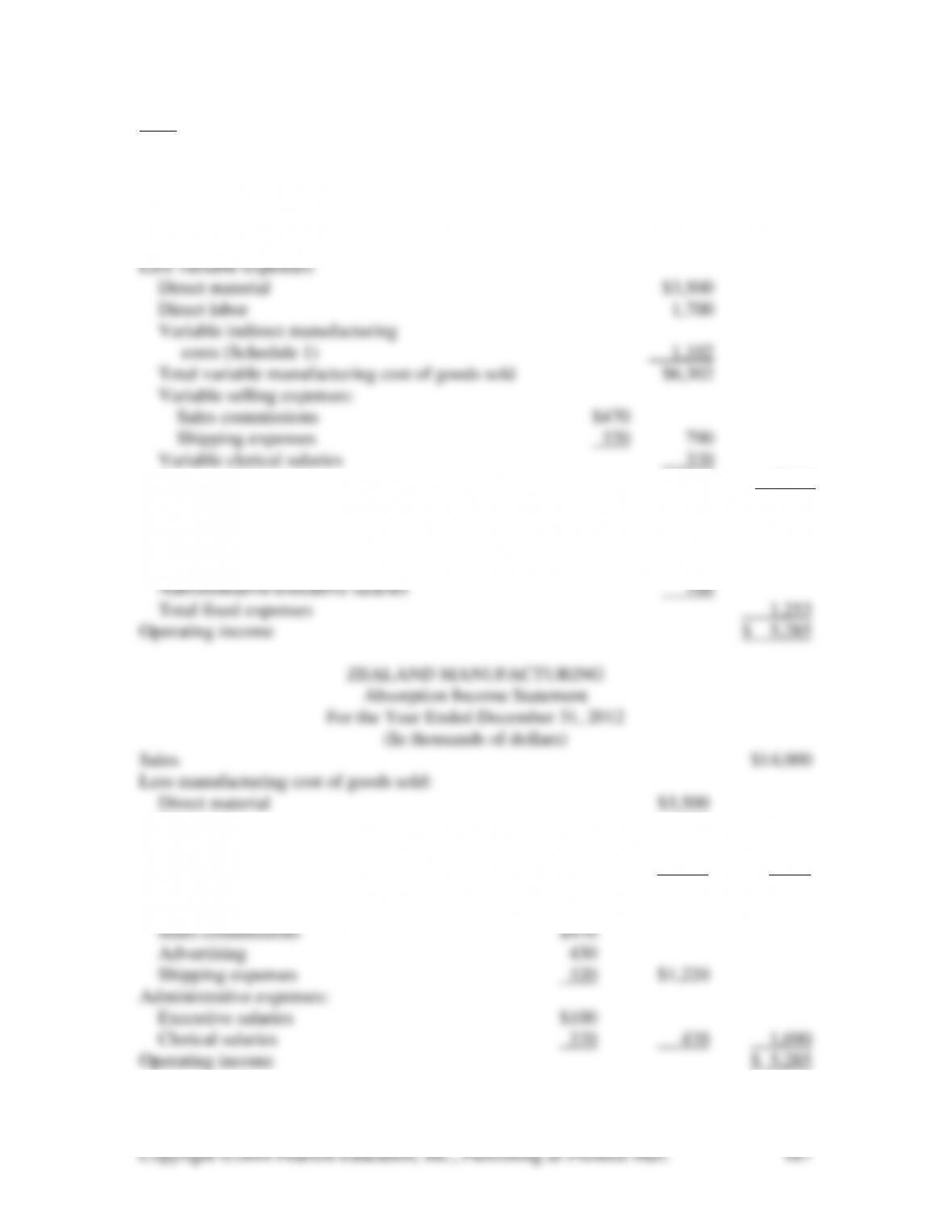
1. ZEALAND MANUFACTURING
Contribution Income Statement
For the Year Ended December 31, 2012
(In thousands of dollars)
Sales $14,000
Total variable expenses 7,462
Contribution margin $ 6,538
Less fixed expenses:
Manufacturing (Schedule 2) $ 723
Selling (advertising) 430
Direct labor 1,700
Indirect manufacturing costs
(Schedules 1 and 2) 1,825 7,025
Gross profit 6,975
Selling expenses:
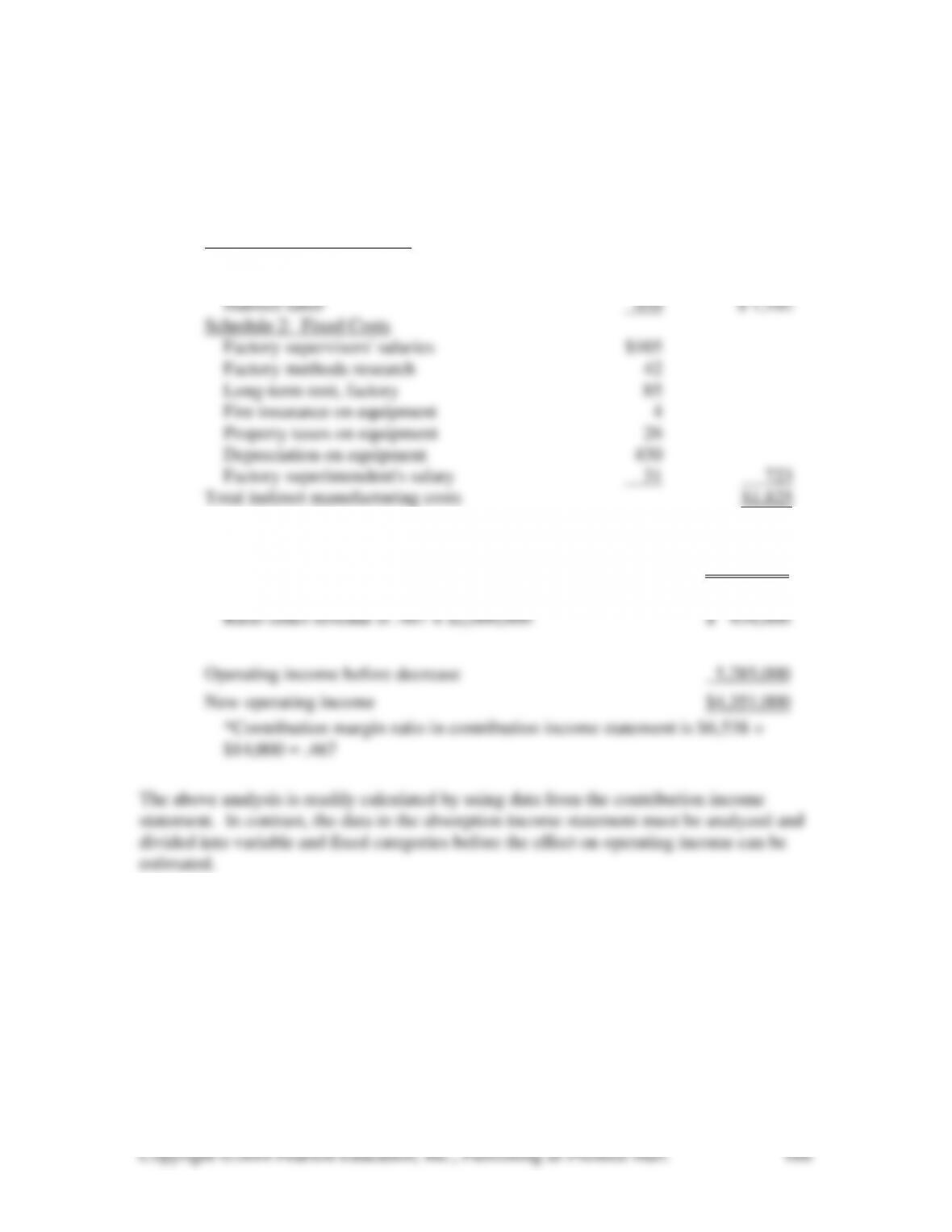
ZEALAND MANUFACTURING
Schedules 1 and 2
Indirect Manufacturing Costs
For the Year Ended December 31, 2012
(In thousands of dollars)
Schedule 1: Variable Costs
Cutting bits $ 53
Abrasives for machining 99
2. Operating income would decrease from $5,285,000 to $4,351,000:
Decrease in revenue $2,000,000
Decrease in total contribution margin*:
5-B2 (30-40 min.)
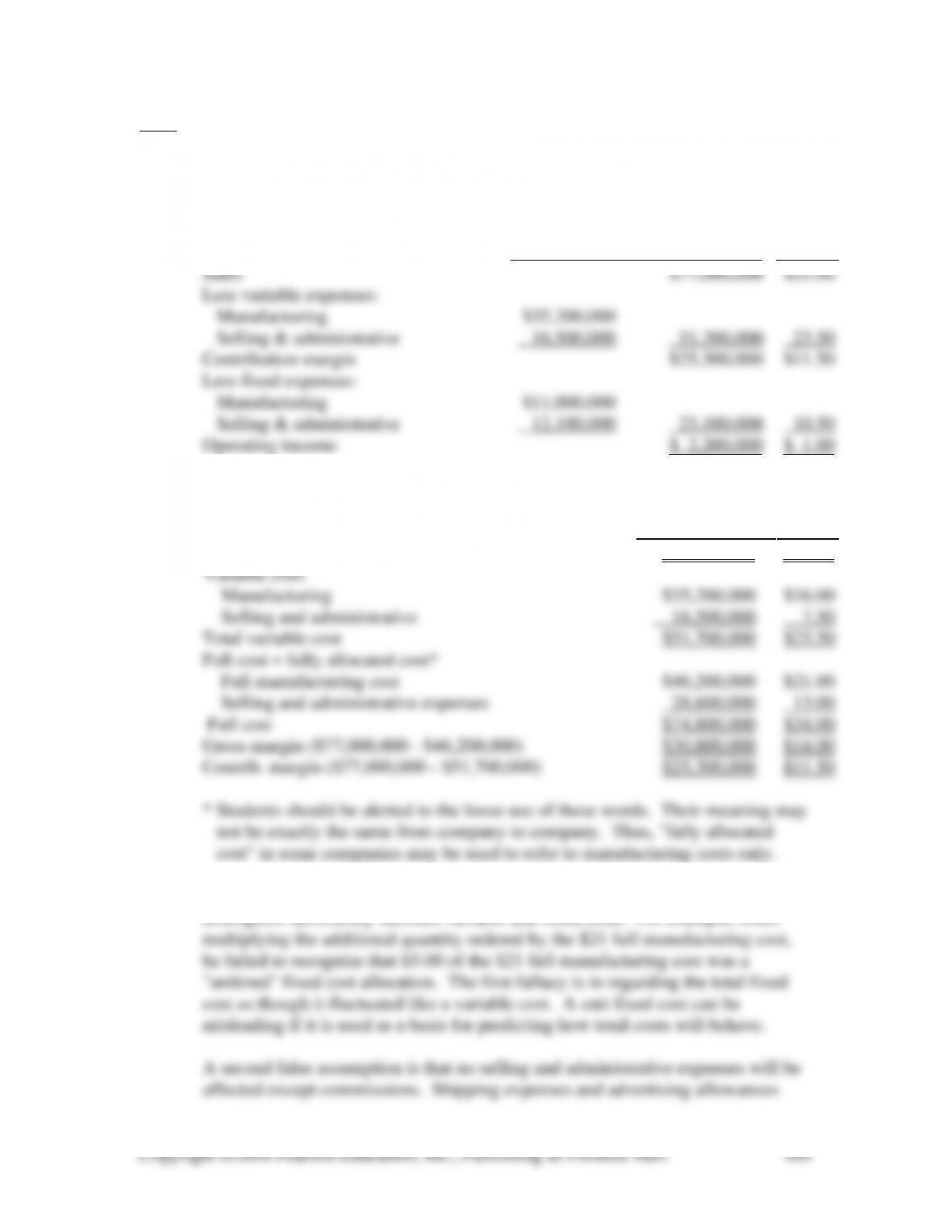
1. PELLE COMPANY
Income Statement
For the Year Ended December 31, 20X0
Total Per Unit
2. Additional details are either in the statement of the problem or in the solution to
requirement 1:
Total Per Unit
Full manufacturing cost $46,200,000 $21.00
3. Chuck’s analysis is incorrect. He was on the right track, but he did not
Copyright ©2014 Pearson Education, Inc., Publishing as Prentice Hall.
190
will be affected also — unless arrangements with Costco on these items differ
from the regular arrangements.
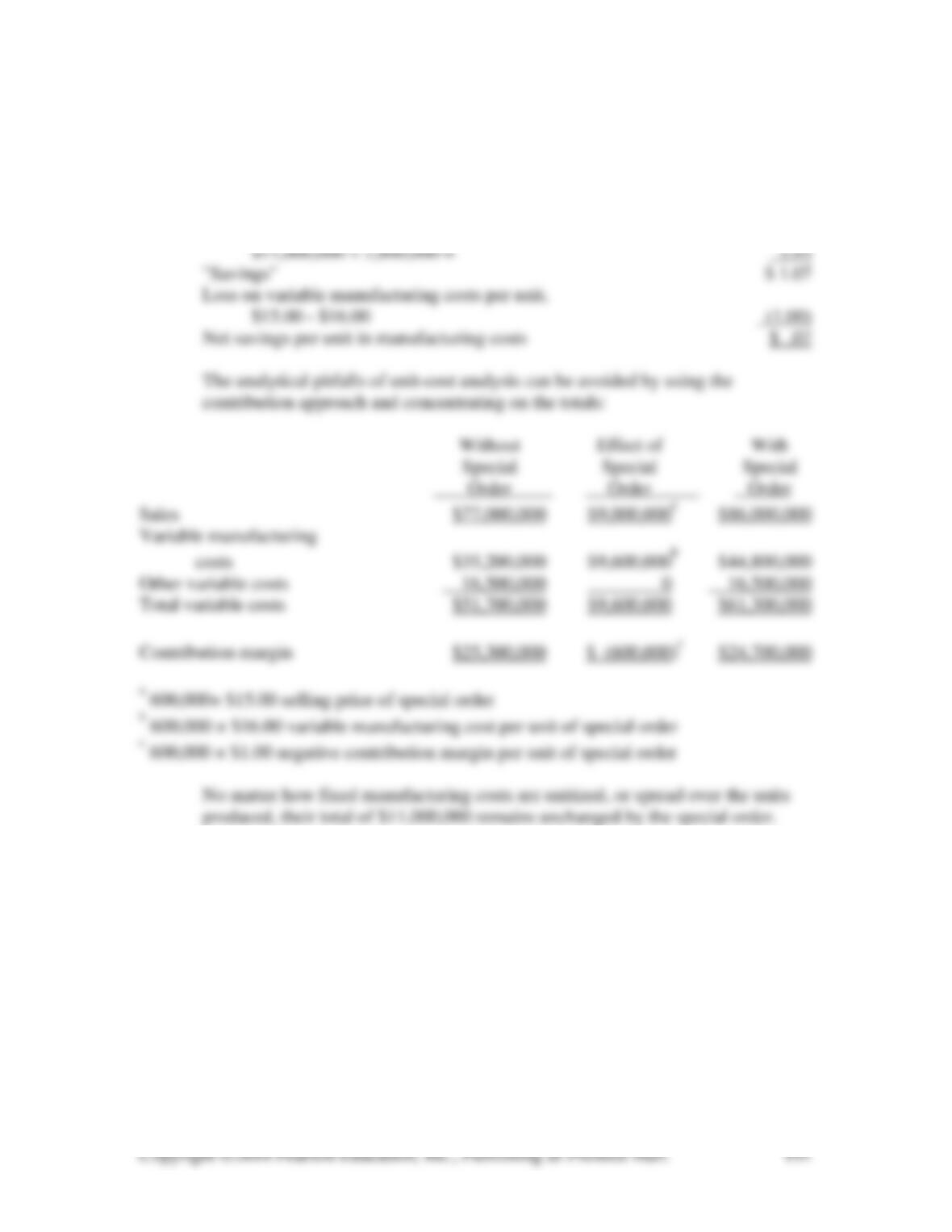
The following summary, which is similar to Exhibit 5-6 in the textbook, is a
correct analysis. The middle columns are all that are really necessary.
Without With
Special Effect of Special
Order Special Order Order
Units 2,200,000 140,000 2,340,000
Total Per Unit
Sales $77,000,000 $4,760,000 $34.00 $81,760,000
Less variable expenses:
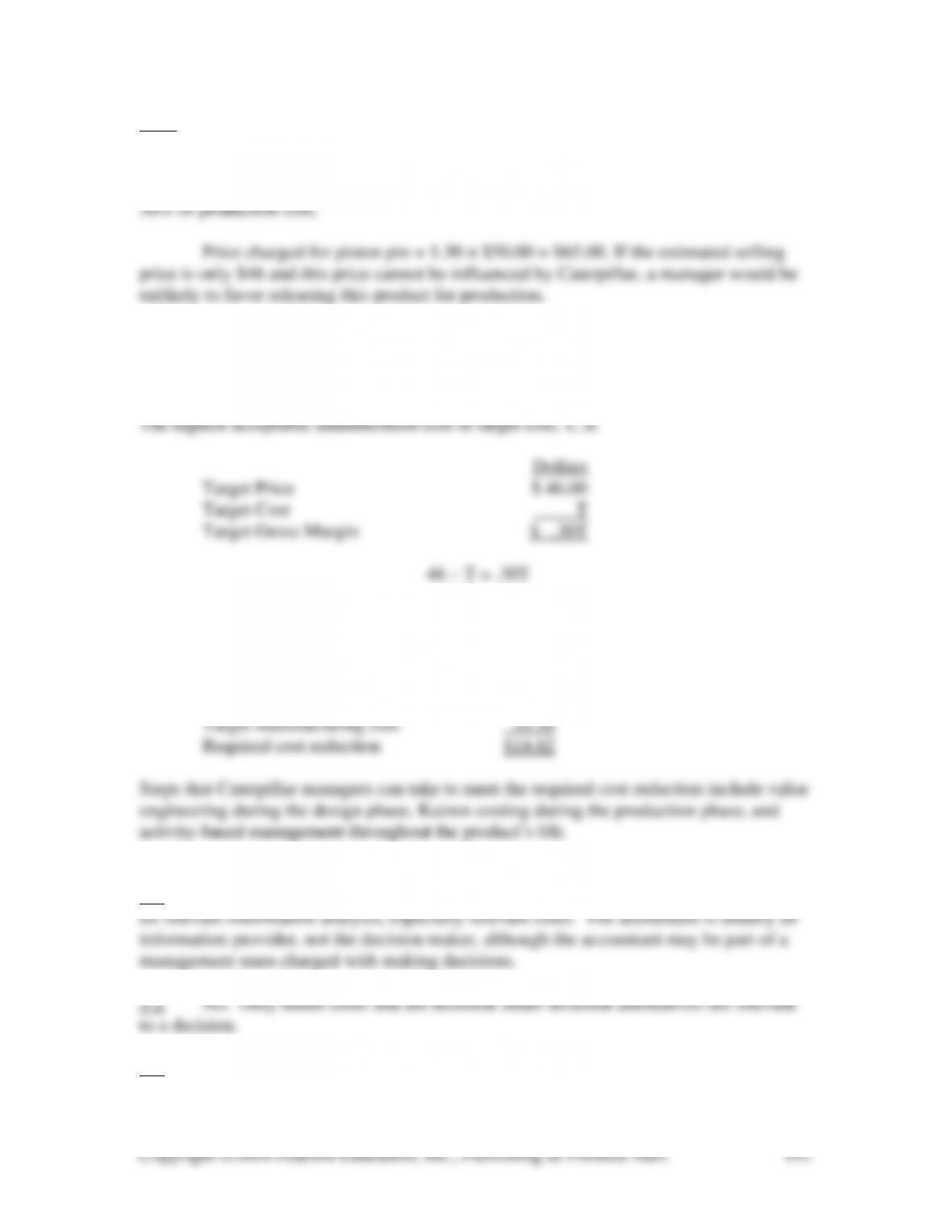
4. Chuck is incorrect. Operating income would have declined from $2,200,000 to
$1,600,000, a decline of $600,000. Chuck’s faulty analysis follows:
Old fixed manufacturing cost per unit,
$11,000,000 ÷ 2,200,000 = $5.00
New fixed manufacturing cost per unit,
5-B3 (10-15 min.)
1. Cost-plus pricing is adding a specified markup to cost to cover those components
of the value chain not included in the cost plus a desired profit. In this case the markup is
2. Target costing assumes the market price cannot be influenced by companies
except by changing the value of the product to consumers. The price charged would then
be the $46 estimated by market research.
1.30T = 46
T = 46 ÷ 1.30 = $35.38
3. The required cost reduction over the product’s life is
Existing manufacturing cost $50.00
5-1 The accountant’s role in decision-making is primarily that of a technical expert
5-3 Past data are unchangeable regardless of present or future action and thus would
not differ under different alternatives.
5-5 Precision is a measure of the accuracy of certain data. It is a quantifiable term.
5-6 Decisions may have both quantitative and qualitative aspects corresponding to
the nature of the facts being considered before deciding. Quantitative implications of
5-7 The contribution approach has several advantages over the absorption approach,
5-8 The terms that describe an income statement that emphasizes the differences
between variable or fixed costs are contribution approach, variable costing, or direct
costing.
5-10 No, fixed costs are not always irrelevant. Often they are not relevant. However,
they can be relevant if they are affected by the decision being considered.
5-11 Customers are one of the factors influencing pricing decisions because they can
5-12 The variable costs of a job can be misused as a guide to pricing. However, the
products.
5-14 Three popular markup formulas are (1) as a percentage of variable manufacturing
costs, (2) as a percentage of total variable costs, and (3) as a percentage of full costs.
5-16 Full costs are more popular than variable costs for pricing because price stability
is encouraged and in the long run all costs must be recovered to stay in business.
5-18 Value engineering is a cost-reduction technique, used primarily during the design
5-19 Kaizen costing is the Japanese term for continuous improvement during
manufacturing.
5-20 In target costing, managers start with a market price. Then they try to design a
5-21 Customer demands and requirements are important in the product development
process. Many companies seek customer input on the design of product features. They
5-22 Not necessarily. There are other important factors that management must
5-23 No. There is confusion between total fixed costs and unit fixed costs. Increasing
5-24 Managers generally find contribution margin income statements more useful,
in sales.
5-25 Marginal cost is the additional cost resulting from producing and selling one
additional unit. It changes as production volume changes. With a given fixed capacity,
Copyright ©2014 Pearson Education, Inc., Publishing as Prentice Hall.
195
accountant’s approximation to marginal cost. It remains constant over the relevant range
of volume. Because the difference between these two costs often is not material (within
the relevant range), in such cases we can use the variable-cost estimate of marginal cost
for decision-making purposes.
5-26 Pricing decisions must be made within legal constraints. These laws help protect
5-27 Managers are directly involved in the research and development and the design
functions. During the initial product research phase, managers often are involved in
surveys, focus groups (with major airlines), and other market research activities to
5-28 (5 min.)
All the data given are historical costs. Most students will identify the $5 and $7
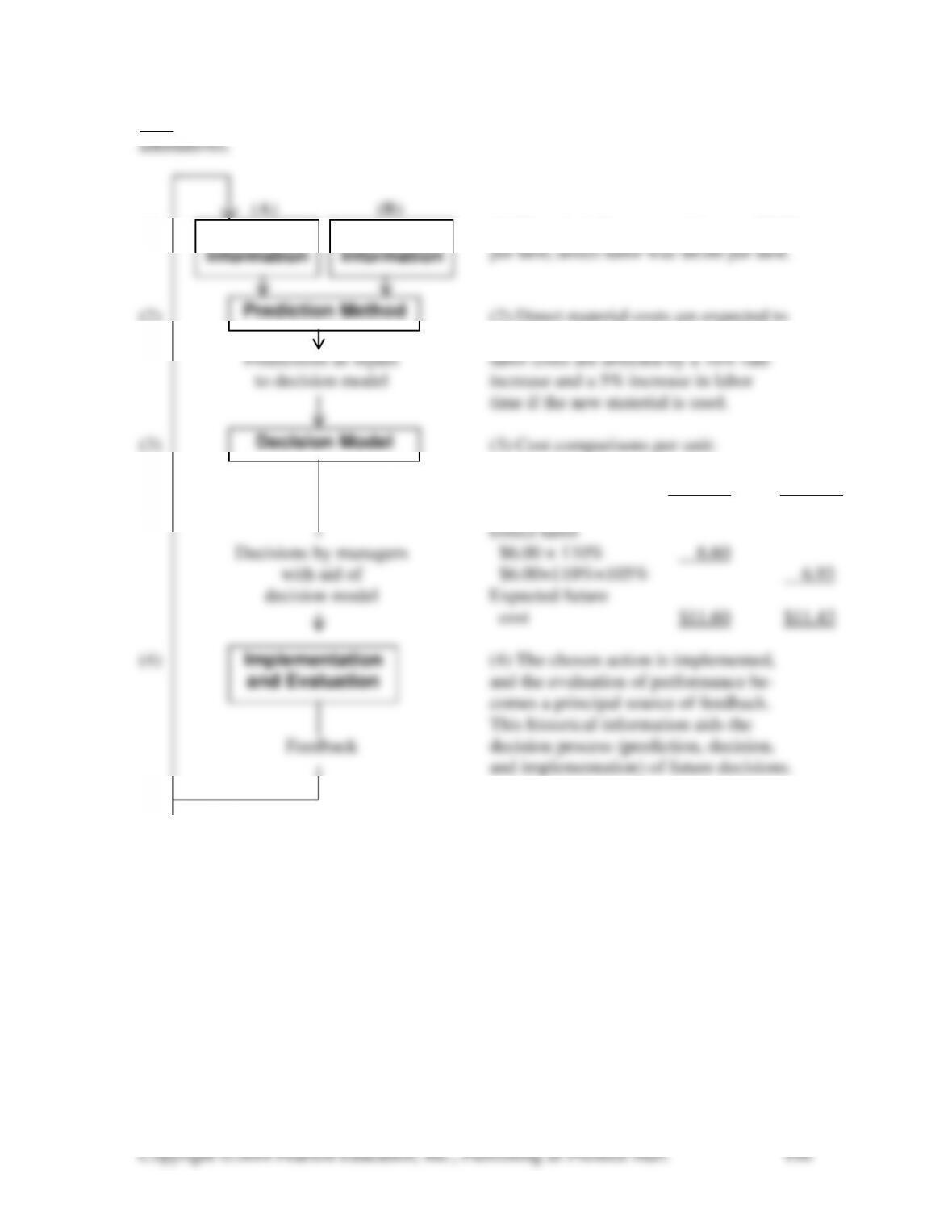
5-29 (20 min.) Some students may forget to apply the 10% wage rate increase to both
(1) (1) Historical direct materials were $5.00
(2) (2) Direct material costs are expected to
fall by 10%, or 50¢ per unit. Direct
Old New
Material Material
Direct material $ 5.00 $ 4.50
Other
Historical
Prediction Method
5-30 (10 min.)
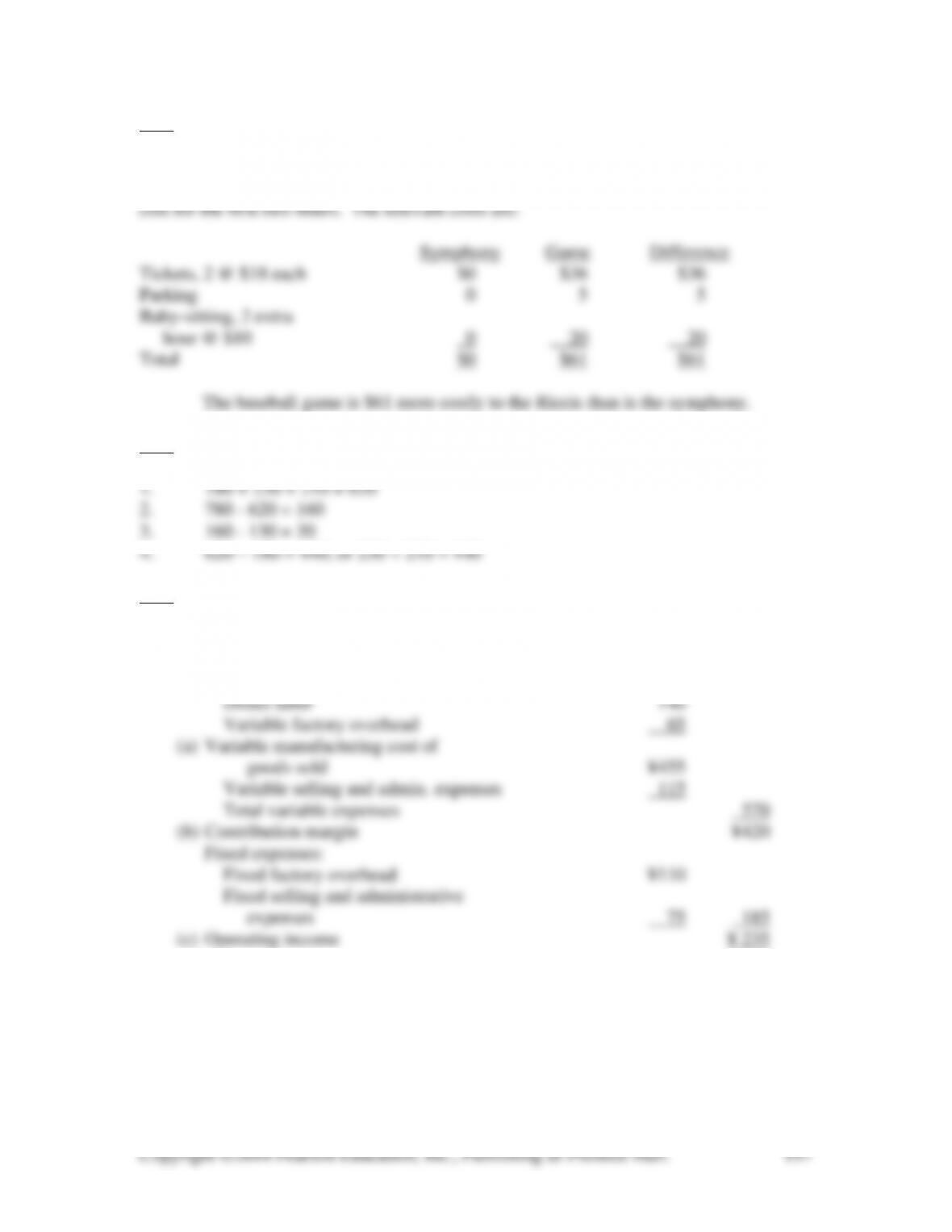
Relevant costs are the future costs that differ between alternatives. Among the
irrelevant costs are the cost of tickets to the symphony, automobile costs, and baby-sitting
5-31 (10 min.) This is a basic exercise. Answers are in thousands of dollars.
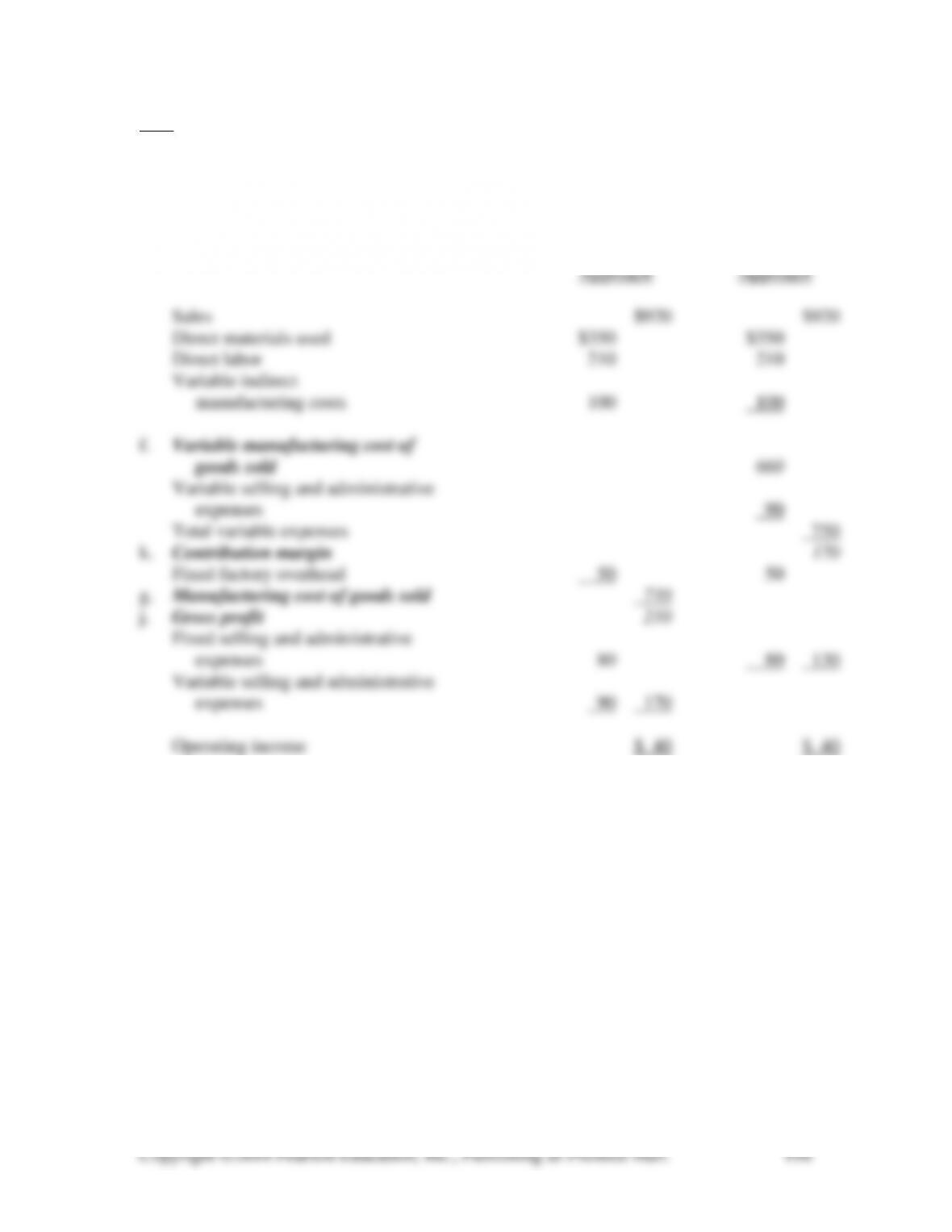
5-32 (10-15 min.) This is a basic exercise. Data are in millions of yens.
Sales ¥990
Variable expenses:
Direct materials ¥250
5-33 (15-20 min.)
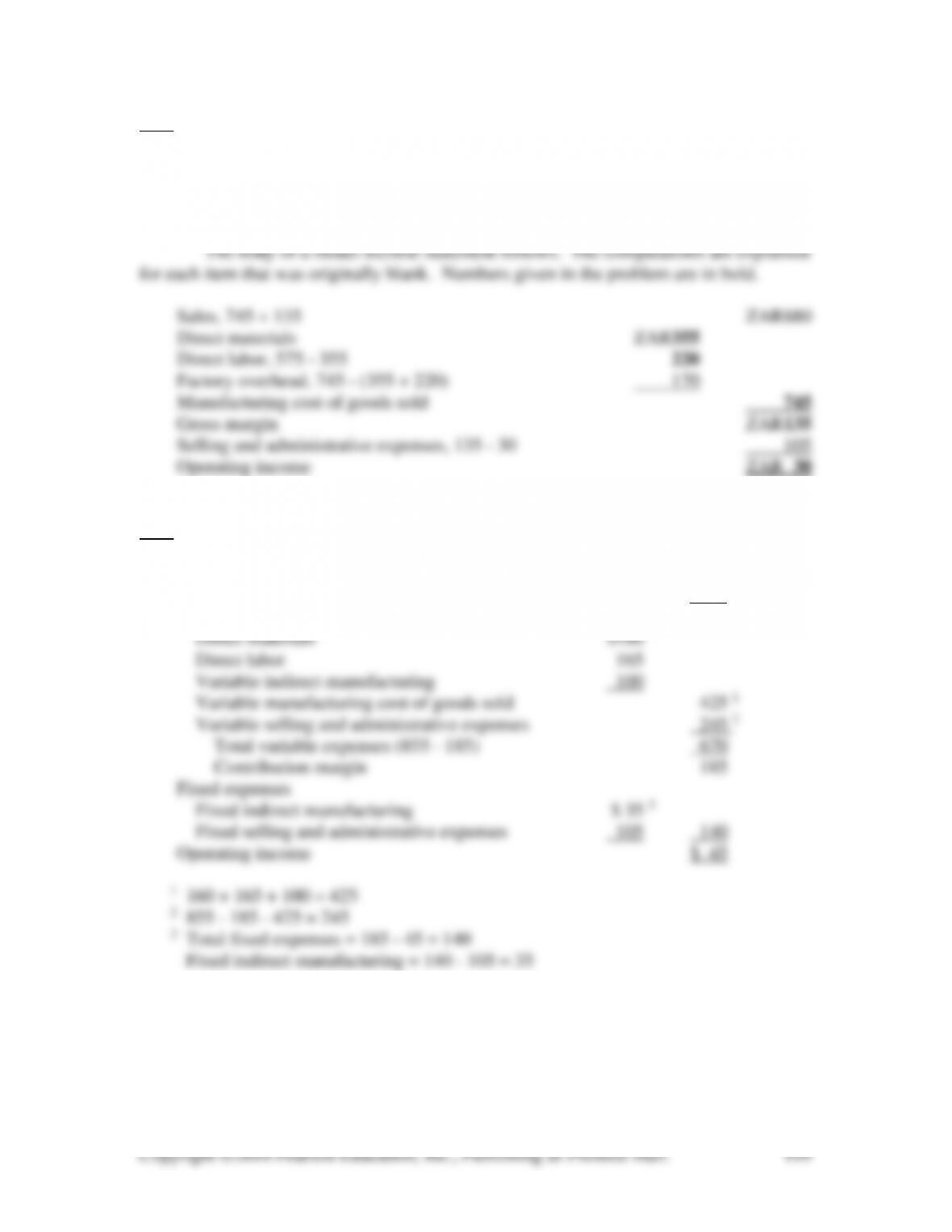
This is a straightforward exercise in basic terms and relationships. To fill all the
blanks, both absorption and contribution income statements must be prepared. Data are
in millions of dollars. Required answers are in italics.
Absorption Contribution
5-34 (10-20 min.) Answers are in thousands of Rands (ZAR).
Prime costs = Direct material + Direct labor
575 = 355 + DL
DL = 220
5-35 (15-20 min.) The data are placed in the format of the income statement, and the
unknowns are computed as shown. Answers are in thousands of Dollars:
Sales $855
Variable expenses
5-36 (10-15 min.)
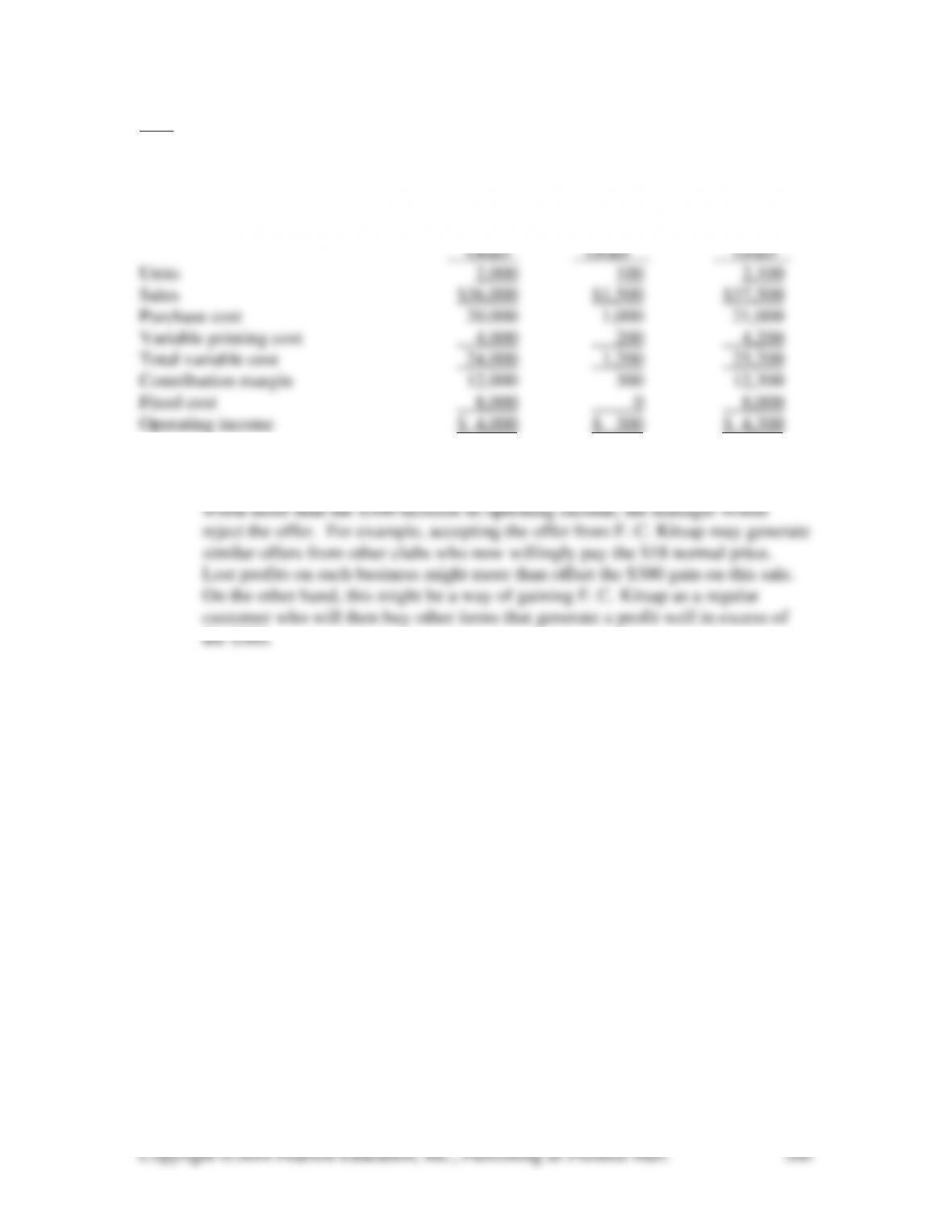
1. Operating income would increase by $300 if the order is accepted.
Without Effect of With
Special Special Special
2. If maximizing operating income in the short run were the only goal, the order
should be accepted. However, if qualitative considerations favoring rejection are