3. The activity-based costing system is generally more accurate because it better
allocates costs on a cause/effect basis. The Produce Department uses all of the produce
monitoring activity. The activity-based costing system recognizes this and allocates these
costs to the department.
However, even knowing an accurate operating income for each product is not sufficient
4-49 (30-35 min.)
1.
Cost
Annual Cost Driver Total
Cost Per Consumption Cost
2. Assuming that the results of the activity analysis are accurate, product 24Z2 is
or $2.63 ÷ $9.03 = 29%! Chrysler’s proposal should be rejected unless Chrysler
is willing to increase the price or unless O’Hanlon can significantly reduce its
costs. O’Hanlon should be aware, however, that the existing costing system is
also over-costing other products since all indirect costs are allocated. The
activity-based costing system should be used to cost all product lines in order to
Copyright ©2014 Pearson Education, Inc., Publishing as Prentice Hall.
166
Costs of implementing activity-based costing include:
• The cost of a pilot study includes salaries of managers who are dedicated to
the study.
• Consultants are often necessary.
• Data collection is extensive since operational and financial data are often not
available as required to support the new ABC system.
• It may be necessary to maintain an ABC system separate from the accounting
system used for external reporting.
4-50 (60 min. or more)
The purpose of this exercise is to force students to look beyond the textbook.
The library has many examples of applications of management accounting that show that
4-51 (20-30 min.)
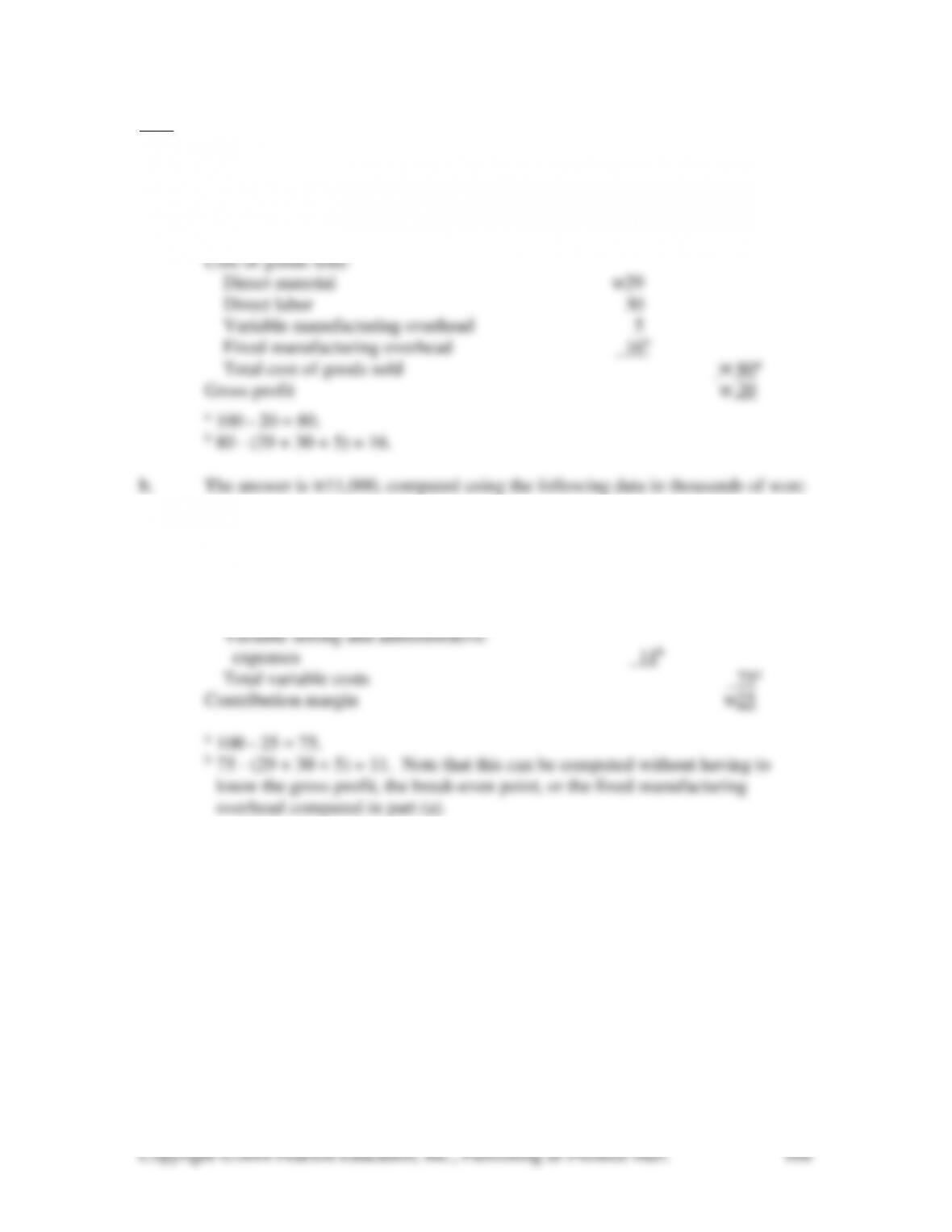
This problem reviews Chapters 2 through 4. It attempts to nail down some terms
that often give students trouble. Sharp distinctions should be made among gross profit,
contribution margin, manufacturing cost of goods sold and variable manufacturing cost of
goods sold. This problem was used originally as an exam question.
Fixed manufacturing overhead 15
Total manufacturing cost of goods sold 80 *
Gross profit 40
Selling and administrative expenses:
Variable 13 ***
4-52 (30-40 min.) This problem was originally used as an exam question. Probably
the easiest way to compute the answers is to prepare an income statement, filling in the
known items, and then solving for the unknowns.
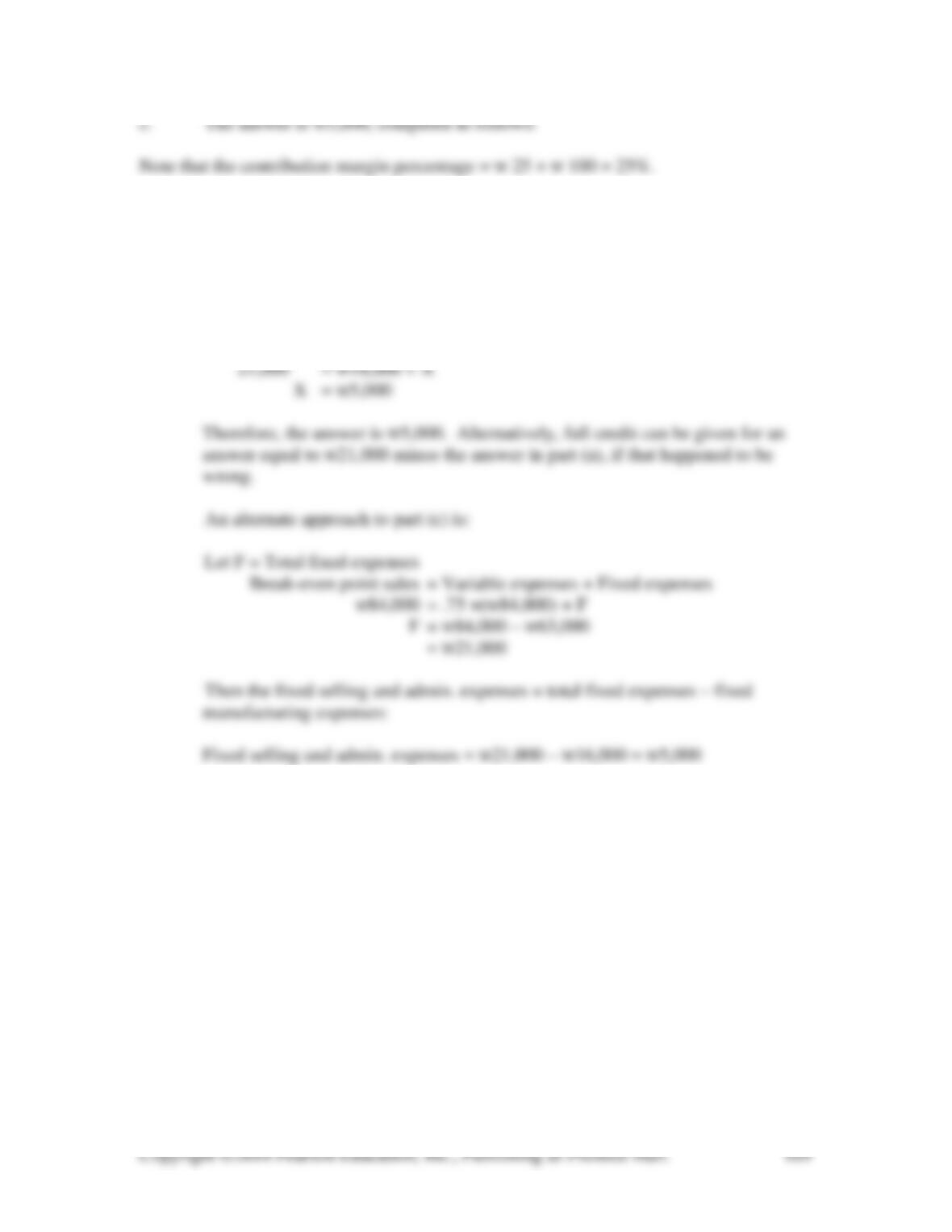
a. The answer is W16,000, computed as follows, in thousands of won:
Sales W100
Sales W100
Variable costs:
Direct material W29
Direct labor 30
Variable manufacturing overhead 5
Copyright ©2014 Pearson Education, Inc., Publishing as Prentice Hall.
169
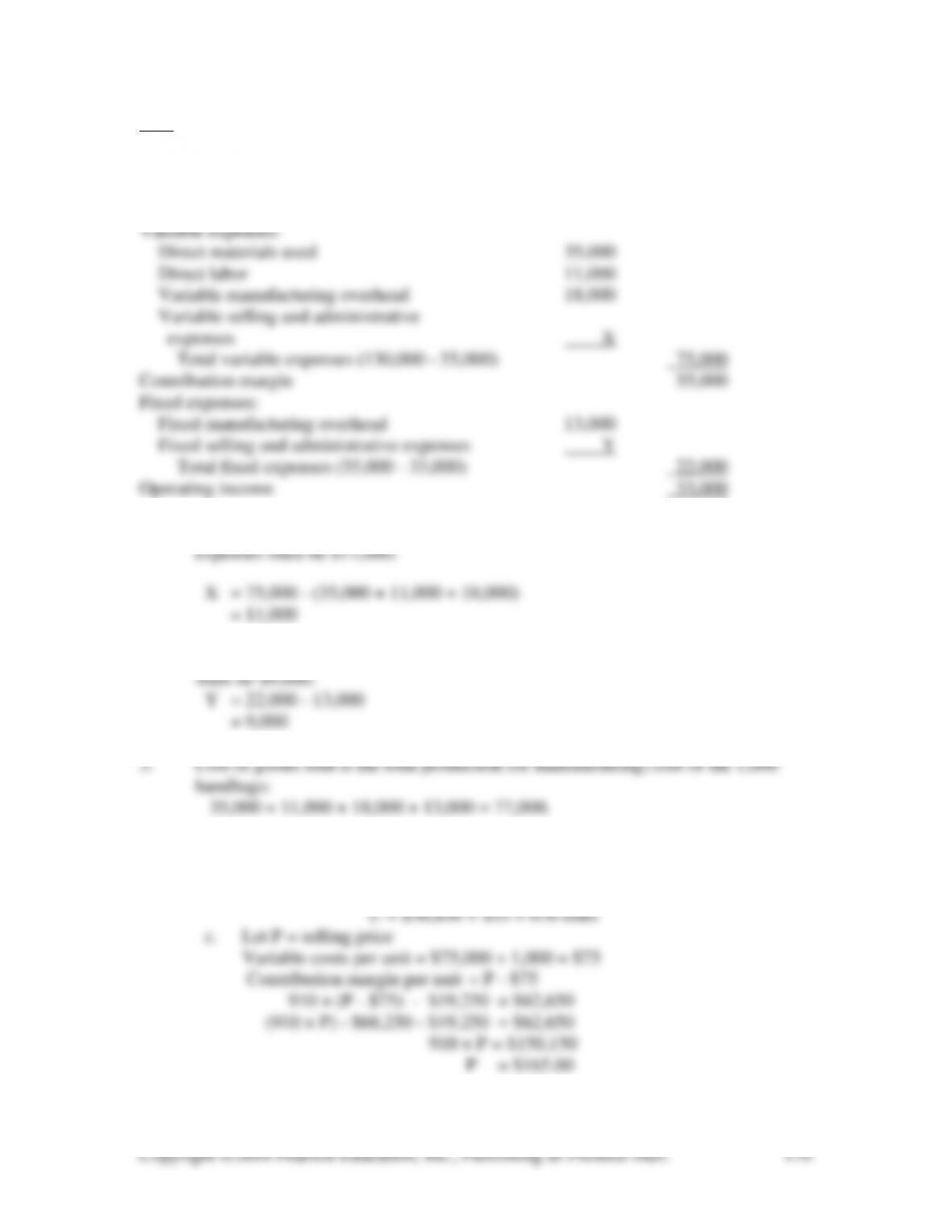
c. The answer is W5,000, computed as follows:
Note that the contribution margin percentage = W 25 ÷ W 100 = 25%.
Break-even point = Total fixed costs ÷ Contribution margin percentage
... Total fixed costs = Break-even point × Contribution margin percentage
= W84,000 × .25
= W21,000
Now, Total fixed costs = Fixed mfg. overhead + Fixed selling and admin. expense
4-53 (30-35 min.) This problem was first used as an examination question.
Putting fixed and variable costs into an income statement format and computing the
missing items provides a framework for this solution. Amounts are in dollars.
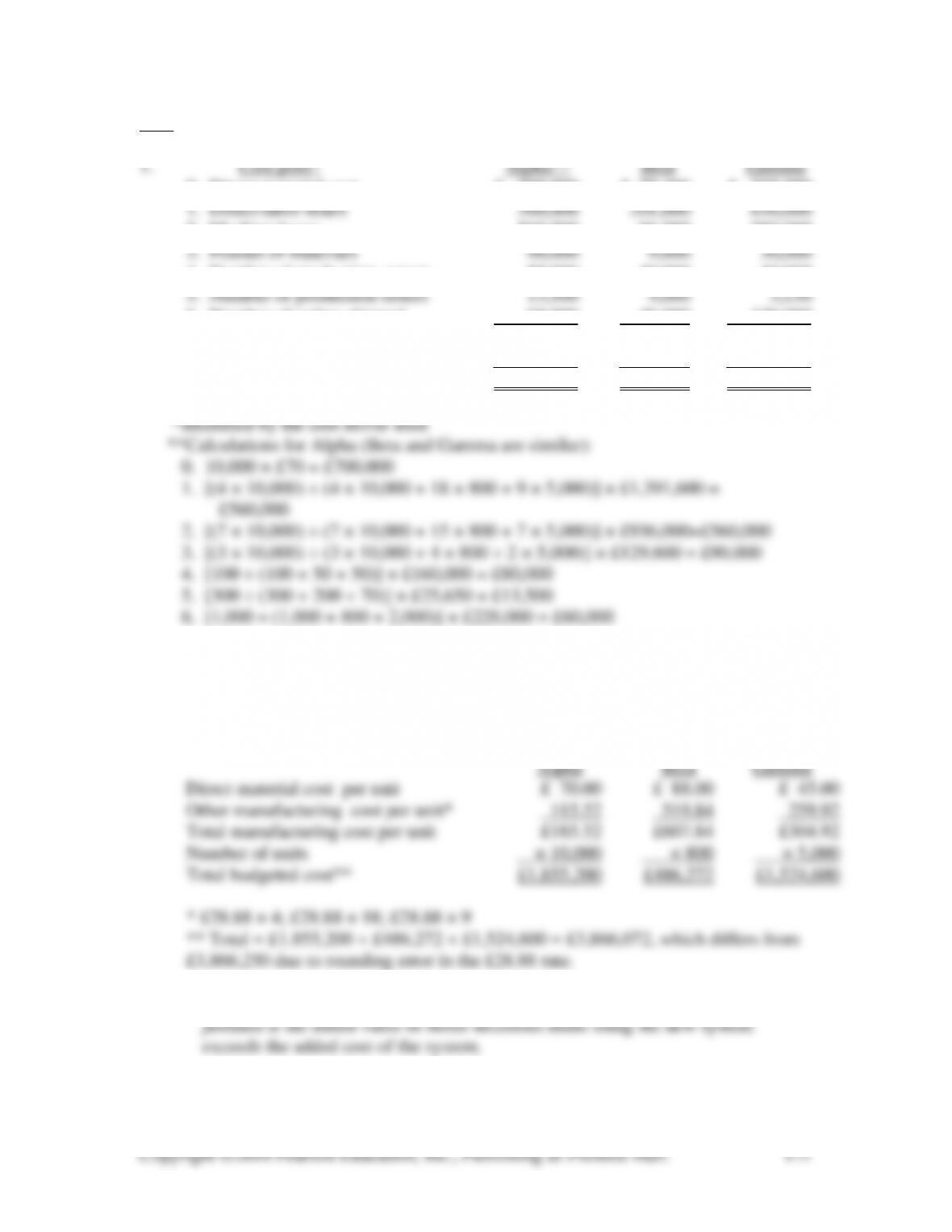
Sales 130,000
1. Since total variable expenses are $75,000, variable selling and administrative
2. Since total fixed expenses are $22,000, fixed selling and administrative expenses
4. a. ($6,250 + $13,000) ÷ ($55,000 ÷ 1,000) = $19,250 ÷ $55 = 350 units
b. Let U = units
$55 × U – $19,250 = $17,600
4-54 (30-45 min.)
0. Direct-material cost £ 700,000 £ 70,400 £ 225,000
2. Machine hours 560,000 96,000 280,000
4. Number of production setups 80,000 40,000 40,000
6. Number of orders shipped 60,000 48,000 120,000
Total budgeted cost £2,063,500 £474,600 £1,328,150
Number of units ÷ 10,000 ÷ 800 ÷ 5,000
Unit cost £ 206.35 £ 593.25 £ 265.63
2. Total cost (except direct materials) per direct-labor hour:
£2,870,850 ÷ (4 × 10,000 + 18 × 800 + 9 × 5,000)
= £2,870,850 ÷ 99,400 = £28.88 per direct-labor hour
3. The new system is more complex and more costly. The added expense would be
4-55 (50-60 min.) This is a difficult problem that forces students to think carefully
1. The existing traditional system simply divides all costs by the number of cheesecakes
produced, regardless of the market for which the cheesecakes are produced:
Ingredients ($900,000 ÷ 500,000) $1.800
2. The ABC system allocates the costs of each of the four activities separately, and it
directly traces the cost of packaging materials as well as the ingredients. Administration
and Facilities Operations and Maintenance costs are first allocated to Mixing and Baking
and Decorating and Packaging as follows because they support the activities in those
departments:
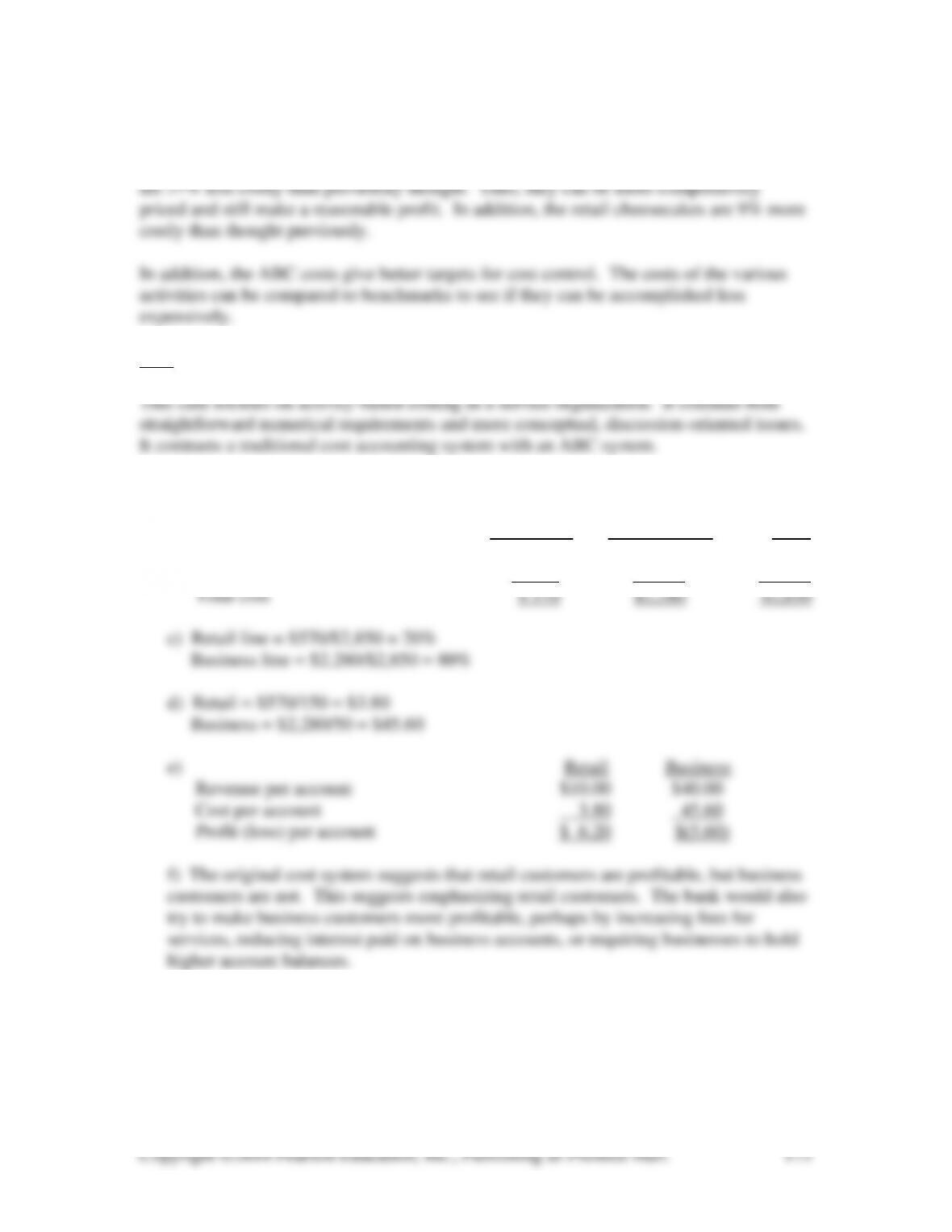
3. In the traditional system, the restaurant cheesecakes received 20% of all production
overhead (100,000 ÷ 500,000 = 20%). In the ABC system, the restaurant cheesecakes
received much less of the cost because they used much fewer resources. In total they
4-56 (50-60 min.) Numbers except per unit amounts are in thousands.
1. a) The indirect cost allocation rate is $2,850 / 11,400 = $.25 per check processed.
b) Retail Line Business Line Total
# of checks processed 2,280 9,120 11,400
Cost / check processed × $.25 × $.25 × $.25
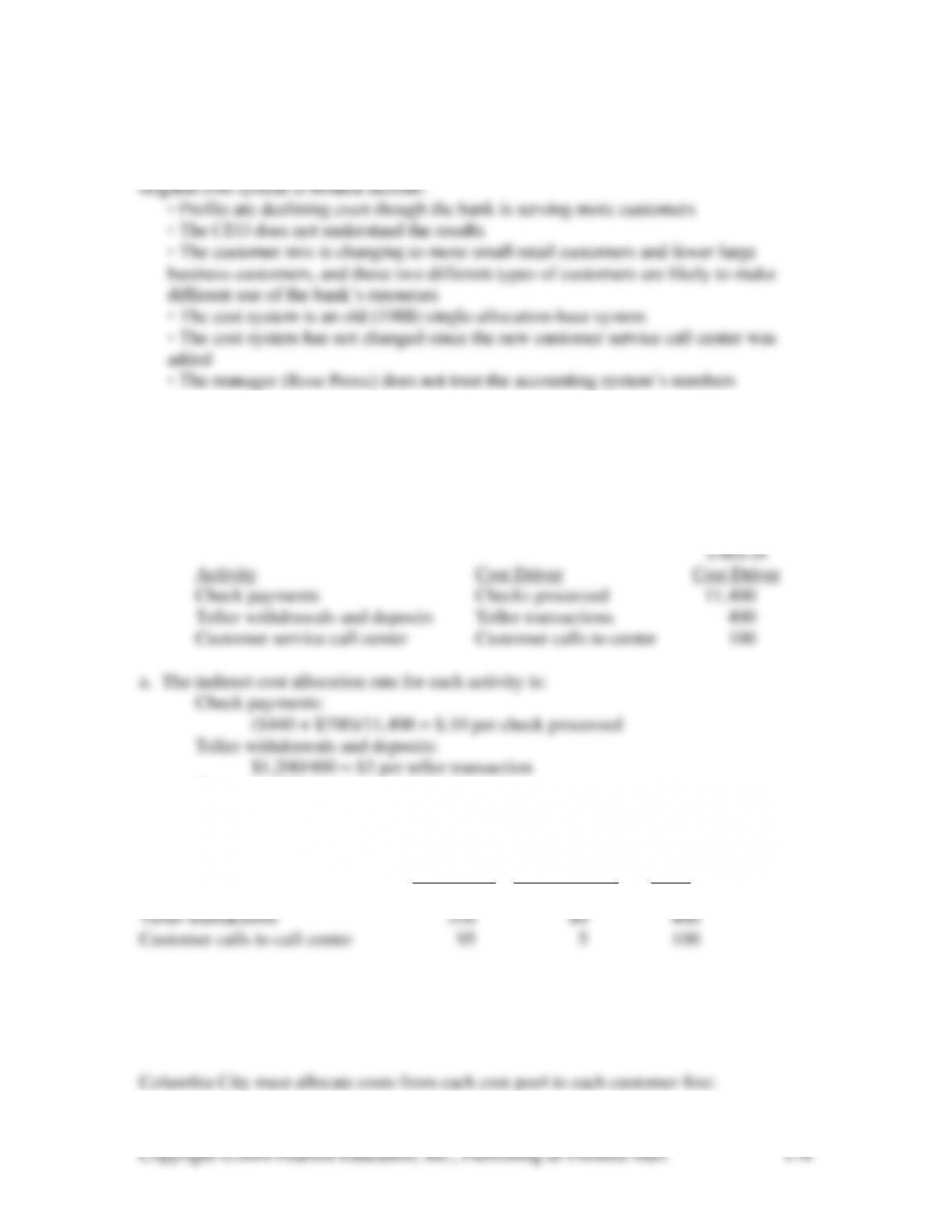
2. Broken machines simply stop running. In contrast, “broken” or outdated cost systems
continue producing potentially misleading costs. Consequently, managers need to
recognize clues that the cost system needs refinement. Signs that Columbia City’s
3. Columbia City has three activities, each with the following expected costs:
Check payments: $440 + $700 = $1,140
Teller withdrawals and deposits: $1,200
Customer service call center: $450 + $60 = $510
The cost drivers and the estimated total quantity of each cost driver are:
Customer call center:
($450 + $60)/100 = $5.10 per customer call
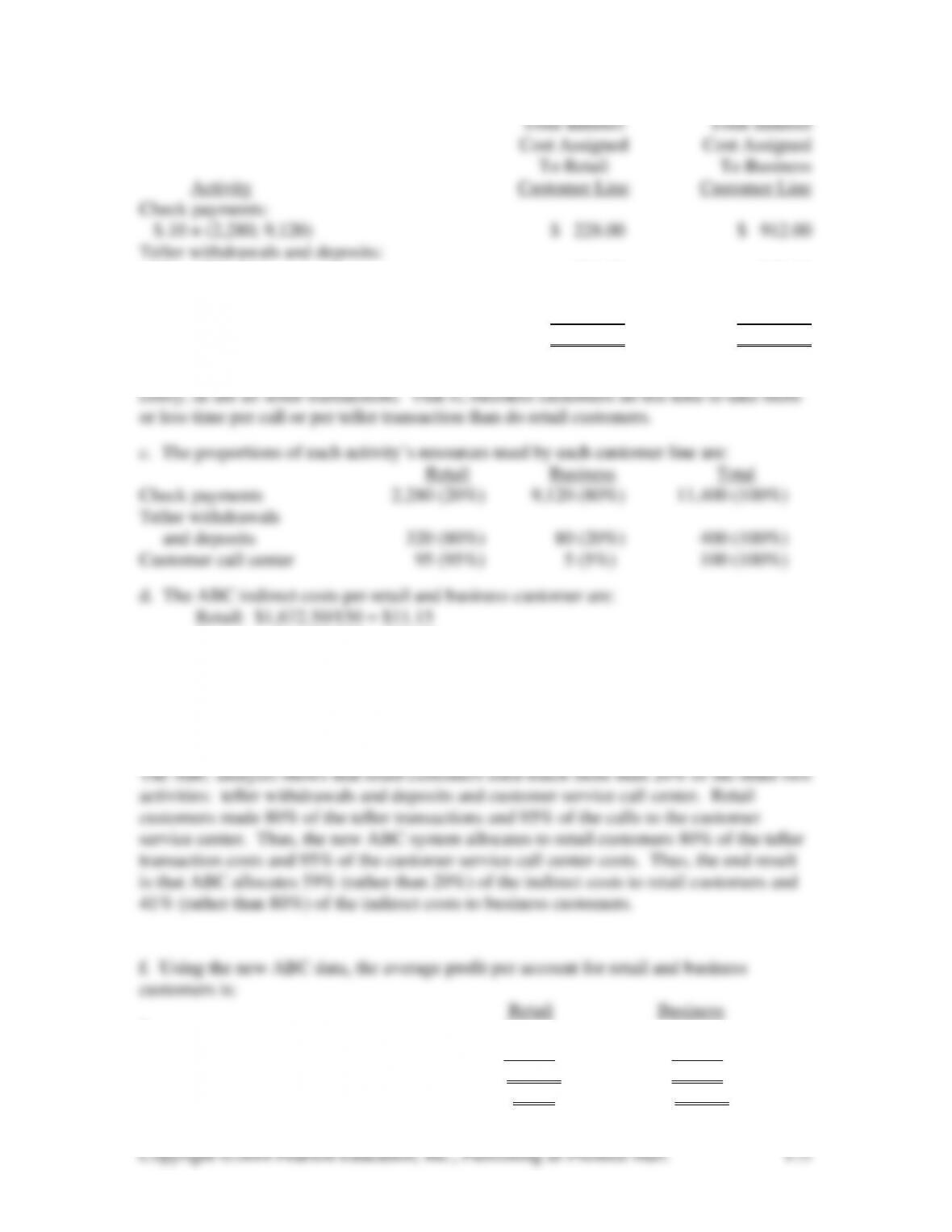
b. The quantity of cost driver activity in each customer line is (in thousands):
Retail Line Business Line Total
Checks processed 2,280 9,120 11,400
Copyright ©2014 Pearson Education, Inc., Publishing as Prentice Hall.
175
Total Indirect Total Indirect
Cost Assigned Cost Assigned
To Retail To Business
Activity Customer Line Customer Line
Check payments:
$.10 × (2,280; 9,120) $ 228.00 $ 912.00
Teller withdrawals and deposits:
$3 × (320; 80) 960.00 240.00
Customer call center:
$5.10 × (95; 5) 484.50 25.50
Total indirect costs $1,672.50 $1,177.50
You might note that this solution assumes that all calls to the call center are equally
Business: $1,177.5/50 = $23.55
e. The original cost system allocates all indirect costs based on the number of checks
processed. Because retail customers write 20% of the checks, the original system
allocated 20% of the indirect costs to retail customers and 80% of the indirect costs were
allocated to business customers.
Revenue per account $10.00 $40.00
ABC cost per account 11.15 23.55
ABC profit (loss) per account $(1.15) $16.45
Original profit (loss) per account $6.20 $(5.60)
The ABC system suggests that business customers are profitable, but retail customers are
4. a) The ABC data suggest that the plan to simply increase the number of checking
account customers was not wise. Assuming it is easier to attract a given number of
retail customers than business customers, it is not surprising that the incentive plan
1) More accurate cost information
a. Can help Columbia City better price its services.
2) Cost control
a. Reduce consumption of costly cost drivers. For example, Columbia City
may want to encourage on-line banking to reduce the number of teller
Copyright ©2014 Pearson Education, Inc., Publishing as Prentice Hall.
177
c) The relative advantage of ABC, that is, when its benefits exceed its cost, is
greatest:
1) When a company sells in a highly competitive industry, accurate cost
information is essential for setting prices that are competitive yet still allow the
2) When a company has high indirect costs. If indirect costs are low, it doesn’t
matter much how they are allocated.
4) When the company has sufficient information technology and accounting
expertise to implement the system and to record cost driver data.
Columbia City Bank is in a highly competitive environment. Most of its costs are
1) Non-accounting managers often serve on ABC teams. As in the case, ABC
system.
2) Managers need to understand ABC data to use it in decisions such as pricing,
product and customer profitability analysis, cost control, etc.
Copyright ©2014 Pearson Education, Inc., Publishing as Prentice Hall.
178
4-57 (30 min.)
1. and 2. The following are the most likely activities and resources that student will
identify. There may be disagreements on the cost behavior – those listed below
are probably most likely, but different behavior can be supported under different
assumptions. Likewise, students might suggest other, equally reasonable, cost
4-58 (15-20 min.)
Nike’s balance sheet shows only one line for Inventories, with a 2011 balance of $2,715
4-59 (50-60 min.) For the solution to this Excel Application Exercise, follow the step-
1. PCB124 = $81.43; PCB136 = $228.02
3. The cost for PCG124 is greater under the ABC system by ($97.80 – $81.43) ÷ $81.43
= 20.1%, while the cost of PCB136 is less by ($228.02 – $203.46) ÷ $228.02 = 10.7%.
4-61 (25 – 30 min.) NOTE TO INSTRUCTOR: This solution is based on the web site
1. The site suggests that you should “Send a warm Bear hug.” The message changes as
2. A Bear-Gram is a unique idea that is the creative alternative to flowers and guaranteed
to last forever. The Bear-Gram is a hand-crafted Teddy Bear that is guaranteed for life.
journey.
3. Activities in the factory include designing new teddy bears, fur cutting, sewing, pin
and assembly (stuffing and installing joints), order processing, and shipping. The fur
4. Any company that has complexity in one or more functions of its value chain is a
good candidate for ABC. In addition, any company can benefit from the increased
5. The company is a manufacturer. It takes raw materials, applies labor and overhead,
and turns the materials into finished goods – teddy bears. Its inventory account would
include three categories: raw materials, work in process, and finished goods. From