Therefore, ABC produces the information used in ABM. If managers in companies with ABC
4-33 No. The main reasons that activity-based costing is becoming so popular relate to
planning and control, not product costing, including (1) decisions about product mix, prices, and
4-34 In such a company the ABC system would not produce more accurate product costs.
However, cost planning and control (the strategic and operational purposes of a cost management
4-35 Benchmarking financial measures should be done with care. Many factors outside the
influence of responsible managers can reduce the comparability of performance measures. For
example, labor costs can vary substantially across regions. If the local labor rates in Youngstown
4-36 (10 min.)
This exercise emphasizes how a given cost item may be seen from different viewpoints.
2. Storeroom clerk salary I F
4. Supervisor training program I F
6. Cutting bits I V
8. Worker’s compensation insurance I V
10. Paper towels in washroom I V
4-37 (10 min.)
1. The cost of components used in products is almost always directly traceable and is a variable
cost.
2. As volume changes over a wide range, the amount of supplies consumed for maintenance will
3. The wages of machine operators who work on only one product can be easily traced to the
product. If these wages would not vary over wide ranges of volume, they would be a fixed cost.
4. Training costs for mechanics would not vary as a function of volume of production assuming
4-38 (20 min.)
1. b, f 7. b, f 13. d, f
3. d, e 9. b, f 15. a**, f
5. b, e 11. b, f 17. b, f
6. b, e 12. b, g 18. d, e
4-39 (10 min.)
2. D
4. I
6. I
8. U
4-40 (20-25 min.)
The first step is determining the revised activity-cost pool amounts (stage 1).
Processing Activity Cost = .90 × $180,000 + .30 × $40,000
= $162,000 + $12,000
= $174,000
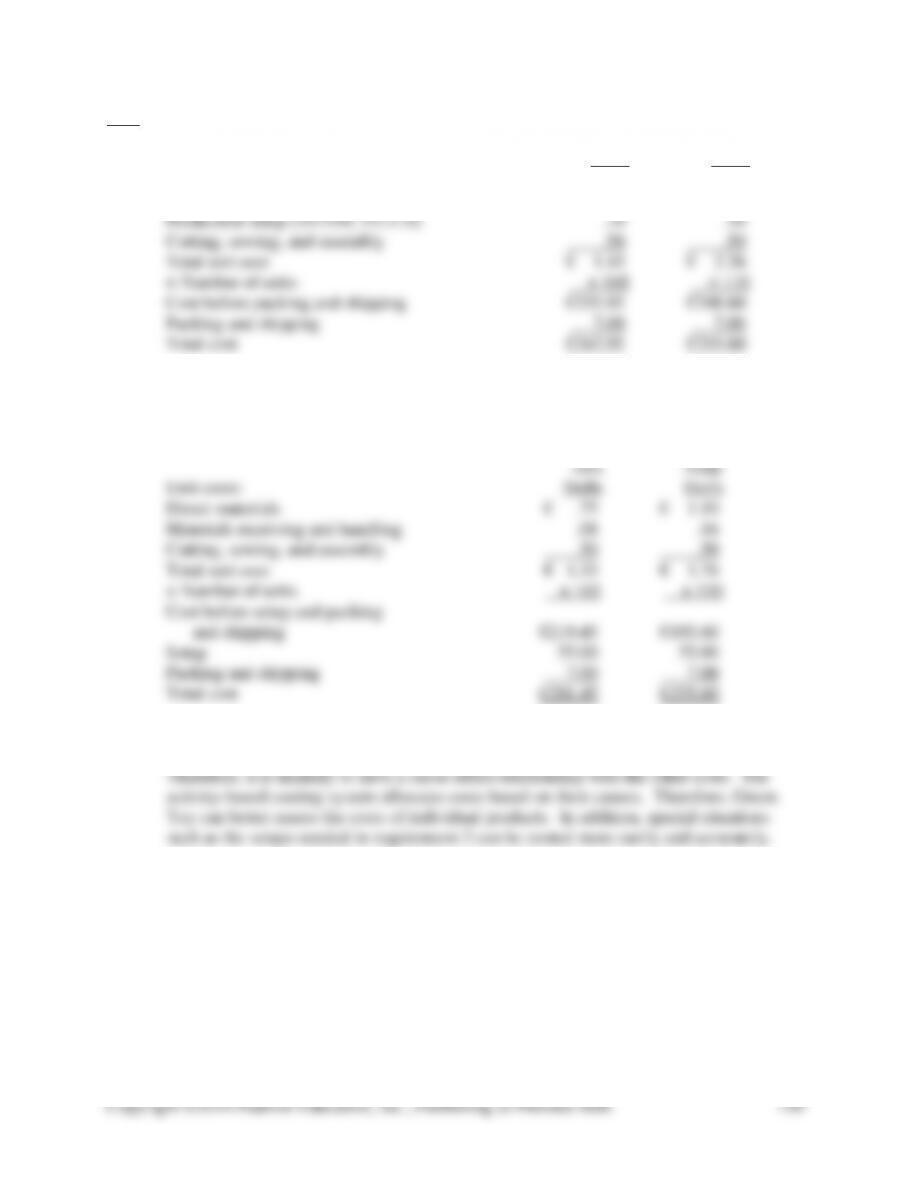
4-41 (20-30 min.)
Ann Andy
1. Unit costs: Dolls Dolls
Direct materials € .75 € 1.10
Materials receiving and handling .08 .16
2. This requirement calls for an understanding of cost drivers. Instead of setup costs being
added as an average unit cost, they are added as a total cost for each product in this
order. In essence, setup costs are driven by the order because the new requirements call
for one setup for each product in each order:
3. The activity-based costing system recognizes the behavior of the costs. Because Gruen
Toy Company has no category for direct labor, it apparently is not a significant cost.
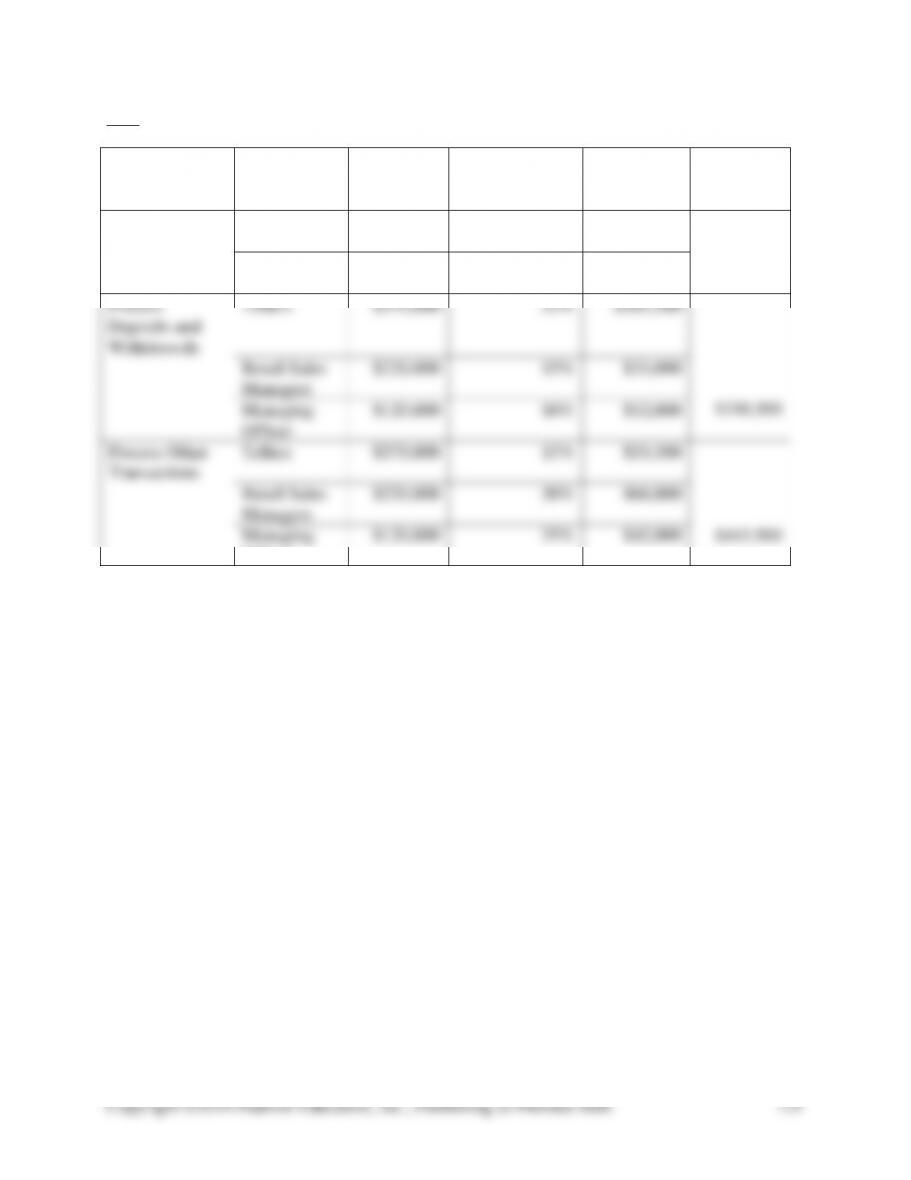
4-42 (15-20 min.)
Activity
Resource
Cost
Consumption
Rate
Allocated
Cost
Total Cost
Open New
Accounts
Tellers
$370,000
20%
$74,000
$107,000
Retail Sales
Managers
$220,000
15%
$33,000
Process
Deposits and
Withdrawals
Tellers
$370,000
55%
$203,500
$248,500
Retail Sales
Managers
$220,000
15%
$33,000
Managing
Officer
$120,000
10%
$12,000
Process Other
Transactions
Tellers
$370,000
15%
$55,500
Retail Sales
Managers
$220,000
30%
$66,000
Managing
Officer
$120,000
35%
$42,000
$163,500
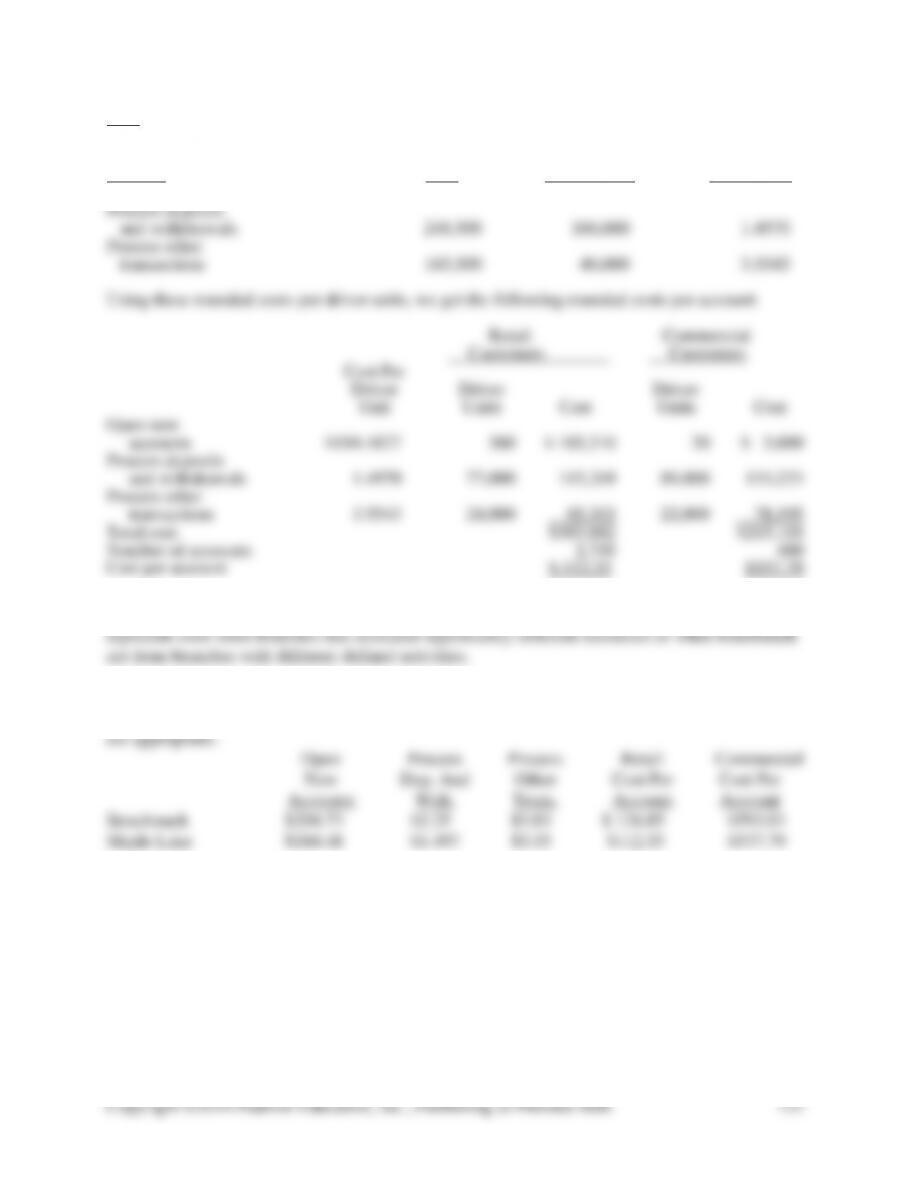
4-43 (20-25 min.)
1.
Total Annual Flow of Cost Per
Activity Cost Driver Units Driver Unit
Open new accounts $ 107,000 580 $184.4827
2. Benchmarking is not appropriate when different costing systems are used, when benchmarks
3. The comparison below indicates that the Maple Lake branch performed extremely well,
much better than the lowest cost across other branches. This assumes that the benchmarks used
4-44 (20-30 min.)
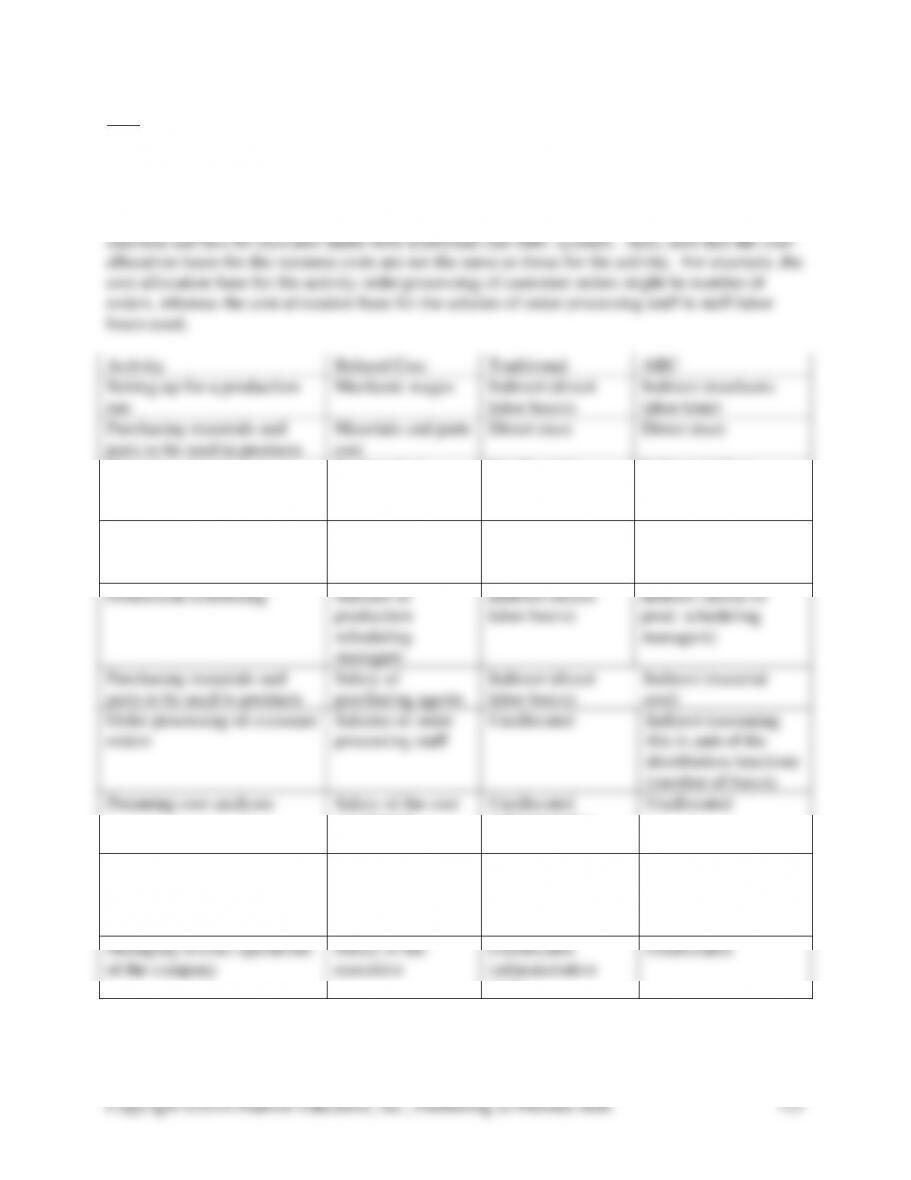
Answers can vary depending on the assumptions. For example, some companies would consider
the order processing activity part of the distribution function in the value chain and would
include this activity in the new ABC system. Others would consider this a support activity and
leave it unallocated. Similarly, production scheduling can be considered part of the production
Activity
Related Cost
Traditional
ABC
Setting up for a production
run
Mechanic wages
Indirect (direct
labor hours)
Indirect (mechanic
labor time)
Purchasing materials and
parts to be used in products
Materials and parts
cost
Direct trace
Direct trace
Shipping sold products to
customers (distributors)
Fuel used on
company’s fleet of
trucks
Unallocated
(period cost)
Indirect (miles)
Market research study
Salaries of market
research staff
Unallocated
(period cost)
Unallocated (R & D
function not
allocated)
Production scheduling
Salaries of
production
scheduling
managers
Indirect (direct
labor hours)
Indirect (hours of
prod. scheduling
managers)
Purchasing materials and
parts to be used in products
Salary of
purchasing agents
Indirect (direct
labor hours)
Indirect (material
cost)
Order processing of customer
orders
Salaries of order
processing staff
Unallocated
Indirect (assuming
this is part of the
distribution function)
(number of hours)
Preparing cost analyses
Salary of the cost
accountant
Unallocated
(administrative
cost)
Unallocated
Designing a new product
Salaries of design
engineers who are
fully dedicated to
this new product
Unallocated (R&D
cost, which is a
period cost)
Direct trace
Managing overall operations
of the company
Salary of the
executive
Unallocated
(administrative
cost)
Unallocated
4-45 (20-30 min.)
This problem provides an overview of cost accumulation and allocation without getting bogged
1. Amounts are in dollars.
Machining Finishing Total
2. Amounts are in dollars. Alpha
Direct Direct Indirect
Material Labor Production
Machining 40,000* 4,500* 5,000*
Finishing 120,000** 8,100** 3,000**
4-46 (20 min.)
This problem is based on a description in Cost Finding and Rate Setting for Hospitals
(Chicago: American Hospital Association), p. 6 and p. 74. It illustrates the idea of using a
weighted average, which is really a version of equivalent units (explained in Chapter 14 on
process costing). If process costing is covered in this course, the applicability of equivalent units
Using unweighted base, 23,000 × $.29 $ 6,670
Using weighted base, 51,000 × $.28 $14,280
The practical problems of cost allocation are described in the cost-finding publication:
One basis for the allocation of laundry costs is pounds of soiled laundry. This is a
good basis provided it is possible for the hospital to identify the source of soiled linens by
laundry. The average of the several two-week tests can be used as the basis for distributing
laundry costs for cost-finding purposes.
Another method is to use laundry prices as a weighting factor for the different types
of pieces. This method has the advantage of allowing for the relative difficulty of different
processing functions, such as pressed versus mangle finishing.
Copyright ©2014 Pearson Education, Inc., Publishing as Prentice Hall.
156
where the laundry processes a large volume of uniforms for student nurses and doctors, and
for dietary, housekeeping, and other service personnel, it may be desirable to separate
washing and pressing costs and to develop separate allocation bases for each of these
functions based on the production statistics. Furthermore, it may be desirable to consider
the effect of different processing cycles, such as the special rinse cycles for operating room
linens or the special cold wash cycles for woolen blankets. Through discussions with the
laundry manager, it is possible to determine whether further analysis is justified. Another
example of possible refinements is the personal laundry done for medical interns, residents,
student nurses, and others; if the volume is large, it might have to be recognized in the
departmental operations.
4-47 (50-60 min.)
1. A summary of results follows.
Pen Cell-Phone
Casings Casings Company
Base Gross Profit Percentage* 1.25% 38.75% 8.07%
Plan Gross Profit Percentage** 6.25% 36.17% 13.73%
Although the company-level gross profit margin improves, the president’s support may not be
strong. Why? Top management is normally hesitant to support actions that do not have total
support among product-line managers unless there is solid evidence of material improvement in
profitability. While the overall gross margin percentage improves, the bottom line still is in red
ink!
Perhaps the most important factor bearing on the president’s support is lack of confidence in the
Copyright ©2014 Pearson Education, Inc., Publishing as Prentice Hall.
157
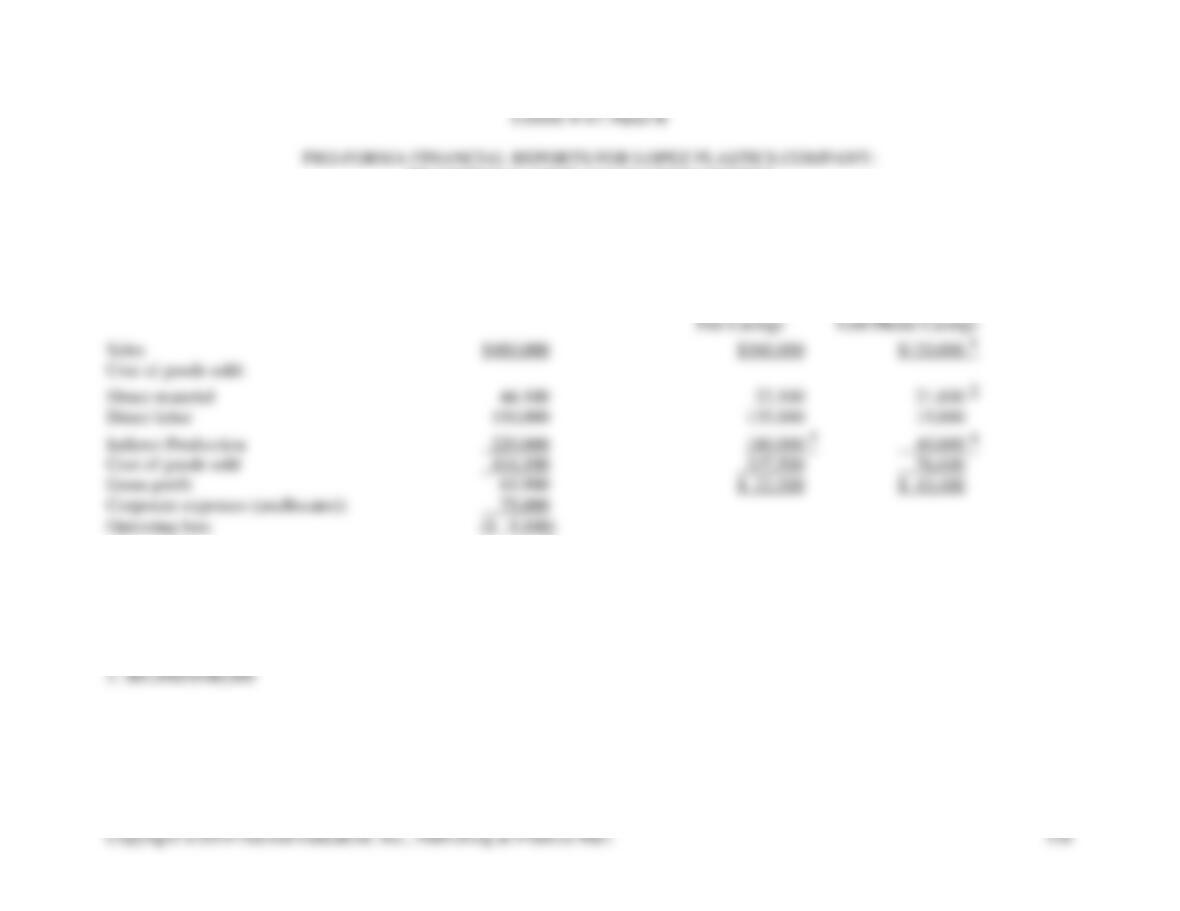
Exhibit 4-47: Panel A
Traditional Cost System Process Map
Unallocate
d
$75,000
Direct
Materials
for Pen
Casings
$22,500
Direct
Labor for
Pen
Casings
$135,000
Direct
Materials
for Cell
Phone
Casings
$21,600
Direct
Labor
for Cell
Phone
Casings
$15,000
Pen Casings
Sales $360,000
Cell Phone Casings
Sales $120,000
All Indirect
Resources
$220,000
All Unallocated
Value Chain
Costs
$75,000
Cost Driver
[Direct Labor Hours = 4,500 +
1,000 = 5,500]
Copyright ©2014 Pearson Education, Inc., Publishing as Prentice Hall.
158
Exhibit 4-47: Panel B
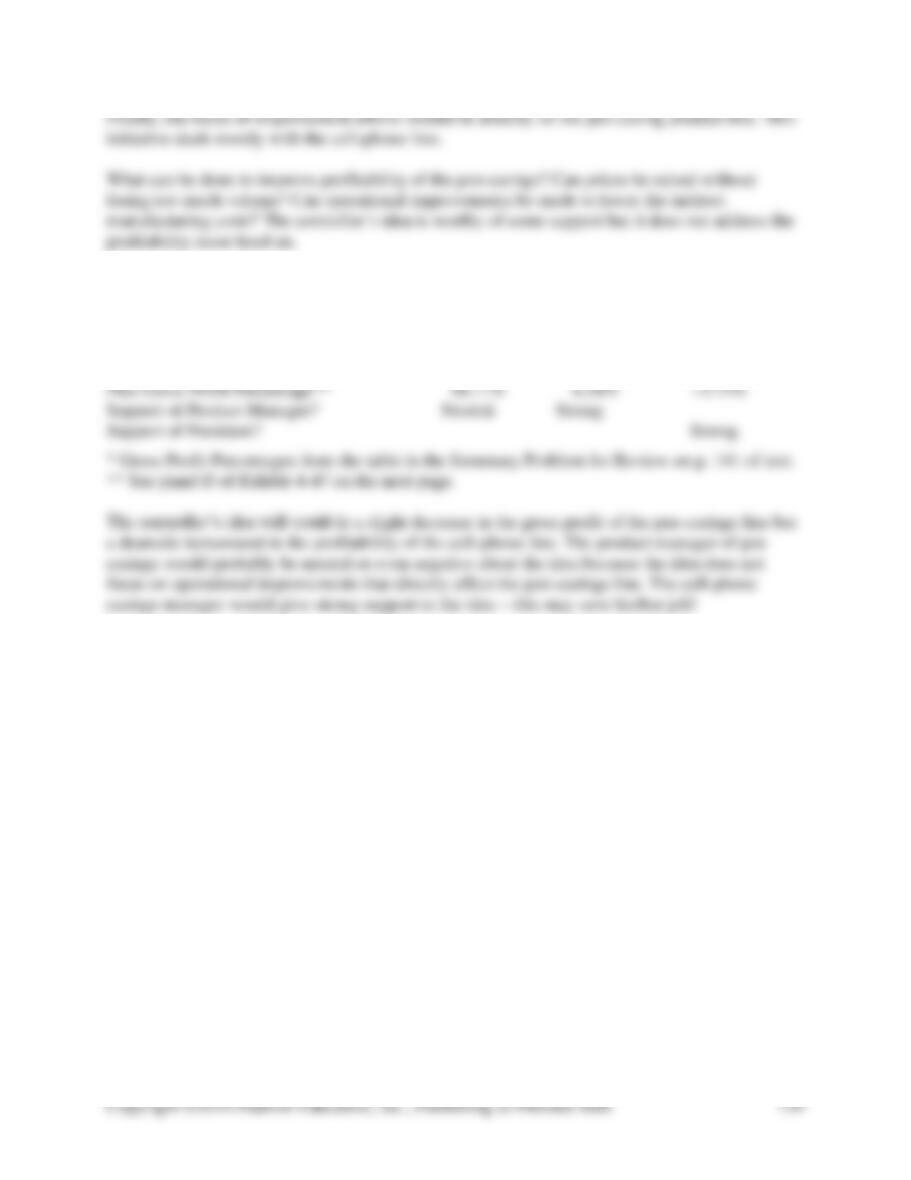
PRO-FORMA FINANCIAL REPORTS FOR LOPEZ PLASTICS COMPANY:
TRADITIONAL COST ALLOCATION SYSTEM
STATEMENT OF OPERTING INCOME CONTRIBUTION TO CORPORATE COSTS
AND PROFIT
[EXTERNAL REPORTING PURPOSE] [INTERNAL STRATEGIC DECISION MAKING
AND OPERATIONAL-CONTROL PURPOSE]
Gross profit margin 13.73% 5 6.25% 36.17%
1. $80,000 × .75 × 2
2. $12,000 × 2 × .90
3. $220,000 × [4,500/(4,500 + 1,000)]
4. $220,000 × [1,000/(4,500 + 1,000)]
Copyright ©2014 Pearson Education, Inc., Publishing as Prentice Hall.
159
Finally, the focus of improvement efforts should be directly on the pen-casing product line. This
initiative deals mostly with the cell-phone line.
What can be done to improve profitability of the pen casings? Can prices be raised without
losing too much volume? Can operational improvements be made to lower the indirect
manufacturing costs? The controller’s idea is worthy of some support but it does not address the
profitability issue head on.
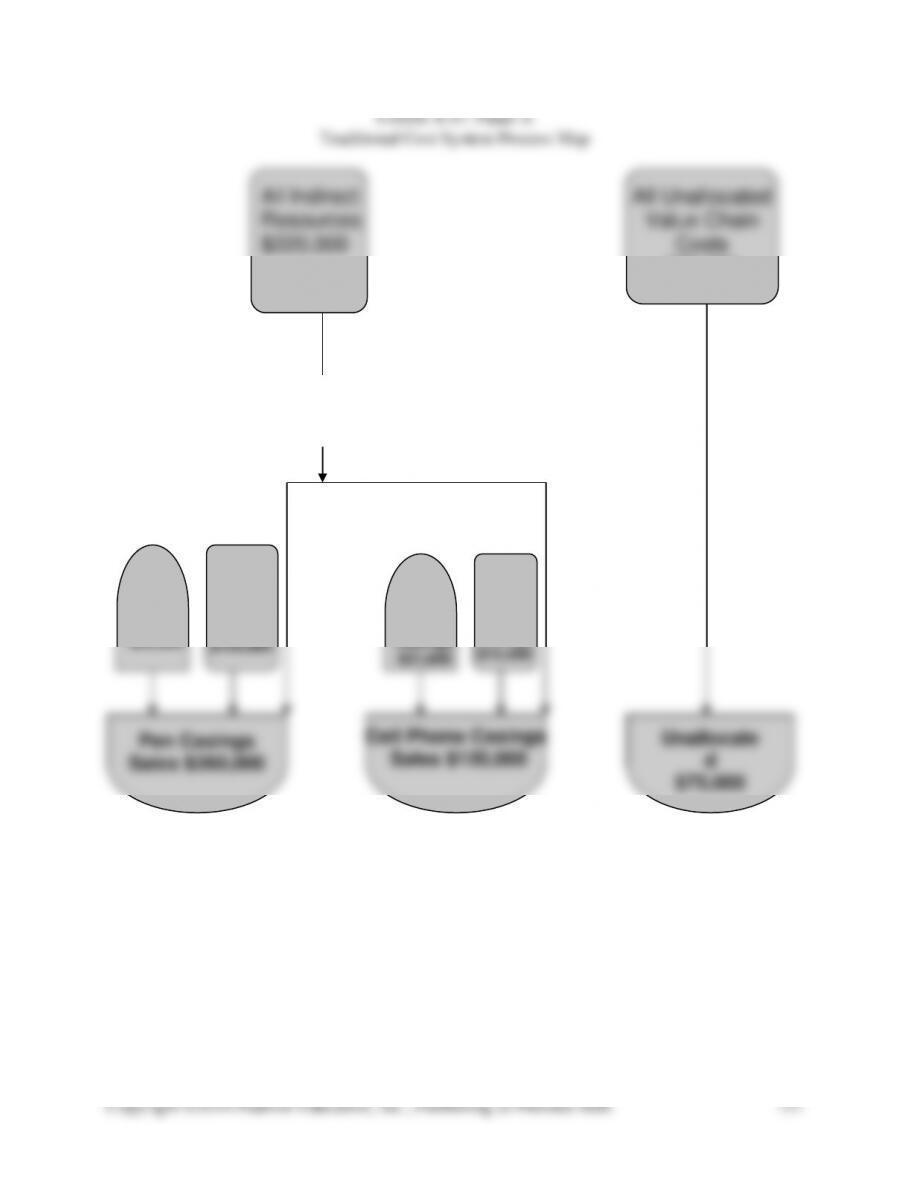
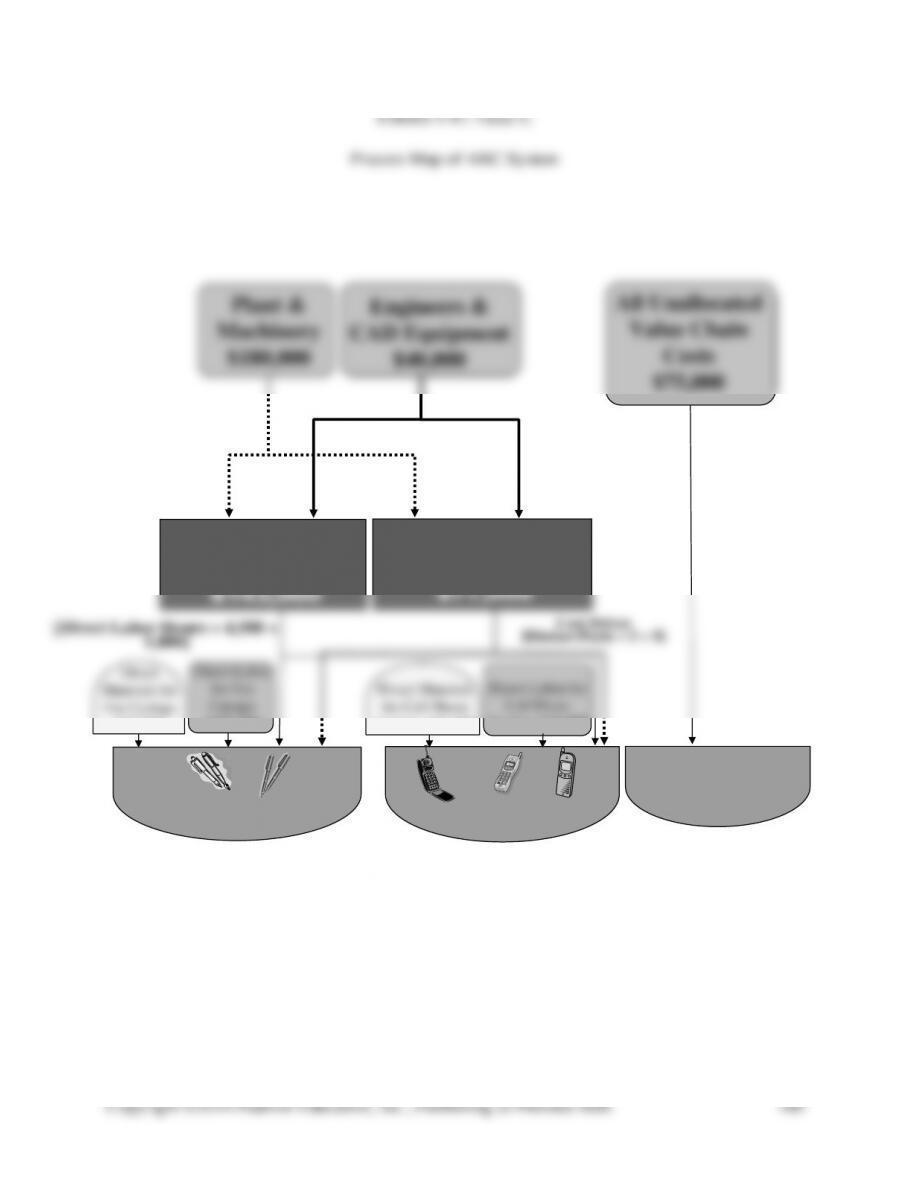
2. Panel C of Exhibit 4-47 that follows is a process map that can be used to explain the impact of
the controller’s idea. Panel D provides a detailed evaluation of the controller’s idea.
Pen Cell-Phone
Casings Casings Company
Base Gross Profit Percentage* 16.22% (28.63%) 8.07%
The president might note that the numbers agree with her informal analysis – generating
confidence in the integrity of the cost accounting system. For reasons previously stated, the
president would strongly support this idea while encouraging all managers involved to keep up
the good work, reminding them that even if all these predictions are realized, the company still is
operating at a loss.
Processing
Activity
$143,000
75%
All Unallocated
Value Chain
Costs
$75,000
Plant &
Machinery
$180,000
Engineers &
CAD Equipment
$40,000
Production
Support Activity
$77,000
80%20%
25%
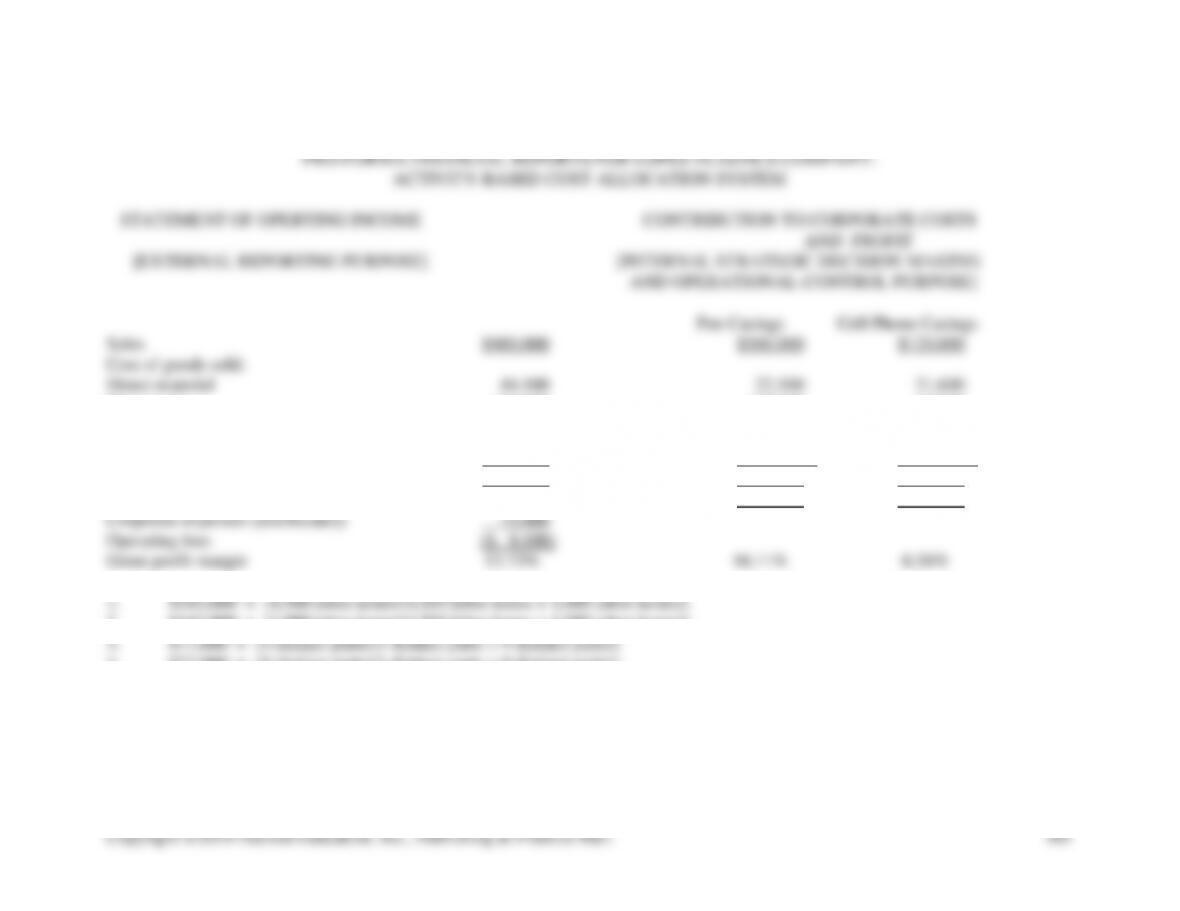
Solution 4-47: Panel D
Direct labor 150,000 135,000 15,000
Processing activity 143,000 117,000 1 26,000 2
Production support activity 77,000 27,500 3 49,500 4
Cost of goods sold 414,100 302,000 112,100
Gross profit 65,900 $ 58,000 $ 7,900
2. $143,000 × [1,000 labor hours/(4,500 labor hours + 1,000 labor hours)]
4. $77,000 × [9 distinct parts/(5 distinct parts + 9 distinct parts)]
3. As vice president, you probably are pleased with the new ABC system. The cost
drivers that are used to allocate activity costs appear to be plausible and reliable and thus
probably represent a sound cause-effect model of operations. This will improve both the
accuracy of product costing and operating managers’ control over costs. Operating
4-48 (30-35 min.)
1. The Produce department has the highest operating income per euro of sales:
Packaged
2. Activity-based rates per unit of cost driver for each activity are:
Ordering €67,870 ÷ 6,170 = €11 per order
Delivery €179,200 ÷ 11,200 = €16 per delivery
Shelf-stocking €128,858 ÷ 3,391 = €38 per hour
Customer support €245,440 ÷ 613,600 = €0.40 per item sold