
CHAPTER 4
COVERAGE OF LEARNING OBJECTIVES
LEARNING OBJECTIVE
FUNDA–
MENTAL
ASSIGN–
MENT
MATERIAL
CRITICAL
THINKING
EXERCISES
AND
EXERCISES
PROBLEMS
CASES,
EXCEL,
COLLAB. &
INTERNET
EXERCISES
LO1: Describe the purposes of
cost management systems.
31, 34
50
LO2: Explain the relationship
between cost, cost object, cost
accumulation, and cost
assignment.
45
56
LO3: Distinguish between
direct and indirect costs.
A1,B1
36, 37, 38, 39,
44
45, 49
56
LO4: Explain the major
reasons for allocating costs.
B2
33, 41
46
54
LO5: Identify the main types of
manufacturing costs: direct
materials, direct labor, and
indirect production costs.
36, 37, 38, 39
LO6: Explain how the financial
statements of merchandisers
and manufacturers differ
because of the types of goods
they sell.
A2
57, 60, 61
LO7: Understand the main
differences between traditional
and activity–based costing
systems and why ABC systems
provide value to managers.
A3, A4, B3,
B4
33, 40, 41, 42,
47
48, 49, 50
55, 56, 57, 58,
59, 60, 61
LO8: Use activity–based cost
information to make strategic
and operational control
decisions.
A4, B4
32, 35, 37, 43,
47
48, 49, 50
55, 56, 60
CHAPTER 4
Cost Management Systems and Activity-Based Costing
4-A1 (20-30 min.)
See Table 4-A1 on the following page.
4-A2 (25-30 min.)
1. Merchandise Inventories, 2,500 devices @ $75 $187,500
2. Direct materials inventory $ 40,000
3.
DANUBE ELECTRONICS PRODUCTS
Statement of Operating Income
For the Year Ended December 31, 20X9
Sales (9,500 units at $180) $1,710,000
Cost of goods sold:
TABLE 4-A1
STATEMENT OF OPERATING INCOME OPERATING INCOME BY PRODUCT LINE
EXTERNAL REPORTING PURPOSE INTERNAL STRATEGIC DECISION MAKING PURPOSE
Custom Large Small
Detailed Std. Std. Cost Type, Assignment Method
Sales $307,900 $57,600 $58,300 $192,000
4. ANNANDALE, INC.
Statement of Operating Income
For the Year Ended December 31, 20X9
Sales (9,500 units at $180) $1,710,000
Cost of goods manufactured and sold:
5. The balance sheet for the merchandiser (Danube) has just one line for inventories, the
ending inventory of the items purchased for resale. The balance sheet for the
manufacturer (Annandale) has three items: direct materials inventory, work-in-process
6. The purpose is providing aggregate measures of inventory value and cost of goods
4-A3 (10-15 min.)
There can be many justifiable answers for each item other than the listed cost driver and
behavior. The purpose of this exercise is to generate an active discussion regarding those
Activity
Or Cost
Resource Cost Driver Behavior
a. * R Number of square feet F
b.** R Number of person hours F
4-A4 (20-30 min.)
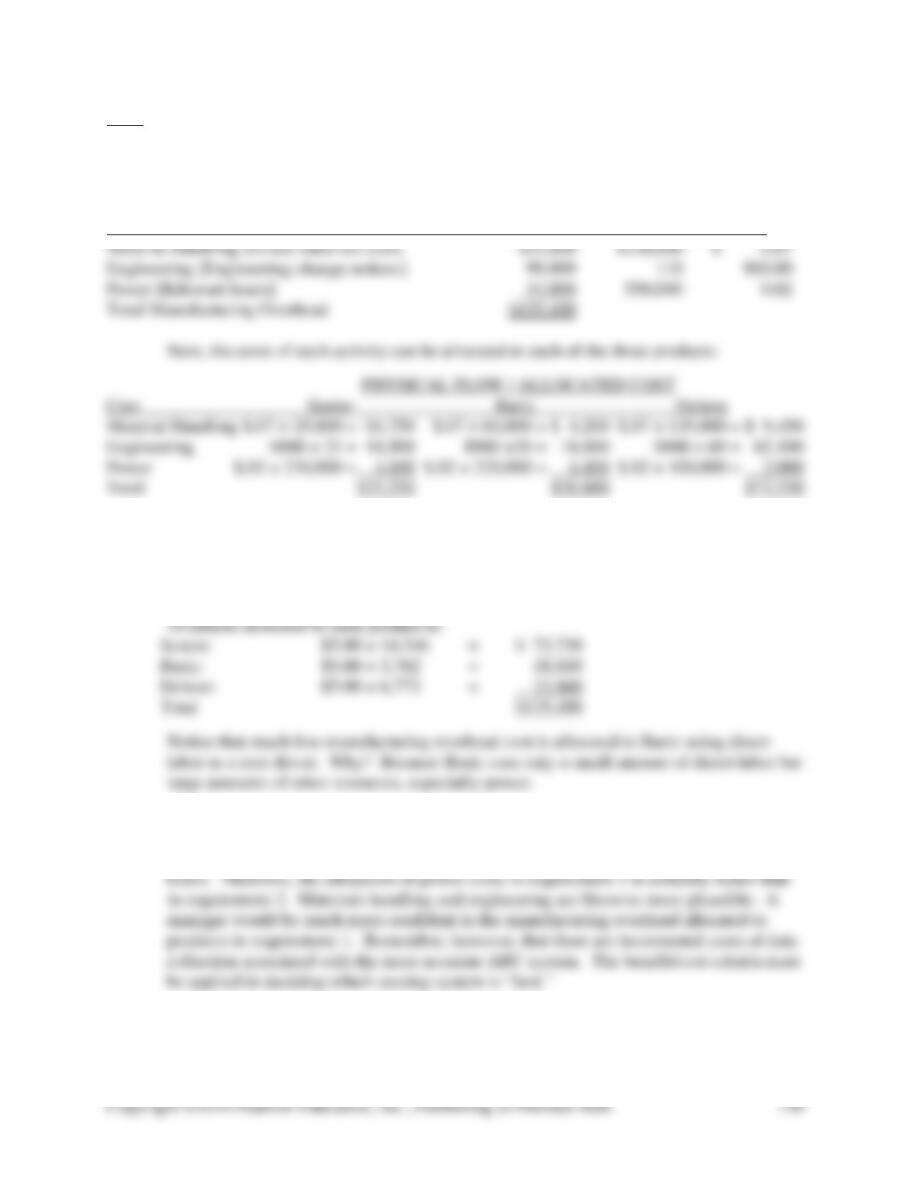
1. The first step is to determine the cost per cost-driver unit for each activity:
Monthly Cost- Cost per
Manufacturing Driver Driver
Activity [Cost driver] Overhead Activity Unit
2. Overhead rate based on direct labor costs:
Rate = Total manufacturing overhead ÷ Total direct labor cost
= $125,400 ÷ $25,080 = $5.00/DL$
3. The product costs in requirement 1 are more accurate if the cost drivers are good
indicators of the causes of the costs — they are both plausible and reliable. For example,
kilowatt hours is certainly a better measure of the cost of power costs than is direct labor
Copyright ©2014 Pearson Education, Inc., Publishing as Prentice Hall.
131
4-B1 (20-30 min.)
See Table 4-B1 on the following page.
4-B2 (25-30 min.)
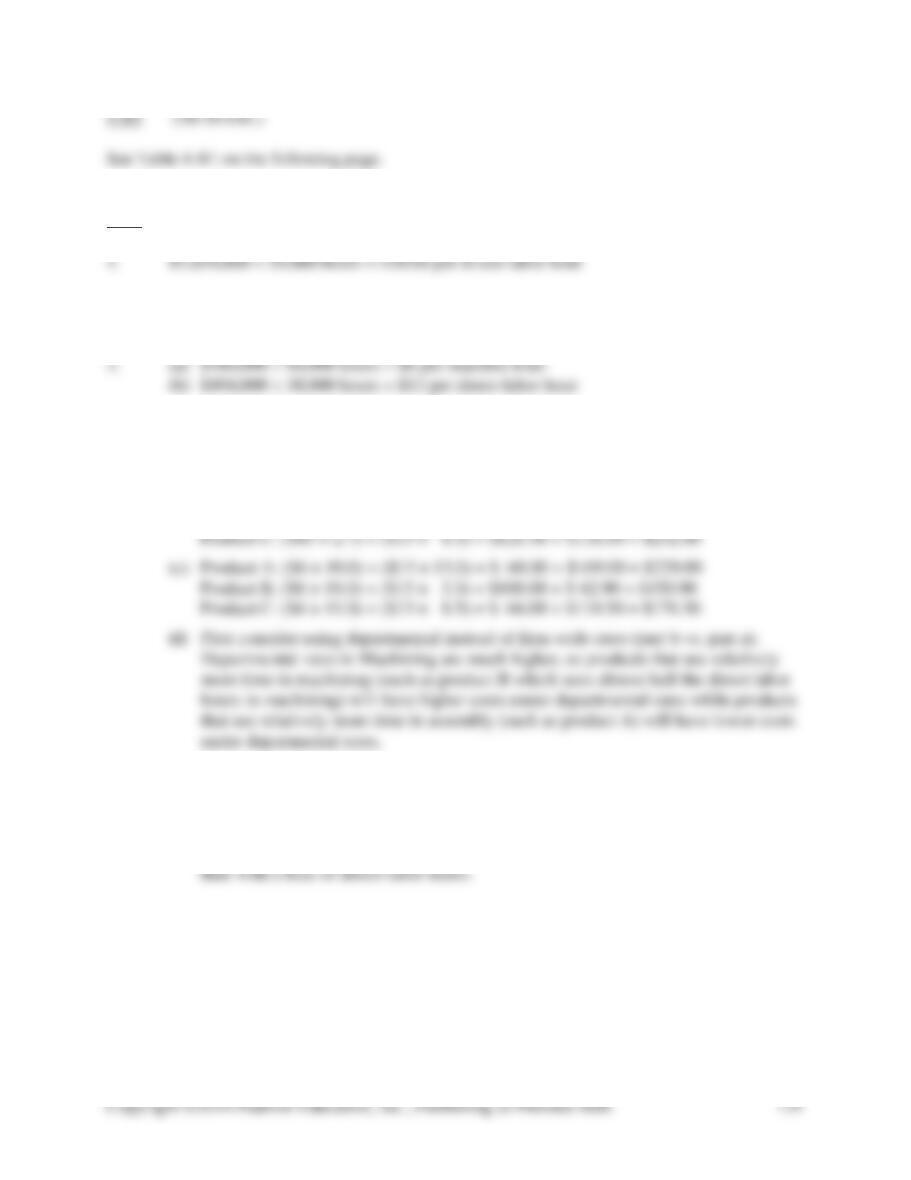
2. (a) $540,000 ÷ 12,000 hours = $45 per direct-labor hour
(b) $494,000 ÷ 38,000 hours = $13 per direct-labor hour
4. (a) Product A: $20.68 × (2.5 + 13.0) = $320.54
Product B: $20.68 × (3.0 + 3.3) = $130.28
Product C: $20.68× (2.7 + 8.5) = $231.62
(b) Product A: ($45 × 2.5) + ($13 × 13.0) = $112.50 + $169.00 = $281.50
Product B: ($45 × 3.0) + ($13 × 3.3) = $135.00 + $ 42.90 = $177.90
Now examine changing to a base of machine hours in machining (part c vs. part a).
Product B is the only one with an increase in cost in (c) compared to (a). Why?
Because B uses less direct labor hours than A or C, so it is is allocated less of the
costs on the basis of direct labor hours. But it uses more machine hours than either
A or C. Therefore, it receives relatively more costs with a base of machine hours
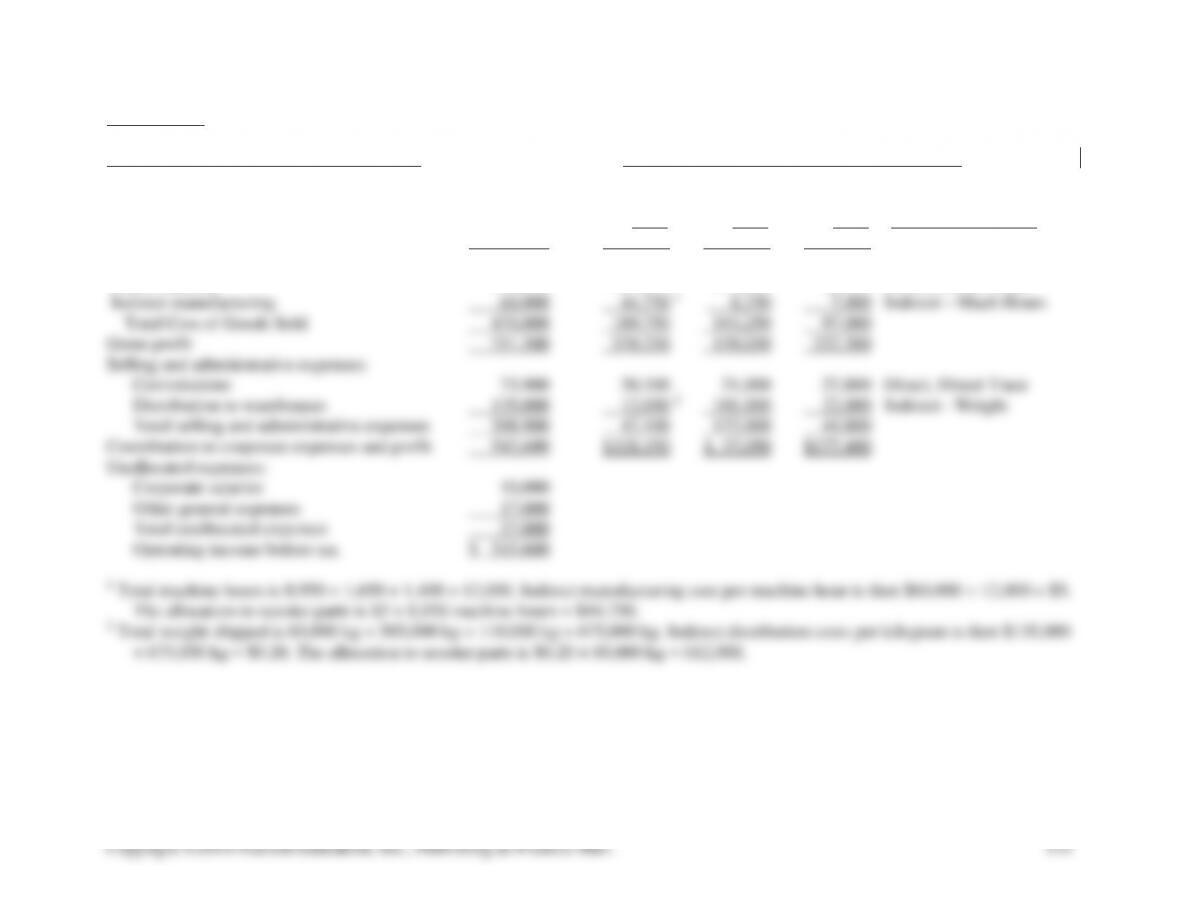
TABLE 4-B1
STATEMENT OF OPERATING INCOME OPERATING INCOME BY PRODUCT LINE
Lawn Hand
Scooter Mower Tool Cost Type,
Parts Parts Parts Assignment Method
Sales $1,221,500 $560,000 $342,300 $319,200
Cost of goods sold:
Direct material 410,000 145,000 175,000 90,000 Direct, Direct Trace
4-B3 (30-35 min.)
1. The existing system allocates all costs based on direct labor cost. The rate for allocating
indirect production costs is:
2. Under an ABC system, Kondo would allocate indirect production costs separately for each
activity. This would result in the following four allocation rates:
Receiving: Receiving costs ÷ Direct material cost
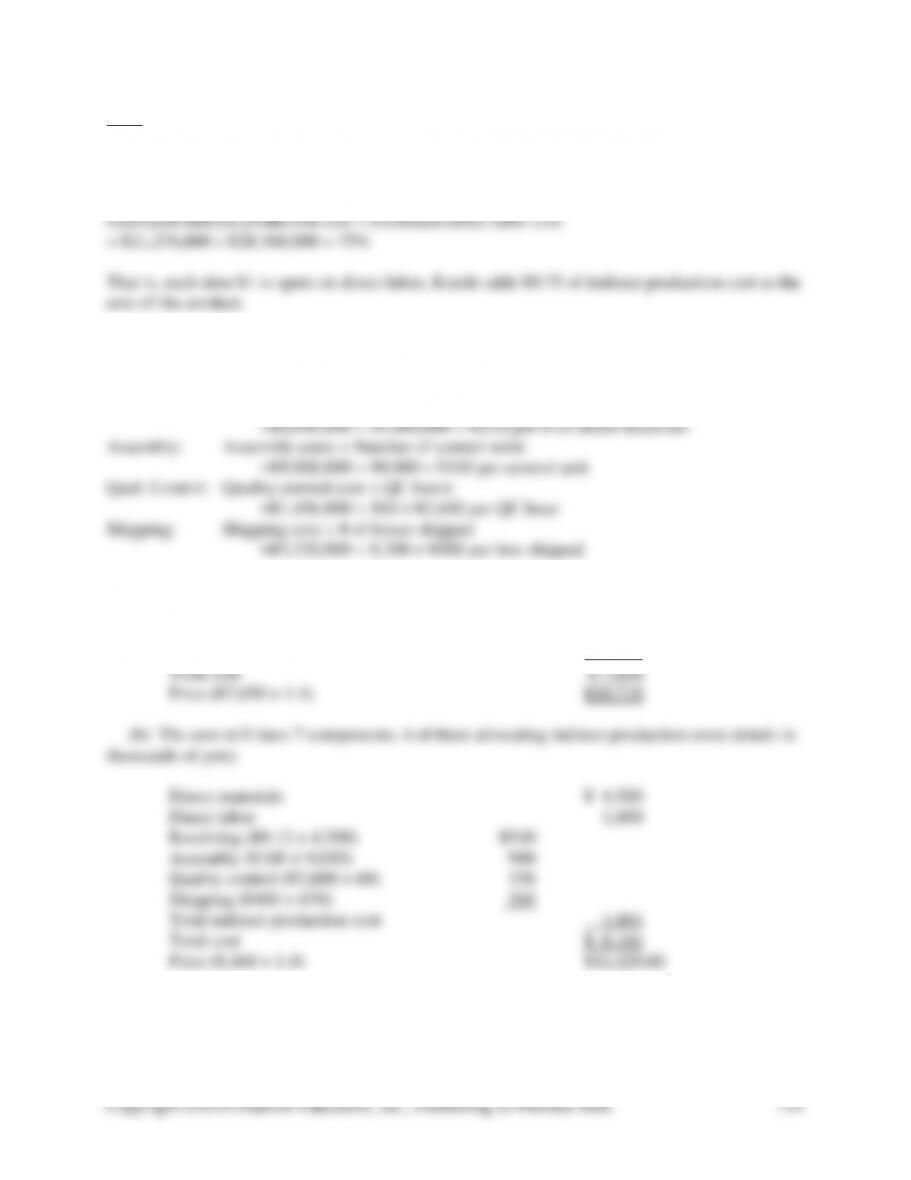
3. (a) The cost will contain 3 components (in thousands of yen):
Direct material ¥ 4,500
Direct labor 1,800
Indirect production cost (¥1,800 × .75) 1,350
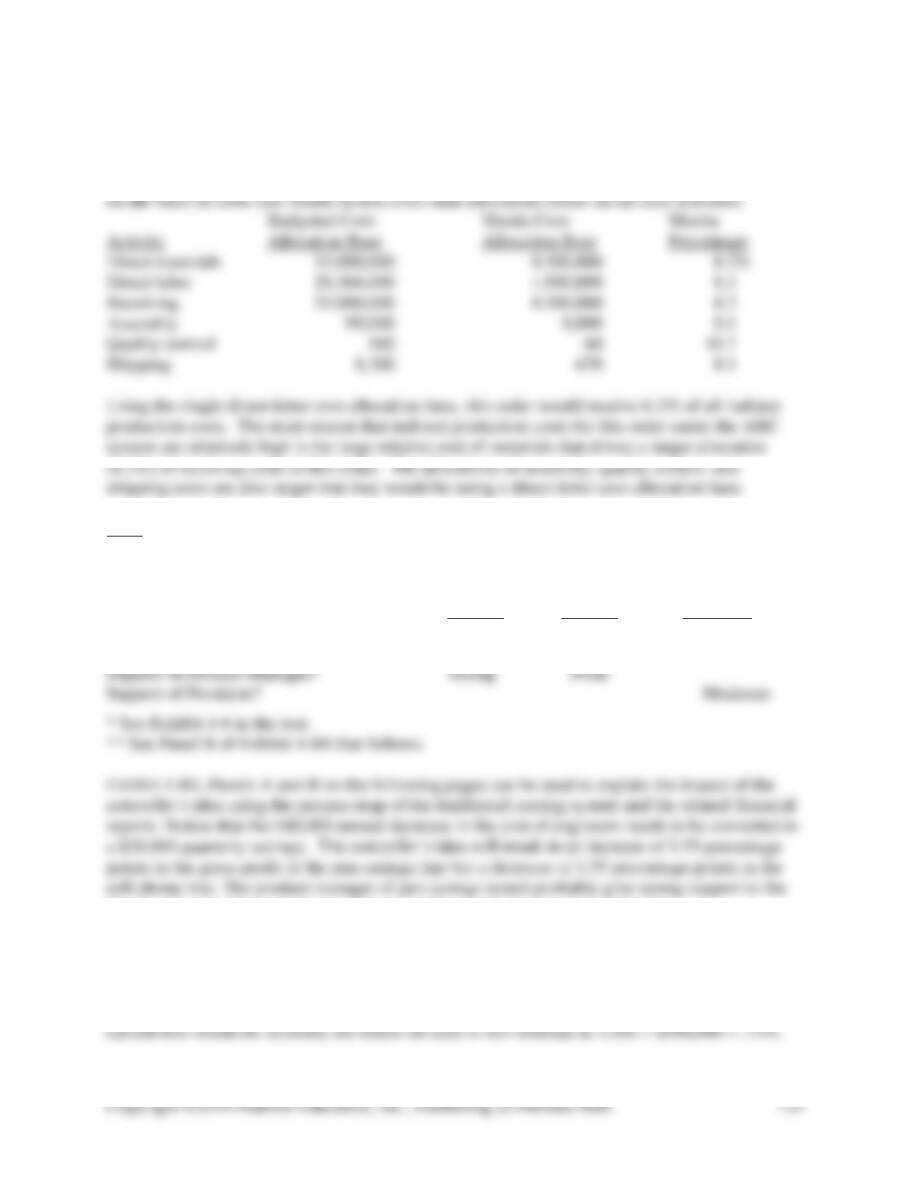
4. The order from Mazda requires a relatively large amount of receiving, quality control, and
shipping resources compared to the relative amount of labor required. This makes its allocated
indirect production costs based on ABC higher than the allocated cost in the traditional system
where the allocation is based on the labor required. The following illustrates why an allocation
4-B4 (50-60 min.)
1. A summary of the analyses follows.
Pen Cell-Phone
Casings Casings Company
Base Gross Profit Percentage* 1.25% 38.75% 8.07%
Plan Gross Profit Percentage** 10.80% 37.20% 17.40%
idea but the cell-phone casings manager would most likely not support the idea.
Although the company-level gross profit margin improves, the president’s support may not be
strong. Why? There is not a strong consensus among product-line managers. Top management is
normally hesitant to support actions that do not have the unanimous support among product-line
managers unless there is solid evidence of material improvement in profitability. While the
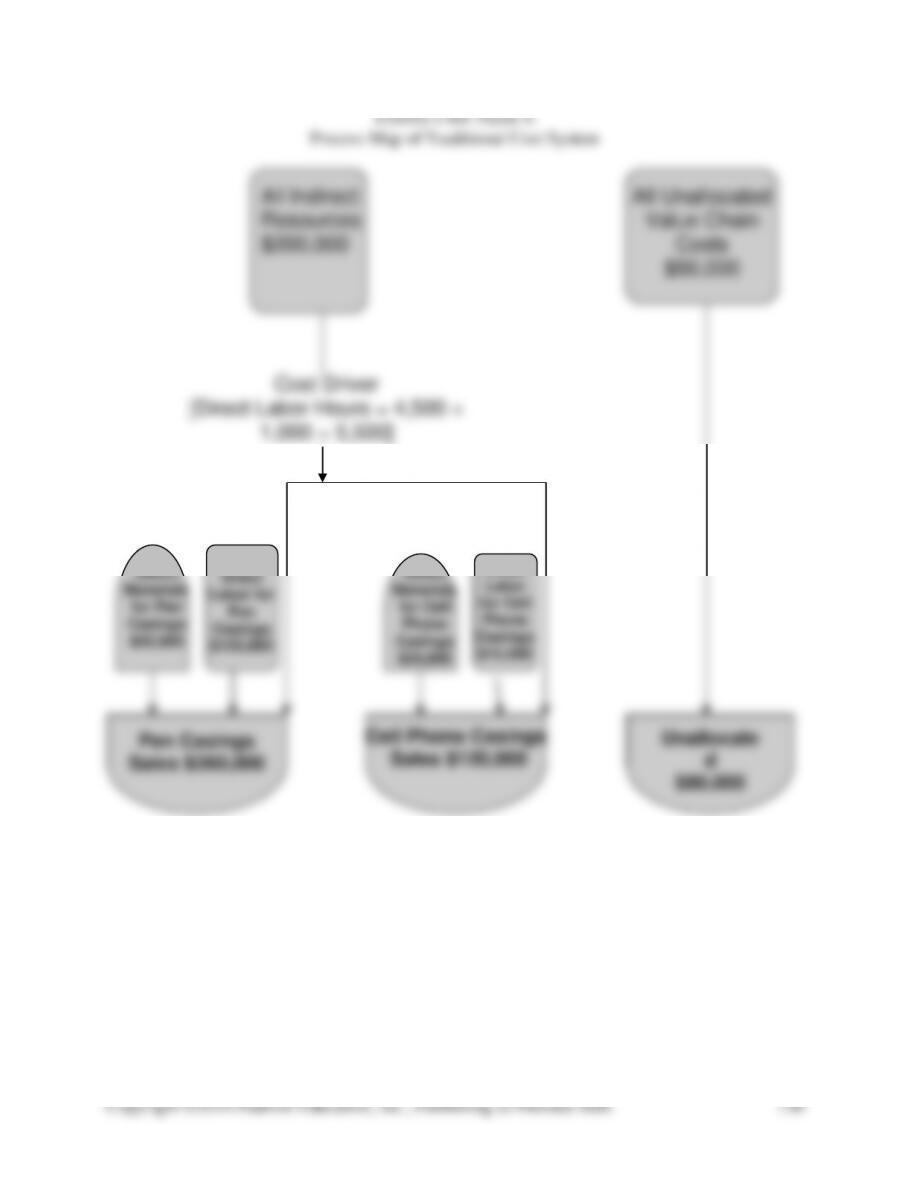
Exhibit 4-B4: Panel A
Process Map of Traditional Cost System
Unallocate
d
$80,000
Direct
Materials
for Pen
Casings
$22,500
Direct
Labor for
Pen
Casings
$135,000
Direct
Materials
for Cell
Phone
Casings
$24,000
Direct
Labor
for Cell
Phone
Casings
$15,000
Pen Casings
Sales $360,000
Cell Phone Casings
Sales $120,000
All Indirect
Resources
$200,000
All Unallocated
Value Chain
Costs
$80,000
Cost Driver
[Direct Labor Hours = 4,500 +
1,000 = 5,500]
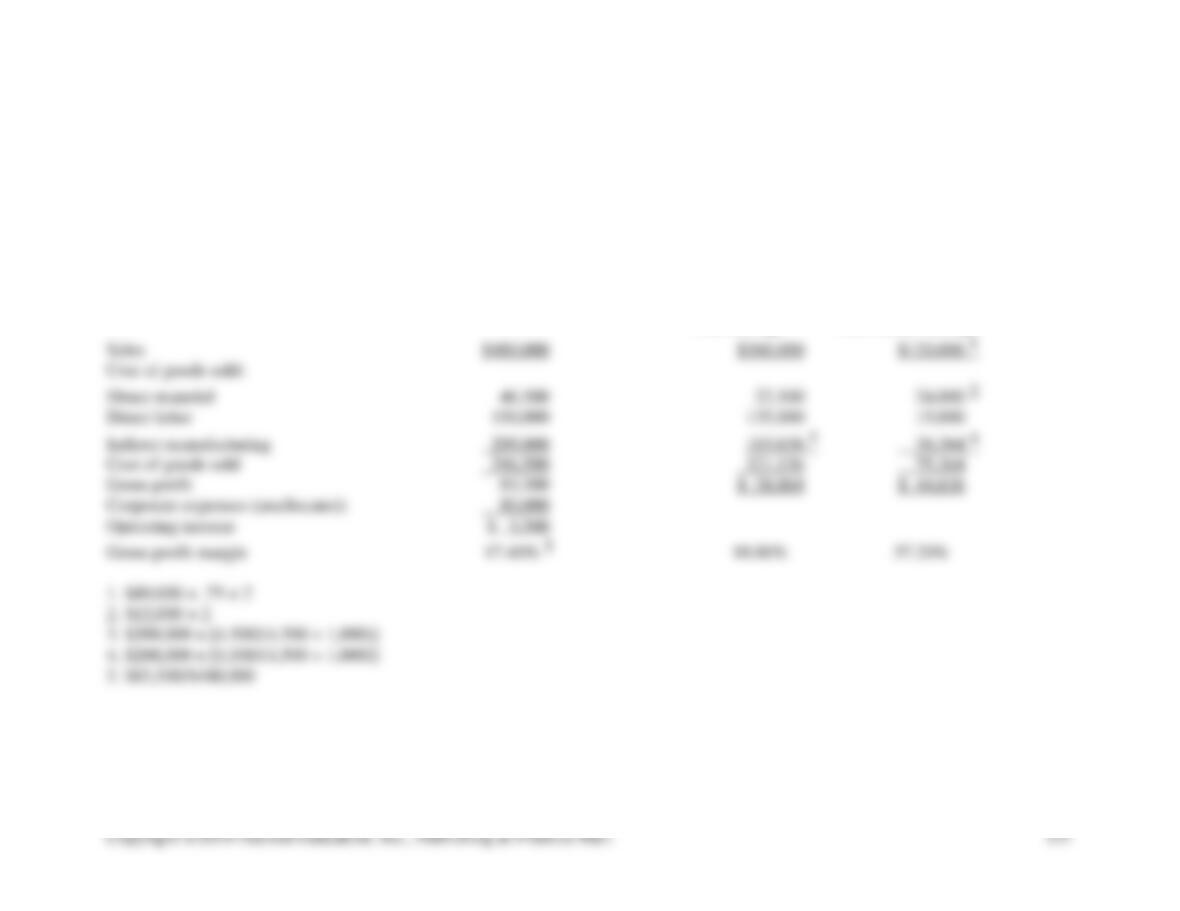
Exhibit 4-B4: Panel B
PRO-FORMA FINANCIAL REPORTS:
TRADITIONAL COST ALLOCATION SYSTEM
STATEMENT OF OPERTING INCOME CONTRIBUTION TO CORPORATE COSTS
AND PROFIT
[EXTERNAL REPORTING PURPOSE] [INTERNAL STRATEGIC DECISION MAKING
AND OPERATIONAL-CONTROL PURPOSE]
Pen Casings Cell Phone Casings
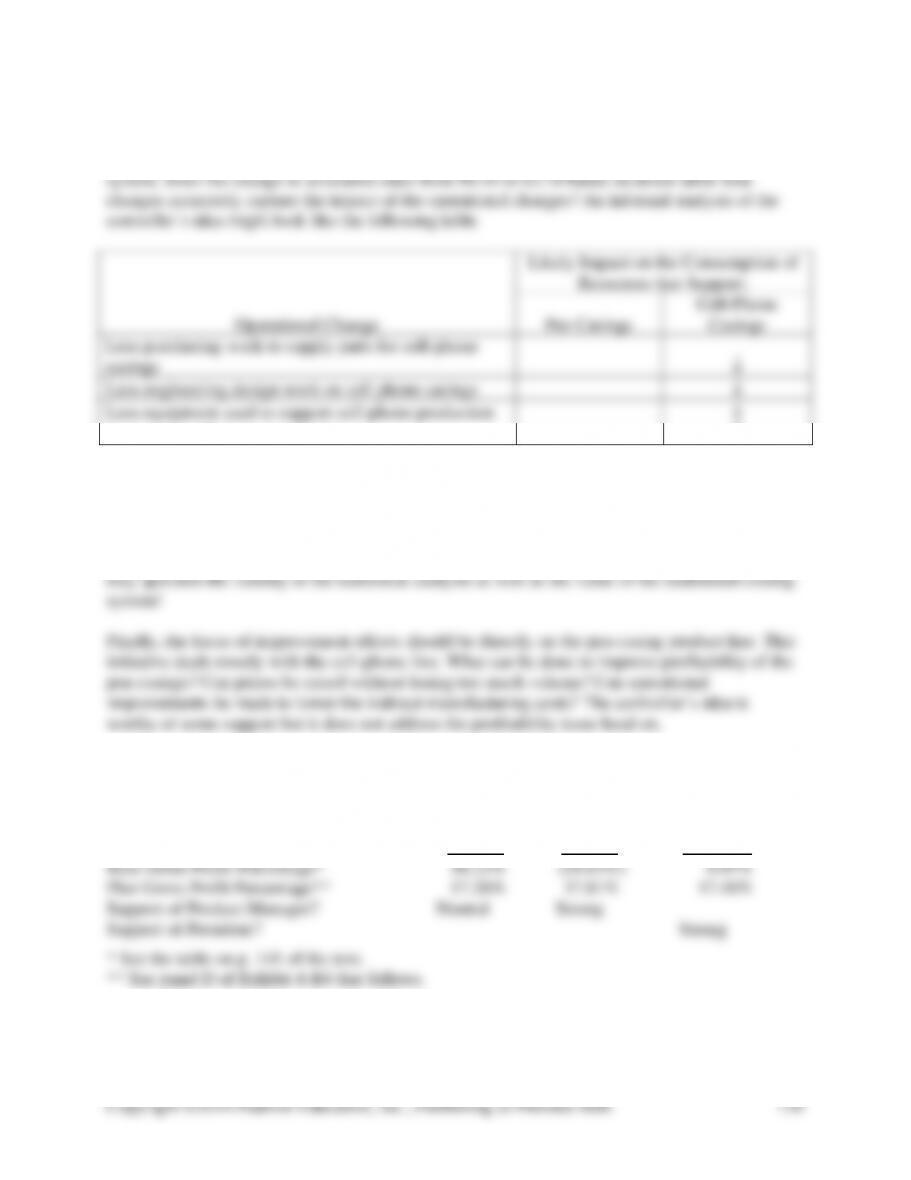
Perhaps the most important factor bearing on the president’s support is lack of confidence in the
accuracy of the cost and hence gross margin figures. She probably will inquire whether the shift
in the consumption percentages by the two activities is captured by the traditional costing
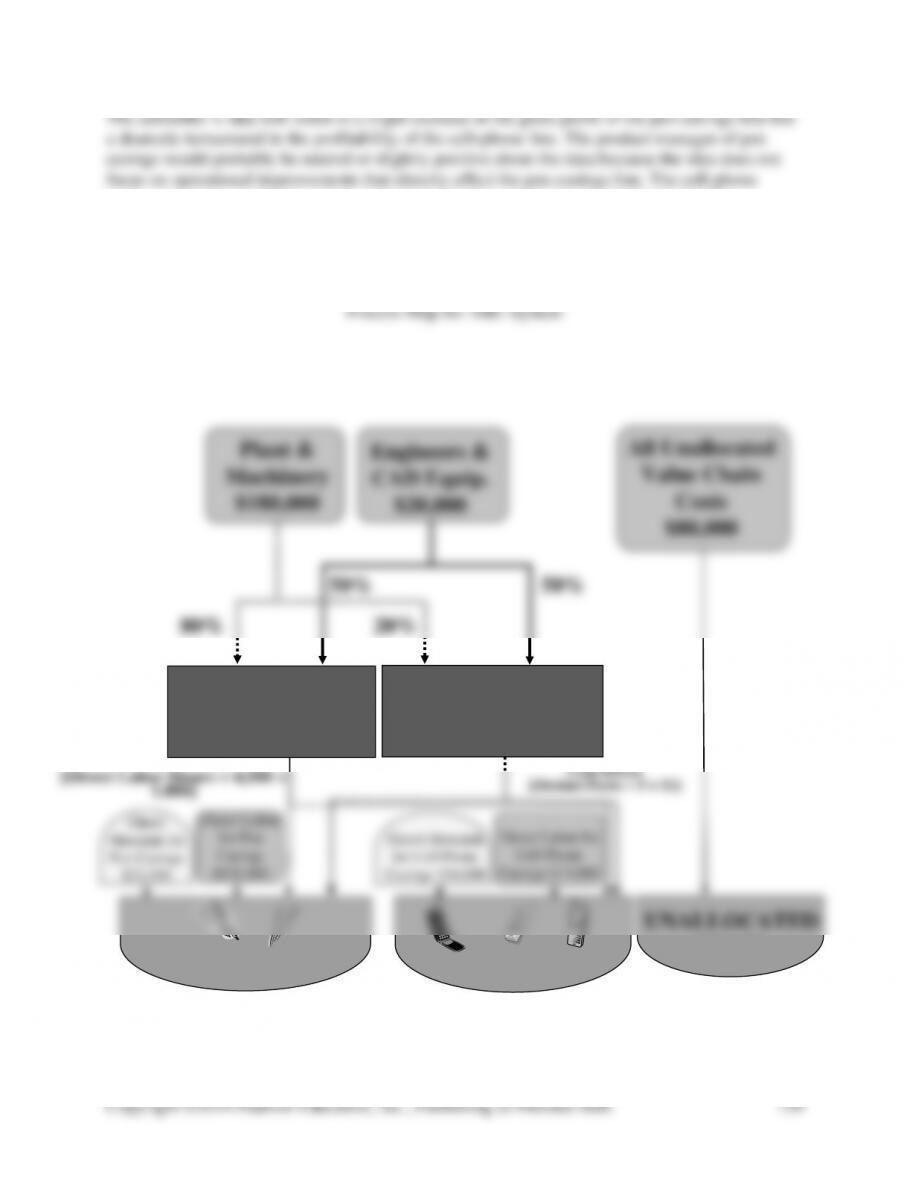
Processing
Activity
$154,000
All Unallocated
Value Chain
Costs
$80,000
Plant &
Machinery
$180,000
Engineers &
CAD Equip.
$20,000
Production
Support Activity
$46,000
50%50%
casings manager would give strong support to the idea – this may save his/her job! The
president would strongly support this idea while encouraging all managers involved to keep up
the good work. Also, note that the numbers agree with the informal analysis – generating
confidence in the integrity of the cost accounting system.
Exhibit 4-B4, Panel C
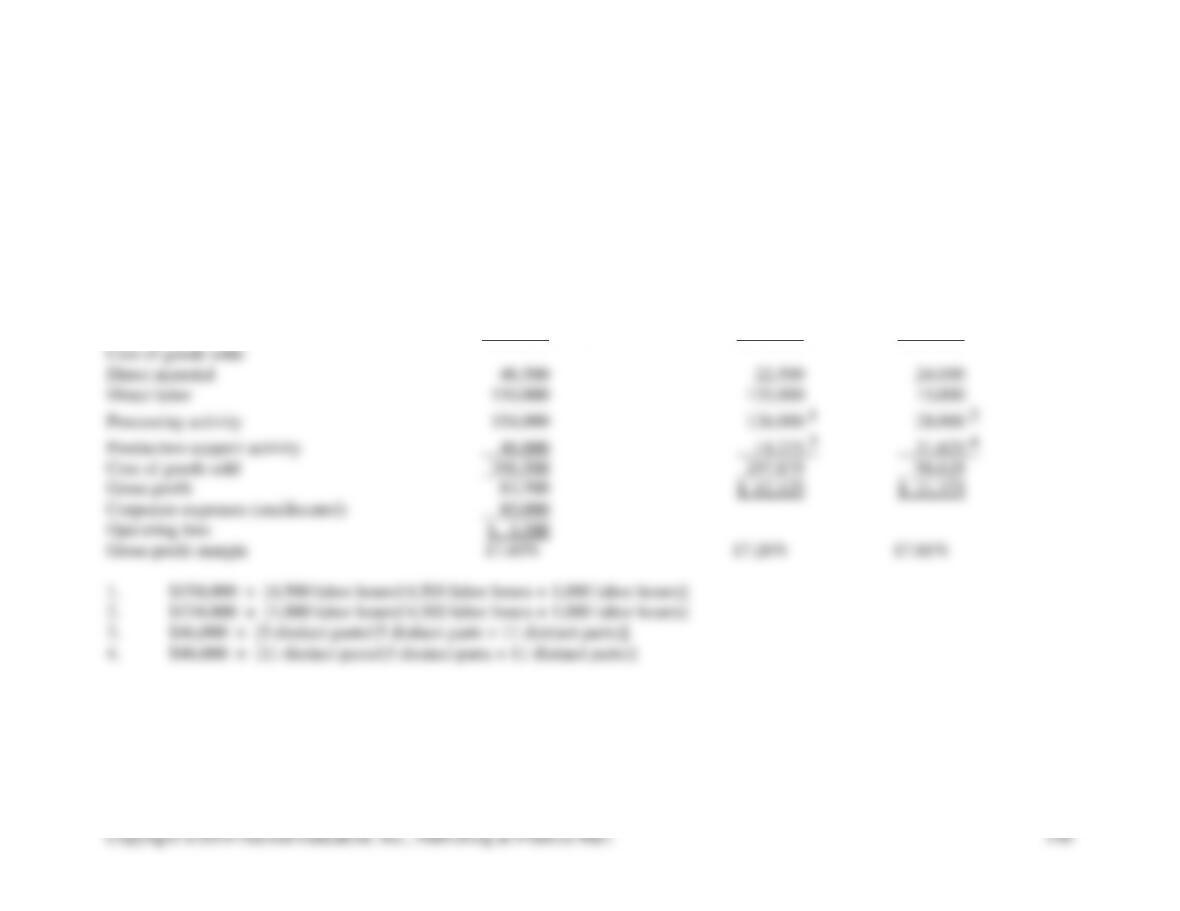
Exhibit 4-B4: Panel D
PRO-FORMA FINANCIAL REPORTS FOR LOPEZ PLASTICS COMPANY:
ACTIVITY-BASED COST ALLOCATION SYSTEM
STATEMENT OF OPERTING INCOME CONTRIBUTION TO CORPORATE COSTS
AND PROFIT
[EXTERNAL REPORTING PURPOSE] [INTERNAL STRATEGIC DECISION MAKING
AND OPERATIONAL-CONTROL PURPOSE]
Pen Casings Cell Phone Casings
Sales $480,000 $360,000 $120,000
3. As vice president, you probably are pleased with the new ABC system. The cost drivers that
are used to allocate activity costs appear to be plausible and reliable and thus probably represent
a sound cause-effect model of operations. This will improve both the accuracy of product costing
and operating managers’ control over costs. Operating managers will be pleased with the ABC
4-1 A cost management system is a collection of tools and techniques that identifies how
management’s decisions affect costs. The three purposes of a CMS are to provide
4-2 a. The production manager needs operational control information.
4-3 Cost objects are any items for which decision makers desire a separate measurement of
4-4 No. Products are one of the main cost objects for most companies, but departments are
4-5 The major purpose of a detailed cost-accounting system is to measure costs for decision
4-6 The two major processes performed by a cost accounting system are cost accumulation
and cost assignment. Cost accumulation is collecting costs by some “natural” classification,
4-7 Managers make important decisions on a daily basis. They base these decisions in large
4-8 Managers can specifically and exclusively identify direct costs with a given cost object
(that is, directly trace them) in an economically feasible way. Indirect costs cannot be so
4-9 Yes, the same cost (for example, the department supervisor’s salary) can be direct with
4-10 Some costs can be physically linked with a department (or a product), but not in an
economically feasible way. An example is the use of departmental meters for measuring power
4-11 The four purposes of cost allocation are (1) to predict the economic effects of strategic
4-12 Generally Accepted Accounting Principles (GAAP) require publically-held companies
4-13 No. The costs in a cost pool are not physically traced to cost objects. Only direct costs
4-15 For financial statement purposes, the typical accounting system allocates only
production costs to the physical units produced. For guiding decisions regarding product-pricing
4-16 Yes. The two criteria that should be met before using any measure as a cost-allocation
base are economic plausibility and reliability. A measure should be plausible – make common
4-17 Production maintenance costs are normally indirect. Sales commissions normally can
4-18 Generally not. They are direct as far as the physical product is concerned, but in
4-19 Depreciation related to production activities is a product cost, not a period cost. Hence,
cost.
4-20 “Expenses” denote all costs deducted from (matched against) revenues in a given period.
4-21 Manufacturing is the transformation of materials into other goods through the use of
labor and factory facilities. In contrast, merchandising companies (retailers or wholesalers) sell
4-22 Direct-labor costs are incurred at the same time the direct labor is used in production.
4-23 The accuracy of any cost system depends on the complexity of operations, the amount
of indirect costs, and the reliability of the cost drivers used to allocate indirect costs. A simple
Copyright ©2014 Pearson Education, Inc., Publishing as Prentice Hall.
144
operation coupled with a well-designed traditional costing system with relatively little indirect
costs and a reliable cost driver as the cost-allocation base can be just as accurate in providing
product or customer costs as a sophisticated ABC system. However, such business environments
rarely exist. Further, traditional costing systems do little to aid the operational control purpose of
cost-management because they do not accumulate or report operational information about key
business activities.
4-24 Activity-based management is using activity-based cost information to improve the
operations of an organization. Managers use ABC information for decision making, planning,
4-25 One of the most significant non-value-added activities in any manufacturing company is
moving inventory, materials, and parts from one point to another during the production process.
4-26 Managers seek to eliminate, or at least reduce as much as possible, non-value-added
4-27 Benchmarking is the continuous process of comparing products, services, and activities
4-28 No two businesses operate in the same manner, and often their competitive
environments are significantly different. As a result, comparing either financial or operational
4-29 Six factors that explain why more and more organizations are adopting activity-based
costing systems are:
1. Fierce competitive pressure has resulted in shrinking margins, making accurate cost
2. Business complexity has increased, resulting in greater diversity in the types of products
3. New production techniques have increased the indirect proportion of total costs — that is,
4. The rapid pace of technology change has shortened product life cycles. This means that
5. The costs associated with bad decisions that result from inaccurate cost determinations
4-30 The four steps are:
Step 2. Determine the relationships among cost object, activities, and resources.
Step 4. Calculate and interpret the new activity-based cost information.
4-31 Whenever a resource is constraining the capacity to meet demand, a company can take
one or more of the following actions:
a. Reduce demand for the resource. In this case, this means either saying “no” to the