3-49 (35-50 min.)
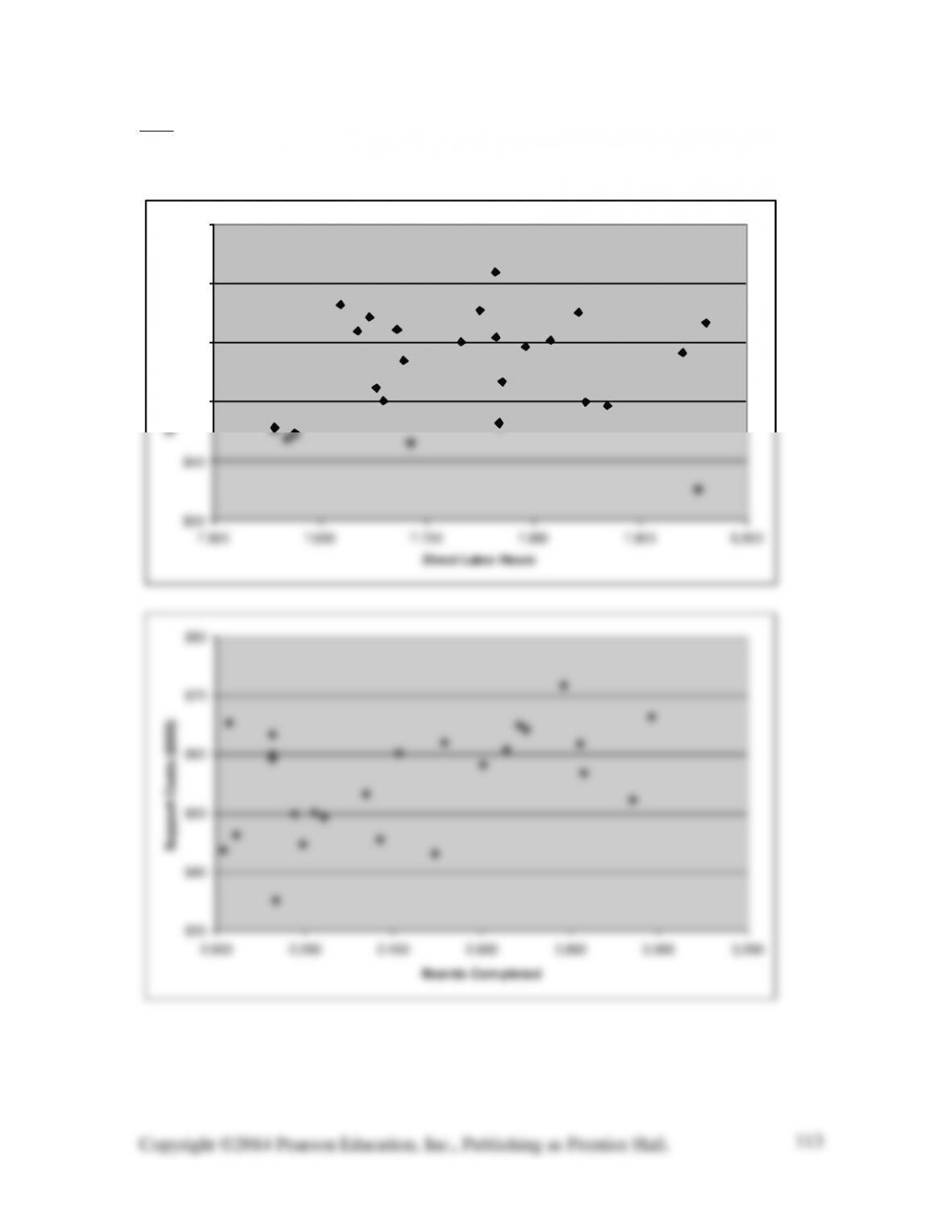
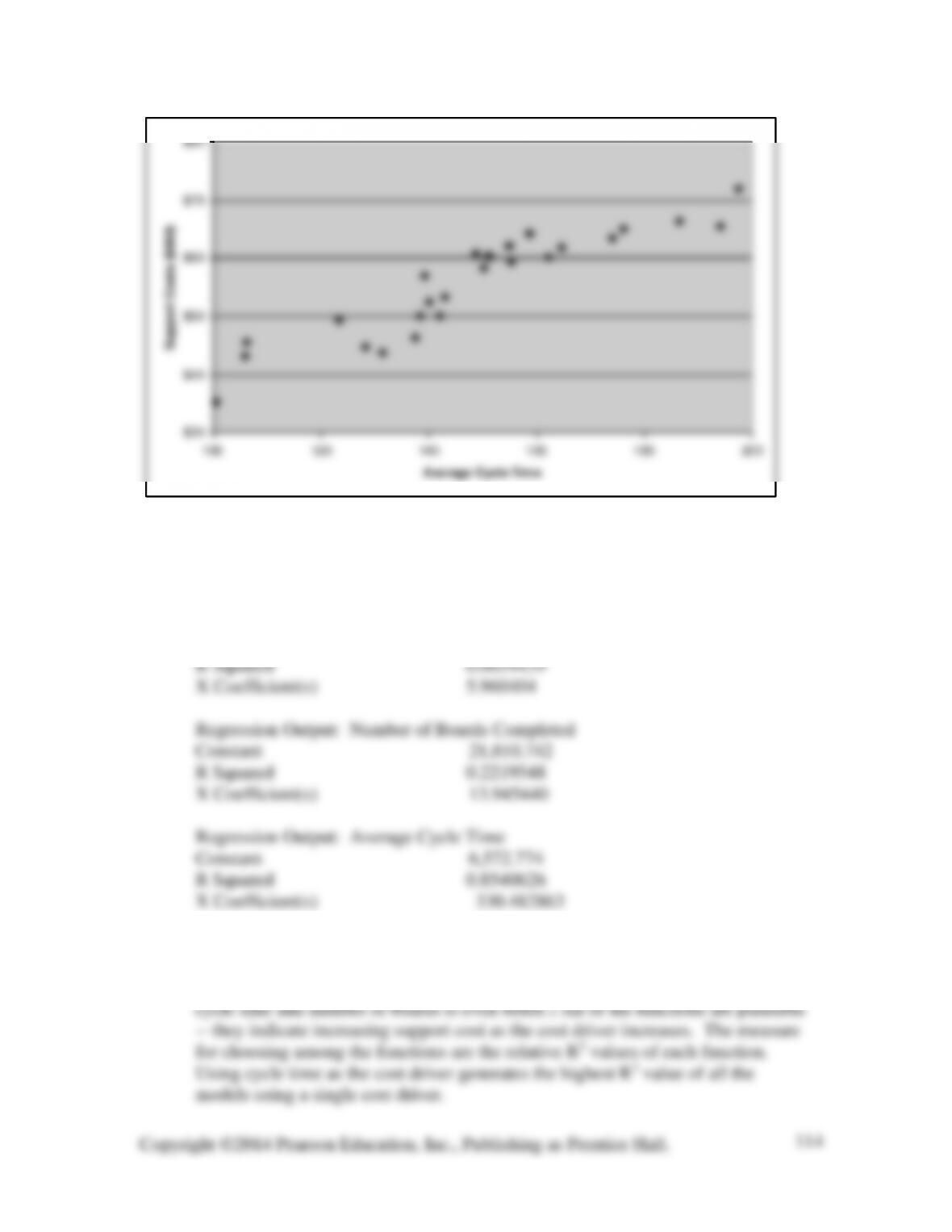
1. The three graphs are as follows:
$30
$40
$50
$60
$70
$80
7,500 7,600 7,700 7,800 7,900 8,000
Direct Labor Hours
Support Costs ($000)
$30
$40
$50
$60
$70
$80
2,000 2,200 2,400 2,600 2,800 3,000 3,200
Boards Completed
Support Costs ($000)
$30
$40
$50
$60
$70
$80
100 120 140 160 180 200
Average Cycle Tim e
Support Costs ($000)
2. This output is generated by a spreadsheet. Regressions of circuit board support
costs using the following as cost drivers:
Regression Output: Direct Labor Hours
Constant 9,466.871
3. The most plausible and reliable regression function, identifying the best single
cost driver for American Micro Devices’ circuit board support costs appears to be
the one that uses cycle time as the cost driver. (A multiple regression using both
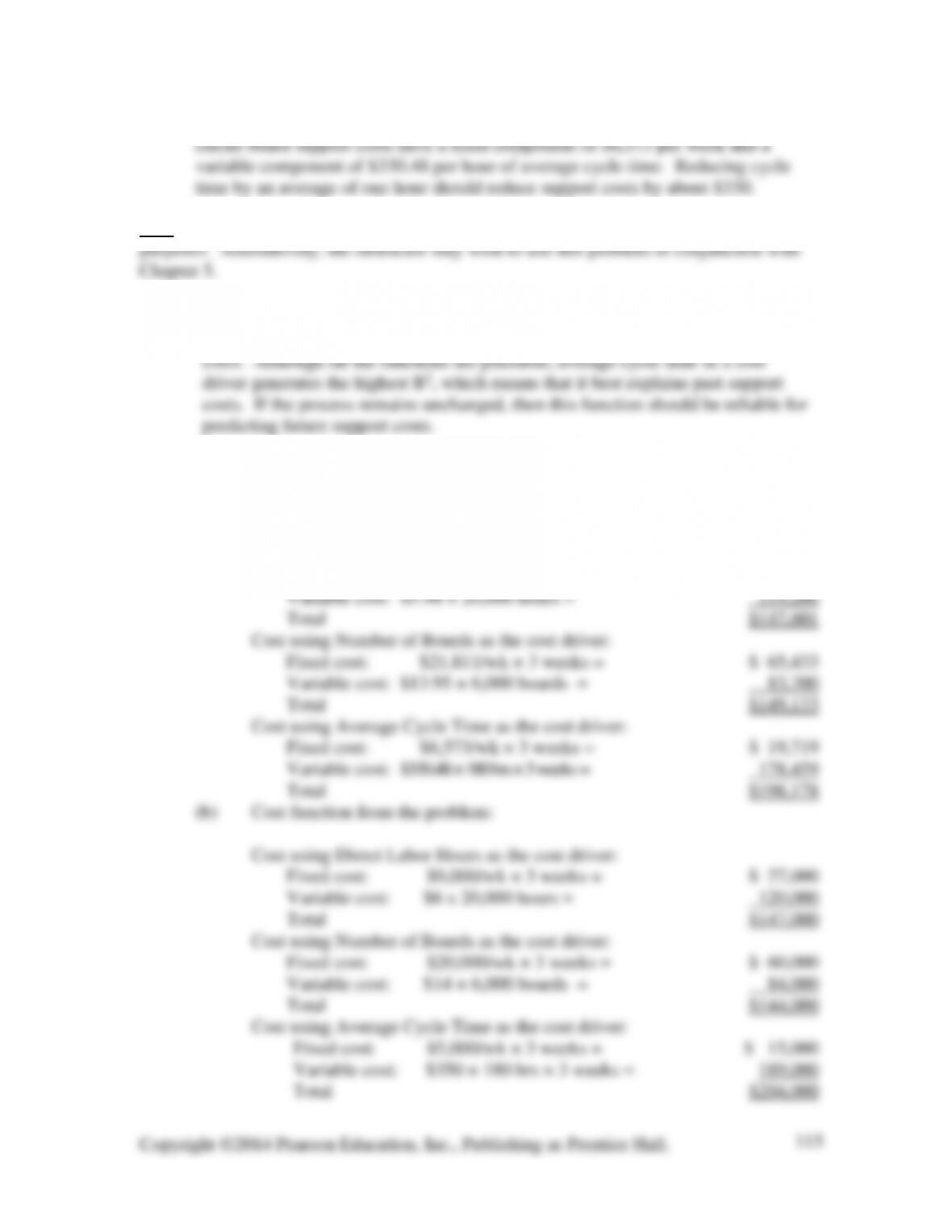
4. The economic meaning of the function using cycle time as the cost driver is that
3-50 (30-35 min.) This problem anticipates the use of cost functions for pricing
1. One would expect that the third cost function, using average cycle time as the
cost driver, would be the most reliable for explaining and predicting support
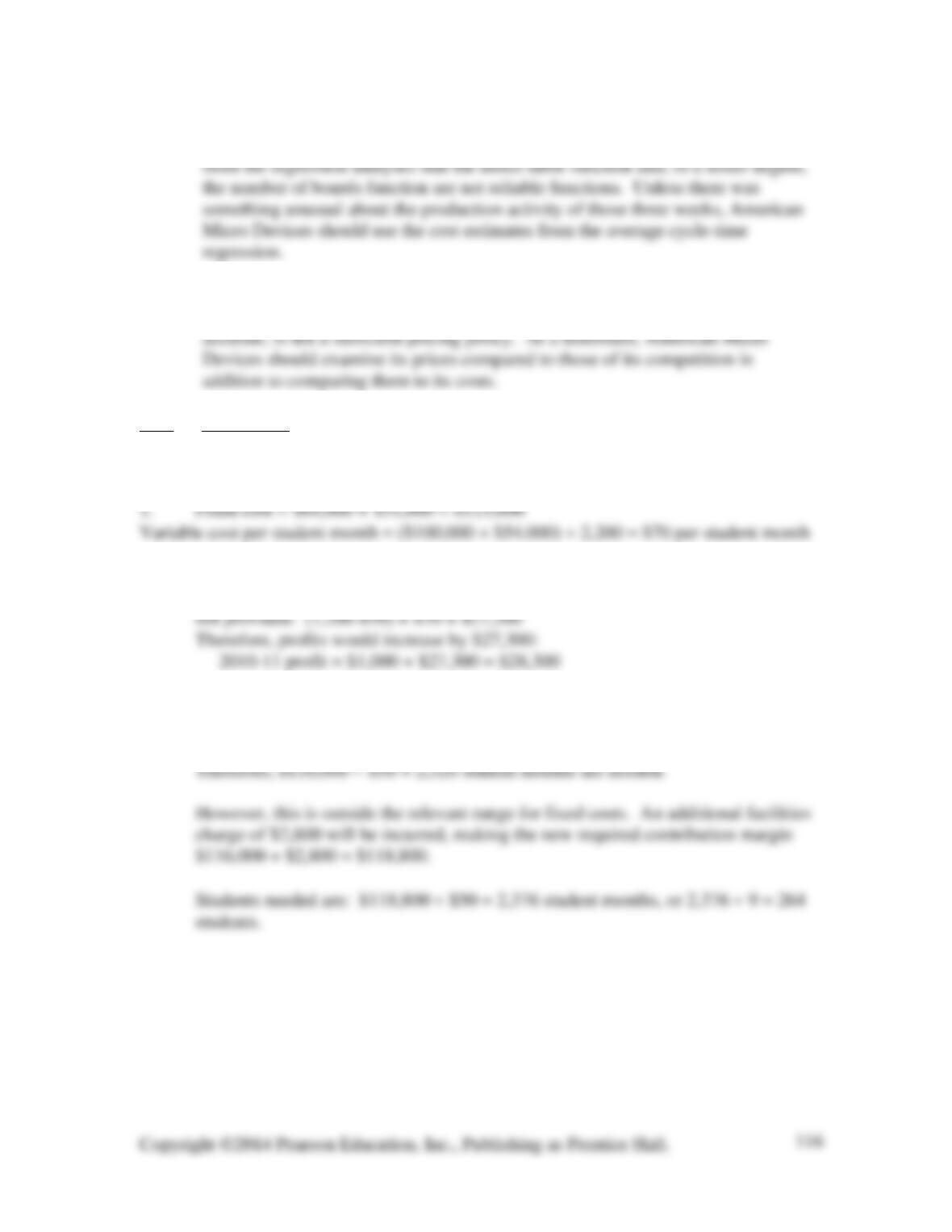
2. The first part of this solution uses the cost function developed in problem 3-49.
The second part uses the cost function given in the problem.
(a) Cost function from 3-49:
Cost using Direct Labor Hours as the cost driver:
Fixed cost: $9,467/wk × 3 weeks = $ 28,401
3. For this three-week period and the particular boards manufactured, the average
cycle-time cost function yields materially different cost predictions. We know
4. In a highly competitive environment, the market influences prices more than
does cost. Therefore, setting prices by marking up costs, even if costs are
3-51 (25-30 min.) This is not a difficult problem, but it forces students to think
through cost and revenue behavior in a situation that differs from those illustrated in the
text.
2. Revenues and fixed costs would not change.
Variable costs would decrease by $70 for each of the students to whom lessons are
3. To make a $1,000 profit, the contribution margin from the students served must
equal the fixed cost plus the profit: $115000 + $1,000 = $116,000.
The contribution margin per student-month is $120 – $70 = $50.
3-52 (30-35 min.)
1. This is only a first pass; obviously Dr. White would be able to specify more
precisely which are committed or discretionary costs. Students will have different
ideas about what is committed and discretionary. The important thing is for them
to be able to explain and justify their classifications.
Program Area Committed Discretionary
2. If all discretionary costs were eliminated, about $94,000 could be saved.
However, some of these “discretionary” cuts may seriously affect the ability of
the health center to deliver its services. There does not seem to be much “fat” in
this budget to begin with, and eliminating such items as transportation for social
burden for Dr. White and the remaining secretarial staff. Cutting these
“discretionary” expenses may be necessary, but they will be painful.
3. Dr. White should prepare for the worst but begin now to build her case for even
higher resources given the past budget cuts and increasing demand for services at
3-53 (45-50 min.) This problem extends the use of activity analysis for control and
1. The number of employees may be an indicator of service department costs in
general. If all users of service departments have roughly the same per capita
usage of services, then using number of employees may be a simple and
reasonably accurate and equitable means of charging for these costs. However,
2. 2008 SS Cost per Employee = 2008 SS Costs ÷ Number of Employees
=$300,000 ÷ 1,721 = $174.32
2008 SS Cost per Report = 2008 SS Costs ÷ Number of Reports
= $300,000 ÷ 1,232 = $243.51
2009 SS Cost per Employee = 2009 SS Costs ÷ Number of Employees
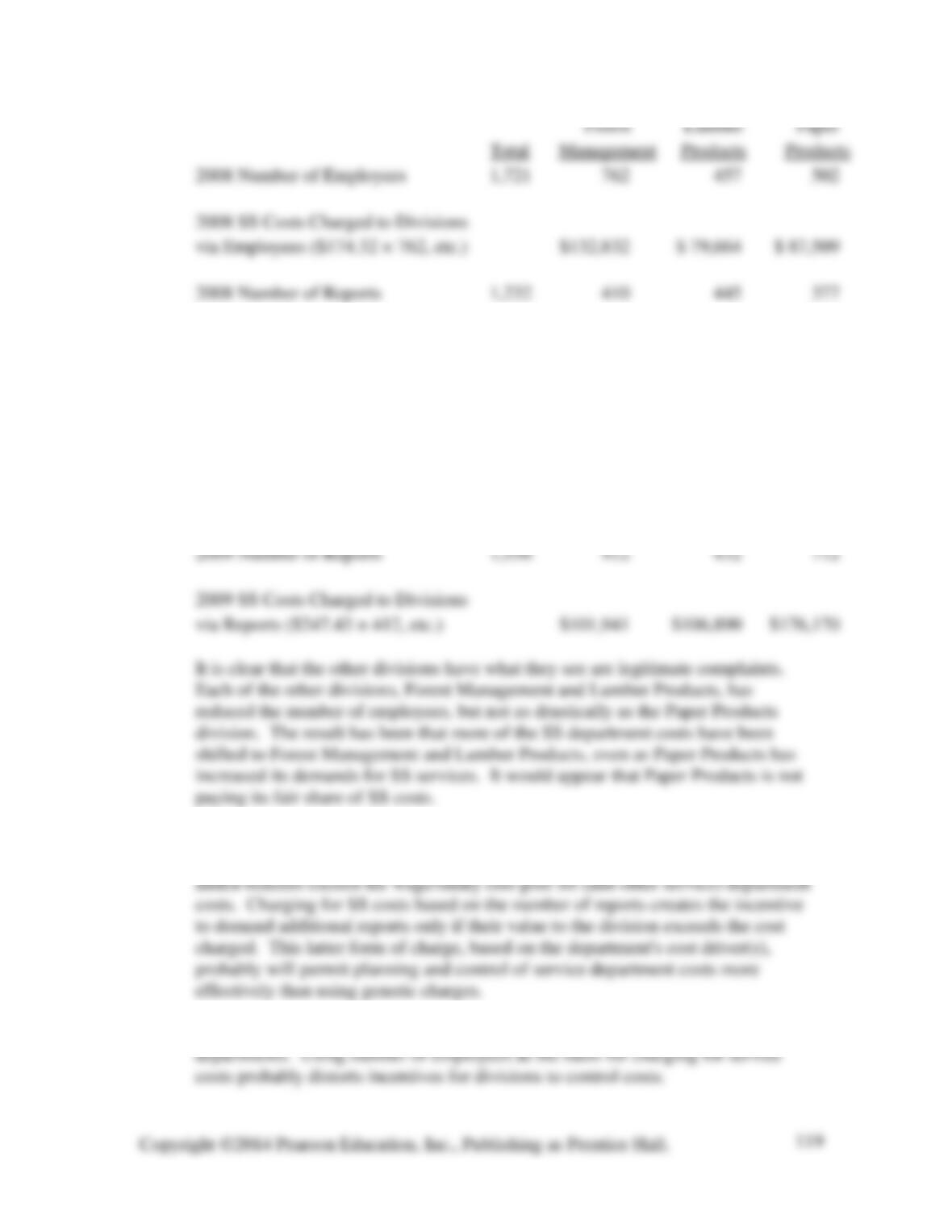
Forest Lumber Paper
Total Management Products Products
2008 Number of Employees 1,721 762 457 502
2008 SS Costs Charged to Divisions
via Employees ($174.32 × 762, etc.) $132,832 $ 79,664 $ 87,509
2008 Number of Reports 1,232 410 445 377
2008 SS Costs Charged to Divisions
via Reports ($243.51 × 410, etc.) $99,839 $108,362 $91,803
2009 Number of Employees 1,295 751 413 131
2009 SS Costs Charged to Divisions
via Employees ($297.30 × 751, etc.) $223,272 $122,785 $38,946
3. Charging for SS department costs on the basis of number of employees creates an
incentive to reduce the number of employees or to add employees only if the
4. It appears that activity analysis should be extended to all of Southeast’s service
3-54 (35-50 min.)
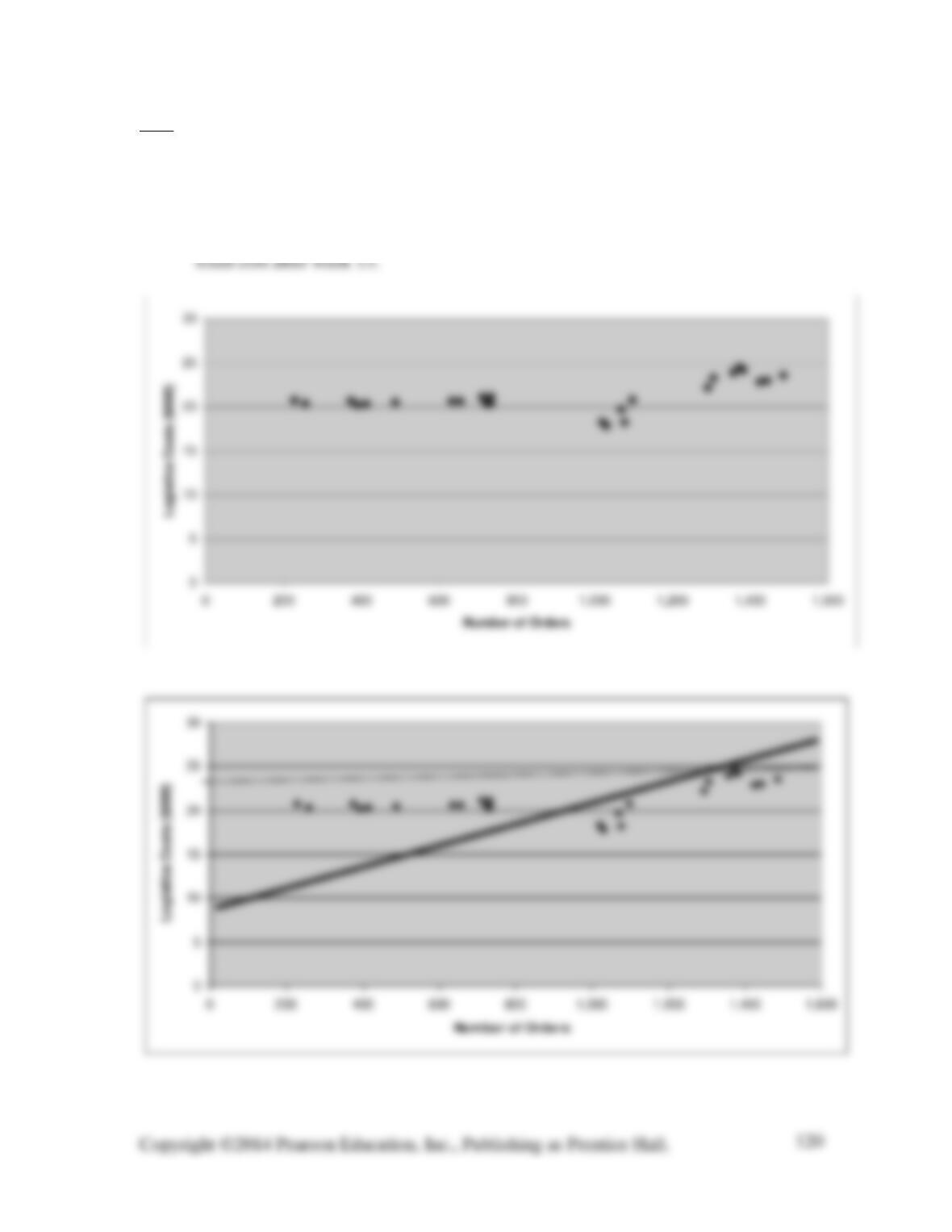
1. See the accompanying graphs. One can see two different cost behaviors that
appear to mirror changes in the cost time series. Matching the cost table and the
graph shows that both the intercept and the slope of the cost function have
changed after week 13 — fixed costs have increased at the same time that variable
costs per order have decreased. In fact, logistics costs seem to be an almost purely
2. The first 13 weeks of data appear to be irrelevant to current cost behavior. Any
3. See the accompanying graph. The data do support Hudson’s expectations: Fixed
costs have increased, and variable costs have decreased. Regression analyses
(though on limited numbers of observations) confirm this.
Regression Output: Weeks 1-13
Constant 5,497.172
3-55 (20-25 min.)
Step Fixed Costs
Mixed Costs
• Depreciation of forklift trucks
• Supervisor salaries per shift: within a
single 8-hour shift the cost of
supervision increases in “chunks” as
sales volume increases
• All regular labor and supervision
salaries when additional 8-hour shifts
are added
• Facilities maintenance
• Lease of equipment based on a base
charge plus a usage charge
• Total salaries of labor that includes
regular (fixed), overtime (variable), and
temporary (variable)
• Total salaries of sales managers that
include a flat amount plus a variable
commission amount
• Telecommunications costs consisting of
a fixed charge per month plus an
additional charge depending on the
number of minutes used
Activity
Plausible Cost Driver
Receiving
• Pallets
Unpacking incoming cases of footwear
• Cases
• Pallets
Picking and packing cases of footwear for shipment to
retail accounts (customers)
• Cases
• Pallets
Processing orders from retail accounts
• Line items
• Orders
Providing customer service to retail accounts
• Orders
• Calls from customers
Processing order changes from retail accounts
• Number of changes
3-56 (20-30 min.) For the solution to this Excel Application Exercise, follow the step-
by-step instructions provided in the textbook chapter.
3-57 (10-30 min.)
The purpose of this exercise is to develop an understanding of different types of
3-58 (40-60 min.) NOTE TO INSTRUCTOR: This solution is based on the web site as
1. For the 2011 One Report, the ten-year summary statistics section is located under
past performance. The information found on the summary report includes
2. The information about revenues is divided into categories – passenger, freight,
and other. The information about operating expenses is listed as one lump sum.
3. RPM is revenue passenger miles and ASM is available seat miles. The available
seat miles is larger. The RPM is found by taking the number of passengers on
each plane and multiplying it by the number of miles that the plane flies for that
4. Using the high-low method for years 2002 and 2005, variable operating costs are
(millions)
Op. Exp. RPM
2005 $6,859 60,223
Fixed op. cost per year = Total operating cost – Variable operating cost
Using 2005: $6,859 – ($0.1131 × 60,223)
= $6,859 – $6,811
= $48
Total operating cost per RPM = 2005 Operating Cost ÷ 2005 RPM
= $6,859 ÷ 60,223 = $0.1139
The total operating cost is almost the same as the variable operating cost, and the
fixed cost is very small. This is not what would generally be expected. Airlines
usually have large fixed costs and small variable costs.
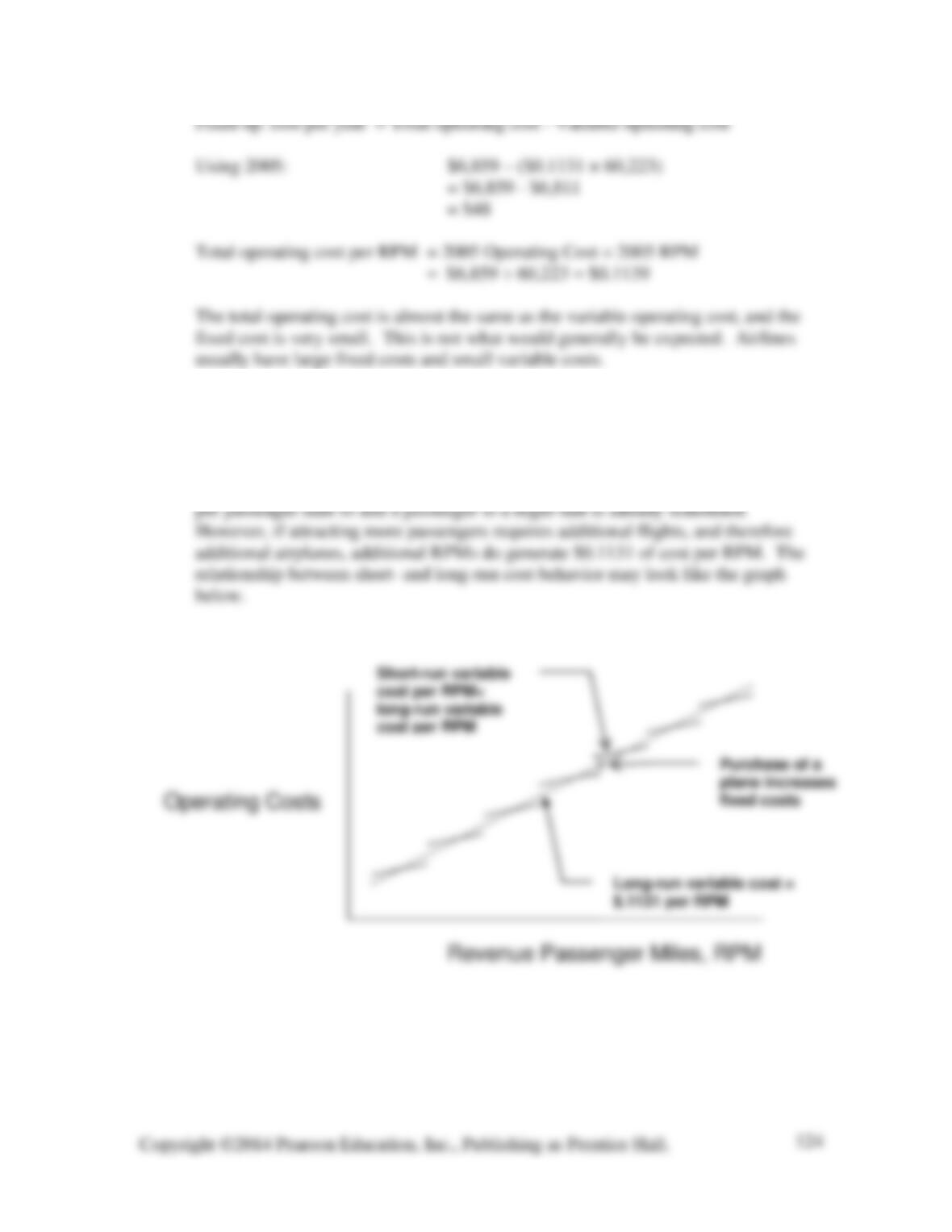
5. As just explained, airlines usually have large fixed costs. In this case the high-
low method is not accurate. The increase in costs between 2002 and 2005 may
have included much investment in airplanes. If this investment in airplanes was
driven by the demand for more RPMs, then it is part of long-run variable costs but
not necessarily part of short-run variable costs. That is, it does not cost $0.1131