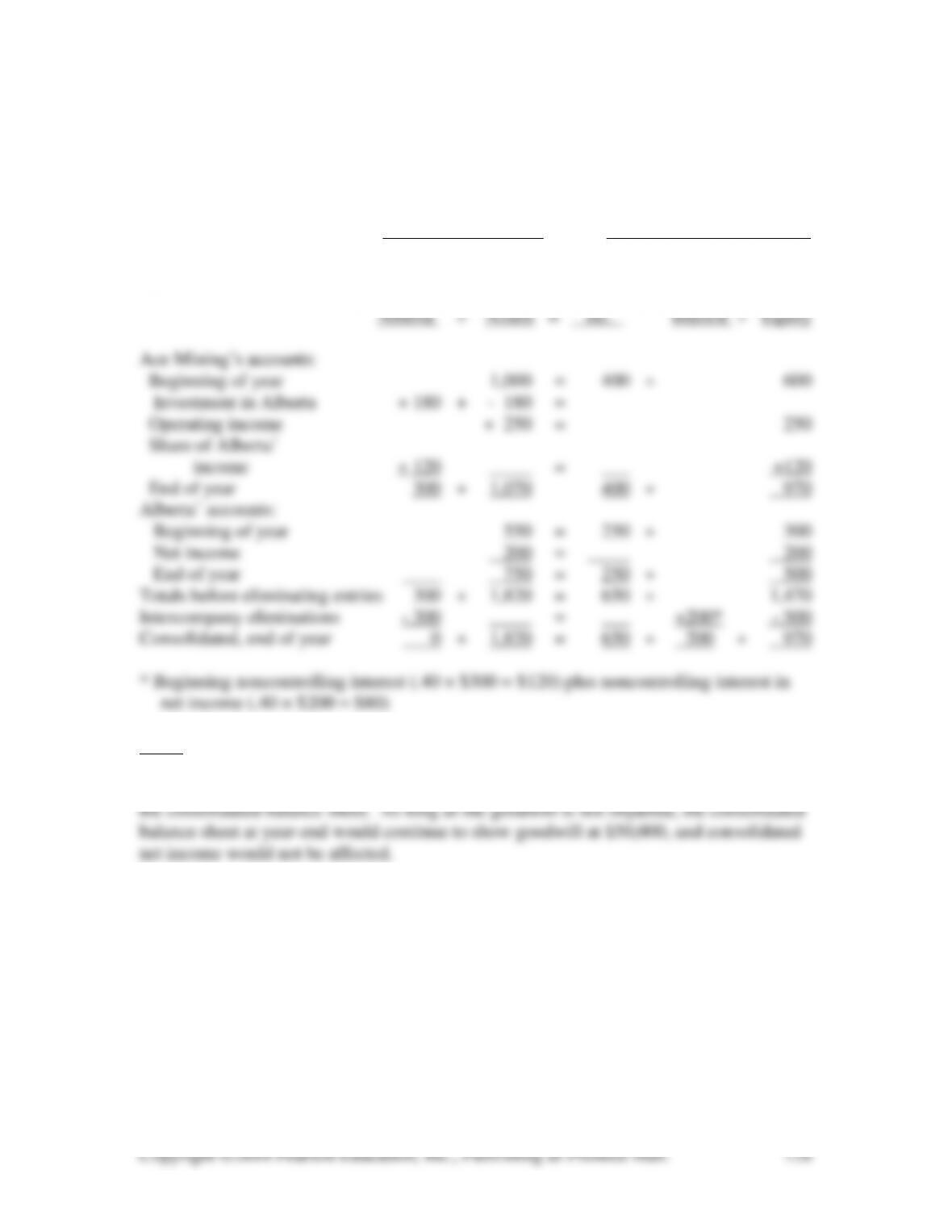
The consolidated balance sheet would be as follows:
Assets = Liab.+Stockholders’ Equity
Invest- Cash
ment and Accounts Noncon- Stock-
in Other Payable, trolling holders’
17-31 (10 min.)
The $50,000 “goodwill” would appear as a separate intangible asset account in
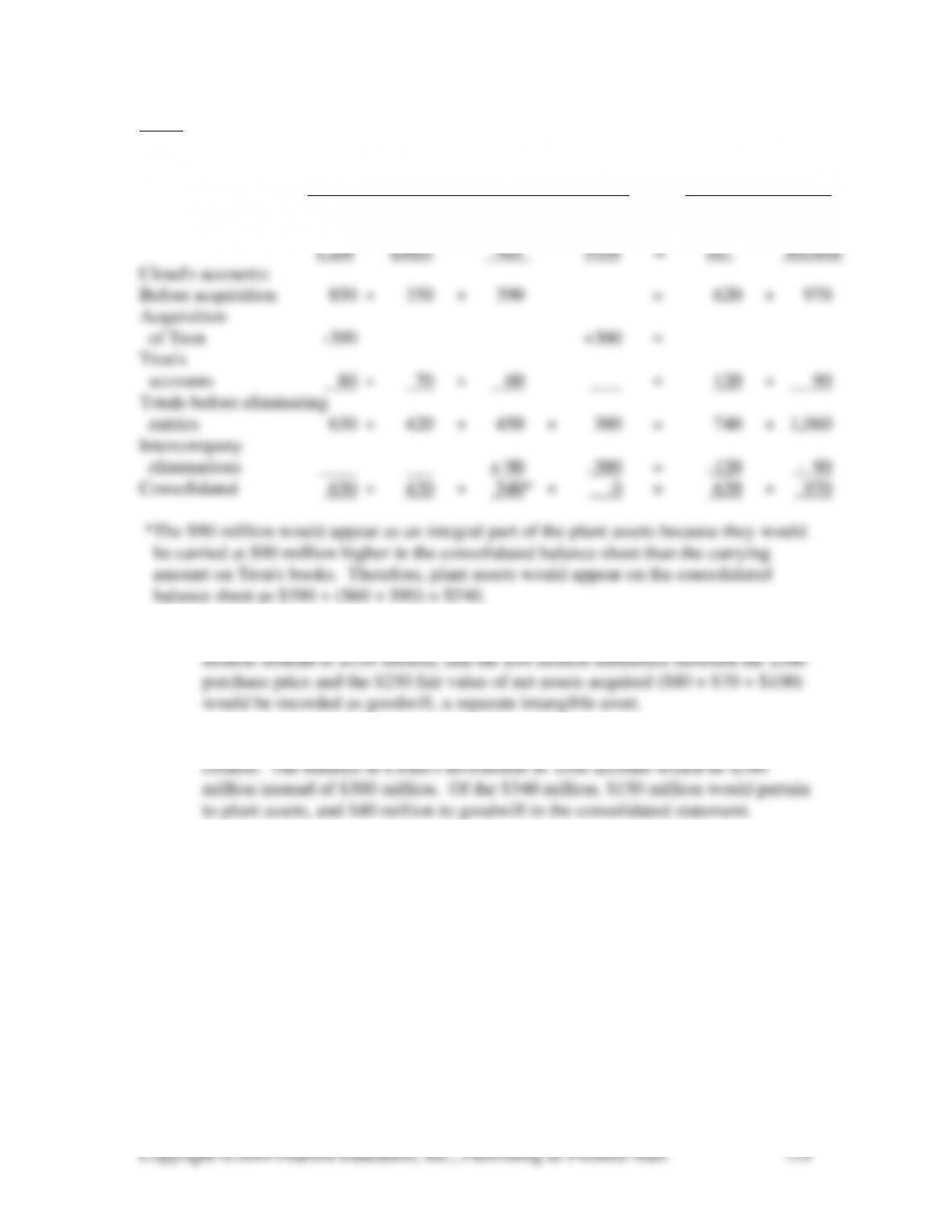
17-32 (20-25 min.) Amounts are in millions of dollars.
1. Stockholders’
Assets = Equity
Plant Invest- Common
Inven- Assets, ment in Stock, Retained
2. The Tron plant assets would be carried in the consolidated balance sheet at $100
3. Cash would be $40 million less, and a goodwill account of $40 million would be
17-33 (10-15 min.)
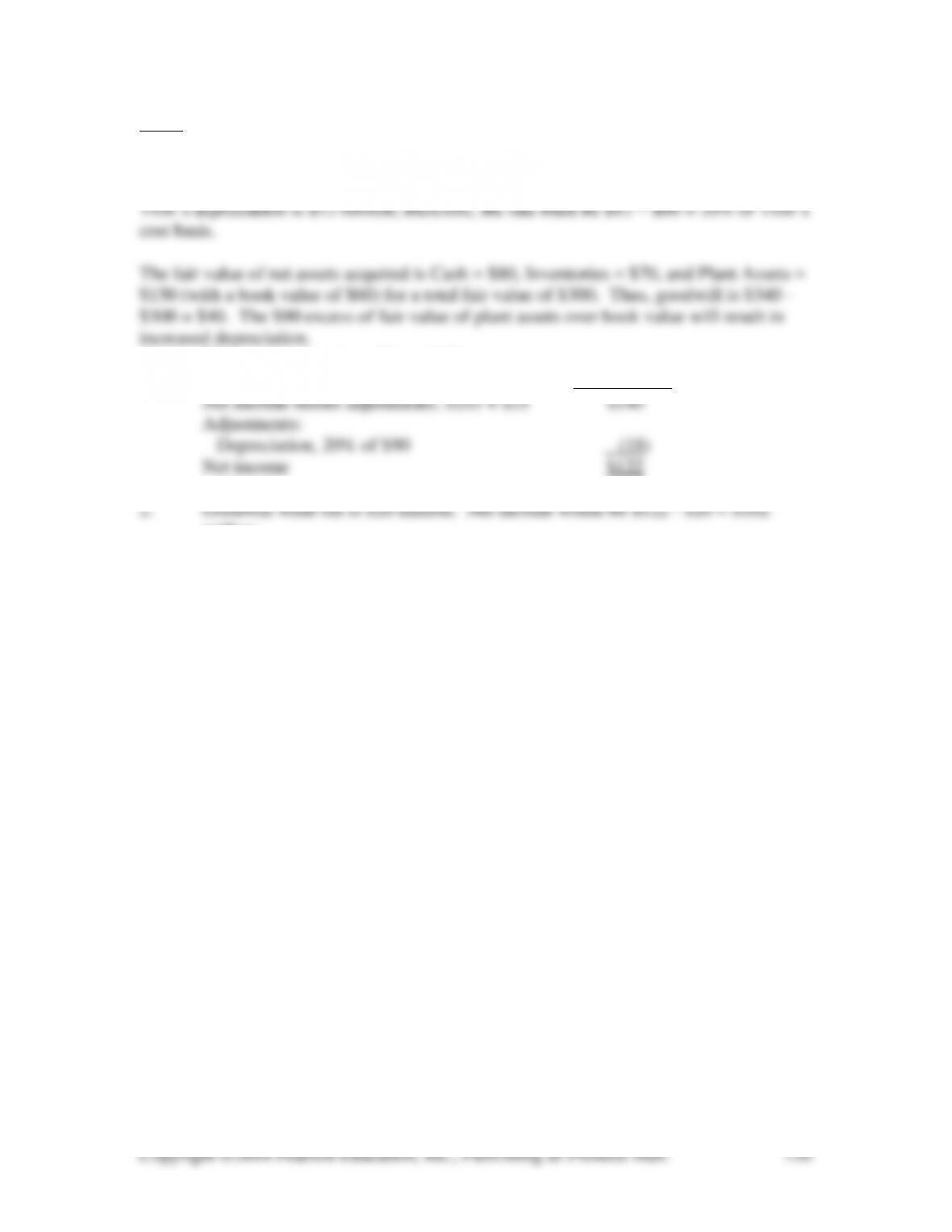
Many students will fail to see that depreciation must be adjusted. The
assumption here is that a 20% rate is appropriate for the year in question. Why? Because
1. The computation (in millions) follows:
Consolidated
million.
17-34 (30 min.)
This problem is based on the actual acquisition of Paramount Pictures by Gulf &
Western.
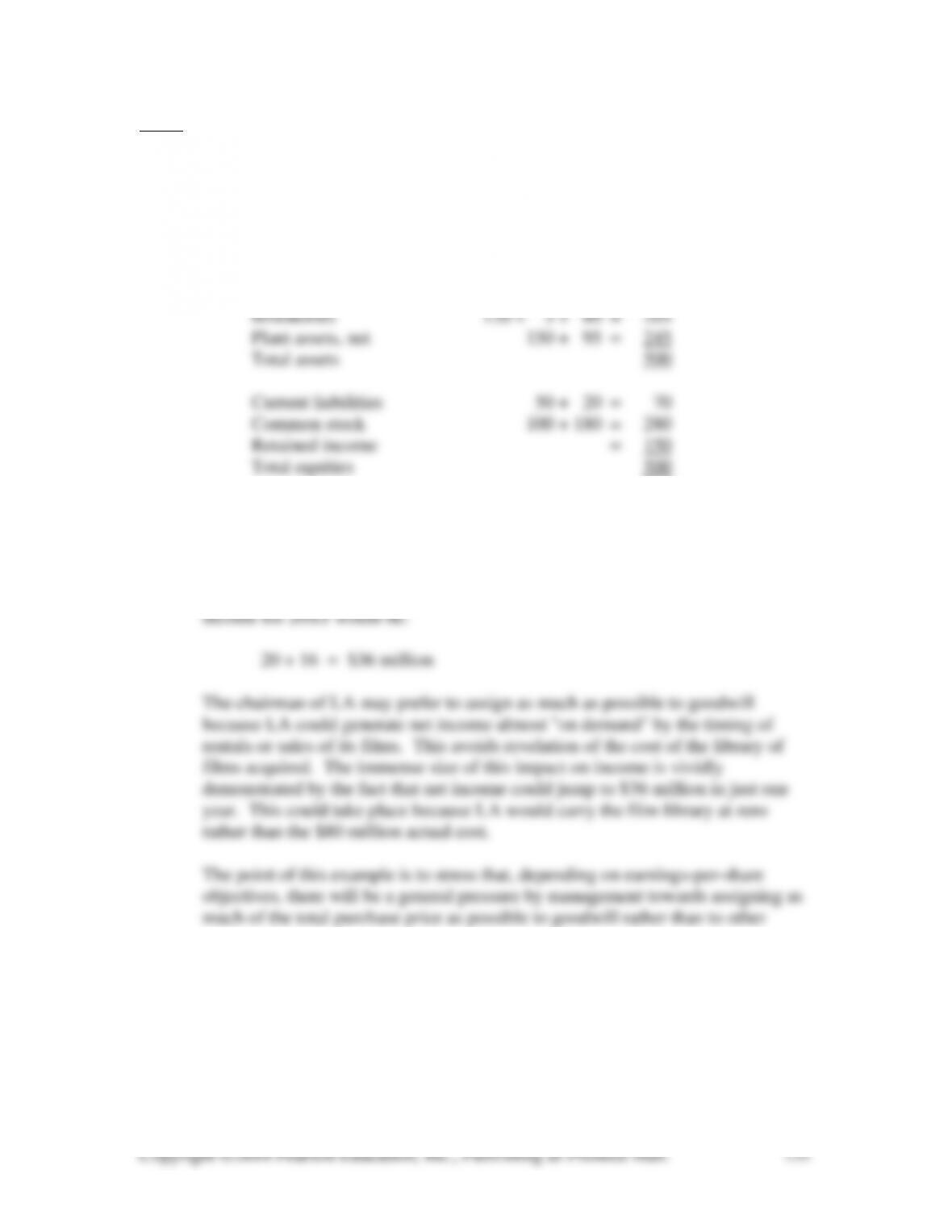
1. The combined company would have the following balance sheet accounts
immediately after the acquisition (in millions of dollars):
Cash and receivables 30 + 22 = 52
2. Net income for 20X0 $19 million
Net income for 20X1:
20 + [16 – (.25 × 80)] $16 million
If the $80 million were assigned to goodwill and no goodwill was written off, net
assets.
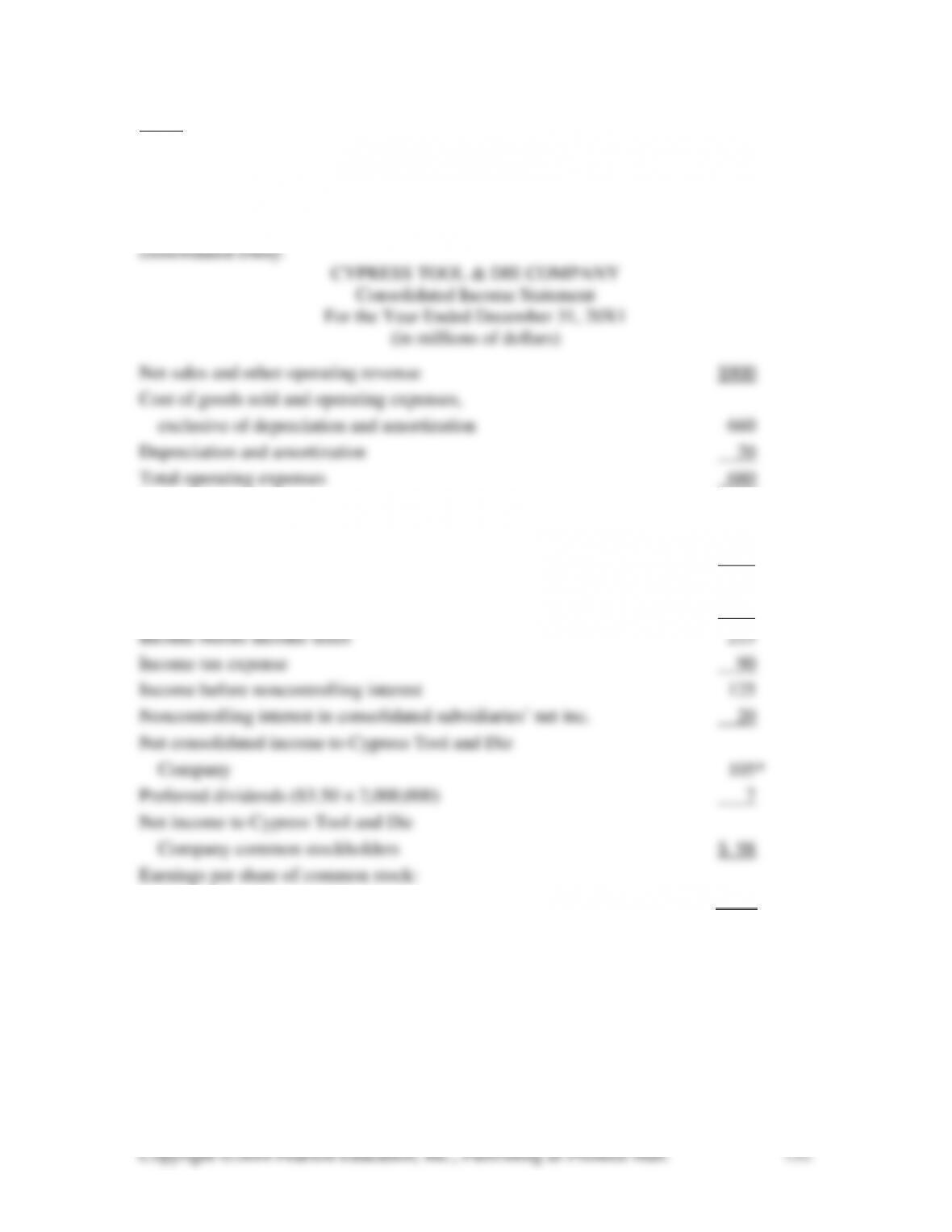
17-35 (50-65 min.)
This is a worthwhile problem because it provides an overall view of
relationships. On balance sheets the noncontrolling interest in subsidiaries is a subpart of
the stockholders’ equity section. On income statements, the noncontrolling interest in
consolidated subsidiaries’ net income is deducted as if it were an expense of the
Operating income before share of
unconsolidated net income 220
Equity in earnings of affiliated companies 20
Total income before interest expense and income taxes 240
Interest expense 25
On shares outstanding (11,000,000 shares) $8.91**
* This is the total figure in dollars that the accountant traditionally labels net income. It
is reported accordingly in the financial press.
** This is the figure most widely quoted by the investment community.
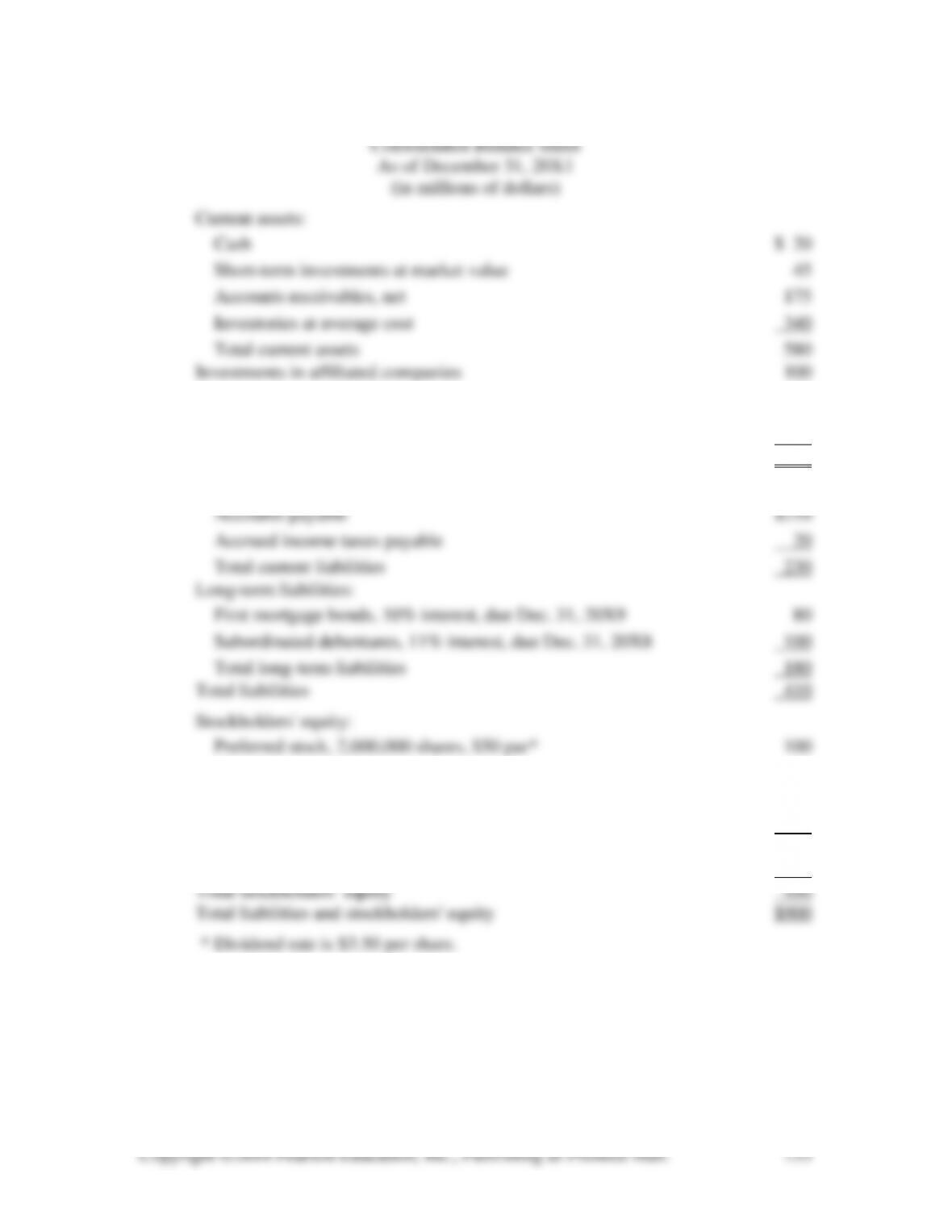
CYPRESS TOOL & DIE COMPANY
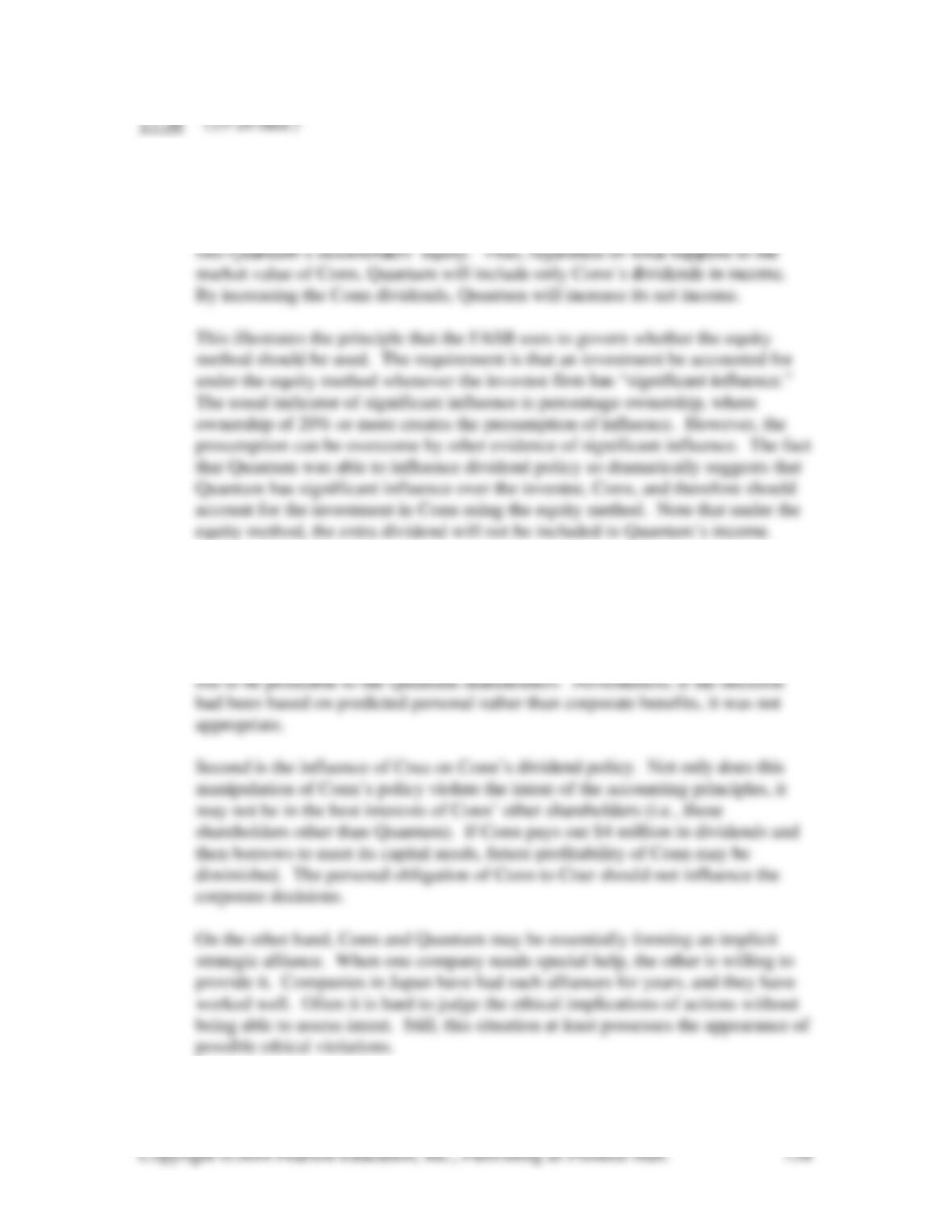
Property, plant, and equipment, net 125
Other assets:
Goodwill 95
Total assets $900
Current liabilities:
Common stock, 11,000,000 shares, $1 par 11
Paid-in capital in excess of par 101
Retained earnings 188
Total stockholders’ equity attributable to Cypress stockholders 400
Noncontrolling interest in subsidiaries 90
Copyright ©2014 Pearson Education, Inc., Publishing as Prentice Hall.
734
17-36 (15-20 min.)
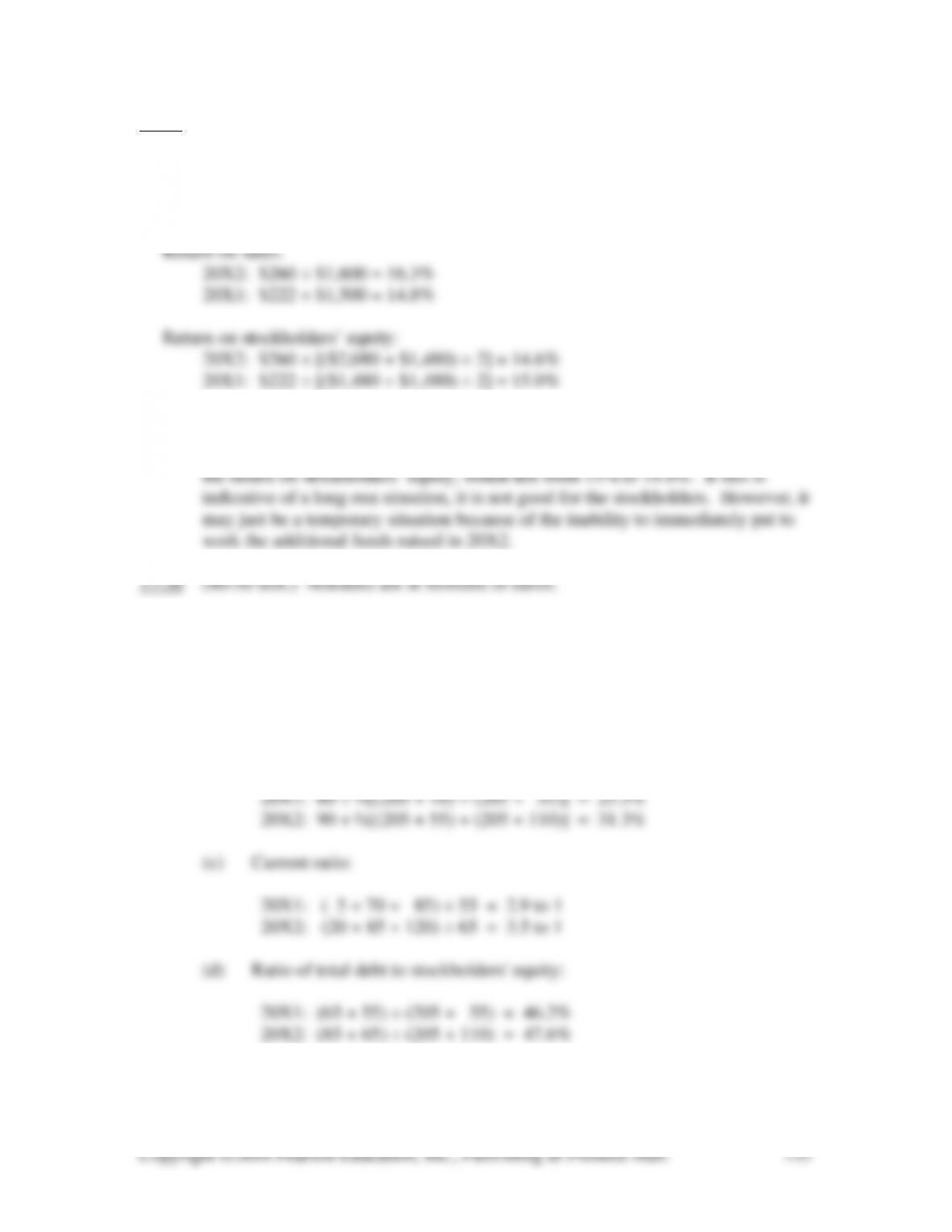
1. Because Quantum Electronics accounts for its 19% investment in Conn Transport
using the market-value method and classifies the securities as available-for-sale
securities, only the amount of dividends paid by Conn are part of the income of
Quantum Electronics. Changes in the market value of Conn are entered directly
2. At least two ethical issues arise. First is the investment by Quantum in Conn. If
the decision was made by Salvador Cruz based only on his friendship with Bud
Conn, and if it was not in the best interests of the shareholders of Quantum, Cruz
was not appropriately carrying out his duties as an officer of Quantum. Presently
this may not be of much concern because the investment appears to have turned
17-37 (10-15 min.)
1. Gross margin percentage:
20X2: $650 ÷ $1,600 = 40.6%
20X1: $580 ÷ $1,500 = 38.7%
2. Both the gross margin percentage and the return on sales increased in 20X2,
which is generally good. However, the most important return to stockholders is
1. (a) Rate of return on sales:
(Sales: 20X1: 380+620 = 1,000; 20X2: 520+980 = 1,500)
20X1: 60 ÷ 1,000 = 6.0%
20X2: 90 ÷ 1,500 = 6.0%
(b) Rate of return on stockholders’ equity:
Copyright ©2014 Pearson Education, Inc., Publishing as Prentice Hall.
736
(e) Ratio of current debt to stockholders’ equity:
20X1: 55 ÷ (205 + 55) = 21.2%
20X2: 65 ÷ (205 + 110) = 20.6%
(f) Gross profit rate:
20X1: 380 ÷ 1,000 = 38%
20X2: 520 ÷ 1,500 = 34.7%
(g) Average collection period for accounts receivable:
20X1: [(1/2) × (40 + 70) × 365] ÷ 1,000 = 20.1 days
20X2: [(1/2) × (70 + 85) × 365] ÷ 1,500 = 18.9 days
(h) Price-earnings ratio (Earnings per share are 60 ÷ 10 = 6
for 20X1 and 90 ÷ 10 = 9 for 20X2):
20X1: 90 ÷ 6 = 15
20X2: 117 ÷ 9 = 13
(i) Dividend-payout percentage (Dividends per share are 15 ÷ 10 =
1.50 for 20X1 and 35 ÷ 10 = 3.50 for 20X2):
20X1: 1.50 ÷ 6 = 25.0%
2. (a) Yes, a, b (d) Yes, b (g) No, d, e (j) No, j
3. The company has grown rapidly and profitably (ratio b). Sales have tripled;
earnings have nearly quadrupled; dividends have increased by a factor of 7; and
17-39 (10 min.)
The first two items indicate that there are noncontrolling (minority) shareholders
in the subsidiaries, whose individual sales, assets, and other detailed accounts have been
added together in the DuPont consolidated statements. The net income attributable to
17-40 (5-10 min.)
2. A component of other income on the income statement.
4. Current liability on the balance sheet.
5. Generally is deducted from net income including noncontrolling interests to get
17-41 (15 min.)
2011. The balance sheet equation and T-account summaries are shown below (in
millions of dollars):
Equity Method Investments Equity Method Investments
2. Chevron recognized $7,363 million of income from the affiliated companies.
3. The income recognized would remain at $7,363 million. The amount of
dividends paid by investees does not affect the parent’s income.
1. ¥ 465. All reported income would be attributable to Toyota’s stockholders.
2. Let X = subsidiaries’ net income
17-43 (15 min.) Amounts are in millions.
1. $14,443 million; the GE income would not change. Instead of consolidating all
3. The consolidated statement allows a comprehensive look at the financial results of
the entire entity owned by the shareholders of General Electric. For example, it
would combine the amount of goods and services sold to customers of GE and
GECS. The unconsolidated statement does not show all of these revenues.
17-44 (10-15 min.) Amounts are in billions.
1. Goodwill = $53.4 – ($29.7 + $10.0 – $21.2) = $34.9. This entire amount will
2. Goodwill would have been $34.9 + $29.7 = $64.6, which would remain on the
3. A manager might prefer to have this as goodwill and avoid an amortization
charge in future years. This will serve to increase the reported income in these
17-45 (15-20 min.) Amounts are in millions.
1. Goodwill would equal the purchase price less the fair value of the net assets
2. Consolidated pretax income is the Medtronic pretax income (which is 2011
3. There would be no amortization of the intangible assets. Assuming no
1. Average assets:
2. Total revenues: $24,355 ÷ .0115427 = $2,109,992
4. Asset turnover:
17-47 (15-20 min.) Monetary amounts are in billions of yen.
HONDA MOTOR COMPANY
Income Statement
For the Year Ended March 31, 2011
Amount Percentage
2. a. Current ratio = Current assets ÷ Current liabilities
= ¥4,690 ÷ ¥3,568 = 1.31
b. Total debt to equity = Total liabilities ÷ Stockholders’ equity
= (¥3,568 + ¥3,420) ÷ ¥4,583
3. These ratios themselves are difficult to interpret without 1) time-series
comparisons, 2) cross-sectional comparisons, and 3) comparisons with
17-48 (15-25 min.)
1. The fact that Nike’s financial statements are “consolidated” means that Nike
combines the statements of the parent company with those of 50% to 100%
2. Sales among consolidated entities must be eliminated when forming consolidated
statements. Thus, the sales from Converse to the Nike retail stores must be
eliminated. That means that, after adding together the accounts of Nike and its
3. Following are the interpretations of the changes in each of the ten ratios:
a. Current ratio – The decline is generally bad, reflecting less liquidity.
However, it might reflect better inventory control, possibly by using just-in–
time methods, which could be good.
b. Average collection period – A slight improvement.
Copyright ©2014 Pearson Education, Inc., Publishing as Prentice Hall.
743
17-49 (25-35 min.) For the solution to this Excel Application Exercise, follow the
step-by-step instructions provided in the textbook chapter.
1. Gap’s current ratio of 2.02 is almost exactly equal to the 2 to 1 rule of thumb.
2. Gap’s debt to equity ratio shows that debt is 169.4% of equity. The rule of
3. The dividend payout ratio is 28.7%. This means that Gap paid to shareholders
17-50 (60 min. or more)
The purpose of this exercise is two-fold. The first is to establish familiarity with
four basic ratios. The second is to deduce why these ratios might vary from company to
company.
Computing the ratios will cause students to find and read a company’s annual
financial statements. They will become familiar with some aspects of that particular
17-51 (30-40 min.) NOTE TO INSTRUCTOR: This solution is based on the web site as
1. General Electric labels its financial statements “General Electric Company and
consolidated affiliates.” Therefore, the company must consolidate some
2. GE calls its balance sheet a “Statement of Financial Position.” GE does not have
subtotals for current assets and current liabilities, although the current items are
4. GE’s return on stockholders’ equity for the last two years is:
2011: $13,120 ÷ (1/2 × ($116,438 + $118,936)) = 11.1%
2010: $11,344 ÷ (1/2 × ($118,936 + $117,291*)) = 9.6%