CHAPTER 17
COVERAGE OF LEARNING OBJECTIVES
LEARNING
OBJECTIVE
FUNDAMENTAL
ASSIGNMENT
MATERIAL
ADDITIONAL
ASSIGNMENT
MATERIAL
EXCEL,
COLLAB., &
INTERNET
EXERCISES
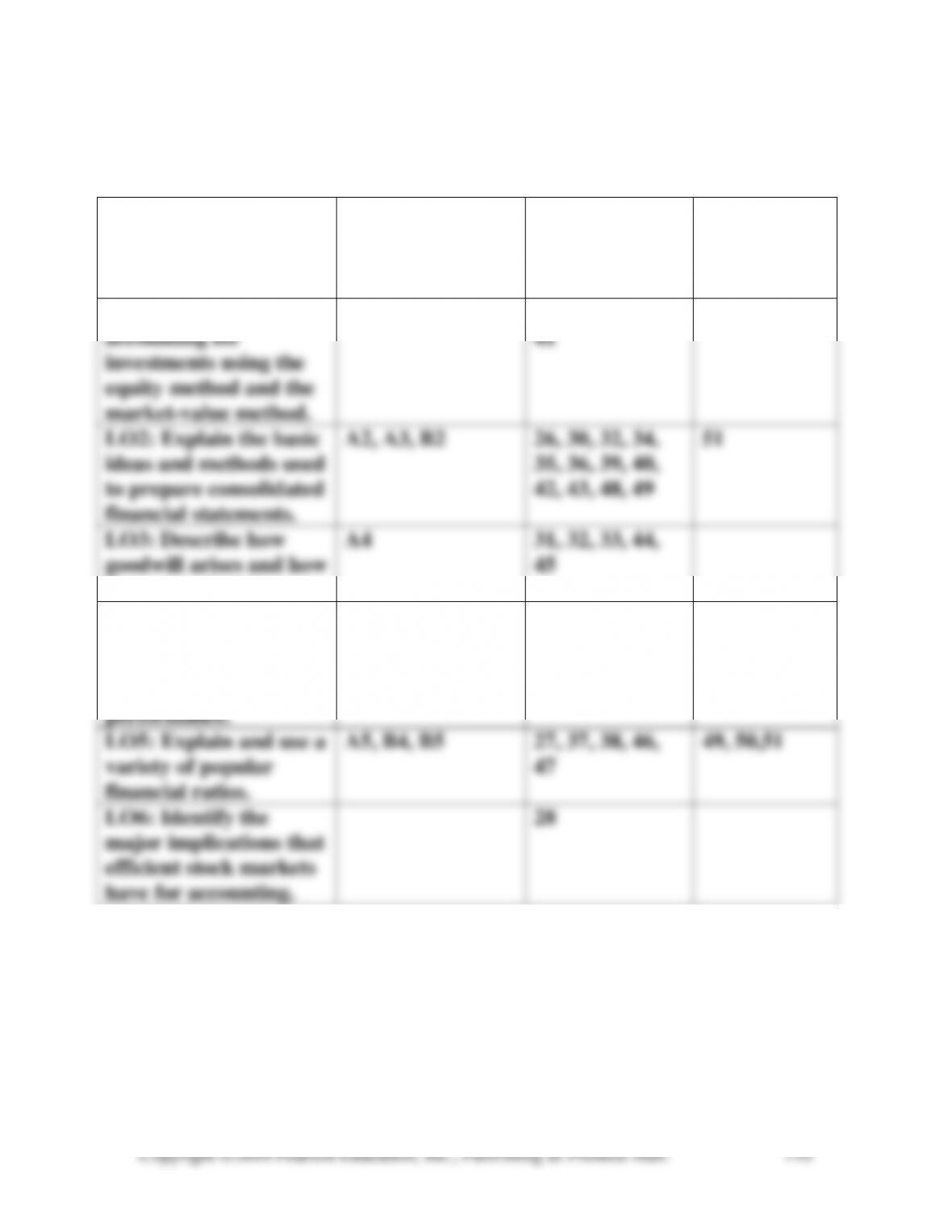
LO1: Contrast
accounting for
investments using the
equity method and the
market-value method.
A1, B1, B3
25, 29, 36, 39,
41
51
LO2: Explain the basic
ideas and methods used
to prepare consolidated
financial statements.
A2, A3, B2
26, 30, 32, 34,
35, 36, 39, 40,
42, 43, 48, 49
51
LO3: Describe how
goodwill arises and how
to account for it.
A4
31, 32, 33, 44,
45
LO4: Use financial
statement analysis to
evaluate an
organization’s
performance.
27, 37, 38, 47
LO5: Explain and use a
variety of popular
financial ratios.
A5, B4, B5
27, 37, 38, 46,
47
49, 50,51
LO6: Identify the
major implications that
efficient stock markets
have for accounting.
28
Copyright ©2014 Pearson Education, Inc., Publishing as Prentice Hall.
711
CHAPTER 17
Understanding and Analyzing Consolidated Financial Statements
1. Equity Method
Assets = Liab. + Stk. Eq.
Invest- Liabil- Stock.
Cash ments ities Equity
a. Acquisition -75 +75 =
2. Market-Value Method
Assets = Liab. + Stk. Eq.
Invest- Liabil- Stock.
Cash ments ities Equity
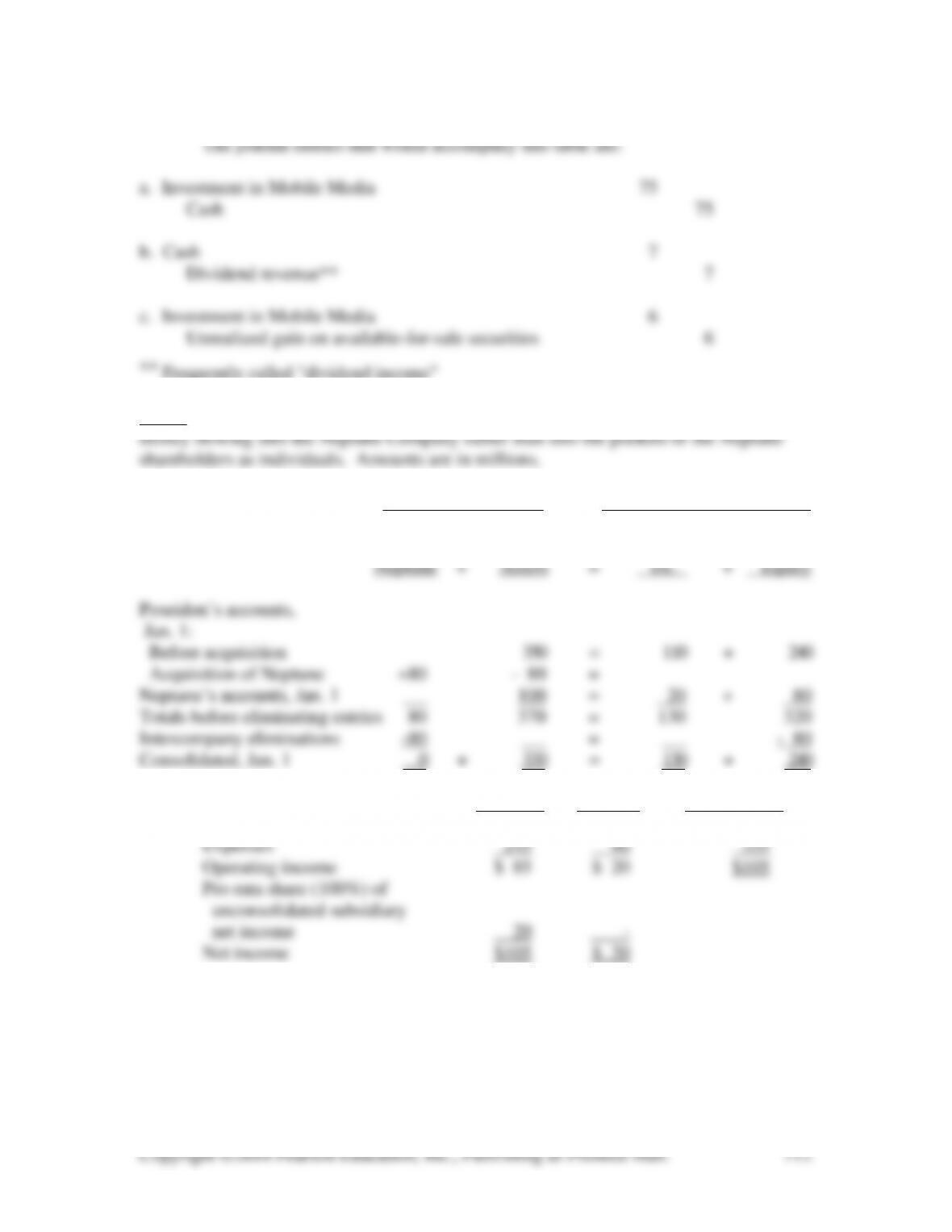
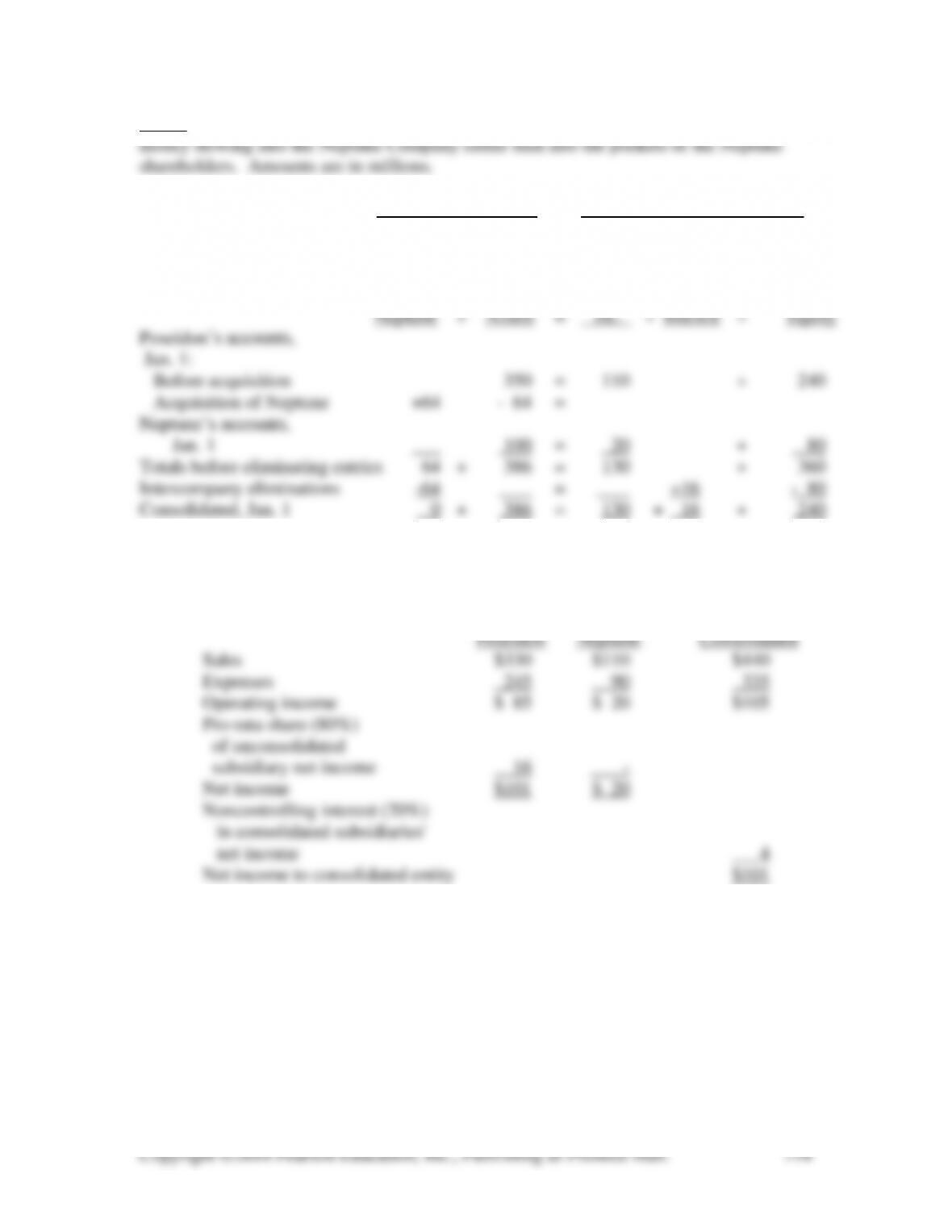
17-A2 (25-35 min.) A common mistake is to think that the $80 million is additional
1. Assets = Liab.+ Stockholders’ Equity
Investment Cash Accounts Stock-
in and Other Payable, holders’
2. Poseidon Neptune Consolidated
Sales $330 $110 $440
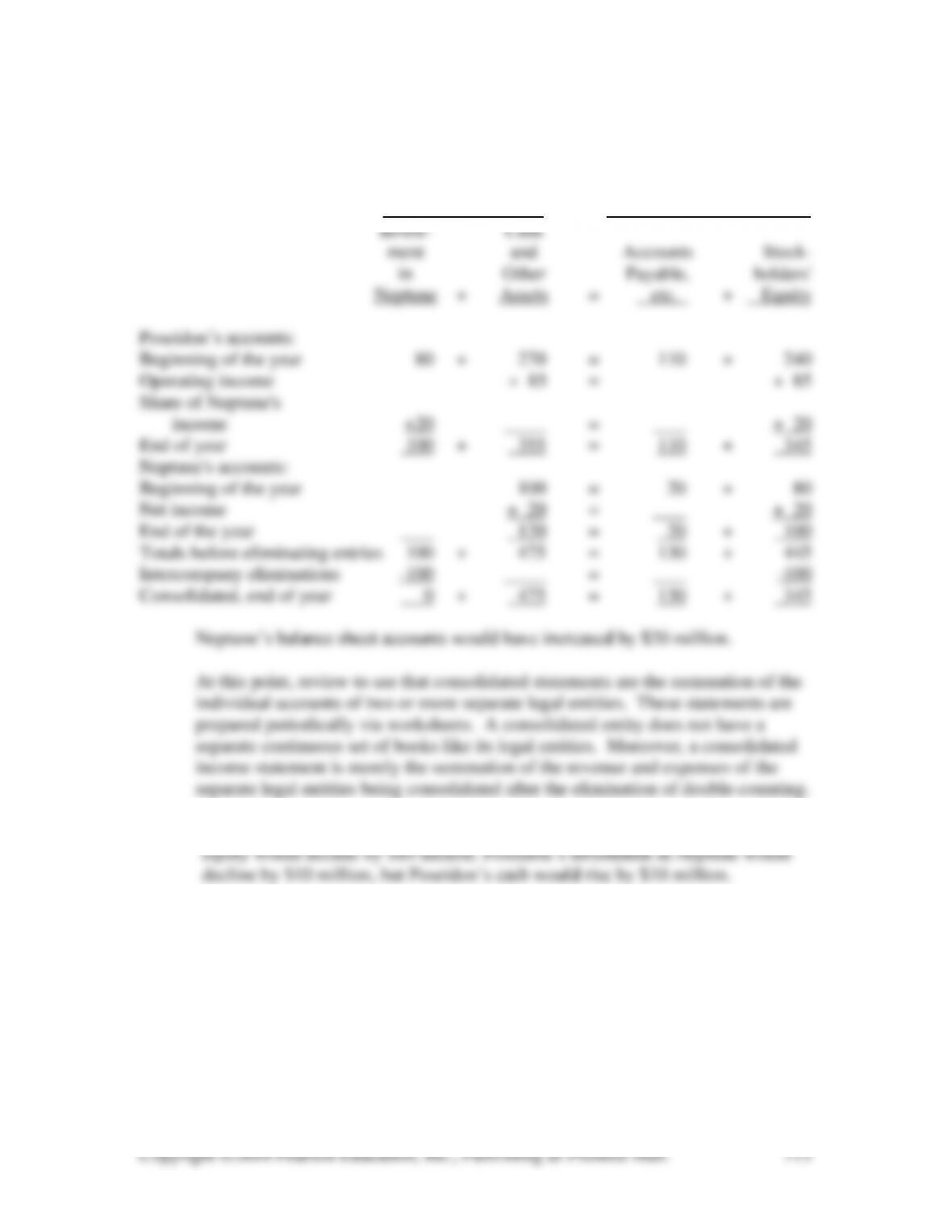
3. Poseidon’s parent-company-only income statement would show its own sales
and expenses plus its pro-rata share of Neptune’s net income, as the equity
method requires. Reflect on the changes in Poseidon’s balance sheet equation
(in millions):
Assets = Liab.+Stockholders’ Equity
4. Consolidated accounts would be unaffected. Neptune’s cash and stockholders’
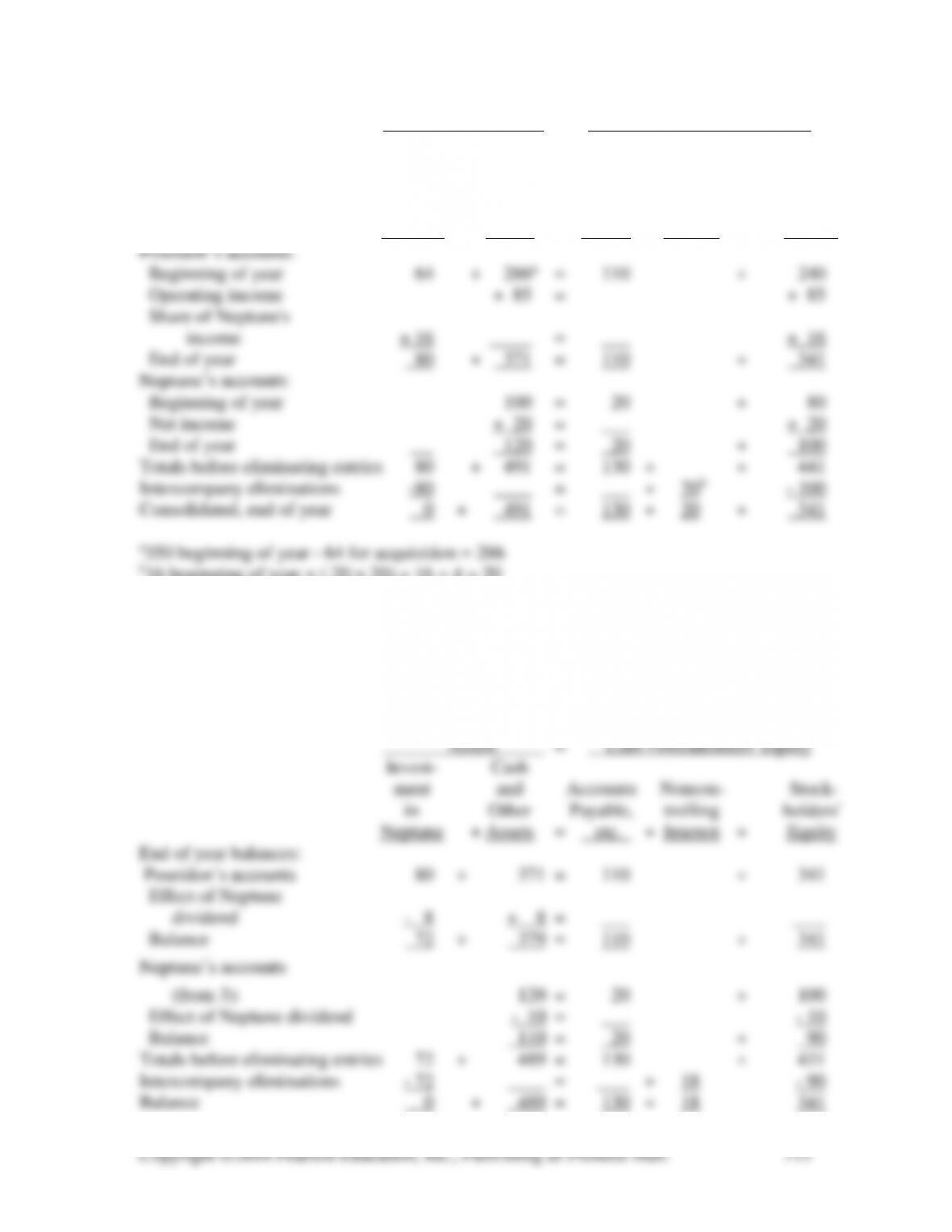
17-A3 (30-45 min.) A common error is to think that the $64 million is additional
1. Assets = Liab.+Stockholders’ Equity
Invest- Cash
ment and Accounts Noncon- Stock-
in Other Payable, trolling holders’
2. The same basic procedures are followed by Poseidon and Neptune regardless of
whether Neptune is 100% owned or 80% owned. However, the presence of a
noncontrolling interest changes the consolidated statements slightly. The income
statements would include:
3. Assets = Liab.+Stockholders’ Equity
Invest- Cash
ment and Accounts Noncon- Stock-
in Other Payable, trolling holders’
Neptune + Assets = etc. + Interest + Equity
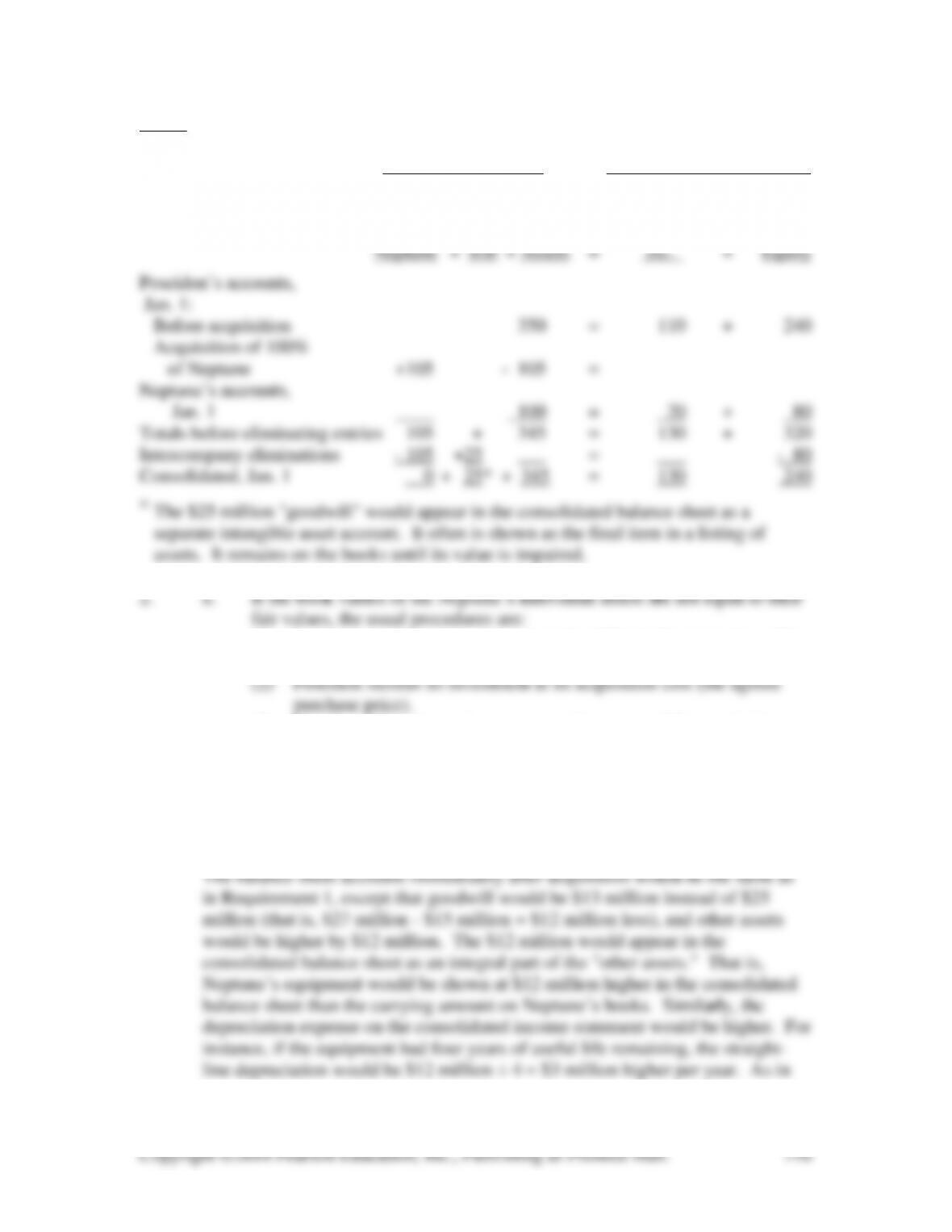
4. Consolidated accounts would be affected because the noncontrolling interest’s
claim would be partially liquidated in the amount of 20% of $10 million, or $2
million. Neptune’s cash would decline by $10 million, Poseidon’s investment in
Neptune would decline by .80 × $10 million = $8 million, but Poseidon’s cash
would rise by $8 million. See following balance sheet equations:
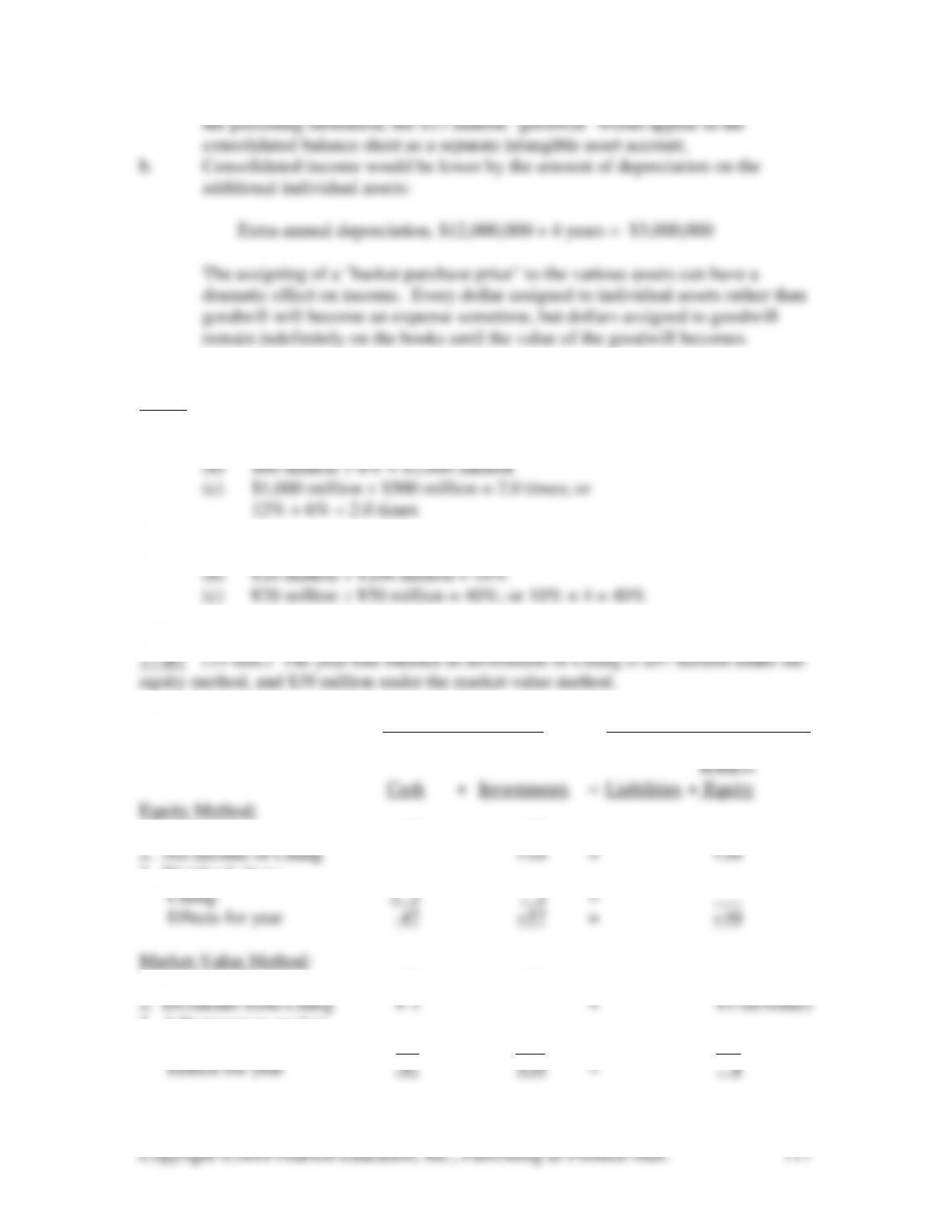
17-A4 (25-35 min.)
1. Assets = Liab.+Stockholders’ Equity
Invest- Cash
ment and Accounts Stock-
in Good- Other Payable, holders’
(1) Neptune continues as a going concern and keeps its accounts on the
same basis as before.
(3) For consolidated reporting purposes, the excess of the acquisition
cost over the book values of Neptune is identified with the individual
assets, item by item. (In effect, they are revalued at the current
market prices prevailing when Poseidon acquired Neptune.) Any
remaining excess that cannot be identified is labeled as purchased
goodwill.
Copyright ©2014 Pearson Education, Inc., Publishing as Prentice Hall.
717
the preceding tabulation, the $13 million “goodwill” would appear in the
consolidated balance sheet as a separate intangible asset account.
b. Consolidated income would be lower by the amount of depreciation on the
additional individual assets:
Extra annual depreciation, $12,000,000 ÷ 4 years = $3,000,000
The assigning of a “basket purchase price” to the various assets can have a
dramatic effect on income. Every dollar assigned to individual assets rather than
goodwill will become an expense sometime, but dollars assigned to goodwill
remain indefinitely on the books until the value of the goodwill becomes
impaired.
17-A5 (10-15 min.)
1. (a) $500 million × 12% = $60 million
2. (a) ¥200 million ÷ 4 = ¥50 million
1. Assets = Liab.+Stockholders’ Equity
Stock-
1. Acquisition -50 +50 =
3. Dividends from
1. Acquisition -50 +50 =
3. Adjustment to market
value – 11 = -11 (loss)
Copyright ©2014 Pearson Education, Inc., Publishing as Prentice Hall.
718
Journal entries (not required):
Equity Method
1. Investment in Chang 50
Cash 50
3. Cash 3
1. Investment in Chang 50
Cash 50
3. Loss on trading securities 11
Investment in Chang 11
17-B2 (25-40 min.) Amounts are in millions of dollars. This is a real acquisition,
1. Assets = Liab.+Stockholders’ Equity
Invest- Cash
ment and Accounts Stock-
in Other Payable, holders’
2. Brunswick Bayliner Consolidated
Sales $1,800 $500 $2,300
3. Brunswick’s parent-company-only income statement would show its own sales
and expenses plus its pro-rata share of Bayliner’s net income (as the equity
method requires). Reflect on the changes in Brunswick’s balance sheet equation
(in millions of dollars):
Assets = Liab.+Stockholders’ Equity
4. The important point to see is that the consolidated accounts would be unaffected.
17-B3 (15-20 min.)
2. The balance is increased by Berkshire Hathaway’s share of American Express’s net
income ($641,550,000 from requirement 1) and decreased by the cash dividends
received from American Express (13.0% × $855,000,000 = $111,150,000):
3. (a) Under the market-value method the dividends received from American
Express would be recognized as income by Berkshire Hathaway:
4. Berkshire Hathaway is obliged to follow the generally accepted accounting
principles for investments:
(a) Investments that represent more than a 50% ownership interest must be
consolidated. A subsidiary is a corporation controlled by another
17-B4 (10-20 min.) Amounts are in millions.
1. a. Operating return on sales = operating income ÷ sales
Operating income = sales × operating return on sales
Operating income = £1,501.3 × 13.741% = £ 206.3
2. Shareholders are most concerned with return on shareholders’ equity. It shows the
17-B5 (20 min.)
1. 4,309 2,128 = 2.02
2. 4,667 2,755 = 169.4%
17-1 Trading securities are investments “held for current resale,” typically
17-2 No. It is true that increased in the market value of available-for-sale securities is
added to other comprehensive income. However, other comprehensive income is a
separate account in stockholders’ equity, not a part of net income. Items that end up in
17-3 Under the equity method, investments are carried in the balance sheet at original
17-4 The equity method recognizes income as it is earned by the investee and
17-5 The equity method is usually appropriate for long-term investments when the
17-6 A parent-subsidiary relationship exists when one corporation (the parent) exerts
17-7 The reasons for establishing subsidiaries include limiting the liabilities in a risky
way.
17-8 No, consolidations are more complex than simply adding together the separate
17-10 If the parent owns less than 100% of the subsidiary stock, then outsiders to the
consolidated group own the remainder. The account Noncontrolling Interest in
17-11 Goodwill is measured by the excess of purchase price over the fair-value, not
the book value, of the net assets (assets less liabilities) acquired.
17-12 No. Rules require that assets in a consolidated statement reflect the fair market
value at the time of the acquisition. Companies may favor recording differences between
17-14 No. Pro forma statements show hypothetical (“as if”) amounts. Formal
17-15 It is difficult to compare financial statements of firms that differ in size. Using
17-16 MD&A is management’s discussion and analysis of an organizations financial
17-17 Three types of comparisons are: 1) time-series comparisons, 2) comparisons
with benchmarks, and 3) cross-sectional comparisons.
17-18 Two short-term ratios are the current ratio and the quick ratio. Five profitability
17-20 Ratios are mechanical because their computation requires following a set rule.
17-21 No. An efficient capital market is one in which market prices “fully reflect” all
17-22 Sources of information include dividend announcements, industry statistics,
trade publications, and national and global economic indicators.
17-23 The quote assumes that the market applies a fixed price-earnings ratio to
price.
17-24 There is much evidence showing that the stock market is not likely to be
17-25 A purchase of about 20% of another company places the purchase at the
borderline between the market-value or equity methods. More than 20% and the equity
method should be used; less than 20% and Pixar should use the market-value method.
17-26 The amount that P pays above the book value of the net assets of S consists of
two parts. The first part is an adjustment of the book values of S’s net assets to market
17-27 If a company reduces its inventories (a component of current assets), and
everything else remains unchanged, its current ratio will decrease. Because holding
inventory can be expensive, both for the capital invested in them and for costs of
17-28 If markets are efficient, investors cannot make abnormal returns by investing on
the basis of publicly-available information. Unless you have access to new information
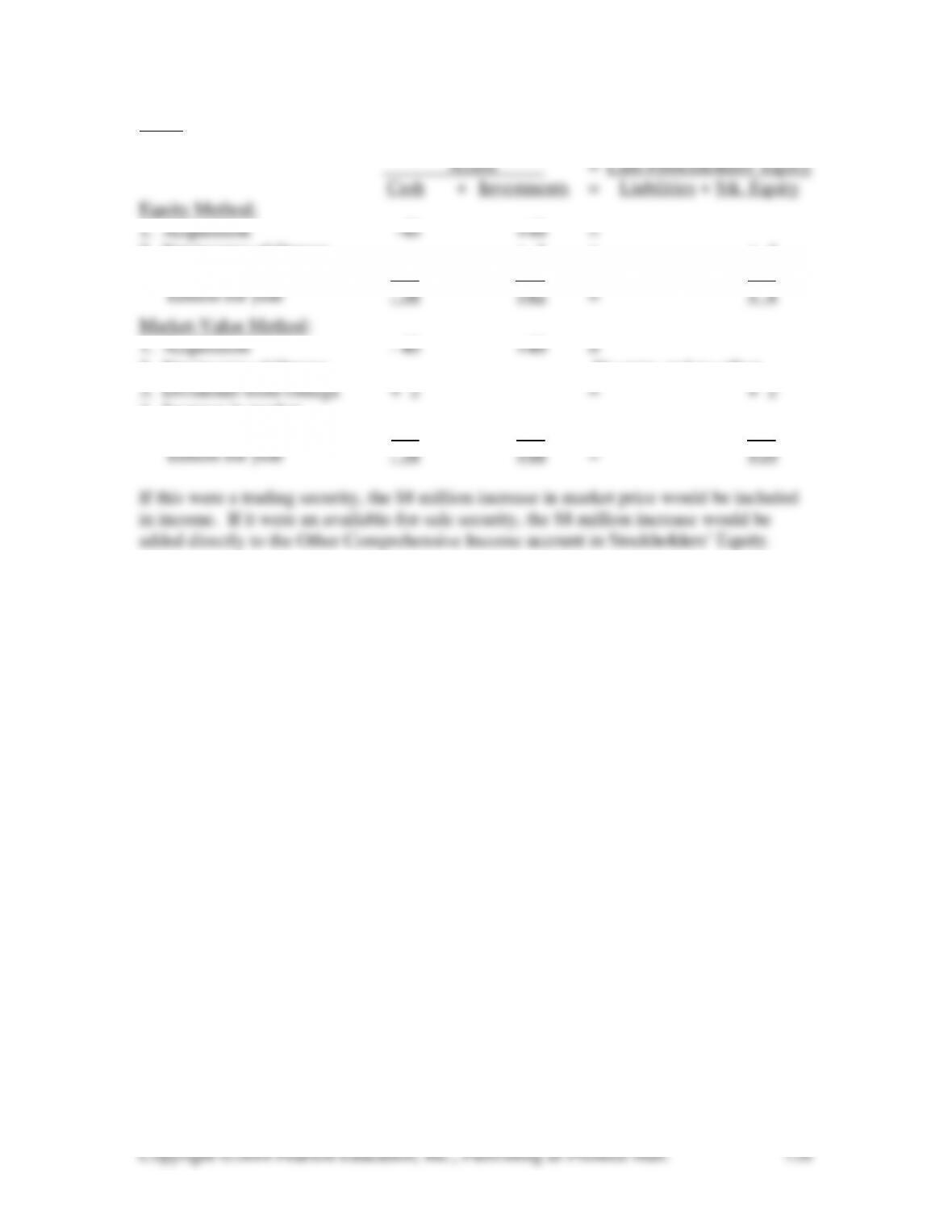
17-29 (15 min.) The year-end balance in Investment in Omega is $42 million under the
equity method, and $48 million under the market-value method:
2. Net income of Omega + 4 = + 4
3. Dividends from Omega + 2 – 2 =
2. Net income of Omega No entry and no effect.
4. Increase in market
value of Omega + 8 = + 8
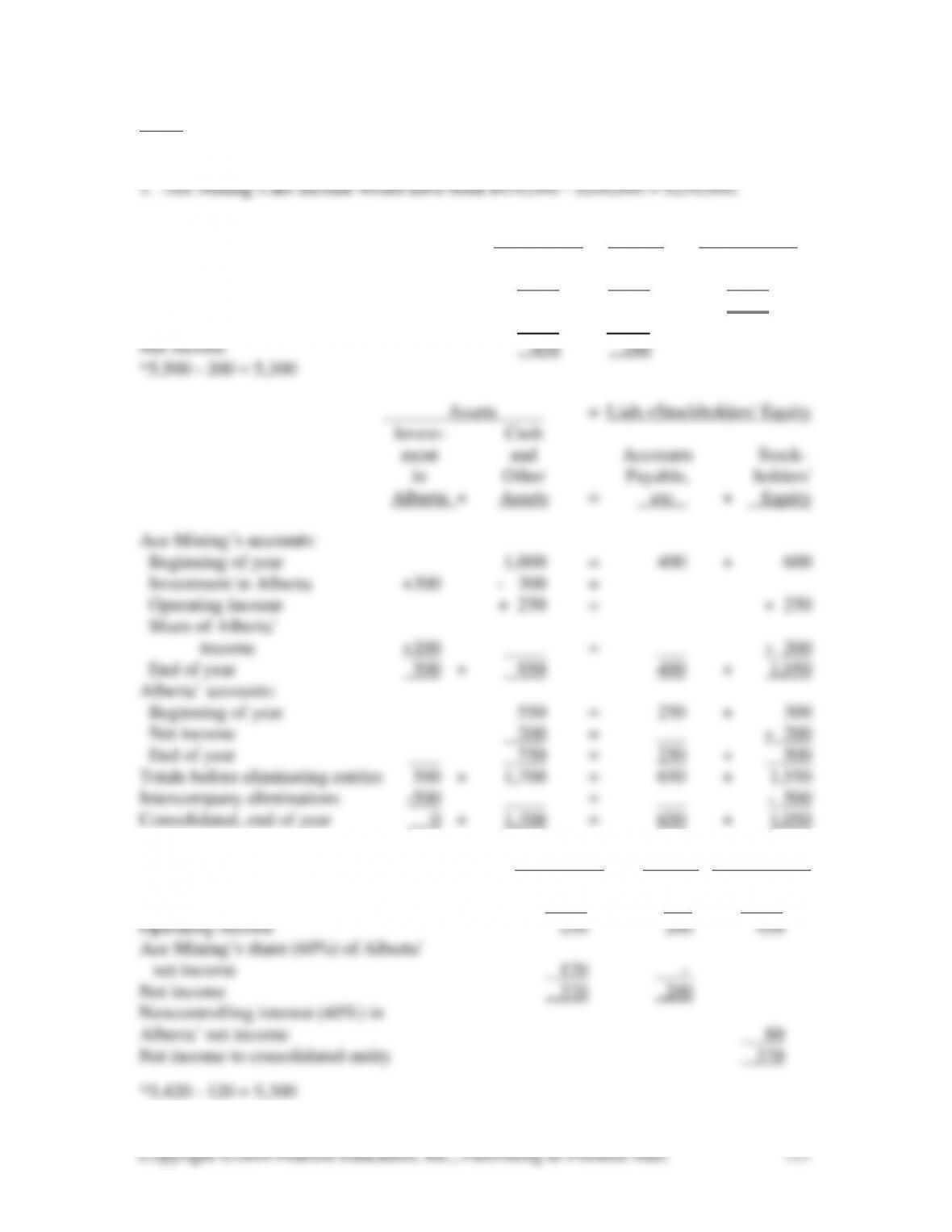
17-30 (35-50 min.) The formal statements are not presented here because the following
tabulations are easier to understand (in thousands of dollars):
2. (In thousands) Ace Mining Alberta Consolidated
Sales (other income is reclassified below) 5,300* 1,100 6,400
Expenses 5,050 900 5,950
Operating income 250 200 450
Ace Mining’s share of Alberta’ net income 200 –
3. Ace Mining Alberta Consolidated
Sales (other income is reclassified below) 5,300* 1,100 6,400
Expenses 5,050 900 5,950