CHAPTER 16
COVERAGE OF LEARNING OBJECTIVES
LEARNING OBJECTIVE
FUNDAMENTAL
ASSIGNMENT
MATERIAL
ADDITIONAL
ASSIGNMENT
MATERIAL
EXCEL,
COLLAB., &
INTERNET
EXERCISES
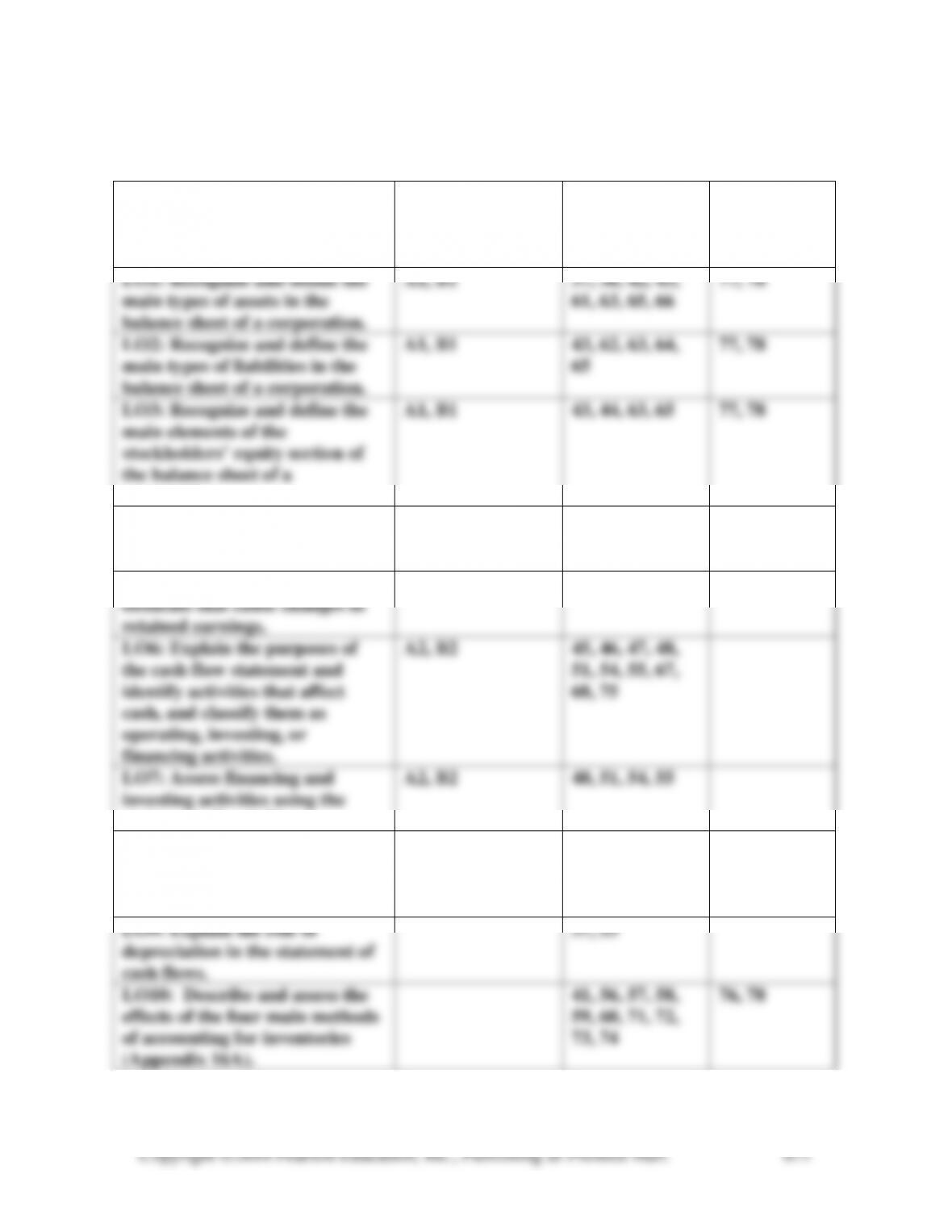
LO1: Recognize and define the
main types of assets in the
balance sheet of a corporation.
A1, B1
37, 38, 42, 43,
61, 63, 65, 66
77, 78
LO2: Recognize and define the
main types of liabilities in the
balance sheet of a corporation.
A1, B1
43, 62, 63, 64,
65
77, 78
LO3: Recognize and define the
main elements of the
stockholders’ equity section of
the balance sheet of a
corporation.
A1, B1
43, 44, 63, 65
77, 78
LO4: Recognize and define the
principal elements in the income
statement of a corporation.
A1
37, 38, 39, 43
66, 75
77, 78
LO5: Recognize and define the
elements that cause changes in
retained earnings.
63, 75
LO6: Explain the purposes of
the cash flow statement and
identify activities that affect
cash, and classify them as
operating, investing, or
financing activities.
A2, B2
45, 46, 47, 48,
51, 54, 55, 67,
68, 75
LO7: Assess financing and
investing activities using the
statement of cash flows.
A2, B2
40, 51, 54, 55
LO8: Use both the direct method
and the indirect method to
explain cash flows from
operating activities.
A2, A3, A4, B2, B3
45, 46, 47, 48,
49, 50, 51, 52,
54, 55, 68, 69,
70
78
LO9: Explain the role of
depreciation in the statement of
cash flows.
37, 53
LO10: Describe and assess the
effects of the four main methods
of accounting for inventories
(Appendix 16A).
41, 56, 57, 58,
59, 60, 71, 72,
73, 74
76, 78
Copyright ©2014 Pearson Education, Inc., Publishing as Prentice Hall.
672
CHAPTER 16
Understanding Corporate Annual Reports: Basic Financial Statements
16-A1 (20-25 min.)
REIGLE COMPANY
Balance Sheet
December 31, 20X0
ASSETS:
Current assets:
Other long-term assets 110,000
Total noncurrent assets 595,000
Total assets $754,000
LIABILITIES AND SHAREHOLDERS’ EQUITY:
Current liabilities:
Shareholders’ equity:
Common stock (50,000 shares @ $.50) 25,000
Additional paid-in capital 124,000*
Retained earnings 204,000
Total shareholders’ equity 353,000
Then:
REIGLE COMPANY
Income Statement
For the Year Ended December 31, 20X0
Revenues $790,000
Cost of sales 470,000
16-A2 (15-20 min.) Although the requirements do not call for it, many students will
find it useful to prepare a balance sheet equation (without beginning balances, which are
not given). Comparing the entries in the Cash column to those in the Retained Earnings
column shows why net income differs from cash provided by operations. This
understanding is necessary to interpret (or prepare) the schedule that reconciles net
16-A3 (10-15 min.)
RIDGEWOOD ANTIQUES
Supporting Schedule to Statement of Cash Flows
Reconciliation of Net Income to Net Cash Provided by
Operating Activities
Copyright ©2014 Pearson Education, Inc., Publishing as Prentice Hall.
676
16-A4 (10 min.)
1. Sales $695,000
Non-depreciation expenses [600,000-80,000] (520,000)
2. Sales $ 695,000
Non-depreciation expenses (520,000)
Depreciation (240,000)
Net income (loss) $ (65,000)
16-B1 (15-20 min.)
INTEL
Balance Sheet
January 1, 2012 (in millions)
ASSETS
Current assets:
Cash and cash equivalents $ 5,065
Other assets 4,648
Total assets $71,119
LIABILITIES AND SHAREHOLDER’S EQUITY
Current liabilities:
Short-term debt $ 247
Common stock and capital in excess of par value $17,036
Retained earnings 29,656
Accumulated other comprehensive income (loss) (781) 45,911
Total liabilities and shareholders’ equity $71,119
*Total Current Liabilities = $71,119 – $45,911 – $3,479 – $2,617 – $7,084 = $12,028
16-B2 (25 min.) This is a good exercise in recognizing items that fit in a Statement of
Cash Flows and placing them in the proper section of the statement. Three items listed in
the problem do not appear in a Statement of Cash Flows: net sales, retained earnings, and
total assets.
WALGREEN COMPANY
Gain on sale of business (434)
Other non-cash expenses 53
Changes in current assets and liabilities:
Increases in accounts receivable (243)
Increases in inventories (592)
Proceeds from sale of business 442
Other cash used by investing activities (203)
Net cash used for investment activities (1,525)
Cash (Used for) Provided by Financing Activities:
Stock repurchases (2,028)
16-B3 (10-15 min.)
All of the items listed, except provision for income taxes and interest expense,
are additions to (or deductions from) net income that are required in computing net cash
flow from operating activities. The main problem is to decide whether each one should
be added to or deducted from net income.
Non-cash losses 22
Deferred income taxes 371
Other non-cash charges affecting earnings 90
Deduct increases in non-cash current assets:
Accounts receivable (187)
16-1 The operating cycle is the time span during which cash is spent to acquire goods
and services that are used to produce the organization’s output, which in turn is sold to
16-2 Prepaid expenses belong in current assets because if they were not present more
cash would be needed in the next year to conduct current operations.
16-4 Accumulated depreciation is not cash; if specific cash is being accumulated for
16-5 Depreciation is a method of cost allocation, not valuation. Therefore, it
represents the decrease in book value but not the decrease in market value.
16-6 The useful life of depreciable assets is never longer than its physical life.
asset.
16-8 Yes. Goodwill arises only when one company buys another company or part of
16-9 Yes. Working capital is current assets less current liabilities, so it shows how
16-10 Subordinated debentures are like any long-term debt except that “subordinated”
16-11 Unlike individual proprietors or partners, stockholders’ personal assets cannot be
confiscated to satisfy the debts of an incorporated entity.
16-12 Stock frequently has a designated par or legal or stated value that is printed on
the face of the certificate. For preferred stock (and bonds), par is a basis for computing
16-13 Other comprehensive income consists of a few special types of gains and losses
that do not appear on the income statement and thus do not become part of retained
16-15 A multi-step income statement contains subtotals that provide users an easy way
16-16 Retained earnings is increased (decreased) by net income (loss), decreased by
dividends paid, and decreased by the repurchase of common shares.
16-17 A cash flows statement aids in predicting future cash flows, evaluating
16-19 Major operating activities include collections from customers, collections of
16-20 Major investing activities include sales and purchases of property, plant, and
16-21 Major financing activities include borrowing from creditors, issuing equity
securities, repaying creditors, repurchasing equity securities, and paying dividends.
16-22 Interest paid or received appears in the operating activities section. Some
commentators favor showing interest paid as a financing activity and interest received as
16-24 The investing section of the statement of cash flows shows the total cash
16-25 Non-cash investing and financing activities generally could have been
accomplished identically in substance (though not in form) by cash transactions. For
16-26 The direct method and indirect method are the two major ways of computing net
16-27 The erroneous impression is that depreciation and other noncash expenses are
income.
16-28 Companies recognize sales revenue on an accrual basis, not a cash basis.
equal.
16-29 Cash flow from operations does not recognize the investment necessary to
replace the fixed resources used in generating the period’s revenues. If a company does
16-30 Depreciation appears only in the operations section of an indirect-method cash
flow statement or in a supporting schedule to the body of the statement of cash flows in a
16-31 The newsletter reinforces the widely held erroneous impression that depreciation
provides cash. If income were to remain the same despite the depreciation increase, there
16-32 Specific identification recognizes the actual cost paid for the particular physical
item sold. First-in, first-out (FIFO) assumes that the items acquired earliest are sold or
16-33 FIFO will have the highest net income, because the older (and hence lower cost)
items comprise the cost of goods sold, making cost of goods sold lower and net income
higher.
16-35 The statement is true under IFRS. The first part is true under both U.S. GAAP
and IFRS — if replacement cost falls and lower ultimate sales prices are expected, the
16-36 No. The opposite is true. Tax expense on reports to shareholders has exceeded
the actual tax payments.
16-37 Most accounting measures of fixed assets are based on historical cost, not market
values. Companies record fixed assets at the cost paid for them, and they spread this cost
16-38 Companies invest in research activities because they believe such investments
will bring future value. In one sense, investments in research are like investments in
fixed assets – they are worthwhile only if the value created is greater than the cost of the
16-39 The gross margin on an income statement might be an appropriate measure for
assessing the success of a sales department. Sales managers are generally responsible for
16-40 The statement of cash flows has three sections. The section on investing
activities generally shows how much cash the company used for expansion and
replacement of facilities. The cash flow from operations section shows how much cash
16-41 If the purchasing officer wishes to maximize her performance evaluation by
reporting the largest possible gross margin, she will not buy the oil at $70 per barrel if the
company uses LIFO. Why? Because the $70 spent for the most recent purchase of oil
16-42 (10-15 min.) The purpose of this problem is to stress the limitations of the use of
historical costs, particularly where there are significant amounts of property, plant, and
equipment. Kr stands for the kroner, the Norwegian measure of currency.
The balance sheet values do not come close to the Kr30 million current market
Land 4.0 Mortgage payable Kr18.0
Building at cost Kr26.0
Accumulated depreciation 6.7 Stockholders’ equity 8.3
16-43 (25-30 min.) This problem is similar to 16-A1, but it is more difficult because it
includes items not shown in exhibits 16-1 and 16-5 and terminology is varied slightly.
HOKKAIDO COMPANY
Balance Sheet
May 31, 20X1
Intangible assets 21,000
Long-term investments 15,000*
Total noncurrent assets 281,000
Total assets ¥383,000
LIABILITIES AND STOCKHOLDERS’ EQUITY:
Total liabilities 226,000
Stockholders’ equity:
Redeemable preferred stock 15,000
Common stock, at par 5,000
Paid-in capital in excess of par 102,000
Copyright ©2014 Pearson Education, Inc., Publishing as Prentice Hall.
687
Total noncurrent assets = Total assets – Total current assets
= ¥383,000 – ¥102,000
= ¥281,000
Long-term investments = Noncurrent assets – Fixed assets, net – Capital
construction fund – Intangible assets
= ¥281,000 – ¥217,000 – ¥28,000 – ¥21,000
= ¥15,000
HOKKAIDO COMPANY
Income Statement
Operating income 79,000
Other income (expenses), net (12,000)
Income before income taxes 67,000
Income taxes (51,000)
Net income ¥ 16,000
16-44 (5-10 min)
Sydney Company’s retained earnings were increased by the net income in 20X1 and
decreased by the dividends paid. The other comprehensive income does not affect
16-45 (5 min.)
The split between cash and credit sales is irrelevant for purposes of this problem.
16-46 (5 min.)
Cost of goods sold $400,000
16-47 (5-10 min.)
Wage and salary expense $155,000
16-48 (5-10 min.)
HOOGENDOORN AND ASSOCIATES
16-49 (5-10 min.)
HOOGENDOORN AND ASSOCIATES
Reconciliation of Net Income to Net Cash Provided by
16-50 (10 min.)
HALIFAX COMPANY
Reconciliation of Net Loss to Net Cash Provided by
16-51 (15-25 min.)
DENALI ALE COMPANY
Statement of Cash Flows
For the Year Ended December 31, 20X1
(in thousands)