CHAPTER 15
COVERAGE OF LEARNING OBJECTIVES
LEARNING OBJECTIVE
FUNDAMENTAL
ASSIGNMENT
MATERIAL
ADDITIONAL
ASSIGNMENT
MATERIAL
EXCEL,
COLLAB., &
INTERNET
EXERCISES
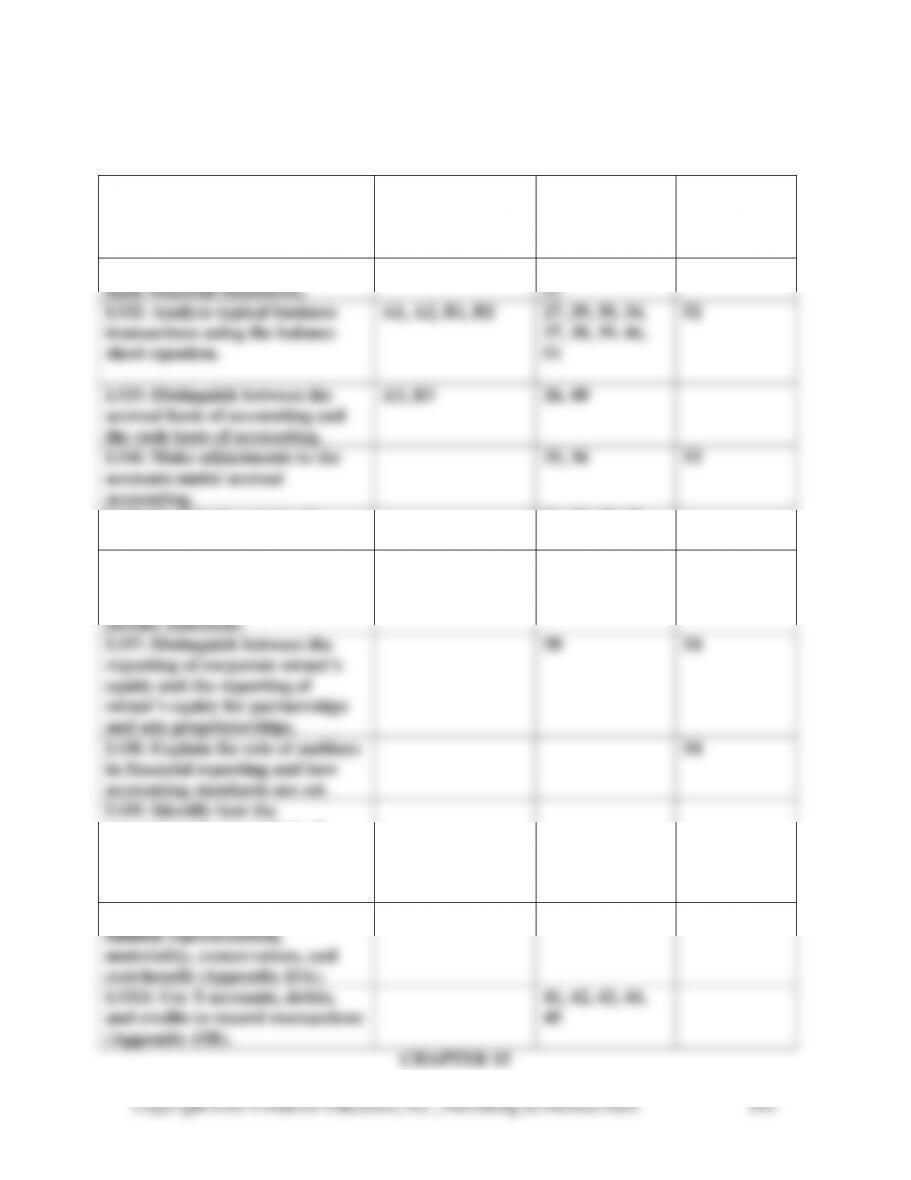
LO1: Read and interpret the
basic financial statements.
24, 25, 32, 38,
51
54
LO2: Analyze typical business
transactions using the balance
sheet equation.
A1, A2, B1, B2
27, 29, 30, 34,
37, 38, 39, 46,
51
52
LO3: Distinguish between the
accrual basis of accounting and
the cash basis of accounting.
A3, B3
26, 40
LO4: Make adjustments to the
accounts under accrual
accounting.
35, 36
53
LO5: Explain the nature of
dividends and retained earnings.
31, 33, 48, 49,
51
LO6: Select relevant items from a
set of data and assemble them
into a balance sheet and an
income statement.
A2, B2
39, 40, 47
48, 49, 51
52
LO7: Distinguish between the
reporting of corporate owner’s
equity and the reporting of
owner’s equity for partnerships
and sole proprietorships.
50
54
LO8: Explain the role of auditors
in financial reporting and how
accounting standards are set.
54
LO9: Identify how the
measurement conventions of
recognition, matching and cost
recovery, and stable monetary
unit affect financial reporting.
L10: Define continuity, relevance,
faithful representation,
materiality, conservatism, and
cost-benefit (Appendix 15A).
28
LO11: Use T-accounts, debits,
and credits to record transactions
(Appendix 15B).
41, 42, 43, 44,
45
CHAPTER 15
Copyright ©2014 Pearson Education, Inc., Publishing as Prentice Hall.
643
Basic Accounting: Concepts, Techniques, and Conventions
15-A1 (20-30 min.)
Case 1. E = 140 – 120 = 20
D = 40 + 20 = 60
Case 2. K = 20 + 170 = 190
J = 55 + 20 – 5 = 70
Case 3. P = 300 – 270 = 30
Q = 90 + 30 – 110 = 10
N = 85 – 35 = 50
L = 105 + 50 + 90 = 245
5. B = 90 – (60 + 25) = 5
1. See Exhibit 15-A2 on the following page.
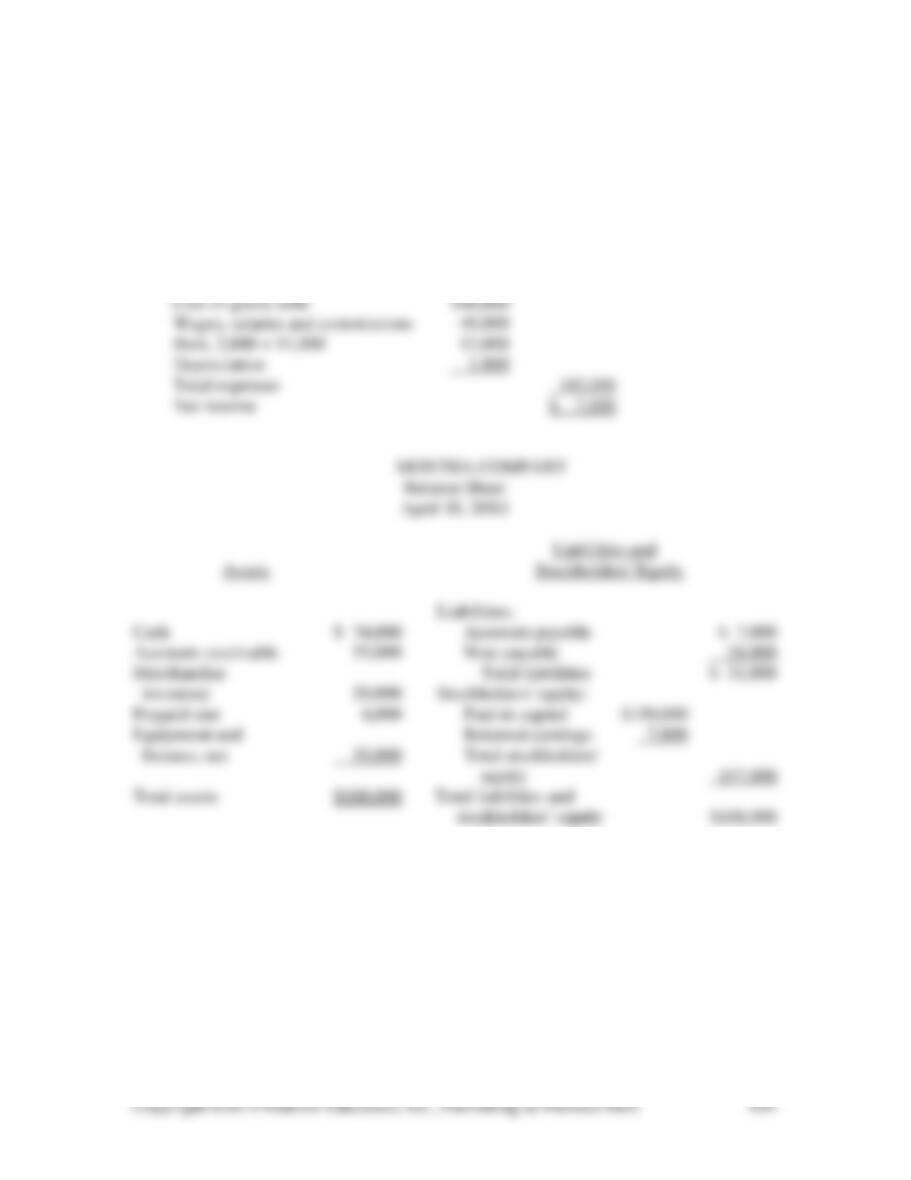
2. MONTHA COMPANY
Income Statement
For the Month Ended April 30, 20X1
Sales (revenue) $110,000
Deduct expenses:
3. Most businesses tend to have net losses during their start-up phase, so Montha’s
ability to show a net income for April is good. Many points can be raised,
including the problem of maintaining an “optimum” cash balance so that
creditors can be paid neither too quickly nor too slowly. See the next solution
also.
Copyright ©2014 Pearson Education, Inc., Publishing as Prentice Hall.
645
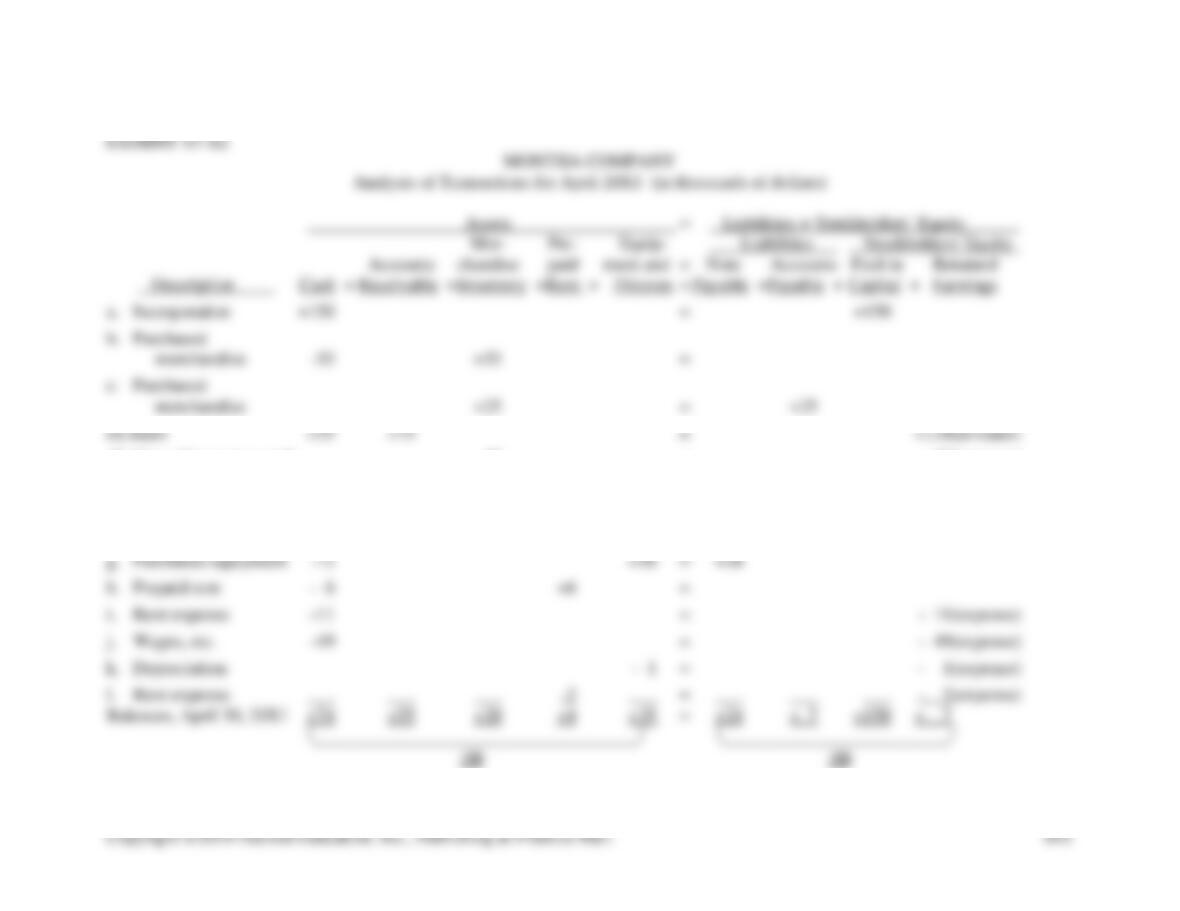
EXHIBIT 15-A2
MONTHA COMPANY
Analysis of Transactions for April 20X1 (in thousands of dollars)
Assets = Liabilities + Stockholders’ Equity
Mer- Pre- Equip- Liabilities Stockholders’ Equity
Accounts chandise paid ment and = Note Accounts Paid-in Retained
Description Cash + Receivable +Inventory +Rent + Fixtures = Payable +Payable + Capital + Earnings
a. Incorporation +150 = +150
b. Purchased
merchandise -35 +35 =
c. Purchased
merchandise +25 = +25
d1.Sales +35 +75 = +110(revenue)
d2. Cost of inventory sold -40 = – 40(expense)
e. Collections +20 -20 =
f. Disbursements to
trade creditors -18 = -18
15-A3 (5-10 min.)
Revenue (cash basis):
Cash sales $35,000
April.
15-B1 (10-15 min.)
This is straightforward. Computations are in millions of dollars.
A = 6,579 – (1,066+506) = 5,007
15-B2 (30-40 min.)
2. THE VOLVO GROUP
Statement of Earnings
For the Month Ended January 31, 2012
(in millions)
Sales SEK650
15-B3 (5-10 min.)
Revenue (cash basis):
Cash sales SEK 190,000,000
Collections from credit customers 300,000,000
Total revenue SEK 490,000,000
Copyright ©2014 Pearson Education, Inc., Publishing as Prentice Hall.
648
EXHIBIT 15-B2 THE VOLVO GROUP
Analysis of Transactions for January 2012
(in millions of SEK)
Assets = Liabilities + Stockholders’ Equity
Property Liabilities Stockholders’ Equity
Accounts Inven- Plant, & Other = Accounts Other Paid-in Capital &
Transaction Cash + Receivable + tories + Equip. + Assets = Payable + Liabilities Retained Earnings
Balances 1/1/12 +30,379 +81,472 +44,599 +53,657 + 143,137 =+56,546 +211,017 +85,681
a1. +190 +460 = +650(increase
revenue)
15-1 The income statement answers questions about financial performance over a
span of time. The balance sheet answers questions about financial status at a point in
time.
15-3 The income statement is a link between two balance sheets. The income
15-4 This statement is fallacious because it does not take into consideration
15-5 Under the accrual basis, companies recognize revenue as it is earned and
15-6 Adjusting entries differ from routine entries in that they deal with implicit
15-7 When managers acquire goods and services that have future value, they record
the cost as an asset and charge it to expense as they use the asset. When assets are used
15-8 It is preferable to refer to the costs rather than the values of assets such as plants
or inventory because the word value has many meanings and is more vague than the word
15-9 Yes. Depreciation is simply the allocation of the acquisition cost (less estimated
15-10 Companies that receive payment in advance of delivering goods or services will

15-11 Accrued wages are payments due to employees for work already done but not
15-12 Retained earnings is neither an asset nor a preferred claim against cash or any
assets.
15-13 Although profitable operations are typically a prerequisite to dividends,
dividends are actually a distribution of assets that “liquidate” a portion of the ownership
claim.
15-14 The basic principles of accounting apply to all businesses. Accounting for
assets, liabilities, revenues, and expenses does not depend on whether the business is a
15-15 Congress has delegated the setting of generally accepted accounting principles to
the Securities and Exchange Commission (SEC). In turn, the SEC has delegated the task
15-16 This statement is not true. The capital markets are increasingly global, and IFRS
are used in more than 100 countries, including those in the European Union. In addition,
15-17 Accountants create value through the information they supply to decision
15-18 Accountants record revenue when 1) the company has earned it and 2) the
15-19 The use of the dollar (or any other monetary unit) as the principal accounting
15-20 The going-concern concept means that a company is expected to use existing
15-21 Relevance is the capability of information to make a difference to the decision
15-22 Economic feasibility sometimes inhibits the adoption of new ways to measure
15-24 Because accountants record land at its historical cost and do not depreciate it, the
land purchased in 1912 would still be listed at its purchase price. The current market
value of that land more than 100 years later is likely to be substantially more than the
15-25 A marketing manager generally focuses on changes in assets, not the general
level of the assets. Marketing decisions deal with generating revenues and the costs of
15-26 A principle of good performance measures is that they recognize performance as
close as possible to the time of the performance. If the goal of the sales staff is to make
sales, then such staff should be evaluated on the amount of sales made. Any delay
15-27 We know that the ending balance in stockholders’ equity will be the beginning
15-28 Relevance means the information makes a difference to the decision maker. If
information has no impact on a decision, it is not relevant to that decision. Information
that cannot affect a decision has no value to a decision maker. If it has predictive value,
15-29 (10-15 min.)
2. False. Accounts receivable should be classified as an asset.
4. True
6. True
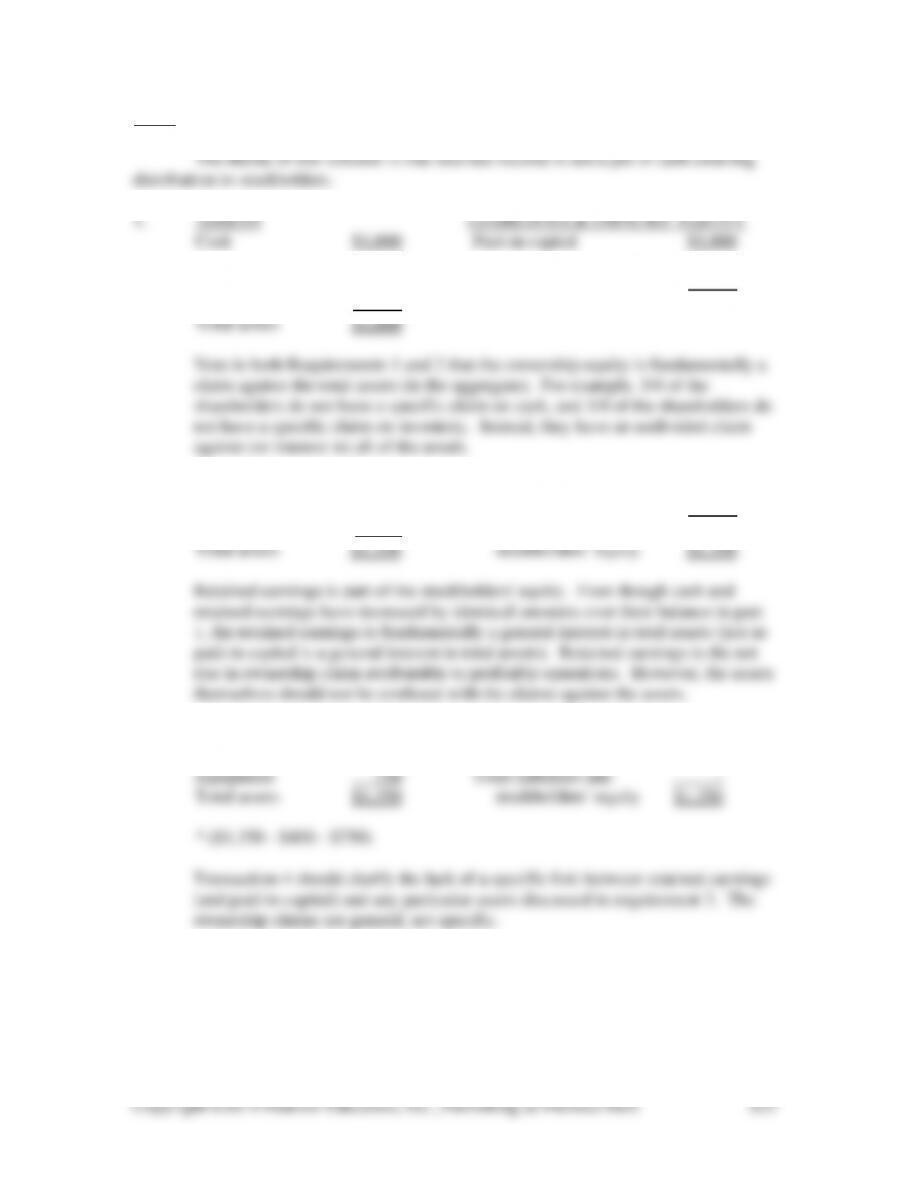
15-30 (5-10 min.) This is a simple exercise showing how the two sides of the balance
sheet must always balance.
LIABILITIES AND
15-31 (15-20 min.)
2. Cash $ 500 Paid-in capital $1,000
Inventory 500
3. Cash $1,350 Paid-in capital $1,000
Retained earnings 350
Total liabilities and
4. Cash $ 200* Paid-in capital $1,000
Inventory 400 Retained earnings 350
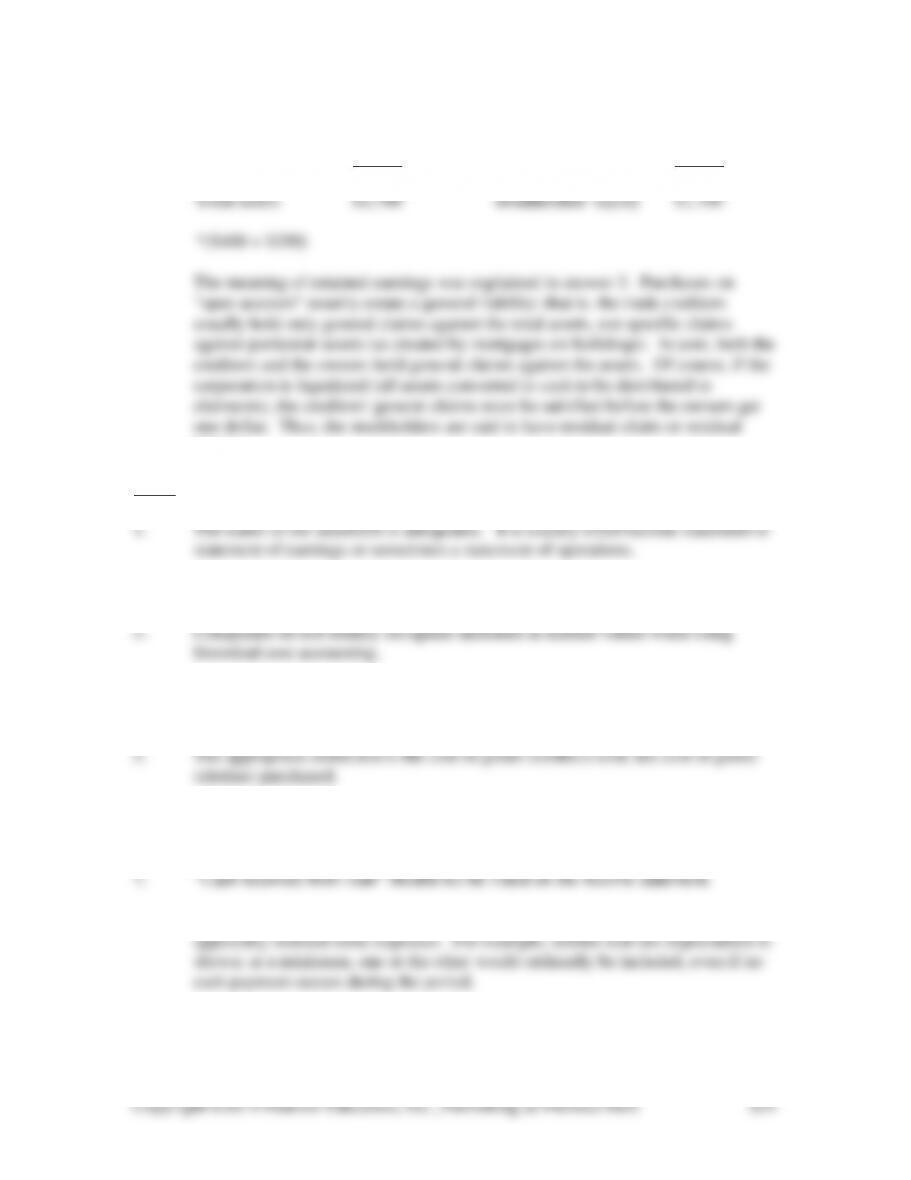
5. Cash $ 200 Accounts payable $ 350
Inventory* 750 Paid-in capital 1,000
Equipment 750 Retained earnings 350
Total liabilities and
interest.
15-32 (10-15 min.)
2. The date should not be for a point in time but for an indicated span of time.
4. Dividends are not expenses, and companies do not deduct them when calculating
net profit.
6. The bottom line is more often titled net income or net earnings, although net
profit is acceptable.
8. Although this is not the major point of the problem, the income statement has
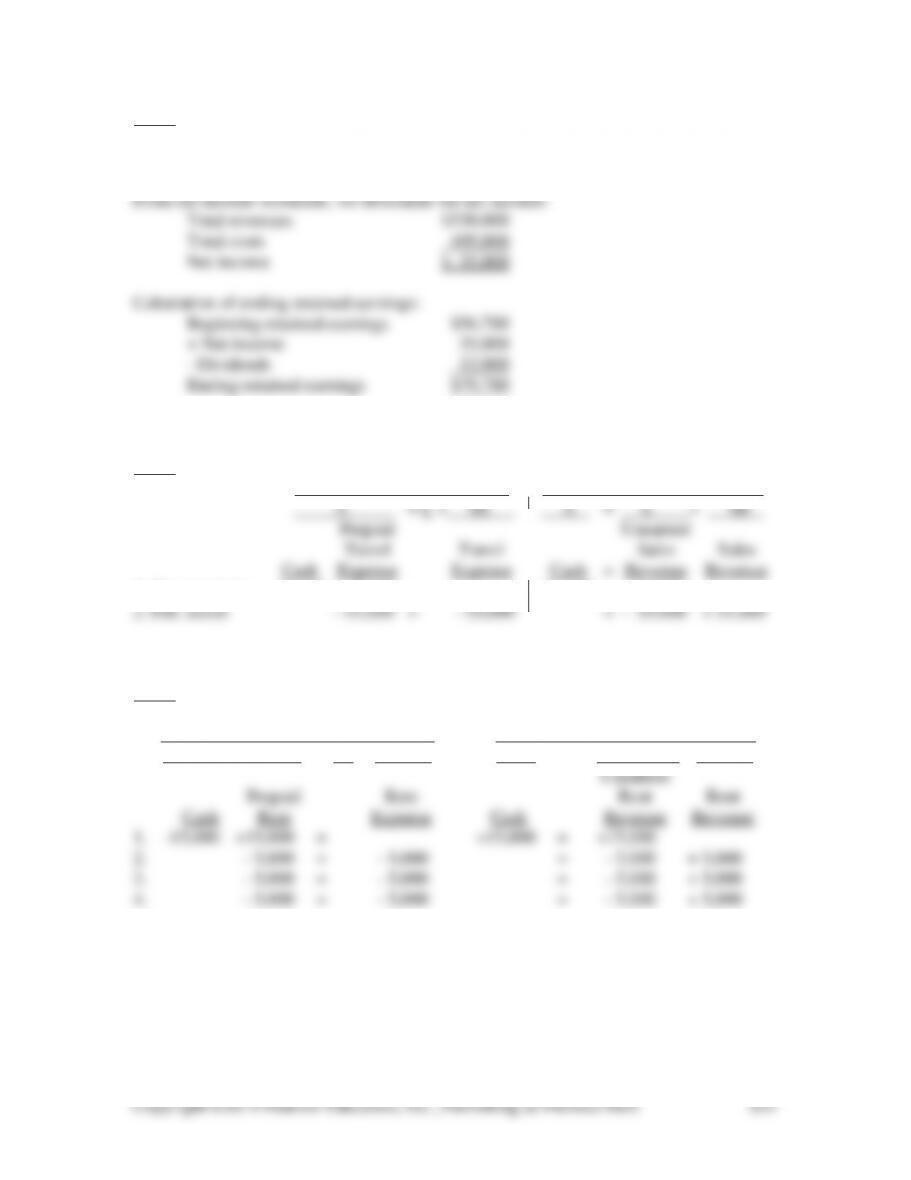
15-33 (5-10 min.) This is a simple exercise showing how the income statement and
balance sheet are linked by the retained earnings account. The purchase of property and
equipment is irrelevant to this exercise because it does not affect retained earnings.
15-34 (10 min.)
Macy’s Delta Airlines
1. Dec. payment – 55,000 + 55,000 = +55,000 = + 55,000
15-35 (10-15 min.)
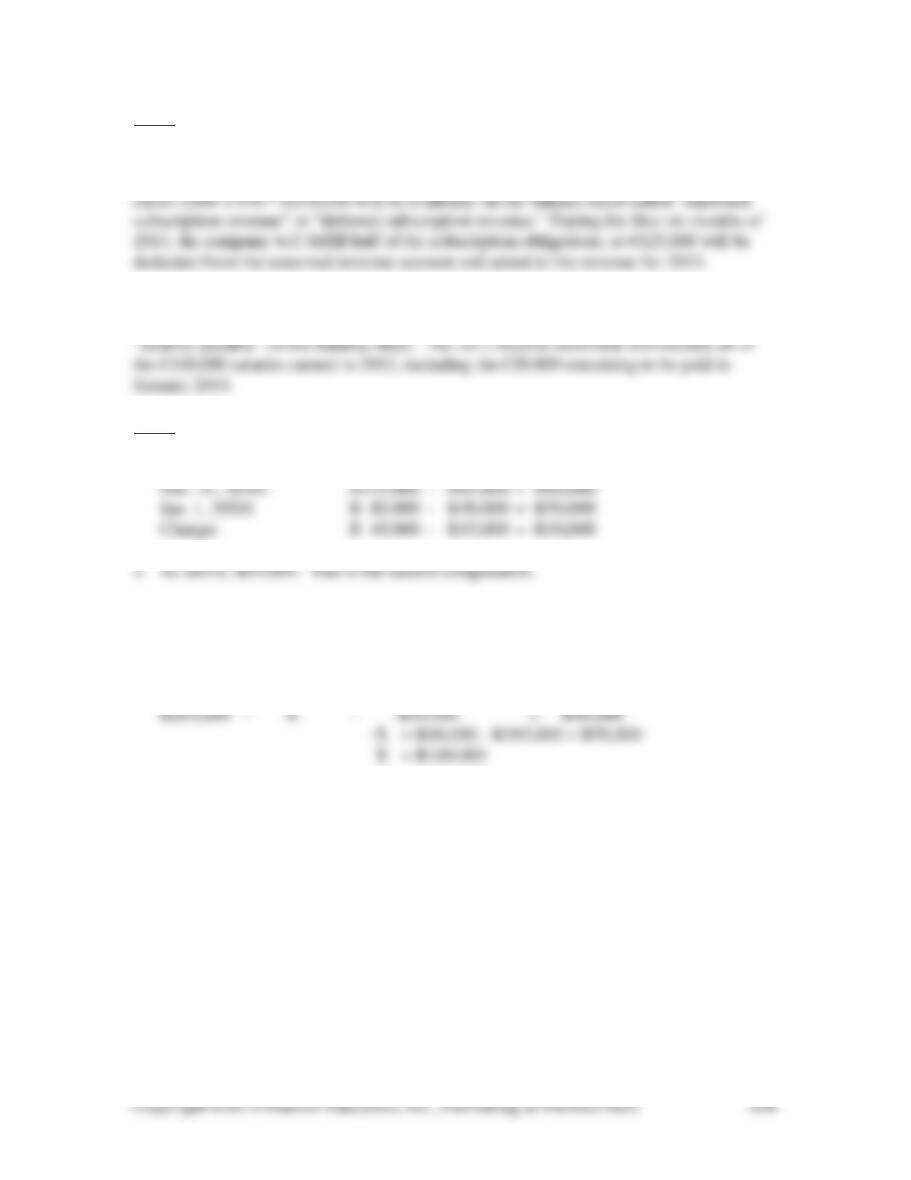
Madison Hardware, Tenant Baldwin, Landlord
A = L + SE A = L + SE
15-36 (10 min.)
1. At the end of 2012, the company has not yet delivered the magazines, so it cannot
recognize any revenue. Thus, there is no impact on the 2012 income statement. The
2. The monthly salaries were €240,000 ÷ 12 = €20,000. At the end of 2012, the
company will owe €20,000 for salaries earned in December. This will be a liability for
15-37 (15-20 min.)
Assets – Liabilities = Stockholders’ equity
2. Change in stockholders’ equity + Cash dividends = Net income
B30,000 + B16,000 = B46,000
3. Let X = Cost of goods sold
Sales – Cost of goods sold – Operating expenses = Net income