Copyright ©2014 Pearson Education, Inc., Publishing as Prentice Hall.
625
14-34 (10-15 min.)
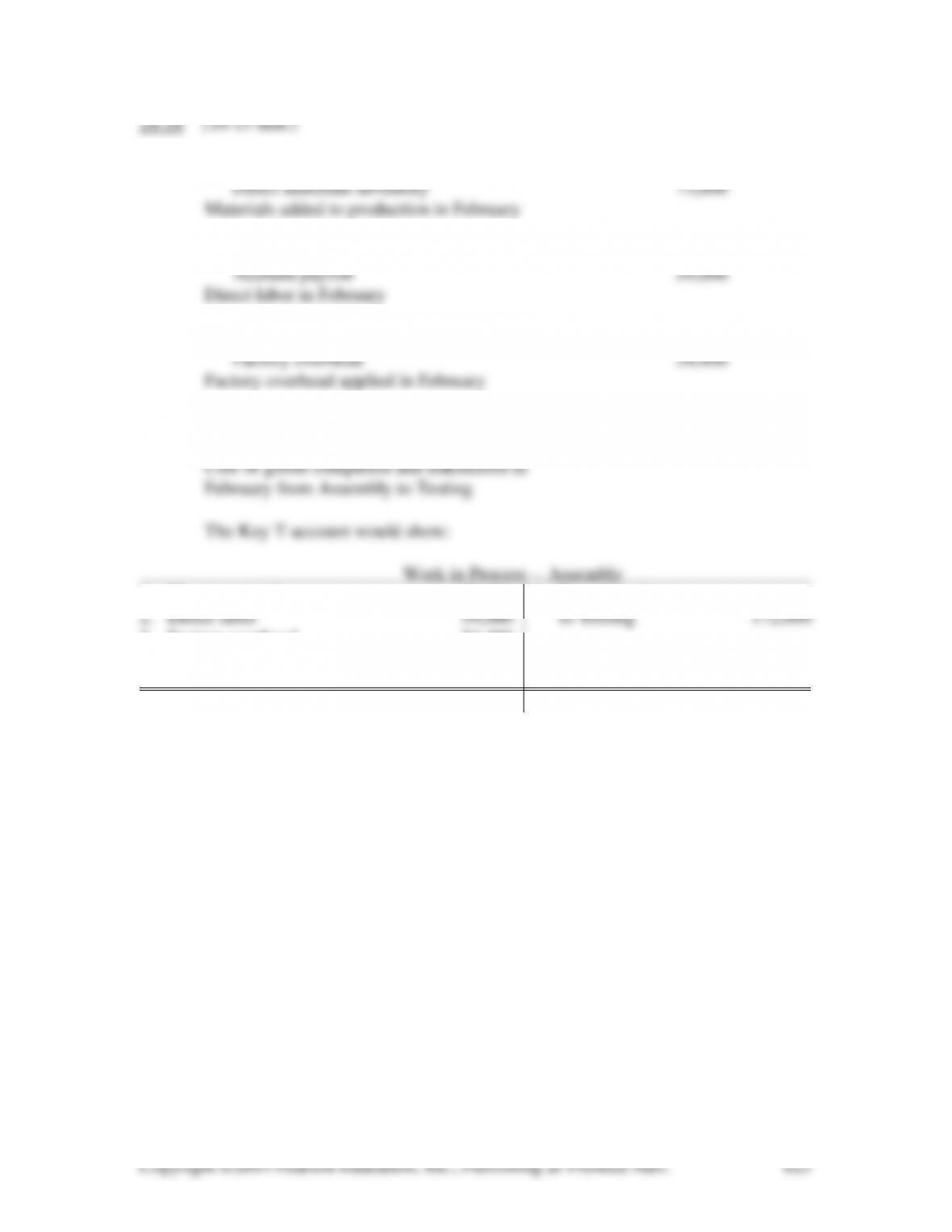
1. Work in process – Assembly 73,600
2. Work in process — Assembly 59,000
3. Work in process — Assembly 54,400
4. Work in process — Testing 172,000
Work in process — Assembly 172,000
1. Direct materials 73,600 4. Transferred out
3. Factory overhead 54,400
Bal. February 28 15,000
Copyright ©2014 Pearson Education, Inc., Publishing as Prentice Hall.
626
14-35 (10-15 min.)
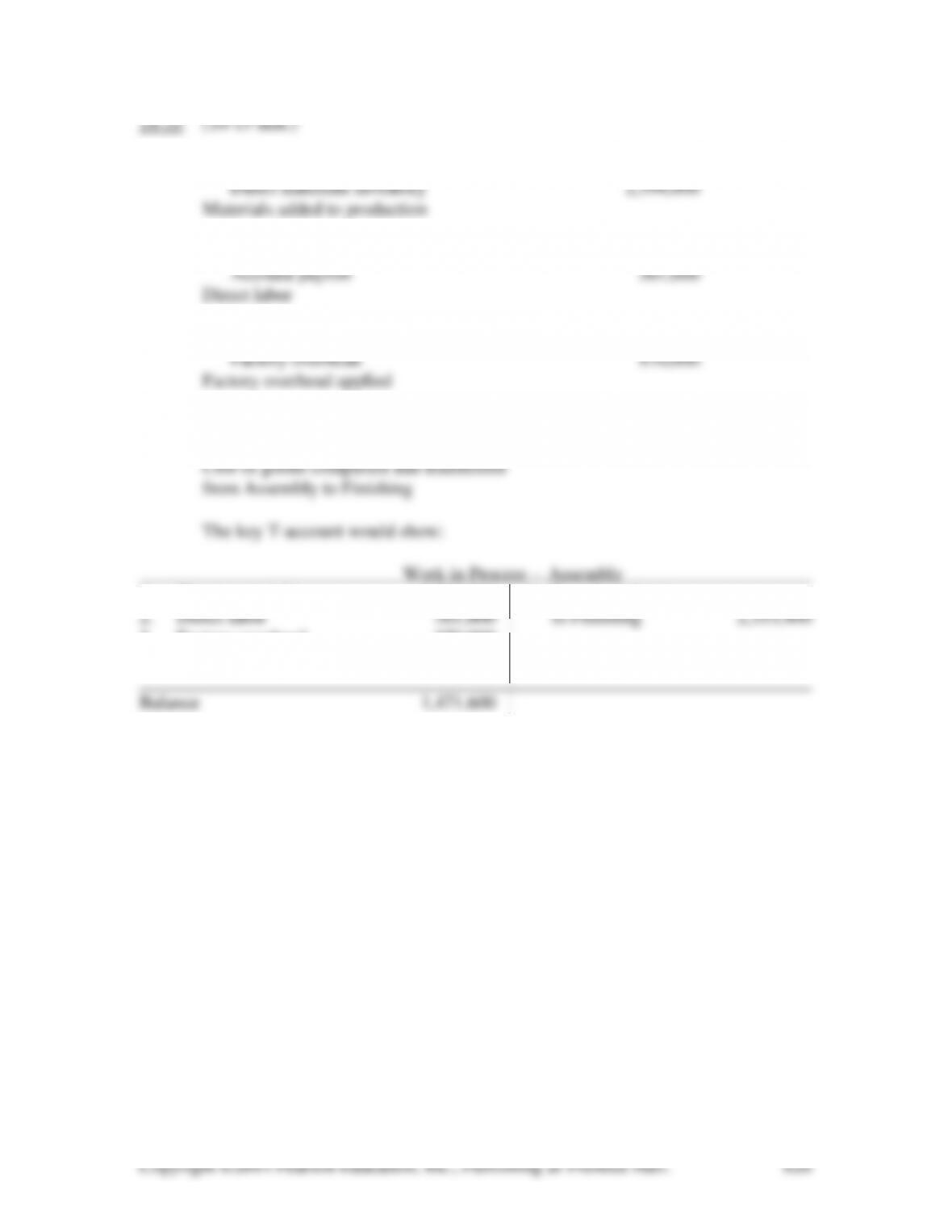
1. Work in process — Assembly 2,394,000
2. Work in process — Assembly 561,000
3. Work in process — Assembly 870,000
4. Work in process — Finishing 2,353,400
Work in process — Assembly 2,353,400
1. Direct materials 2,394,000 4. Transferred out
3. Factory overhead 870,000
14-36 (10-15 min.)
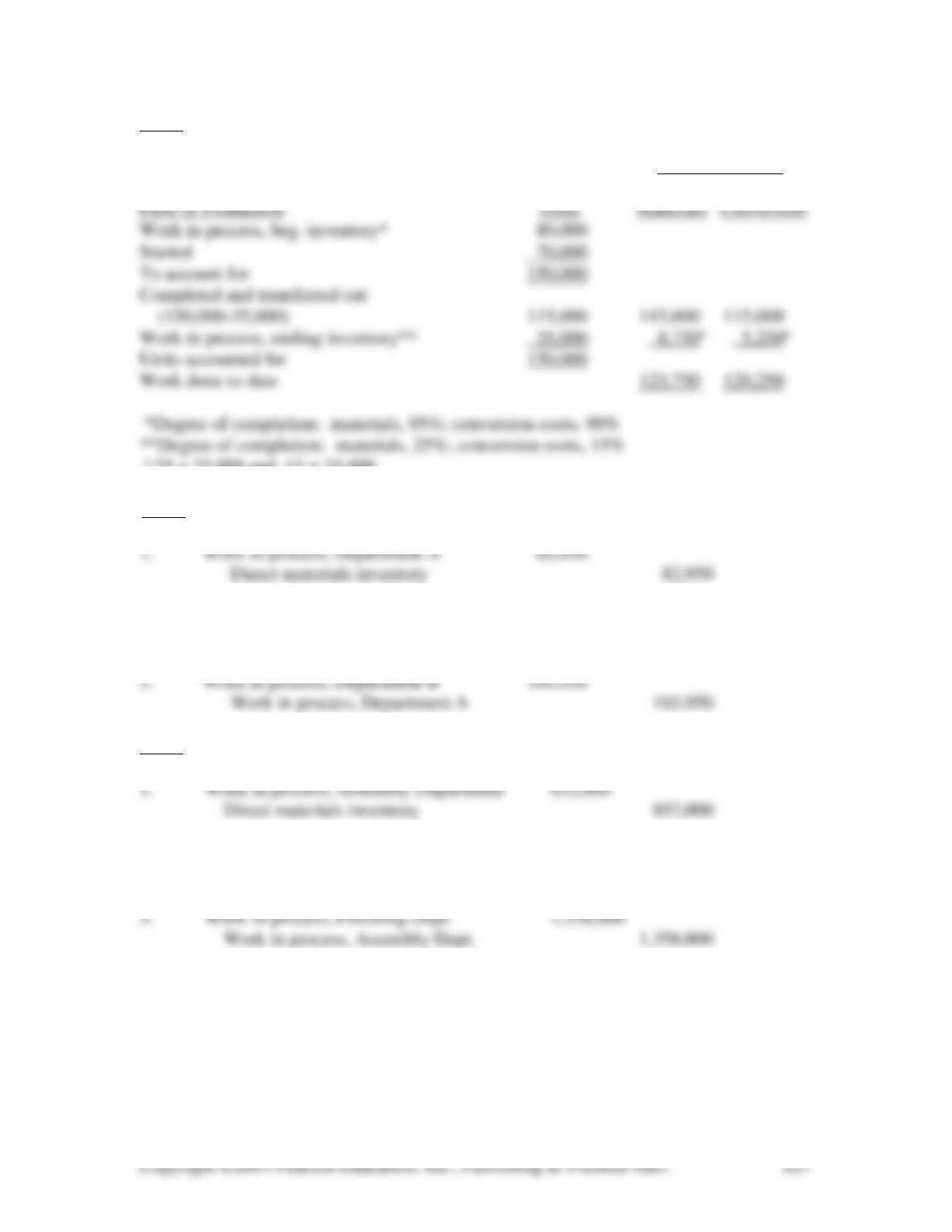
(Step 2)
(Step 1) Equivalent Units
Physical Direct
14-37 (5-10 min.)
2. Work in process, Department A 39,800
Various accounts 39,800
14-38 (5-10 min.)
2. Work in process, Assembly Department 634,500
Various accounts 634,500
14-39 (10-15 min.)
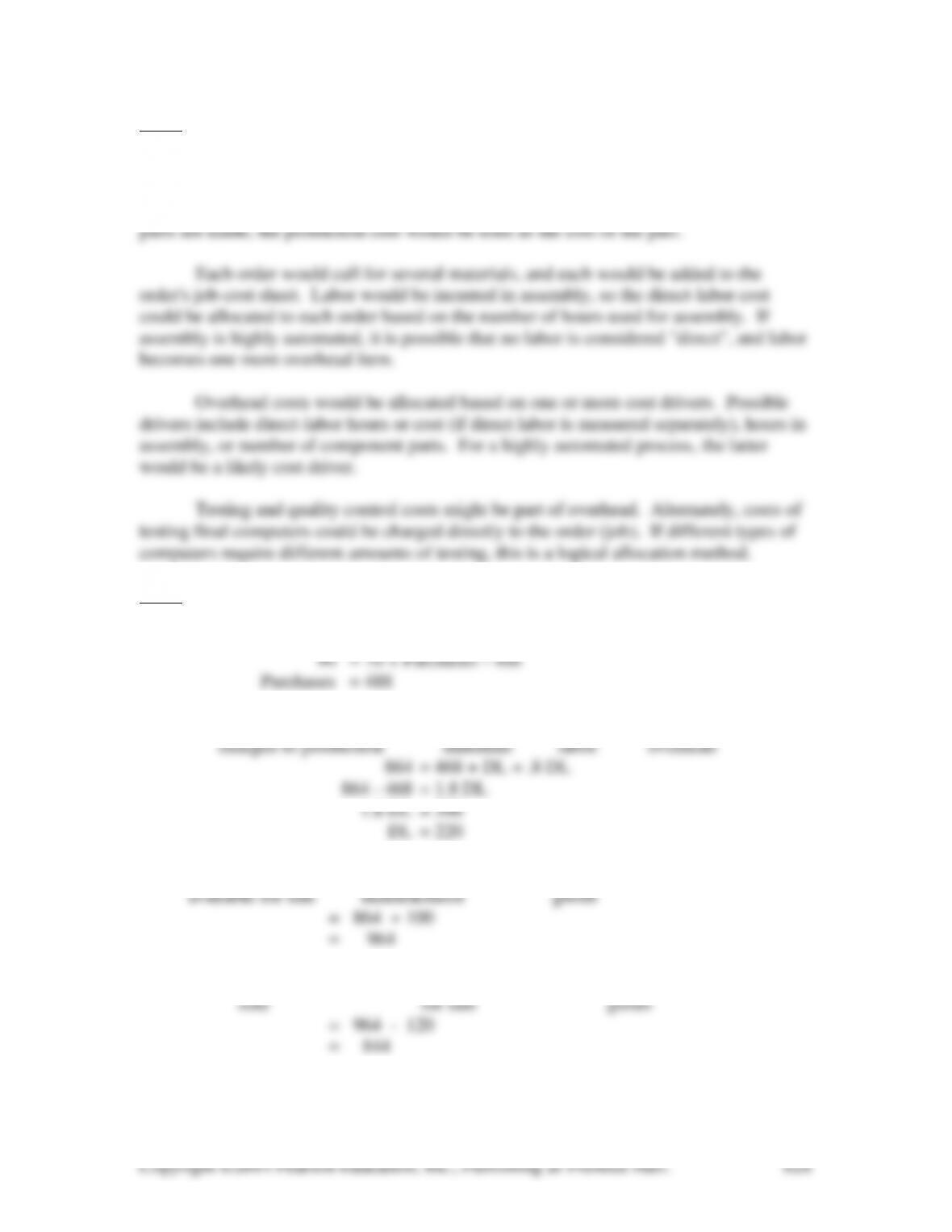
Dell would most likely use a job-cost system with each order considered a job.
Because each order is assembled from a set of common parts, there is a single cost for
each part. Most of the parts are purchased, so the cost is the purchase price. If some
14-40 (15-25 min.)
1. Ending inventory = Beginning inventory + Purchases – Usage
2. Total manufacturing costs = Direct + Direct + Factory
3. Cost of goods = Cost of goods + Beginning finished
4. Cost of goods = Cost of goods available – Ending finished
14-41 (25-35 min.)
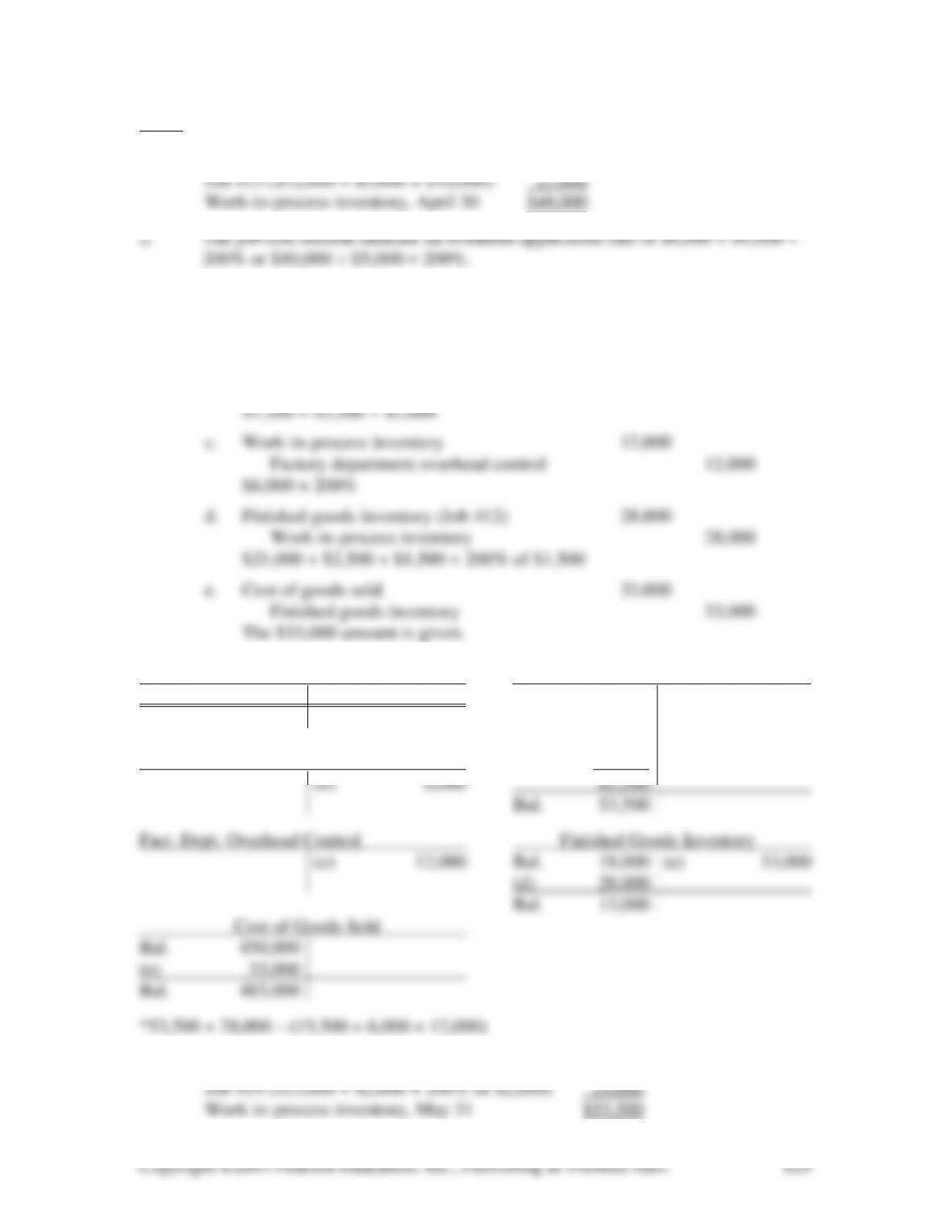
1. Job 412 ($ 9,000 + $4,000 + $8,000) $21,000
3. a. Work-in-process inventory 15,500
Direct materials inventory 15,500
Job 412 of $2,500 + Job 414 of $13,000
b. Work-in-process inventory 6,000
Accrued payroll 6,000
Direct Materials Inventory Work-in-Process Inventory
Bal. 19,000 (a) 15,500 Bal.* 48,000 (d) 28,000
Bal. 3,500 (a) 15,500
(b) 6,000
Accrued Payroll (c) 12,000
4. Job 413 ($27,000 + $2,500 + 200% of $2,500) $34,500
14-42 (20 min.)
1. Compensation for nonchargeable time,
.25 × $3,000,000 $ 750,000
2. Hourly rate:
$99,840 ÷ (48 × 40) = $99,840 ÷ 1,920 = $52.00
Many students will forget that “his work there” includes an overhead application:
14-43 (30-40 min.) Answers to requirements follow the analysis.
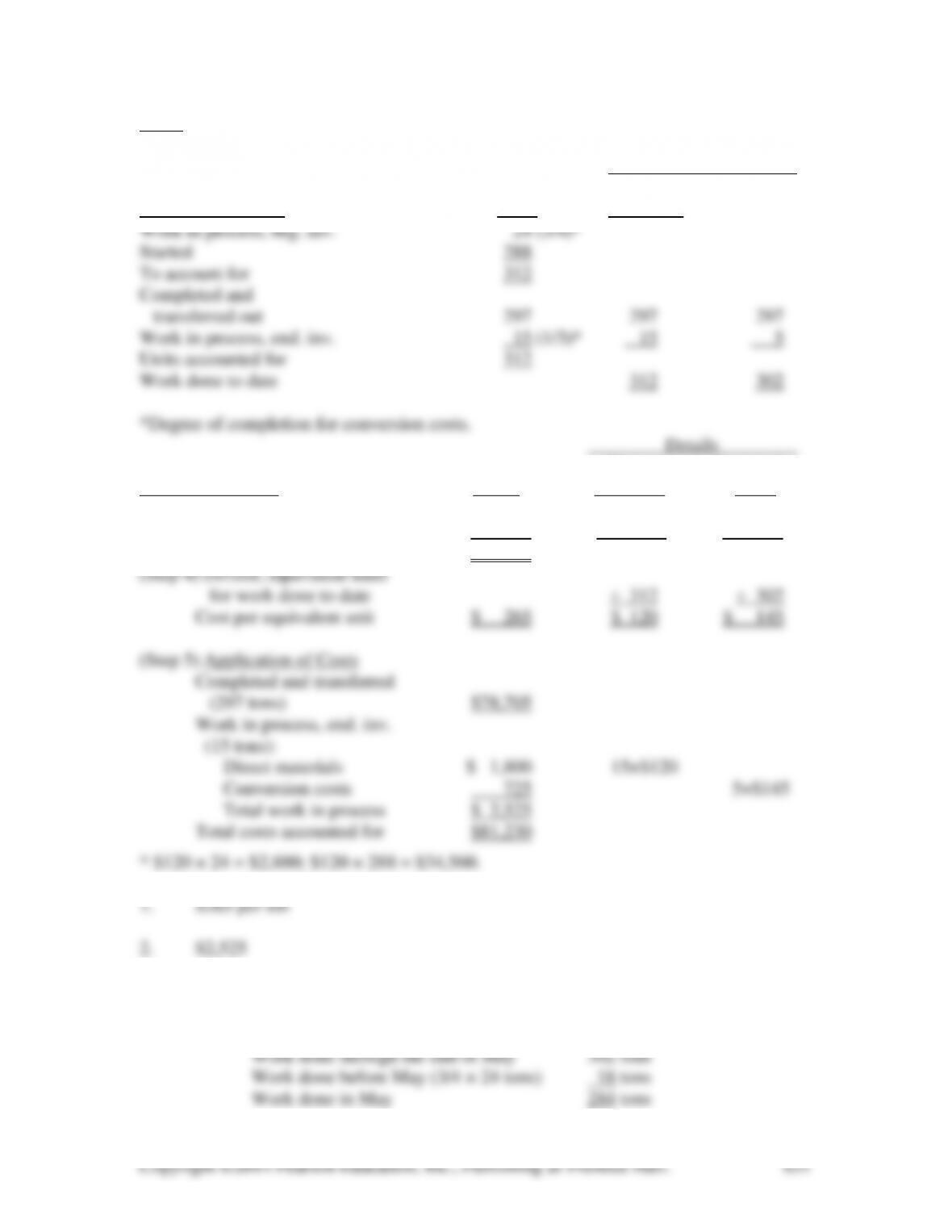
(Step 2)
(Step 1) Equivalent Units
Physical Direct Conversion
Flow of Production Units Materials
Direct Conversion
Costs Totals Materials Costs
Work in process, beg. inv. $ 6,000 $ 2,880* $ 3,120
Costs added currently 75,230 34,560* 40,670
(Step 3) Total costs to account for $81,230 $37,440 $43,790
3. This requirement cannot be answered directly from the data using the weighted
average process cost method. We must look at the equivalent units of conversion work
done in May only:
Copyright ©2014 Pearson Education, Inc., Publishing as Prentice Hall.
632
Budget for 284 tons:
$16,000 + ($80 × 284) = $38,720
Budget – Actual = $38,720 – $40,670 = $1,950 unfavorable
During May, conversion costs were $1,950 (or 5%) above budget.
14-44 (15-20 min.)
1. Potato chips are a homogeneous product with low unit cost that must be
processed through a sequence of continuous steps (sequential processing).
2. Activity-based accounting systems are most beneficial when products and/or
processes are characterized by diversity. Diversity can be in the volume of
3. Frito-Lay produces over 6,000 pounds of potato chips each hour, 24 hours a day.
This translates into more than 52 million pounds per year. Since at any point in
Copyright ©2014 Pearson Education, Inc., Publishing as Prentice Hall.
633
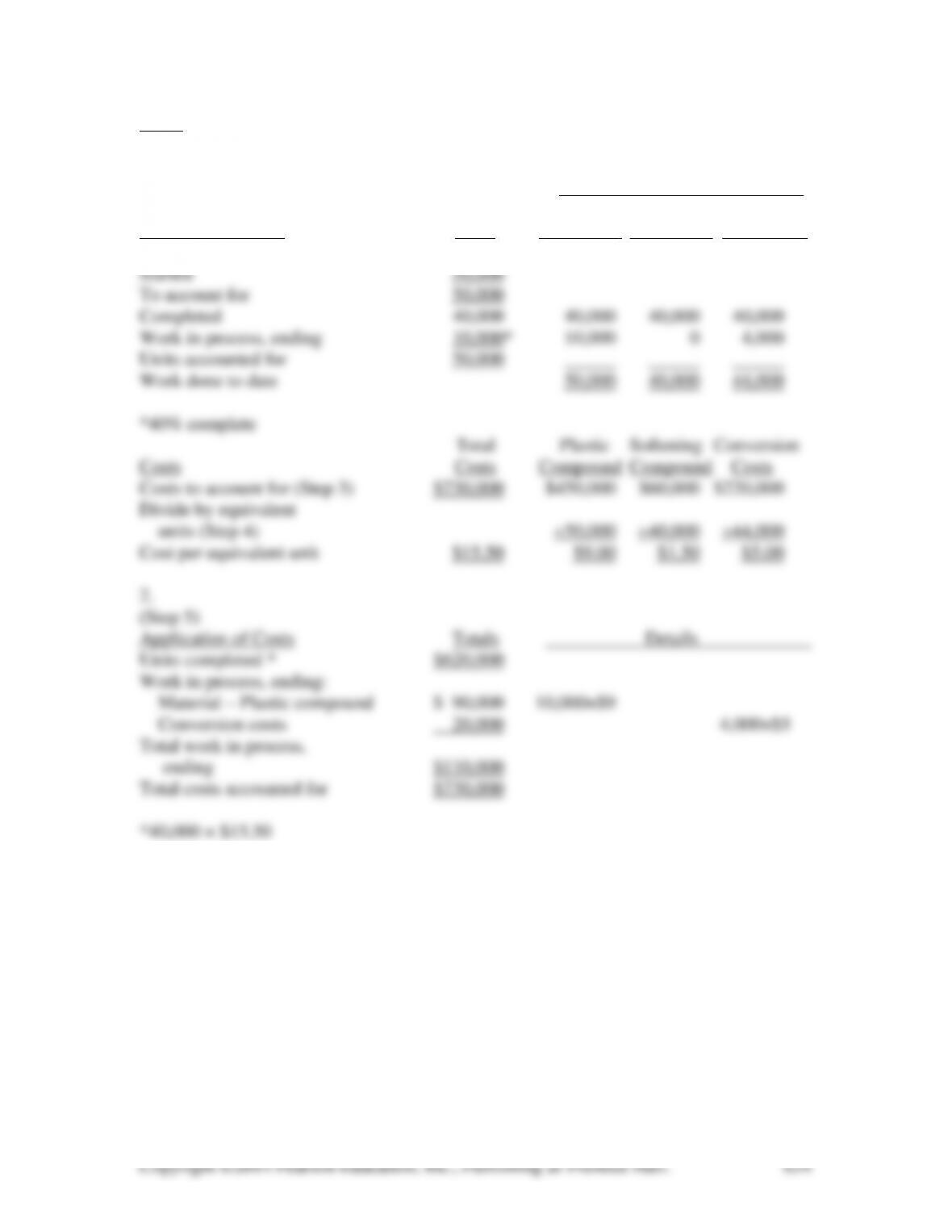
14–45 (15–20 min.)
1. (Step 2)
(Step 1) Equivalent Units
Physical Materials
2. Details
Total Materials Conversion
3. Ending work in process, 1,600,000 units:
Materials and supplies, 1,600,000 × $.05 $ 80,000
14-46 (20 min.)
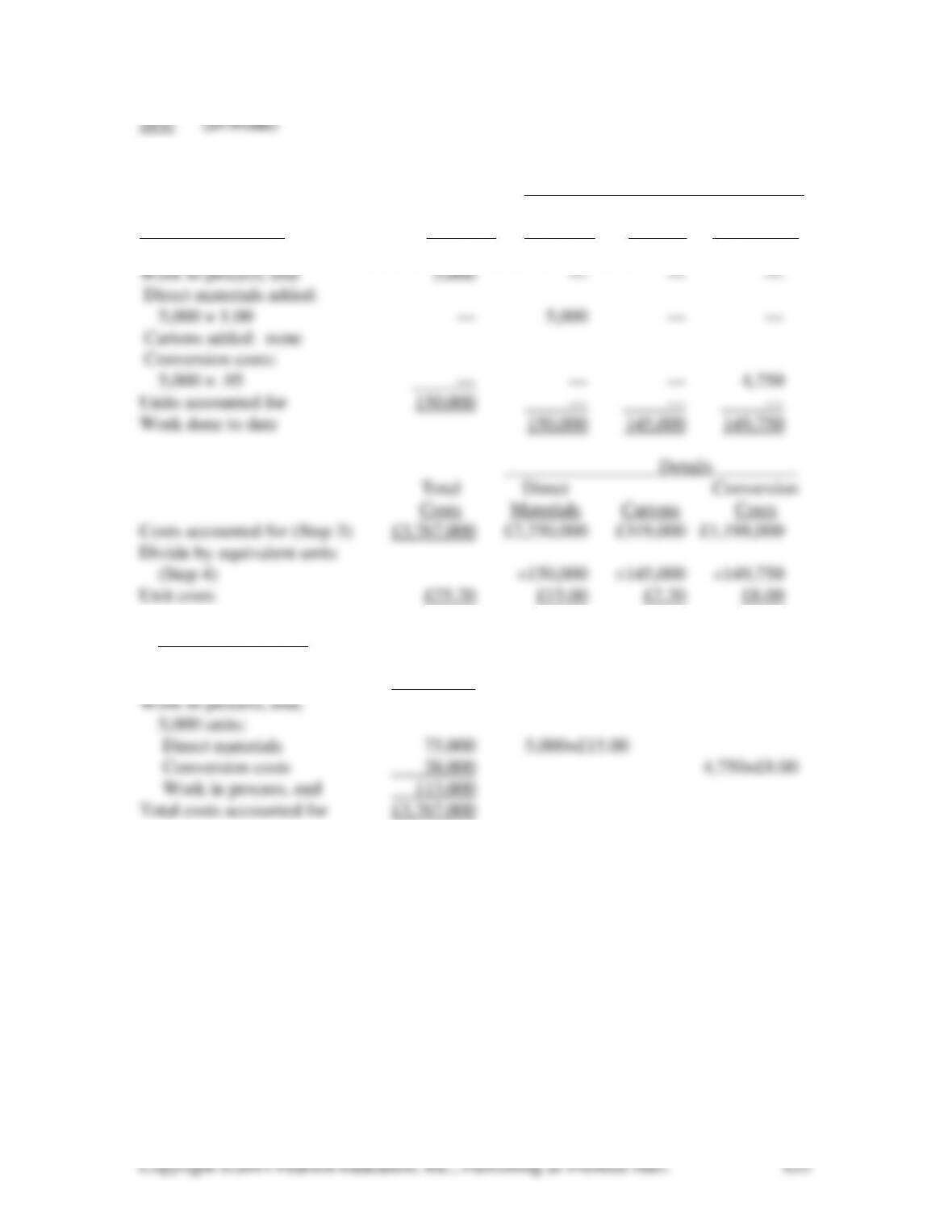
1. (Step 2)
(Step 1) Equivalent Units
Physical Plastic Softening
Flow of Production Units Compound Compound Conversion
Work in process, beginning 0
Copyright ©2014 Pearson Education, Inc., Publishing as Prentice Hall.
635
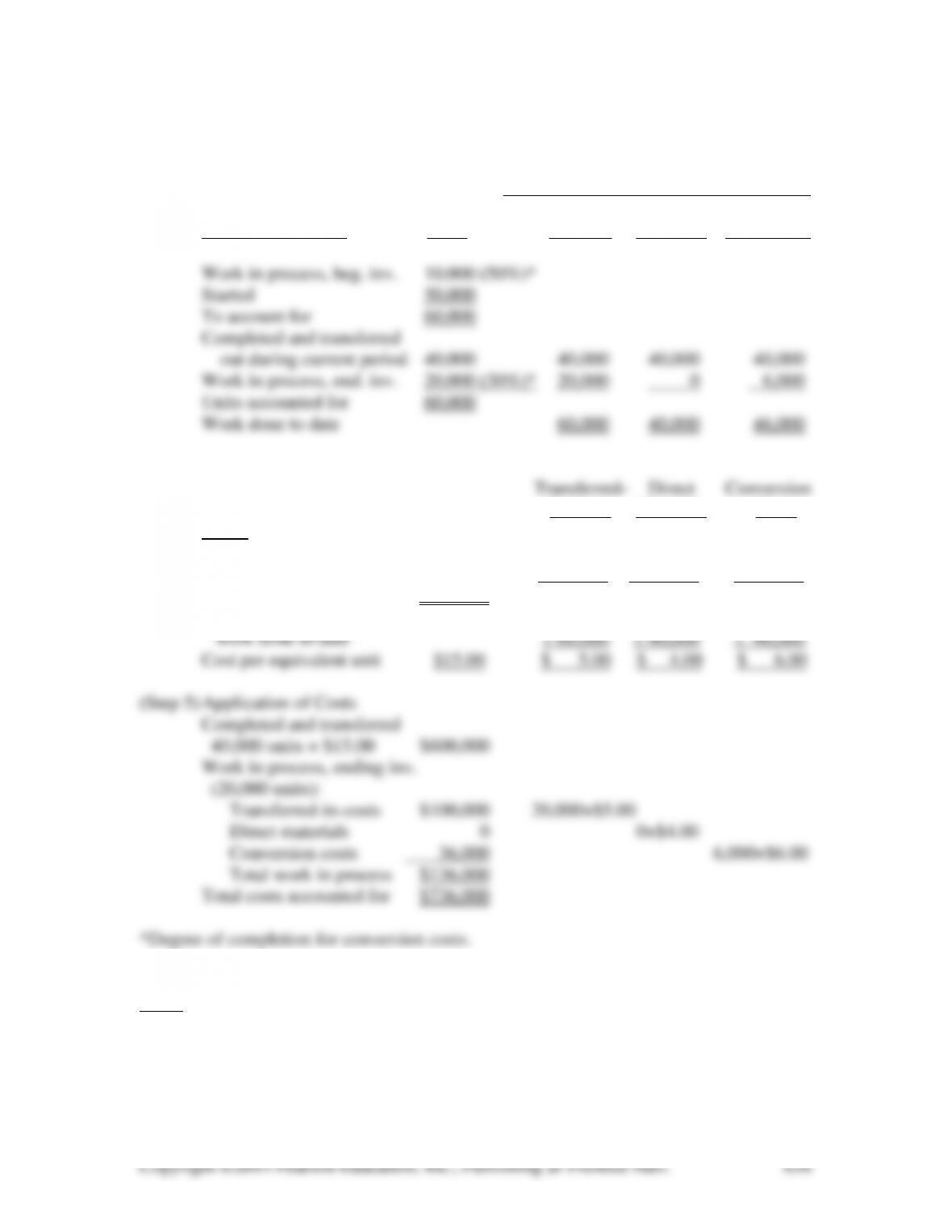
14–47 (20–30 min.)
1. Step 2
(Step 1) Equivalent Units
Physical Direct
Flow of Production Flow Materials Cartons Conversion
Units started and completed 145,000 145,000 145,000 145,000
2. Application of costs (Step 5):
To units completed,
145,000 × £25.20 £3,654,000
14-48 (25-30 min.)
(Step 2)
(Step 1) Equivalent Units
Physical Transferred- Direct
Flow of Production Units In-Costs Materials Conversion
In Costs Materials Costs
Costs:
Work in process, beg. inv. $ 50,000 $ 40,000 $ 30,000
Costs added currently 250,000 120,000 246,000
(Step 3) Total costs to account for $736,000 $300,000 $160,000 $276,000
(Step 4) Divisor, equivalent units for
14-49 (15-20 min.)
1. Materials and parts inventory 273,800
Accounts payable or cash 273,800
Copyright ©2014 Pearson Education, Inc., Publishing as Prentice Hall.
637
Conversion costs 89,600
Accrued payroll, accounts payable,
accumulated depreciation, etc. 89,600
Finished goods inventory (12,800 × $28) 358,400
Materials and parts inventory (12,800 × 21) 268,800
Conversion costs (12,800 × $7) 89,600
2. Cost of goods sold 358,400
Finished goods inventory 358,400
month.
3. Because the balance in the Conversion Costs account must be zero at the end of
the month, and because only $89,600 was transferred out of the Conversion
14-50 (15-20 min.) Amounts are in dollars.
Direct Materials Work in Process
90,000 Beg. Bal. 120,000 To Fin. Gds. 220,000
Dir. Materials 90,000
1. Cost of goods sold comes from the finished goods account:
2. Let EB = Ending balance in work in process
4. Since overhead is overapplied by $80,000, the adjusted CGS = 160,000 – 80,000 =
80,000.
14-51 (15-20 min.) Amounts are in dollars.
Direct Materials Work in Process
20,000 50,000 Beg. Bal. 300,000 To Fin. Gds. 600,000
1. Direct materials used:
3. Cost of Goods manufactured is (from the WIP account):
4. Cost of goods sold before adjustment for over- or under-applied overhead comes
from the finished goods account:
14-52 (20-25 min.)
1. Contract manufacturers make apparel, footwear, and equipment products for
Nike. Almost all these products would be made through process manufacturing so the
2. The choice of cost-allocation base is a key to accurate costing of products and
customers. Managers at the various distribution centers give much thought to the
selection of plausible and reliable cost-allocation bases since there are many from which
to choose for a specific activity- or cost-resource pool. The suggestions below should
14-53 (30-40 min.) For the solution to this Excel Application Exercise, follow the step-
14-54 (45 min. or more)
The purpose of this exercise is to make students think about the characteristics of
real production processes and how to account for them. Depending on the assumptions
students make about the type of production process used in each of these examples, they
Copyright ©2014 Pearson Education, Inc., Publishing as Prentice Hall.
641
may suggest a different type of accounting system than those listed on the next page.
These are just suggestions about what the groups might conclude.
a. Process costing, because there are large volumes of identical product.
b. Process costing. Although each application is unique, it is likely that identifying
the differences and trying to account for them is not cost-benefit efficient.
c. Probably job costing. It depends on how many identical couches students think
that Ethan Allen makes at one time. If each is unique, or if small batches are
produced, a job-costing system is most likely used.
d. Job costing. Major construction projects are generally treated as a single job.
e. Process costing. Refining oil into gasoline is a classic process-costing
environment, where there is a single continuous process.
f. Job costing. Each order at FedEx Office’s is unique. The only question is
whether it is cost-benefit efficient to determine job costs for each order.
g. Job costing. Each ferry built is a single job, although there may be parts that are
produced in a process that allows process costing.
14-55 (30-40 min.) NOTE TO INSTRUCTOR. This solution is based on the Web sites
1. Land’s End is mainly a merchandising firm. The main activity is selling clothing to
individuals, although the firm also engages in some corporate sales. Process-costing
2. La-Z-Boy is a manufacturing firm. Its main activity is manufacturing furniture. The
firm states that it has an extensive line of furniture products – in many types and
3. Tasty Baking Company is a manufacturing firm. The firm makes large volumes of