CHAPTER 13
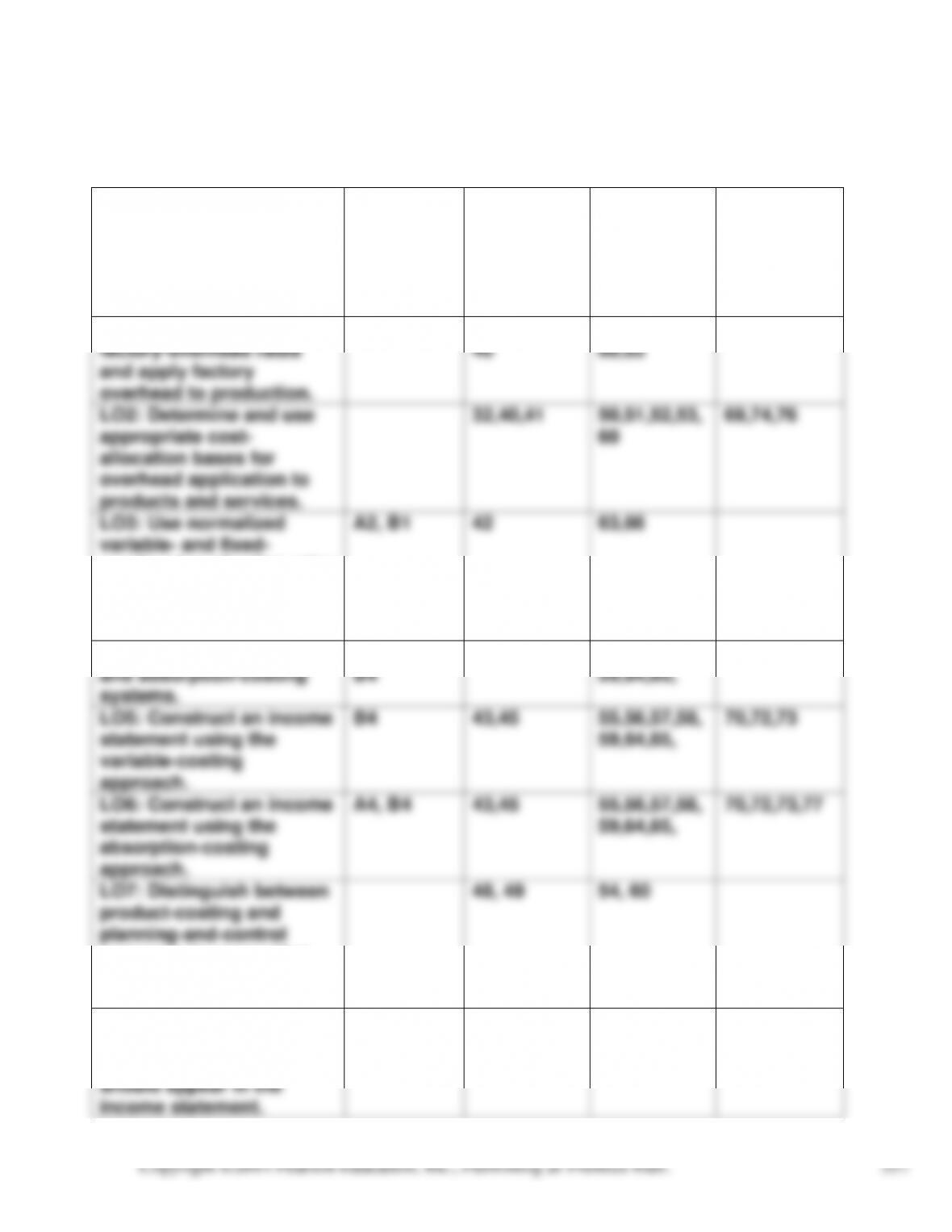
COVERAGE OF LEARNING OBJECTIVES
LEARNING OBJECTIVE
FUNDA-
MENTAL
ASSIGN-
MENT
MATERIAL
CRITICAL
THINKING
EXERCISES
AND
EXERCISES
PROBLEMS
CASES,
NIKE 10K,
EXCEL,
COLLAB. &
INTERNET
EXERCISES
LO1: Compute budgeted
factory-overhead rates
and apply factory
overhead to production.
A1,B2
33,34,38,39,
40
50,51,52,53,
60,63
69,75,76
LO2: Determine and use
appropriate cost-
allocation bases for
overhead application to
products and services.
32,40,41
50,51,52,53,
60
69,74,76
LO3: Use normalized
variable- and fixed-
overhead application rates
and explain the
disposition of overhead
variances.
A2, B1
42
63,66
LO4: Compare variable-
and absorption-costing
systems.
A3, A4, B3,
B4
35,43,44,45
55,56,57,58,
59,64,65,
70,72,73
LO5: Construct an income
statement using the
variable-costing
approach.
B4
43,45
55,56,57,58,
59,64,65,
70,72,73
LO6: Construct an income
statement using the
absorption-costing
approach.
A4, B4
43,45
55,56,57,58,
59,64,65,
70,72,73,77
LO7: Distinguish between
product-costing and
planning-and-control
purposes in accounting
for variable and fixed
costs.
48, 49
54, 60
LO8: Compute the
production-volume
variance and show how it
should appear in the
income statement.
36,37,46,47,
48,49
60,61,62,67,
68,
71,72,73

LO9: Reconcile variable-
and absorption-costing
operating income and
explain why a company
might prefer to use a
variable-costing
approach.
B4
55,56,61,64
70
Copyright ©2014 Pearson Education, Inc., Publishing as Prentice Hall.
559
CHAPTER 13
Accounting for Overhead Costs
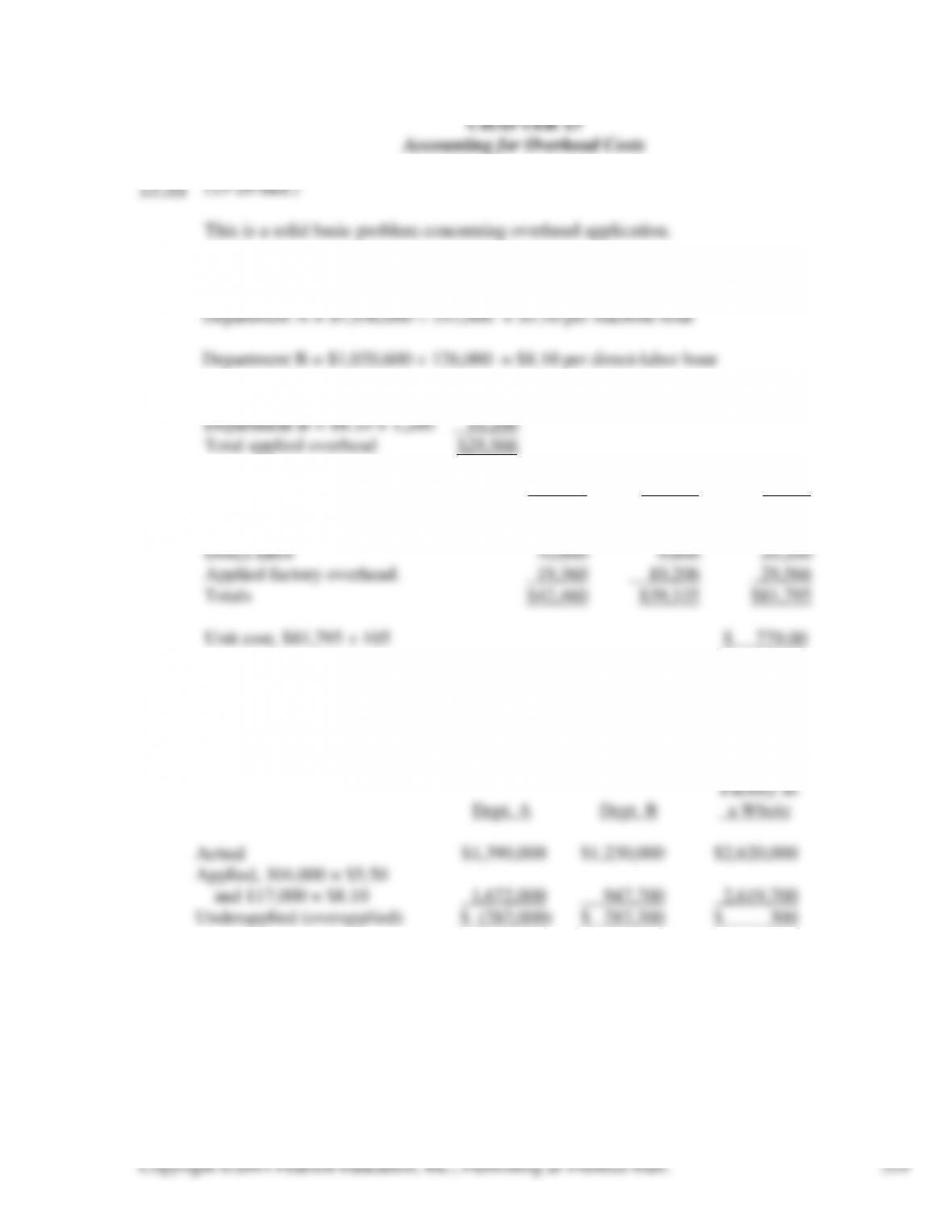
1. Overhead rate = Budgeted overhead ÷ Appropriate cost driver
2. Department A = $5.50 × 3,520 $19,360
3. Dept. A Dept. B Total
Direct material $12,500 $19,529 $32,029
4. Students must be on guard to get their definitions clear. “Overapplied” essentially means that
“actual” overhead is less than that absorbed by (applied to) the products worked on during the
period.
Computations follow:
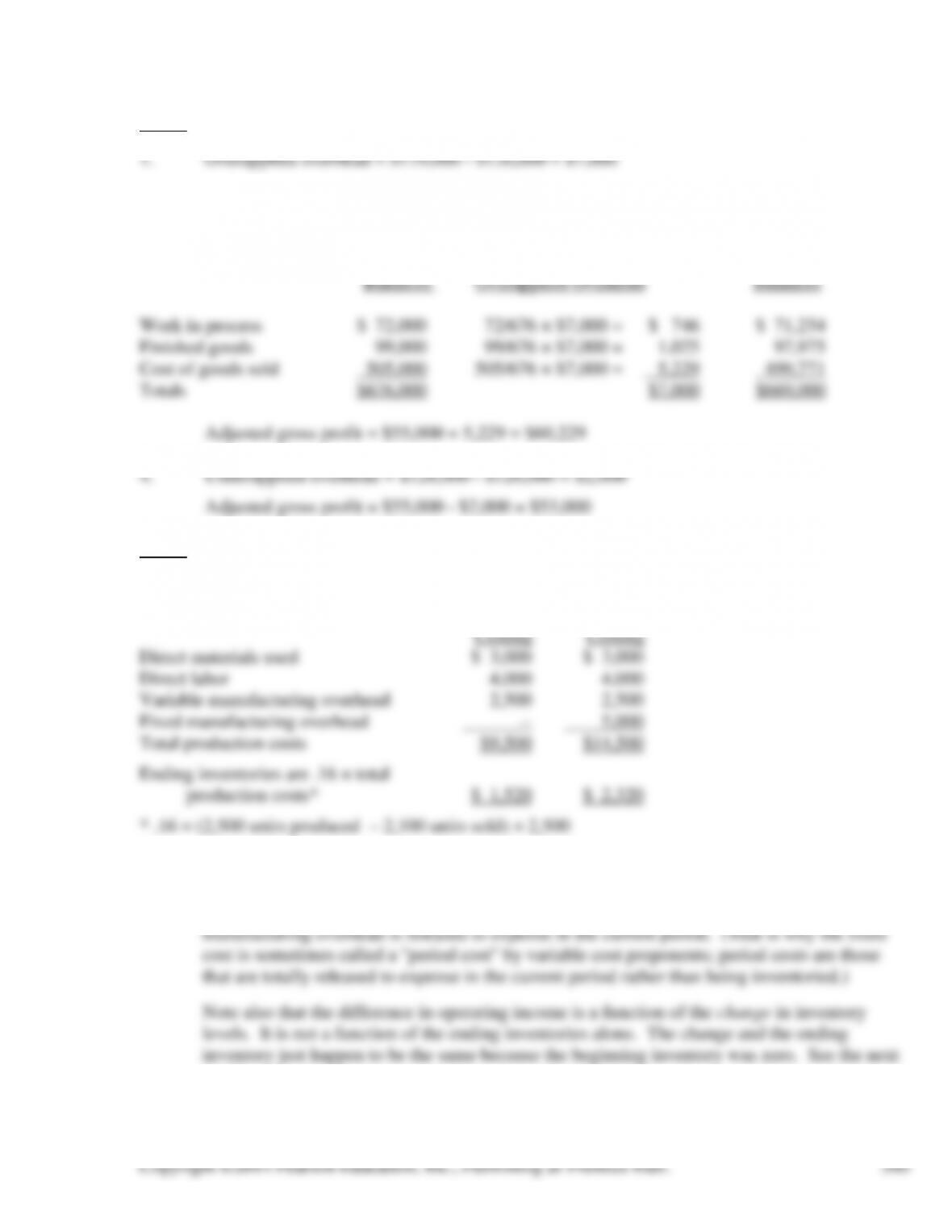
13-A2 (15 min.) Note that the direct materials inventory is irrelevant.
2. Adjusted gross profit = $55,000 + $7,000 = $62,000
3. Proration schedule:
Unadjusted Proration of Adjusted
13-A3 (15-20 min.) Gross margin and ending direct-materials inventories are irrelevant.
1. & 2. (1) (2)
Variable Absorption
3. The $800 difference in ending inventories is accounted for by the 16% of the $5,000 fixed
manufacturing overhead that is lodged in ending inventory under absorption costing.
Operating income would be $800 lower under variable costing because all of the fixed
problem.
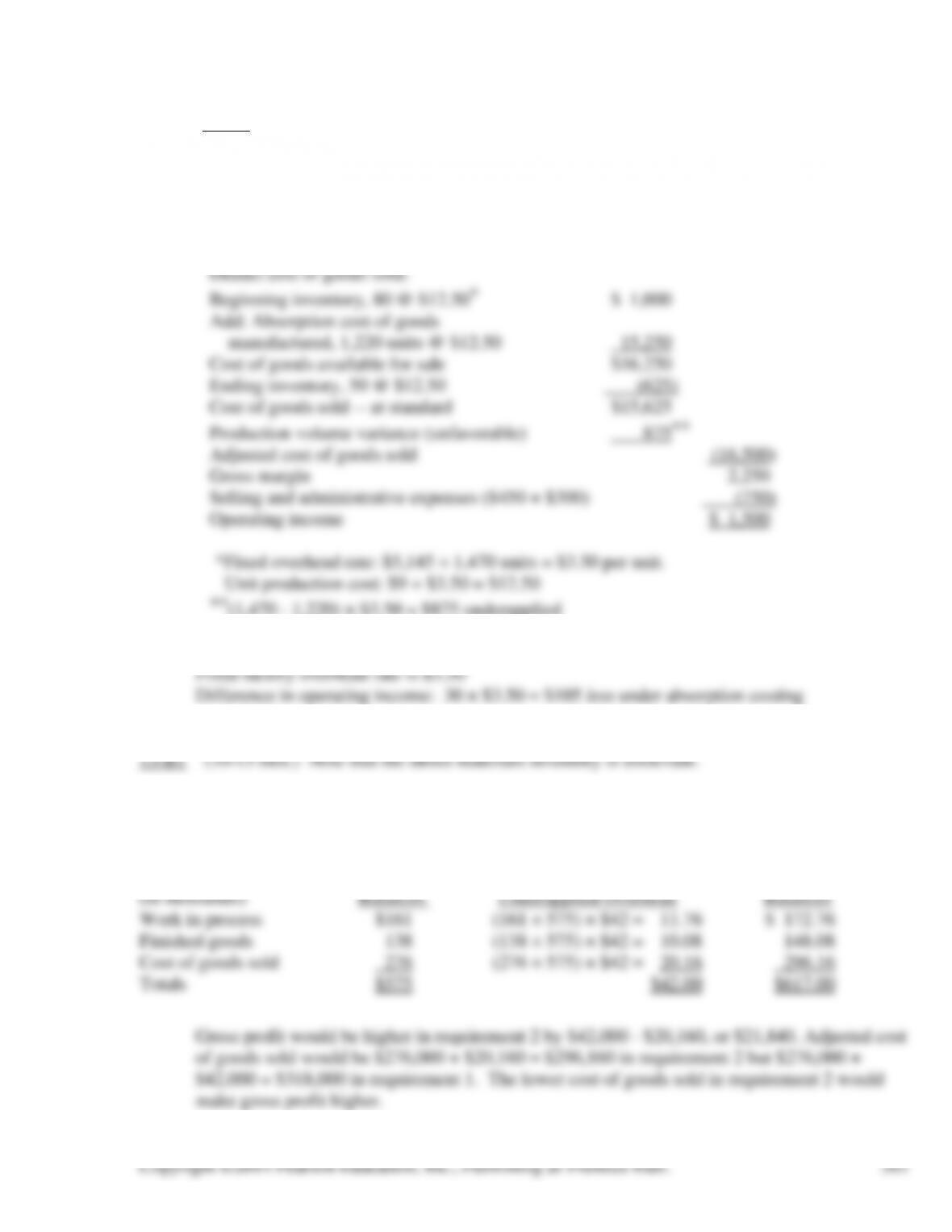
13-A4 (20-30 min.)
1. HOFFMAN COMPANY
Absorption Costing Income Statement
For the Year Ended December 31, 20X1
Sales $18,750
2. Change in inventory units 80 – 50 = 30 decrease
1. Adjusted cost of goods sold is $276,000 plus $42,000 or $318,000.
2.
Unadjusted Proration of Adjusted
13-B2 (15-20 min.)
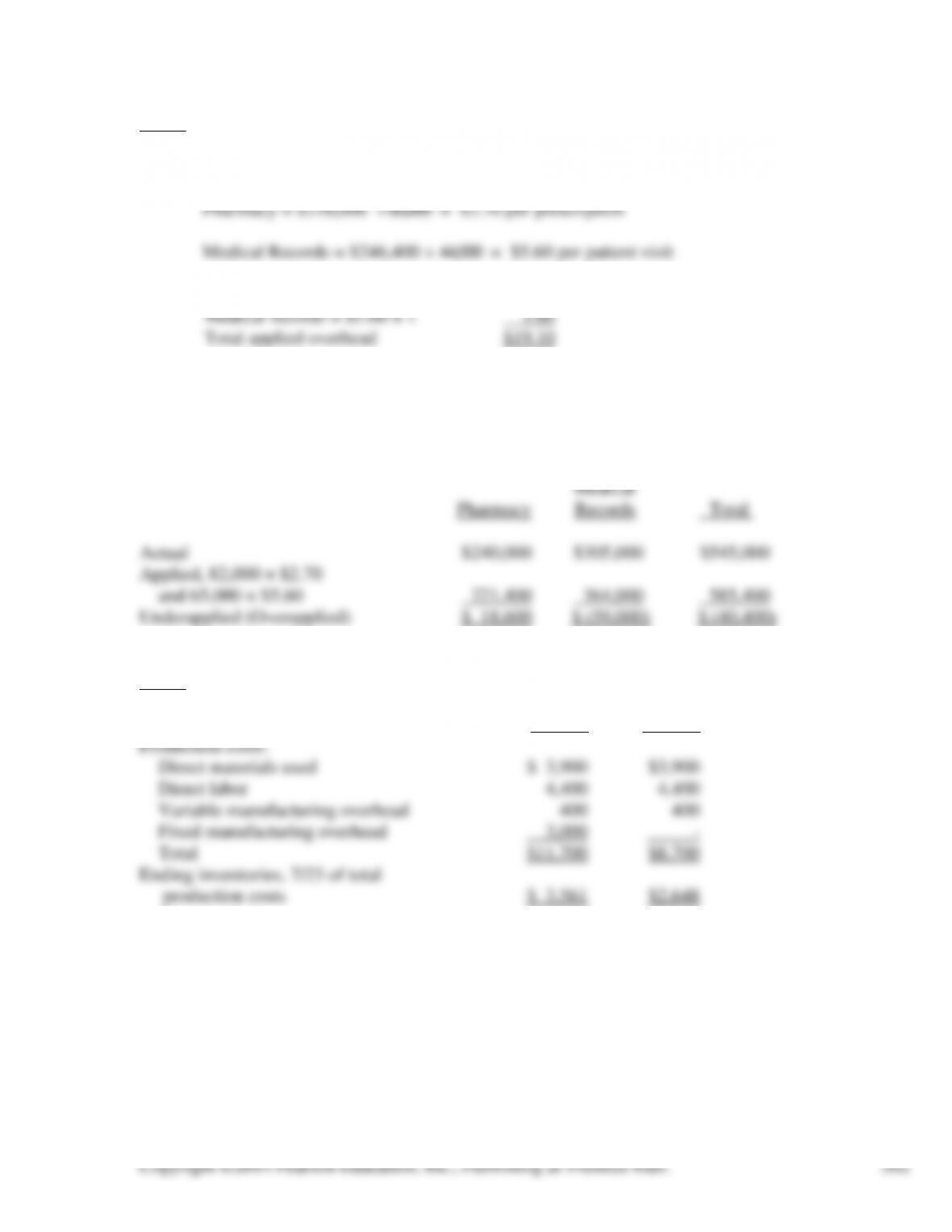
1. Overhead rate = Budgeted overhead ÷ Budgeted Cost Driver Level
2. Pharmacy = $2.70 × 5 $13.50
3. Students must be on guard to get their definitions clear. “Overapplied” essentially means that
“actual” overhead is less than that absorbed by (applied to) the products worked on during the
period.
Computations follow:
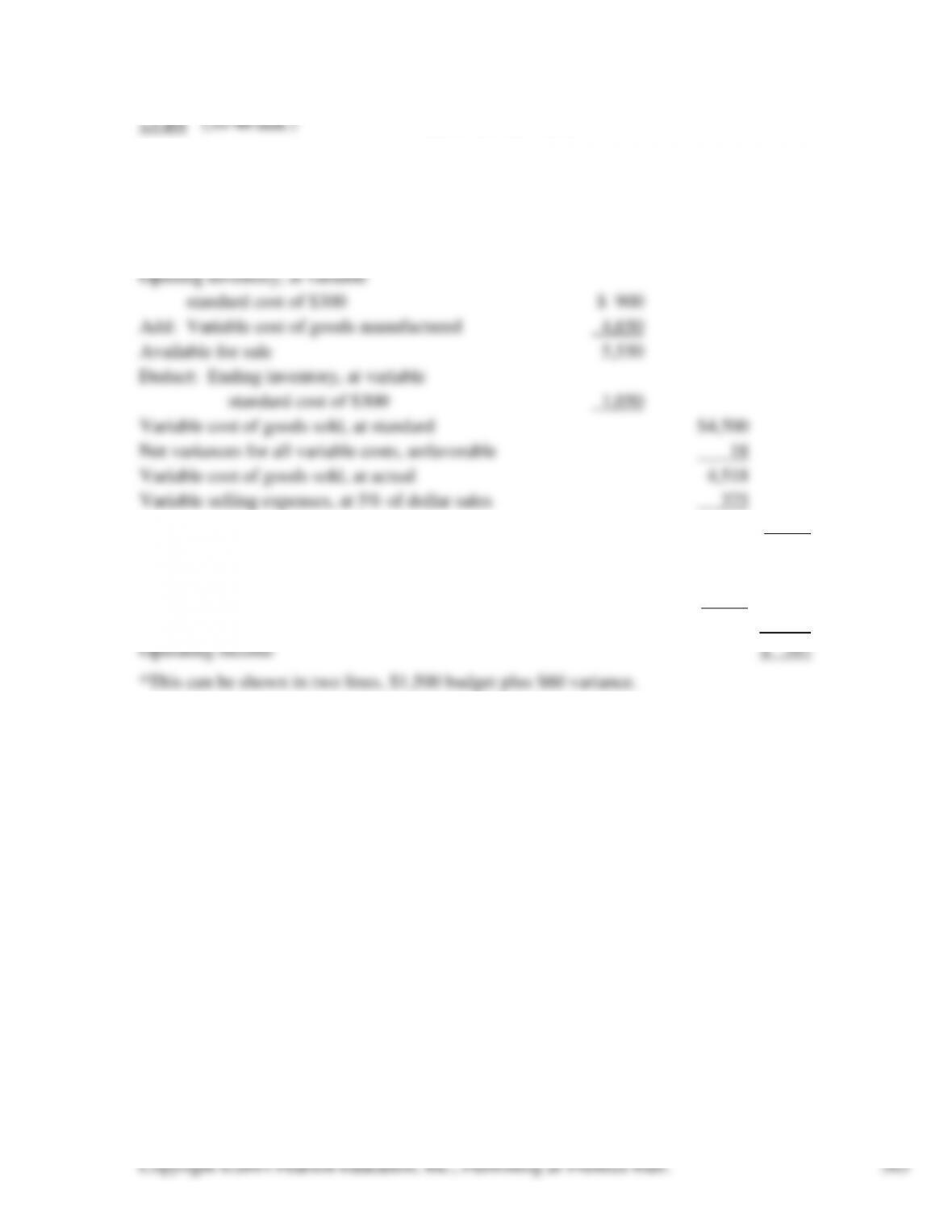
13-B3 (10 min.) (1) (2)
Absorption Variable
Costing Costing
Copyright ©2014 Pearson Education, Inc., Publishing as Prentice Hall.
563
13-B4 (30-40 min.)
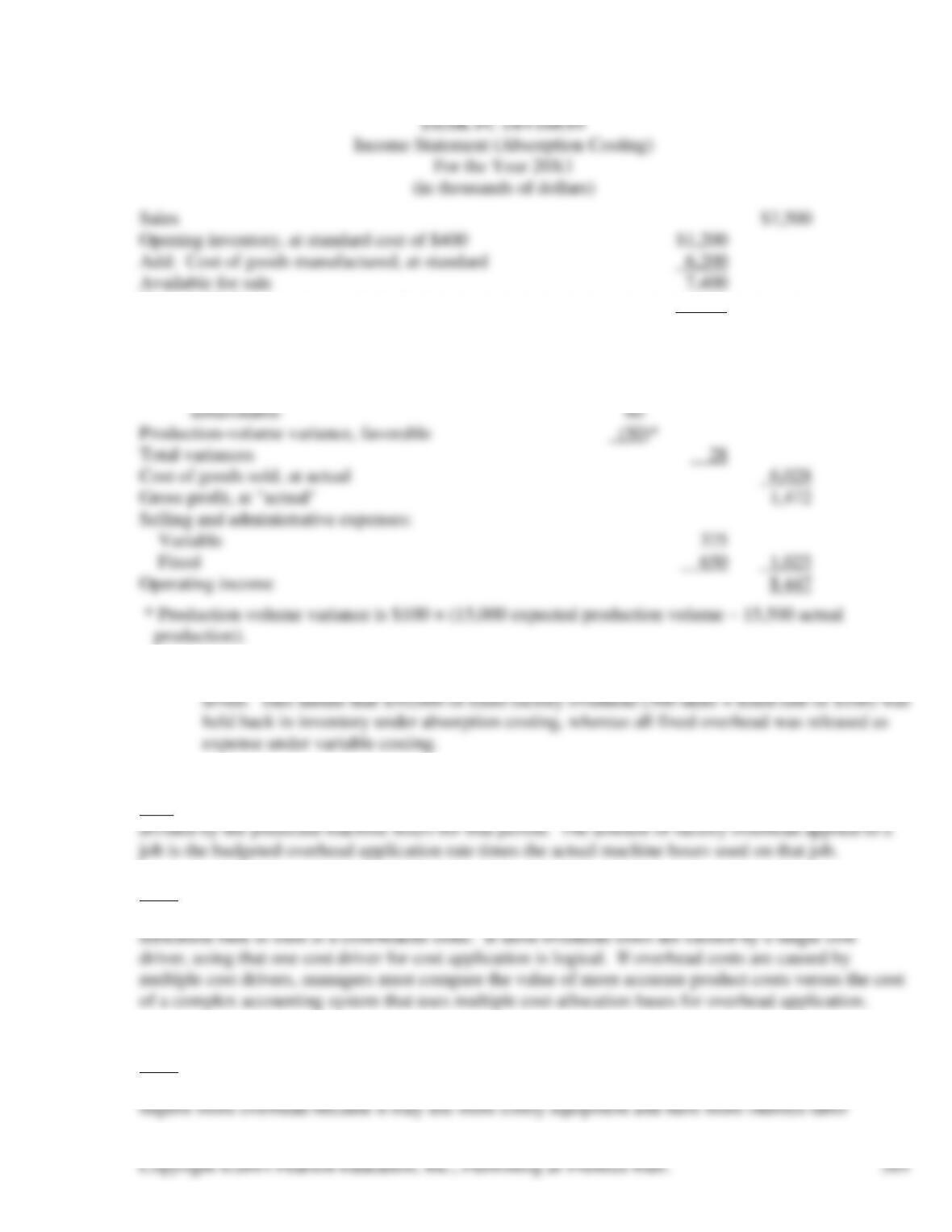
1. DESK PC DIVISION
Income Statement (Variable Costing)
For the Year 20X1
(in thousands of dollars)
Sales (15,000 × $500) $7,500
Total variable costs charged against sales 4,893
Contribution margin 2,607
Fixed factory overhead 1,560*
Fixed selling and administrative expenses 650
Total fixed expenses 2,210
Copyright ©2014 Pearson Education, Inc., Publishing as Prentice Hall.
564
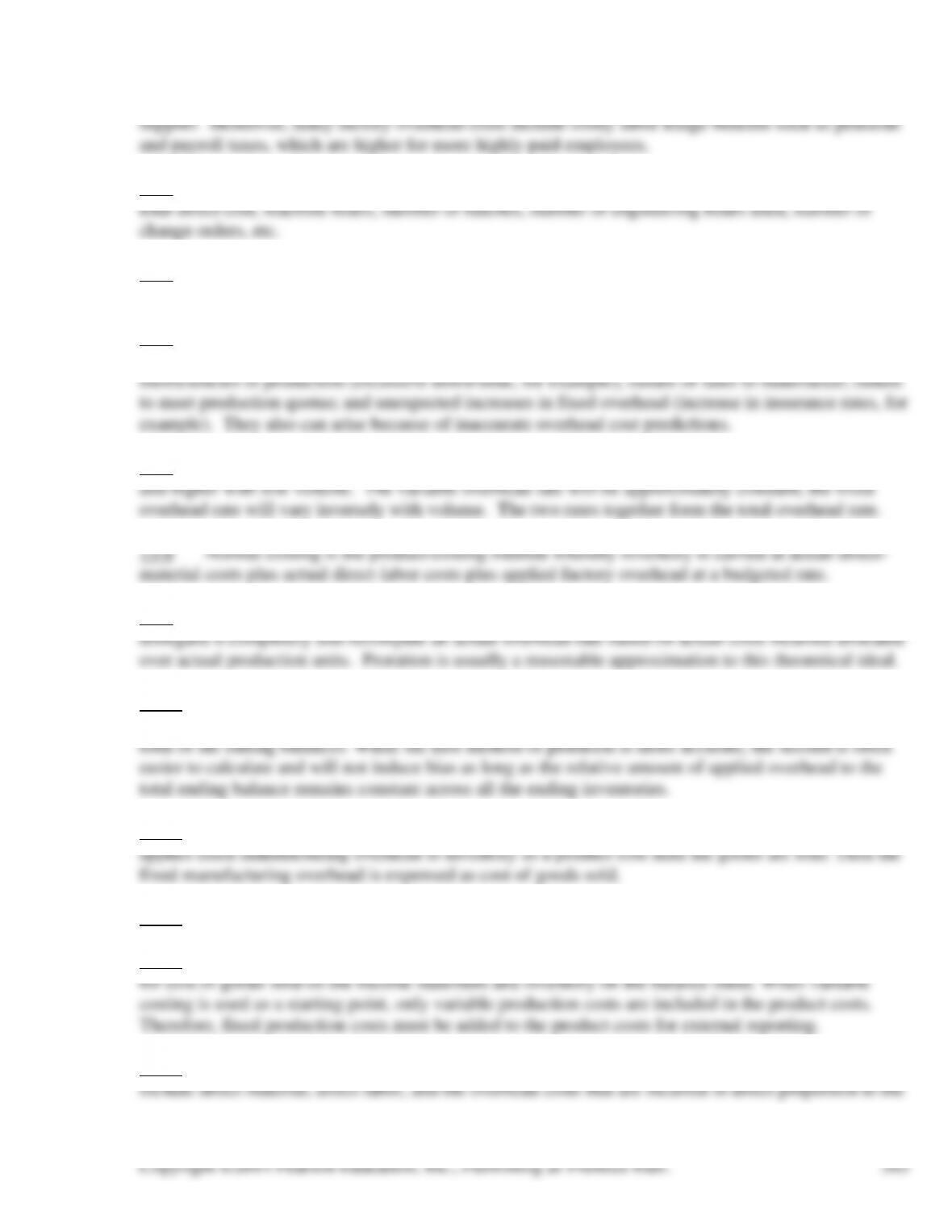
DESK PC DIVISION
Income Statement (Absorption Costing)
For the Year 20X1
(in thousands of dollars)
Sales $7,500
Opening inventory, at standard cost of $400 $1,200
Add: Cost of goods manufactured, at standard 6,200
Available for sale 7,400
Deduct: Ending inventory, at standard 1,400
Cost of goods sold, at standard 6,000
Net variances for variable manufacturing
costs, unfavorable $18
Fixed factory overhead budget variance,
2. The $50,000 difference in operating income is attributable to the 500-unit increase in inventory
13-1 The budgeted overhead application rate is the predicted factory overhead for the budget period
13-2 No. In the past, most organizations have used only one cost-allocation base per department.
However, the trend is toward using multiple cost-allocation bases. Whether more than one cost-
13-3 Yes. Direct-labor cost may be the best cost-allocation base for overhead allocation even if
wage rates vary within a department. For example, higher skilled labor (with higher wage rates) may
Copyright ©2014 Pearson Education, Inc., Publishing as Prentice Hall.
565
support. Moreover, many factory overhead costs include costly labor fringe benefits such as pensions
and payroll taxes, which are higher for more highly paid employees.
13-4 Cost-allocation bases might include direct labor cost, direct labor hours, direct material cost,
13-5 The comparison of actual overhead costs to budgeted overhead costs is part of the control
process. It tells managers when the actual results differ from what was expected.
13-6 Incurred overhead will differ from applied overhead in much the same way as any estimate
will differ from actual experience. Specific causes might be: variations in suppliers’ prices;
13-7 No. Using “actual” overhead rates, unit costs will be lower as production volume increases
13-9 The best theoretical method of allocating underapplied or overapplied overhead is to
13-10 Proration can be calculated based on the relative amount of applied overhead that resides in
the ending balances, or it can be based on the relative amount of each total ending balance to the grand
13-11 Variable costing expenses fixed manufacturing overhead immediately. Absorption costing
13-12 The production-volume variance appears only on an absorption-costing income statement.
13-13 For external reporting purposes, companies must include all production costs in product costs
13-14 No. Variable costing means that all variable costs of manufacturing are inventoried. These
Copyright ©2014 Pearson Education, Inc., Publishing as Prentice Hall.
566
volume of production, even though these costs may only indirectly affect the production process and
thus are categorized as “overhead.”
13-16 No. Variable costing is not acceptable for external reporting. However, an increasing number
13-17 The tax authorities and those in charge of the rules for financial reporting do not allow use of
variable costing. Why? They believe it violates the matching principle.
13-18 Variable costing and cost-volume-profit analysis are both based on separate measurements of
13-19 The contribution margin is revenue less variable costs (including both variable manufacturing
13-21 First, the unit product cost in absorption costing includes an allocation of fixed costs, while in
variable costing it consists of only variable manufacturing costs. Second, fixed costs appear as a
13-22 This statement describes the treatment of fixed costs in an absorption-costing system.
13-23 Yes. Only when actual production volume exactly equals the expected volume is the applied
13-24 The production-volume variance depends on the expected volume of production used as the
13-25 Direct labor is a variable cost. The expected amount (i.e., flexible-budget amount) for a
13-26 No. Production-volume variances provide no information about the control of fixed
13-27 Yes. The unit fixed cost is inversely proportional to the denominator, expected units of
production.
13-29 The manager might produce extra units even if they will not be sold. Each unit produced will
13-30 Variable- and absorption-costing incomes differ only when the level of inventory changes.
costing.
13-31 No. Only the overhead production-volume variance is unique to an absorption-costing
system. All other overhead variances occur in both variable- and absorption-costing systems.
13-32 A strong relationship between the factory overhead incurred and the cost-allocation base is
the best available indication of a cause-and-effect relationship. That is, the more of the cost-allocation
13-33 No. Some service firms trace only direct-labor costs to individual jobs. However, with
13-34 Fixed costs are difficult to deal with because revenue must be enough to cover fixed as well as
variable costs before a company makes a profit, but fixed costs do not vary with the volume of
production. Suppose that a company views a product cost as the amount that needs to be received in
revenue in the long-run to be profitable. Such companies often want to assign fixed costs to the
13-35 Most pricing and promotion decisions are short-run decisions. They can be reversed if
conditions in the marketplace change. Thus, the decisions are unlikely to affect fixed costs unless they
increase or decrease demand enough that the volume moves outside the relevant range. The
13-36 A production-volume variance arises when production exceeds or falls short of the volume
used to set the fixed overhead rate, often the expected volume. However, unlike the sales-volume
variance, the production-volume variance does not directly measure the economic consequences of the
13-37 Some companies apply all costs from various stages of the value chain to their products or
services. This gives a measure of all of the costs that have to be covered by revenues during the
13-38 (10-15 min.)
Total budgeted amount of cost-allocation base = $200,000 ÷ $4
= 50,000 machine hours
13-39 (10-15 min.)
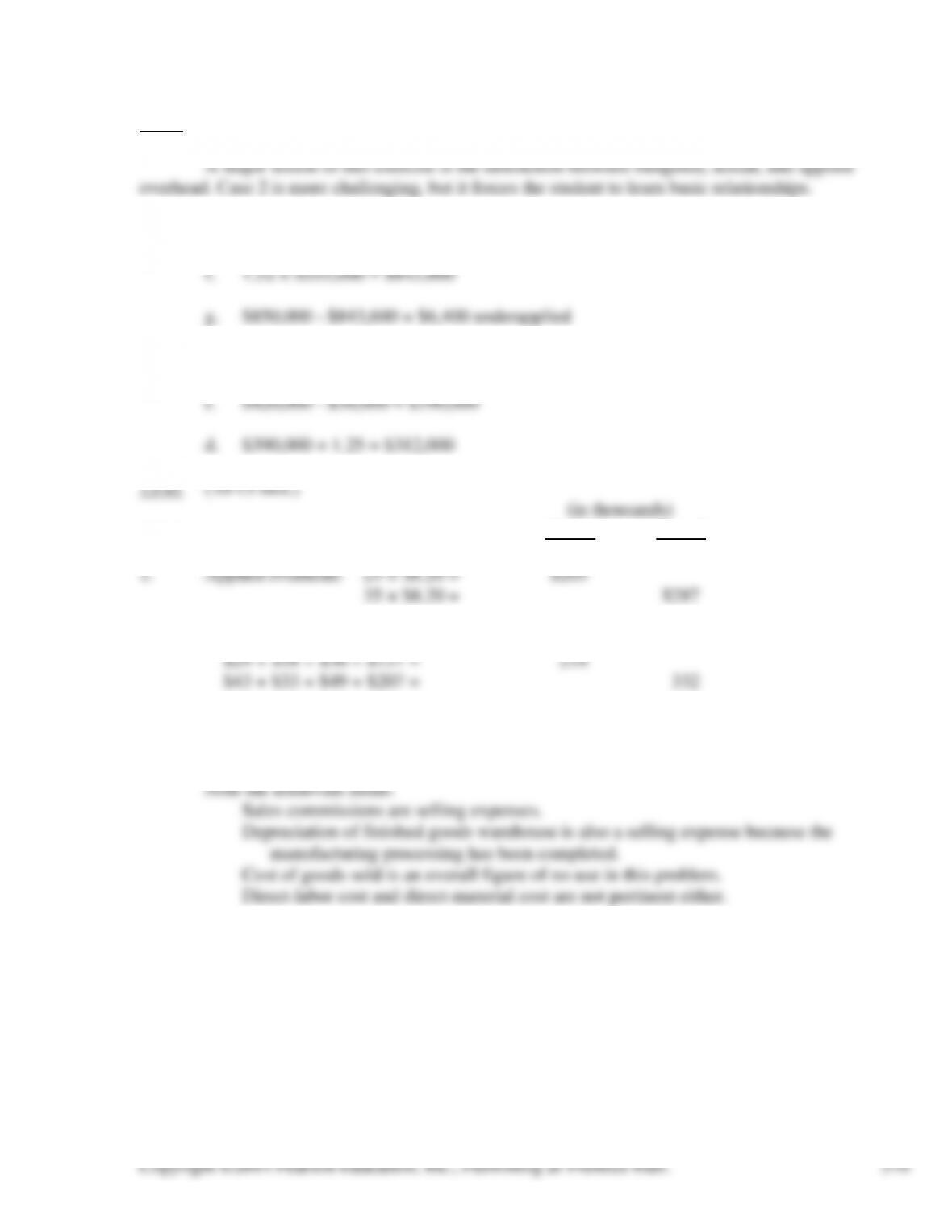
Budgeted overhead application rate
13-40 (15-20 min.)
1. c. $646,000 ÷ $425,000 = 152% of direct-labor cost
2. b. $415,000 ÷ 1.25 = $332,000
Case 1 Case 2
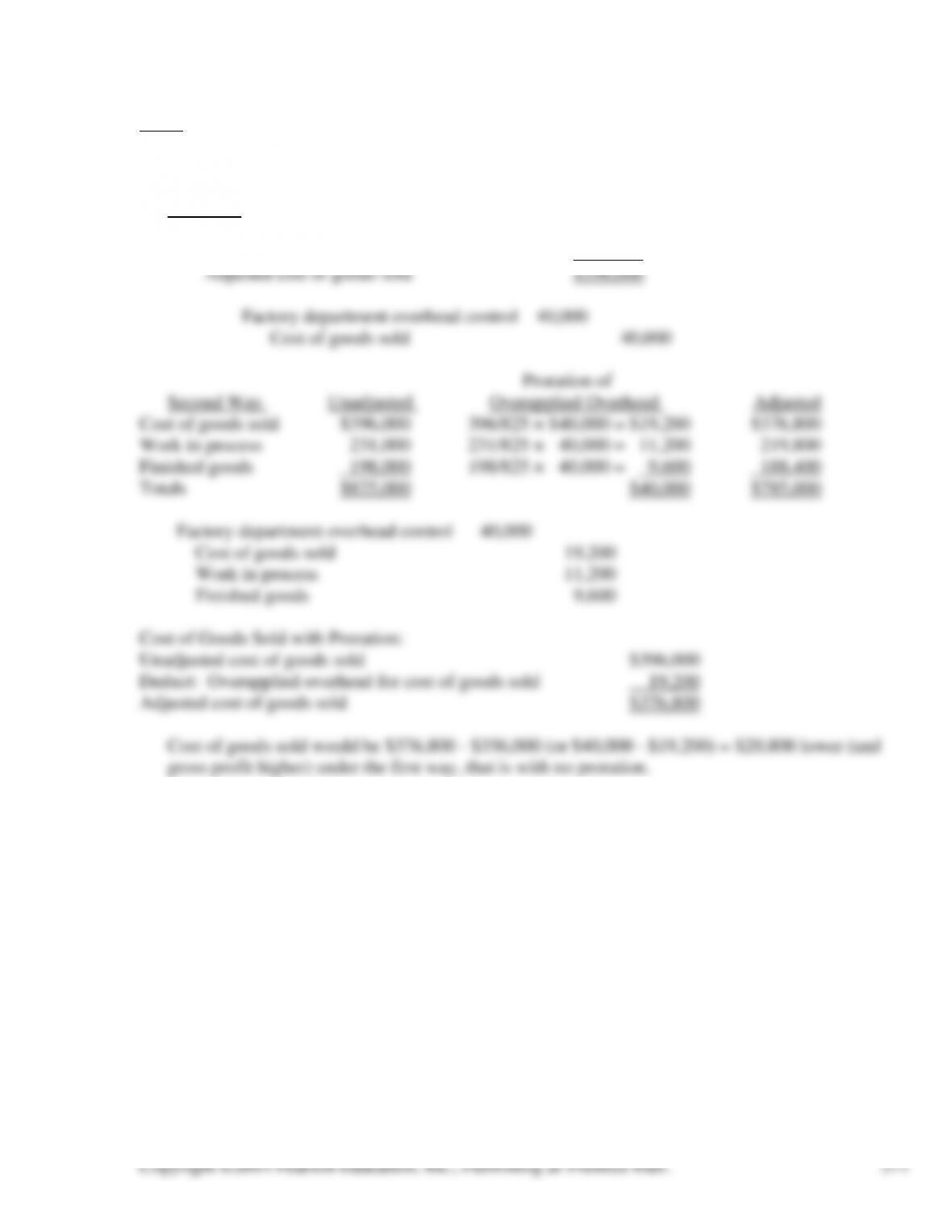
2. Overhead incurred:
3. Underapplied overhead: $218 – $205 = 13
Underapplied overhead: $332 – $287 = 45
13-42 (10-15 min.)
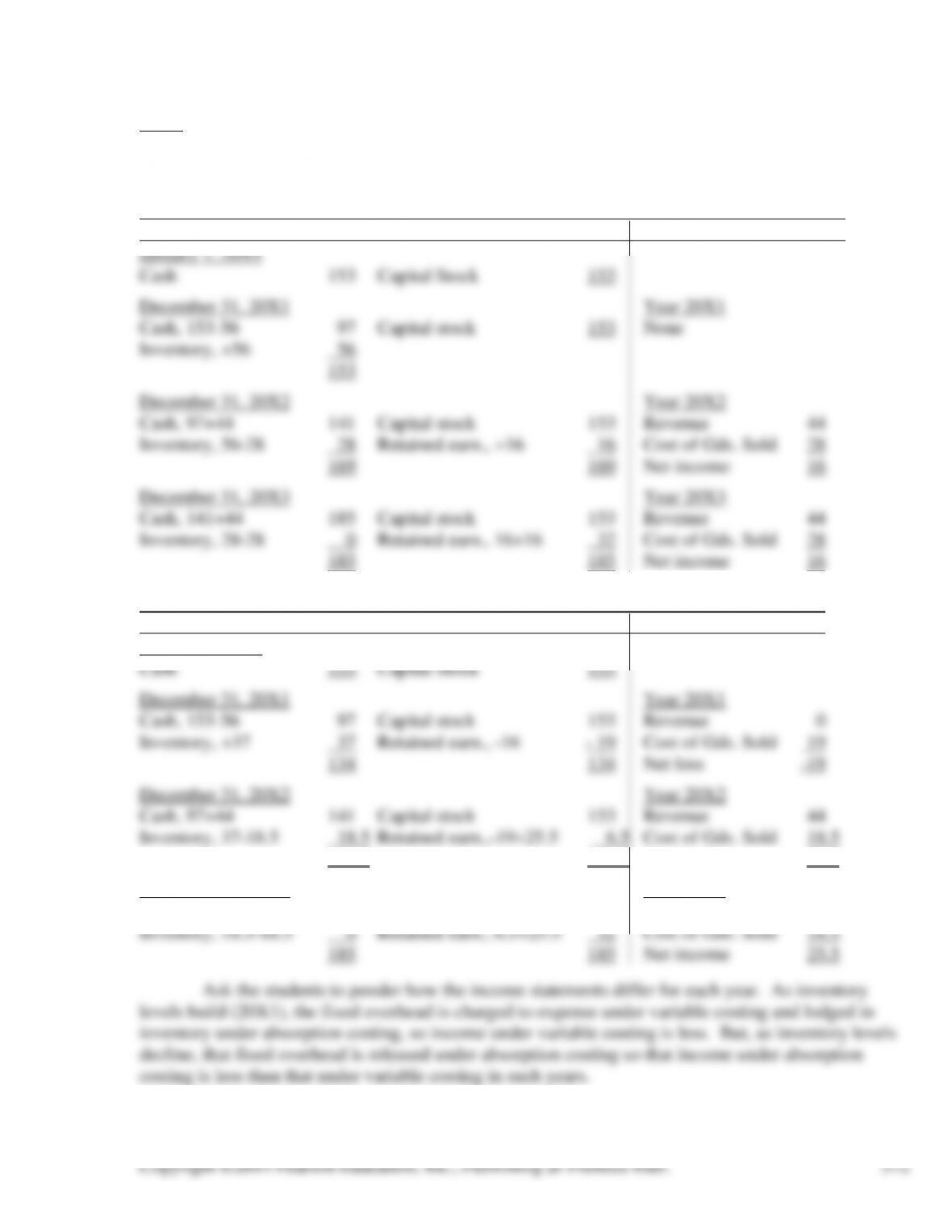
Overhead is overapplied by $456,000 – $416,000 = $40,000.
First Way
Unadjusted cost of goods sold $396,000
Deduct: Overapplied overhead 40,000
13-43 (20 min.)
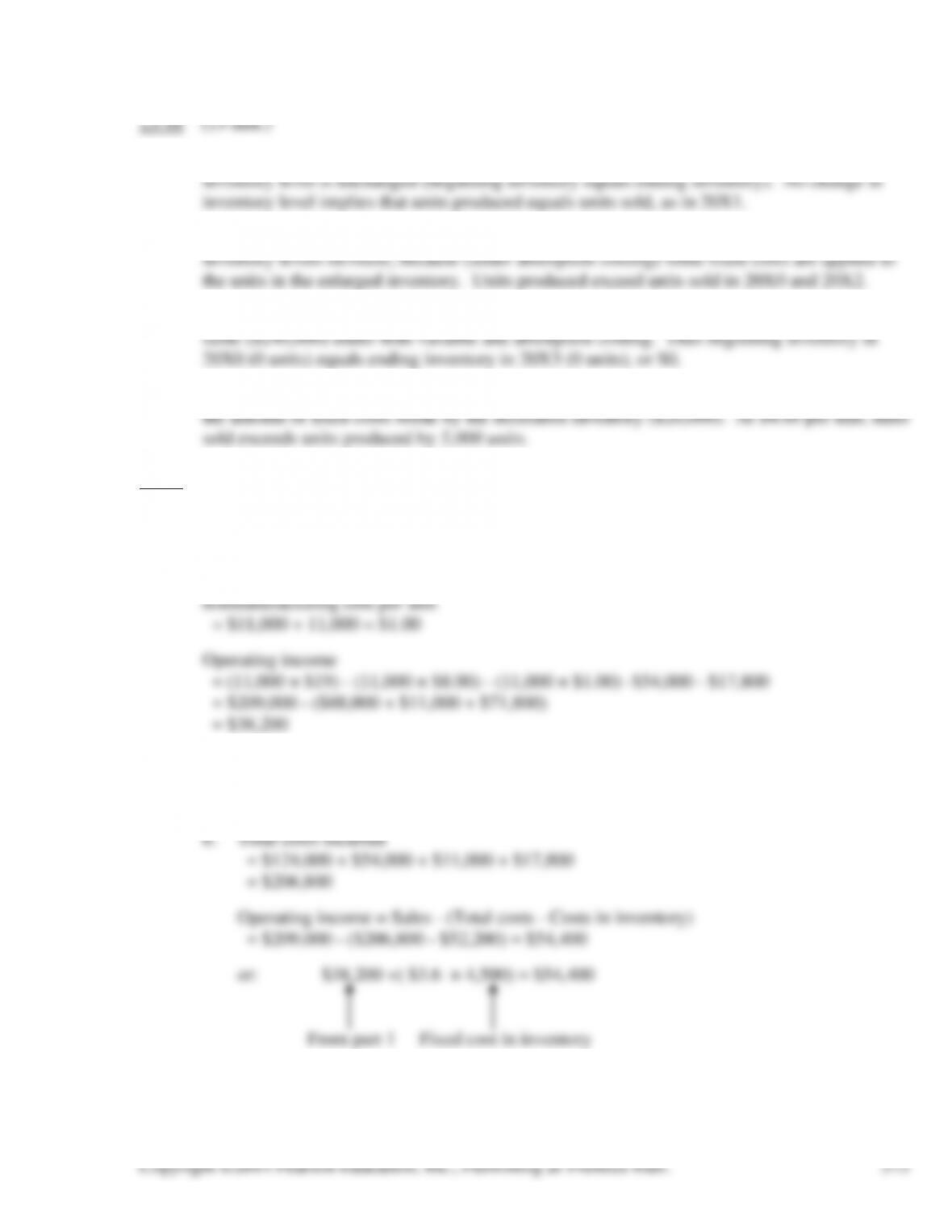
1. This exercise helps students obtain a fundamental look at the essential conceptual differences
between the two inventory methods. Amounts are in thousands of dollars.
Absorption Costing
Balance Sheets Income Statements
2. Variable (Direct) Costing
Balance Sheets Income Statements
January 1, 20X1
159.5 159.5 Net income 25.5
December 31, 20X3 Year 20X3
Cash, 141+44 185 Capital stock 153 Revenue 44
Copyright ©2014 Pearson Education, Inc., Publishing as Prentice Hall.
573
13-44 (15 min.)
1. Variable-costing operating income equals absorption-costing operating income whenever the
2. Absorption-costing operating income exceeds variable-costing operating income when
3. Repeat the idea in part (1), now considering the four-year total operating income, which is the
4. 20X3’s variable-costing operating income exceeds the absorption-costing operating income by
13-45 (10-15 min.)
1. Variable manufacturing cost per unit
= $124,000 ÷ 15,500 = $8.00
Assume that variable nonmanufacturing costs vary with sales units. Then, variable
2. a. (15,500 – 11,000) × [$8.00 + ($54,000 ÷ 15,000)]
= 4,500 units × $11.6 unit cost
= $52,200
13-46 (5-10 min.)
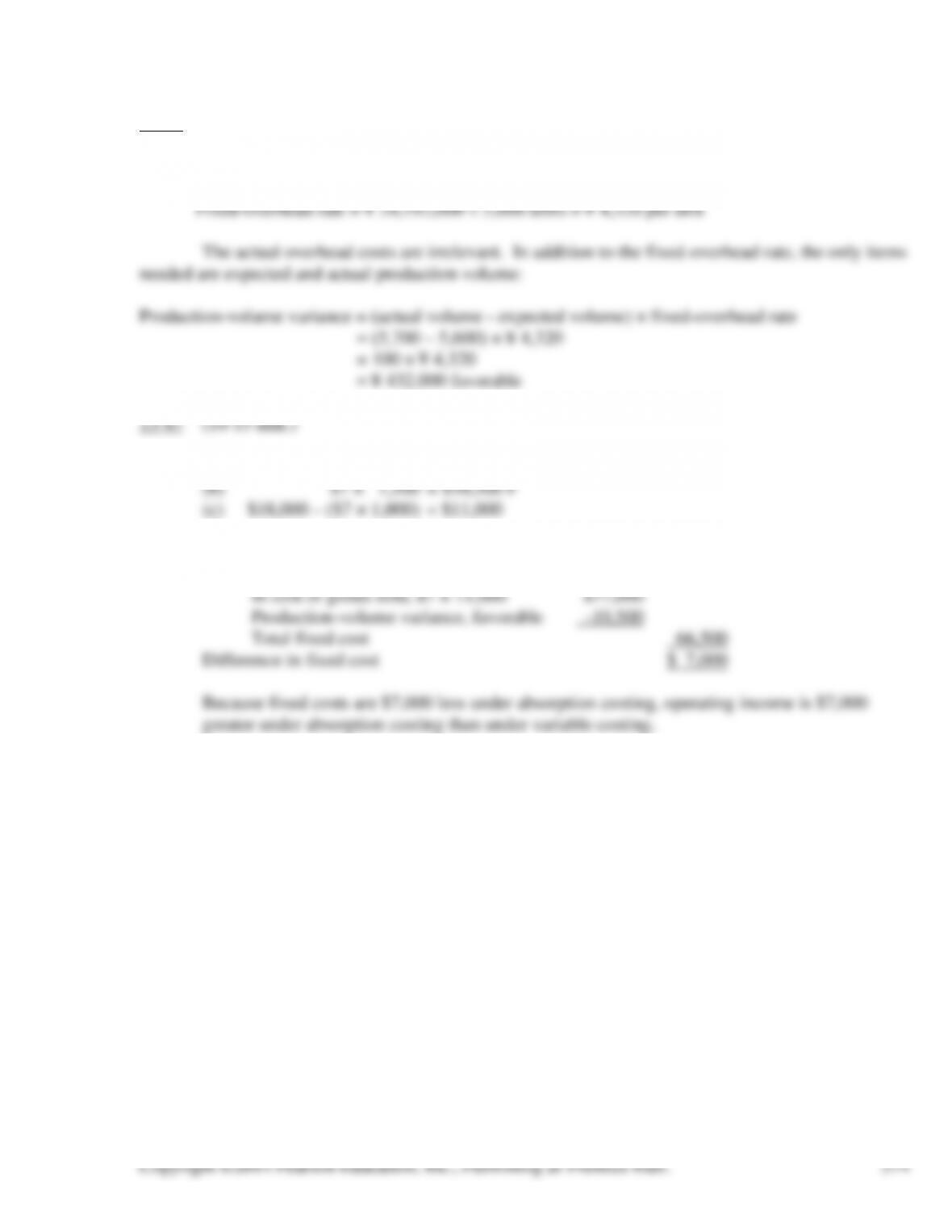
This exercise requires sorting the relevant information from the irrelevant. Computing the
production-volume variance requires knowledge of the fixed-overhead rate:
1. (a) $7 × 10,500 = $73,500
2. Fixed costs charged by variable costing $73,500
Fixed costs charged by absorption costing:
13-48 (15 min.)
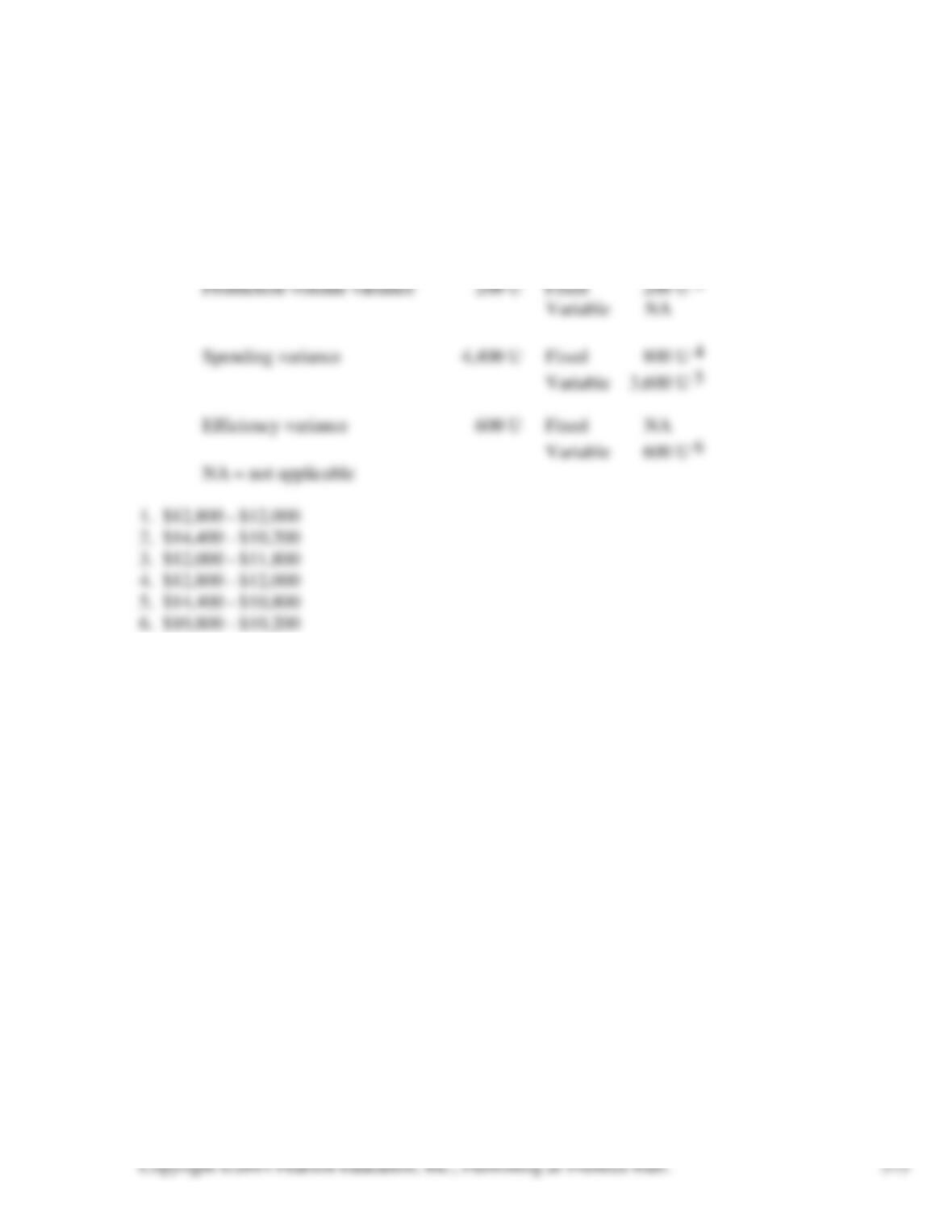
Variances in dollars:
Flexible-budget variance 5,000 U Fixed 800 U 1
Variable 4,200 U 2
13-49 (15-20 min.)
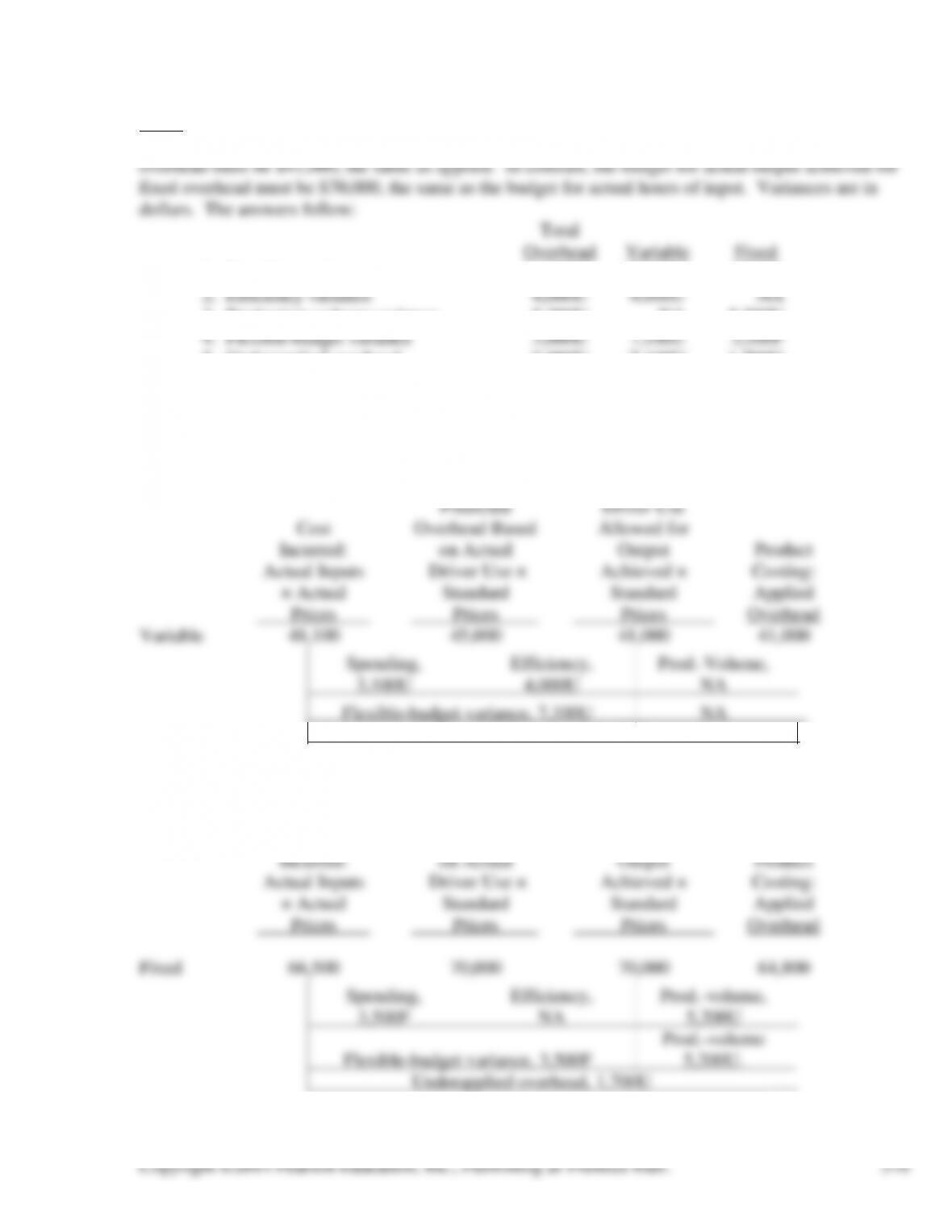
Note that the budget for standard hours allowed for actual output achieved for variable
1. Spending variance 400F 3,100U 3,500F
3. Production-volume variance 5,200U NA 5,200U
5. Underapplied overhead 8,800U 7,100U 1,700U
NA = not applicable
These relationships could be presented in the same way as in Exhibit 13-10:
Flexible Budget:
Standard
Underapplied overhead, 7,100U
Flexible Budget:
Standard
Predicted Driver Use
Cost Overhead Based Allowed for