
CHAPTER 11
COVERAGE OF LEARNING OBJECTIVES
LEARNING OBJECTIVE
FUNDA-
MENTAL
ASSIGN–
MENT
MATERIAL
CRITICAL
THINKING
EXERCISES
AND
EXERCISES
PROBLEMS
CASES,
EXCEL,
COLLAB., &
INTERNET
EXERCISES
LO1: Describe capital
budgeting decisions and
use the net present value
(NPV) method to make
such decisions.
A1, A2, B1
B2
26, 29, 30
31, 32, 33
34, 35, 36
37, 38, 39
40, 41
51, 52, 53
54, 55, 56
62, 64
68,69, 70, 71,
73, 75
LO2: Use sensitivity
analysis to evaluate effect
of changes in predictions.
40, 41
68, 71
LO3: Calculate the NPV
difference between two
projects using both the
total project and
differential approaches.
51, 52
LO4: Identify relevant
cash flows for NPV
analyses.
25, 27
51, 52, 53
54, 55, 56
57, 60, 61
68, 69, 70, 74
LO5: Compute the after-
tax net present values of
projects.
A3, A4, B3
B4
42, 43, 44
45
57, 58, 59
60, 64, 65, 66
70, 72
LO6: Explain the after-tax
effect of cash of disposing
of assets.
A5, B5
28
58, 59
71
LO7: Use the payback
model and the accounting
rate-of-return model and
compare them with the
NPV model.
40, 46, 47, 48
61, 62
73
LO8: Reconcile conflict
between using NPV model
for making a decision and
using accounting income
for evaluating the related
performance.
63
LO9: Compute the impact
of inflation on a capital-
budgeting project.
49, 50
66, 67
Copyright ©2014 Pearson Education, Inc., Publishing as Prentice Hall.
450
CHAPTER 11
Capital Budgeting
11-A1 (15-25 min.) Answers are printed in the text at the end of the assignment
material.
11-A2 (20-30 min.) This is a straightforward exercise.
1 & 2. The model indicates that the computers should be acquired because the net
present value is positive.
1. The model indicates that the servers should not be acquired.
Sketch of Cash Flows
12% Total (in thousands)
Discount PV 0 1 2 3
2. The computers should be acquired. The net present value rises, and now it is
positive:
After-tax impact of disposal on cash: .60 × ($90,000 – 0) $ 54,000

3. This requirement demonstrates that the choice of a discount rate often is critical.
Applying an 8% discount factor:
11-A4 (25-30 min.)
1. Cash effects of operations:
Before tax annual cash inflow $ 420,000
Taxes @ 45%: 420,000 × .45 189,000
After-tax cash inflow $ 231,000
Present value @ 14%: $231,000 × 5.2161 $1,204,919
2. The 7-year MACRS analysis will apply regardless of the economic life of the
equipment. The only change from requirement 1 will be the added five years of
cash effects from operations:
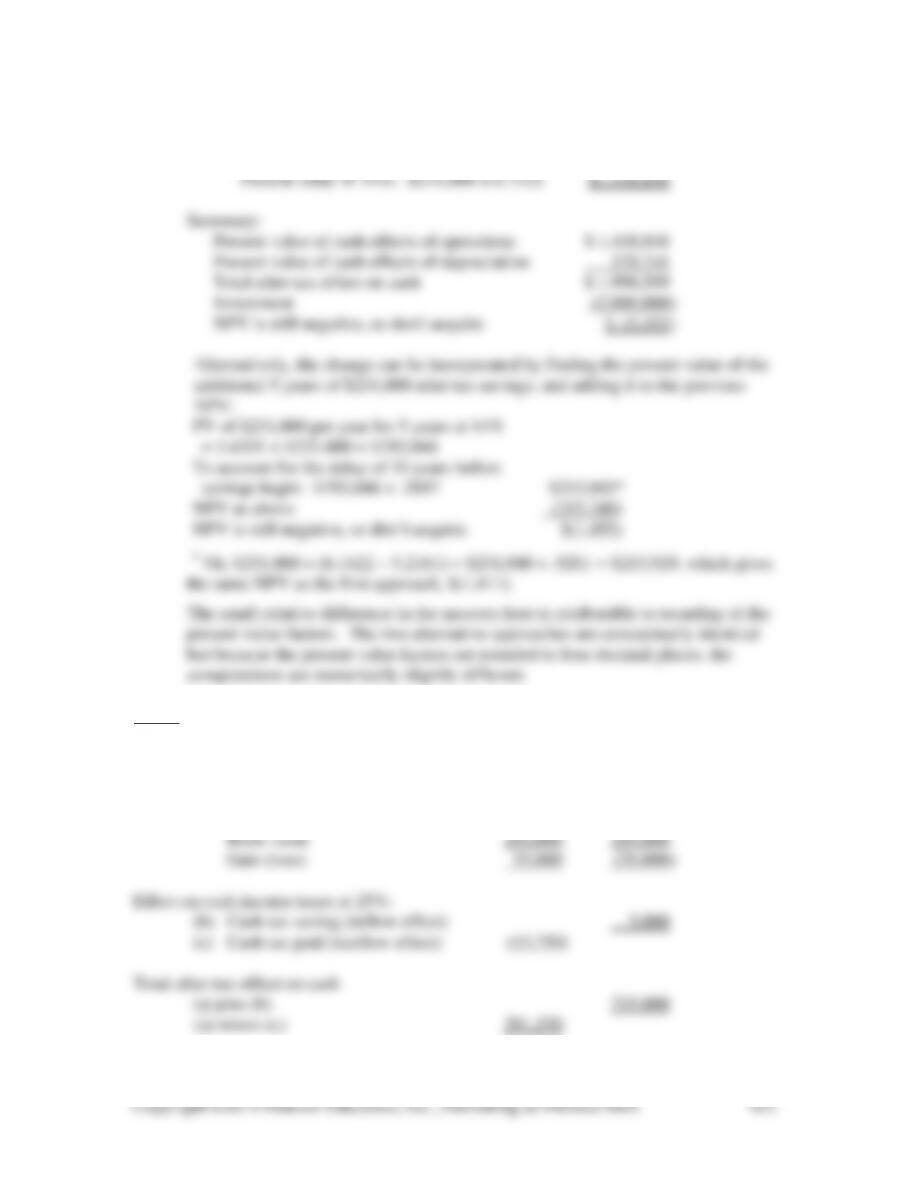
This change can be incorporated by re-computing the value of the $231,000
after-tax inflow but now for 15 years, and then using that in the calculation:
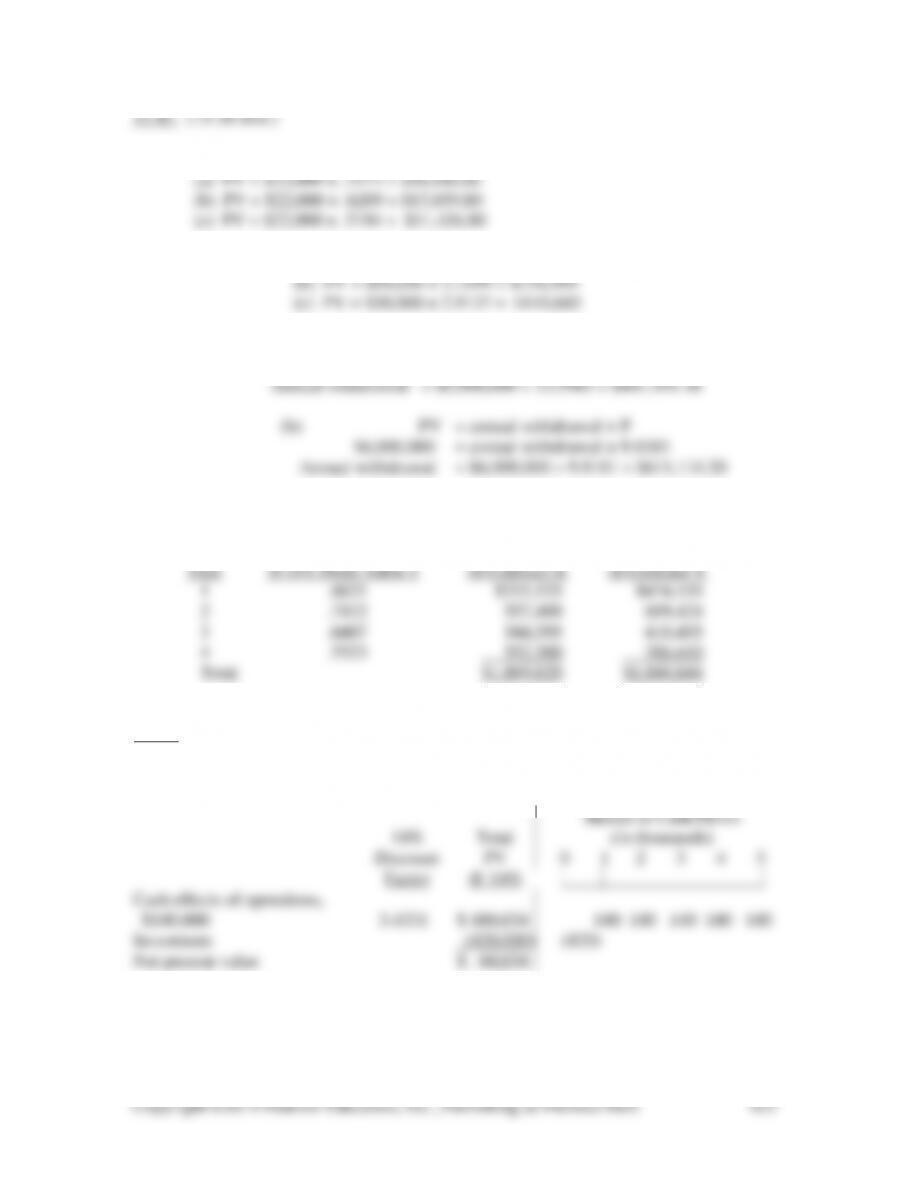
11-A5 (5-10 min.)
Many students forget to add the cash proceeds to the tax effect. Answers are in
dollars.
(a) Cash sale price 305,000 230,000
Copyright ©2014 Pearson Education, Inc., Publishing as Prentice Hall.
453
11-B1 (15-20 min.)
1. Using the right table is essential. Factors for this part are from Table 1:
2. Use Table 2: (a) PV = $50,000 × 3.4651 = $173,255
3. Use Table 2: (a) PV = annual withdrawal × F
$6,000,000 = annual withdrawal × 13.5903
4. Contract Y has the higher present value despite the lower total dollars paid:
Present Value Present Value Present Value
11-B2 (20-30 min.) This is a straightforward exercise.
1 & 2. The model indicates that the equipment should be acquired because the net
present value is positive.
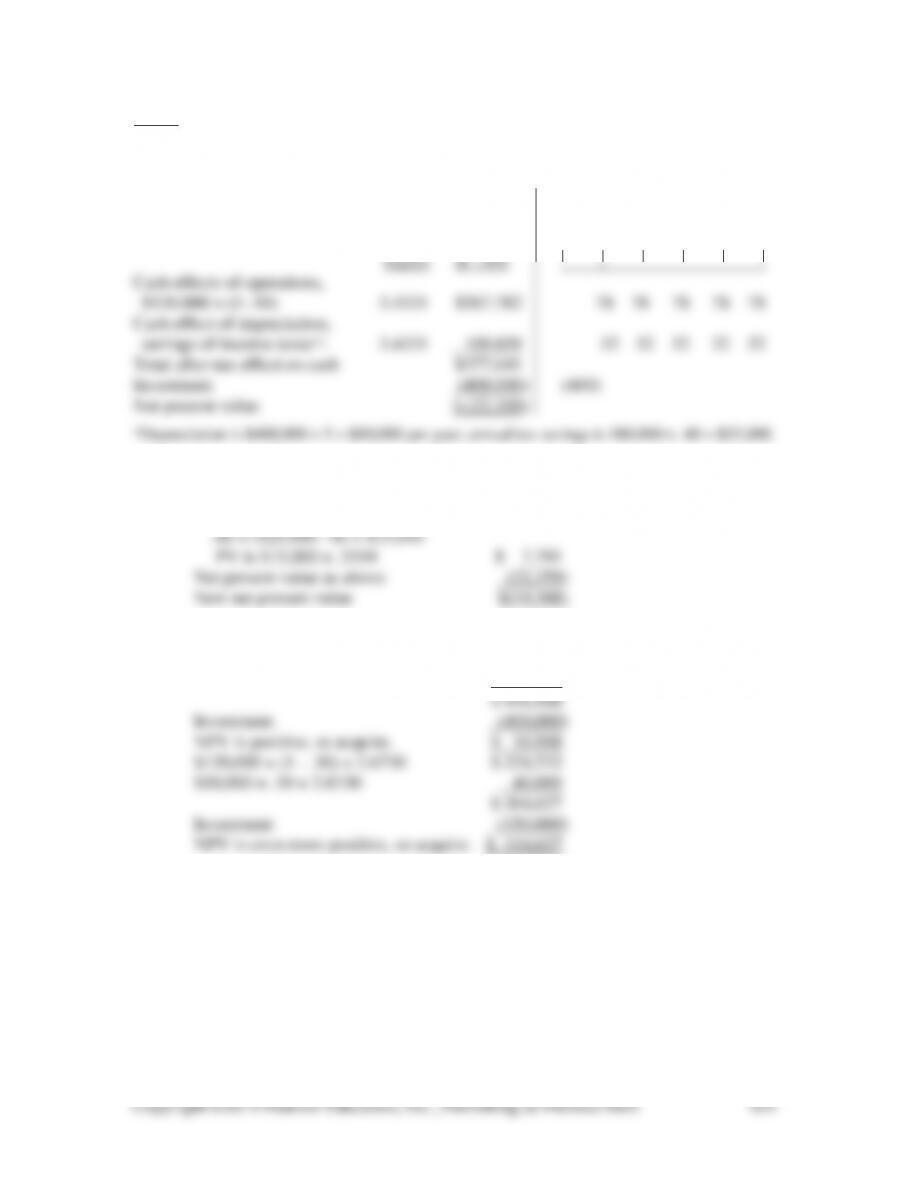
11-B3 (20-30 min.) This is a straightforward exercise.
1. The model indicates that the equipment should not be acquired.
Sketch of Cash Flows
14% Total (in thousands)
Discount PV 0 1 2 3 4 5
2. The equipment should not be acquired. The net present value is negative.
After-tax impact of disposal on cash:
3. Applying 10% discount factors:
$130,000 × (1 – .40) × 3.7908 $ 295,682
$80,000 × .40 × 3.7908 121,306
Copyright ©2014 Pearson Education, Inc., Publishing as Prentice Hall.
455
11-B4 (25-30 min.)
1. See Exhibit 11-B4 on the following page for requirement 1.
2. The major reason for this requirement is to underscore the fact that the present
value of the depreciation tax savings is unchanged regardless of the length of the
economic life of the asset.
PV @ 10% of 6 years of $41,250 4.3553 × 41,250 $ 179,656
11-B5 (5-10 min.)
Many students forget to add the cash proceeds to the tax effect. Answers are in
dollars.
1. 2.
(a) Cash sale price 35,000 85,000
Copyright ©2014 Pearson Education, Inc., Publishing as Prentice Hall.
456
EXHIBIT 11-B4
(Dollar amounts in thousands) Total
1. 10% PV Sketch of Cash Flows (in dollars)
Discount @ 10% 0 1 2 3 4 5 6
Factor ($000)
Cash effects on operations,
$75 × (1 – .45) 3.7908 156.371 <––– 41.25 41.25 41.25 41.25 41.25

11-1 The accountant has a limited role in the project identification phase. In the
selection phase, accountants provide information for predicting cash inflows and
11-3 No. A higher required rate of return reduces the present value of future cash
11-4 No. It is true that the DCF model assumes certainty and perfect capital markets.
11-5 Yes, double counting does occur if depreciation expense is considered
11-6 No. The IRR and NPV models generally make the same decision. Suppose we
11-7 The real-options model recognizes the value in allowing investment in stages –
that is, contingent investments. If managers can adjust the investment after gaining the
11-8 Sensitivity analysis is especially appropriate for organizations that do not have
11-9 The differential approach should lead to the same choice between alternatives as
11-10 The NPV model is appropriate for all types of investments. However, with
some types of investments, such as those in advanced technology, NPV must be carefully

11-11 The marginal tax rate is the rate paid on additional amounts of pretax income.
In contrast, the average tax rate is the total taxes paid divided by the total pretax income.
11-12 No. Two sets of books are appropriate. The objectives of tax reporting and
shareholder reporting differ; therefore, the rules for reporting to each differ. If companies
11-13 Tax avoidance is the achieving of a reduction in income tax payments through
11-15 Companies should prefer accelerated rather than straight-line depreciation for
11-16 Yes. Two streams may be identified: (a) inflows from operations and (b)
11-17 Because of the time value of money, the earlier a company takes tax deductions
and thereby saves taxes, the larger the present value of the tax savings.
11-18 Yes. MACRS treats assets as if they were purchased at midyear, so they have
depreciation effects for one tax year more than the number of years of their depreciable
11-20 It is useful to learn the “payback” and “accounting rate-of-return” methods of
capital budgeting because they are widely used today. In addition, the payback method

11-21 The basic flaw in the payback method is that it does not compare the total
11-22 If a company makes capital-budgeting decisions using DCF and evaluates
performance using accrual accounting numbers, a conflict may arise. Often accrual
value.
11-23 The three components of the market or nominal interest rate are: 1) risk-free
element, or pure rate of interest, 2) business-risk element, and 3) inflation element.
11-24 The correct analysis under inflation (a) uses a required rate that includes an
11-25 It is difficult to predict the cash flows to be received from an investment in
research and development (R&D) because there is so much uncertainty involved. The
11-26 The net present value of an investment project represents the increase (or
decrease) in the value of the firm from investing in the project, provided the cash flows
11-27 The direct cash flows are the easiest to predict. These would include the
investment in the new machine (less any salvage value of the old machine), the savings in
labor and other variable operating costs because of the decreased production time per
11-28 The first situation is reasonably clear. There is no legal or ethical reason not to
take the depreciation allowed by the tax law. The second is much more problematic.
Investing offshore is generally not illegal, although its ethics might be questionable. If
1. The present value is $640,000 and the annual payments are an annuity, requiring
use of Table 2:
2. (a)$640,000 = annual payment × 8.1109
annual payment = $640,000 ÷ 8.1109 = $78,906
3. (a) Total payments= 15 × $74,771 = $1,121,565
11-30 (10 min.) The initial step on solving present value problems focuses on a
1. Use Table 1, row 10, 4% column. Bank of America will lend $506,700,000.
2. Use Table 2, row 10, 4% column. Bank of America will lend $608,317,500.
The $75 million is a uniform periodic payment at the end of a series of years.
Therefore, it is an annuity. Its present value is:

Copyright ©2014 Pearson Education, Inc., Publishing as Prentice Hall.
461
PVA = $75,000,000 × 8.1109 = $608,317,500
In particular, note that Bank of America is willing to lend more than in
requirement 1 even though the interest rate is the same. Why? Because the bank
will receive the $750,000,000 more quickly if it receives 10 payments of
$75,000,000 per year rather than waiting to receive the entire $750,000,000 at
the end of 10 years.
11-31 (10-20 min.)
2. The annual rates would be halved and the periods doubled.
3. Present values rise because the money is repaid more quickly:
11-32 (10-15 min.)
1. $300,000 = Future amount × .6830
2. $300,000 = Annual installments × 3.1699
11-33 (10 min.)
The deferral cost Jenner $1,388,800 in present value, computed as follows:
Present value of $8,000,000 in 2 years $6,611,200
Present value of $8,000,000 today 8,000,000

Copyright ©2014 Pearson Education, Inc., Publishing as Prentice Hall.
462
2013 .9091 17,272,900 17,272,900
2014 .8264 17,354,400 23,965,600
Total $49,627,300 $48,238,500
Difference ($49,627,300 – $48,238,500) = $1, 388,800
11-34 (5-10 min.) This simple exercise requires use of both Table B-1 and Table B-2.
11-35 (20-25 min.) This basic exercise develops comfort with the tables and the NPV
method.
Number of years 7 18 18 28
b(5.2732 × CF) – $70,000 = ($10,009); CF = ($70,000 – $10,009) 5.2732 = $11,377
c(F × $30,000) – $50,000 = 231,157; F = $281,157 $30,000 = 9.3719
11-36 (10 min.)
Buy. The net present value is positive.
Initial outlay * $(44,000)
11-37 (10-15 min.)
2. 250,000 – 200,000 = 50,000 ├ an annuity of 3 payments (a)
3. 300,000 – 250,000 = 50,000 ┘
Copyright ©2014 Pearson Education, Inc., Publishing as Prentice Hall.
463
4. 450,000 – 300,000 = 150,000 ┐ an annuity of 2 payments
5. 500,000 – 350,000 = 150,000 ┘ deferred three years (b)
(a) $50,000 × 2.3216 $116,080
2. The NPV is positive because at a 12% rate, the present value of the net inflows
will be higher than at 14%, so NPV will increase.
1. NPV @ 10% = $2,300 × 6.8137 = $15,671.51 – $15,000 = $671.51. With a
required rate of 10%, the NPV is positive, so this investment is desirable.
3. The higher the required rate of return, the lower the NPV of future cash flows.
11-39 (10-15 min.)
1. NPV @ 10% = 10,000 × 3.7908 = $37,908 – $36,048 = $1,860
3. The NPV at the company’s cost of capital, 10%, is positive, so the project should
be accepted.
11-40 (30-45 min.)

1. $40,000 ÷ $10,000 = 4 years
3. a) NPV = ($10,000 × 2.3216) – $40,000 = ($16,784)
b) NPV = ($10,000 × 5.2161) – $40,000 = $12,161
5. NPV = ($9,000 × 2.9137) – $40,000 = ($13,777)
1. NPV = ($15,000 × 3.7908) – $52,000 = $56,862 – $52,000 = $4,862
3. (a) NPV = ($12,000 × 3.7908) – $52,000 = $45,490 – $52,000 = $(6,510)
(b) NPV = ($18,000 × 3.7908) – $52,000 = $68,234 – $52,000 = $16,234
5. (Savings × 3.7908) – $52,000 = 0
11-42 (5-10 min.) Amounts in thousands of dollars.
Annual Income Statement Effects:
(S) Sales 750
(E) Expenses excluding depreciation 275
(D) Depreciation 200

Copyright ©2014 Pearson Education, Inc., Publishing as Prentice Hall.
465
After-tax cash inflow from operations 304
Cash effect of depreciation tax deduction:
(D) Depreciation 200
Multiplied by tax rate ×.36
Tax savings due to depreciation 72
Total after-tax effect on cash 376
11-43 (5-10 min.)
Cash effect of operations:
Cash inflow from operations: $1,700,000 – $350,000 $1,350,000
Multiplied by (1 –37% tax rate) ×.63
11-44 (10 min.)
The month and day on which an asset is acquired does not affect its tax
1. 3-year property: 33.33% & 44.45% of $55,000 $18,332 $24,448
3. 5-year property: 20% and 32% of $16,000 3,200 5,120
11-45 (10 min.)
This problem could be solved by specifying appropriate schedules of tax savings
and computing the present values. However, the process would be extremely time-
Copyright ©2014 Pearson Education, Inc., Publishing as Prentice Hall.
466
(d) $950,000 × .7975 × .45 = $ 340,931
(e) $420,000 × .7782 × .25 = $ 81,711
11-46 (10-15 min.)
Annual addition to profit = 25% × $14,000 = $3,500.
1. Payback period is $28,000 ÷ $3,500 = 8 years. It is not a good measure of
2. NPV = $5,114. Reject the proposal because NPV is negative.
3. ARR = (Increase in average cash flow – Increase in depreciation) ÷ Initial
1. Investment A payback period: $36,000 ÷ $4,000 = 9 years
2. NPV of A: $4,000 × 9.8181 = $39,272 – $36,000 = $3,272
3. The payback model does not consider the overall profitability of the two investments.
It ignores all cash flows beyond the payback period and gives all cash inflows during the
11-48 (15 min.)
2. $7,000 × 6.1446 = $43,012. The company should buy because the net present
value is a positive $43,012 – $28,000 = $15,012.

11-49 (30 min.)
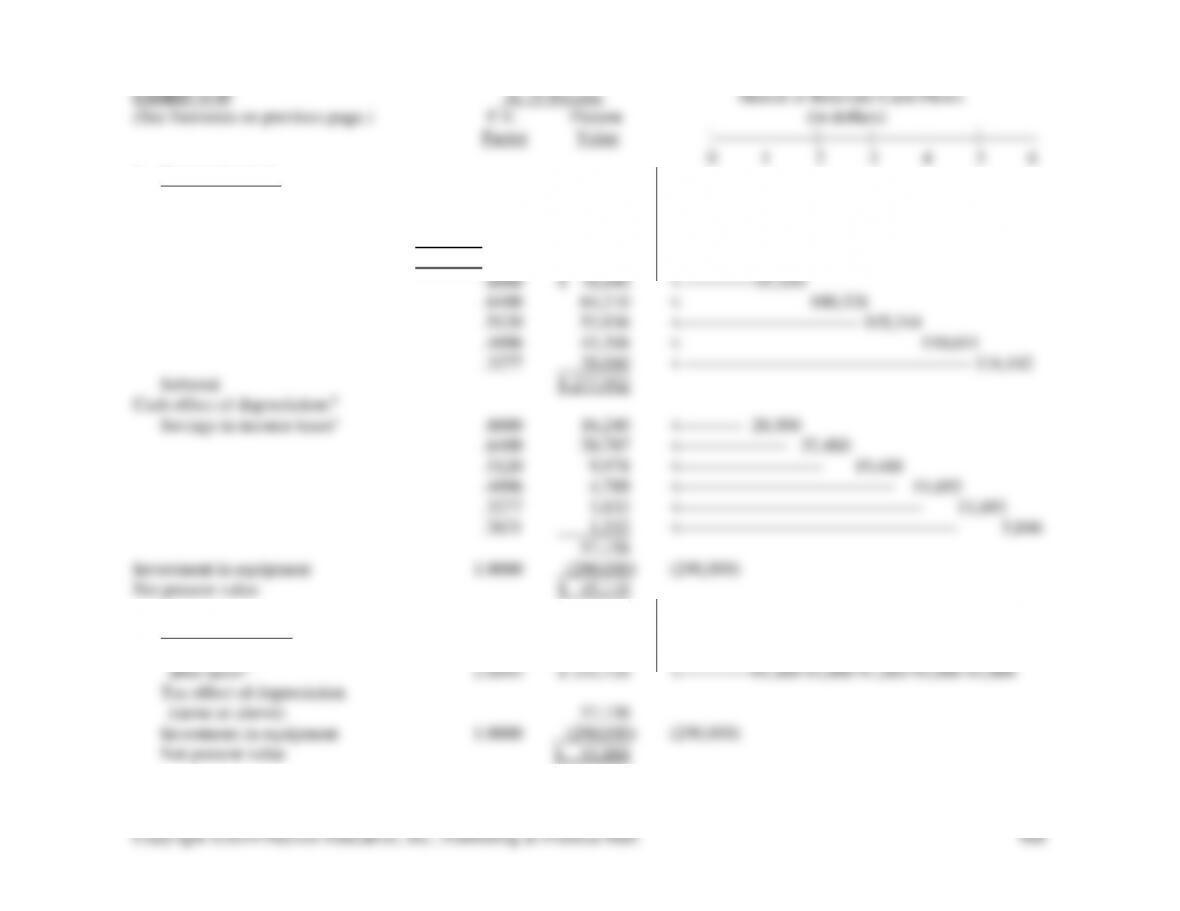
1 & 2. See Exhibit 11-49 on the following page for requirements 1 and 2.
The footnotes for the exhibit follow:
a Be sure to use a nominal discount rate, which includes an element attributable to
3. The method of Requirement 1 is correct. The required rate of return includes an
inflation element, and the cash inflows are adjusted for inflation. In Requirement
2 the required rate of return includes an inflation element, but the cash inflows
Copyright ©2014 Pearson Education, Inc., Publishing as Prentice Hall.
468
EXHIBIT 11–49 At 25 Percent Sketch of Relevant Cash Flows
(See footnotes on previous page.) P.V. Present (in dollars)
Factor Value ––––––––––––––––––––––––––––––––––––
0 1 2 3 4 5 6
1. Correct Analysis
Cash operating inflows:a
Pretax inflow in year-0 dollars $140,000
Tax effect at 35% 49,000
After-tax effect $ 91,000
2. Incorrect Analysis
Cash operating inflows