The company is $6 better off with the contribution of $24 from selling lumber
rather than $18 from selling the chair.
1. Cost to San Jose division of using ArnoPrint:
($.20 × 180 pages) + (250 copies per page × $.02 × 180 pages)
= $36.00 + $900.00 = $936.00
2. If ArnoPrint has idle capacity, the minimum transfer price is its variable costs,
3. The optimal decision might be to go with Jiffy Press since one to two days may
be saved in getting the reports to the client. Potential future earnings for
4. Top management has decreased the sense of autonomy of its San Jose office in
10-51 (10 – 15 min.)
The minimum transfer price is $23. Any price below $23 would cause the
Fabricating Division to lose profit. In fact, the minimum transfer price could be slightly
10-52 (15 min.)
This simple example provides a good opportunity to discuss the issue of moving
profits from one division to another through transfer prices. The setting is different from
any presented in the chapter.
Michelin certainly has an incentive to transfer tires at as low price as possible. A
profits.
10-53 (15 min.)
1. The optimal transfer price is $350 per unit:
(a) Tax savings with $350 transfer price:
2. With these changes, the $200 transfer price is optimal:
(a) Tax savings with $350 transfer price:
[.40 ($350 – $200)] – [.30 ($350-$200)]
Copyright ©2014 Pearson Education, Inc., Publishing as Prentice Hall.
442
10-54 (15-20 min.)
1. 1,500 units × ($37 – $21) = $24,000 increase in operating income if units are
purchased inside.
3. Currently available outside purchase price of $37 per unit.
4. (a) Benefit of $24,000 from the Montreal Division’s viewpoint, but
disadvantage of 1,500 units × ($40 – $21) = $28,500 from the Toronto
5. (a) Toronto Division’s current ROI = $36,000 ÷ $300,000 = 12%. Proposed
investment earns an ROI = $2,000 ÷ $20,000 = 10%. Therefore, the
10-55 (25-35 min.)
In a short space, this case gets to the heart of the problems of a control system:
1. The strong points of the present plan include the tendency of the PED manager to
hire the optimal number of engineers and to use them efficiently. At first glance,
the production managers will also tend to behave in similar fashion. In addition,
the user receives no surprises because the total cost of each “contract” is known
in advance.
2. Most students will favor the present system, although a minority may like the
proposed system. Of course, other systems are possible. For example, an
internal accounting system could capitalize the PED costs and amortize them
over the “useful life” of the expected cost savings. The latter system would then
provide a method of performance evaluation (incentive) that would be consistent
Copyright ©2014 Pearson Education, Inc., Publishing as Prentice Hall.
444
the problems of goal congruence and effort for a year or two or more. However,
as time passes, the system invariably warrants correction or revamping.
For example, after a class discussion of this case in an executive program, a
French executive said in effect:
“This case is one that I’ve experienced. A few years ago, our top
management adopted the no-charge system to spur heavier use of
latter.
Copyright ©2014 Pearson Education, Inc., Publishing as Prentice Hall.
445
10-56 (20-30 min.)
1. Management by Objectives (MBO) is a formal system for developing and
making measurable the goals for each position in the organization for a given
1. Increased subordinate motivation to accomplish goals.
3. Increased development of subordinate abilities through the systematic
establishment of goals by subordinates.
5. Increased communication between subordinate and superior.
Disadvantages associated with MBO include:
2. Difficulty in dealing with non-quantifiable factors.
4. The increased emphasis on counseling often requires too much time.
2. The human value premises of MBO suggest that subordinates will attempt 100%
achievement if they accept a clear and tangible set of objectives. Inherent in
MBO is the premise that goal formation is a joint process, where individual
1. Goal setting at Haida Company is not a joint process. Ravenhill assumes
2. Ravenhill has assumed that no errors have been made in assigning
objectives.
4. It is likely that Ravenhill failed to use periodic review sessions to help
subordinates find ways to meet their goals.
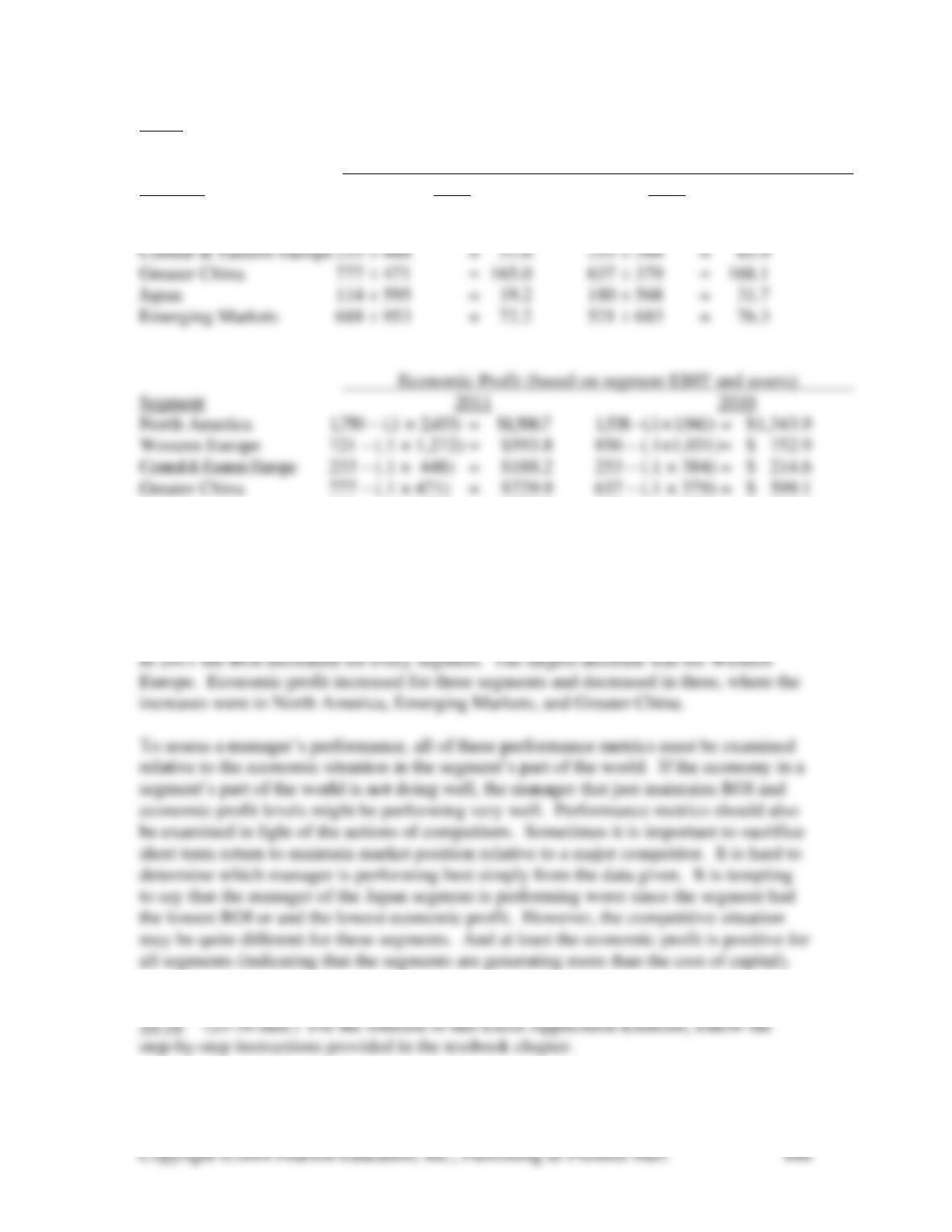
10-57 (25-30 min.) All amounts in this solution (except percentages) are in millions of
dollars.
ROA (based on segment EBIT and assets)
Segment 2011 2010
North America 1,750 ÷ 2,433 = 71.9% 1,538 ÷ 1,941 = 79.2%
Western Europe 721 ÷ 1,272 = 56.7 856 ÷ 1,031 = 83.0
Japan 114 – (.1 × 595) = $54.5 180 – (.1 × 568) = $ 123.2
Emerging Markets 688 – (.1 × 953 ) = $592.7 521 – (.1 × 683) = $ 452.7
The North America segment produced the most economic profit both years, and Greater
China had the highest ROI in both years. The Japan segment had the lowest ROI both
years and the lowest economic profit both years.
1. Duane has the best performance using ROI, while Louis has the highest economic
profit.
3. The method chosen will affect the decisions of the managers. The manager of Duane,
the one with the largest ROI, would reject proposed investments returning between 10%
10-59 (40 min. or more)
The purpose of this exercise is to recognize that return on investment, a summary
performance measure, is composed of two parts that may differ greatly by company and
by industry. It also requires students to find publicly available information about a
10-60 (40-50 min.) NOTE TO INSTRUCTOR: This solution is based on the web site
1. The main focus is on being able to locate a Marriott hotel in a particular city,
2. Each of Marriott’s brands appears to operate at least somewhat independently.
3. In the 2011 annual report, footnote 16 reported information on four segments,
North American Full-service Lodging, North American Limited-service Lodging,
International Lodging, and Luxury Lodging. In previous years, there had been
4. Using average balances for assets, the ROA calculations are:
NA Full-service $351 ÷ $1,231 = 28.5%
5. Using average balances for assets and income (which both include amounts not
allocated to segments), the ROA for the corporation as a whole was $198 ÷
$7,447 = 2.7%. The ROA for the corporation is substantially lower than the ROA
6. Marriott primarily provides lodging services. If one segment provides lodging to
employees of another segment, transfer prices are necessary. However, this is
unlikely to comprise a large percentage of the business of any of the segments.