CHAPTER 10
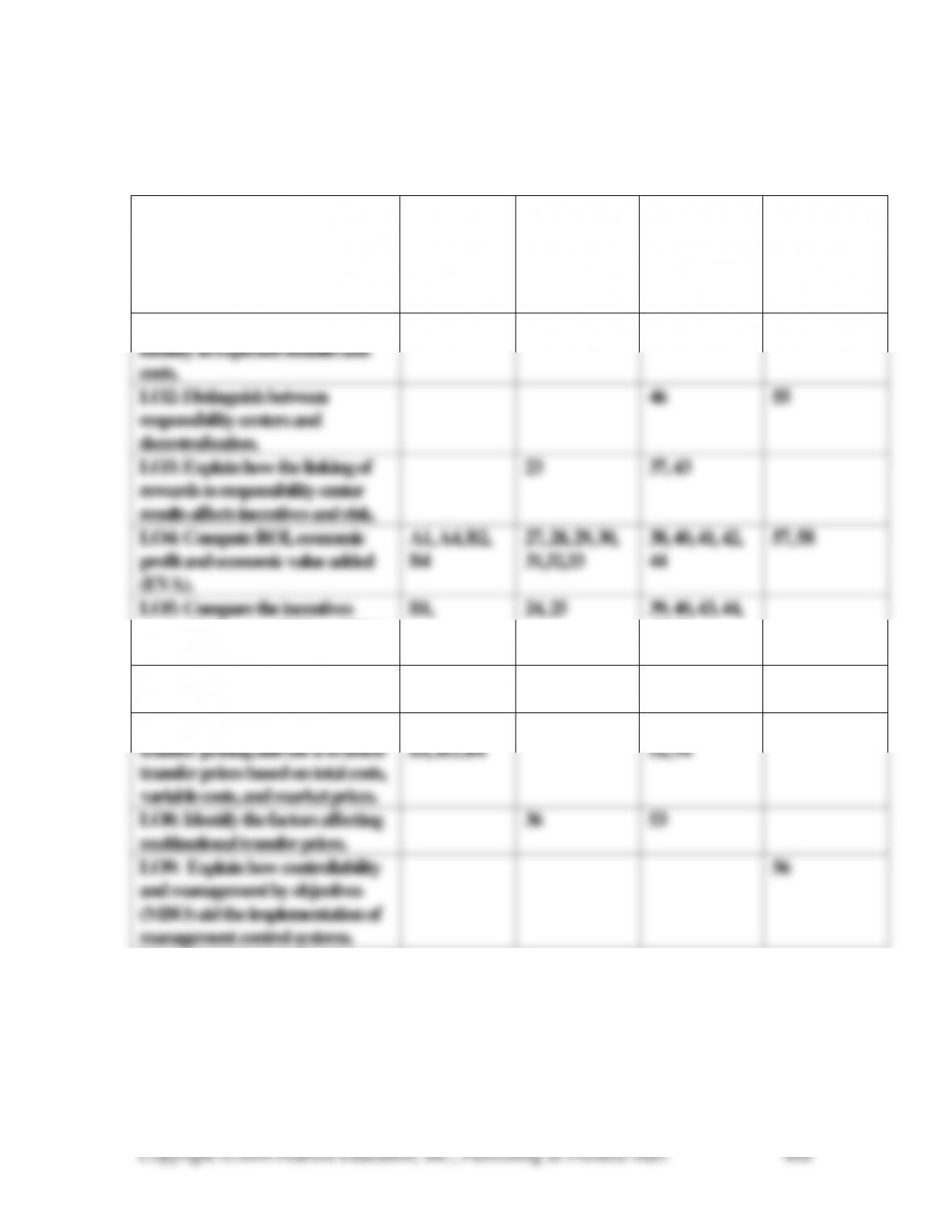
COVERAGE OF LEARNING OBJECTIVES
LEARNING OBJECTIVE
FUNDA–
MENTAL
ASSIGN–
MENT
MATERIAL
CRITICAL
THINKING
EXERCISES
AND
EXERCISES
PROBLEMS
CASES,
EXCEL,
COLLAB., &
INTERNET
EXERCISES
LO1: Define decentralization and
identify its expected benefits and
costs.
A2, A4, B4
25, 26
59, 60
LO2: Distinguish between
responsibility centers and
decentralization.
46
55
LO3: Explain how the linking of
rewards to responsibility center
results affects incentives and risk.
23
37, 43
LO4: Compute ROI, economic
profit and economic value added
(EVA).
A1, A4, B2,
B4
27, 28, 29, 30,
31,32,33
38, 40, 41, 42,
44
57, 58
LO5: Compare the incentives
created by income, ROI, and EVA
performance measures.
B1,
24, 25
39, 40, 43, 44,
45, 54
LO6: Define transfer prices and
identify their purpose.
A2, A3, A4,
B3, B4
26
46, 47, 48, 49,
50, 51, 54
55
LO7: State the general rule for
transfer pricing and use it to assess
transfer prices based on total costs,
variable costs, and market prices.
A2, A3, A4,
B1, B3, B4
34, 35
46, 47, 48, 49,
52, 54
55
LO8: Identify the factors affecting
multinational transfer prices.
36
53
LO9: Explain how controllability
and management by objectives
(MBO) aid the implementation of
management control systems.
56
Copyright ©2014 Pearson Education, Inc., Publishing as Prentice Hall.
409
CHAPTER 10
Management Control in Decentralized Organizations
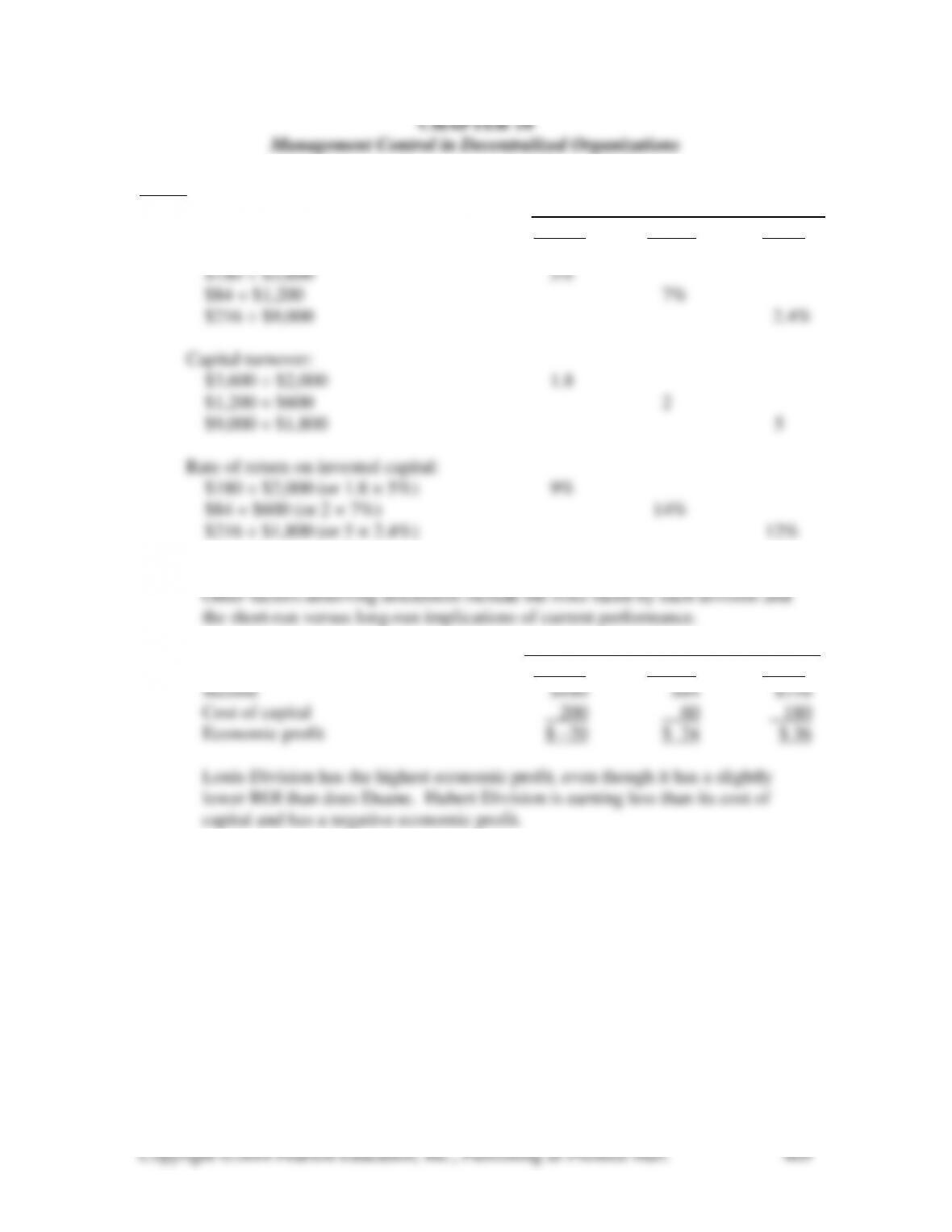
10-A1 (10-15 min.) Dollar amounts are in thousands.
Division
Hubert Duane Louis
Return on sales:
2. If ROI is used for judging relative performance, Duane is best for this period.
3. Division
Hubert Duane Louis
Copyright ©2014 Pearson Education, Inc., Publishing as Prentice Hall.
410
10-A2 (30 min.)
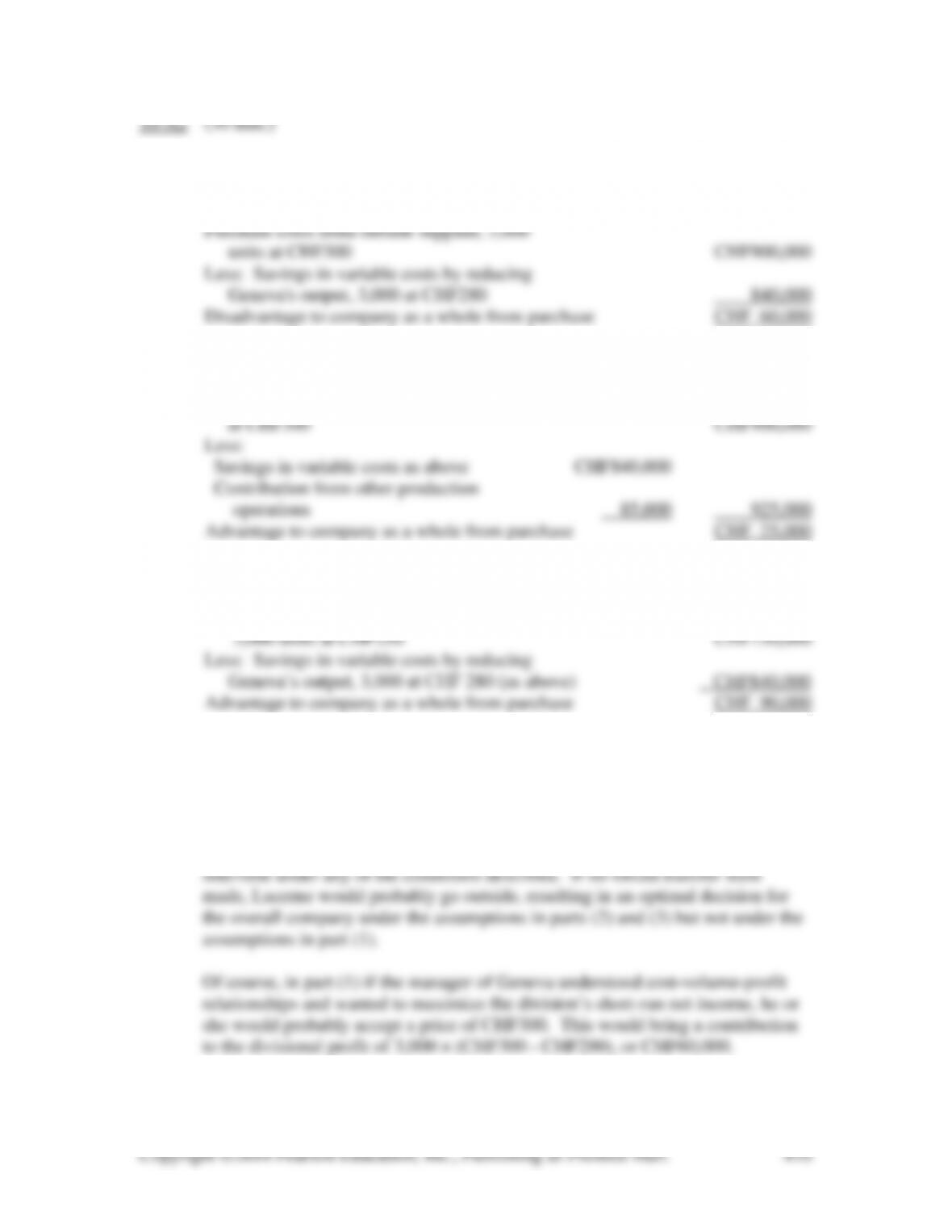
1. Assume that fixed costs will continue. The company as a whole will be worse
off if Lucerne buys from outside supplier:
2. Company will benefit if Lucerne buys outside:
Purchase costs from outsider, 3,000 units
3. Company will benefit if Lucerne buys on outside:
Purchase costs from outsider,
4. As president, I would not want to become immersed in these disputes. If
arbitration is necessary, it probably should be conducted by some other officer
on the corporate staff. One possibility is to have the immediate line boss of the
two managers make a decision.
If decentralization is to be strictly adhered to, the arbitrator probably should not
Copyright ©2014 Pearson Education, Inc., Publishing as Prentice Hall.
411
Suppose, however, that Geneva refuses to meet the price of CHF300. This
would mean that the company will be CHF60,000 poorer in the short run.
Should top management interfere and force a transfer at CHF300? This would
undercut the philosophy of decentralization. Many managers would not interfere
because they would view the CHF60,000 as the price that has to be paid for true
decentralization. But how high must this price go before the temptation to
interfere would be irresistible? CHF70,000? CHF80,000? How much? On the
other hand, the Geneva manager may realize that CHF60,000 is being sacrificed
but may have decided that it is worth more than CHF60,000 to achieve some
long-term subjective benefits.
In sum, the point of this question is that any structure that interferes with lower-
level decision-making weakens decentralization. Of course, such interference
may occasionally be necessary to prevent horrendous blunders. But recurring
interference and constraints simply transform a decentralized organization into a
centralized organization.
10-A3 (10 min.)
The company as a whole would benefit because the CHF60,000 disadvantage of
purchasing from an outside supplier calculated in 10-A2 Part 1 would be more
10-A4 (30-35 min.)
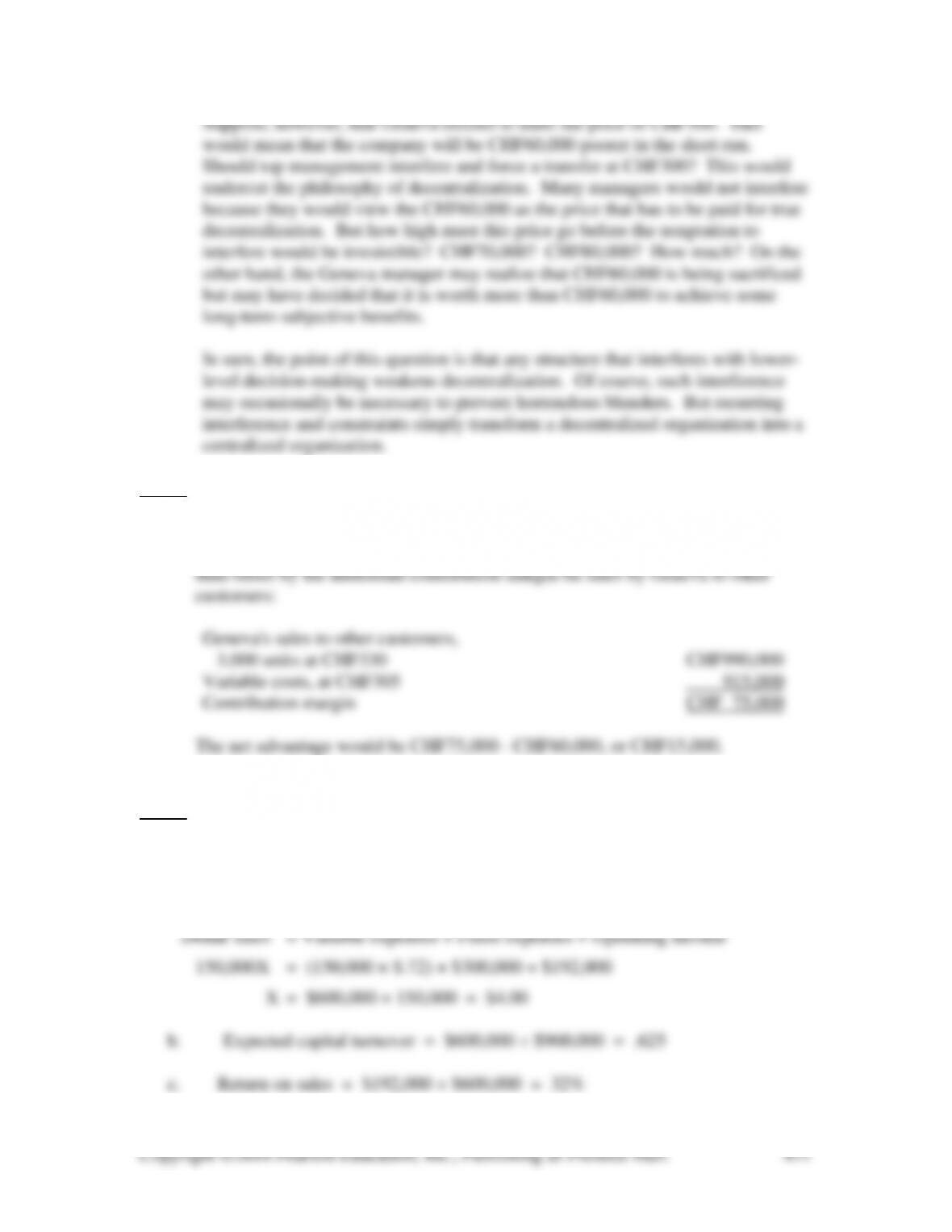
1. a. 20% of $960,000 = $192,000 target operating income
Let X = Unit sales price
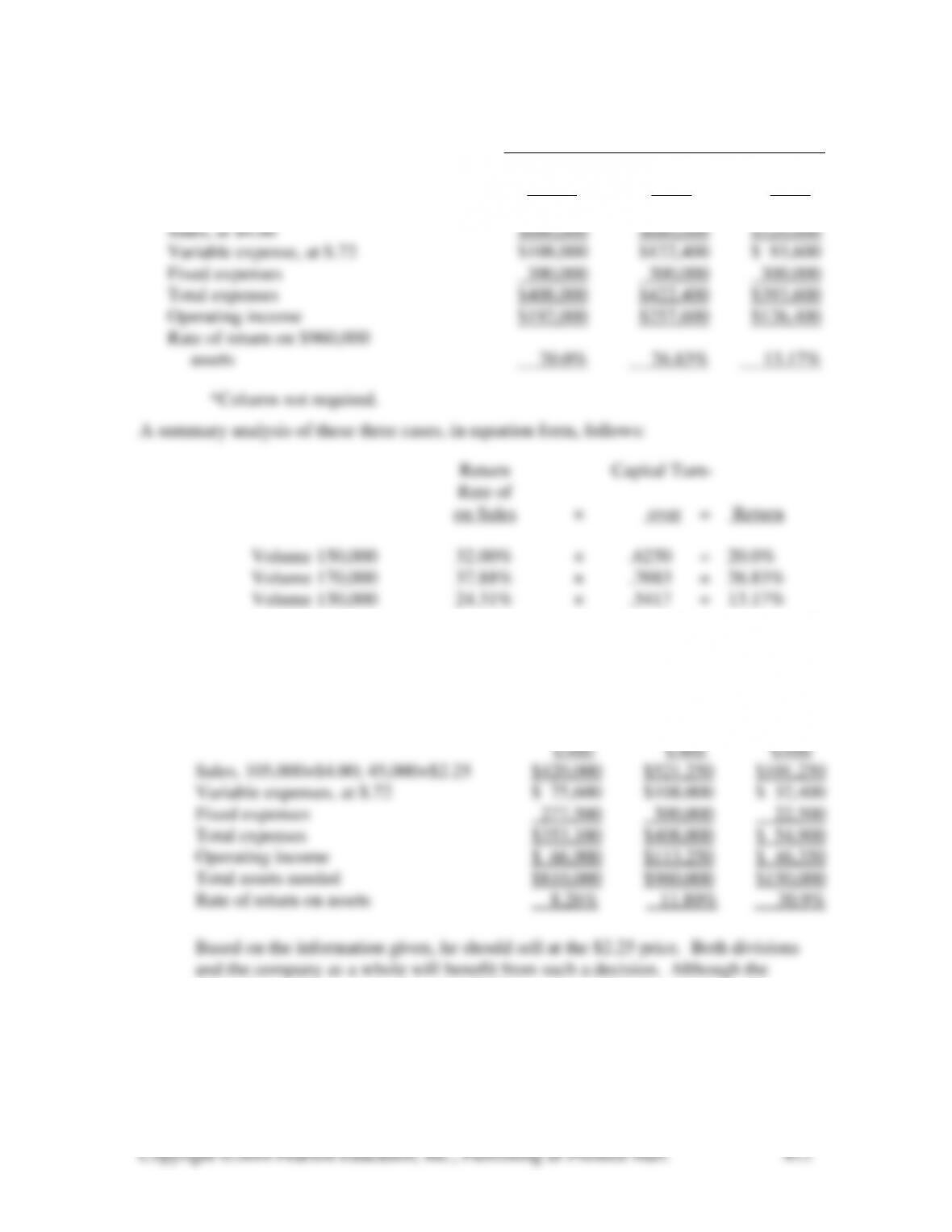
2. a, b.
Sales Volume
150,000 170,000 130,000
Units* Units Units
3. If the units are not sold to the other division, average available assets would
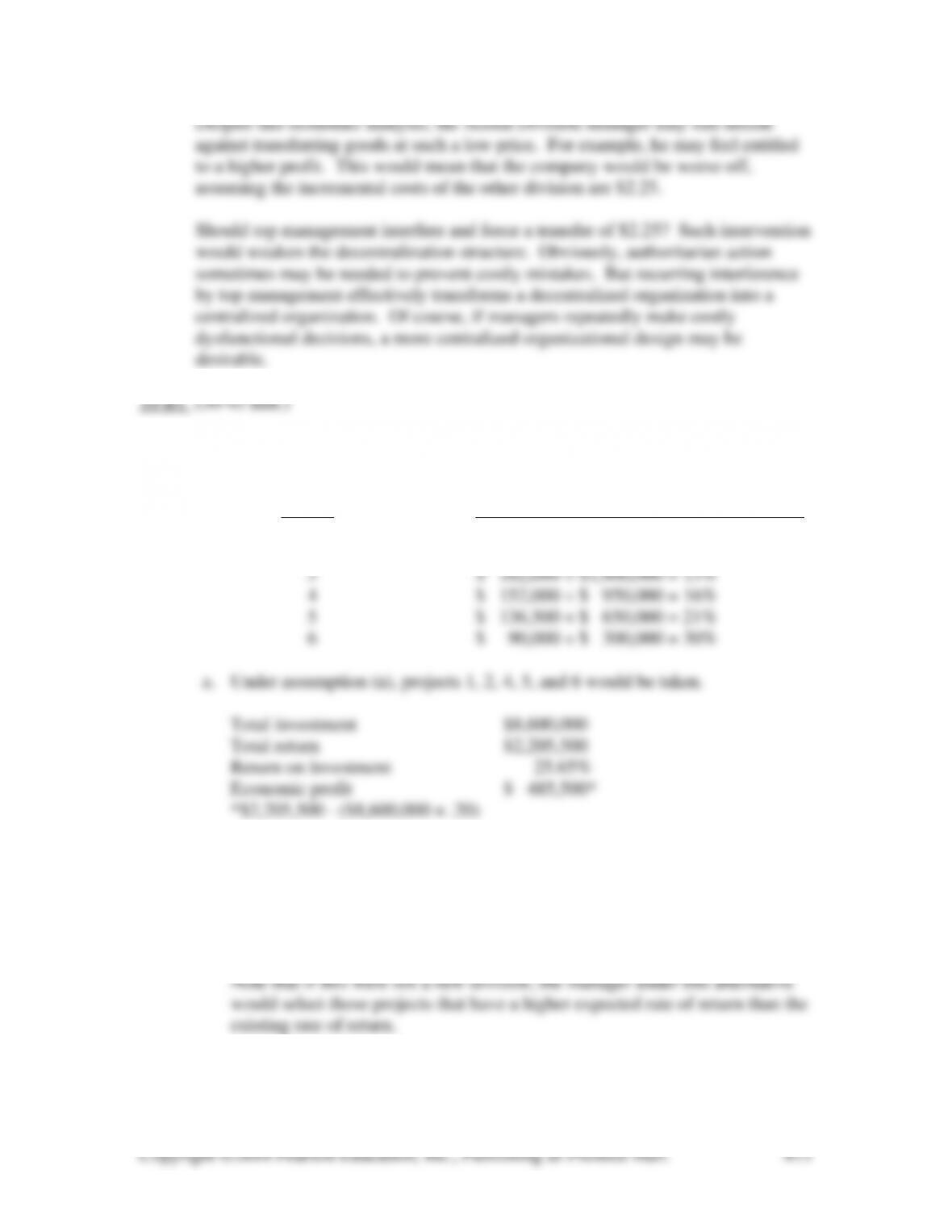
decrease by $150,000, from $960,000 to $810,000. Fixed overhead would be
reduced to $300,000 – $22,500 = $277,500. Results would be:
Sell Sell Difference
105,000 150,000 45,000
original overall target rate of return of 20% is unattainable, the division will
nevertheless earn a better rate of return on assets with the intracompany business
than without it. The additional units will earn a 30.9% incremental rate of return,
which exceeds the 8.26% rate earned on 105,000 units. As a result, the overall
rate of return would increase from 8.26% to 11.80%, as shown in the schedule
above.
Copyright ©2014 Pearson Education, Inc., Publishing as Prentice Hall.
413
Despite this economic analysis, the Austin Division manager may still decide
against transferring goods at such a low price. For example, he may feel entitled
to a higher profit. This would mean that the company would be worse off,
assuming the incremental costs of the other division are $2.25.
Should top management interfere and force a transfer of $2.25? Such intervention
would weaken the decentralization structure. Obviously, authoritarian action
sometimes may be needed to prevent costly mistakes. But recurring interference
by top management effectively transforms a decentralized organization into a
centralized organization. Of course, if managers repeatedly make costly
dysfunctional decisions, a more centralized organizational design may be
desirable.
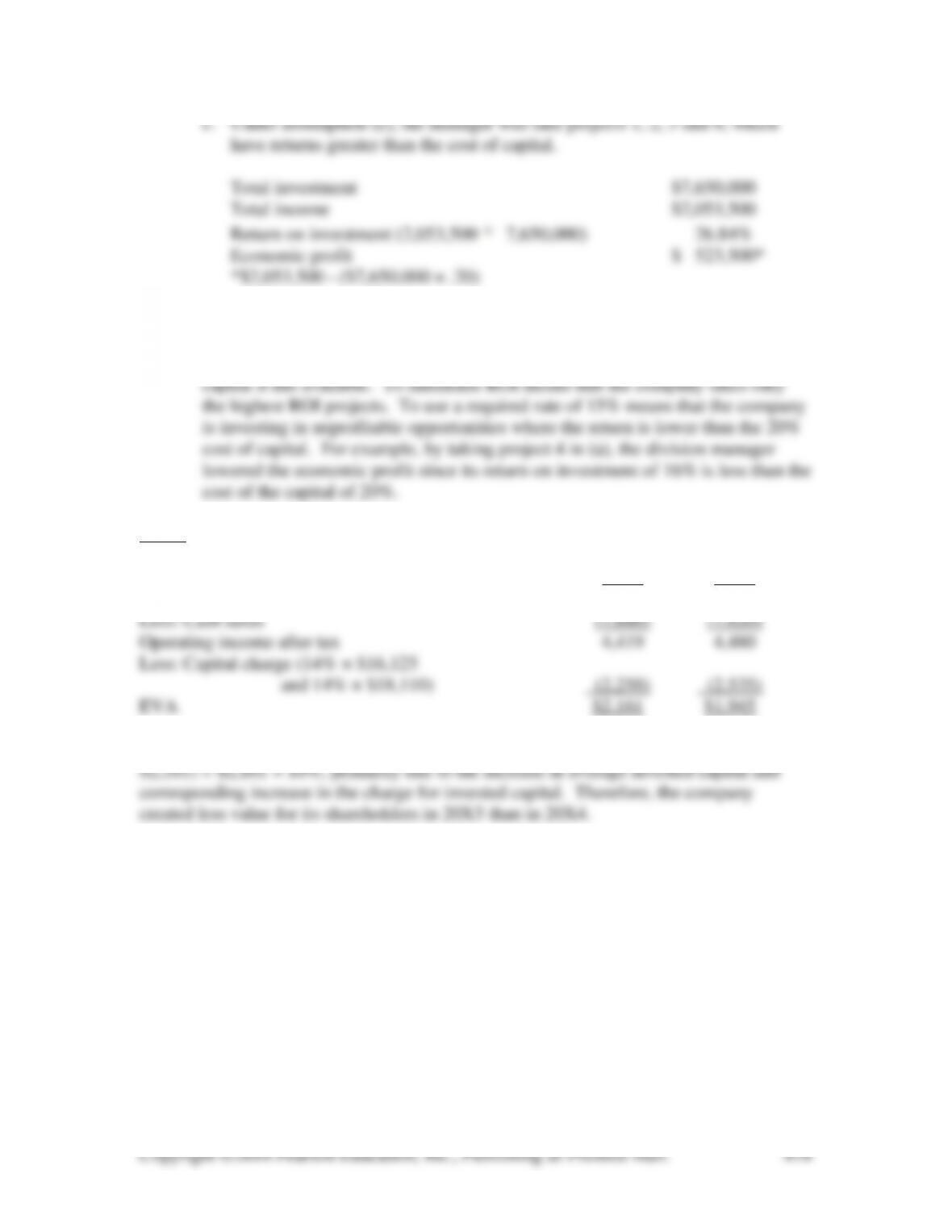
1. The percentage return for each project is as follows:
Percentage
Project Return
1 $1,200,000 ÷ $4,800,000 = 25%
2 $ 627,000 ÷ $1,900,000 = 33%
The manager taking the above projects would be following the company rule.
b. Under assumption (b), the rational manager will take only project 2, since
this gives a return on investment of $627,000 ÷ $1,900,000 = 33% (and an
economic profit of $627,000 – ($1,900,000 × .20) = $247,000). Adding any
further projects at lower returns lowers the overall return on capital invested.
Copyright ©2014 Pearson Education, Inc., Publishing as Prentice Hall.
414
c. Under assumption (c), the manager will take projects 1, 2, 5 and 6, which
have returns greater than the cost of capital.
Total investment $7,650,000
Total income $2,053,500
Return on investment (2,053,500 7,650,000) 26.84%
Economic profit $ 523,500*
*$2,053,500 – ($7,650,000 × .20)
2. The essence of the concept of economic profit is that it requires the manager to
take all projects that promise a return to the company over and above the cost of
the capital invested. This will maximize total return to the company for the
10-B2 (10 min.) Amounts are in millions.
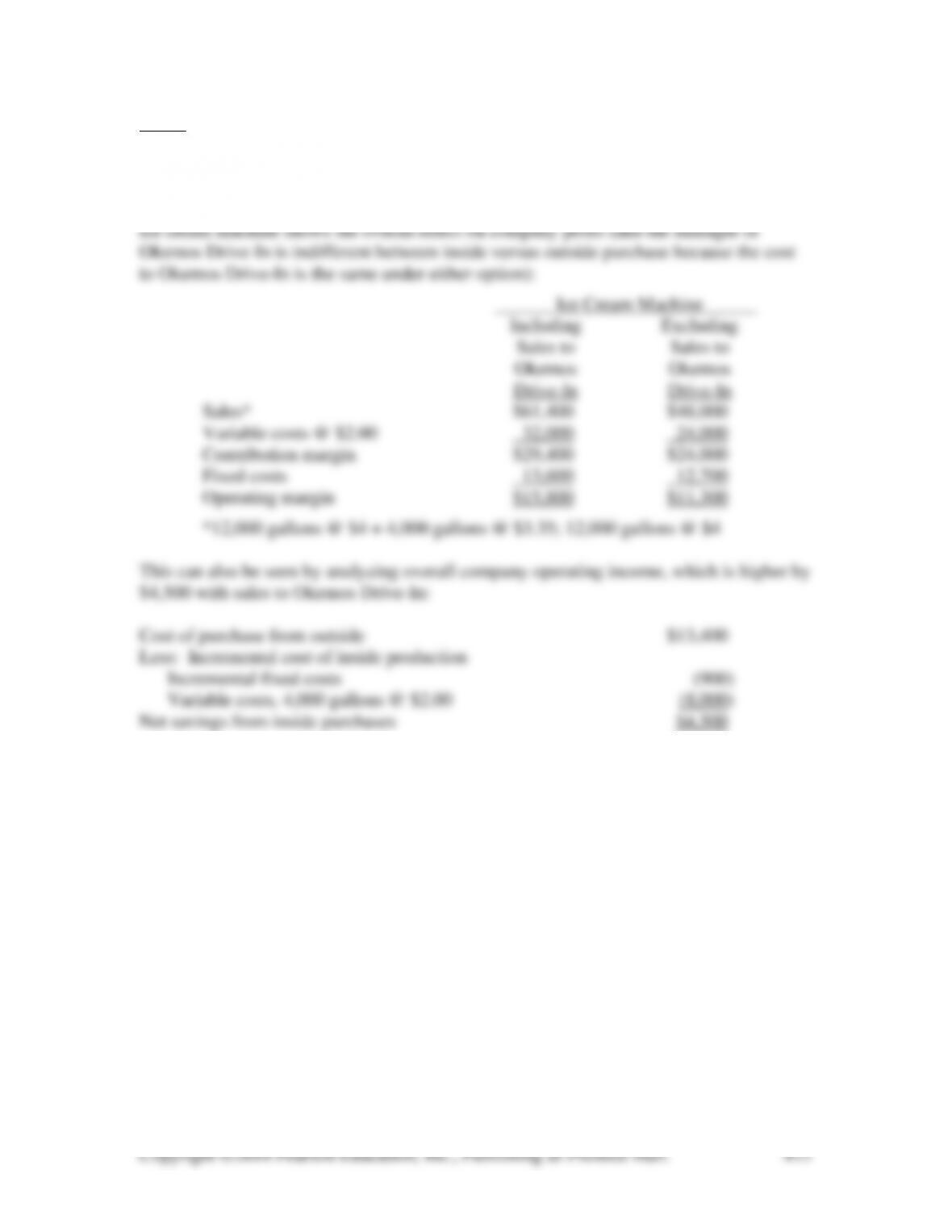
1. 20X4 20X5
Pretax operating income $6,105 $6,100
2. Although profit after tax increased slightly in 20X5, EVA decreased by ($1,945 –
10-B3 (20 min.)
The appropriate transfer price is the market price of $3.35 per gallon. As long as
the market price is met, the buying divisions must purchase from the internal divisions.
At this price, both divisions have incentives to make choices that maximize operating
income for the corporation as a whole. At this price, the analysis by the manager of the
Copyright ©2014 Pearson Education, Inc., Publishing as Prentice Hall.
416
10-B4 (30-45 min.)
1. a. Contribution margin per unit = ¥7,350 – ¥4,900 = ¥2,450
Total contribution = ¥2,450 × 3,350 units = ¥8,207,500
2. a. Desired operating income
= 24% × ¥16,000,000 = ¥3,840,000
Let X = units to be sold to reach desired return
¥2,450 × X units = ¥5,700,000 + ¥3,840,000
3. Examine the operating income and rate of return on assets with and without the
1,200-unit transfer (amounts are thousands of Japanese Yen):
Sell Sell Difference
2,950 4,150 1,200
units units units
Copyright ©2014 Pearson Education, Inc., Publishing as Prentice Hall.
417
Based on the information given, the Sendai division should sell 1,200 units to the
European Marketing division at the ¥6,150 price. Both divisions and the
company as a whole will benefit from such a decision. Although the original
overall target rate of return of 24% is unattainable, the division will nevertheless
earn a better rate of return with the intracompany business than without it. The
additional units earn a 24% incremental rate of return, which exceeds the 16.6%
rate earned on 2,950 units. As a result, the overall rate of return will increase
from 16.6% to 18.9%, as shown in the schedule above. In addition, the extra sales
meet the return target of 24%.
Despite this economic analysis, the Sendai manager may still decide against
transferring goods at such a low price. For example, he may feel entitled to a
10-1 Benefits of decentralization include: 1) lower-level managers may make better
decisions because they have better knowledge of local conditions; 2) managers develop
their management skills so that there are more managers qualified to move up in the
10-2 One of the limitations in decentralization is lack of knowledge in segments of the
organization. This is especially true in geographically decentralized operations.

10-3 It is more difficult to hold managers of nonprofit organizations responsible for
10-4 No. Profit centers facilitate decentralization, but one can exist without the other.
They are different concepts, as the chapter explains.
10-5 Decentralization is usually most successful in organizations where segments are
10-6 Employment contracts must balance the incentives created for managers, the risk
10-7 The major advantage of the rate of return analysis of performance is its attention
10-9 The major difference is that economic profit includes a capital charge, that is, a
cost of using all capital. In contrast, net income includes a charge for using debt capital
R&D.
10-10 Economic value added (EVA) is after-tax operating income minus the after-tax
weighted-average cost of capital multiplied by the sum of average long-term liabilities
and stockholders’ equity. Companies can improve EVA by
• Investing in products or projects that generate more after-tax operating
income than the cost of the capital used,
Copyright ©2014 Pearson Education, Inc., Publishing as Prentice Hall.
419
Total assets = Total liabilities + Stockholders’ equity
Current assets + Non-current assets = Current liabilities + Long-term debt +
Stockholders’ equity
Current assets – Current liabilities + Non-current assets = Long-term debt +
Stockholder’s equity
The right-hand side of the above equation represents the capital structure of an
organization – that is, how capital is financed. The left-hand side represents the actual
capital — working capital and non-current assets. Either definition can be used.
10-11 Division A’s manager would reject the proposed project because it would reduce
the division’s ROI. Division B’s manager would accept the proposed project because it
10-12 Three possible definitions of invested capital are:
2. Total assets less current liabilities
10-13 There is some truth to this statement. However, using a historical cost accounting
10-14 The use of gross book value rather than net book value of assets to compute ROI
may affect the speed with which managers replace assets. Gross book value leads to
10-15 Companies need transfer-pricing systems to accurately determine the efficiency of
various divisions of a company’s operation when using profit or investment centers. If
10-16 Using full costs can mask the real behavior of a cost. Any transfer price that
includes a fixed cost element makes a fixed cost in the producing department look like a
10-17 If a producing division has idle capacity, a transfer price at the variable cost will
usually be optimal. Why? Because it costs the firm as a whole only the variable costs to
10-18 Variable-cost transfer prices can also lead to dysfunctional decisions. For
10-19 Negotiated transfer prices are likely to lead to better transfer pricing decisions
10-20 Multinational transfer prices are influenced by the relative income-tax rates in the
10-21 In organizations using management by objectives (MBO), managers and their
10-22 When making performance targets becomes too important, managers may be
10-23 A decision to decentralize is based on a desire to achieve specific objectives in a
particular environment. If a company’s objectives change or its environment change, a
10-24 No. ROI and economic profit create different motivations for managers. Goal
congruence and managerial effort would usually be accomplished better by economic
profit.
10-25 Profit measures and other performance measures by themselves do not cause
unethical behavior. However, the way managers use them may. Managers charged with
10-26 When top management second-guesses divisional managers frequently, many
advantages of decentralization are lost. Segment autonomy disappears. Essentially, top
1. Turnover of capital = Sales ÷ Invested capital
2. Return on sales = $9,100÷ $227,500
= 4.0%
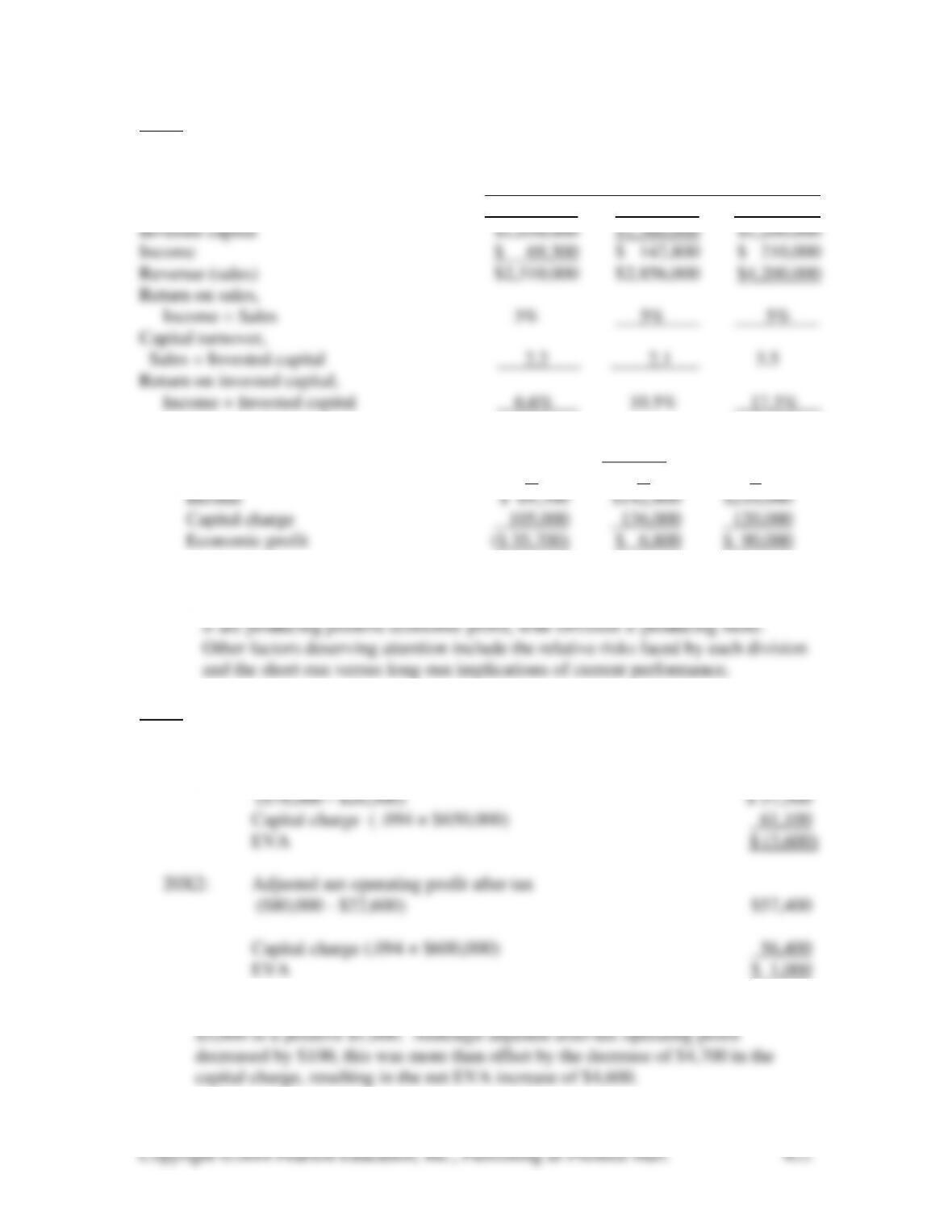
10-28 (5 min.)
The basic equation: ROI = Return on Sales × Capital turnover
10-29 (15-20 min.)
1. The filled-in blanks are underscored:
Division
X Y Z
2. Division
X Y Z
3. If the criterion for judging relative performance is ROI, Division Z is best for
this period. If the criterion is economic profit, then both Division Y and Division
10-30 (10 – 15 min.) Dollar amounts are in thousands.
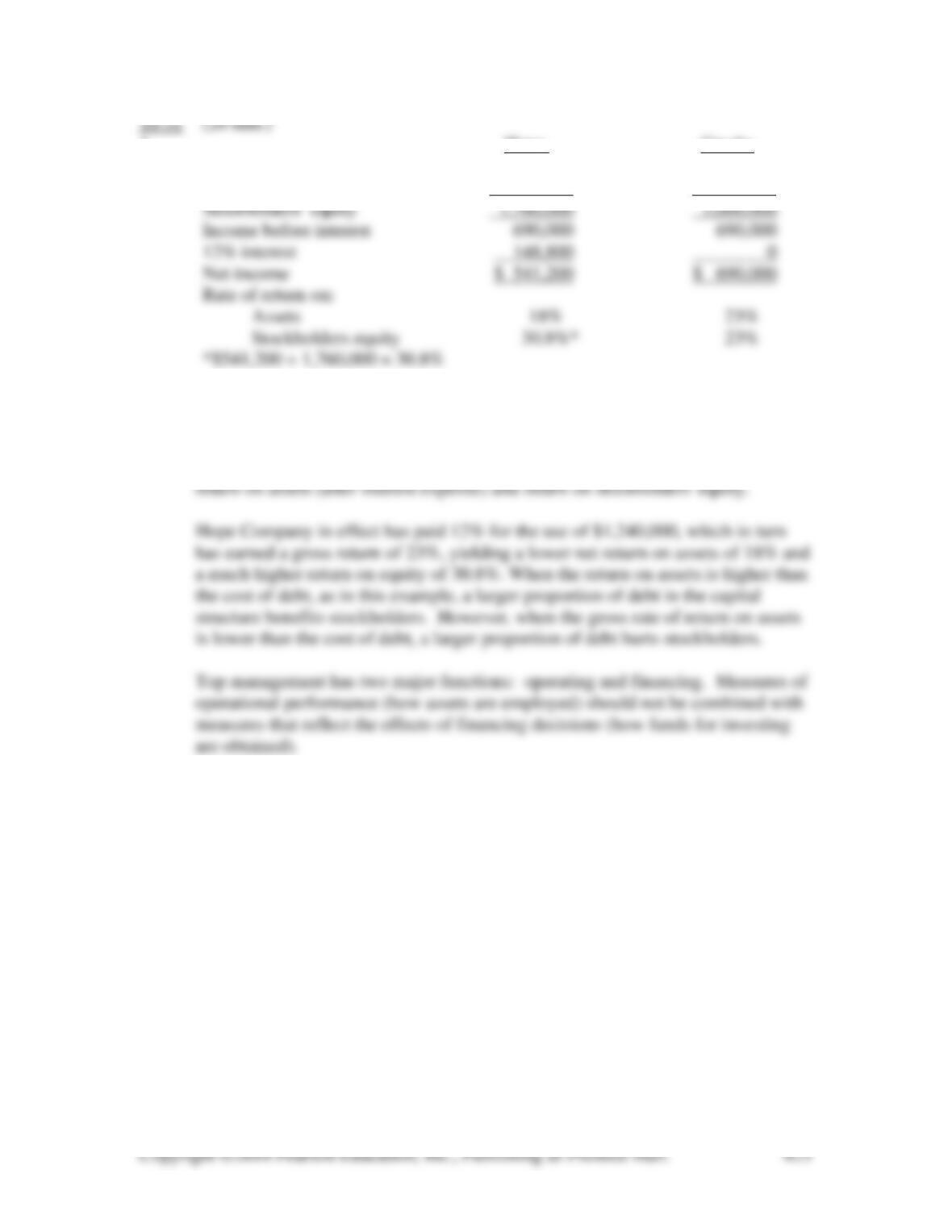
1.
20X1: Adjusted net operating profit after tax
2. Lohmann’s overall performance improved, with EVA increasing from a negative
Copyright ©2014 Pearson Education, Inc., Publishing as Prentice Hall.
423
10-31 (20 min.)
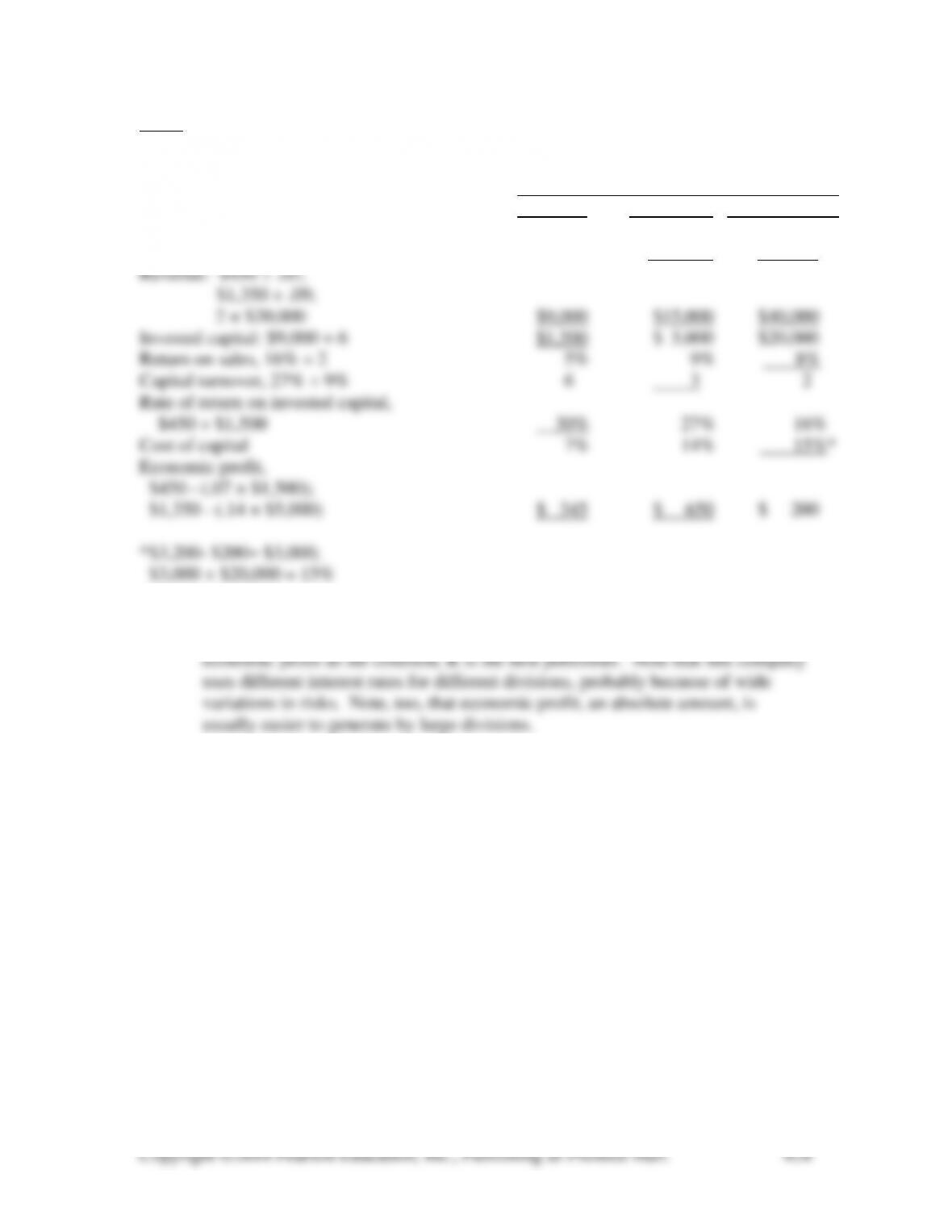
1. Hope Crosby
Assets $3,000,000 $3,000,000
Liabilities 1,240,000 0
2. The gross rate of return on assets (before considering interest expense) is 690,000
÷ 3,000,000 = 23%. For Crosby, with no debt in the capital structure, the return
on assets and return on stockholders’ equity are the same. For Hope, with a large
amount of debt in the capital structure, there is a large impact of debt on the net
10-32 (20-30 min.) This problem presses the student more than those immediately
preceding it. Dollar amounts are in thousands.
1. Division
J K L
Income: .27 × $5,000;
.16 × $20,000 $ 450 $ 1,350 $ 3,200
2. This requirement can generate much discussion or little discussion, as the
instructor desires. Using ROI as the criterion, J is the best performer. Using
10-33 (15 min.)
1 & 2.
(2) (1)
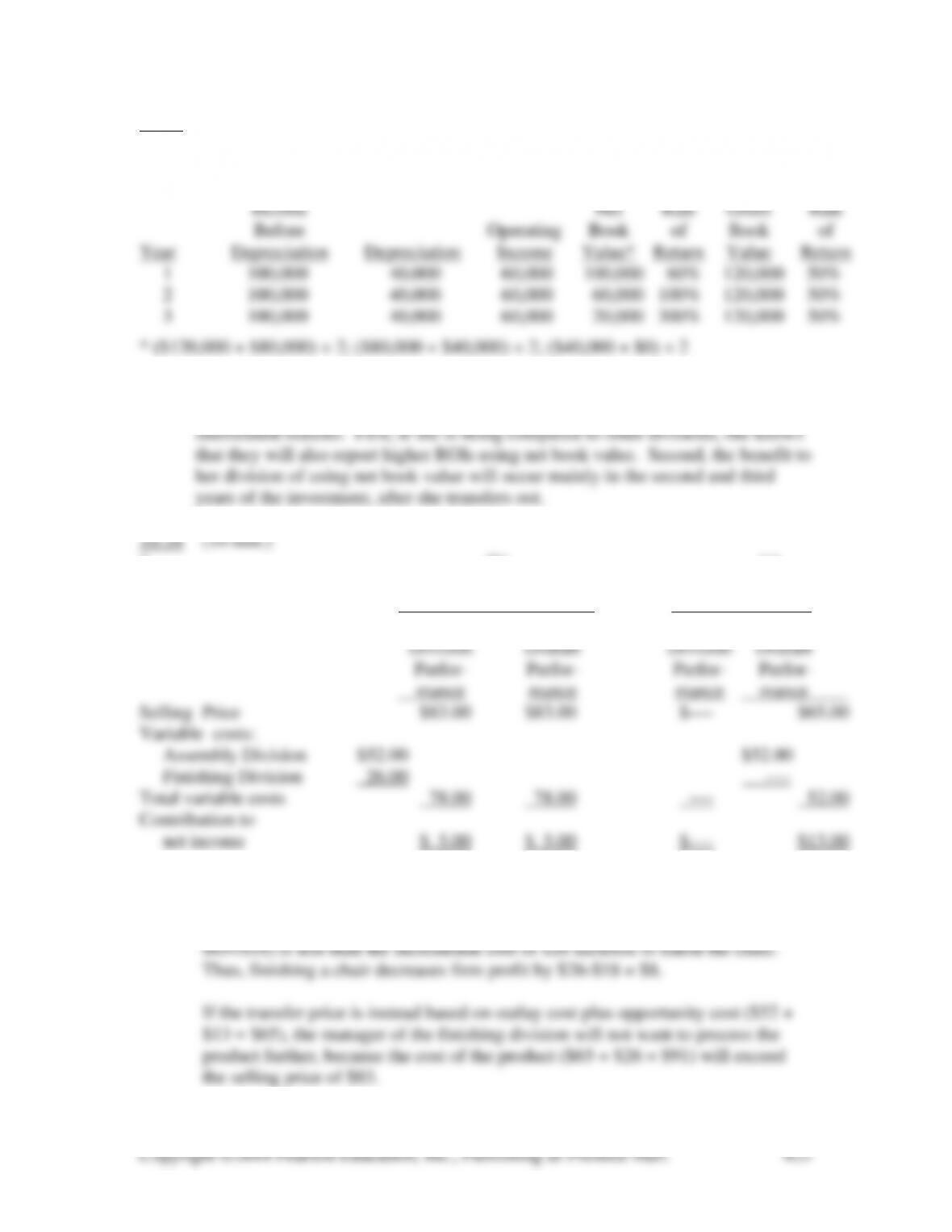
3. LaVilla might prefer the net book value because it always gives a higher ROI.
However, she might prefer to be evaluated based on gross book value for two
1. (b) (a)
Sell to Outsiders
Process Further at Transfer Point
Finishing Finishing
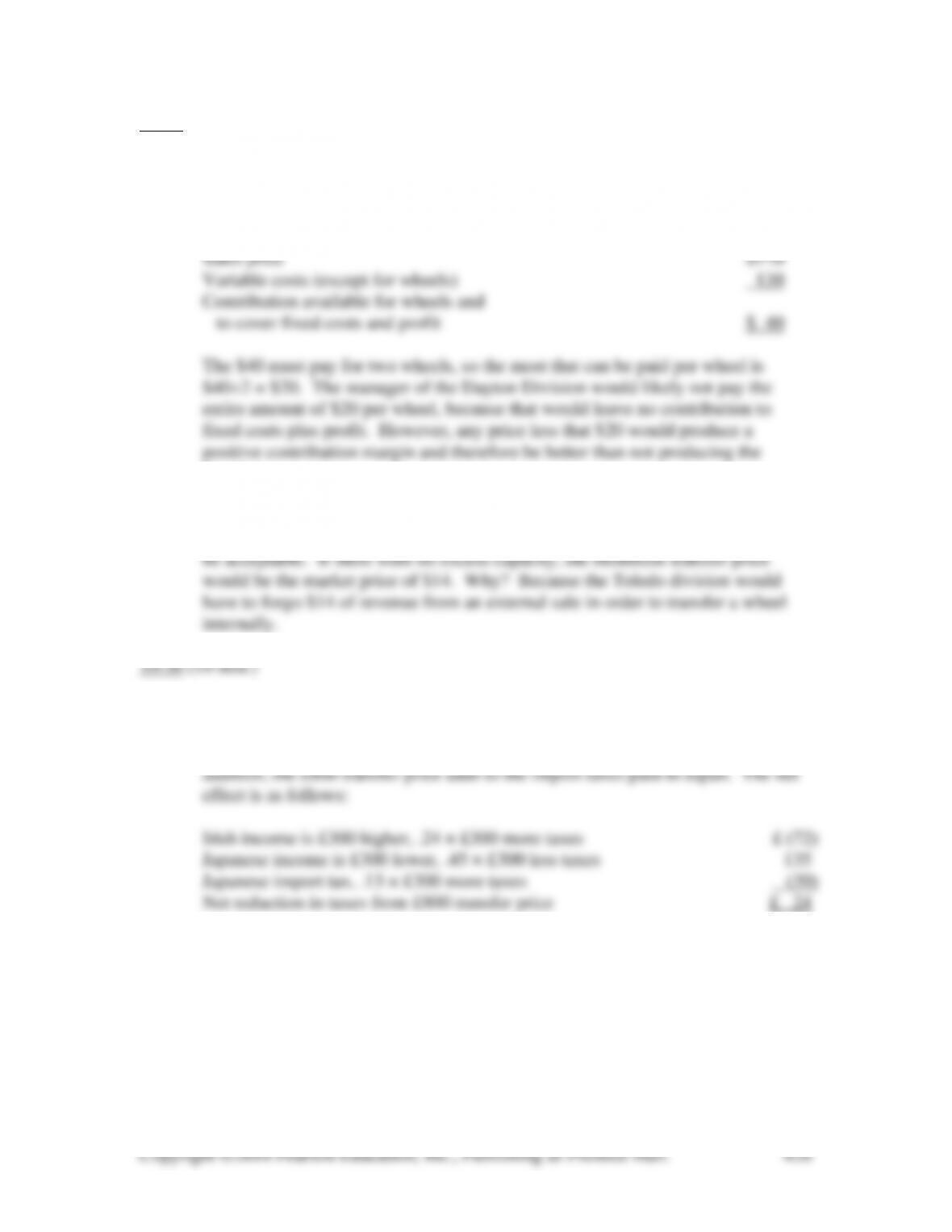
2. If the transfer price is based on variable cost of $52, the manager of the Finishing
Division would want the product processed further. But this would hurt overall
company performance. The incremental revenue from finishing the chair ($83–
10-35 (10-15 min.)
1. If wheels were available for $14 each in the market, Dayton would not be willing
to pay more than $14 to Toledo. If wheels could not be purchased in the market,
the maximum price would be $20, computed as follows:
bicycles.
2. Because there is excess capacity, any transfer price above the variable cost of
$10 would result in a positive contribution margin. No price below $10 would
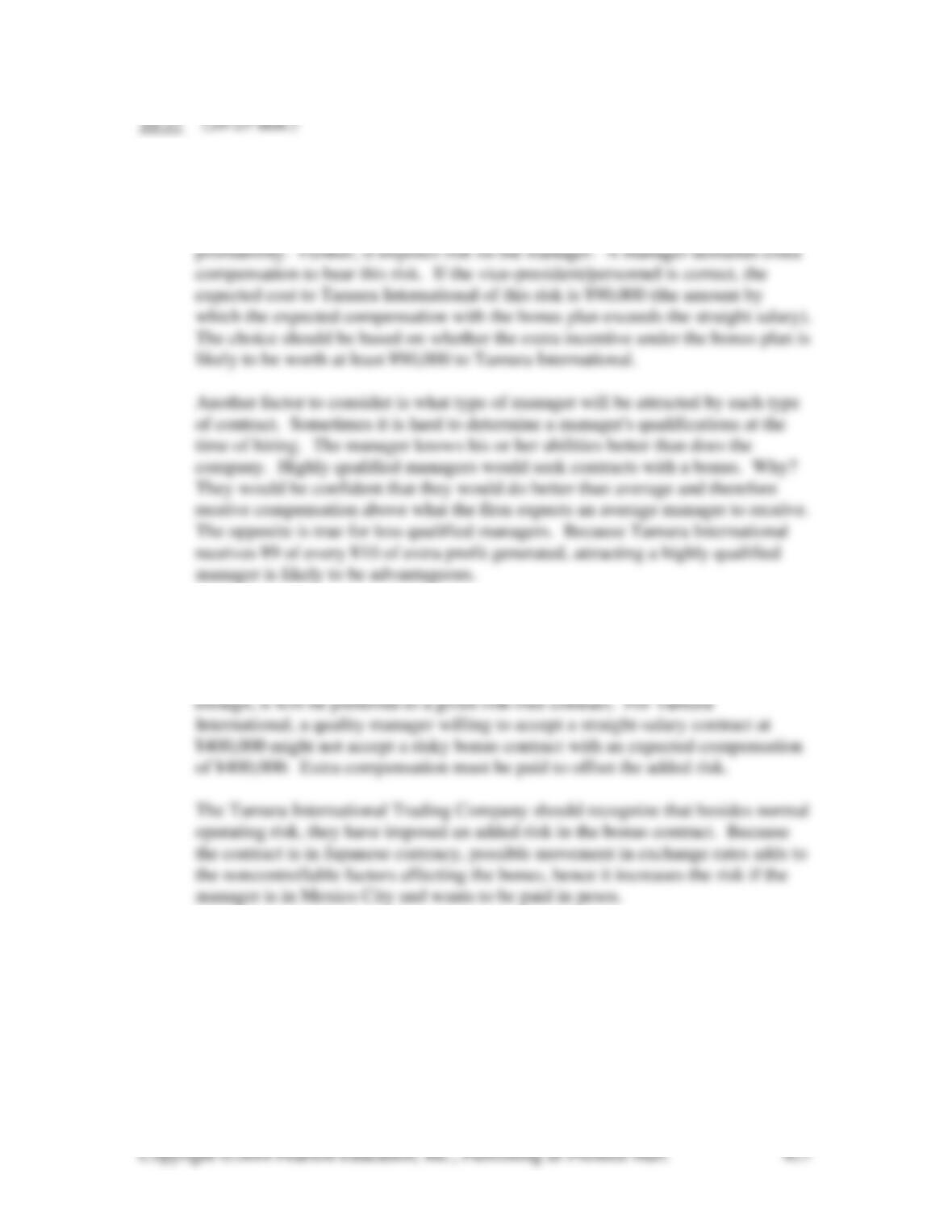
1. Princeton is better off using a £800 transfer price. A £800 transfer price places
an extra £800 – £500 = £300 of income in Ireland instead of Japan, while a £500
transfer price places an extra £300 of income in Japan instead of Ireland. In
2. The total taxes saved by the £800 transfer price is £24 per unit.
Copyright ©2014 Pearson Education, Inc., Publishing as Prentice Hall.
427
10-37 (20-25 min.)
1. The two contracts illustrate the tradeoff between incentive and risk in
employment contracts. The bonus contract provides more incentive to generate
profits than does the straight salary. This should benefit Tamura International.
On the other hand, it may cause the manager to focus too much on short-run
2. Managers are generally risk averse. This means that they prefer a contract with
less risk to one with more risk if the expected compensation does not differ. It
does not mean that managers avoid risks, only that they want to be compensated
for such risk-seeking. If a risky contract has an expected compensation high