
1
CHAPTER 1
COVERAGE OF LEARNING OBJECTIVES
LEARNING OBJECTIVE
FUNDA-
MENTAL
ASSIGN-
MENT
MATERIAL
CRITICAL
THINKING
EXERCISES
AND
EXERCISES
PROBLEMS
CASES,
EXCEL,
COLLAB., &
INTERNET
EXERCISES
LO1: Explain why accounting is
essential for decision makers and
managers.
30, 31
52, 55
LO2: Describe the major users
and uses of accounting
information.
A1, B1
28, 29, 33
39, 40, 42
55
LO3: Explain the role of budgets
and performance reports in
planning and control.
A2, B2
32
45
53
LO4: Describe the cost-benefit
and behavioral issues involved in
designing an accounting system.
41, 43
LO5: Discuss the role
accountants play in the
company’s value chain functions.
A1, B1
30, 31, 34, 35,
36
39, 42, 44, 46
LO6: Identify current trends in
management accounting.
54
LO7: Explain why ethics and
standards of ethical conduct are
important to accountants.
A3, B3
37, 38
47, 48, 49
51, 52, 55

2
CHAPTER 1
Managerial Accounting, the Business Organization, and Professional Ethics
1-A1 (10-15 min.)
Information is often useful for more than one function, so the following classifications for
each activity are not definitive but serve as a starting point for discussion:
1. Scorekeeping. A depreciation schedule is used in preparing financial statements
to report the results of activities.
2. Problem solving. Helps a manager assess the impact of a purchase decision.
3. Scorekeeping. Reports on the results of an operation. Could also be attention
directing if scrap is an area that might require management attention.
4. Attention directing. Focuses attention on areas that need attention.
5. Attention directing. Helps managers learn about the information contained in a
performance report.
6. Scorekeeping. The statement reports what has happened. Could also be attention
directing if the report highlights a problem or issue.
7. Problem solving. Assuming the cost comparison is to help the manager decide
between two alternatives, this is problem solving.
8. Attention directing. Variances point out areas where results differ from
expectations. Interpreting them directs attention to possible causes of the
differences.
9. Problem solving. Aids a decision about where to make parts.
10. Attention directing and problem solving. Budgeting involves making decisions
about planned activities — hence, aiding problem solving. Budgets also direct
attention to areas of opportunity or concern — hence, directing attention.
Reporting against the budget also has a scorekeeping dimension.
3
1-A2 (15-20 min.)
1. Budgeted Actual Deviations
Amounts Amounts or Variances
2. Because of the management by exception rule, room rental and entertainment
require no explanation. The actual expenditure for food exceeded the budget by
$132) and the remaining $83 ($215 – $132) is explained by expenditures above
$8.25 per person.
1-A3 (10 min.)
2. Felix must address his level of competence for the assignment. If his supervisor
3. The credibility standard should cause Mary Sue to decline to omit the information
4
1-B1 (15-20 min.)
1. Problem solving. Provides information for deciding between two alternative
courses of action.
3. Problem solving. Helps a manager decide among alternatives.
5. Problem solving. Provides information to managers for deciding whether to move
corporate headquarters.
7. Attention directing. Directs attention to areas where actual results differed from
the budget.
9. Problem solving. Produces information to help the marketing department make a
decision about a marketing campaign.
11. Attention directing. Directs attention to stores with either high or low ratios of
advertising expenses to sales.
13. Attention directing or problem solving, depending on the use of the schedule. If it
14. Scorekeeping. Records items needed for financial statements.
5
1-B2 (10-15 min.)
1 & 2. Budget Actual Variance
3. The cost of fireworks was $600 ÷ $40,000 = 1.5% under budget while sales were
just $560 ÷ $80,000 = .7% under budget. Did fireworks suppliers lower their
1-B3 (15 – 20 min.)
1. A code of conduct is a document specifying the ethical standards of an
organization.
2. Different companies include different elements in their codes of conduct. Some of
the items included in companies’ codes of conduct include maintaining a dress
code, avoiding illegal drugs, following instructions of superiors, being reliable
3. Simply having a code of conduct does not guarantee ethical behavior by
employees. Most important is top management’s ethical example and its support
6
1-1 Internal managers and external parties use accounting information:
a. Internal reporting is used by managers for planning and controlling operations,
1-2 The emphasis of financial accounting has traditionally been on the historical data
1-4 Scorekeeping is the recording (including accumulation and classification) of data
for a later evaluation of performance. Attention directing is the reporting and
1-5 No. GAAP applies to financial reporting for external users. Internal accounting
reports are not restricted by GAAP.
1-6 Yes, though the act covers more than foreign bribes. The Foreign Corrupt
1-7 Many managers believe that the costs of applying the provisions of the Sarbanes-
1-8 Users cannot easily observe the quality of accounting information. Thus, they
users.
1-9 No. The ethics developed as a student carry over into one’s professional life.
1-10 Public accounting firms, law firms, management consultants, real estate firms,
transportation companies, banks, insurance companies, and hotels are examples of
1-11 Two considerations are cost-benefit balance and behavioral effects. Cost-benefit
balance refers to how well an accounting system helps achieve management’s goals in
Copyright ©2014 Pearson Education, Inc., Publishing as Prentice Hall.
7
relation to the cost of the system. The behavioral-effects consideration specifies that an
accounting system should be judged by how it will affect the behavior (that is, decisions)
of managers.
1-12 Yes. Measurement and recording is an integral part of management. For
1-13 A budget is a quantitative expression of a plan of action; a performance report
1-14 No. Management by exception means that management directs more attention to
1-15 Information that is relevant for decisions about a product depends on the product’s
1-16 The six functions are: (1) research and development – generation and
(3) production – use of resources to produce a product or service; (4) marketing –
1-17 No. Some functions in the value chain may not be present in some organizations
1-19 Management accountants are the information specialists. In non-hierarchical
companies, they are more directly involved with managers and are often parts of cross-
8
1-21 The two parts of the CMA examination are: (1) financial planning, performance,
and control, and (2) financial decision making.
1-22 This is not true. About one-third of CEOs in companies with revenues greater
1-23 Changes in technology are affecting how accountants operate. Increasing
computing capabilities and decreasing computing costs have changed how accountants
1-24 The essence of the just-in-time philosophy is the elimination of waste,
1-25 Moving tools and products that are in process from one location to another in a
(2) confidentiality – refrain from disclosing or using confidential information, (3) integrity
– avoid conflicts of interest, refuse gifts that might influence actions, recognize
9
1-28 (5-10 min.)
Typical activities associated with the treasurer function include:
❑ Provision of capital
❑ Investor relations
1-29 (10 – 15 min.)
2. Controller. Advising managers aids operating decisions.
4. Treasurer. Analysts affect the company’s ability to raise capital, which is the
responsibility of the treasurer.
6. Controller. Tax returns are part of the accounting process overseen by the
controller.
8. Treasurer. Allowing credit is a financial decision.
10
1-30 (5-10 min.)
Activities 2, 4, 5, and possibly 6 are primarily associated with marketing decisions.
The management accountant would assist in these decisions as follows:
1-31 (5-10 min.)
Activities 1, 7, and 8 are primarily associated with production decisions.
The management accountant would assist in these decisions as follows:
1-32 (5 min.)
11
1-33 (10 min.)
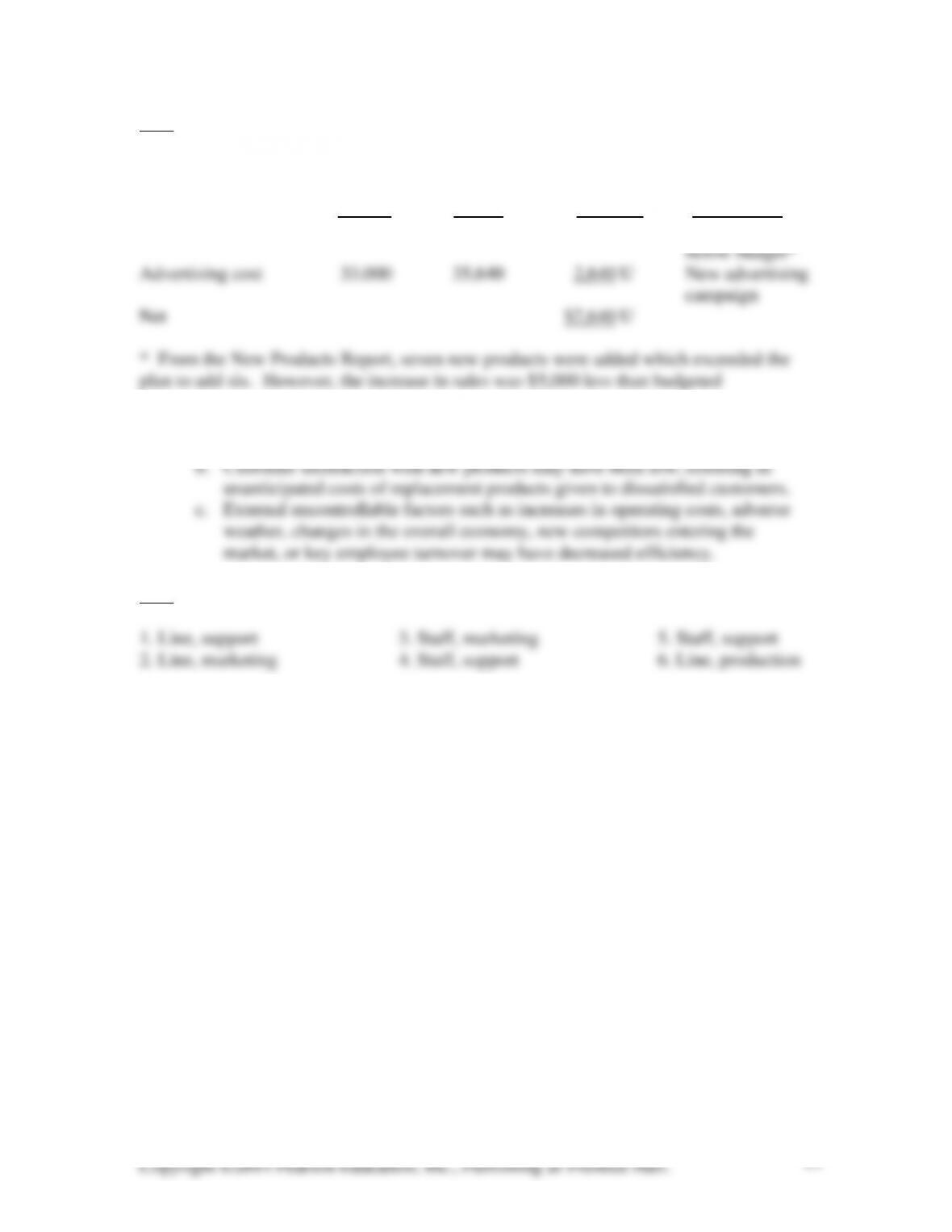
1. Performance Report
Budget Actual Variance Explanation
Revenues $356,400 $351,400 $5,000 U Additional sales
2. Factors that may not have been considered include:
a. Raw material costs for new products may have been higher than budgeted.
1-34 (5 min.)
12
1-35 (30 min.)
Microsoft is a company that most students will know and have some
understanding of what functions its managers perform. Nevertheless, this may not be an
13
1-36 (15-20 min.)
The management accountant’s major purpose is to provide information that helps
line managers plan and control operations and make decisions. The accountant supplies
1-37 (5 min.)
Costs of a poor ethical environment include legal costs and costs due to absenteeism and
1-38 (5 min.)
There are numerous examples.