174 Perloff • Microeconomics: Theory and Applications with Calculus, Third Edition
12. Suppose the demand curve for a good is Q = 9 − p and the supply curve is Q =
2p. The government
imposes a specific tax of
τ
= 1 per unit. What would be the equilibrium? What effect does the tax
have on consumer surplus, producer surplus, and deadweight loss?
Answers to Additional Questions and Problems
1. Surplus in Market 1 is $180 but only $160 in Market 2.
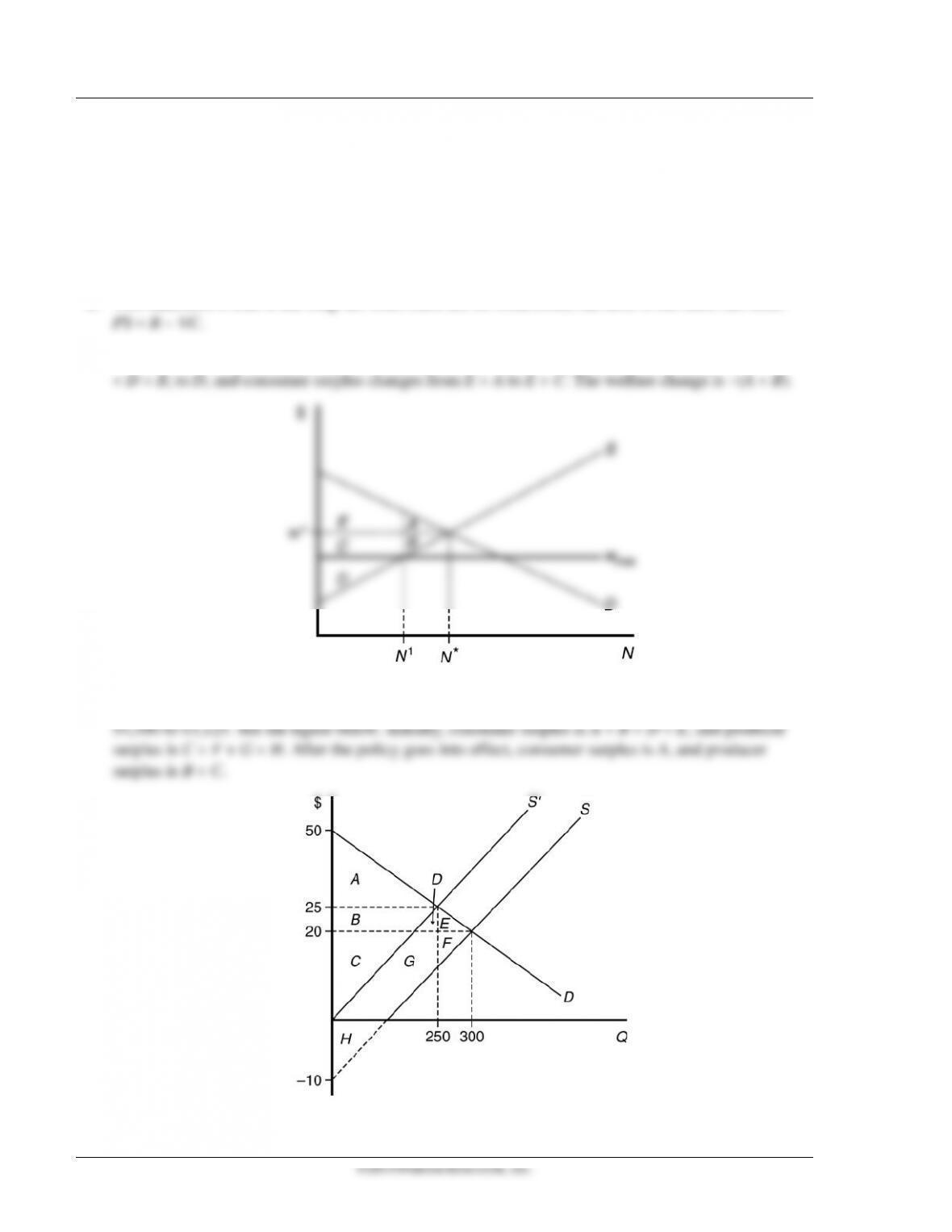
3. When the maximum wage is imposed, employment falls from N* to N′, producer surplus falls from C
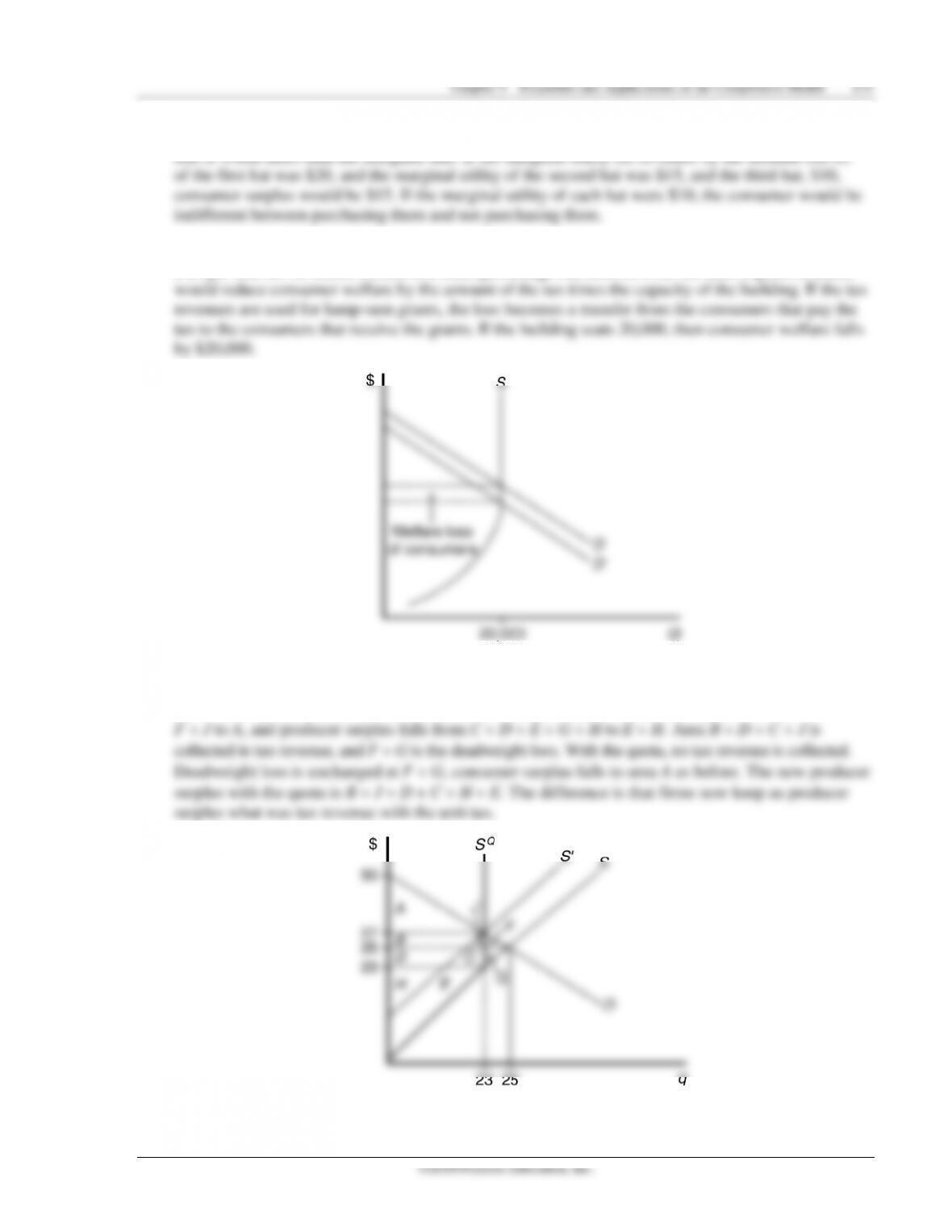
4. When the baker’s license is instituted, the supply curve shifts upwards by $100. Quantity falls from
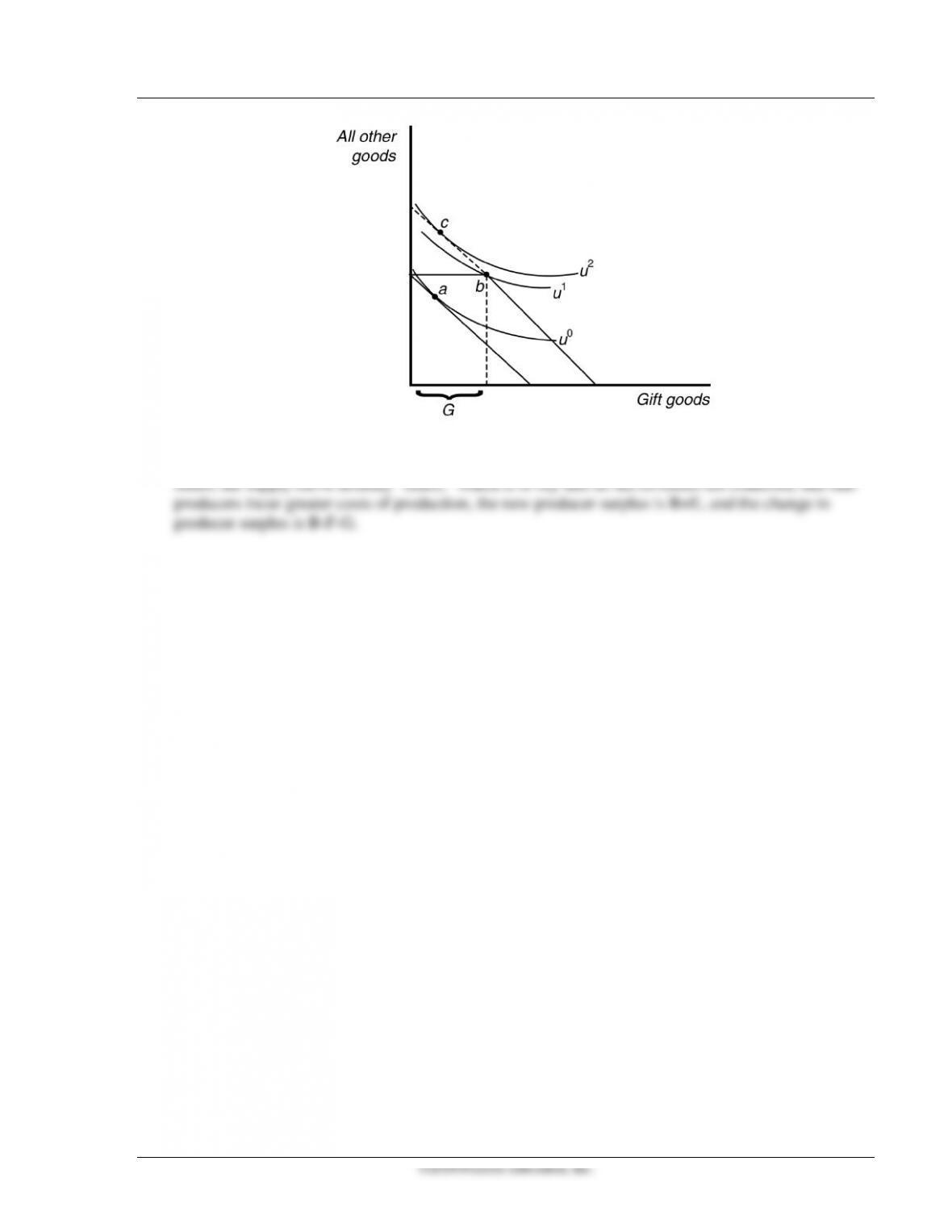
300 to 250, price increases from $20 to $25, and consumer and producer surplus each fall from
176 Perloff • Microeconomics: Theory and Applications with Calculus, Third Edition
©2014 Pearson Education, Inc.
9. By setting demand equal to supply, we discover that the initial equilibrium price is $3, and the quantity
of miles run is 6. With the subsidy, the new demand curve is P = 8 − 1Ú2 Q, or Q = 16 − 2P. The new
equilibrium quantity is 8 miles, and the price including the subsidy is $4.
10. The allocation mechanism is inefficient because there is no guarantee that the fans who value the
tickets the most will receive them. Suppose the winning fans may purchase tickets for $100 each.
was described it the text, scalpers emerge and create a secondary market for resold tickets.
11. If people think the gift they receive are not worth the price paid by the giver, they can return the gift
12. The equilibrium without the tax is p = 3 and Q = 6. With the tax, the new equilibrium will be p = 11/3
Answers to Exercises in the Text
1.1 a. Rent is a fixed cost to farmers because it does not vary with the amount of output. Thus, the rent
b. Does it make a difference whether firms own or rent the land? Not really. The opportunity cost
to a farmer who owns the land is the amount for which that land could be rented in a competitive
1.2 a. The supply of antiquities potentially comes from two sources: existing antiquities and newly
b. With the ban on newly excavated antiquities, established dealers possess a resource that has
become relatively more scarce. This allows them to earn an extra opportunity value as their
c. Questionable newly excavated antiquities might reduce the demand for antiquities, shifting the
Chapter 9 Properties and Applications of the Competitive Model 177
d. Rent is a payment to the owner of an input beyond the minimum necessary for the factor to be
1.3 Tiger Woods captured essentially all the rent from non–sports–related companies but not from sports–
related companies. This is because Mr. Woods’ sponsorship of sports–related companies increased
the value of the Tiger brand and provided other financial opportunities for Mr. Woods, and the sports-
2.1 Profit is the difference between a firm’s revenue and its cost. Producer surplus is the difference
between the amount for which a good sells and the minimum amount necessary for the seller to be
2.2 Producer surplus (PS) is the difference between the amount for which a good sells and the minimum
amount necessary for the seller to be willing to produce the good. This is equal to the area under the
of a triangle with a height equal to the price ($10) and a base equal to the difference in the 22 units
supplied at the $10 price and the 2 units supplied when price equals zero:
0.5(10)20 = 100.
2.3
**( 1)
*( 1) 1/
0(/) .
1
Ap Ap
PS Ap Q A dQ
η
η
ηη
η
+
+
=−=
+
∫
3.1 If we take as given the assumption, stated in the question, that “the government cannot force or bribe
firms to produce more than the competitive level,” which is to say, the government itself is prohibited
3.2 The equilibrium price and quantity are:
178 Perloff • Microeconomics: Theory and Applications with Calculus, Third Edition
6.44
6743.
∗
∗
=
=
p
Q
0
∫
3.3 a. The equilibrium price and quantity are:
Q = (PN –2)/0.112, and P = 2+(0.012/0.112)*(PN -2)
dP/dPN = 0.12/0.112 = 0.107143
Chapter 9 Properties and Applications of the Competitive Model 179
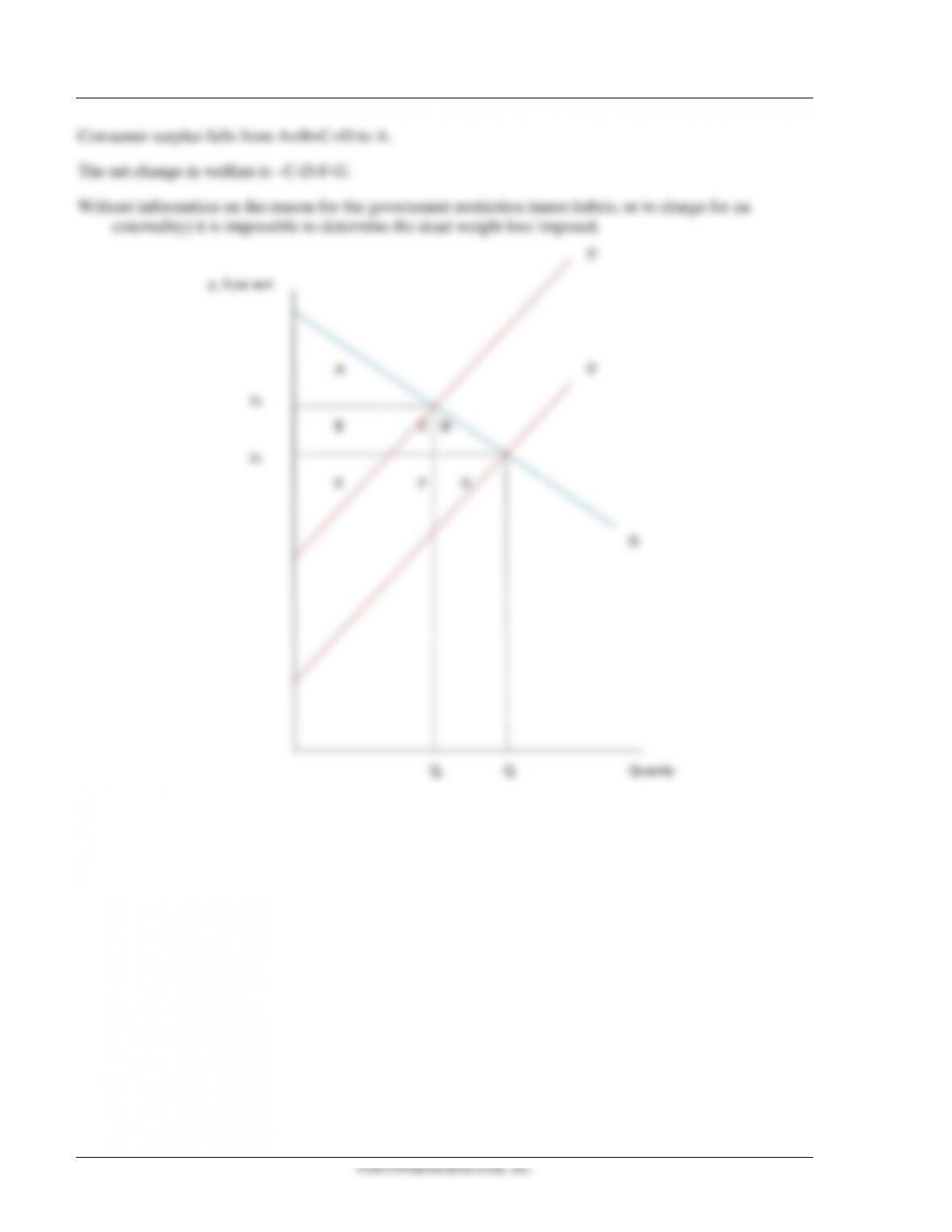
4.1 Assuming that the government–imposed restriction raise the firms’ costs such that, as the question
180 Perloff • Microeconomics: Theory and Applications with Calculus, Third Edition
©2014 Pearson Education, Inc.
Consumer surplus falls from A+B+C+D to A.
The net change in welfare is –C-D-F-G.
Without information on the reason for the government restriction (mere hubris, or to charge for an
externality) it is impossible to determine the dead weight loss imposed.
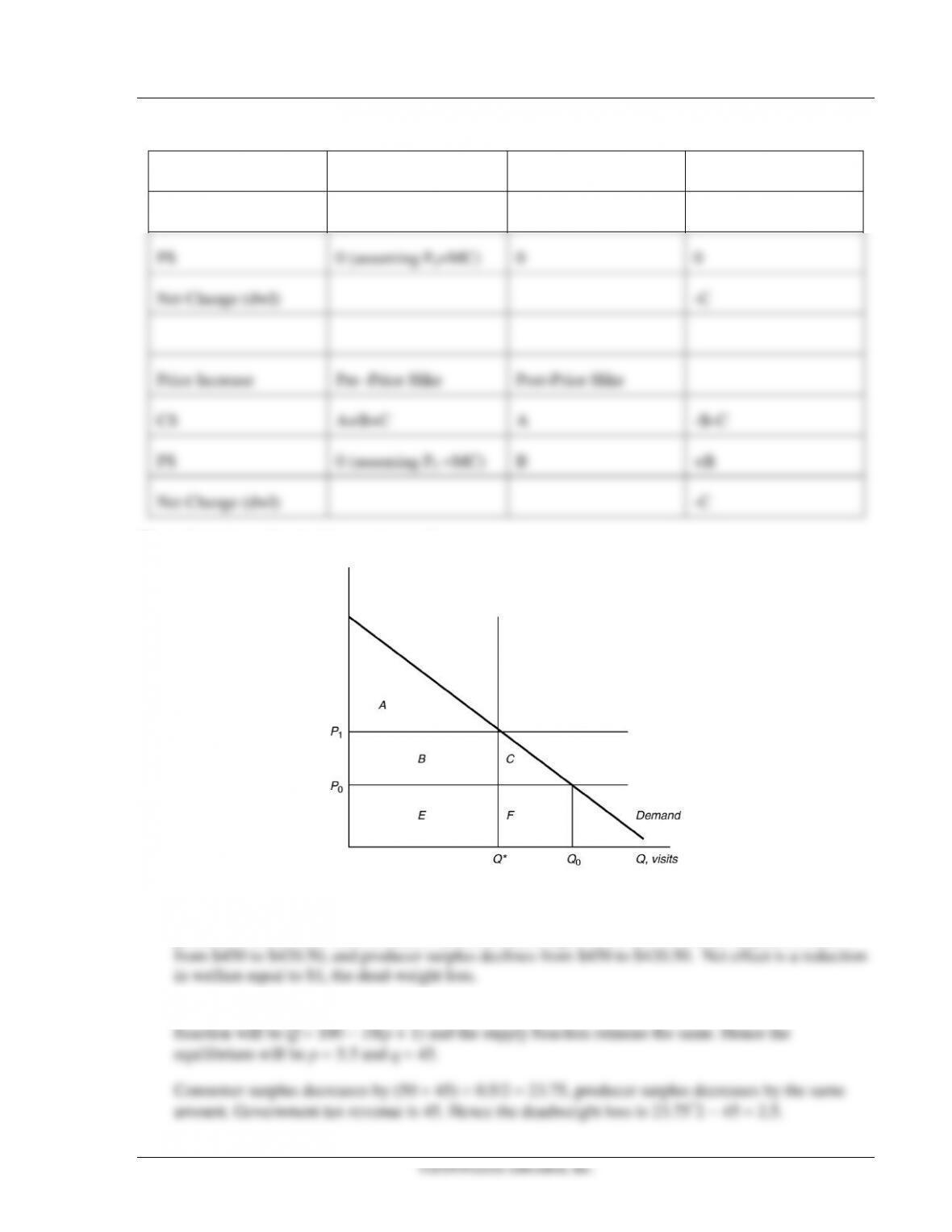
4.2 Using the same methods as the text to evaluate the two policies, we have:
Chapter 9 Properties and Applications of the Competitive Model 181
Quota Analysis Pre Quota Post Quota Change
CS A+B+C A+B -C
The policies have identical impacts on welfare.
5.1 The initial equilibrium is Q* = 30, p* = 30. The tax reduces output to 29. Consumers pay $31 and
producers receive $29. Tax revenue is $58, and deadweight loss is $1. Consumer surplus declines
5.2 The equilibrium price and quantity without the tax is p = 5 and Q = 50. With the tax, the demand
182 Perloff • Microeconomics: Theory and Applications with Calculus, Third Edition
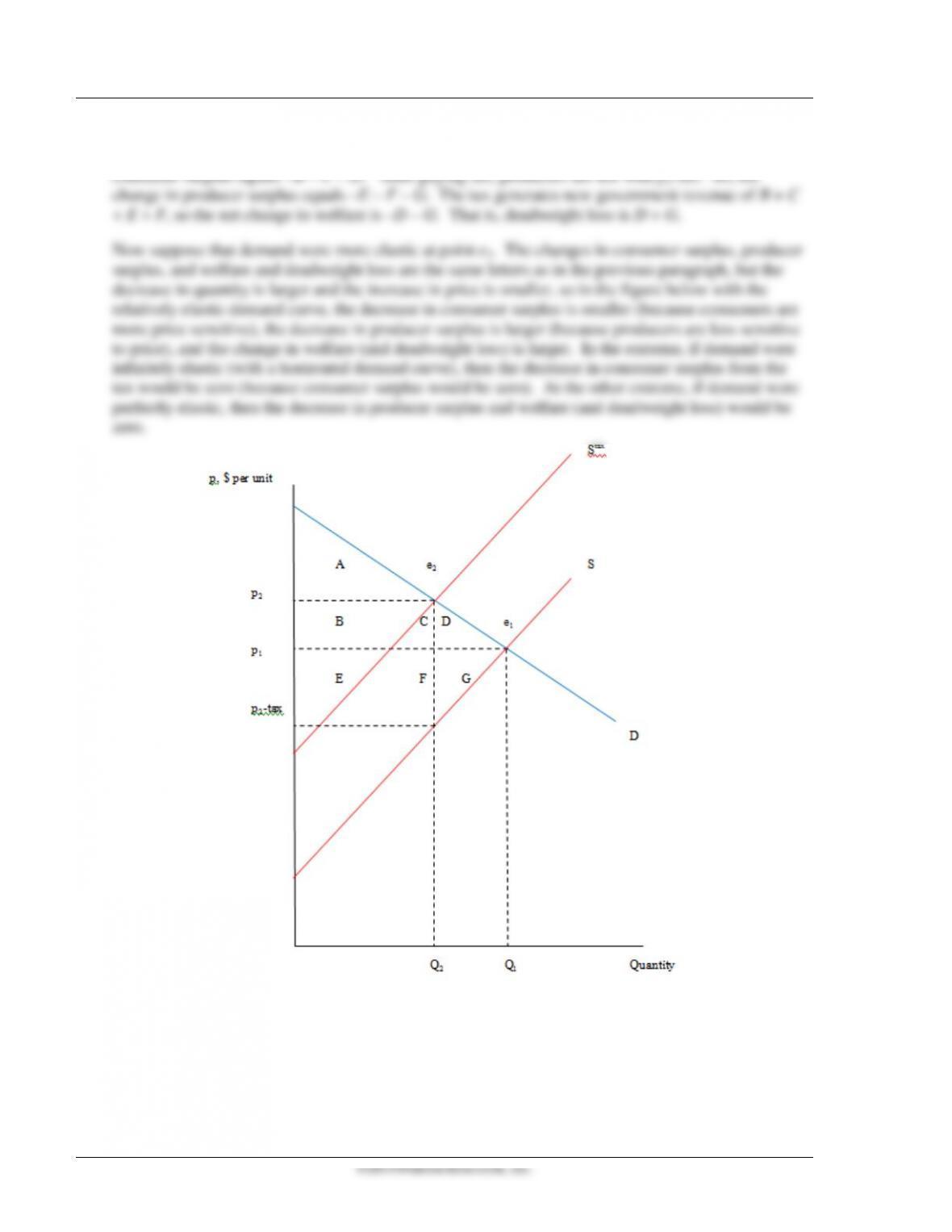
5.3 With the tax, the market price increases from p1, where the original supply curve intersects the
demand curve, to p2, where the supply curve with the tax intersects the demand curve. The change in
5.4 Given
Chapter 9 Properties and Applications of the Competitive Model 183
Qd = 100 – 10p
Qs = 10p
Initial equilibrium occurs as p = 5, Q = 50
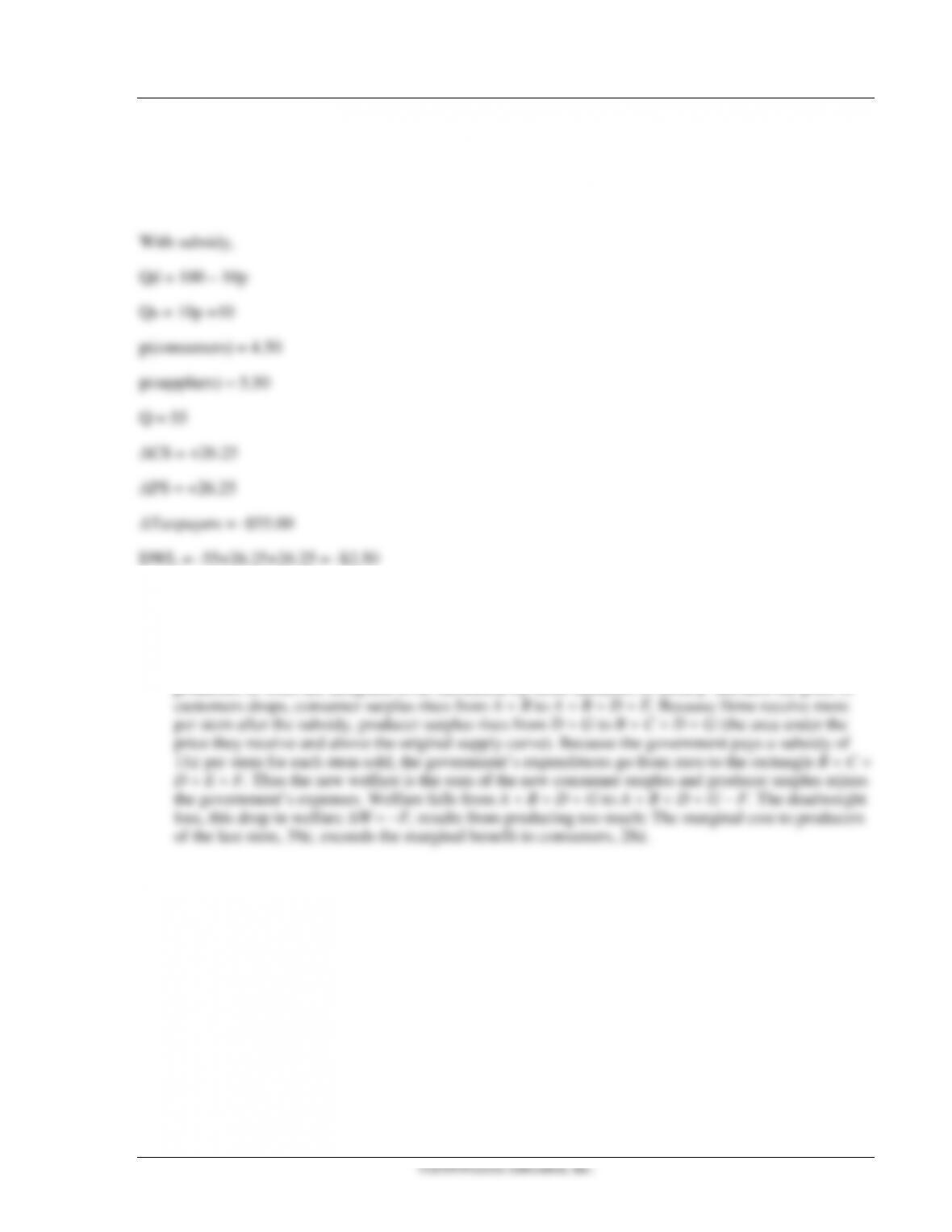
5.5 The specific subsidy shifts the supply curve, S in the figure below, down by s = 11¢, to the curve
labeled S − 11¢. Consequently, the equilibrium shifts from e1 to e2, so the quantity sold increases (from
1.25 to 1.34 billion rose stems per year), the price that consumers pay falls (from 30¢ to 28¢ per
stem), and the amount that suppliers receive, including the subsidy, rises (from 30¢ to 39¢), so that
the differential between what the consumers pay and what the producers receive is 11¢. Consumers and