142 Perloff • Microeconomics: Theory and Applications with Calculus, Third Edition
3.5 The price of labor (w) is now 25 percent cheaper. Assuming that the price of capital (r) does not
change and remains the same, the isocost faced by producers becomes less steep (−w/r before the
3.6 From the information given and assuming that there are no economies of scale in shipping baseballs,
it appears that balls are produced using a constant return to scale, fixed–proportion production
3.8 The Lagrangian for cost minimization is
)( b
aKAL
qrKwLL −++=
λ
.
The conditions for a critical value of L, K, and λ—the first-order conditions—for an interior
ar
A
3.9 L:
wL rK q L K
++ −−
ρρ ρ
λ
FOCs
1
1
0
0
0
wL
rK
q LK
−
−
−=
−=
−− =
ρ
ρ
ρρ ρ
λρ
λρ
Chapter 7 Costs 143
©2014 Pearson Education, Inc.
From the FOCs
ρρ
ρ
ρ
ρ
ρ
1
111
1
)(
−
−−−
+= rwqwL
and
ρρ
ρ
ρ
ρ
ρ
1
111
1
)(
−
−−−
+= rwqrK
.
In turn, the cost function, C, is
ρ
ρ
ρ
ρ
ρ
ρ
1
1
1)
(),,(
−
−
−+
=rw
qq
rwC
.
3.10 If the wage increases, the firm should use more capital and less labor at all output levels; thus, the
expansion path increases in slope.
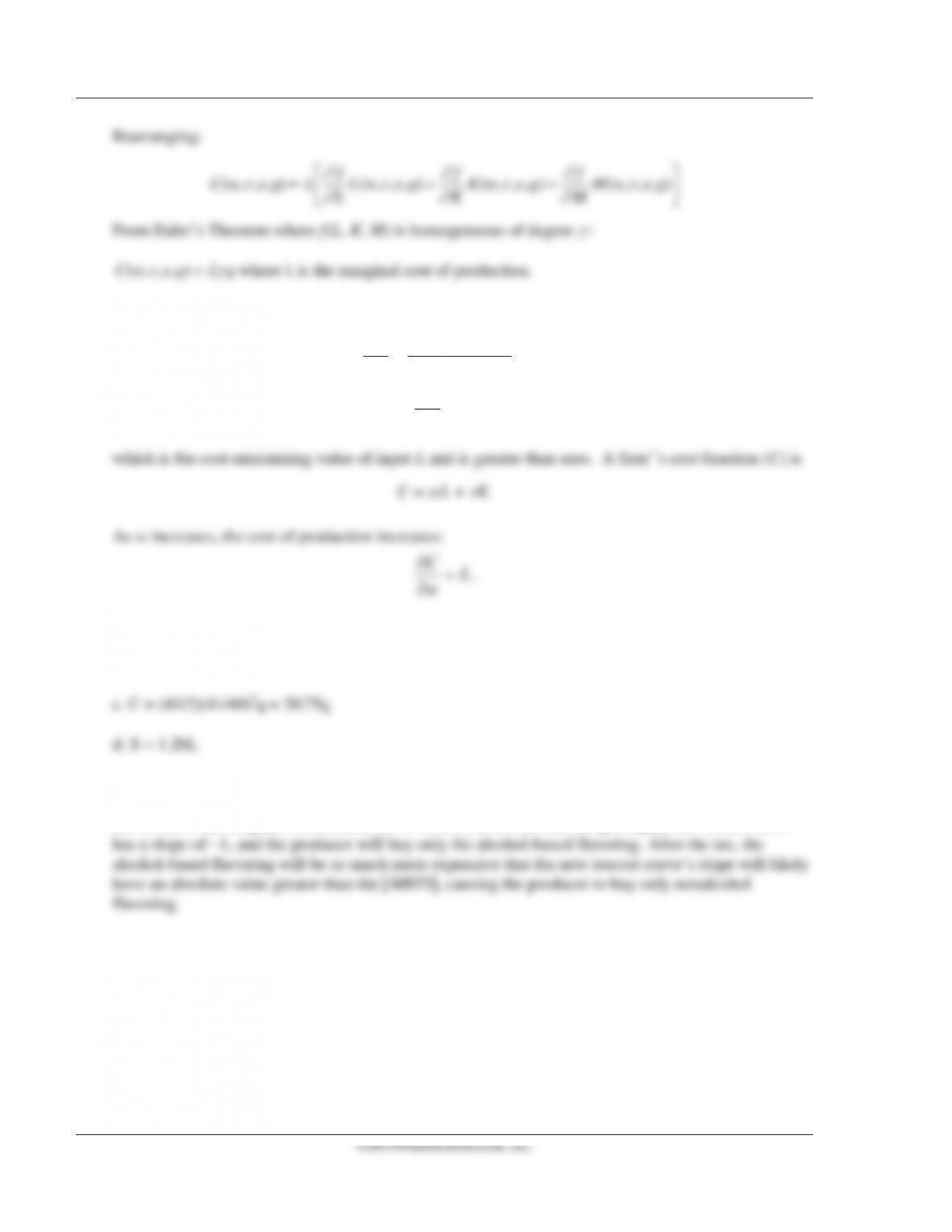
3.11 Paddles and nets are perfect complements because the company always sells one net with two
paddles. The expansion path is a straight line with slope 2. The change in relative prices of paddles
and nets does not change the expansion path.
3.12 If there are constant returns to scale, the long-run expansion path will be a straight line, indicating a
3.13
( ,,,) ( ,,,) ( ,,,) ( ,,,)C Cwreq wLwreq rKwreq eMwreq== ++
where L(.), K(.) and M(.) are the factor
LK M
∂∂ ∂
144 Perloff • Microeconomics: Theory and Applications with Calculus, Third Edition
©2014 Pearson Education, Inc.
Rearranging:
( ,,,) ( ,,,) ( ,,,) ( ,,,)
ff f
Cwreq Lwreq K wreq Mwreq
LK M
= ++
∂∂ ∂
λ∂∂ ∂
From Euler’s Theorem where f(L, K, M) is homogeneous of degree
γ
:
( ,,,)Cwreq q=
λγ
where λ is the marginal cost of production.
3.14 The derivative of the cost function with respect to w is
q
aAa
raw
w
C
aa
aa
−
−−
−
=
∂
∂
1
11
)1(
L
w
C=
∂
∂
,
w
∂
3.15 a. MPL = L-3q3; MPs = q3/40S3
b. L = S
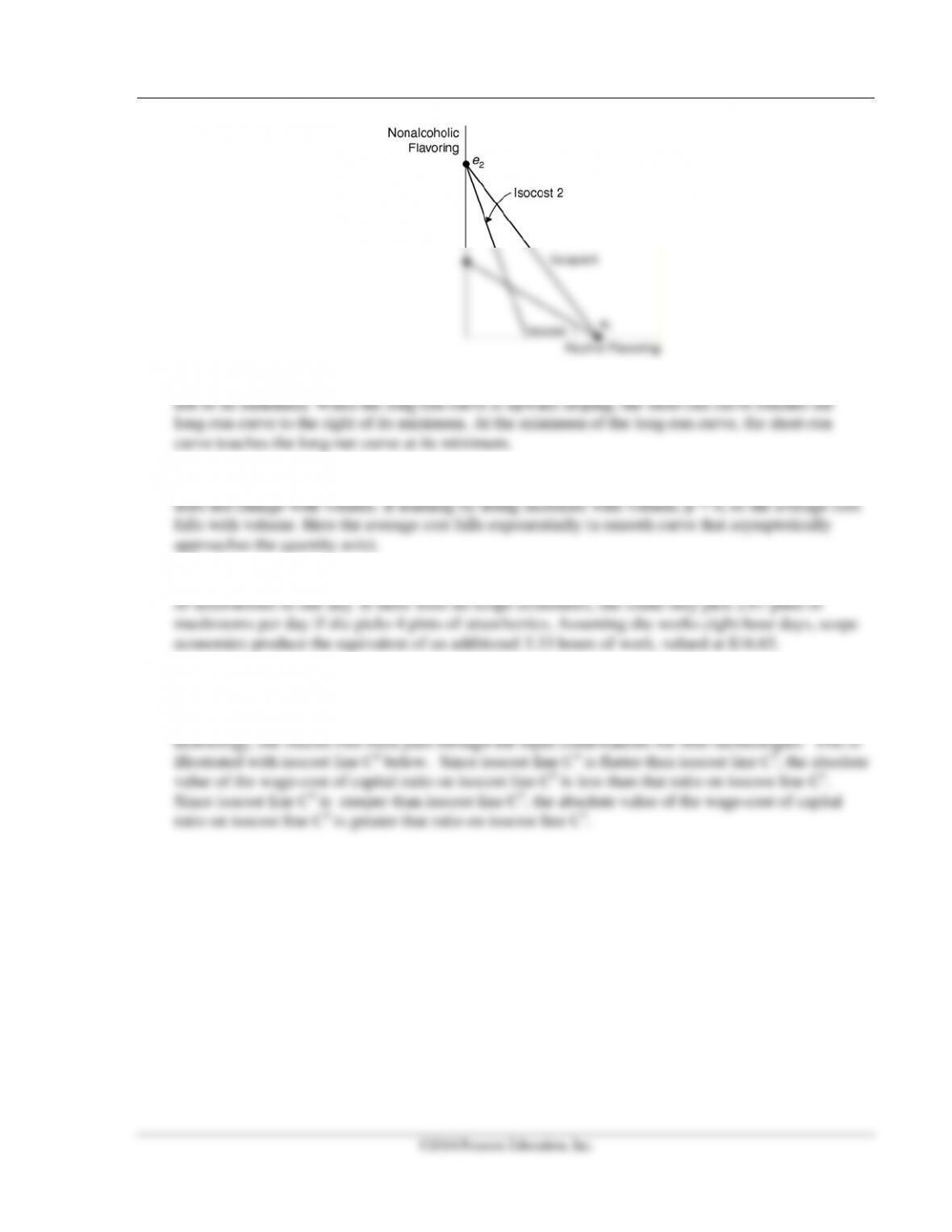
3.16 Since the two flavorings are perfect substitutes, we can draw a linear isoquant. Assuming the alcohol–
based flavoring produces more flavor per ounce than the nonalcoholic flavoring (we can use less of
Chapter 7 Costs 145
©2014 Pearson Education, Inc.
4.1 When the long–run curve is sloping downward, the short-run curve touches the long-run curve to the
4.2 The average cost of producing one unit is α (regardless of the value of β). If β = 0, the average cost
5.1 If her production possibilities frontier is PPF1, she can pick 6 pints of mushrooms and 4 pints
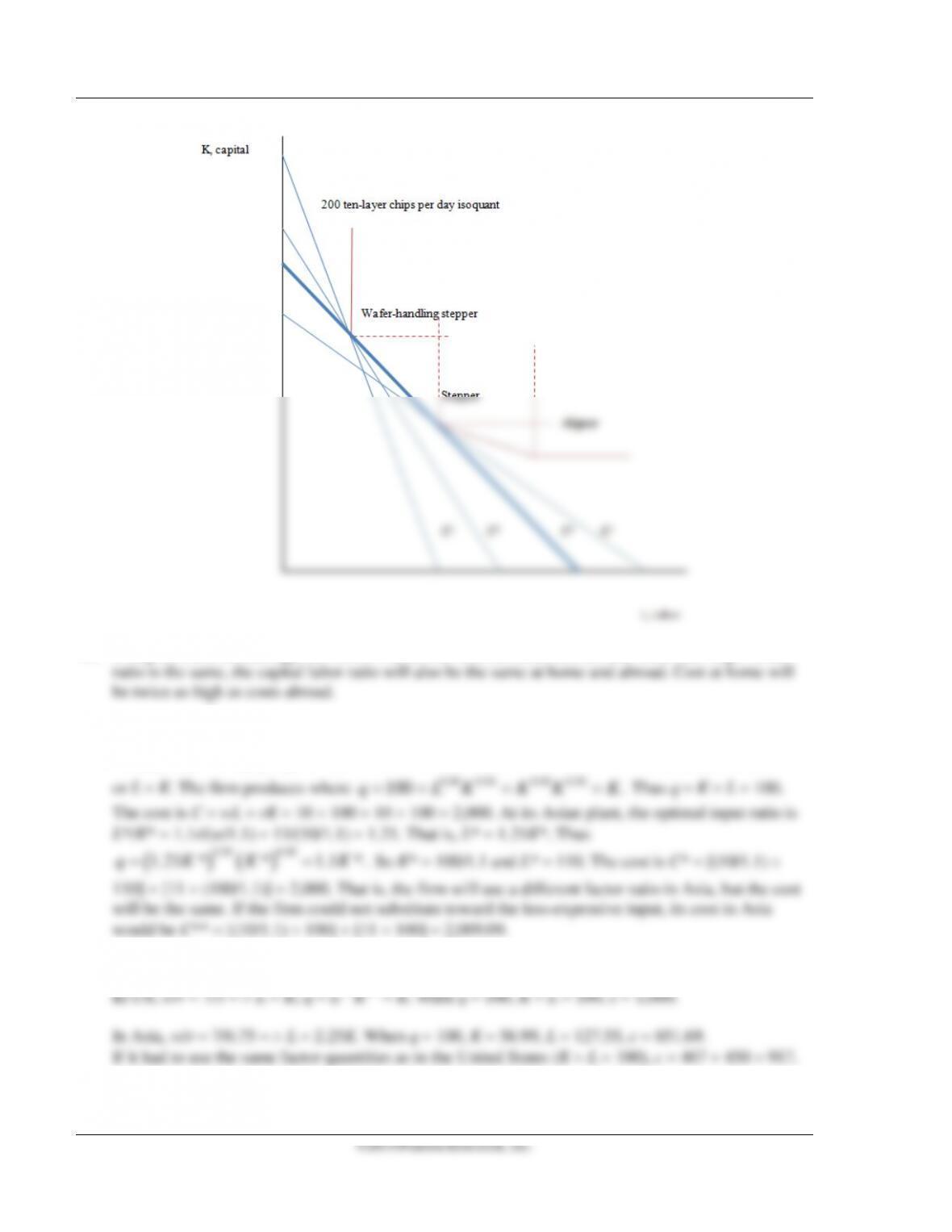
6.1 An isocost line shows all the combinations of inputs that require the same total expenditure. The
slopes of the isocost lines equal the wage divided by the price of capital (multiplied by minus one).
For the firm to be indifferent between using the wafer-handling stepper technology and the stepper
146 Perloff • Microeconomics: Theory and Applications with Calculus, Third Edition
©2014 Pearson Education, Inc.
6.2 Using the same technology, the MRTS will be the same at home and abroad. Since the wage–rental
6.3 The firm chooses its optimal labor-capital ratio using Equation 7.11: MPL/w = MPK/r. That is,
()
1/2 /
q wL =
( )
1/2 / ,q rK
or L/K = r/w. In the United States where w = r = 10, the optimal L/K = 1,
0.50 0.50 0.50 0.50
6.4 MPL/MPK = (0.7q/L)/ (0.3q/K) = 7K/3L = w/r
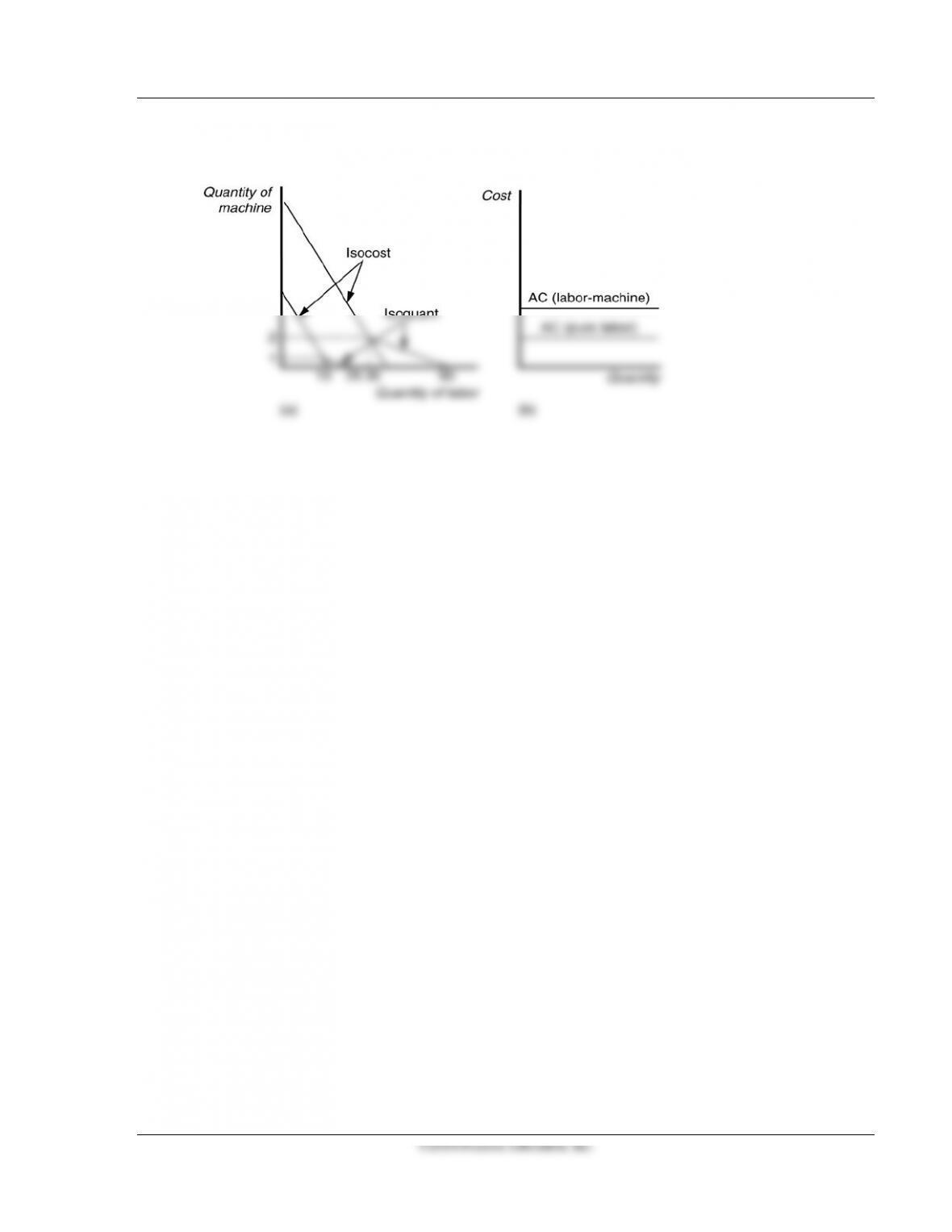
6.5 a. See (a) below.
Chapter 7 Costs 147
b. See (a) The firm chooses labor-machine technology.
c. See (b) below.