
109
©2014 Pearson Education, Inc.
Chapter 6
Firms and Production
Chapter Outline
6.1 The Ownership and Management of Firms
Private, Public, and Nonprofit Firms
The Ownership of For-Profit Firms
The Management of Firms
What Owners Want
6.2 Production
Production Functions
Time and the Variability of Inputs
6.3 Short-Run Production: One Variable and One Fixed Input
Solved Problem 6.1
Interpretation of Graphs
Solved Problem 6.2
Law of Diminishing Marginal Returns
Application: Malthus and the Green Revolution
6.4 Long-Run Production: Two Variable Inputs
Isoquants
Properties of Isoquants
Shape of Isoquants
Application: A Semiconductor Integrated Circuit Isoquant
Substituting Inputs
Solved Problem 6.3
Diminishing Marginal Rates of Technical Substitution
The Elasticity of Substitution
Constant Elasticity of Substitution Production Function
Linear Production Function
Fixed-Proportion Production Function
Cobb-Douglas Production Function
Solved Problem 6.4

Chapter 6 Firms and Production 110
©2014 Pearson Education, Inc.
6.5 Returns to Scale
Constant, Increasing, and Decreasing Returns to Scale
Solved Problem 6.5
Application: Returns to Scale in U.S. Manufacturing
Varying Returns to Scale
6.6 Productivity and Technical Change
Relative Productivity
Application: U.S. Electric Generation Efficiency
Innovations
Technical Progress
Organizational Change
Application: Tato Nano’s Technical and Organizational Innovations
Teaching Tips
Before beginning the material in Chapter 6, you might remind students that the course is broken roughly
into thirds and that this material begins the second portion of the course, in which activity inside the firm is
discussed in detail. Throughout Chapters 6 and 7, it is helpful to students if you emphasize the conceptual
parallels between the mechanics of cost minimization, isoquants, and isocost lines to those of utility
maximization, indifference curves, and budget lines.
Because students take for granted that firms exist, you may want to begin with a discussion of why firms
do exist. If you begin by asking the class to define the purpose of a firm, “to make money” will likely be
the most frequently offered response, although some may also offer answers related to tax advantages or
limitation of liability. In an effort to get students to think about firms as a mechanism for reducing
transaction costs, you might ask the class to consider the following example.
Suppose you want to make money in the landscaping industry. But instead of starting a firm, each morning
you rent a U-haul truck, rent several lawn mowers, trimmers, and rakes, and drive up and down the street
yelling: “Who wants to cut lawns today?” Once you have enough workers, you ring doorbells to get
customers, collect the money, pay the workers, pay for the rented capital, and put the residual in my
pocket. Thus you are making money, but there is no firm.
At this point, students may not remember the term transaction costs from Chapter 1, but they should be
able to suggest lots of ways that the residual (profits) could be increased by doing things such as purchasing
some or all of the capital, hiring permanent employees, and contracting with customers. You might want to
conclude this with counterexamples of instances where it is better to use the market rather than internalize
all transactions related to a final product. Suppose, for example, that a firm that manufactures engines needs
castings. If the quality of the castings drops off, the firm can seek other suppliers, which is the foundry
owner’s problem. If the firm owns the foundry, problems at the foundry are internal to the firm and must
be solved by management rather than through the use of the market. This discussion can lead you into the
material on ownership and management that begins the chapter or to a discussion of outsourcing and
mergers that are covered later in the text.
Another point you may want to make regarding terminology is the reference to firms as having wants and
needs. Firms are operated by owners and managers who want and need things, but a firm is simply a legal

Chapter 6 Firms and Production 111
©2014 Pearson Education, Inc.
entity that, of course, cannot want or need anything. It is a misuse of terms to say that “a firm wants…,”
but it is a convenience that economists use.
As you work through Chapters 6 and 7, you may need to remind students at times that this material is not
about prices and profits. As the text notes, efficient production is necessary but not sufficient for profit
maximization. Also remind the class occasionally that capital, labor, and output are measured in physical
units rather than dollars in Chapter 6.
When covering the short–run product definitions (total, average, and marginal), it is important to note that
while quantities of labor and output information must be given or come from a production function that is
given, all of the remaining concepts are derived from the relationship between these two variables. Students
sometimes get confused about what information must be given and what can be derived from information
that is already known. It is also important to explain how each curve is related to the others, as students
tend to think of each as a stand–alone object. This strategy is also effective in Chapter 7, where you should
note that all of the cost and product curves are different ways to look at the same information. When discussing
long-run production, you may want to begin by asking the class about the similarities between isoquants
and indifference curves. This is helpful when introducing the concept of substitutability and the MRTS.
The text has a nice, straightforward explanation of technical change. Since most of the technical change that
is discussed in the popular press is not neutral but has some effect on employment, it is well worth covering
and supplementing with current examples to go with the applications already in the chapter. As a contrast,
you may want to discuss the inability to adopt technical change in some production processes, as in the piano
industry described below in the additional application. Finally, the Tata Motors example that closes the
chapter is a good example of process innovation that may be especially useful if you have management
majors in your classes.
Additional Applications
Technical Changes in Piano Making
It takes one year and over 200 production workers to build a Steinway Model D grand piano, which has
12,000 parts. The factory produces 150 of these pianos per year.
Steinway’s technology virtually stopped evolving about 1900. The number of pianos produced per year and
the number of workers in the factory has remained constant. They can’t use machinery to replace workers,
but they can use machinery to aid the workers.
Steinway still uses some equipment that was built in the Victorian era, such as a veneer–edge cutter from
1871. Modern equipment is used to refine the tools they use, improve the tolerances of action parts, and
make parts that don’t need custom fitting. A computer–aided router cuts the final shape of the top lid.
A “sounder” machine breaks the pianos in by pounding every key 8,000 times within 45 minutes. An
engineer uses CAD/CAM software on a computer to design an action part.
Similarly, new materials are used, partly of necessity. Since the ban on the trade of ivory in 1989, keys are
now made of a mock-ivory polymer. Cloth bushings that line certain metal pins that serve as hinges in the
action are now made of TeflonTM–impregnated wool.
Yamaha, using a more mechanized approach, makes 250,000 pianos per year, compared to the 523,000
pianos Steinway has produced in 140 years. Yamaha makes fine instruments, but they are not in the class
of the Steinway grand piano.

Chapter 6 Firms and Production 112
©2014 Pearson Education, Inc.
1. Given the information provided, what do you predict about the shape of isoquants for Steinway?
2. The story about production at Steinway is very similar to that of the C. F. Martin Company, makers
of some of the world’s finest acoustic guitars. The production of Martin guitars is also characterized
by the use of highly skilled labor, limited substitutability between capital and labor, and use of very
old machines to perform certain tasks. Why do you suppose that this limited substitutability occurs in
the musical instrument industry, when other industries, such as the automobile industry, are characterized
by a much greater degree of input substitutability?
The Cost of Producing Wine at Only a Small Fraction of the Price1
Most consumer goods are not sold by the manufacturer. Instead, they are produced by the manufacturer,
who sells to a wholesaler, who in turn sells to a retailer, who sells to the public. Such is the case with
most wine.
There has been an outcry in recent years over increases in wine prices. Although prices have risen sharply,
the multilevel market structure and the markup that occurs at the wholesale and retail level have a much
larger role in the price increases than the production of the wine itself. Total production costs for a typical
$24 bottle of wine are just $4.92, or about 20.4 percent of the final price, whereas wholesale and retail
markups together make up 40 percent of the final price. Not surprisingly, raw materials (grapes) are the
single biggest cost. The cost of the grapes may be as much as 60 percent of total production costs but
varies greatly from lower–quality inexpensive wines to the highest quality wines. The second-highest cost
for many vintners is the barrels used to ferment the wine. French oak barrels cost as much as $700 apiece
and last only a few years. The other major production cost, other than the actual physical plant where the
winemaking occurs, is time. Quality wines spend 2–2½ years aging in barrels and then an additional eight
months in bottles before being ready for sale. John Conover explains that “(Y)ou’ve got five-and-a-half
years of capital and cash flow tied up into running the operation.” Although production costs vary widely
from low-end to high-end wine, it is still the case that wholesale and retail markups make up a greater
percentage of the price than do production costs.
1. How much substitutability do you suppose exists between inputs in winemaking? How might this
factor affect efforts to cut costs?
2. If a firm were to find a new technology that cut the required aging time in half, how would it affect
the demand for other inputs?
Discussion Questions
1. For what type of firms is the long run likely to be only a matter of hours or days? For what type of
firms is it likely to be measured in years?
2. What do you think are the main causes of inefficiency in most firms?
3. Why do both the marginal product of labor and average product of labor curves usually rise first and
then fall as labor is increased?
4. Can you describe a production process that first has constant returns, then increasing returns to scale?
5. Does the long run occur sooner if there is a rental market for capital (machines)?
1Based on Dana Nigro, “What’s Behind the Bottle Price?” Wine Spectator, December 15, 2002:50–56.

Chapter 6 Firms and Production 113
©2014 Pearson Education, Inc.
6. Are inventions and organizational innovations more likely to be labor or capital saving?
7. Under what circumstance would society not want a firm to produce efficiently?
8. Should economists consider materials a choice variable?
Additional Questions and Problems
1. Write the equation for the marginal product of capital for each of the following production functions.
a. Q = K + L
b. Q = 4K0.5L
c. Q = 5L0.5K − L
2. Using the production function from part (c) in Question 1, assume that capital is fixed at two units.
At what point does MPL reach zero?
3. Suppose inputs are only substitutable at two units of labor for every one unit of capital. What would
be the equation for the production function? What is the average and marginal product of labor in
this case?
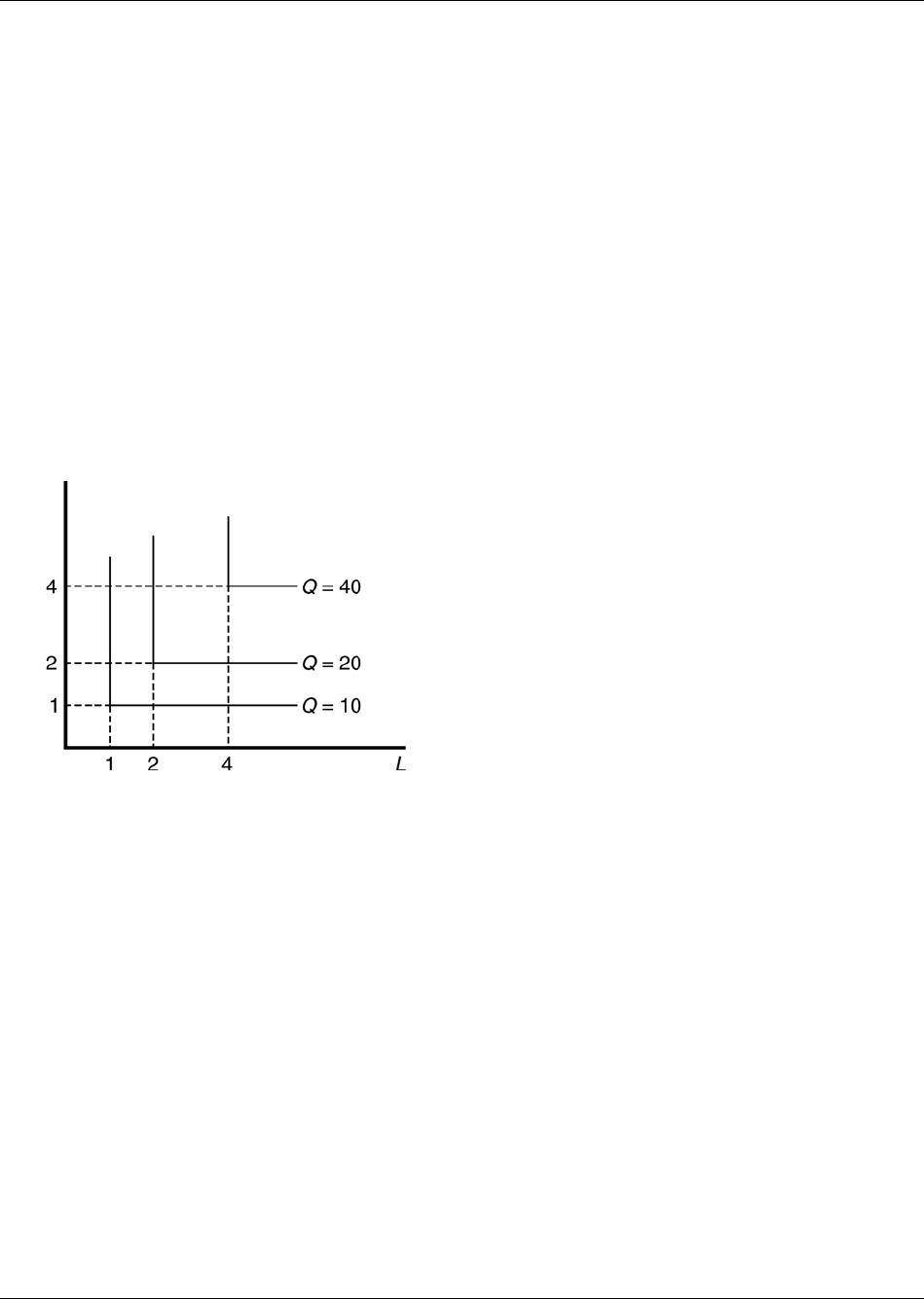
4. Draw a graph showing a set of isoquants that depict capital and labor to be perfect complements
(not substitutable at all) in a production function that exhibits constant returns to scale. Be sure to
label the input and output levels on the isoquants.
5. The original production function is Q = 10K0.4L0.5. A technological change occurs that alters the
production function to Q = 15K0.4L0.7. Is this an example of neutral technological change? Why or
why not?
6. True or false, explain your answer. “Marginal products in the Cobb-Douglas function cannot be
negative.”
7. In some firms, managers are given sales volume–based bonuses. Explain why this might not be an
efficient compensation strategy.
8. Suppose that as long as neither input exceeds four times the other, capital and labor are perfect
substitutes at a one-to–one ratio. However, once the input ratio reaches four to one in favor of
either input, no further substitution is possible. Draw the isoquants.
9. In an industry where there are increasing returns to scale over wide ranges of output, would you
expect to find a few relatively large firms or many relatively small firms? Why?
10. Suppose output is produced according to the production function Q = M0.5K0.5L0.5, where M is
materials. Does this production function exhibit decreasing, increasing, or constant returns to scale?
Show using an example.
11. Suppose both capital and labor were fixed in the short run. How would this affect the firm’s production
decision? Can you think of examples where this might be so?
12. Suppose output is produced according to the production function Q =
min(K, L), what is the expansion
path of this production function?
Chapter 6 Firms and Production 114
©2014 Pearson Education, Inc.
13. Using what you learn in this chapter, explain why professors often give a short break during a long lecture.
Answers to Additional Questions and Problems
1. In each case, the derivative
∂
Q/
∂
K gives the marginal product of capital MPK.
a. MPK = 1
b. MPK = 2K−0.5L
c. MPK = 5L0.5 − L
2. For the production function Q = 5L0.5K − L, when K = 2, Q = 10L0.5 − L.
MPL = 5L−0.5 − 1. Thus MPL = 0 when L = 25.
3. The production function is Q = 2K + L. APL = 2K/L + 1. MPL = 1.
4. The isoquants are “L” shaped, indicating perfect complementarity, and for every doubling of inputs,
output also doubles.
5. This is not a neutral technical change because the marginal productivity of the inputs, and thus the
input ratio is affected by the change in the output elasticity of labor from 0.4 to 0.7 (the productivity
of labor increases). If the only difference had been the increase in the technology constant from
10 to 15, it would have been a neutral change.
6. In the Cobb-Douglas production function Q = AK
α
L
β
, as long as the output elasticities are positive,
the marginal products cannot be negative. For example, increases in labor will always have the
marginal effect
β
Q/L.
7. When managers have the incentive to maximize revenue, they may cause the firm to overproduce.
Especially when capital is fixed, there are limits to how much a firm can efficiently produce. In an
attempt to achieve greater bonus levels, managers may sell product that the firm is not capable of
producing profitably or even at all in the short run. Not only does this error cost the firm in the
current period, but it also may damage customer relations, reducing revenues in future periods due
to customer loss.
8. As long as the input ratio stays with the 4-to–1 limits, the isoquants have a slope of −1. Outside these
limits, they are either vertical or horizontal, indicating that no further substitution is possible.