Chapter 5 Consumer Welfare and Policy Analysis 87
7. The conventional welfare program was replaced by the Earned Income Tax Credit program in 1997.
Under the new program, the benefit is calculated as a fixed percent of earnings of low income
families. Explain why this new design helps to encourage labor supply?
Answers to Additional Questions and Problems
1. Surplus in Market 1 is $180 but only $160 in Market 2.
2. This is false unless the consumer’s demand is perfectly elastic. Under normal circumstances, the first
unit is worth more than the marginal unit. If the marginal utility (as revealed by the demand curve)
3. A sold out venue implies that the demand curve crosses the supply curve in its perfectly inelastic
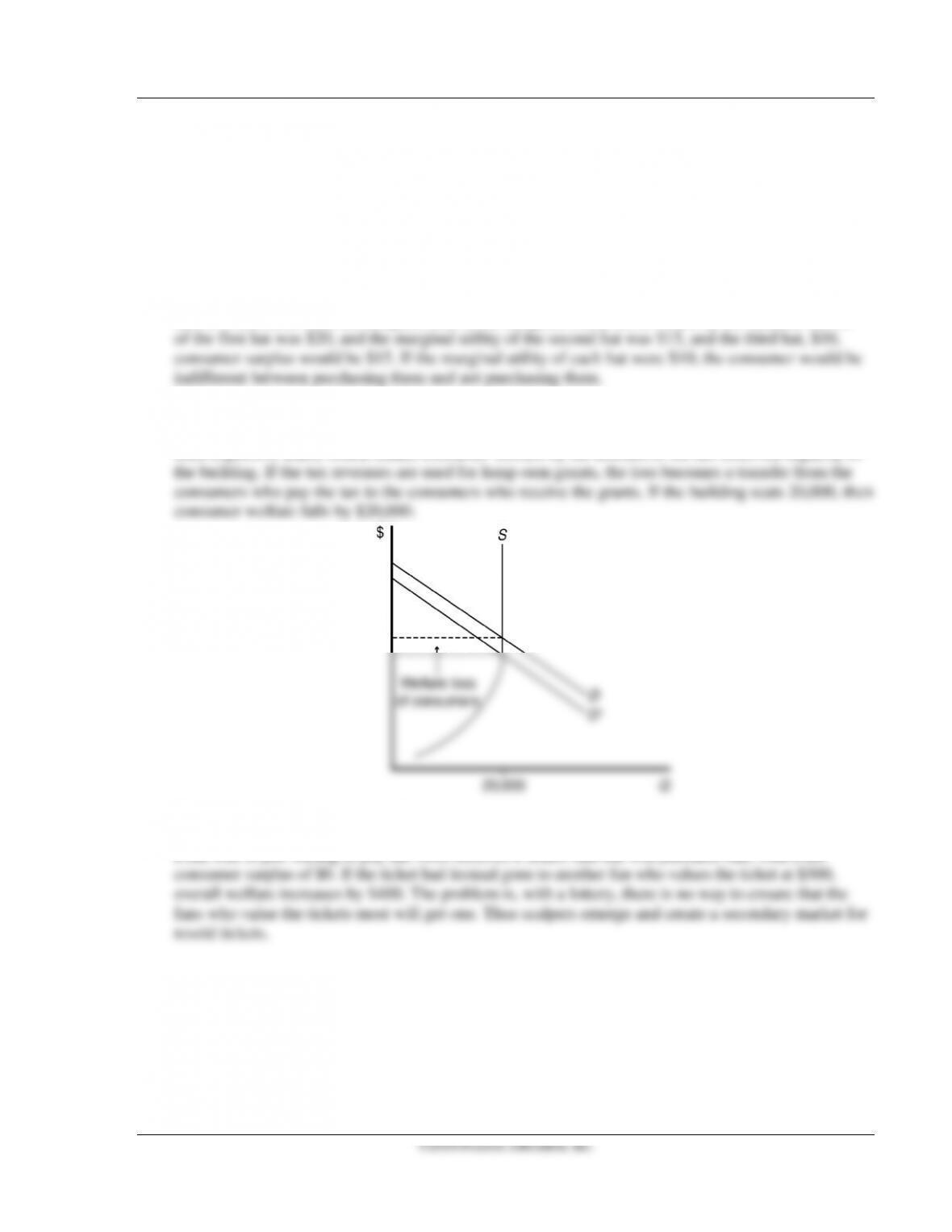
range at current prices, a $1 per seat tax on tickets (which is a small percentage increase for even the
4. The allocation mechanism is inefficient because there is no guarantee that the fans who value the
tickets the most will receive them. Suppose the winning fans may purchase tickets for $100 each. If
Chapter 5 Consumer Welfare and Policy Analysis 88
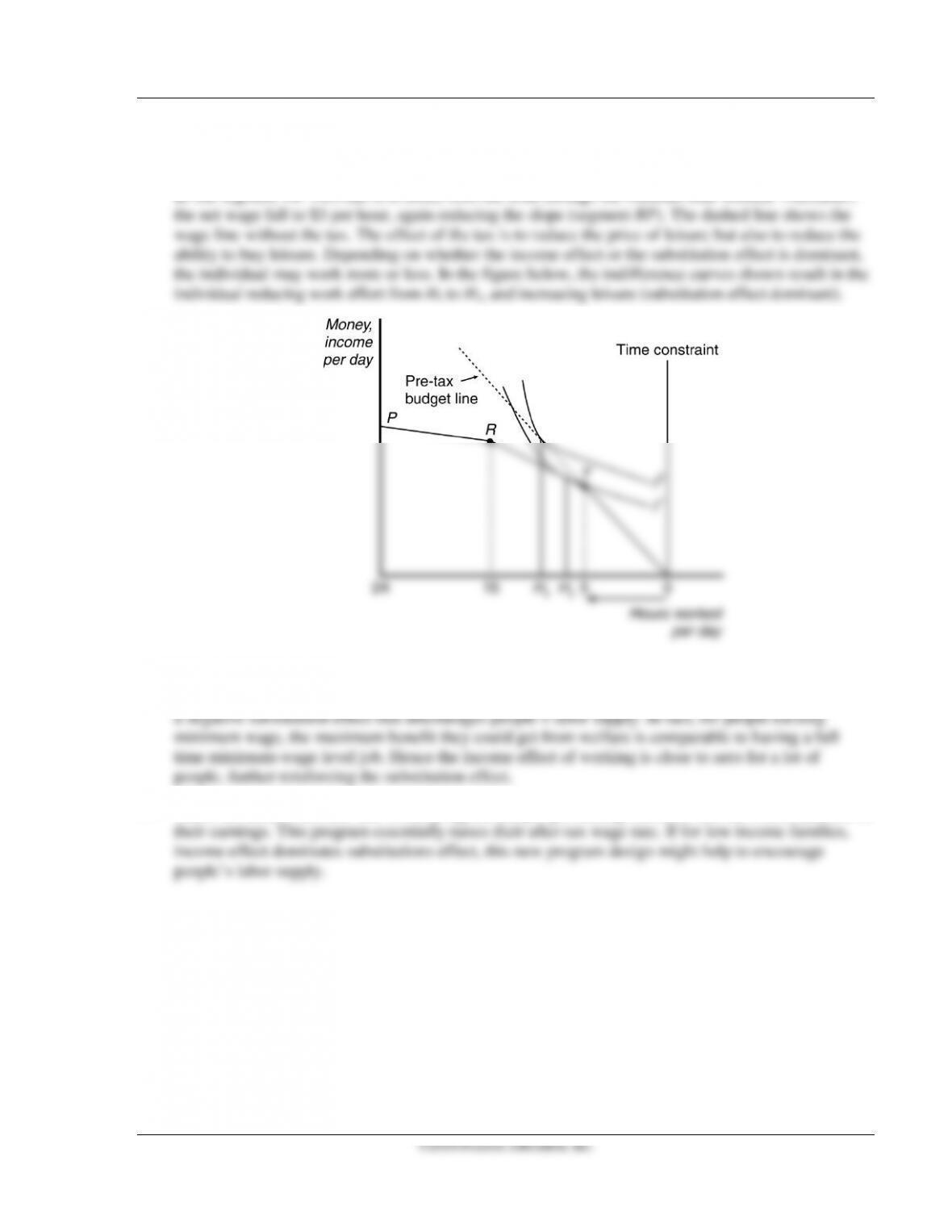
5. When the marginal taxes are imposed, the budget constraint becomes nonlinear. Beginning at 0 hours of
labor (24 hours of leisure), until labor supply is equal to 5 hours, the slope of the budget line is –w,
the wage rate. Thereafter the after-tax rate drops to $8, reducing the slope of the budget line, shown
6. Under the welfare program’s benefit calculation formula for low income families, the more they
work, the less benefit they would receive from the government. Hence, this program generates
7. Under the Earned Income Tax Credit program, people get earning subsidies that are a fixed percent of
Chapter 5 Consumer Welfare and Policy Analysis 89
Answers to Exercises in the Text
1.1 Consumer surplus is the monetary difference between what a consumer is willing to pay for the
quantity of the good purchased and what the good actually costs. When the demand curve is linear,
this is the area of the triangle under the demand curve and above the price level. The demand curve
intersects the vertical price axis at 60 and the price is $30, so the height of the triangle is 30. At a
price of $30, consumers demand
1.2 Consumer surplus is the monetary difference between what a consumer is willing to pay for the
quantity of the good purchased and what the good actually costs. When the demand curve is linear,
this is the area of the triangle under the demand curve and above the price level. The demand curve
intersects the vertical, price axis at a, the price is 0.5a, so the height of the triangle is 0.5a. At a price
of 0.5a, consumers demand
p = a – bq
0.5a = a – bq
q =
0.5a
b
units,
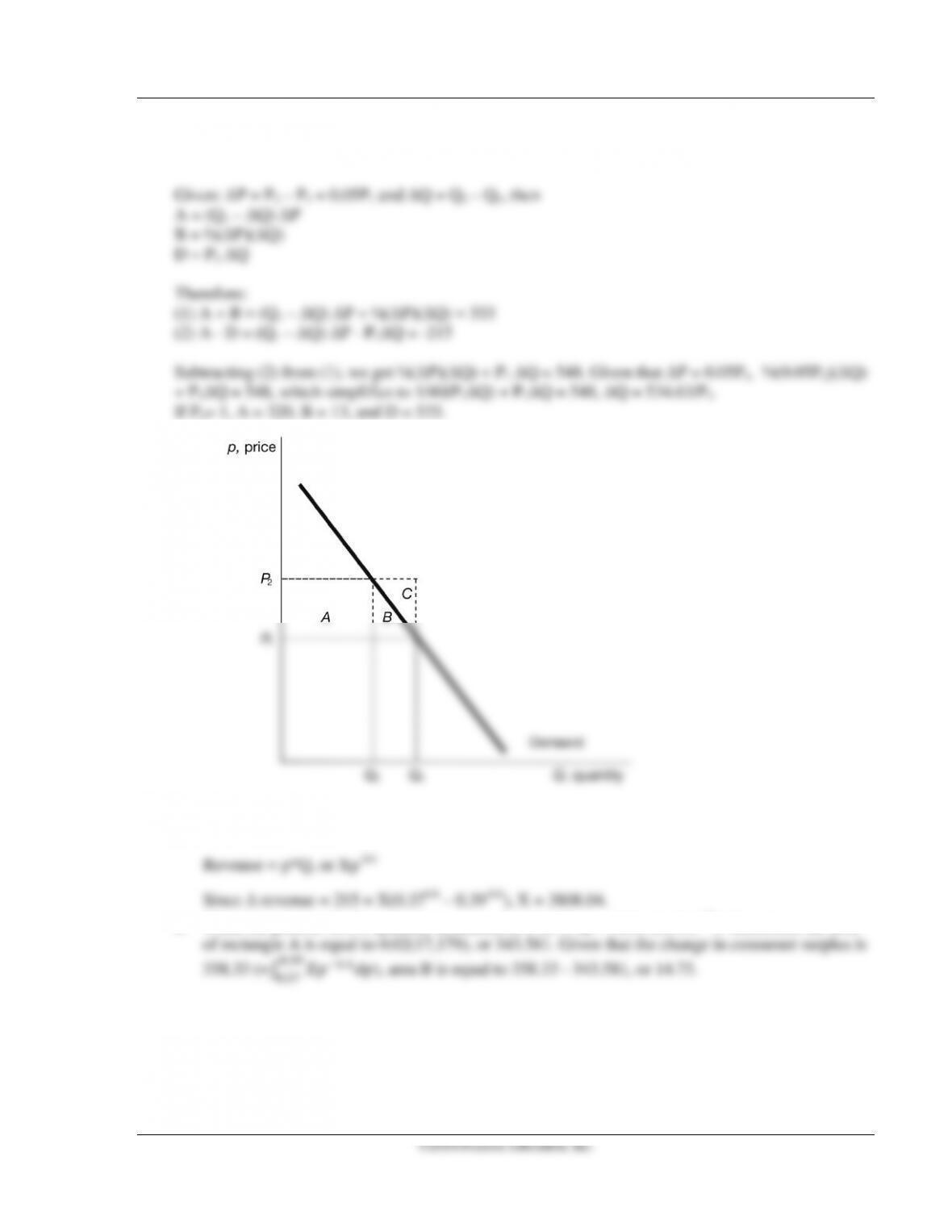
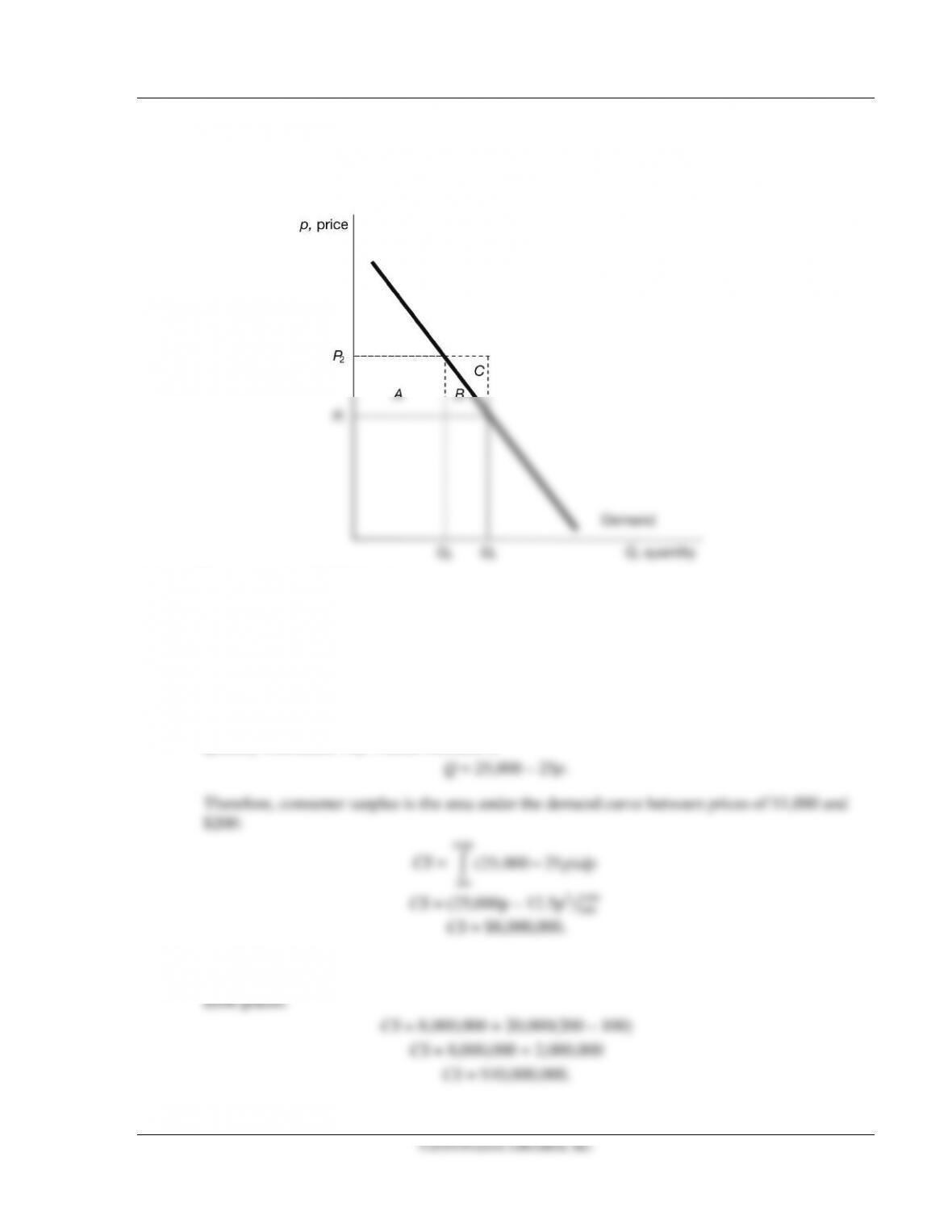
1.3 The question asks for the area of B, given only three pieces of information: (1) the change in
consumer surplus is 333; (2) the change in revenue is –215; and (3) there is a 5% price increase. Or,
Chapter 5 Consumer Welfare and Policy Analysis 90
referring to the figure below: A + B =333; A – D = –215 (where D is the area between Q2 and Q1,
below price P1); and P2 = 1.05P1.
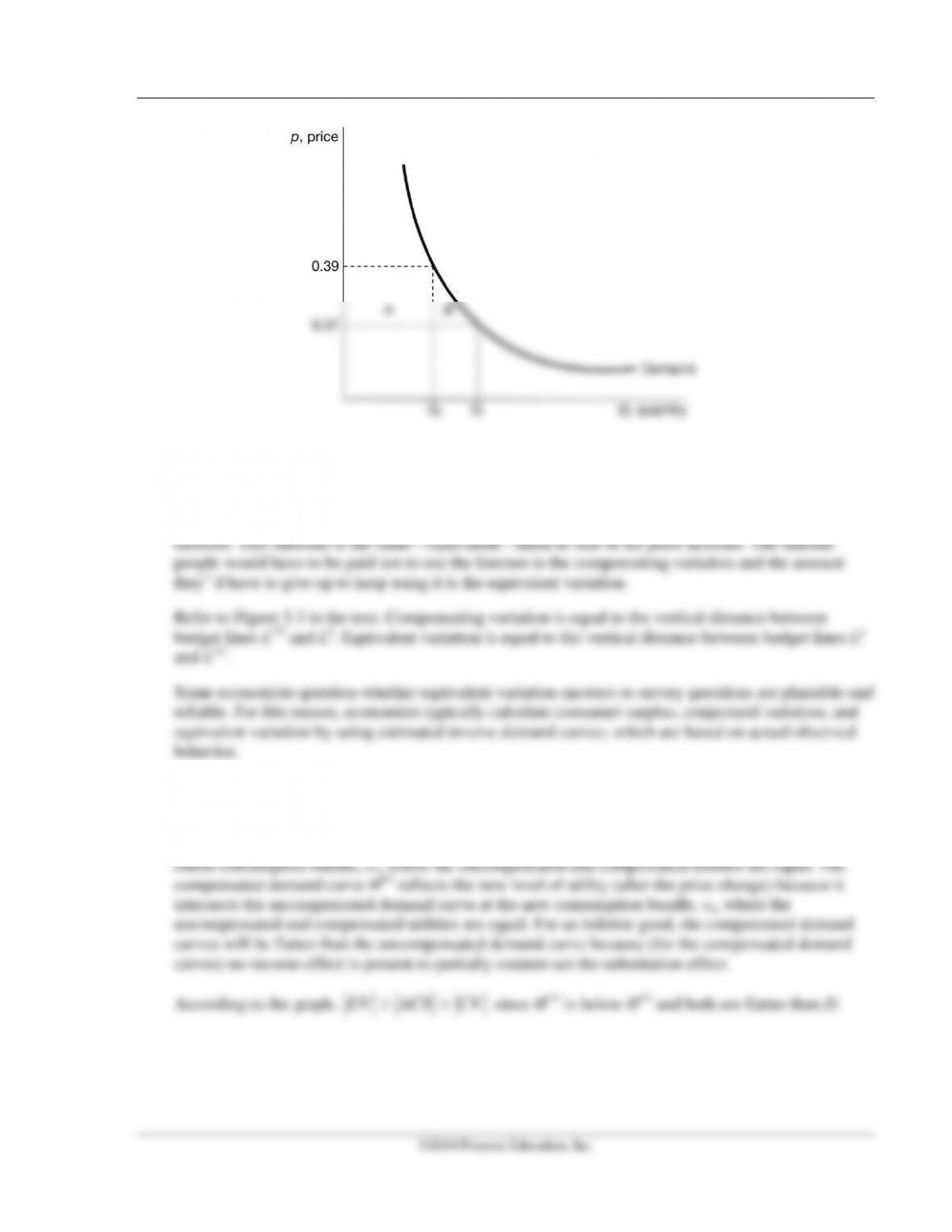
1.4 a. Consumer surplus is the monetary difference between what a consumer is willing to pay for the
quantity of the good purchased and what the good actually costs.
Chapter 5 Consumer Welfare and Policy Analysis 91
©2014 Pearson Education, Inc.
2.1 Compensating variation is the amount of money that would fully compensate an individual for a price
increase. This measure of the welfare harm of a price increase is called the compensating variation
because we give money to the consumer, compensating him or her. Equivalent variation is the
amount of income that, if taken from a consumer, would lower utility by the same amount as a price
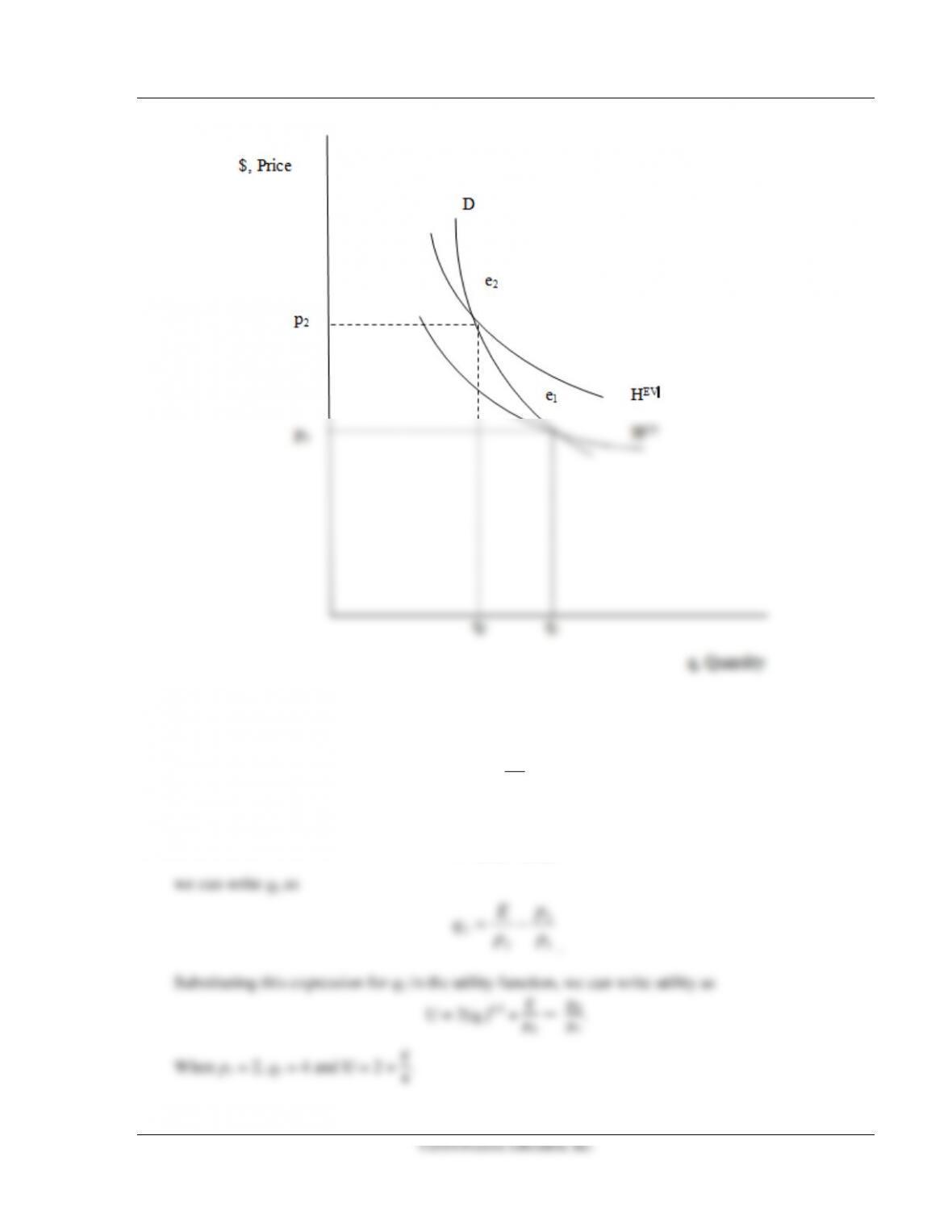
2.2 Compensating variation is the amount of money that would fully compensate an individual for a price
increase. Equivalent variation is the amount of income that, if taken from a consumer, would lower
utility by the same amount as a price increase. The compensated demand curve HCV reflects the initial
level of utility (before the price change) because it intersects the uncompensated demand curve at the
Chapter 5 Consumer Welfare and Policy Analysis 92
©2014 Pearson Education, Inc.
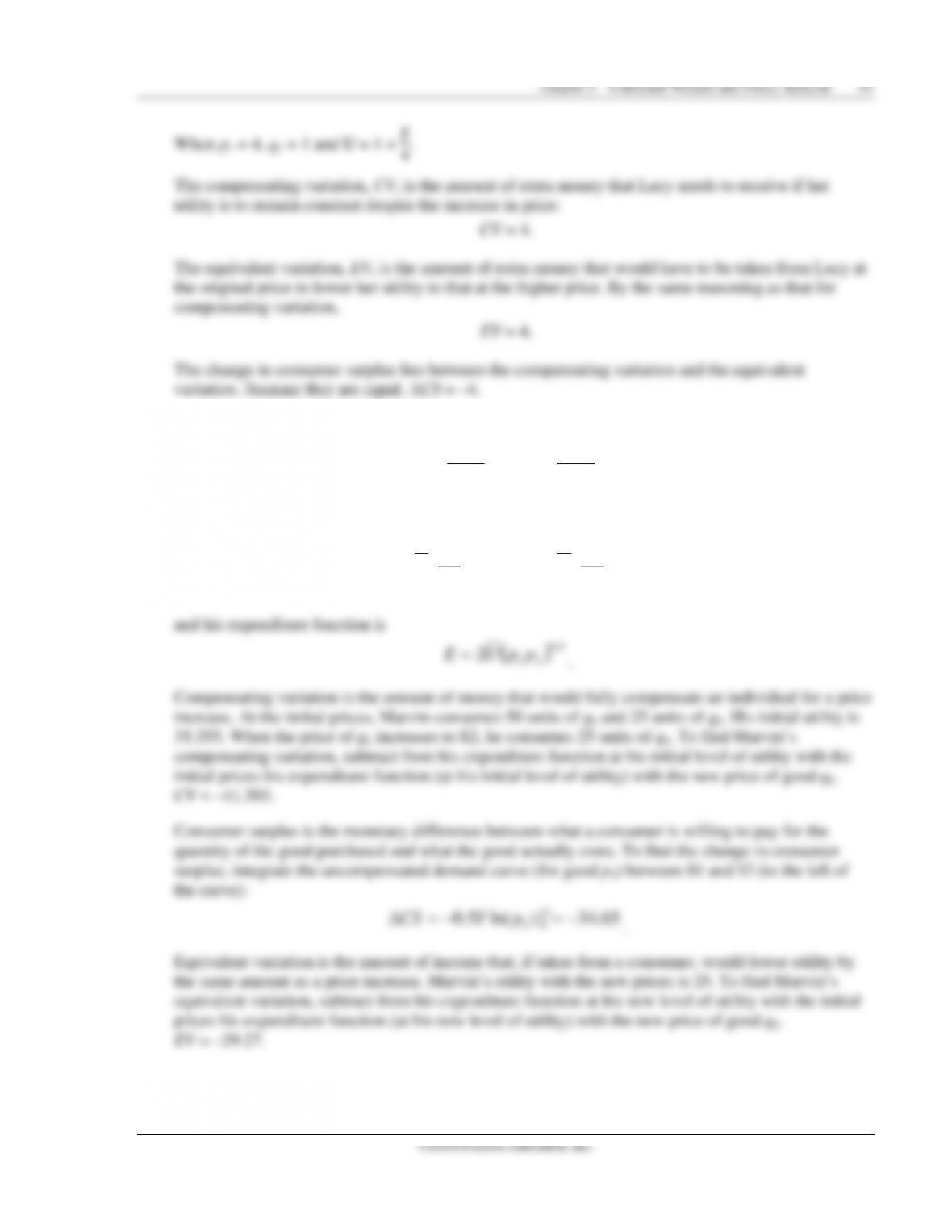
2.3 Compensating variation is the amount of money that would fully compensate an individual for a price
increase. With a quasilinear utility function, the demand for good is a function of its price:
2
2
1
1
.
p
qp
=
Substituting this for q1 in the expenditure equation,
E = p1q1 + p2q2,
©2014 Pearson Education, Inc.
2.4 First, note that Marvin’s uncompensated demand curves are
1
1
5.0
p
Y
q=
and
2
2
5.0
p
Y
q=
,
his compensated demand curves are
5
.0
1
2
1
=p
p
U
q
and
5.0
2
1
2
=p
p
Uq
,
Chapter 5 Consumer Welfare and Policy Analysis 94
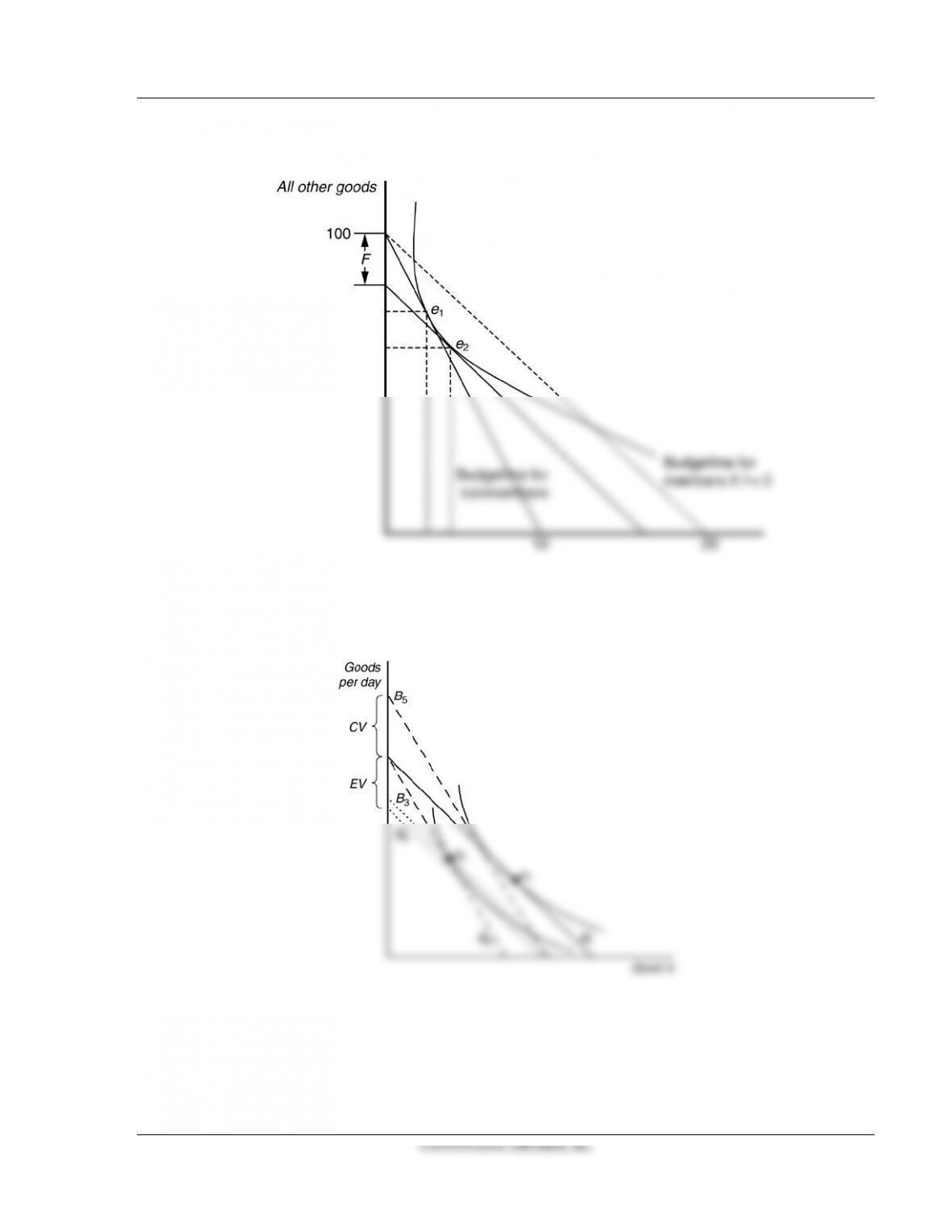
2.5 See figure. Assume the budget is $100. Compare e1 and e2. We know that you would go to the pool
fewer times if you did not purchase the membership.
3.1 See figure. Starting with the original budget B1 the consumer chooses bundle e1. An ad valorem tax
changes the budget line to B2 with an optimal bundle e2. A lump sum tax with equal revenue
generation changes the budget line to B3. The difference between budget lines B1 and B4 is the
equivalent variation and the difference between B2 and B4 is the compensating variation.
Chapter 5 Consumer Welfare and Policy Analysis 95
3.2 Rx is equal to A + 2B in the graph below (or A + B + C). This is because R in the textbook footnote
equation is initial revenue, before the price increase, or p1 multiplied by Q1. Then, in the textbook
footnote equation, you subtract triangle B from Rx to get the lost consumer surplus (A + 2B – B = A +
B). Triangle B is subtracted from Rx in the formula because the price elasticity of demand is negative.
3.3 a. The price of the 20,000th bid is
p = 1,000 – 0.4Q
p = 1,000 – 0.4(20,000)
p = $200.
Consumer surplus is the monetary difference between what a consumer is willing to pay for the
quantity of the good purchased and what the good actually costs. That is, market consumer
surplus is that area under the market inverse demand curve above the market price up to the
quantity consumers buy. Market demand is
b. At a $100 price, consumers will receive surplus of $8,000,000 as calculated above plus the
20,000 consumers who acquire a ticket will have surplus equal to the difference in the $200 and
Chapter 5 Consumer Welfare and Policy Analysis 96
c. Consumer surplus with the $100 price is larger, so that will be how Springsteen chooses to price
tickets for his concert.
3.4 Consumer surplus is the monetary difference between what a consumer is willing to pay for the
quantity of the good purchased and what the good actually costs. This is equal to the area under the
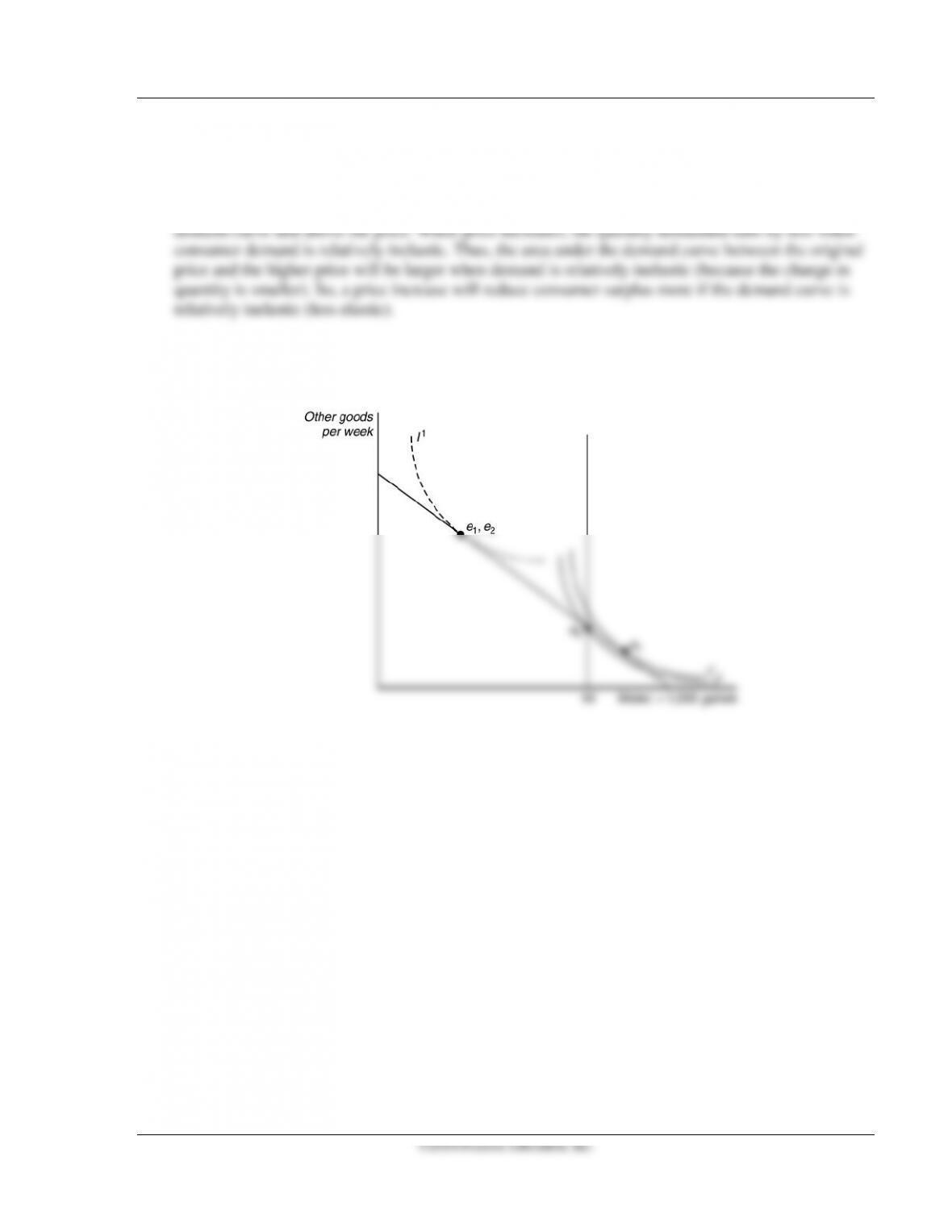
4.1 See figure. e1 will be the same as e2 if the tangent point of the (dashed) indifference curve and the
budget line is on the solid region of the budget line. If the tangent point is on the dashed region, e2
will be different to e1, and e2 will be the corner solution.