42 Perloff • Microeconomics: Theory and Applications with Calculus, Third Edition
1. Show using indifference curves and a budget line that if preferences are intransitive, standard utility
maximization solutions may not result.
2. Suppose three of the subjects meet on the street after the above experiment. Each is carrying one item
(the money, the tickets, or the coffee percolator). Two of these individuals have intransitive preferences;
the other does not. How many exchanges could take place involving all three people before one would
be unwilling to trade? What would your answer be if only one had intransitive preferences?
Additional Questions and Problems
1. Maximizing behavior in the context of school performance (not utility maximization) would imply
2. Consider two goods that are perfect substitutes. What is likely to be true about their relative prices?
Can you confirm your hypothesis with examples?
3. From the total utility schedule shown below, calculate the marginal utility of each additional unit of
4. Suppose a consumer’s utility derived from consuming bananas is described by the function
U = 10X + 3X 2
− (1/3)X3
. Compute marginal utility.
5. What information is contained in the slope of an indifference curve? Why are these curves typically
convex to the origin?
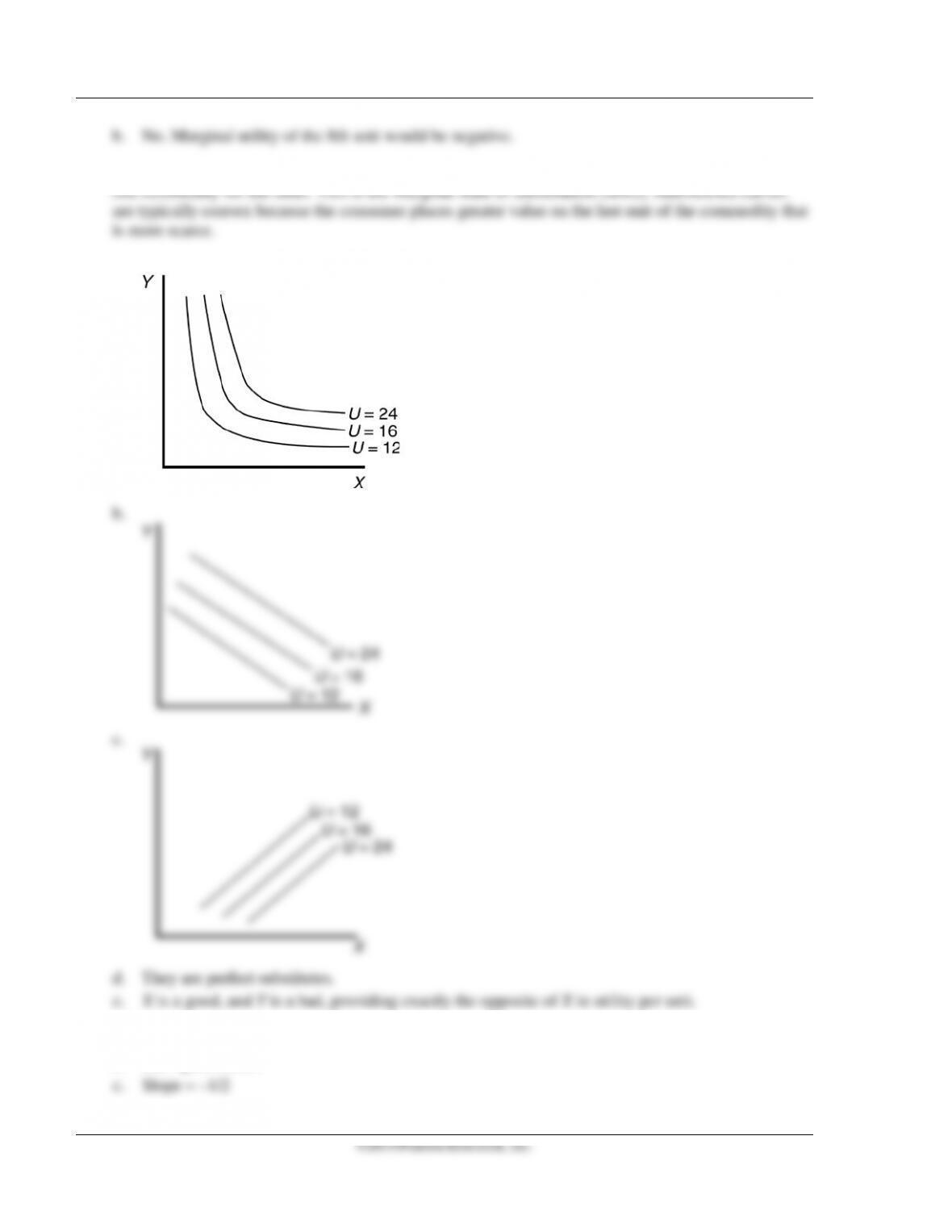
6. For each of the utility functions below, draw a set of indifference curves showing utility levels
U = 12, U = 16, and U = 24.
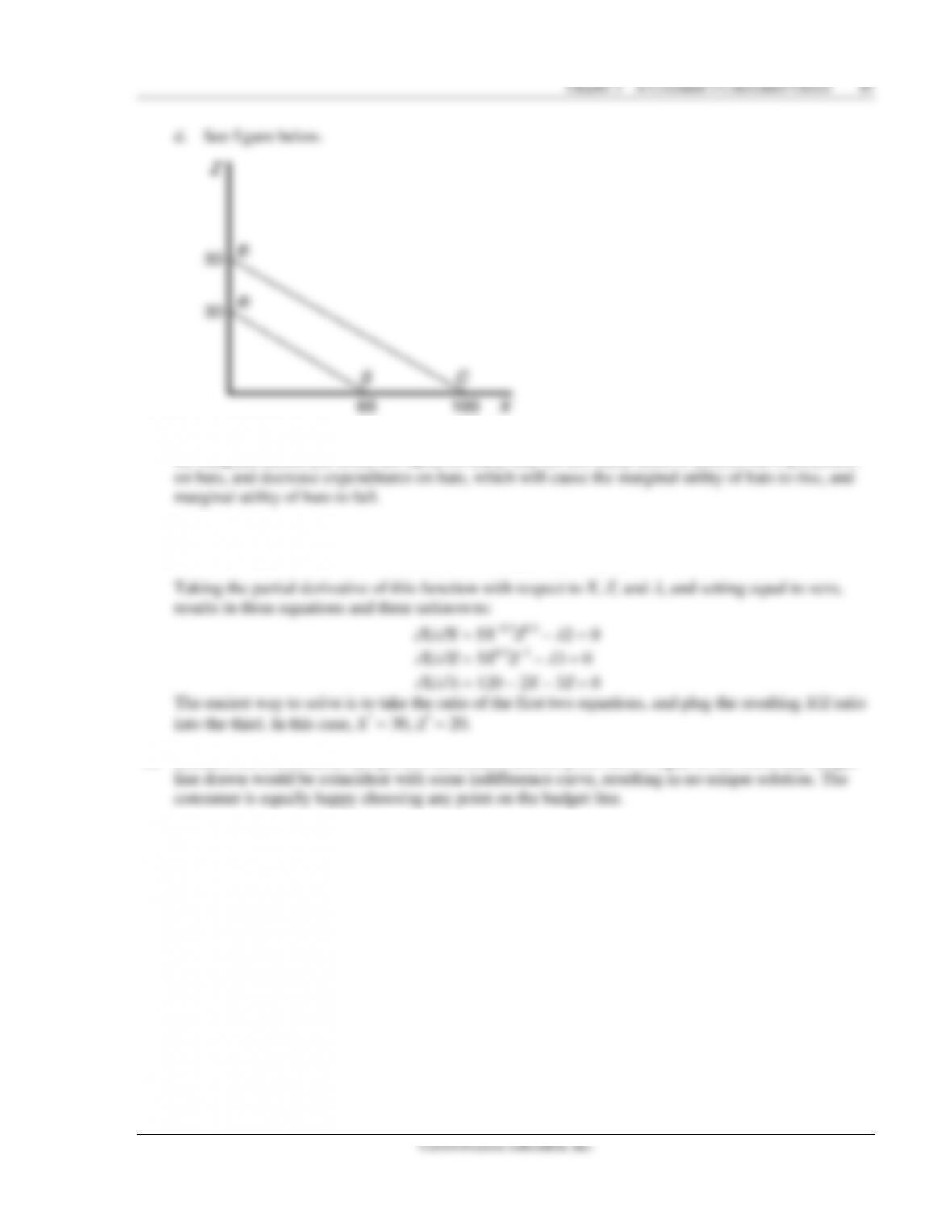
7. Suppose a consumer has an income of $500 and faces prices pX = 5 and pZ = 10.
a. Write the equation for the budget constraint.
8. Larry and Teri allocate their consumption between two goods: hats and bats. The price of hats is $4
Chapter 3 A Consumer’s Constrained Choice 43
each and the price of bats is $8 each. For Larry, the marginal utility of the last hat consumed was 8
10. Confirm that if a consumer’s utility function is described by U = 2X + Z, and prices are pX = 2 and
11. Suppose Carmela’s income is $100 per week, which she allocates between sandwiches and books.
12. Show in graph a person’s utility function such that he will be indifferent between an education
voucher and cash.
13. What happens to the budget line if the government increases tax on cigarettes but nothing else?
Answers to Additional Questions and Problems
1. Some individuals may practice what is known as satisficing behavior. In the context of school
performance, this would mean performing to some minimum acceptable standard, such as C quality
2. Goods that are perfect substitutes are generally priced equally, or nearly so. For example, stores often
3.
Units of
X 1 2 3 4 5 6 7 8 9
MU
15 20 15 12 8 4 2 1 0
4. MU = 10 + 6X – X2
a.
Units of
MU
44 Perloff • Microeconomics: Theory and Applications with Calculus, Third Edition
©2014 Pearson Education, Inc.
b. No. Marginal utility of the 8th unit would be negative.
5. The slope of an indifference curve indicates the rate at which the consumer is willing to exchange
6. a.
7. a. 5X + 10Z = 500
b. See figure below.
©2014 Pearson Education, Inc.
8. The ratio of marginal utility per dollar should be equal for the last unit of all commodities. For Teri,
9. Setting up the Lagrangian results in
L = 10X0.5Z0.5 − l(2X + 3Z − 120)
10. Because the commodities are perfect substitutes, and the price ratio is equal to the MRS, any budget
46 Perloff • Microeconomics: Theory and Applications with Calculus, Third Edition
11. Because the price of books falls when Carmela purchases more than 5 books in one week, the budget
constraint is nonlinear. As Figure 3.5 shows, the budget line is kinked at a. This nonlinearity makes it
possible that a single indifference curve could be tangent to the constraint in two places. In this case,
the consumer is indifferent between purchasing 3 books per week at full price and purchasing 10 books
per week with the discount.
12. See figure below. If one’s indifference curve touches the budget line under the voucher at the kink
13. See figure below. With the higher cigarette tax, the budget line AB will rotate to AC such that the
maximum bundle for all other goods remains the same but becomes smaller for cigarette.
Chapter 3 A Consumer’s Constrained Choice 47
Answers to Exercises in the Text
1.1 If consumers receive more of any product, even if they have as much of that product as they need for
1.2 At the lower–right (or upper–left) portion, the indifference curve could switch from convex to
concave, forming a hook. An example of when this may occur might be with Apple products versus
1.3 Indifference curves are convex because the rate at which consumers are willing to trade one good for
another varies with their endowments of the goods. Along a single indifference curve, utility is constant.
In order to keep the consumer’s utility at the same level, some of one good must be forgone in order
1.5 If the neutral product is on the vertical axis, the indifference curves are parallel vertical lines.
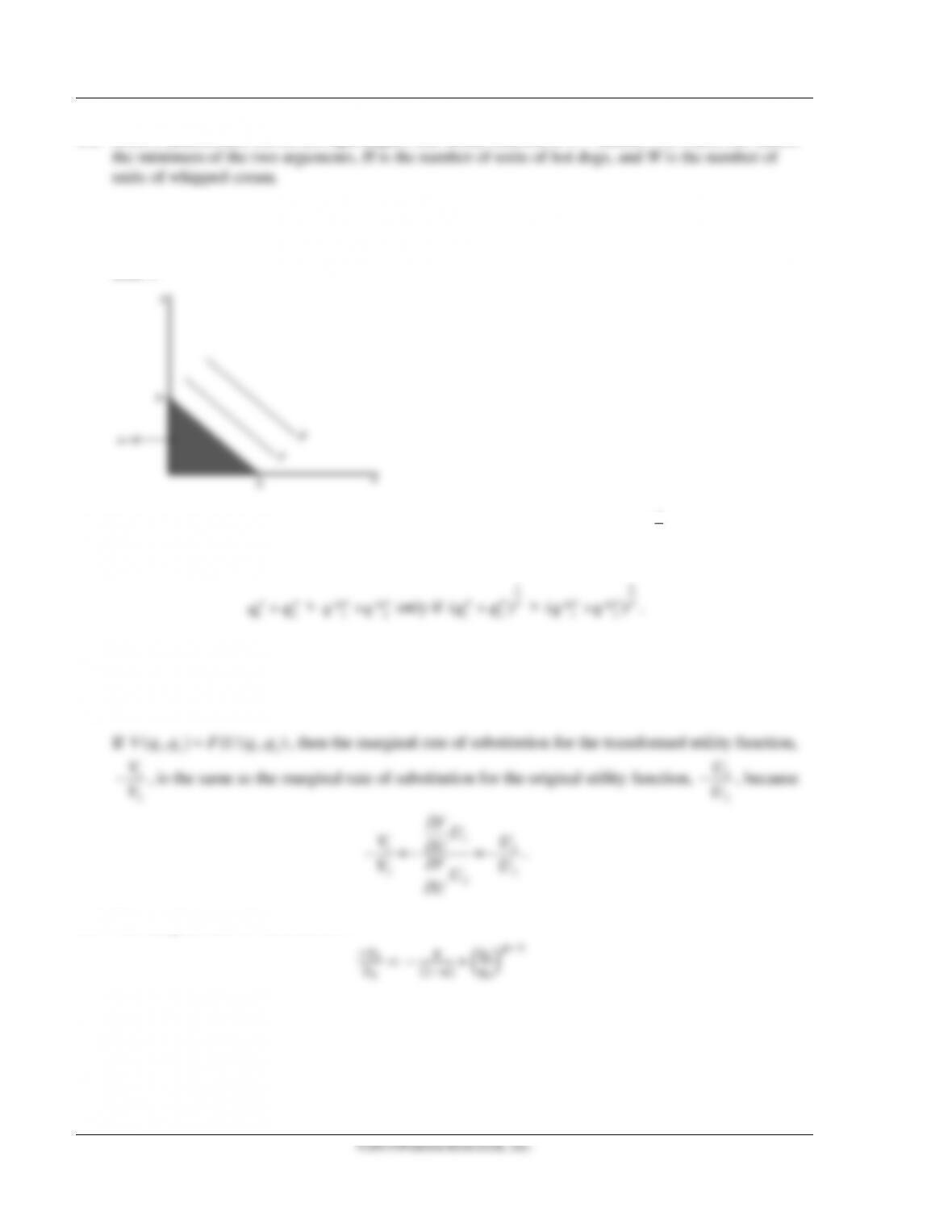
2.1 U = a(A + B); where a is a
positive constant, A denotes
number of tickets to the opera,
and B denotes number of tickets
to the baseball games.
48 Perloff • Microeconomics: Theory and Applications with Calculus, Third Edition
©2014 Pearson Education, Inc.
2.2 Sofia’s indifference curves are right angles. Her utility function is U = min(H, W), where min means
the minimum of the two arguments, H is the number of units of hot dogs, and W is the number of
units of whipped cream.
2.3 In this case, the commodities are perfect substitutes above the threshold level, resulting in linear rather
than convex indifference curves. The “more is better assumption” is violated below the threshold
level. For example, an increase in X from 1 to 2 provides no additional utility unless Y is greater
2.4 In this example, there is a positive monotonic transformation for U =
1
12
()qq
ρρ
ρ
+
such that there is an
equivalent utility function U =
12
qq
ρρ
+
because
12
qq
+
ρρ
ρρ
1
ρρ
ρ
1
ρρ
ρ
2.5 The marginal rate of substitution (MRS) is the slope at a point on an indifference curve. It is the
maximum amount of one good that a consumer will sacrifice (trade) to obtain one more unit of
another good.
U
2
V
2
FU
U
∂
2
U
2.6 The marginal rate of substitution is
Chapter 3 A Consumer’s Constrained Choice 49
2.7 = 1 +
2.8 The marginal rate of substitution (MRS) is the slope at a point on an indifference curve. Phil’s MRS is
the same for a given q1 because
11
1
1
Uq
3.1 Suppose that Dale purchases two goods at prices p1 and p2. If her original income is Y, the intercept of
the budget line on the Good 1 axis (where the consumer buys only Good 1) is Y/p1. Similarly, the
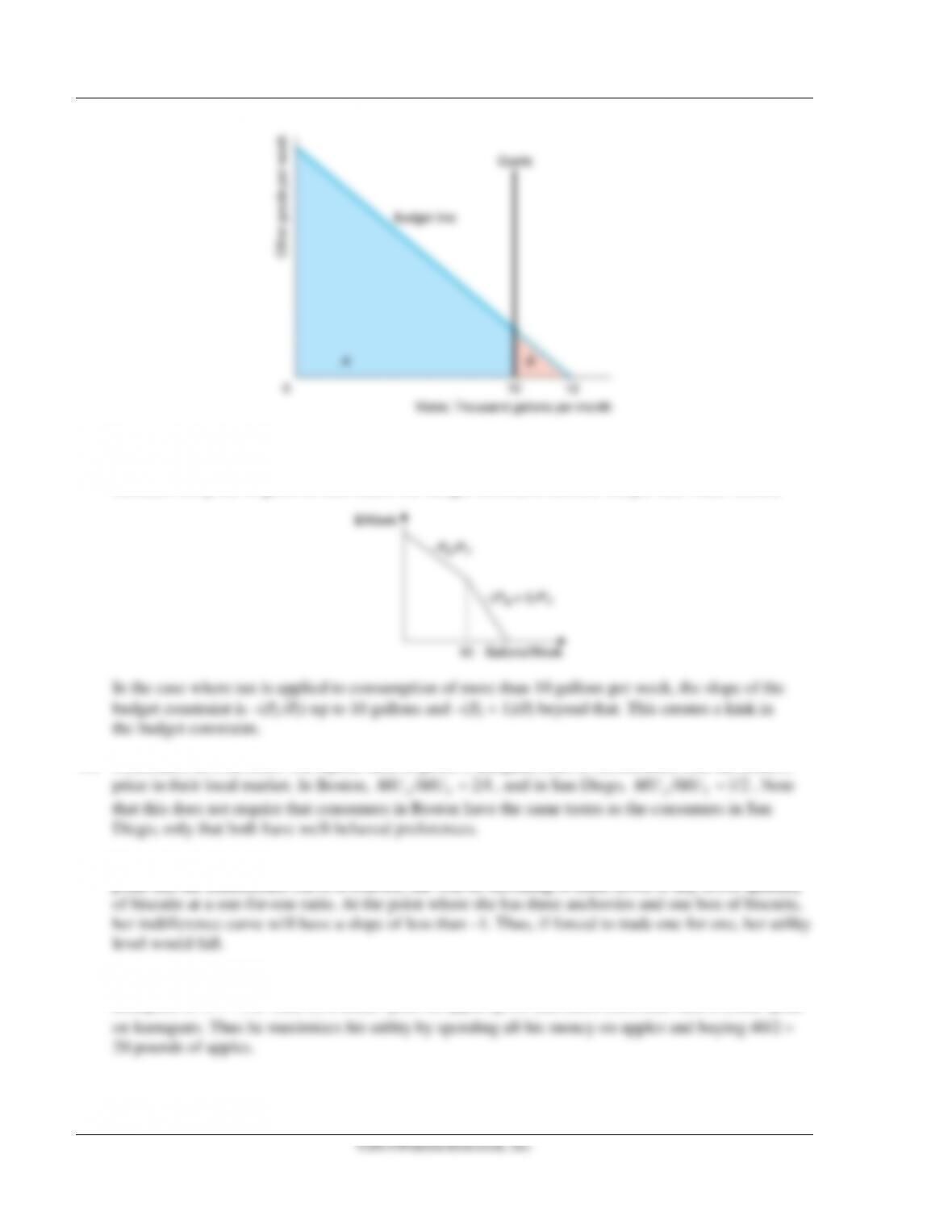
3.3 The consumer can afford to buy up to 12,000 gallons of water a week if not constrained. The
50 Perloff • Microeconomics: Theory and Applications with Calculus, Third Edition
©2014 Pearson Education, Inc.
3.4 Assume other goods (Y) are on the vertical axis and gasoline (G) is on the horizontal axis. If the slope
of the budget constraint before the tax is −P
G/P
Y, after the tax it will become −(P
G + 1)/P
Y. Thus, a tax
increases the price of gasoline and makes the budget constraint become steeper and rotate inward.
4.2 She will prefer the bundle with two anchovies and two boxes of biscuits because if MRS = –1 at this
4.3 Andy’s marginal utility of apples divided by the price of apples is
3/2 1.5.=
The marginal utility for
Chapter 3 A Consumer’s Constrained Choice 51
4.4 In order for him to be maximizing his utility, he must set his consumption such that the marginal
utility per dollar (MU/p) of the last unit consumed is equal across commodities. In this case:
10 /10 5/2.≠
Specifically, the marginal utility per dollar is greater for cookies. Therefore, he should decrease his
consumption of books and increase his consumption of cookies.
4.5 In what follows it is assumed we have the number of $12 shoes on the vertical axis and the number of
$3 shoes on the horizontal axis. After the tariff, the $3 shoes cost 3 × 1.67 = 5.01, and the $12 shoes
cost 12 × 1.37 = 16.44. The slope of the budget constraint before the tariff is –3/12 = –0.25, and after
4.6 Helen’s indifference curves are right–angles. If her new budget line passes through her original