364 Perloff • Microeconomics: Theory and Applications with Calculus, Third Edition
Should you offer to pay by the hour, pay a fixed fee, or pay by the weight of the weeds picked? What
is the person doing the weeding likely to prefer?
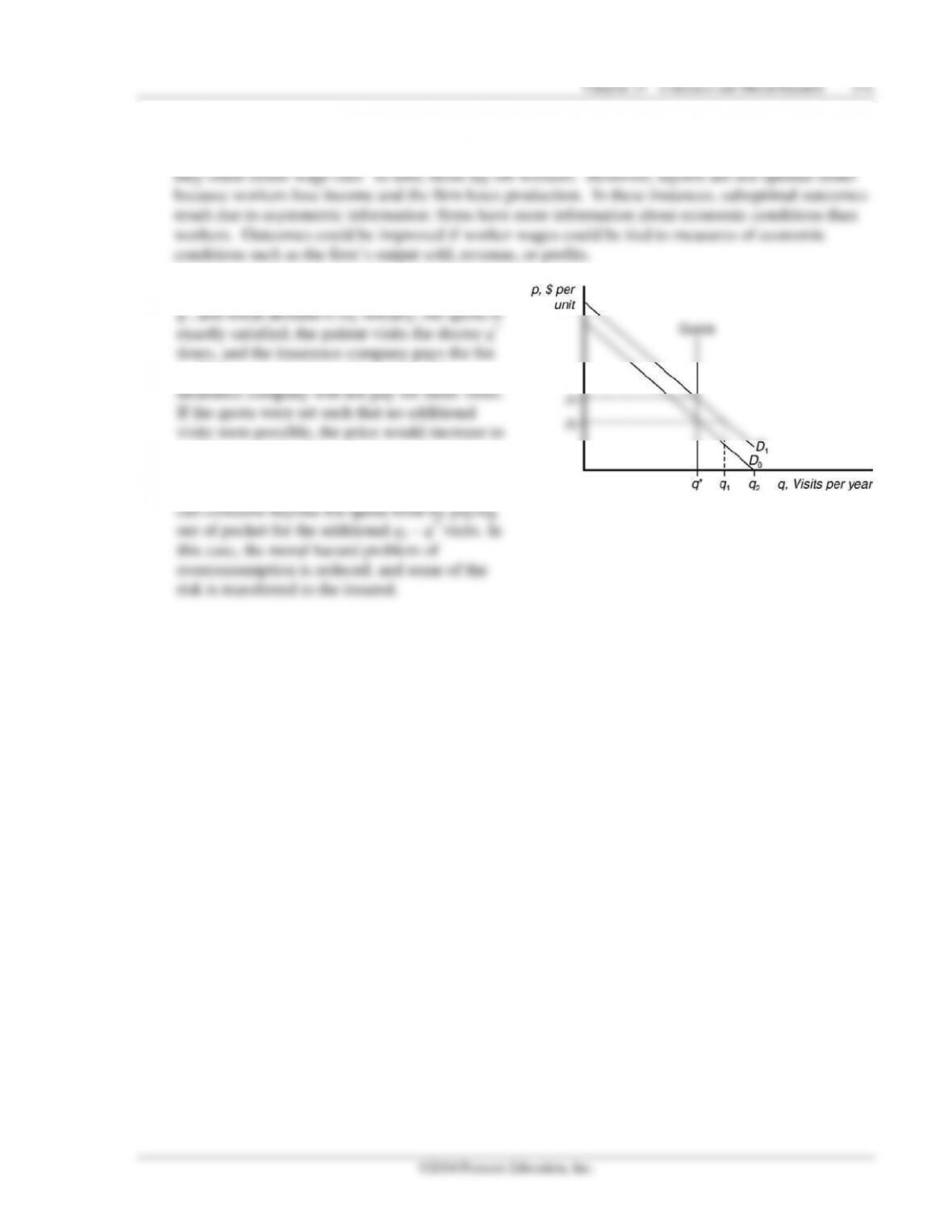
8. Why do some firms offer a money–back guarantee for their goods? What is the moral hazard
implication of this policy?
9. In 1997, the old welfare program, which provides income support for low-income families, was
replaced by the Earned Income Tax Credit program, which gives earning subsidy for low-income
working families. Why may this new program help to reduce the moral hazard problem of long-term
welfare recipients?
Answers to Additional Questions and Problems
1. The advantage of individual incentives is that the player gains personally by performing better on
the field. When players perform better, the team typically performs better. For example, with
2. With many hand tools, such as a hammer or a pair of pliers, it is very difficult for the customer to tell
the quality of the tool by simple inspection, or even in a short–term, in–store test. The quality of these
3. Paying by commission is a more incentive–compatible contract for the auto dealer. This way,
salespeople have the incentive to actively work while on the sales floor and attempt to get every
4. Workers in the service department are not paid based on commission due to the asymmetry of
information between the mechanic and the consumer, and the resulting possibility for moral hazard in
the form of ex-post opportunism. Once the mechanic has the car, the more he or she repairs (whether
366 Perloff • Microeconomics: Theory and Applications with Calculus, Third Edition
1.4 There may be an incentive for investment managers to shirk with such a contract. Because the
1.6 Moral hazard is opportunism characterized by an informed person’ taking advantage of a less–
informed person through an unobserved action. If candies can be reliably labeled tested or untested,
2.1 This agreement led to very long conversations. Whichever of them was enjoying the call more
apparently figured that he or she would get the full marginal benefit of one more minute of talking
2.2 A partner who works an extra hour bears the full opportunity cost of this extra hour but gets only half
the marginal benefit from the extra business profit. The opportunity cost of extra time spent at the
2.3 Arthur does not sell the quantity of ducks that maximizes joint profits. Instead, he sells a quantity
that is less than that amount. This is because Arthur bears 100 percent of the marginal cost of each
2.4 If Paula pays Arthur a fixed–fee salary of $168, Arthur has no incentive to buy any carvings for
resale, given that the $12 per carving cost comes out of his pocket. Thus Arthur sells no carvings if he
12 carvings. Paula must monitor his behavior. (Paula’s residual profit is the joint profit minus $168,
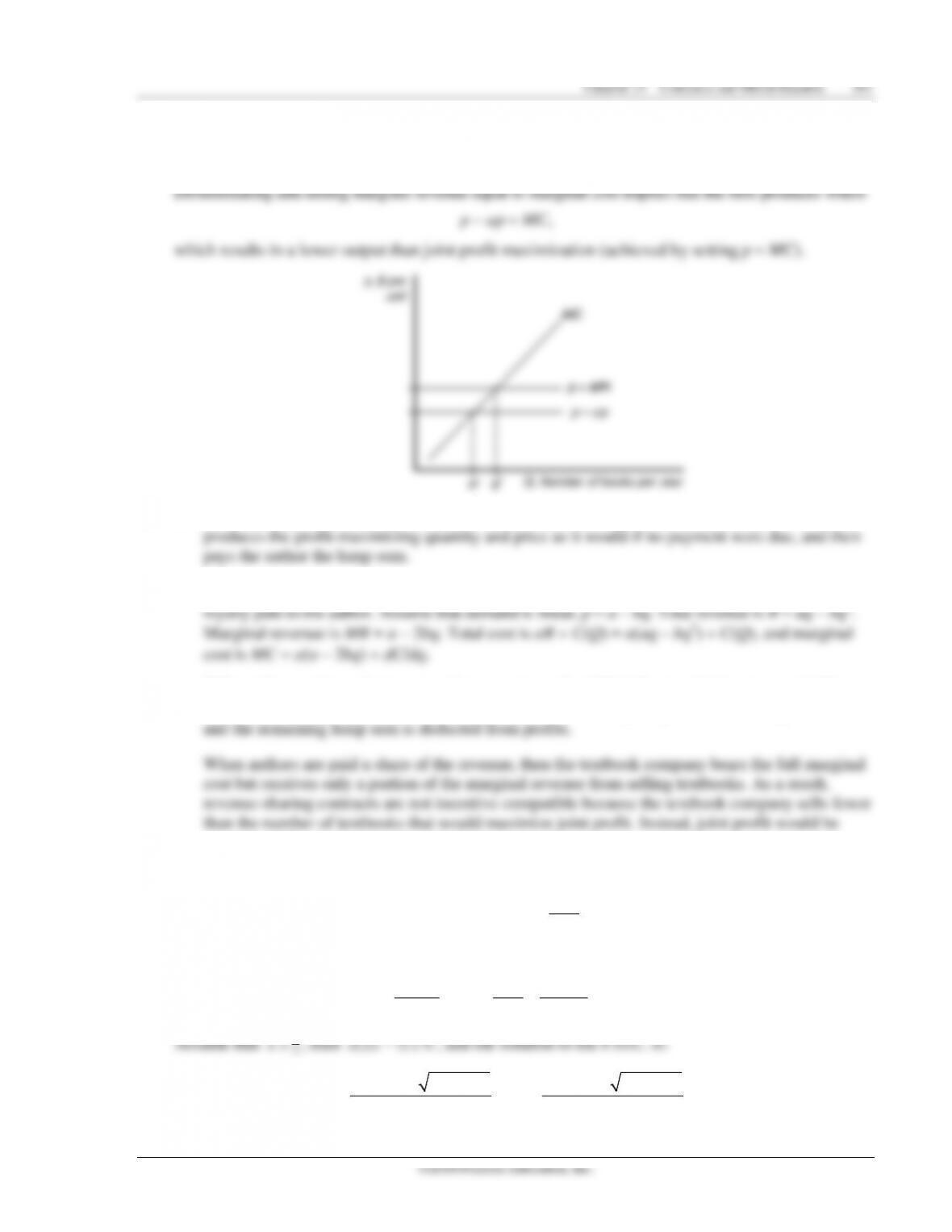
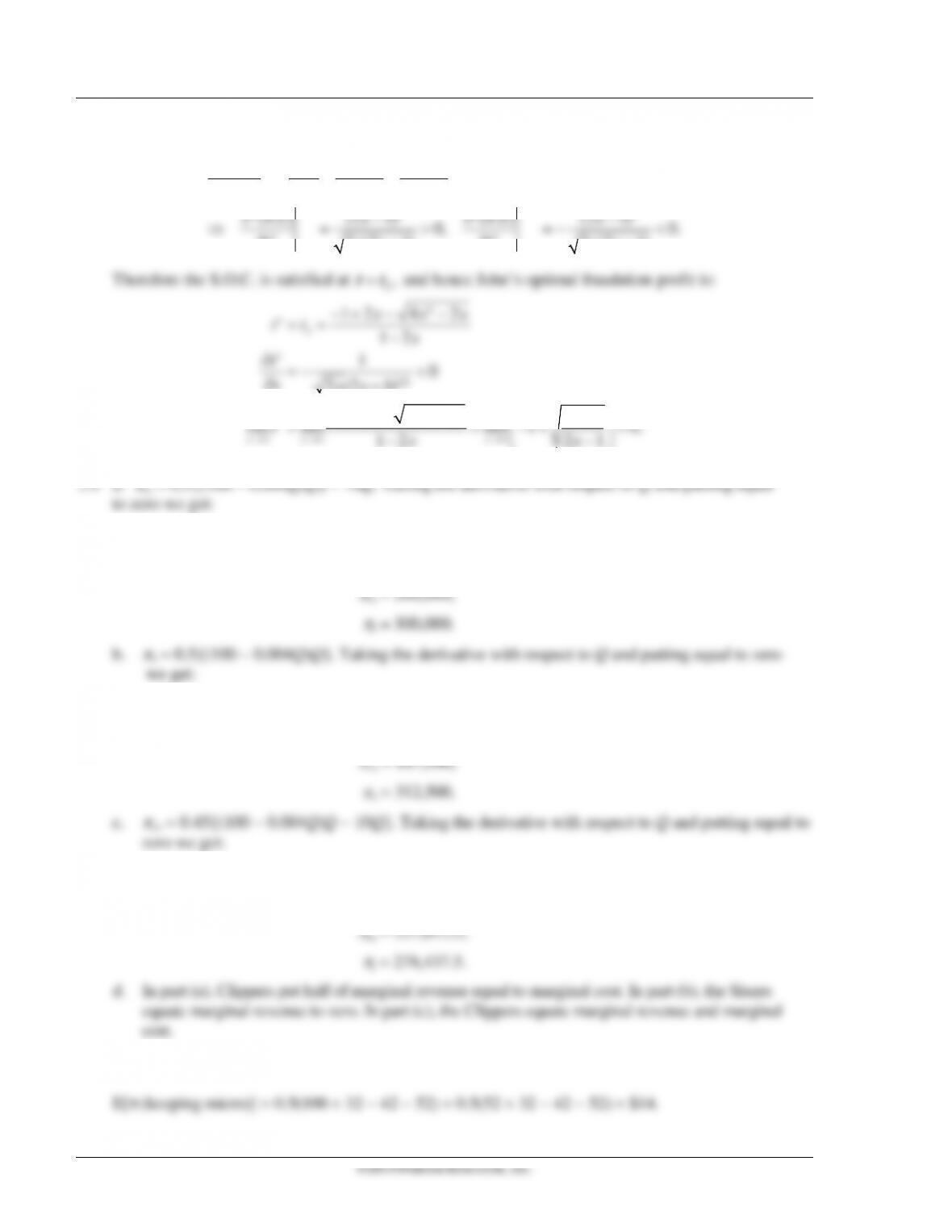
2.5 Yes, it is efficient because the agent has the incentive to produce the profit-maximizing quantity. The
368 Perloff • Microeconomics: Theory and Applications with Calculus, Third Edition
The S.O.C. is:
12
22
2 23
2 22 2
22
() 2 4 2
1 (1 ) (1 )
( ) (2 1) ( ) (2 1)
0, 0.
2 (2 1) 2 (2 1)
tt tt
E x tx t x
t tt t
Ex E x
tt
xx xx
π
ππ
= =
∂=−+ −
∂ ++ +
∂ −∂ −
⇒ => =−<
∂∂
−−
©2014 Pearson Education, Inc.
3.1 In this case, the problem arises because a given doctor receives the same amount of revenue no matter
3.2 The payoff to Padma will be a function of the actual value of the recoverable sunken treasure and of
how hard Aaron works to retrieve it. If Aaron is paid a flat fee and the amount of recoverable treasure
3.3 Such an agreement interferes with the ability to write an optimal contract. It forces the franchiser to
continue to support a franchisee even when that franchisee is underperforming, even to the point of
3.4 Moral hazard is opportunism characterized by an informed person’s taking advantage of a less–
informed person through an unobserved action. Moral hazard results in this instance because Louisa
has less incentive to practice bike safety with insurance because the insurance company bears the cost
4.1 The bond is posted because law firms exist and thrive primarily based on their reputations. If a partner
were to become involved in illegal activities and he or she were caught, it would seriously damage
4.2 The minimum bond that deters stealing is $2,500.
4.3 If the worker does not view the additional pay as an efficiency wage, it has no effect on the outcome
370 Perloff • Microeconomics: Theory and Applications with Calculus, Third Edition
4.4 This is a moral hazard problem. If Medicare does not cover these costs, the hospitals will be more
4.5 The price difference between used rental cars and used cars owned by individuals is due to moral
hazard: those who rent cars likely do not take as good of care of them as those who own cars because
4.6 The advantage of this compensation package is that it ties Ms. Whitman’s incentives to the value of
company stock, which is of primary concern to shareholders. As such, it should reduce moral hazard
4.7 If Adrienne launches the new product, then there is a 30 percent she will receive 10 percent of the
amount of $20 over $8 million. The other outcomes when launching the new product will not
generate profit over $8 million. So, if Adrienne launches the new product, then she would expect to
receive $1.2 million (from 10 percent of $12 million).
5.1 For a firm to sort between hard-working and lazy employees using contingent and fixed-fee contracts,
the lazy employees and the hard–working employees must prefer different contracts. Specifically, the