354 Perloff • Microeconomics: Theory and Applications with Calculus, Third Edition
4. With changing technology, used computers are often obsolete and cannot be upgraded to run current
software, making them a poor investment. Only used computers that have current or nearly current
5. If employers use years of education as a signal of quality, an individual who has 14 years of
schooling may be viewed as inferior to an individual with 16. The sheepskin effect (completing the
6. If the initial solution is a pooling equilibrium, where all workers are paid the average wage, it must be
that the wage premium given to technical school graduates is not sufficient to get them to attend the
7. Standardized test scores serve as a signal for both students and schools. Students can signal ability
through high scores. Secondary schools use test scores as a signal of school quality. If schools spend
8. With the two kinds of groceries, one should expect the high search cost type consumers to shop in the
9. Price comparison Web sites are expected to drive price to converge with each other. Reasons behind
price dispersions for identical items may be: (i) difference in service, such as warrantees or return
policies; (ii) some firms may simply charge a higher price, hoping people unaware of the price
comparison Web site or people who do not want to spend time searching for a lower price will shop
at their Web site. This is essentially a “tourist–trap” model.
Answers to Exercises in the Text
1.1 This is moral hazard.
1.2 Because insurance costs do not vary with soil type, buying insurance is unattractive for houses on
©2014 Pearson Education, Inc.
1.4 This is adverse selection.
1.5 a. For actuarially fair insurance the expected profit should be zero. Therefore, if everybody
b. No healthy person will buy the insurance because its price is greater than the cost of getting sick.
c. If only unhealthy people purchase insurance then price = (0.4)(10,000) = $4,000.
d. For unhealthy people U(purchasing insurance) = (30,000 − 4,000)0.5 = 161.24. The expected
e. Only unhealthy people will buy insurance and the price of insurance will be $4,000. Here the
problem is one of adverse selection.
2.1 Insurance companies use home addresses to increase their ability to predict losses. If this practice is
outlawed, the insurance firm must place all drivers (cars) in the same risk pool. If drivers are not
required to buy insurance, the price is set at the high-risk price, and drivers in low–risk areas do not
2.3 Adverse selection occurs when one party to a transaction possesses information about a hidden
characteristic that is unknown to other parties and takes economic advantage of this information.
Moral hazard is opportunism characterized by an informed person’s taking advantage of a less–
3.1 Consumers do not want to purchase a lemon but cannot readily distinguish lemons from non-lemons
upon simple inspection. They are therefore very wary of a virtually new car offered for resale.
356 Perloff • Microeconomics: Theory and Applications with Calculus, Third Edition
3.2 Before eating, consumers can only gain information about the price of the meal and its general
characteristics, such as the type of cuisine. They are generally unable to tell the quality of a restaurant
3.3 Because buyers are risk neutral, if they believe that the probability of getting a lemon is
θ
, the most
3.5 Because buyers are risk neutral, if they believe that the probability of getting a lemon is θ, the most
they are willing to pay for a car of unknown quality is the value of a high-quality car multiplied by
the probability of the unknown car being of high quality plus the value of a lemon multiplied by the
10,000 – 8,000θ ≥ 8,000
2,000 ≥ 8,000θ
0.25 ≥ θ.
3.6 Consumers will be willing to pay a price for staplers that equals their cost of production. If one firm
©2014 Pearson Education, Inc.
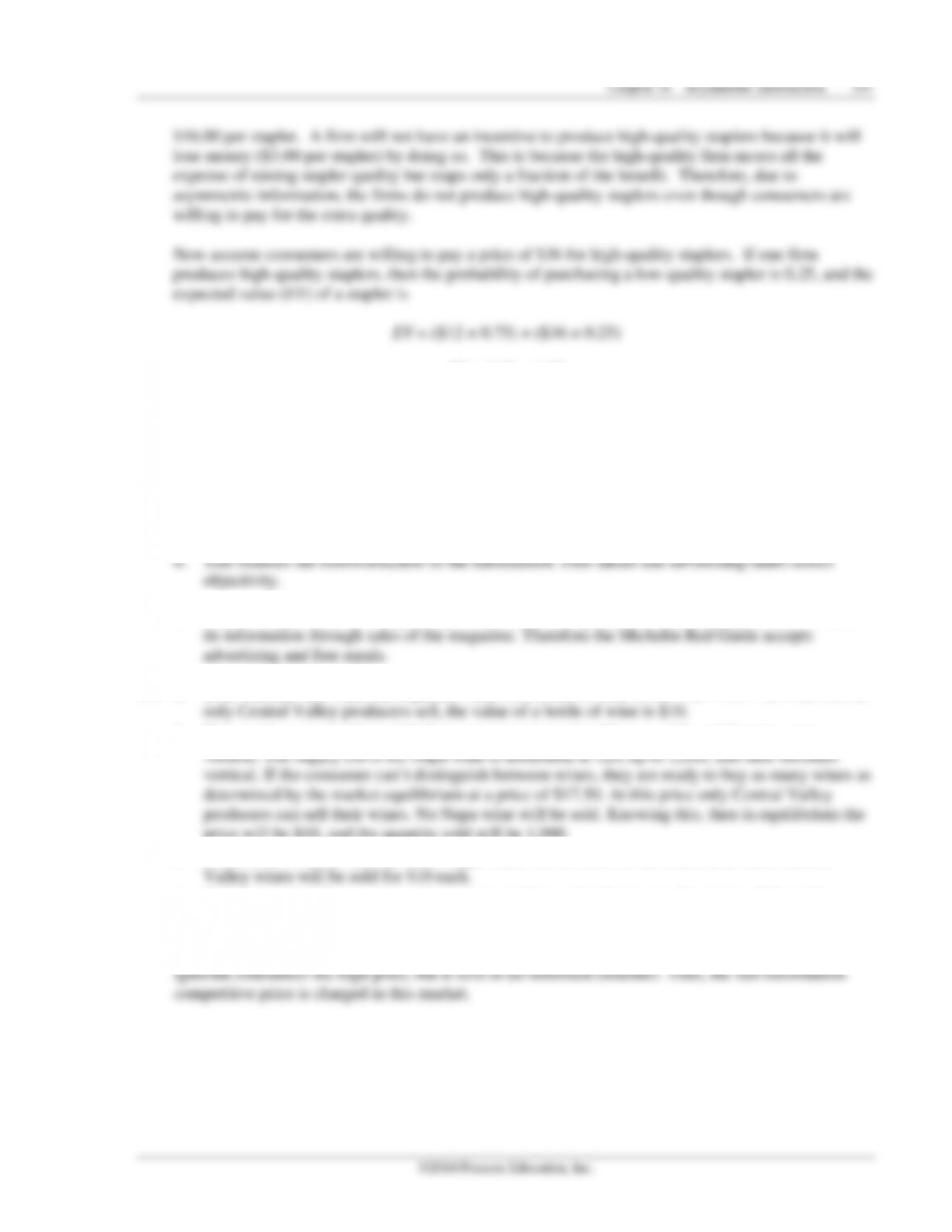
EV = $17.00.
Firms that produce low-quality staplers will receive a price of $17.00 and incur costs of $12.00 per
stapler. The firm that produces high–quality staplers will receive a price of $17.00 and incur costs of
$16.00 per stapler. Now a firm will have an incentive to produce high–quality staplers.
3.7 a. This information prevents the lemons problem and creates a market for high–quality restaurants.
c. The information that the magazine provides is a public good and it does not get the full value of
3.8 a. If all wineries sell wine, the expected value of a bottle of wine is 0.5 × 25 + 0.5 × 10 = $17.50. If
b. The supply curve for Central Valley wine is horizontal at $5, up to 100, and then becomes
c. If bottles are clearly labeled, 1,000 Napa wines will be sold for $25 each, and 1,000 Central
d. If there is no labeling, we have the lemons problem and only low-quality wine will be sold.
4.1 If almost all consumers know the true prices, and all but one firm charges the full–information
competitive price, then it does not pay for a firm to set a high price. It gains a little from charging
358 Perloff • Microeconomics: Theory and Applications with Calculus, Third Edition
4.2 Automobile companies can sell practically the same car under different names and for different prices
due to the asymmetry of information. The asymmetry of information in this case basically means that
automobile companies and dealers know more about the cars then the customers do. The asymmetry
5.1 The firm is willing to pay c* to have potential employees tested only if the firm believes that there is
variation in worker quality (productivity) that will be accurately revealed by the test, and that the
5.2 This policy could help students in the job market if they would have earned poor grades. It will hurt
students who would have performed well. It is also likely to harm students who would have received
5.3 The practice of screening by education level is not viewed as discrimination. Statistical
discrimination is the practice of attributing productivity differences along racial, gender, or ethnic
5.4 In Figure 18.2 in the text, in order for both types of equilibria to be possible, the solution must lie
5.5 The following explanation might be more straight-forward:
Education of eh is the signal. It pays the high–ability group to signal if cheh < (wh − wl). Low-ability
workers will only signal eh if cleh < (wh − wl) or eh < (wh − wl)/cl. Thus, eh is a successful signal of