Chapter 17 Property Rights, Externalities, Rivalry, and Exclusion 339
Answers to Additional Questions and Problems
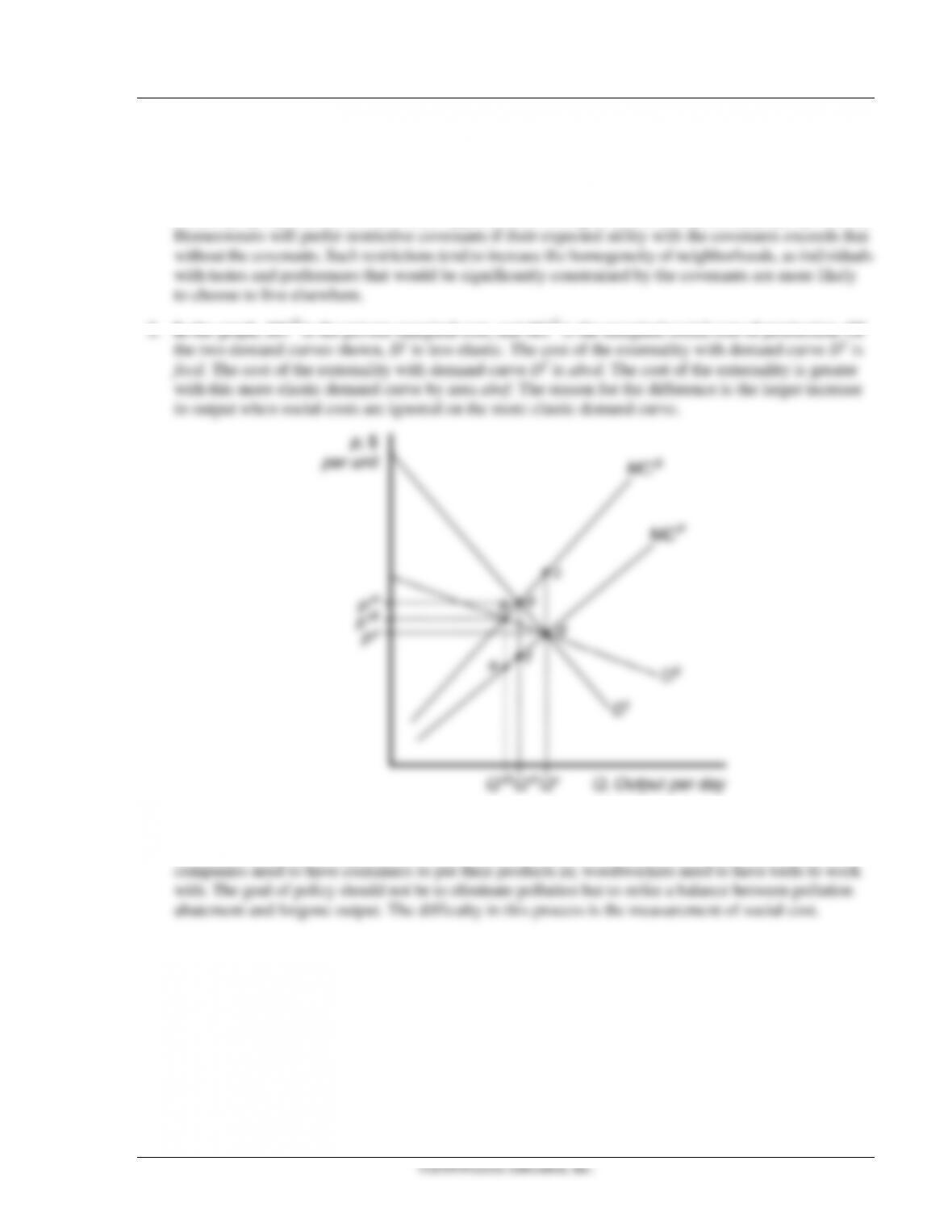
1. Restrictive covenants have a private cost, as they reduce personal freedom by constraining choices.
However, there are social costs associated with having neighbors who make additions or alterations
to their property that reduce the overall appearance of a neighborhood (and possibly property values).
3. The elimination of all pollution is not possible. Even the elimination of all industrial pollution would
mean the end of industrial production. Even the cleanest industries create some pollution. Spring water
340 Perloff • Microeconomics: Theory and Applications with Calculus, Third Edition
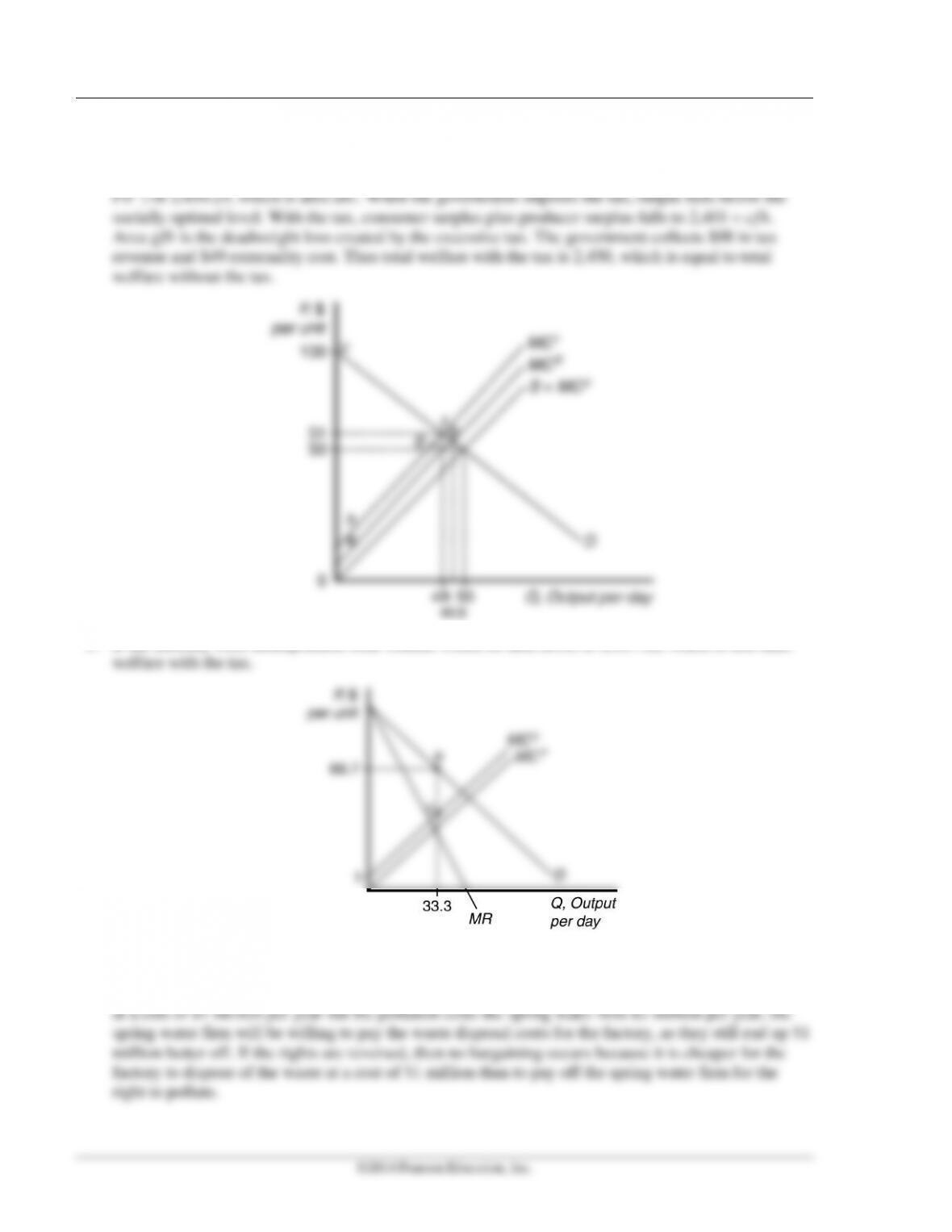
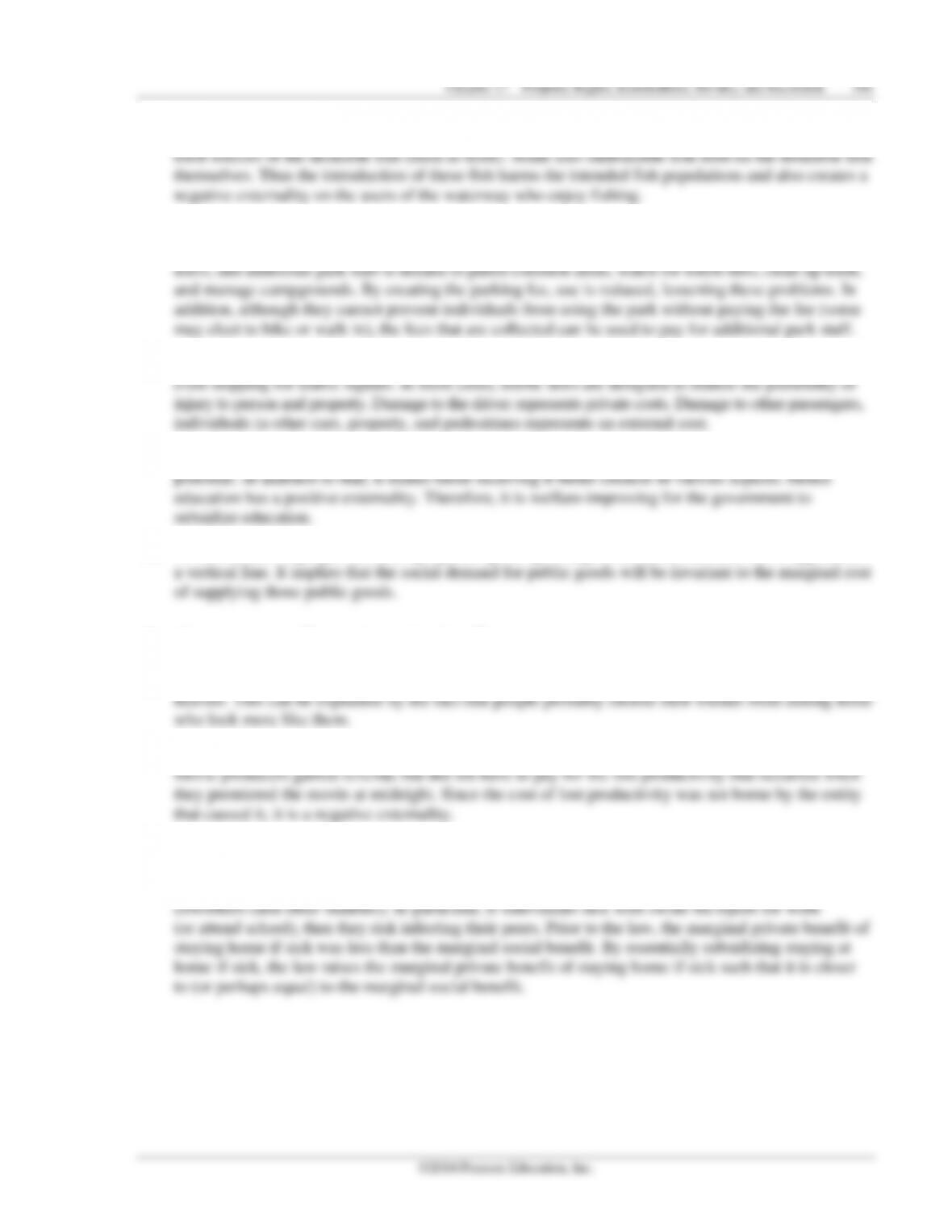
4. Without government intervention, the equilibrium quantity is 50, price is $50, and total welfare is
2,450, which is consumer surplus plus producer surplus, less deadweight loss of $50. The socially
optimal output level is 49.5. The socially optimal level of production results in total welfare (CS +
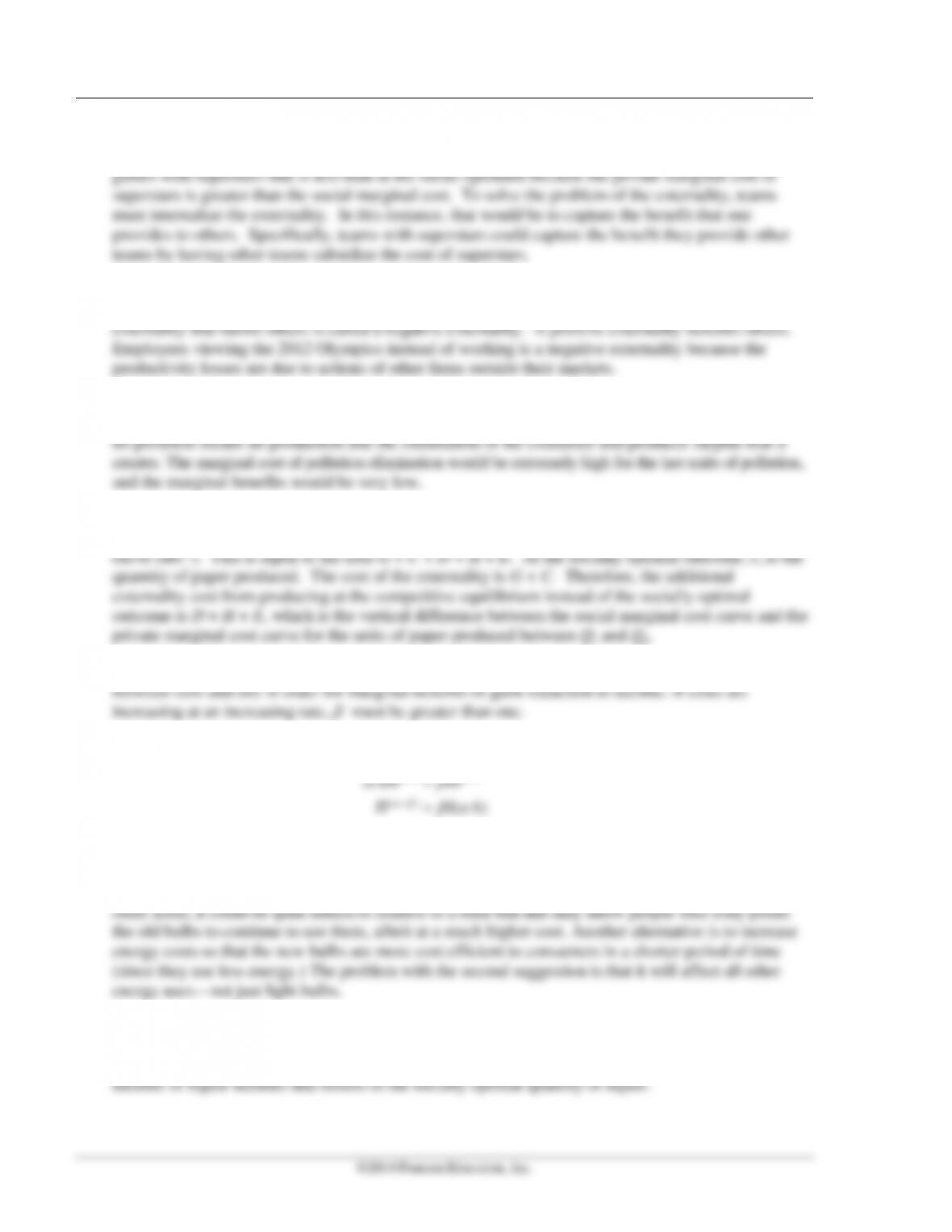
6. Without the establishment of property rights, the factory and the spring water firm are unable to
negotiate a solution. However, if property rights are established in either one’s favor, bargaining may
occur. For example, if the factory has the right to pollute the stream rather than internalize the waste
342 Perloff • Microeconomics: Theory and Applications with Calculus, Third Edition
1.4 In the presence of a positive externality, the competitive market results in a quantity that is too low
(relative to the social optimum). In this instance, the competitive market results in a quantity of
1.5 An externality occurs when a person’s well-being or a firm’s production capability is directly affected
by the actions of other consumers or firms rather than indirectly through changes in prices. An
2.1 Zero pollution is probably impossible to attain even if it were desirable. Any type of production
results in some level of pollution (even spring water has to be delivered, which requires trucks). Thus
2.2 At the competitive market outcome, ec is the quantity of paper produced. The cost of the externality
is the vertical difference between the social marginal cost curve (MCs) and the private marginal cost
2.3 The parameter A must be positive in order for gunk reduction to be beneficial, and
α
must be
2.4 To determine this level, set marginal benefit equal to marginal cost.
11
()
1/( )
[ /( )
AH H
HA
αβ
αβ
αβ
αβ
βα
−−
−
−
=
=
3.1 One alternative is a tax on the old bulbs that makes the cost of each bulb greater than the reservation
price of consumers for the new bulbs. If the tax is used to pay for reduced energy consumption in
3.2 If liquor creates a negative externality, then the competitive equilibrium will result in a quantity of
liquor that is too high. The socially optimal quantity of liquor is where the social marginal cost of
liquor equals the social marginal benefit from liquor. Thus, the regulatory agency should provide the
©2014 Pearson Education, Inc.
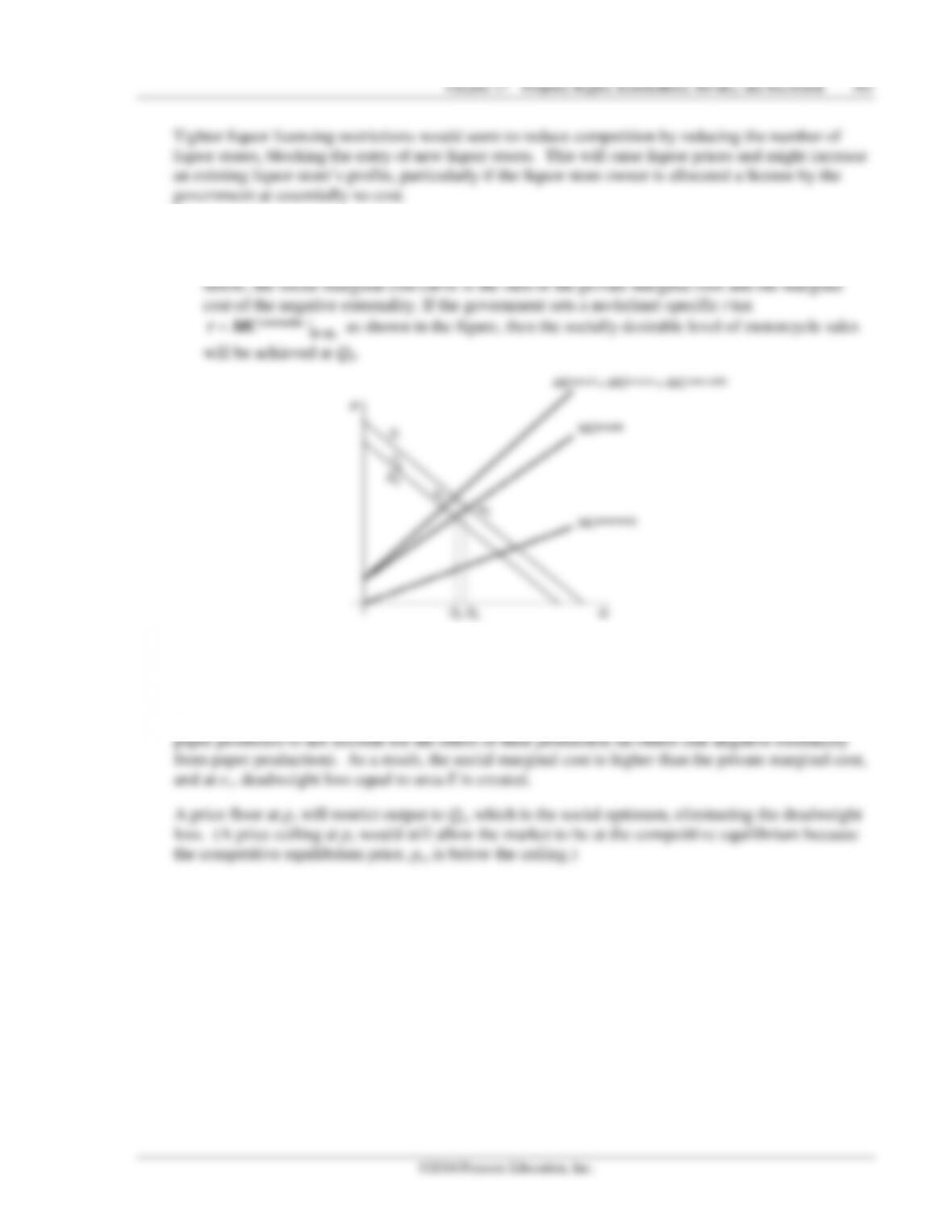
3.3 a. Yes, there is a negative externality.
b. For simplicity, assume that each motorcyclist rides without a helmet. As shown in the figure
3.4 A specific tax of $84 per ton of output or per unit of emissions (gunk) leads to the social optimum.
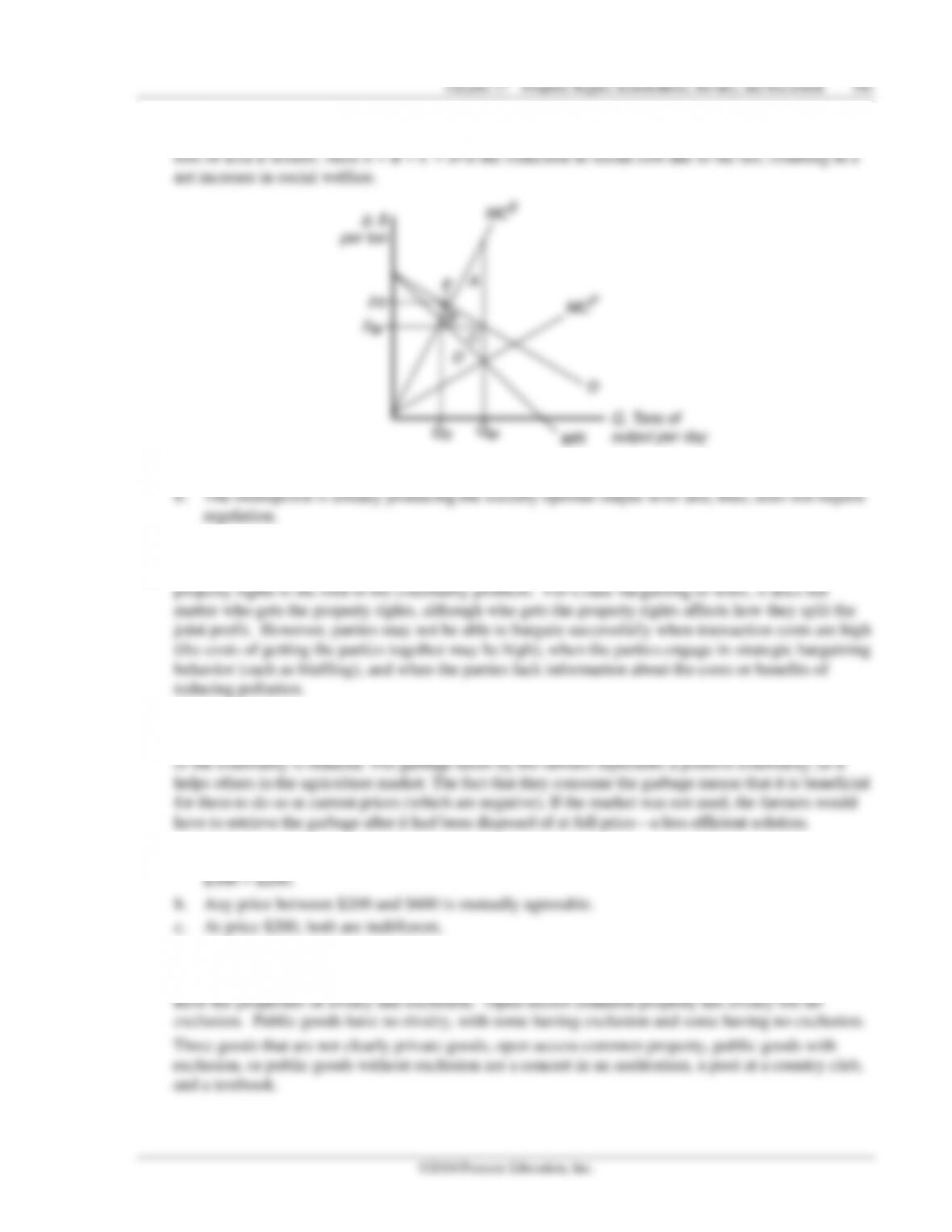
3.5 In this market for paper, the competitive equilibrium is at ec, where the private marginal cost curve
and the demand curve intersect. The social optimum is at es, where the social marginal cost curve and
the demand curve intersect. Too much paper is produced at the competitive equilibrium because
344 Perloff • Microeconomics: Theory and Applications with Calculus, Third Edition
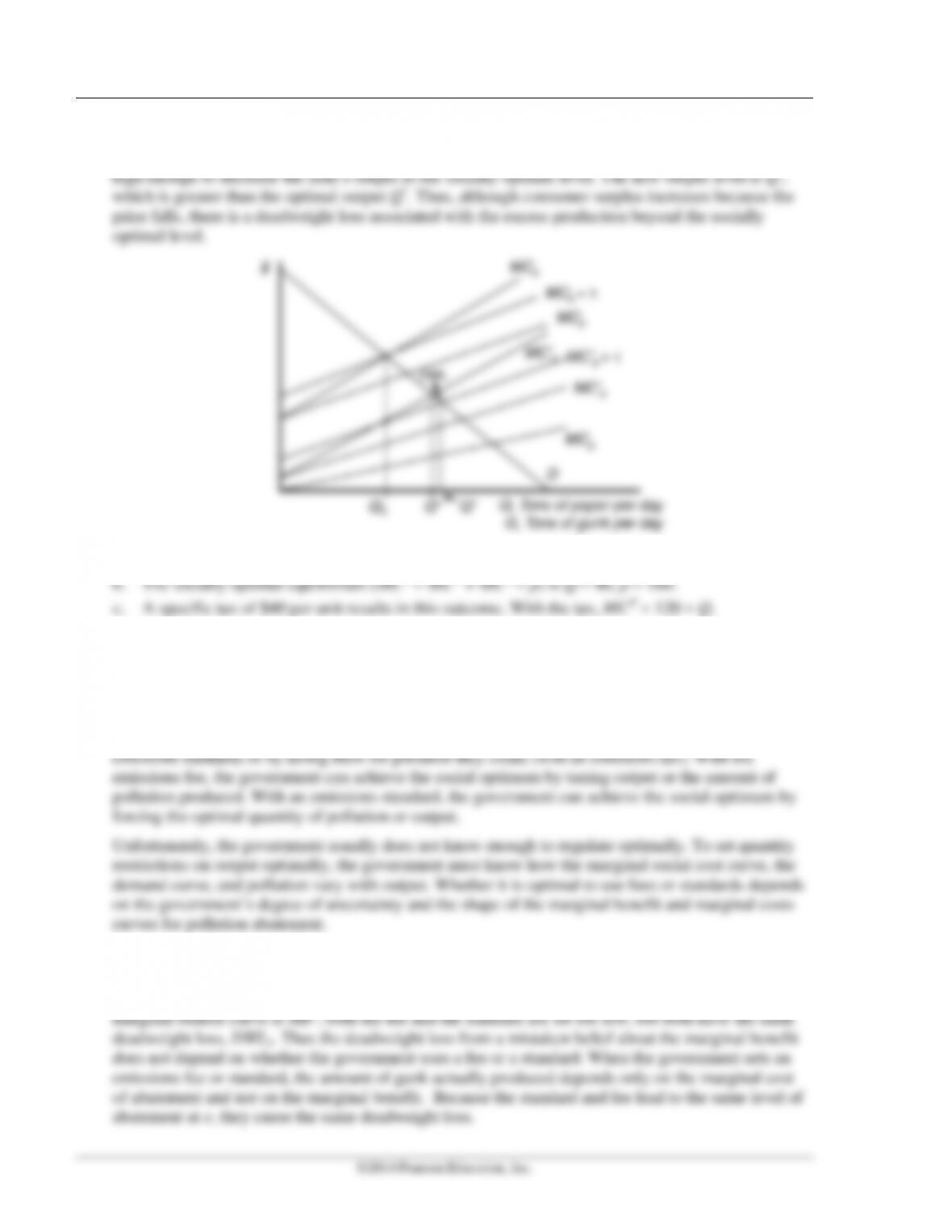
3.6 When the marginal private cost of output falls, output increases (as does the quantity of gunk
produced). If the tax remains unchanged at $84, as shown by the dashed line in the figure, it is not
3.7 a. The unregulated equilibrium (MCP = p) is Q = 60, p = 140.
3.8 The fleet operators would recover only half the cost of conversion. Assuming the cost of cleaner fuels is
no less than the cost of gasoline, there is no incentive for fleet operators to make the change.
3.9 If a government has sufficient knowledge about pollution damage, the demand curve, costs, and the
production technology, it can force a competitive market to produce the social optimum. The government
might control pollution directly by restricting the amount of pollution that firms may produce (with an
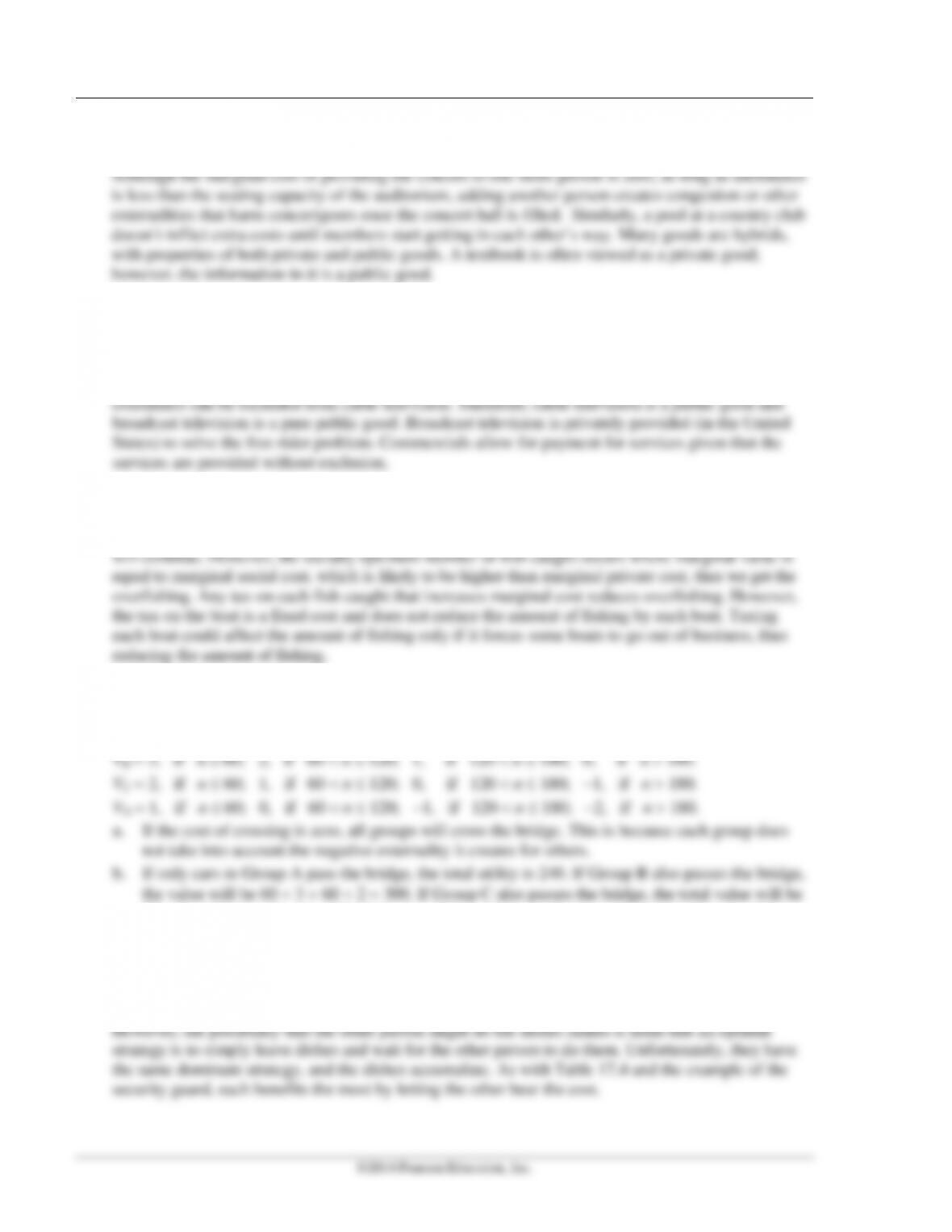
3.10 The government uses its expected marginal benefit curve to set a standard at S or a fee at f. If the true
marginal benefit curve is MB1, the optimal standard is S1 and the optimal fee is f1. The deadweight
loss from setting either the fee or the standard too high is the same, DWL1. Similarly, if the true
346 Perloff • Microeconomics: Theory and Applications with Calculus, Third Edition
Many goods differ in the degree to which they have rivalry and exclusion. A concert in an auditorium
that is not filled has elements of both a private good (exclusion) and a public good (no rivalry).
6.2 Yes. My use of the bridge creates negative externality for others by creating congestion. A toll can
internalize the negative externality.
6.3 Pure public goods have two important characteristics. They are nonrival in consumption, as are
broadcast and cable television, and they are nonexcludable. While broadcast television is nonexcludable,
6.4 Suppose the average value of fishing is a decreasing function of number of fish caught. In order to
maximize private value, each boat continues fishing up to the point where marginal value (price in a
competitive market) is equal to marginal cost; that is, as long as there is positive net gain, the fishing
6.5 The value of crossing the bridge depends on the number of cars on the bridge (in the following, n is
the number of cars on the bridge):
VA = 4, if n ≤ 60; 3, if 60 < n ≤ 120; 2, if 120 < n ≤ 180; 1, if n > 180.
60 × 2 + 60 × 1 + 60 × 0 = 180. With the addition of Group D, the total value is 60 × 1 + 60 ×
0 + 60 × −1 + 60 × −2 = −120. The total utility is maximized when 120 (Groups A and B) pass
the bridge.
6.6 The sink and the dishes are both a form of public good for those who live in the house. If there were
no one else there who might clean up, each individual would benefit from cleaning up the mess.
348 Perloff • Microeconomics: Theory and Applications with Calculus, Third Edition
G
GU
G
GU
∂
∂
+
∂
∂)()(
21
=1.
This shows the optimal provision of the public good is unique and independent of P1 and P2.
6.13 In Nash equilibrium, each person maximizes her utility taking the number of hours the other works as
24tB + tA = 552. Solving these two equations we get tA = tB = 22.08.
To find the number of hours that maximizes the sum of utilities, we take the partial derivative of the
7.1 There are several ways to demonstrate that welfare can go up despite the pollution. For example, one
7.2 Going from no trade to free trade, consumers gain areas B and C, while domestic firms lose B. Thus,