Chapter 16 Uncertainty 323
Answers to Exercises in the Text
1.2 Assuming that the painting is not insured against fire, its expected value is
$550 (0.2 $1,000) (0.1 $0) (0.7 $500).= × + ×+ ×
1.3 The expected value is
1,875 = 7,500.
1.4 The expected value is the value of each possible outcome times the probability of that outcome:
EV = Pr(no piers)(4000) + Pr(piers)(–1000)
EV = 0.75(4000) + 0.25(–1000)
1.5 For individuals, gambling at a casino and buying a stock might not be too different. Both serve to
redistribute wealth within a society. For the society as whole, stock market places an important role in
1.6 The expected punishment for violating traffic laws is
θ
V, where
θ
is the probability of being caught
1.7 The probability of being caught must be at least 0.625, because $800 × 0.625 = $500.
324 Perloff • Microeconomics: Theory and Applications with Calculus, Third Edition
2.1 A fair bet is one whose expected value is zero. The expected value (EV) is the value of each possible
2.2 The figure plots
() .UW W=
Since it is a concave function, Jen is a risk-averse individual.
510 15 20 25 W
1
2
3
4
5
6U
Chapter 16 Uncertainty 325
2.4 When x increases from x0 to x1, the chord showing expected utility shifts downward. Initially the risk
premium is $10. After the increase in x, the risk premium increases to $40.
2.6 U(100) = Ln(100) = 4.6. Note that the expected value of the gamble is 0.5 × 120 + 0.5 × 80 = 100.
0.5U(120) + 0.5U(80) = 0.5 × Ln(120) + 0.5 × Ln(80)
= 4.5845.
100 − 97.98 = 2.02.
2.7 Hugo’s expected wealth is
( ) ( )
21
33
144 225
96 75 171.
EW =× +×
=+=
33
21
33
12 15 13.
=× +× =
He would pay up to an amount P to avoid bearing the risk, where U(EW − P) equals his expected
326 Perloff • Microeconomics: Theory and Applications with Calculus, Third Edition
2.8 Yes, Mary is risk averse because she has a declining marginal utility of wealth (MUW = 1/3 W−2/3).
2.9 No. Risk-neutral individuals are indifferent between certainty and a fair bet. Thus they may or may
2.10 a. EV = 0.6(100,000) + 0.4(–20,000) = $52,000.
Var = [0.6($48,0002) + 0.4(–72,0002)] = $3456 million.
b. Yes, she would accept the offer because the expected value of the harvest ($52,000) is below that
2.11 Job 1’s expected value is 30, its variance is 100, and its standard deviation is 10. Job 2’s expected
value is 36, its variance is 189, and its standard deviation is 13.74. Job 3’s expected value is 30, its
2.12 Since
= −
= −
2
2
100 2
2,
dU W
dW
dU
dW
Chapter 16 Uncertainty 327
©2014 Pearson Education, Inc.
the Arrow-Pratt measure is
ρ
=−=
−
2
22
() .
100 2
dU
dW
WdU W
dW
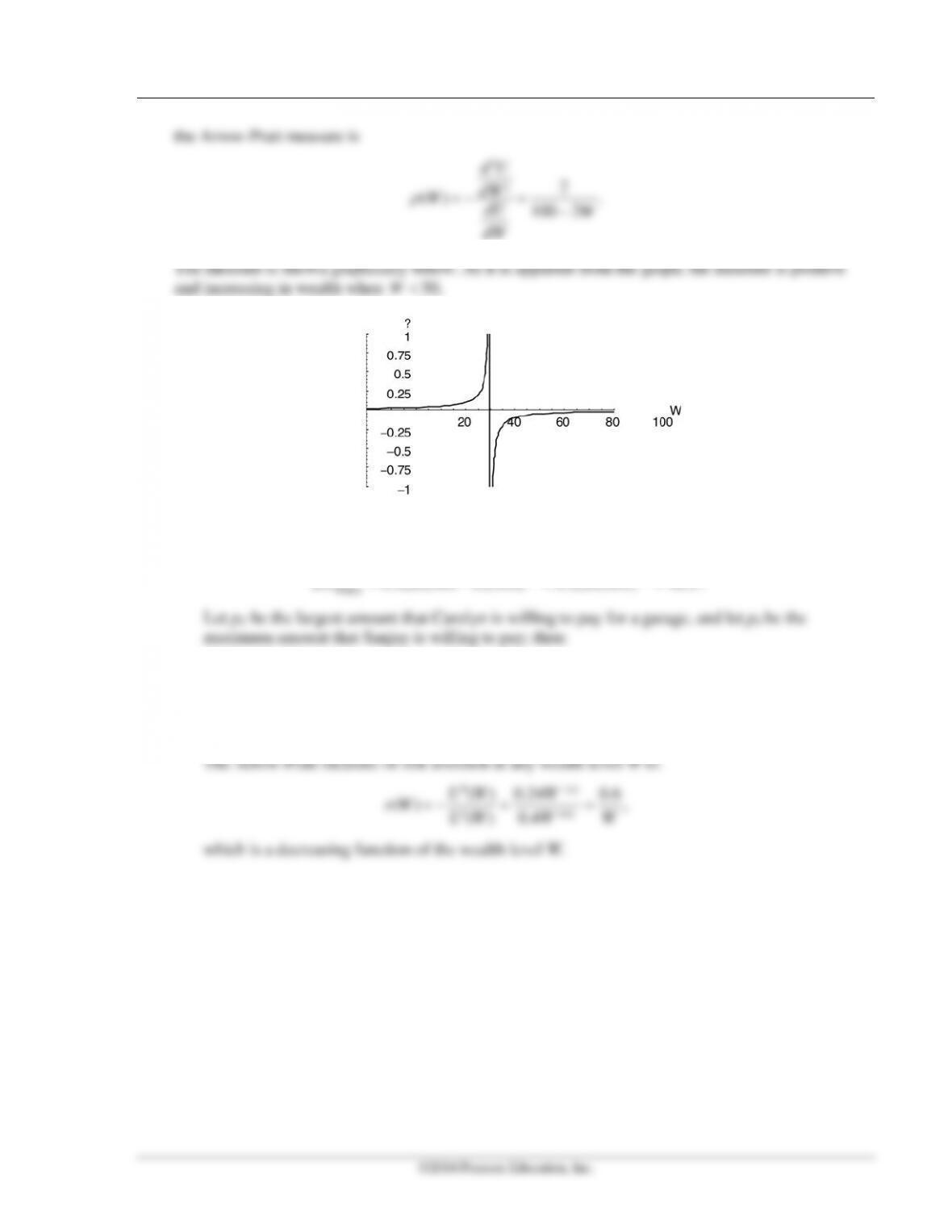
The measure is shown graphically below. As it is apparent from the graph, the measure is positive
and increasing in wealth when
50.W<
2.13 a. Expected utilities for street parking are:
= −+ =
= −+ =
0.4 0.4
Carolyn
0.4 0.4
Sanjay
EU 0.5(80,000 10,000) 0.5(80,000) 89.08
EU 0.5(20,000 10,000) 0.5(20,000) 46.17
0.4 Carolyn
0.4 Sanjay
(80,000 ) EU 89.08 5100.11
(20,000 ) EU 46.17 5515.13
CC
SS
pp
pp
− = = ⇒=
− = = ⇒=
b.
5100.11 5515.13
CS
pp=<=
because Sanjay is more risk averse than Carolyn.
328 Perloff • Microeconomics: Theory and Applications with Calculus, Third Edition
Thus Sanjay is more risk averse than Carolyn because Carolyn is wealthier than Sanjay.
3.1 If she sends them together, the expected utility is qU(0) + (1 – q)U($2000). If they are sent
3.2 Fair insurance is a bet between an insurer and a policyholder in which the value of the bet to the
policyholder is zero. In this example, the cost of a $1.00 insurance payment if successfully sued is
$0.05263 if not sued (from a 5 percent probability of being successfully sued divided by a 95 percent
3.3 a. Fair insurance is a bet between an insurer and a policyholder in which the value of the bet to the
policyholder is zero. In this example, the insurance company will make a $70,000 payment with
probability 0.02, so the cost should be $1,400.
1,592 = 4(X)0.5
398 = X0.5
3.4 a. Risk Neutral: Y is the wealth
UINS = Y − 150.
The expected utility of no insurance = (1/36)(Y − 400) + (35/36)Y = Y − 11.11. A risk-neutral
person doesn’t buy insurance.
©2014 Pearson Education, Inc.
3.5 If individuals know that the government will provide subsidies to homeowners with losses, they have
22
even though the probability of a loss does not change. The expected utility chord swings upward,
resulting in a higher utility level if there is a flood [U(w1)]. The risk premium of the individual
22
4.1 If they were married, Andy would receive half the potential earnings whether they stayed married
investment is the probability of staying together,
1
2,
times Kim’s half of the returns if they stay
together, $12,000. Thus, Andy’s expected return on the investment, $6,000, is less than the cost of the
education, so Andy is unwilling to make that investment (regardless of other investment opportunities).
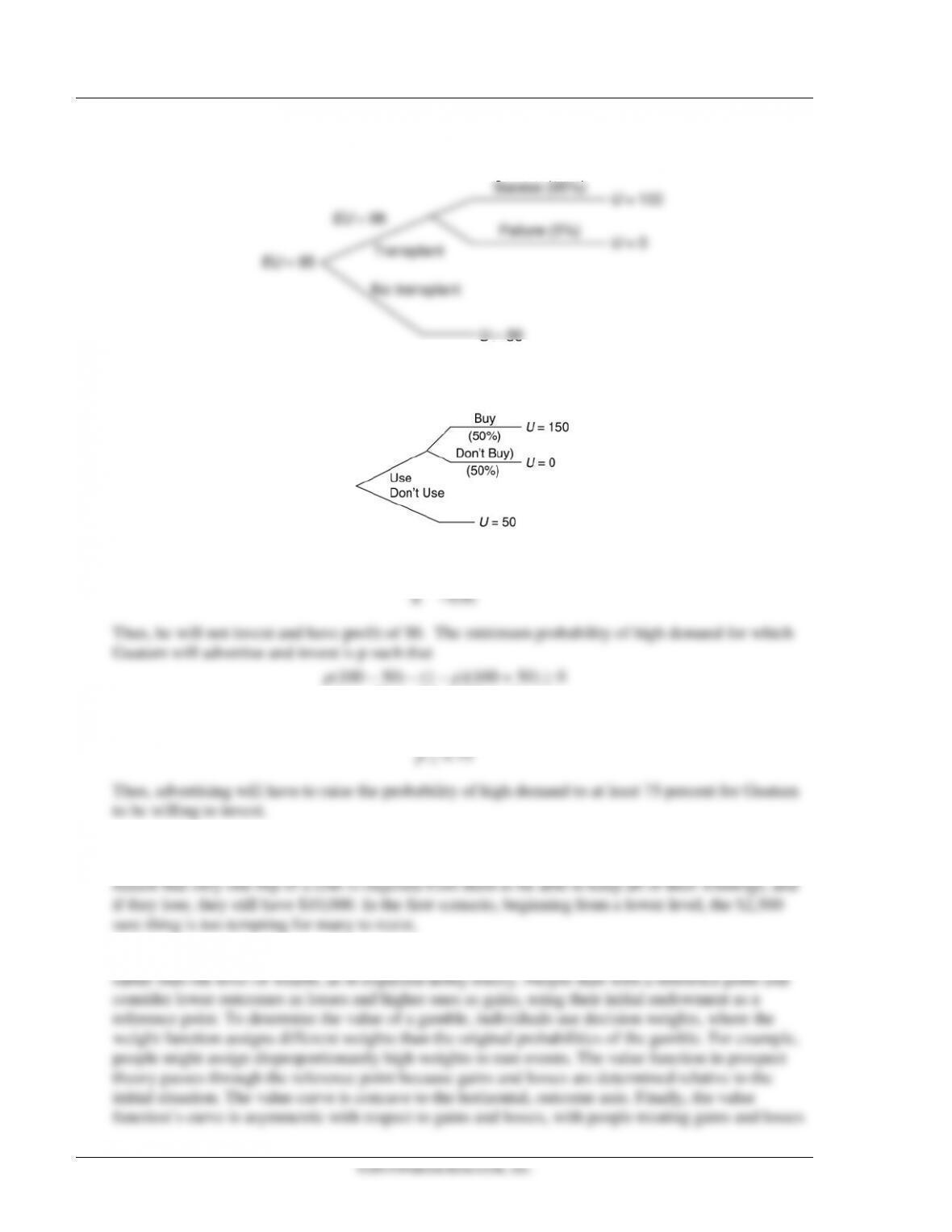
4.2 The plaintiff must believe that X is at least $83,333 ($50,000/0.6) in order for the expected value of
330 Perloff • Microeconomics: Theory and Applications with Calculus, Third Edition
4.3 In the decision tree below, the individual decides to have the transplant because the expected utility
from the transplant is greater than remaining on dialysis.
4.4 In the decision tree below, the individual decides to use the roundup-resistant beets because the
expected utility from the roundup-resistant beet is greater than not using it.
4.5 Guatam’s expected profits (π) without advertising if he makes the investment is
π = 0.4(100) – 0.6(100)
50p – 150 + 150p ≥ 0
200p ≥ 150
5.1 It is not consistent because the two experiments have identical payoffs. The second choice probably is
more popular in Scenario B for most individuals because they are starting from a higher level. They
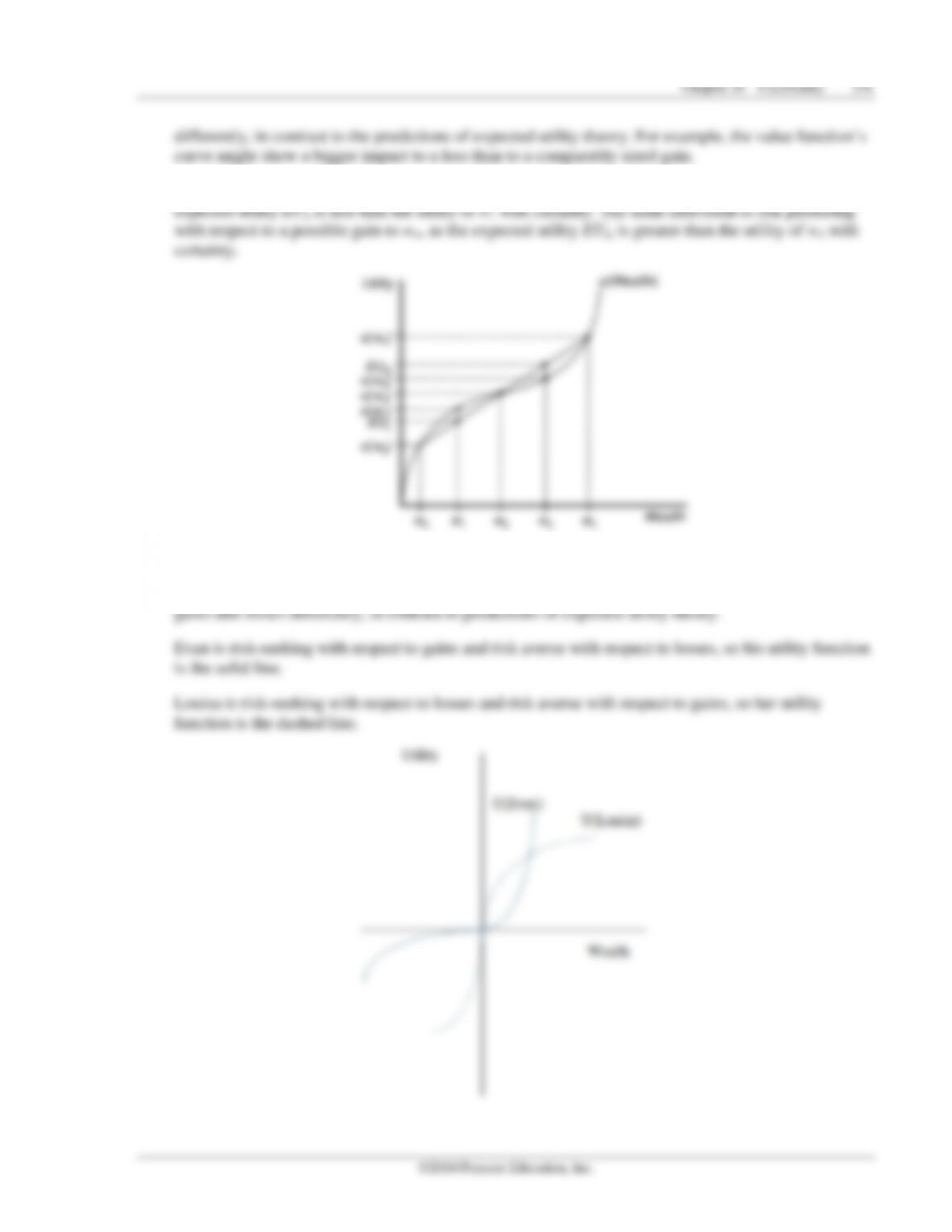
5.2 According to prospect theory, people are concerned about gains and losses—the changes in wealth—
©2014 Pearson Education, Inc.
5.3 If the individual has wealth w2 and faces the possibility of a loss to w0, he or she is risk averse, as the
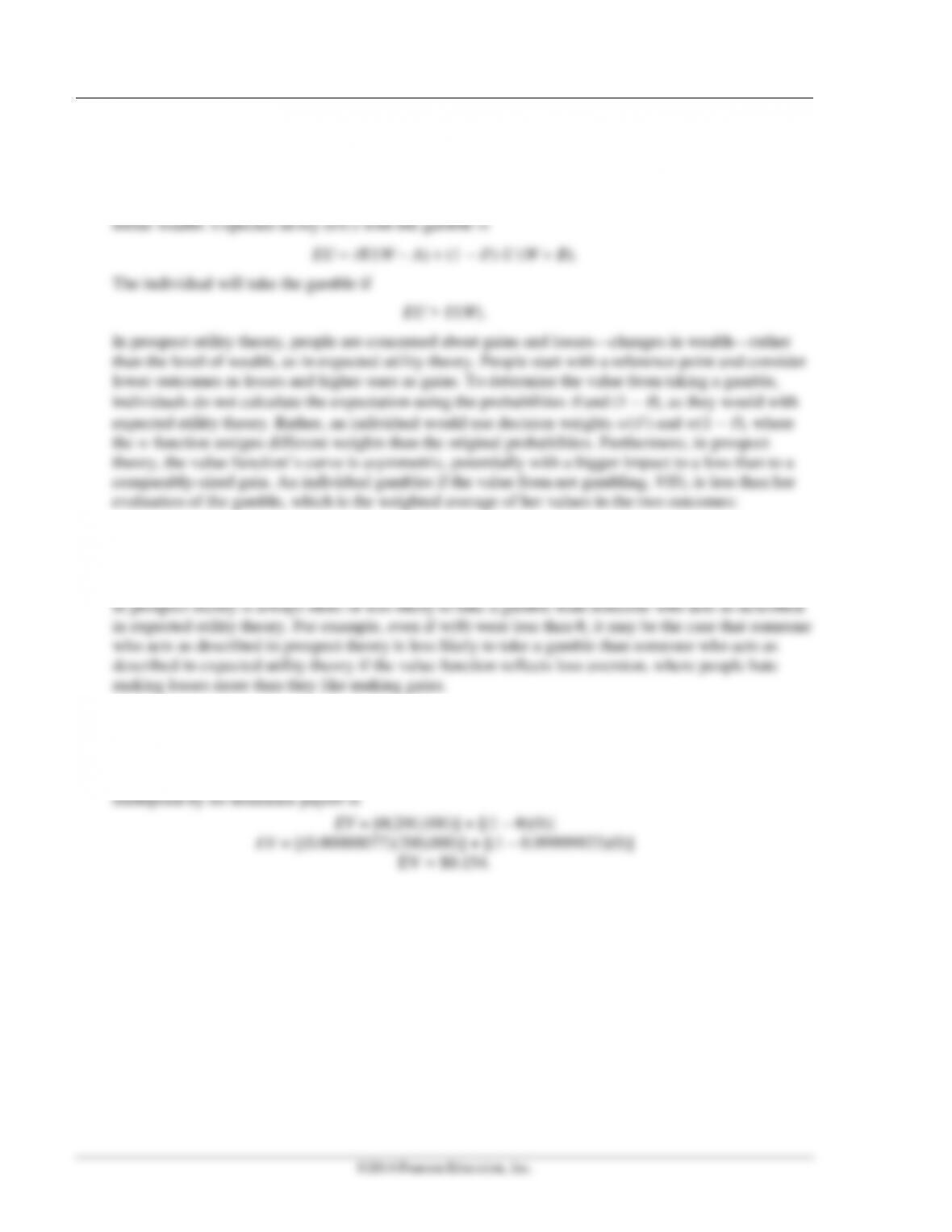
5.4 According to prospect theory, people are concerned about gains and losses rather than the level of
wealth. People start with a reference point and consider lower outcomes as losses and higher ones as
gains. Evan’s and Louisa’s utility functions are consistent with prospect theory because they treat
332 Perloff • Microeconomics: Theory and Applications with Calculus, Third Edition
5.5 Kahneman and Tversky’s (1979) prospect theory is an alternative theory of decision-making under
uncertainty that can explain some of the choices people make that are inconsistent with expected
utility theory.
In expected utility theory, if an individual does not take a gamble, then his utility is U(W), where W is
V(0) < [w(
θ
)V(−A) + (1 −
θ
) V(B)].
Because prospect theory differs from expected utility theory in both the valuation of outcomes and
how they are weighted, it is not possible to state conditions for which someone who acts as described
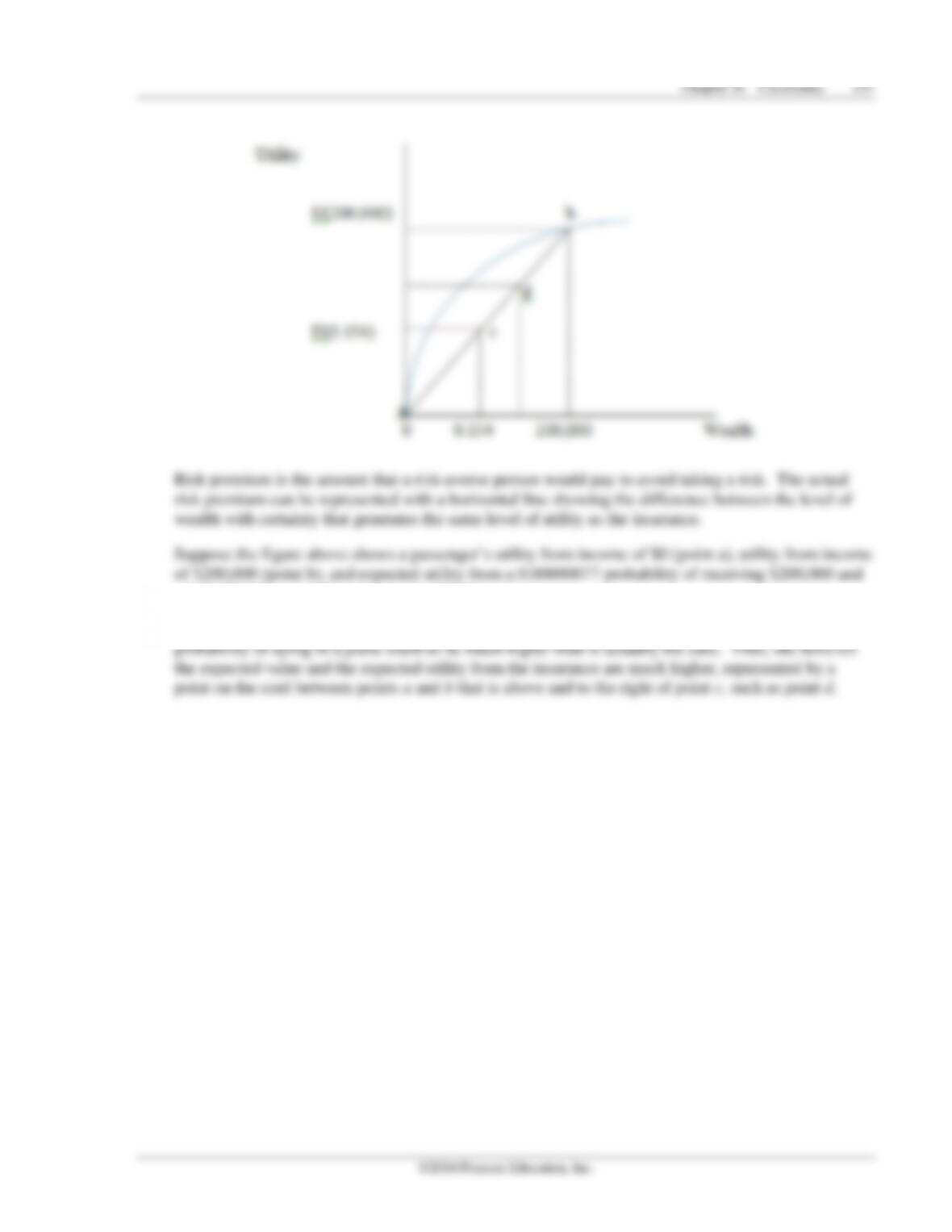
6.1 Fair insurance is a bet between an insurer and a policyholder in which the value of the bet to the
policyholder is zero. For insurance to be fair, its expected value must be zero. The expected value
(EV) of the insurance is the probability of dying in a plane crash (θ) multiplied by the insurance
payment in the event of a crash ($200,000) plus the probability of not dying in a plane crash (1 – θ)
©2014 Pearson Education, Inc.
a 0.99999923 probability of receiving $0.00 (point c).
A risk–averse person might by unfair flight insurance because she incorrectly perceives the