Chapter 15 Factor Markets 306
8. Use a graph to show the effect of free agency on the wages paid by a team in the NHL. Assume that
prior to free agency players could only play for the team that drafted them.
9. In a competitive market, a firm produces a good with price p. Suppose the marginal product of the
labor it hires is MPL. What is the marginal revenue product of its labor?
10. Suppose the interest rate is 7 percent. Which is worth more, $10,000 today or $18,000 seven years
from now? Which would you prefer if your discount rate was zero? What if it was infinite?
11. Compare the value of $1,000 invested at 5 percent after three years when interest is compounded
annually versus semi annually (twice a year).
12. Given that all individuals face the same interest rates at any given time, why do we observe
differences in savings versus consumption between individuals with the same income level?
13. Using Equation 15.6, discuss the incentives of students if government loans are available for college
at a nominal interest rate that is less than the inflation rate.
14. A firm is considering buying a machine for $500. It expects to earn $200 profits from its use for each
of the next four years, after which the machine can be sold for scrap in year five for $50. At an interest
rate of 10 percent, use the net present value rule to decide if they should make the investment or not.
15. Answer Question 14 using the internal rate of return (irr) approach, assuming that the machine costs
$1,000 but lasts forever.
16. One of the difficulties in choosing an appropriate level of advertising is judging the longevity or
persistence of its effects. Suppose you could run an ad that cost $9,000 that would increase sales by
$3,500 for the next three years. Should you purchase the ad or not if the current interest rate is 5
percent? What if the price increased to $10,000?
17. If all government expenditures are expensed (paid for in the current period) rather than amortized
(paid for over the life of the commodity), what is the wisdom of a balanced budget amendment?
How would it alter the physical and human capital investment decisions made by the government?
18. Why might a college athlete invest heavily in training to become a professional basketball player
given that the chances of succeeding are less than 2 percent? Does this mean that investing in human
capital in the form of practicing jump shots is necessarily a bad investment?
19. When the Federal Reserve Board acts to cut interest rates, they hope to stimulate the economy.
However, some individuals are made worse off by these changes. Who benefits and who suffers
when interest rates fall?
20. If an investment would generate a steady profit flow of $10 million a year forever and its market
price is $100 million, what is the internal rate of return?
21. Suppose you buy a big-screen TV with $1,000 down and $500 per year for the next two years. If the
interest rate is fixed at 5 percent, what is the present value of the TV?
Answers to Additional Questions and Problems
1. Calculate the marginal revenue product of labor, and set it equal to the wage to determine labor demand.
©2014 Pearson Education, Inc.
2. When the firm produces using fixed proportions technology, it is unable to substitute away from
3. If the demand is perfectly inelastic and supply is perfectly elastic, employers will pay the entire tax
4. For the competitive market solution, set LS = LD.
100 – 2w = 2w
w* = 25
w* = 16.67
5. To find the profit-maximizing labor demands, set up the profit function as shown in Equation 15.7 in
the text. Differentiate with respect to L and K, and solve.
L* = 0.064 0.04(40)5 = 53.08
K* = 0.063 0.042(40)5 = 35.39.
©2014 Pearson Education, Inc.
11. Compounded annually, the value is $1,157.63. Compounded semi annually, the value is $1,159.69.
12. Because different individuals are faced with different life circumstances (the presence of small
13. Whenever the nominal rate is less than the inflation rate, the real rate of interest is negative (in
14. The net present value of the investment is $747.72. Invested at the 10 percent interest rate given,
17. A large portion of government expenditures are made to purchase durable goods that provide a stream
of services over many years. If a balanced budget amendment requires that expenses be equally offset
by revenue, the government would be unable to justify purchasing such goods. Thus even though a
18. There are two possible reasons here, and both are likely partly responsible. The first is uncertainty, or
imperfect information. If players believe that they have a much greater chance of success, they may
19. When interest rates fall, borrowers are better off, but lenders (and savers) are worse off. Interest rate
20. The internal rate of return can be calculated using Equation 15.20. irr = f/PV = 10/100 = 0.1.
21. The present value of the TV is 1,000 + 500/(1 + 0.05) + 500/(1 + 0.05)2 = 1,930.
Chapter 15 Factor Markets 310
Answers to Exercises in the Text
1.1 The competitive firm’s demand curve for labor is given by the equation w = MRPL = p ⋅ MPL. When
1.2 Before the tax, the competitive firm’s labor demand was p × MPL. After the tax, the firm’s effective
1.3 The effect is indeterminate. With a change in relative factor prices, a firm that can easily substitute
1.4 As technology improves we can assume that MC decreases. Therefore the MC curve shifts down.
1.5 a. We know g is the number of garlic cloves in a dish and H is hours worked. Using the chain rule,
Jacqueline’s marginal product is
MP =
10 = 103/
1 = 3/
1.6 Equations 15.12 and 15.13 are problematic because d = 0 for a CRS Cobb-Douglas, which makes the
Chapter 15 Factor Markets 311
©2014 Pearson Education, Inc.
MRPL=
L
q
q
R
∂
∂
∂
∂
,
where R is revenue. In a competitive market, firms are price takers, so marginal revenue equals the
market price:
q
R
∂
∂
= p.
The marginal product of labor is
L
q
∂
∂
=
1
1
)(
−
−
+
ρ
ρ
ρ
ρρ
LKL
.
Combined,
MRPL =
1
1
)(
−
−
+
ρ
ρ
ρ
ρρ
LKLp
.
1.9 No. In the production function given, labor and capital are perfect substitutes. The firm will produce
using whichever input is cheaper. Long–run average cost will equal long-run marginal cost (min{w,
r}). Thus firm size is indeterminate.
1.10 Let demand be p = AQ-b. Then MR =
= p + Q
.
1.12 If the labor supply curve is horizontal, there is no effect in either case. If it is positively sloped, the
effect is larger if the output market is monopolistic. Because price is larger than marginal revenue for
1.13 In the short run, when L < K, MPL = 1 so MRPL = (MR)(MPL) = MR. Its demand for labor will be w
1.14 When labor falls from L to L* =
L, output falls from Q = L0.5K0.5 to Q* = (
L)0.5K0.5 =
L0.5K0.5 =
Q . Output falls to ~71% of its original level (
.71).
Chapter 15 Factor Markets 312
©2014 Pearson Education, Inc.
MPK =
Q/K so MPK* =
Q*/K as capital stays the same. MPK* =
(
Q)/K =
(
Q/K) =
MPK. Consequently, r*/p = MPK* dropped to ~71% of its original level.
Suppose L = 100, K = 100 so Q = 100. Then, L* =
L = 50, K = 100 so Q* = 500.51000.5 = 502
70.71. Output fell by 29.29. Initially, MPL = w/p and MPL =
Q/L =
(100/100) =
.
Thus, the real wage was w/p =
or w =
as p = 1. We showed w* = 2
= 0.7071 or wages rose
by 0.2071.
Initially MPK = r/p where MPK =
Q/K =
(100/100) =
. So, r =
initially. We showed that
MPK* =
MPK or r*/p =
r* =
r and as r =
, r* =
=
= 0.3536. The
rental rate of capital fell by 0.1464.
1.15 a. When somebody is hired, there is a series of obligations, such as health insurance, created that
b. Future costs should be discounted because expenditures in the future have a lower opportunity
2.1 An individual with a zero discount rate views current and future consumption as equally attractive.
2.2 The present value is $285.94 = 100 + 100/1.05 + 100/1.052.
2.3 A principal of $2,000 would earn $200 in interest per year at 10 percent compounded annually.
2.4 The cost to buy the washer now is $800. If we don’t buy the washer now, the present discounted
value of five years’ higher operating cost by using the older washer (assuming they are realized at
2.6 The question is whether saving $10 per year for 10 years is worth $100 now (the difference in the
2.7 Because the first contract is paid immediately, its present value equals the contract payment of $1
million. Our pro can use Equation 15.19 and a calculator to determine the present value of the second
Payment
Present Value at 5% Present Value at 20%
©2014 Pearson Education, Inc.
2.8 a. PV of Cash back = 20,000 − 500 = 19,500.
b. 5,000 + (5000/1 + i) + (5000/(1 + i)2) + (5000/(1 + i)3) = 19,500 → i = 0.0171 = 1.71%.
2.9 An individual would have to use a discount rate of zero in order for this rule to apply.
2.10 Assume the 3 percent interest rate is an annual rate. Then the present values is
$4 $48,666.67.
(0.03/365)
= = =
f
PV i
2.11 Whether you should buy or rent depends on how long you believe the phone will last and the interest
rate. Even if the interest (discount) rate is zero, the phone would have to last 10 years for the payments
to be equal. At an interest rate of 10 percent, the cost is equal only if the phone lasts forever. Thus the
individual is better off renting.
2.12 The NPV = 1 − 12/1.07 + 20/1.072 ≈ 7.254, which is positive, so the firm should invest. Solving for
2.13 Using Equation 15.17 gives a close approximation of the precise answer, which would be derived
The extra gas costs $600/year: 6,000 miles at 10 mpg = 600 gal, compared to 6,000 miles at 20 mpg =
At 10%: PV2 = 2,274.47 + 4,967.37 = 7,241.84.
©2014 Pearson Education, Inc.
2.17 The present value of the expected returns is $196.7 million. If the purchase price is $205 million, it is
2.18 The internal rate of return is 20/400 = 0.05.
2.20 A tax on interest earnings decreases people’s willingness to lend, an upward shift in the supply curve.
3.1 The price of oil would have to be more than p(1 + i).
3.2. In the first period, Q1 + Q2 = Q and p2 = (1 + i)p1
Q1 = Ap1ɛ and Q2 = Ap2ɛ = A[(1 + i)p1]ɛ so Ap1ɛ + A[(1 + i)p1]ɛ = Q
[1 + (1 + )]
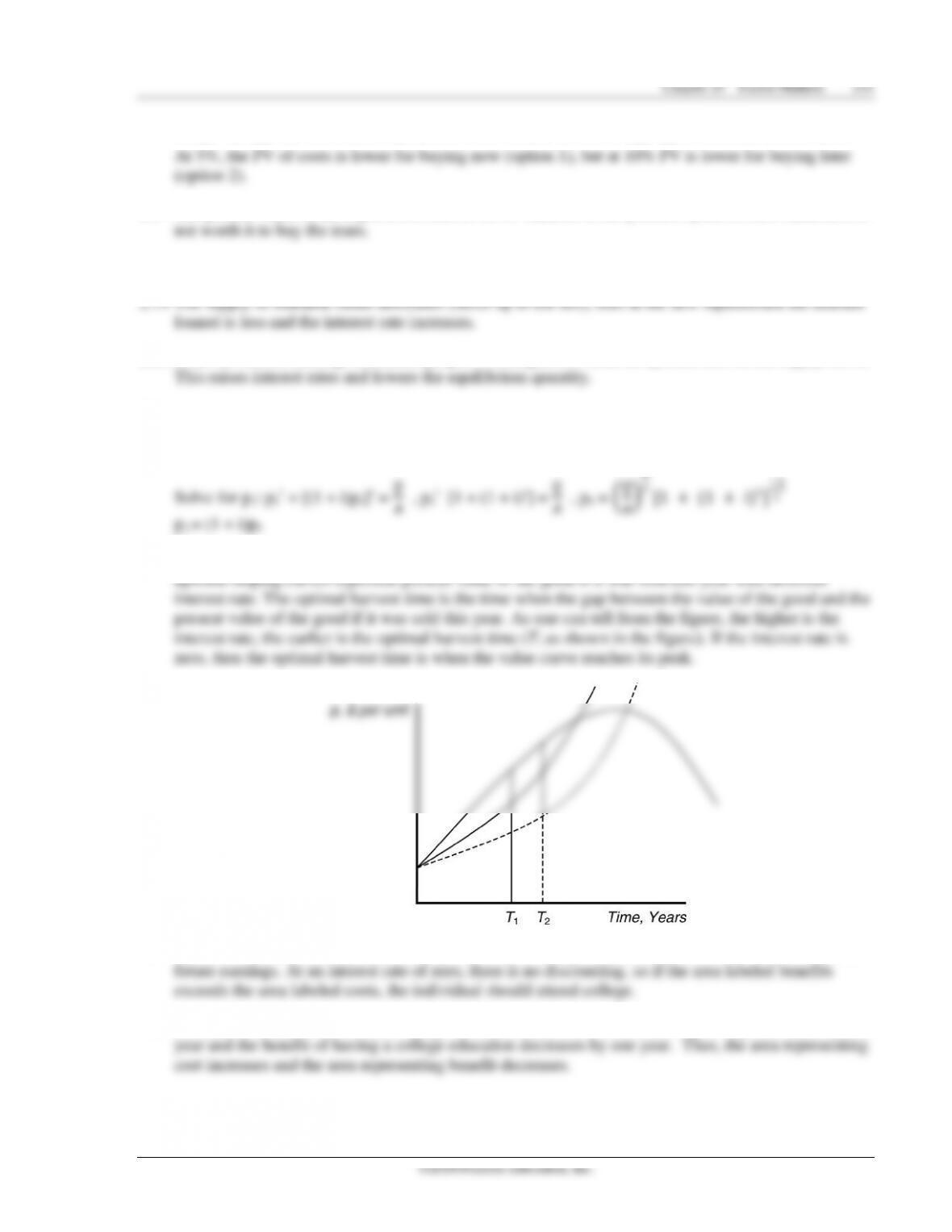
3.3 Suppose the value of the good goes up first, then decreases, as shown in the figure below. The two
4.1 The lower the interest rate, the lower the cost of borrowing for tuition, and the lower the discount on
4.2 If it takes a fifth year to obtain a college education, then the cost of attending college increases by one