294 Perloff • Microeconomics: Theory and Applications with Calculus, Third Edition
=
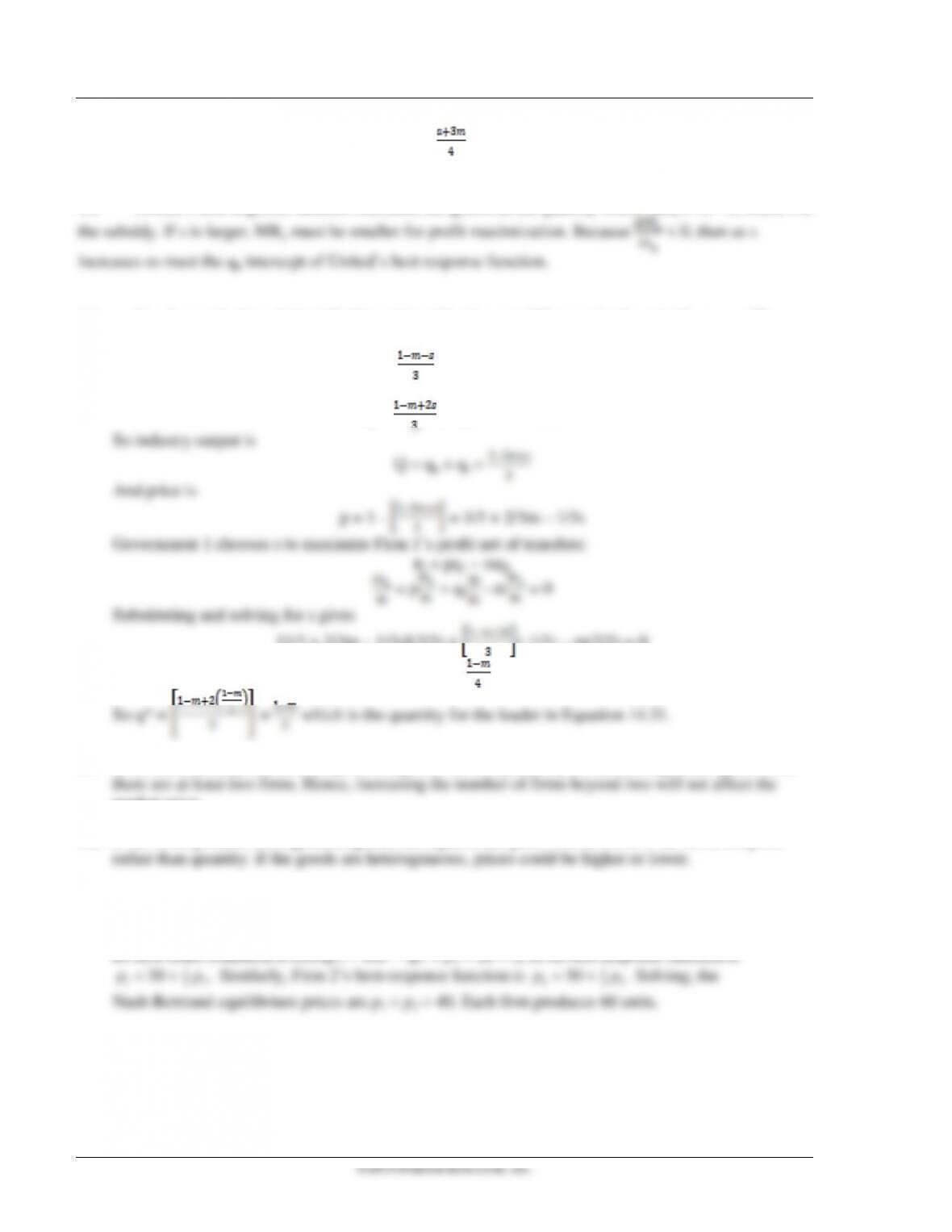
4.4 Use the results from Solved Problem 4.1 and let the cost difference be the subsidy: x = –s. The
problem gives a = 1 and b = 1 for demand. The unsubsidized firm’s best response is
qu = (Equation 14.21).
The subsidized firm’s best response is
qs = (Equation 14.22).
s* =
5.1 In the Bertrand equilibrium, the price is equal to the competitive price for homogeneous good when
market price.
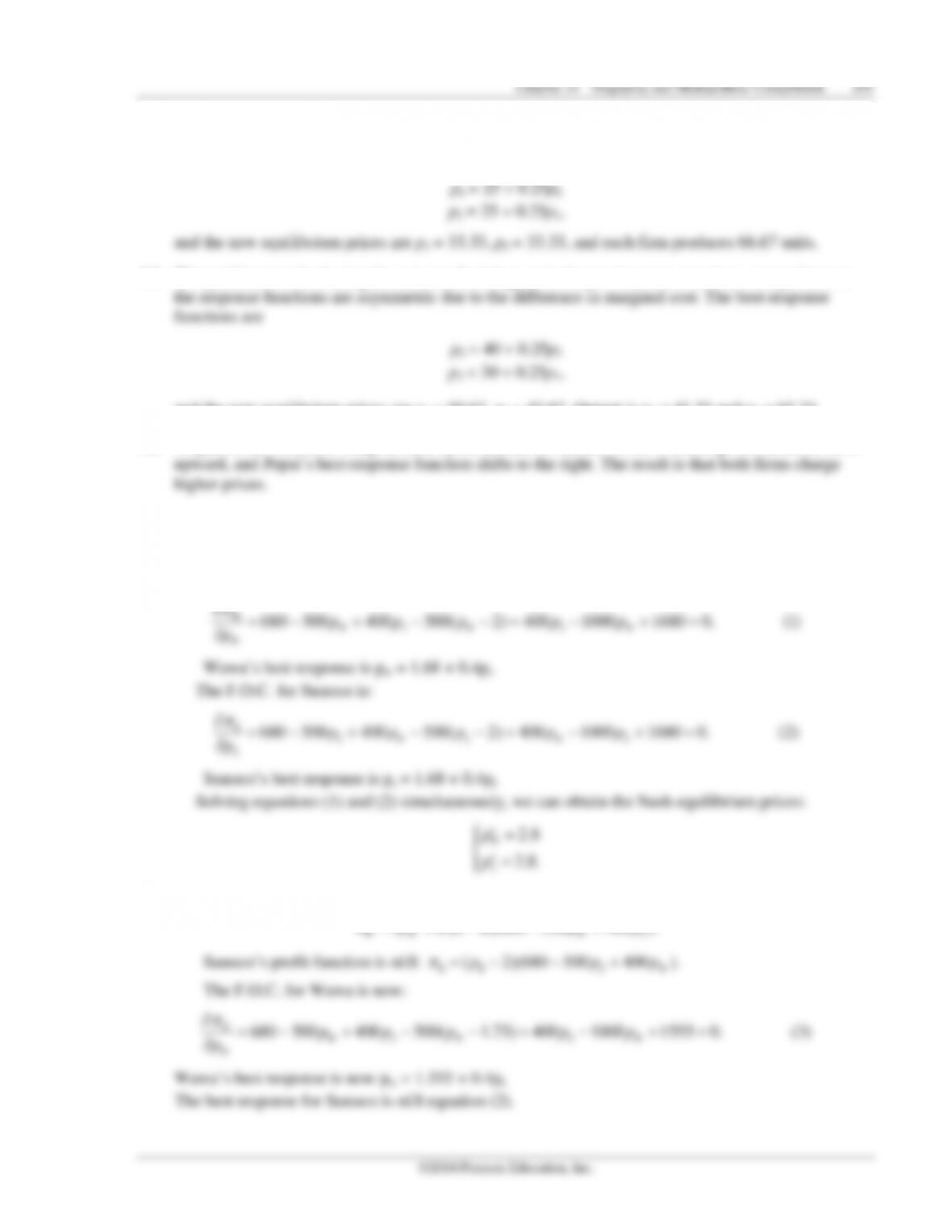
5.3 Firm 1 wants to maximize its profit:
π
1 = (p1 − 10)q1 = (p1 − 10)(100 − 2p1 + p2).
296 Perloff • Microeconomics: Theory and Applications with Calculus, Third Edition
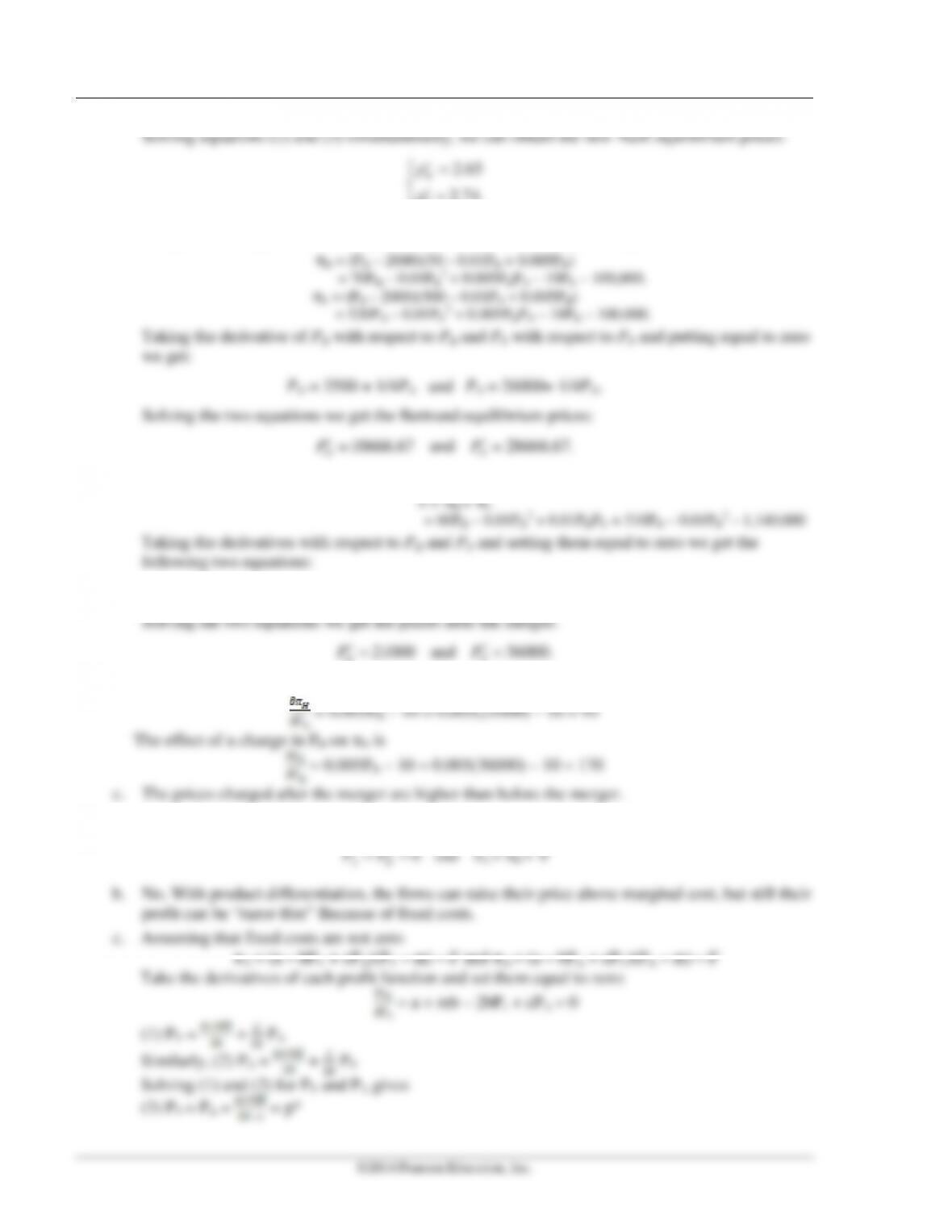
Solving equations (2) and (3) simultaneously, we can obtain the new Nash equilibrium prices:
∗
∗
=
=
2.65
2.74.
W
S
p
p
5.8 a. The profits of Highland Park Hospital and Evanston Northwestern Hospital are:
H
N
b. After the merger, the new entity maximizes the following profit function:
2PH − PN = 6000 and 2PN − PH = 51000.
H
N
The effect of a change in PN on πH is
5.9 a. Suppose that there is a positive fixed and sunk cost F. At the Bertrand equilibrium
**
0= =
AB
PP
and πA = πB = -F
b. No. With product differentiation, the firms can raise their price above marginal cost, but still their
profit can be “razor thin” Because of fixed costs.
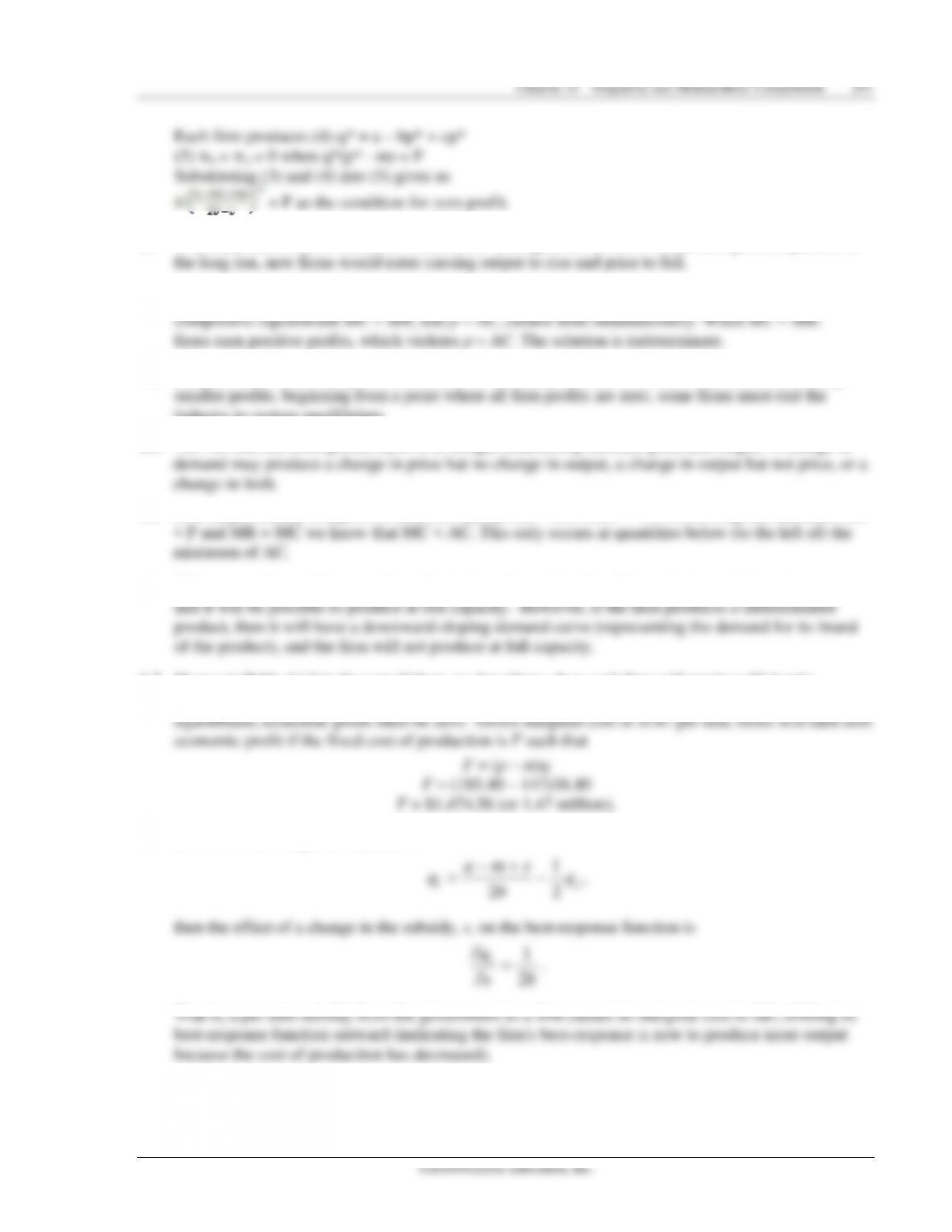
c. Assuming that fixed costs are not zero
πV = (a – bPV + cPA)(PV – m) – F and πA = (a – bPA + cPV)(PA – m) – F
Take the derivatives of each profit function and set them equal to zero:
= a + mb – 2bPv + cPA = 0
(1) PV = + PA
Similarly, (2) PA = + PV
Solving (1) and (2) for PV and PA gives
(3) PV = PA = = p*
©2014 Pearson Education, Inc.
6.1 A subsidy that lowers fixed costs would lower average costs so firms would earn positive profits. In
6.2 If there are no fixed costs, MC = AC. The two conditions that must hold for a monopolistically
6.3 Because firms must bear part of the burden of the tax, profits are reduced. With each firm earning
6.6 With competition, if firms produce identical products, then they’ll have horizontal demand curves,
6.7 Shown in Table 14.2 in the text, if there are four firms, then each firm will produce 38.4 units.
Market output will be 154 units, and the market price will be 185.40. For four firms to be an
7.1 If Firm i’s best–response function is
ji
q
b
sma
q2
1
2−
+−
=
,
then the effect of a change in the subsidy, s, on the best–response function is
bs
qi
2
1
=
∂
∂
.
That is, a per-unit subsidy from the government to a firm causes its marginal cost to fall, shifting its
best-response function outward (indicating the firm’s best-response is now to produce more output
because the cost of production has decreased).
7.2 Each firm maximizes profit by producing such that
298 Perloff • Microeconomics: Theory and Applications with Calculus, Third Edition
b
sm
a
q
i
3
+−
=
,
so
b
sma
qqQ 3
)(2
21
+−
=+=
and
3
22 sma
p−+
=
.
Substituting these values into Firm I’s profit function,
iii
qsmpq )( −−=
π
,
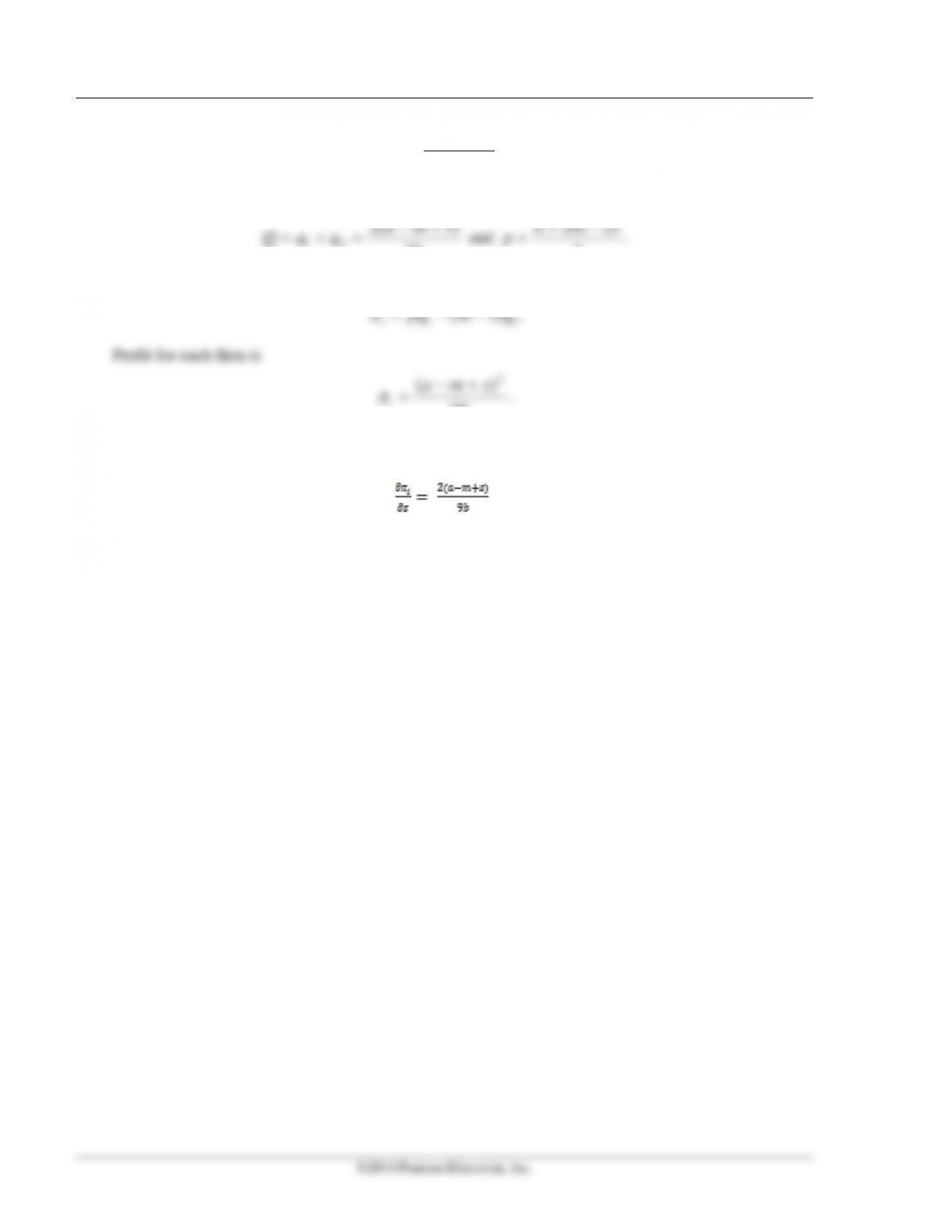
Profit for each firm is
b
sma
i9
)( 2
+−
=
π
.
Thus,
.