284 Perloff • Microeconomics: Theory and Applications with Calculus, Third Edition
5. Suppose the market demand function facing three firms is Q = 500 − 2p. Each firm has a marginal
cost of $5 per unit. What is the cartel solution? Suppose instead that one of the firms could supply up
to 100 units at MC = 4, and the other two firms had a marginal cost of $5. How would this alter the
final output, price, and profit? Does this complicate the division of profits? How?
6. In an industry where any firm can enter the industry and produce according to the cost function
C = 50 + 5q, what is the optimal number of firms? Does your answer change if there are no fixed
costs?
7. True, false, or uncertain; explain your answer. “If all firms charge the same price, they must be
colluding.” Does your answer create difficulties for those charged with enforcing industrial policy?
8. In a Cournot duopoly, each firm has marginal cost MC = 20, and market demand is Q = 100 − 1/2p.
What are the best response functions of each firm? What is the best output level for each? How does
the total output level compare to the cartel output level?
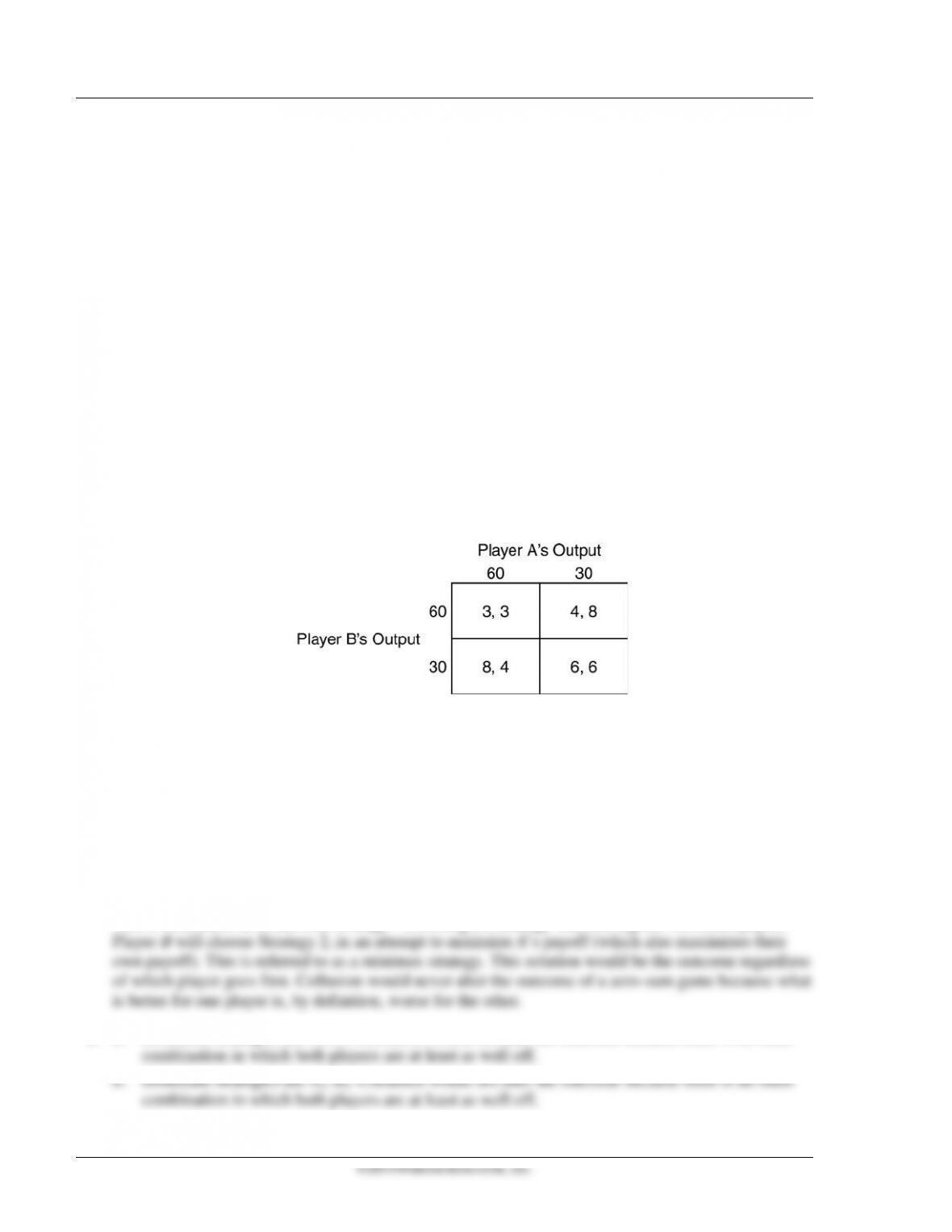
9. Assume that the payoffs in the matrix below are profits from various output choices, based on a non-
cooperative game, with A as the leader. Because of product tie–ins, the firms must choose to produce
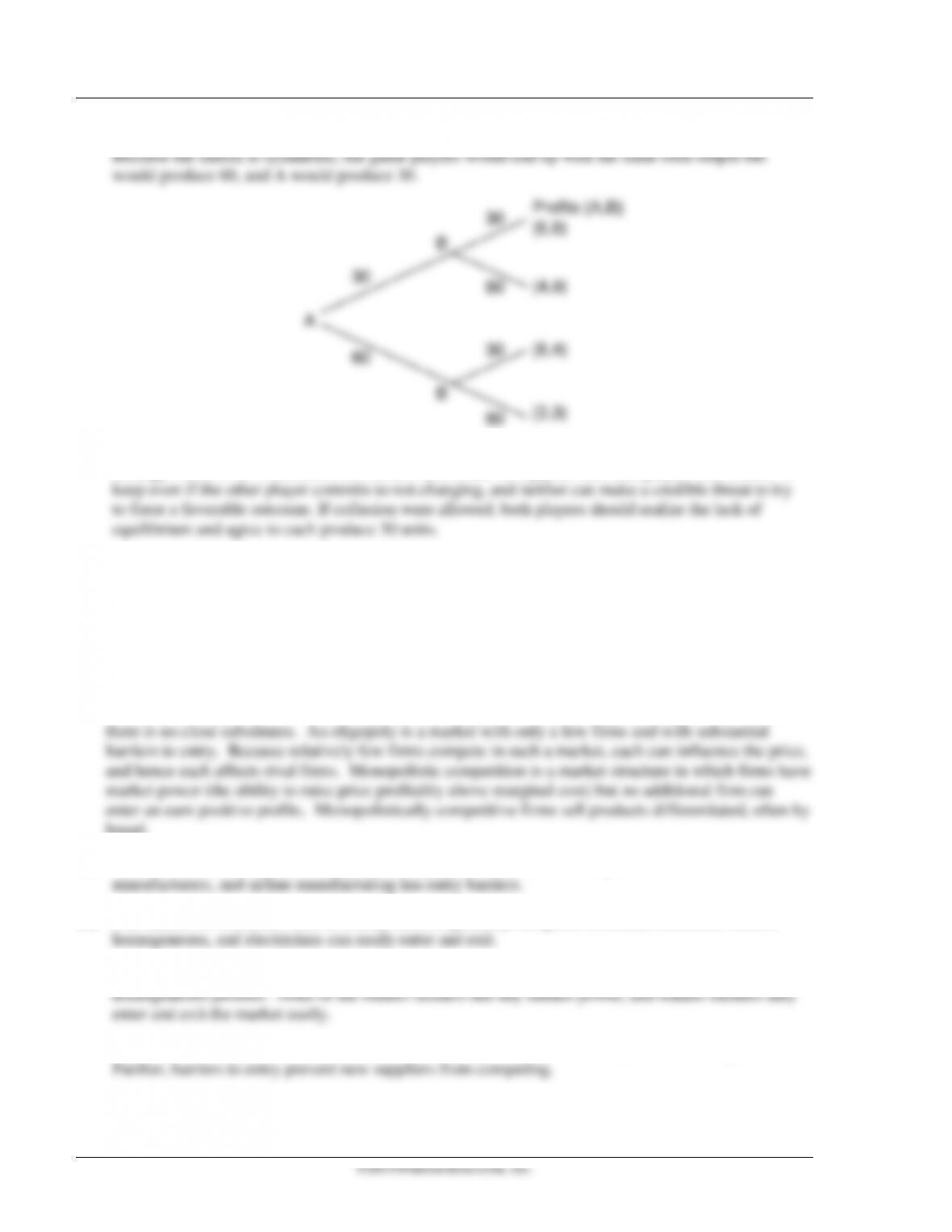
either 60 units or 30. No other output levels are possible. Re-write the payoffs in extended “tree”
form similar to Figure 13.2 in the text. Payoffs shown are A, B. What is the equilibrium? How would
your answer change if B was the leader?
10. Suppose in Question 9 that movement was simultaneous rather than sequential. Is there a unique
equilibrium? If so, what is it? Instead, suppose movement was simultaneous, but collusion were
permitted. Would the outcome change?
11. How do a Bertrand equilibrium output and price compare to those of competitive equilibrium?
Answers to Additional Questions and Problems
1. In the payoff matrix, player A’s highest payoff is in the upper left (A1, B1), but B regards this as the
least preferred. Since B will not select B1, A can assure that they will not lose by selecting strategy A2.
This is referred to as a maximin strategy—choosing the strategy with the highest minimum payoff.
Chapter 14 Oligopoly and Monopolistic Competition 285
©2014 Pearson Education, Inc.
c. Prisoners’ dilemma. Dominant strategies are A1, B1. If the players could collude they would
choose A2, B2, which has a higher payoff for both.
3. Local governments are most likely to subsidize firms that will bring in large quantities of tax revenue
(once the subsidies expire) and employment opportunities. All else equal, a firm that promises to
4. Because the teams have the ability to make a credible threat that they will leave and move to another
city, they are able to force the current host city into a prisoners’ dilemma game against other potential
sites. Cities that currently have teams with old stadiums or buildings that lack revenue–enhancing
5. In a cartel solution, the firms set a monopoly price using MC = MR.
MR = 250 − Q
MC = 5
6. With only one firm, average cost will fall continuously as the $50 fixed cost is spread across increasing
7. Uncertain. If all firms in an industry have the same cost function, they will naturally end up charging
8. First, calculate the residual demand function.
q1 = 100 − 1/2 p − q2
p = 200 − 2q1 − 2q2
Then, to derive the best-response function, set MC
=
MR for each firm.
286 Perloff • Microeconomics: Theory and Applications with Calculus, Third Edition
9. Firm A as the leader will choose to produce 60, knowing that B’s best response is to produce 30.
10. If movement were simultaneous, there is no unique equilibrium because neither player has a dominant
strategy. There is no combination of choices that results in a payout that both players will choose to
11. The Bertrand equilibrium has the same output and price as the competitive equilibrium.
Answers to Exercises in the Text
1.1 A competitive market structure is one in which many firms produce identical products and firms can
easily enter and exit the market. Because each firm produces a small share of the total market output
and its product is identical to that of other firms, each firm is a price taker, meaning that the firm
cannot raise its price above the market price. A monopoly is the only supplier of a good for which
(a) Airliner manufacturing is an oligopoly or duopoly because there are only a few airliner
(b) The market for electrical work in a small town is perfectly competitive because electrical work is
(c) The market for tomatoes is perfectly competitive because there are many tomato farmers selling a
(d) The market for cable television in a city is a monopoly because there is only one cable supplier.
Chapter 14 Oligopoly and Monopolistic Competition 287
2.1 Cartel members agree to restrict output to raise price to maximize joint profits. However, cartel
members have an incentive to cheat by producing more than the agreed–upon amount (or by lowering
2.2 The cartel will maximize joint profit. The cartel’s profit function (π) can be written as
Π = (100 – 2Q)Q – 20Q.
where Q is total output. Maximizing with respect to Q,
Q∂
∂
π
=100 – 2Q – 2Q – 20.
Setting this equal to zero and solving for Q,
100 – 2Q – 2Q – 20 = 0
80 = 4Q
Q = 20 units.
In turn, each of the four firms will produce 5 units.
2.3 a. The sum of the profits of auction houses Sotheby’s (i) and Christie’s (j) are:
πi + πj = rp[Di(r) + Dj(r)] – [2F + v(Di(r) + Dj(r))] = rpD(r) – [2F + vD(r)].
where: D(r) is the market demand = Di(r) + Dj(r).
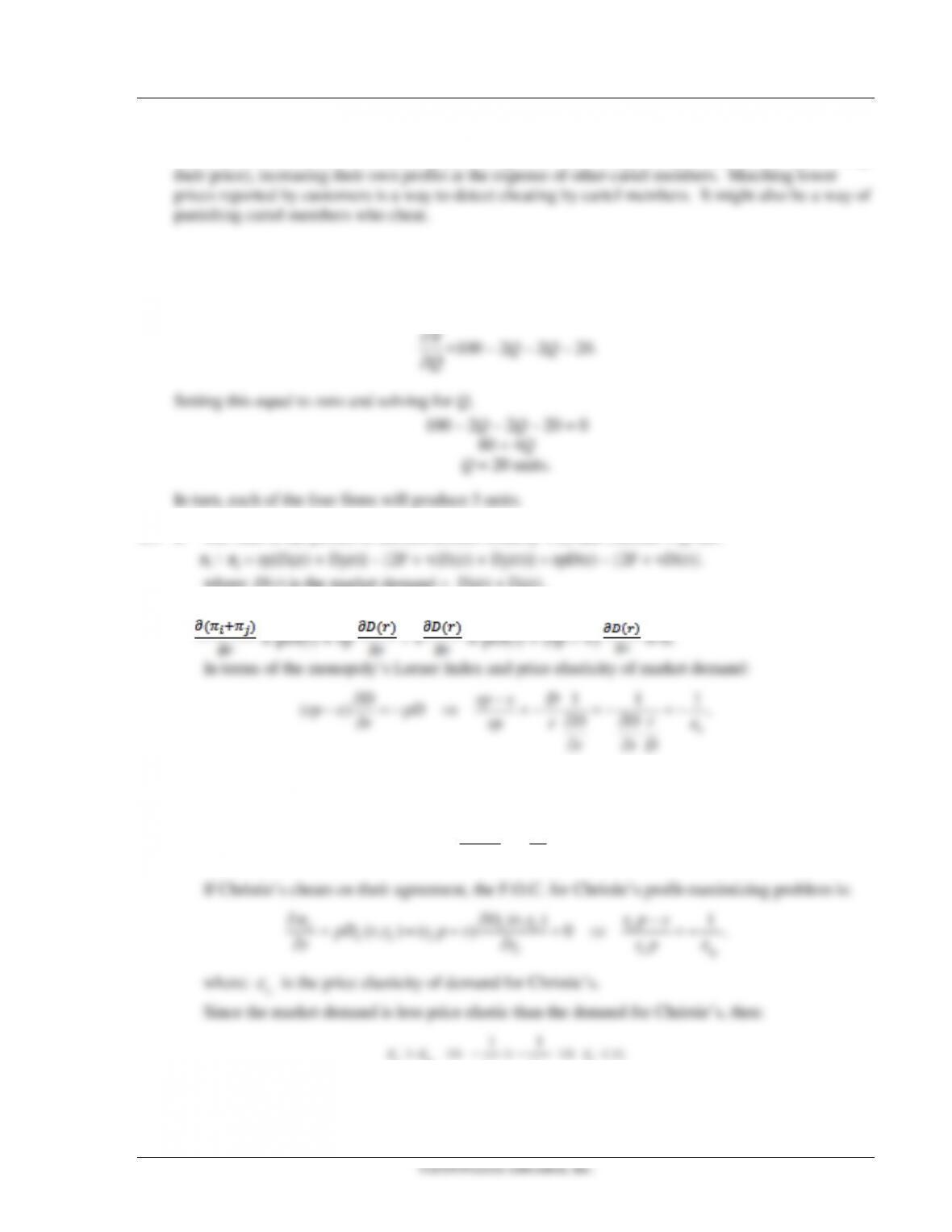
b. The F.O.C. for maximizing the sum of profits is:
ε
∂∂
∂
∂∂
r
r rp r r rD
where
ε
r
is the commission rate elasticity of market demand.
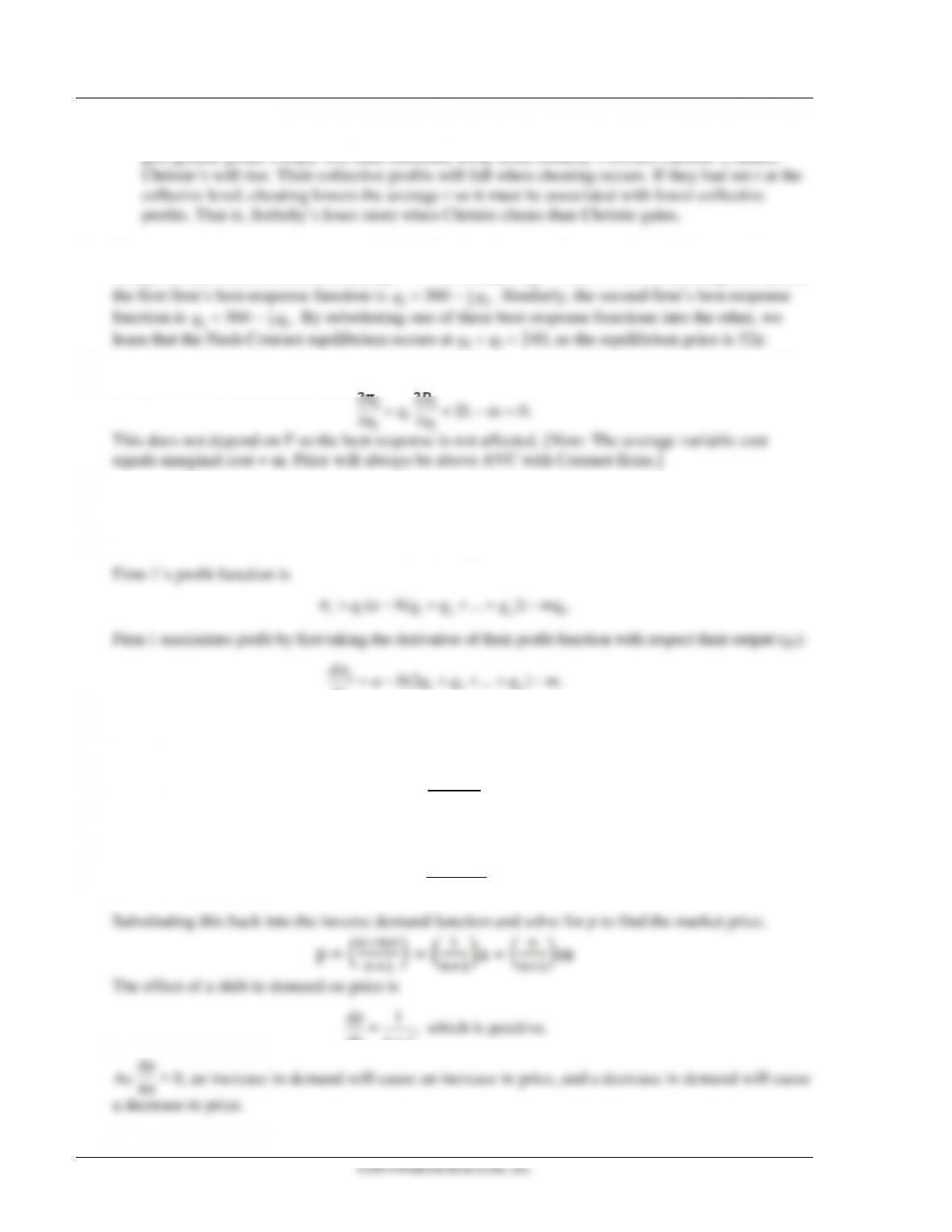
c. If they jointly set the commission rate, the F.O.C. for the profit-maximizing problem is:
ε
−= − 1.
r
rp v
rp
288 Perloff • Microeconomics: Theory and Applications with Calculus, Third Edition
i.e., Christie’s has incentives to cheat on their agreement by lowering its own commission, and
3.1 The inverse demand curve is p = 1 − 0.001Q. The first firm’s profit is π1 = [1 − 0.001(q1 + q2)]q1 −
0.28q1. Its first-order condition is dπ1/dq1 = 1 − 0.001(2q1 + q2) − 0.28 = 0. If we rearrange the terms,
1
3.2 Firm i’s profit with fixed costs is πi = Di(q1, q2)qi – (F + mqi) where Di is the inverse demand for Firm
i. The F.O.C. for profit maximization is
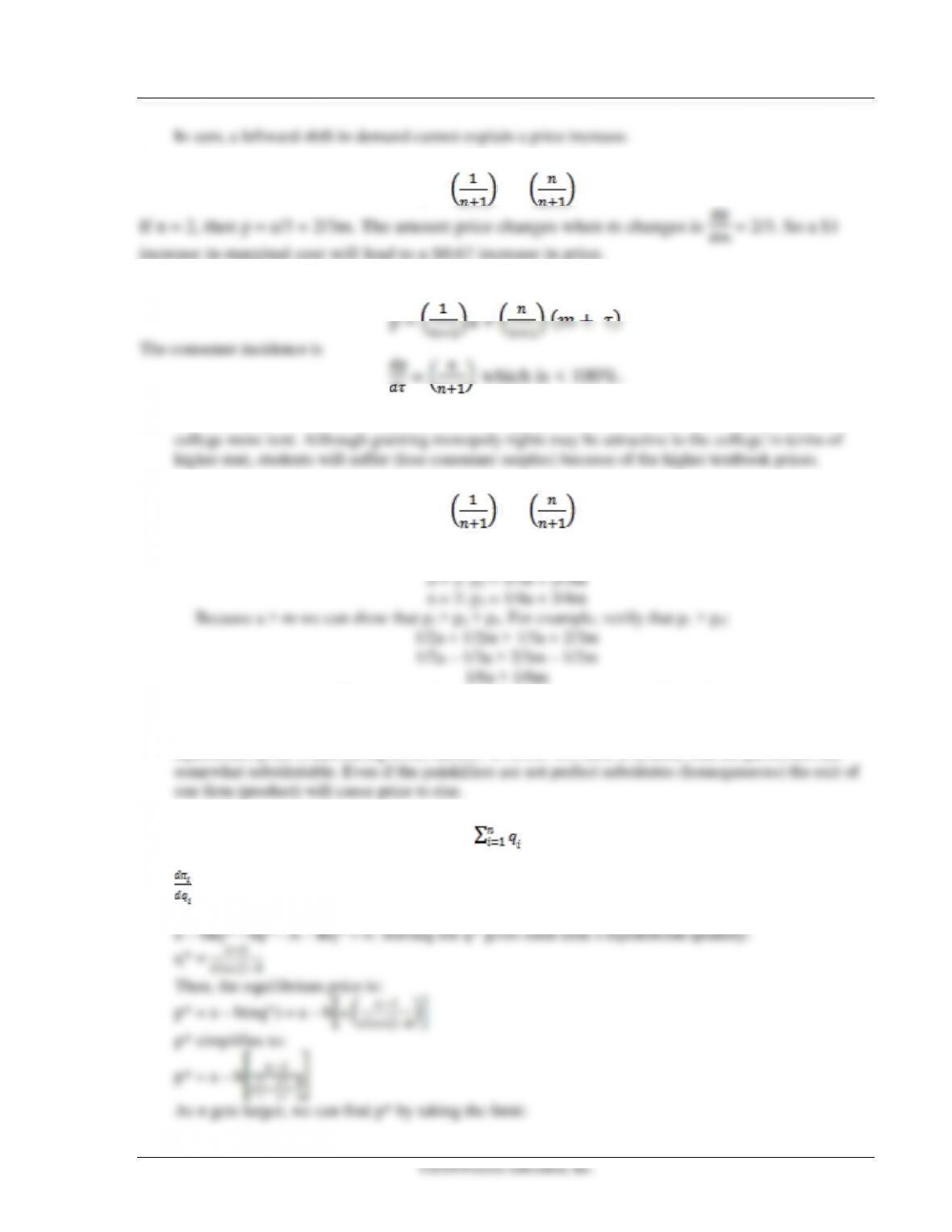
3.3 Consider a Cournot equilibrium where each of n firms faces a constant marginal cost of m and the
market demand curve is
p = a − bQ.
Chapter 14 Oligopoly and Monopolistic Competition 289
©2014 Pearson Education, Inc.
In sum, a leftward shift in demand cannot explain a price increase.
3.4 If there are two firms, then we found in Question 3.3 that
p = a + m
3.5 Again, using the result from Question 3.3, if the effective, after–tax marginal cost is m + τ then
3.6 The monopoly will make more profit than the duopoly will, so the monopoly is willing to pay the
3.7 Using the result from Question 3.3 that
p = a + m
we can find p for n = 1, 2, and 3: n = 1: p1 = 1/2a + 1/2m
a > m is true so p1 > p2. Thus, one explanation is that the state price ceiling is between p2 and p3.
3.8 The increase in price after the exit of one firm is consistent with a Cournot equilibrium, where the
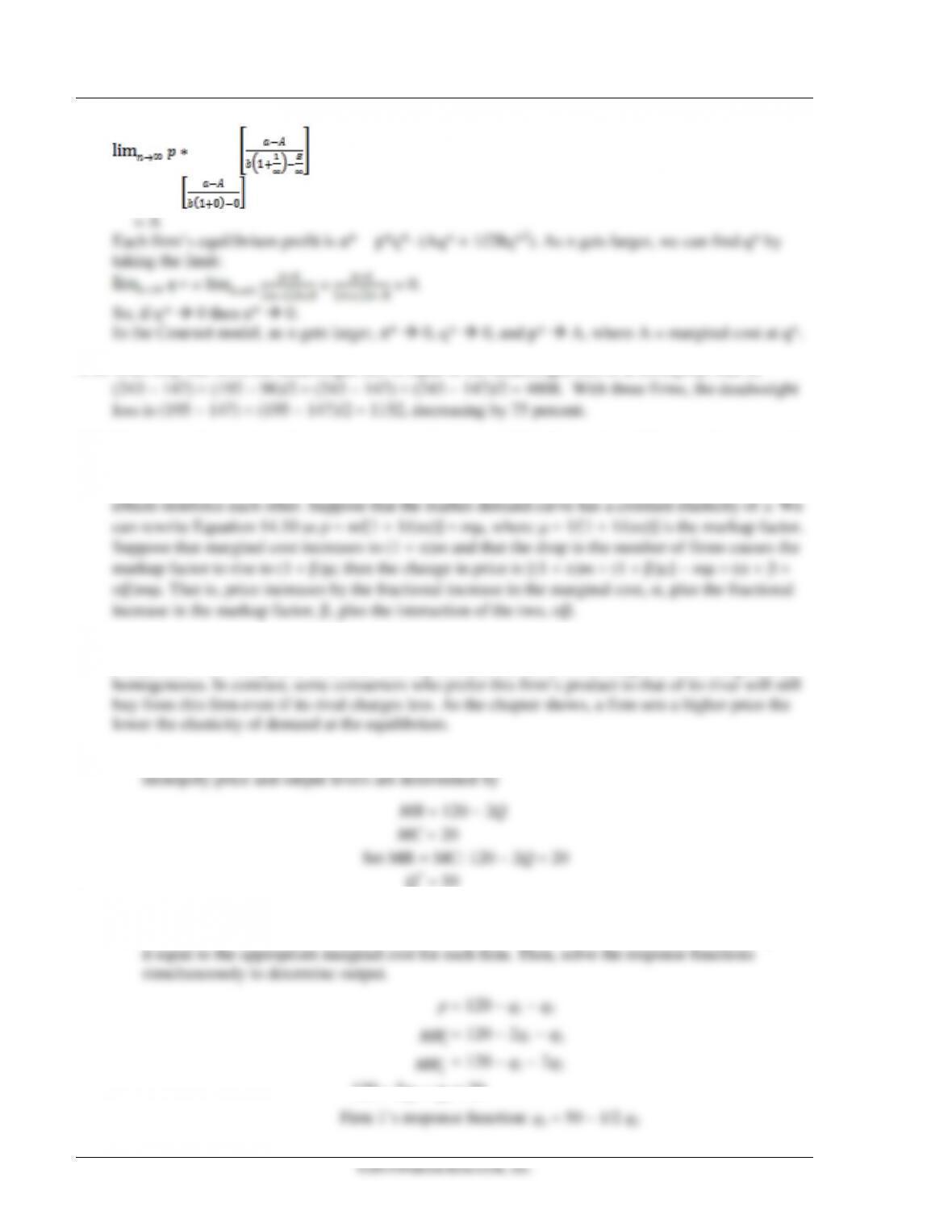
3.9 Each firm’s profit function is
πi = (a – bQ)qi – (Aqi + 1/2Bqi2) where Q =
The F.O.C. is
= (a – bQ) – bqi – A – Bqi = 0.
The equilibrium is where q* = qi. At equilibrium, Q = nq* so the F.O.C. becomes
290 Perloff • Microeconomics: Theory and Applications with Calculus, Third Edition
= a – b
= a – b
3.11 One approach is to show that a rise in marginal cost or a fall in the number of firms tends to cause the
price to rise. The section titled “The Cournot Model with Many Firms” shows that as the number of
firms falls, market power increases and the markup of price over marginal cost increases. The two
3.12 By differentiating its product, a firm makes the residual demand curve it faces less elastic
everywhere. For example, no consumer will buy from that firm if its rival charges less and the goods are
3.13 (a) If there is a collusion, Firm 1 should produce all output due to its lower marginal cost. The
p* = 70.
(b) To calculate the Cournot equilibrium, derive the response function and solve each by setting
2
120 − 2q1 − q2 = 20
292 Perloff • Microeconomics: Theory and Applications with Calculus, Third Edition
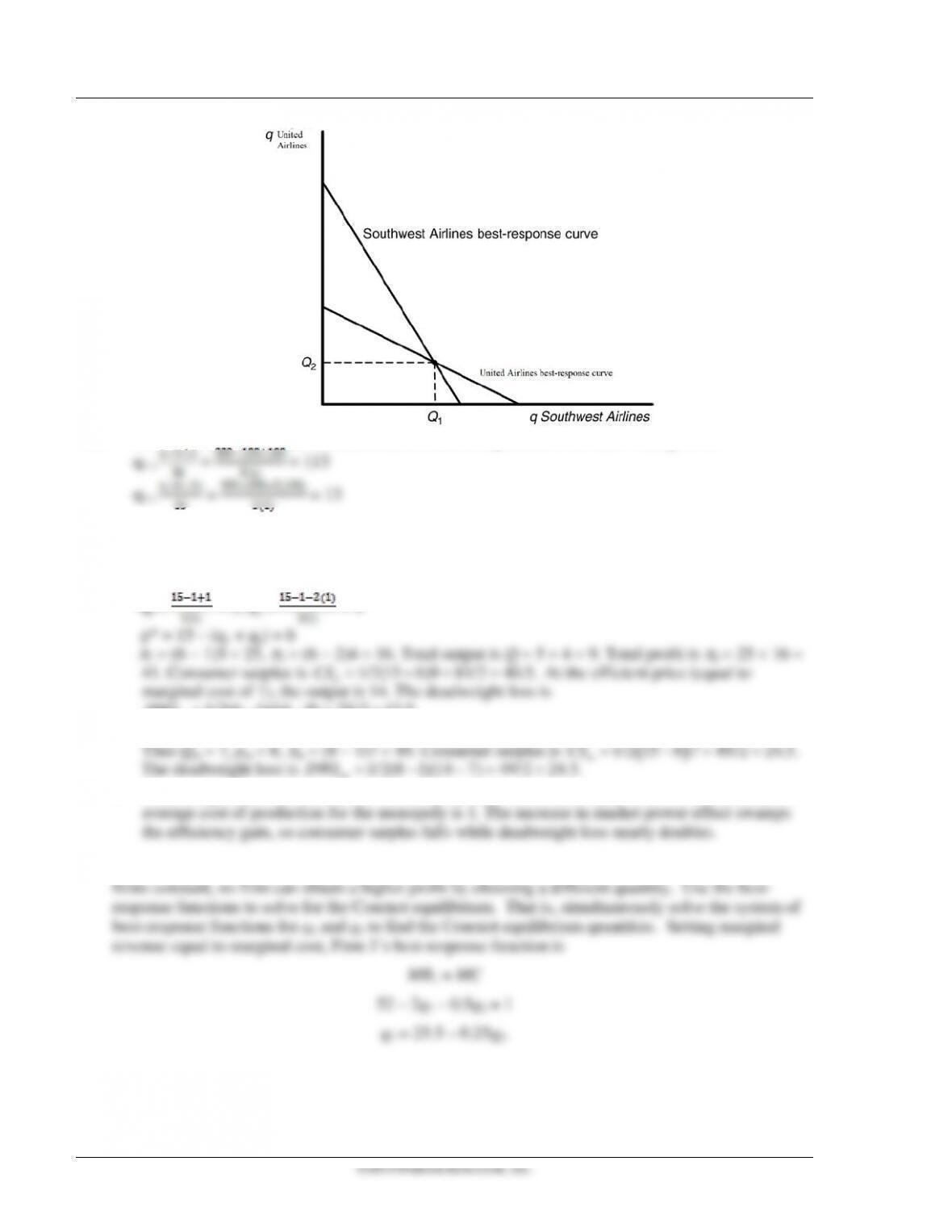
3.16 Let United be Firm 1 and let American be Firm 2. Equations 14.21 and 14.22 give us:
3.17 You can solve this problem using calculus or the formulas for the linear demand and constant
marginal cost Cournot model from the chapter.
a. For the duopoly,
1/2(6 1)(14 9) 25/2 12.5.= − −= =
d
DWL
b. A monopoly equates its marginal revenue and marginal cost: MR = 15 − 2Qm = 1 = MC.
m
c. The average cost of production for the duopoly is [(5 × 1) + (4 × 2)]/(5 + 4) = 1.44, whereas the
3.18 A Cournot equilibrium is a set of quantities sold by firms such that, holding the quantities of all other
Chapter 14 Oligopoly and Monopolistic Competition 293
©2014 Pearson Education, Inc.
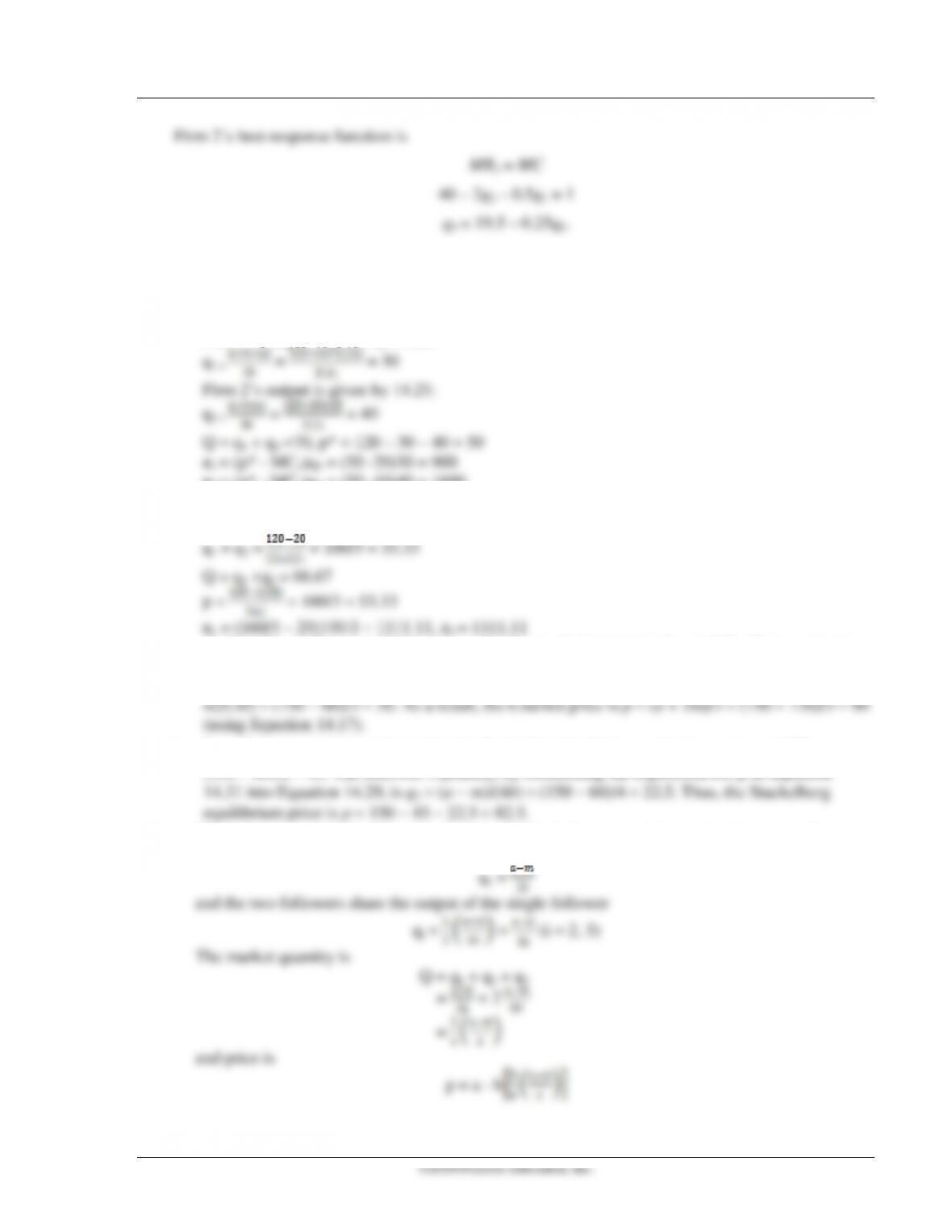
Firm 2’s best-response function is
MR2 = MC
40 – 2q2 – 0.5q1 = 1
q2 = 19.5 – 0.25q1.
The Nash–Cournot equilibrium quantities are q1 = 22 units and q2 = 14 units.
3.19 The answers are:
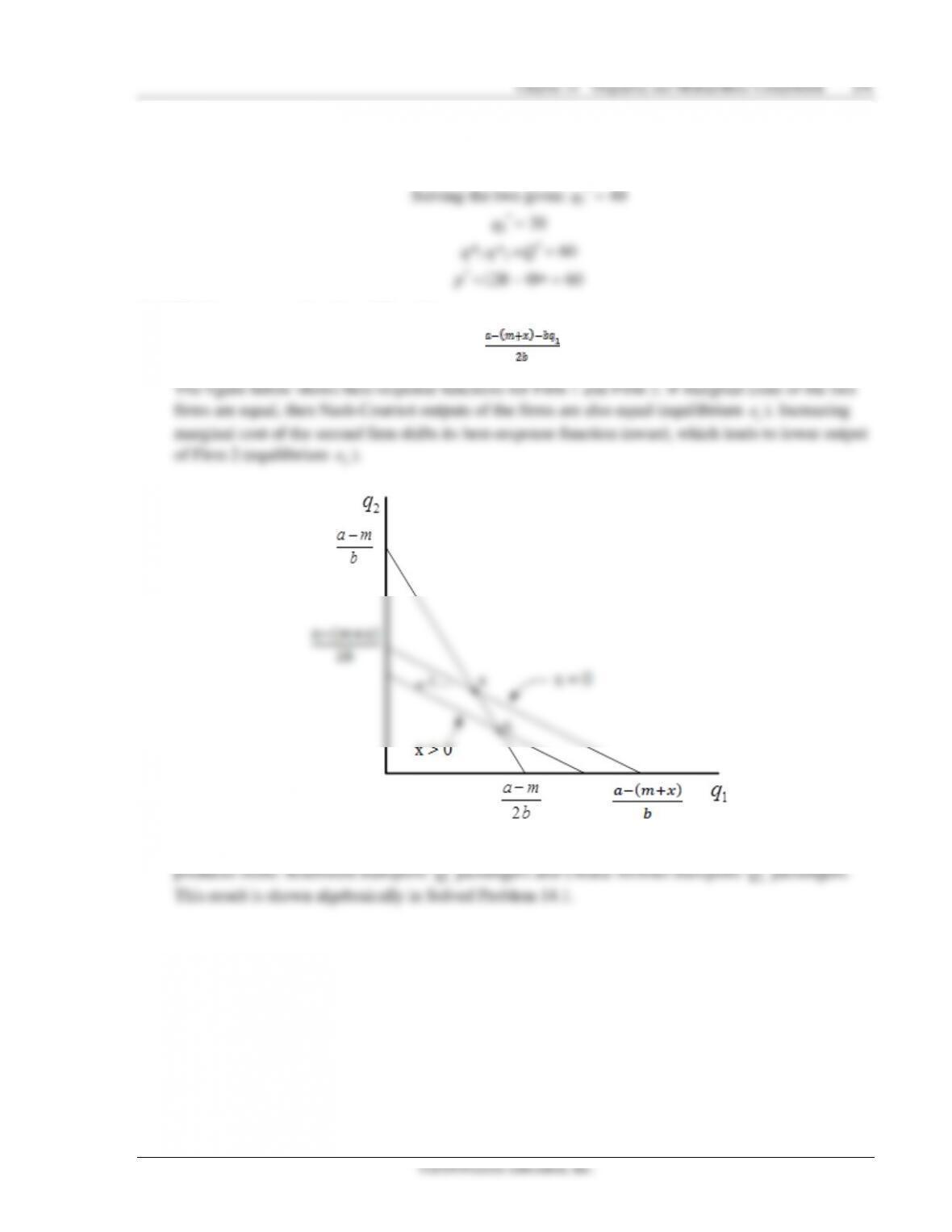
a. Use Equations 14.21 and 14.22 with a = 120, b = 1, m = MC2 = 10, and x = (MC2 –MC1) = 10.
Firm 1’s output is given by 14.22:
π2 = (p* – MC2)q2 = (50 -10)40 = 1600
b. Use Equations 14.16 and 14.17 to find
c. As Firm 2’s profit was 1,600 in part a, a fixed cost slightly greater than 1,600 will prevent entry.
4.1 a. Using Equation 14.16, the Cournot equilibrium quantity for each of the duopoly firms is q = (a −
b. From Equation 14.31, we know that the Stackelberg leader’s quantity is q1 = (a − m)/(2b) =
4.2 When there are multiple followers, they simply divide the residual demand and appear to the
leader to be the same as a single follower. Thus, the leader’s output is still given by Equation 14.31: